
Your Guide to a Training ROI Calculator
A training ROI calculator is a tool that translates the impact of your learning and development programs into financial terms. It compares the total cost of a training initiative to the monetary benefits it generates, providing a clear percentage that demonstrates whether the investment was profitable. It is the mechanism for framing training not as an expense, but as a strategic value driver for the business.
Why a Training ROI Calculator Is a Strategic Necessity

In today's business climate, every department must justify its budget with data. Anecdotal success stories and positive employee feedback are no longer sufficient. Learning and Development (L&D) leaders need to communicate in the language of the C-suite, which means focusing on numbers, data, and financial returns.
A training ROI calculator serves as a strategic compass. It helps translate abstract learning outcomes into the concrete financial metrics that leadership understands and respects.
This tool moves L&D beyond tracking simple metrics like completion rates or satisfaction surveys. It provides a solid framework to prove that well-designed training directly contributes to the bottom line. It functions as a pre-packaged business case, arming you with the hard evidence needed to secure funding for effective programs and champion new learning initiatives.
From Cost Center to Value Driver
A training ROI calculator is essential for reframing L&D's role within the organization. By quantifying the value of your programs, you prove that training isn't just a line item on an expense report—it's a powerful engine for growth and efficiency. This shift is crucial for gaining strategic influence.
For instance, with a calculator, you can demonstrate a direct link showing how:
- Your new sales training led to a measurable increase in quarterly revenue.
- Updated compliance programs generated significant savings by preventing potential fines.
- Technical upskilling boosted team productivity and reduced costly operational errors.
Using training ROI calculators has become standard practice for organizations that want to justify their L&D spend. A recent industry report found that companies systematically measuring training ROI see an average return of 353%. For every dollar they spend, they get $4.53 back in benefits like higher productivity and lower employee turnover.
Quantifying the Impact of Modern Training
The need for a clear ROI becomes even more urgent as companies embrace advanced learning technologies like Augmented and Virtual Reality. Immersive training with AR/VR delivers substantial benefits, and a calculator is the perfect tool to quantify them. You can connect a VR safety simulation to a measurable drop in workplace accidents and their associated costs. Or you can show exactly how AR-guided assistance for field technicians reduces service times, minimizes errors, and cuts travel costs.
Our guide on virtual reality training solutions dives deeper into how these applications are changing the game.
Ultimately, the strategic power of an ROI calculator extends beyond training. It reinforces the broader business need to analyze and improve returns in every department. The same concepts are applied in areas like marketing, as seen in understanding the principles of maximizing return on investment. A training ROI calculator isn't just a formula; it's a key to proving value, securing resources, and making data-driven decisions that propel the entire organization forward.
Breaking Down the Training ROI Formula
The formula behind any training ROI calculator may appear complex initially, but it is based on two core concepts: the value created by the training and its total cost. The equation is straightforward:
ROI (%) = [(Total Program Benefits – Total Program Costs) / Total Program Costs] x 100
To understand the value of the final outcome (the benefits), you must first account for every resource invested (the costs). Let's examine each component of this formula to ensure accurate calculations.
Identifying the True Costs of Training
The "costs" side of the equation is often underestimated. While it's easy to account for major expenditures, overlooking hidden costs will produce a misleadingly high ROI that will not withstand scrutiny. A complete and transparent accounting of all costs is non-negotiable.
To get the full picture, you need to tally up everything:
- Direct Costs: These are the most obvious expenses, such as instructor fees, the development or purchase price of training materials, software licenses, and travel or venue rentals for in-person sessions.
- Indirect Costs: This category is frequently forgotten but is equally important. The largest component is employee time. Every hour an employee spends in training is an hour they are not performing their primary job functions. This must be calculated by multiplying the total training hours by the employees' average hourly wage.
- Administrative Costs: Do not omit the time your own L&D team spends planning, scheduling, and managing the entire program. These hours are a real investment and must be included in the total cost.
Capturing every cost, large and small, is the foundation of a defensible ROI calculation. When you present your numbers, a detailed cost breakdown demonstrates rigor and transparency, building trust with leadership.
Uncovering Tangible Training Benefits
Now, we connect learning to business results. This is where you move beyond qualitative concepts like "improved morale" and identify quantifiable gains. The objective is to assign a dollar value to the impact of new skills and knowledge.
This requires knowing precisely which business metrics the training was designed to influence. For a deeper dive on this, check out our guide on how to measure training effectiveness.
Here are some common, tangible benefits you can measure:
- Increased Productivity: Did the new software training enable the team to complete tasks faster? If so, you can calculate the value of the hours saved. If 20 employees each save one hour per week, that’s 20 hours of productivity reclaimed every week.
- Reduced Errors: For technical skills, particularly in manufacturing or field service, a significant benefit is the reduction of costly mistakes. AR/VR training, for example, often leads to a measurable decrease in assembly errors or safety incidents, which translates directly to savings on materials, rework, and potential fines.
- Improved Sales Figures: Did a new sales training program lead to higher close rates or larger deals? You can directly attribute a portion of that new revenue as a benefit of the training.
- Lower Employee Turnover: Effective leadership training can have a major impact on retention. You can calculate the savings from avoiding recruitment, hiring, and onboarding costs for every employee who chooses to stay.
To help you organize your data, here is a framework for what to measure.
Identifying Training Program Costs vs Benefits
| Category | Specific Examples | How to Measure |
|---|---|---|
| Direct Costs | Instructor fees, training materials, software licenses, venue rental, travel & accommodation. | Sum of all invoices and receipts. |
| Indirect Costs | Employee wages for time in training, productivity loss during training. | (Hourly Wage x Training Hours) x # of Employees. |
| Admin Costs | L&D staff time for planning, scheduling, and management. | (Admin Hourly Wage x Hours Spent) x # of Staff. |
| Productivity Gains | Time saved on tasks, increased output per hour, faster project completion. | Value of time saved, value of additional output. |
| Quality Improvements | Reduced error rates, fewer customer complaints, less material waste. | Cost of rework/waste avoided, value of customer retention. |
| Revenue Increases | Higher sales conversion rates, larger average deal size, more upsells. | Direct attribution of increased revenue. |
| Cost Savings | Lower employee turnover, reduced safety incidents, decreased compliance fines. | Cost to rehire, cost of incidents/fines avoided. |
Thinking through these categories ensures you're capturing the full financial story of your training program.
Ultimately, understanding the core principles of Cost-Benefit Analysis is what makes this all click. When you meticulously track both the complete costs and the monetized benefits, your training ROI calculator stops being just a formula. It becomes a powerful tool to prove the concrete value L&D brings to the table.
How to Accurately Calculate Training ROI Step-by-Step
Let's move from the concept of ROI to a quantifiable result you can present to your leadership team. A solid training ROI calculation is not about estimation; it’s a methodical process that produces a defensible figure.
This guide provides a roadmap. You can apply these steps to any training program, from a leadership retreat to a highly technical upskilling program using AR/VR. Following a structured process ensures all bases are covered, making your final number a true reflection of the program's financial impact. Think of it as building a business case—each step adds a layer of credible proof.
This infographic breaks down the core logic. It's simple: benefits minus costs equals your return.
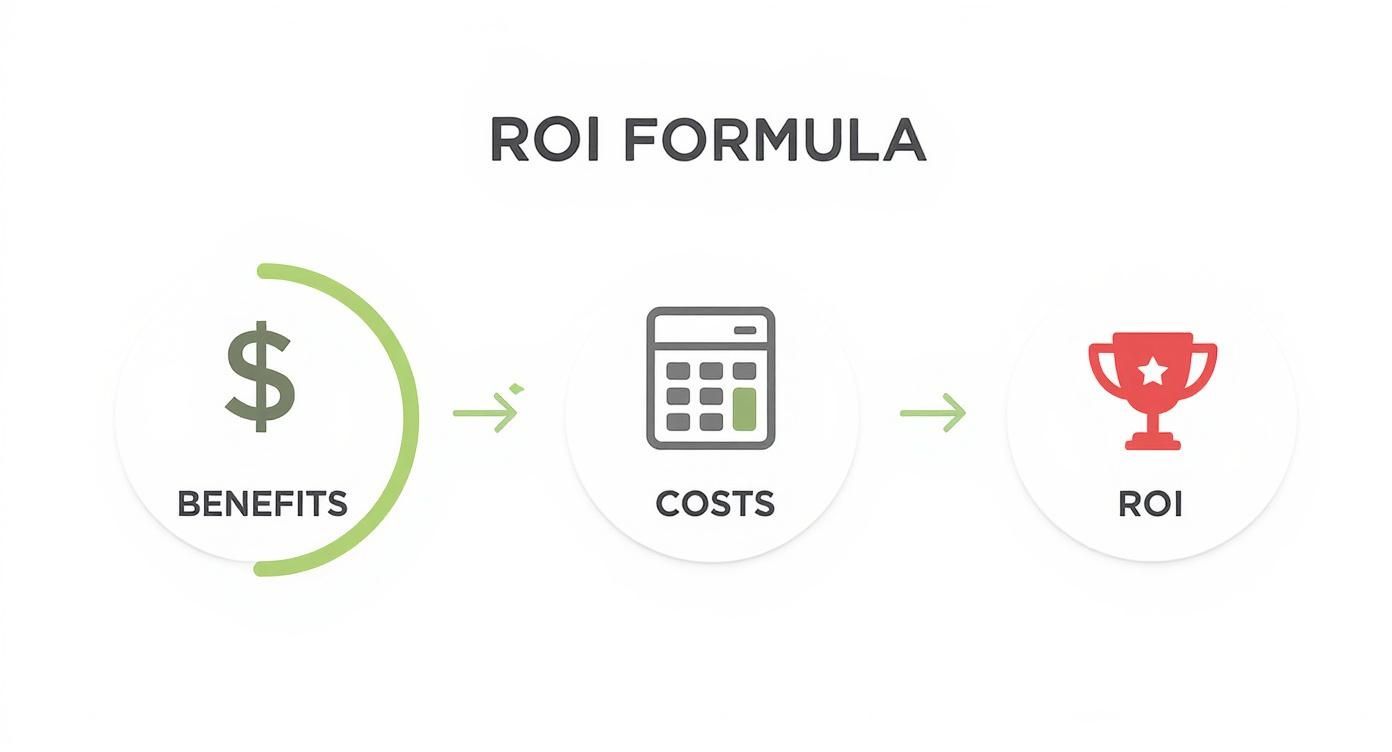
The visual makes it clear: a positive ROI is achieved only when the financial value of the gains exceeds the total investment.
1. Set Clear Business Objectives
Before measuring anything, you must define what success looks like. This is the most critical step and the one most often overlooked. Your training goals must be tied directly to specific, measurable business outcomes.
Avoid vague goals like "improve communication." Be concrete. Aim for something like, "reduce customer support escalations by 15% within six months." That clarity provides a real metric to track and makes the ROI calculation possible.
2. Tally All Program Costs
A credible ROI calculation begins with a complete and honest list of every single cost. As previously covered, this means accounting for both obvious direct expenses and the indirect ones that are often forgotten. To build a real financial picture, your list needs to include:
- Direct Costs: Items like instructor fees, course materials, software licenses, and any travel expenses.
- Indirect Costs: Crucially, this includes the wages of employees for the time they spend in training instead of performing their jobs.
- Development and Administrative Costs: This covers the time your own L&D team spends designing, planning, and managing the program.
Forgetting to include employee time is a common mistake that will artificially inflate your ROI and undermine your credibility with stakeholders. A meticulous cost analysis is the foundation of a trustworthy result.
3. Measure Post-Training Performance
Once the training is complete, it's time to measure. Revisit the business objectives you set in step one. You need to collect performance data for a set period—long enough to observe a real change, but not so long that other business factors can influence the results.
For example, if your goal was to increase production line output, you would track the average units produced per hour for several months after the training. Then, you would compare that to the baseline data gathered before the training began.
4. Isolate the Impact of Training
This step is absolutely crucial for building a believable case. Business performance rarely changes due to a single factor. An increase in sales might be due to your training, but it could also result from a new marketing campaign, favorable market conditions, or a competitor's misstep.
To isolate the training's true effect, the best method is using a control group. This means comparing the performance of the employees who received the training against a similar group of employees who did not.
The performance gap between these two groups can be confidently attributed to the training program itself. Without this step, your ROI figure is merely an estimate.
5. Convert Performance Gains to Monetary Value
Now it's time to translate performance improvements into dollars. This is where your training ROI calculator demonstrates its value. The method for this conversion depends on the metric you’re tracking.
- Time Saved: If a new process saves each of 50 employees two hours a week and their average hourly wage is $30, the monetary benefit is $3,000 per week (50 employees x 2 hours x $30/hour).
- Increased Output: If your team increased production by 500 units a month and each unit has a profit margin of $10, that’s a $5,000 monthly benefit.
- Reduced Errors: If costly mistakes decreased by 20 per month, and each error costs an average of $150 to fix, you've saved $3,000 a month.
For a deeper dive, our article on how to train staff effectively explores how different training methods produce these kinds of measurable, monetizable outcomes.
6. Calculate Your Final ROI Percentage
With all the data collected, the final step is a simple calculation using the standard formula.
ROI (%) = [(Total Monetary Benefits – Total Program Costs) / Total Program Costs] x 100
For example, if your total benefits came to $150,000 and your total costs were $50,000, the math is: [($150,000 – $50,000) / $50,000] x 100 = 200%. That percentage makes a powerful statement: for every dollar invested, the company received two dollars back in net benefits.
Interpreting Your ROI to Tell a Powerful Story
After running the numbers through your training ROI calculator, you have a final percentage. However, a number on its own is just data. The real value comes from turning that data point into a compelling story that resonates with stakeholders and drives intelligent business decisions.
The ROI figure isn’t the final grade for your training program. It’s the headline. It’s your opportunity to connect the L&D budget to tangible business outcomes and explain the why behind the investment.
Beyond the Bottom Line: A Holistic View of Your Results
Your ROI percentage is where the conversation starts, not where it ends. A high ROI is excellent, but without context, it lacks depth. Conversely, a lower-than-expected number is not a failure; it’s a powerful diagnostic tool that indicates where to focus improvement efforts.
Imagine you achieved a 150% ROI on a sales enablement program. The number is solid, but the story is more persuasive: "Our $20,000 investment in sales training generated $50,000 in net benefits. We achieved this by increasing our team's average deal size by 18%, demonstrating they are now more confident upselling and articulating value to clients."
Now, what if the ROI is only 15%? Frame it as a strategic insight: "Our initial return on the new compliance module was 15%, primarily from avoiding potential fines. More importantly, post-training feedback identified a critical knowledge gap in process application. We are now addressing this with targeted micro-learning. This initial investment showed us exactly where to focus to achieve greater returns next quarter."
The narrative you build around your ROI is what secures future budgets and positions L&D as a strategic partner. It demonstrates a commitment to continuous improvement, not just reporting a single metric.
Turning a Low ROI into a Strategic Win
A low or even negative ROI can feel like a setback, but these figures often contain the most valuable insights. When you investigate why the number is what it is, you uncover critical information that can make your next initiative more successful. A lower-than-expected ROI might indicate:
- Misaligned Objectives: The training itself might have been effective, but perhaps it was aimed at a business metric that was not a top priority for the company at that time.
- Barriers to Application: Employees may have learned the skills perfectly but encountered roadblocks on the job—such as outdated software or unsupportive managers—that prevented them from applying their new knowledge.
- Incorrect Timing: The impact of some training, especially for complex soft skills, takes time to manifest. Your measurement window may have been too short to capture the full payoff.
Presenting these findings shows you're doing more than just crunching numbers. It tells leadership that you are not only celebrating wins but also actively diagnosing challenges to make every L&D dollar work harder.
Framing Your Findings for Maximum Impact
When presenting your results, you are not just delivering a report; you are telling the story of a strategic investment. Don’t just lead with the number. Build a narrative around the entire journey.
A powerful report typically follows this structure:
- The Business Problem: Begin by reminding everyone of the challenge you were trying to solve.
- The Investment: Clearly lay out the total costs. Transparency demonstrates thoroughness.
- The Tangible Returns: Present the hard financial benefits that led to your ROI percentage.
- The Ancillary Benefits: Did team morale improve? Did you observe better collaboration between departments? Highlight these secondary, qualitative benefits.
- The Key Learnings: Discuss what the data revealed—what worked, what didn’t, and any surprises.
- Data-Backed Recommendations: Use your findings to propose clear, concrete next steps. This transforms your report from a retrospective document into a forward-looking action plan.
This approach transforms your ROI report from a static document into a dynamic tool for growth, proving that L&D is not a cost center—it's a core driver of business strategy.
Real-World Examples of Training ROI in Action

Formulas and theory are useful, but observing a training ROI calculator in a real-world business scenario provides clarity. The true test is applying these principles to practical situations. Let’s walk through two detailed examples from different business functions to demonstrate how to draw a direct line from training expenditure to bottom-line impact.
Consider these case studies a blueprint. They break down costs, pinpoint benefits, and assign a dollar value to performance gains. You can adapt this logic to build a rock-solid business case for your own training programs, regardless of your industry.
Example 1: Sales Enablement for Higher Close Rates
A company decides to invest in a new sales methodology program for its team of 50 account executives. The objective is to increase the average deal size and boost the overall win rate.
Calculating the Costs:
- Direct Costs: The company hires an external training vendor for $40,000, which covers the program and all materials.
- Indirect Costs: Each of the 50 reps spends 16 hours in training. With an average hourly wage of $45, the total cost of their time away from selling is $36,000 (50 reps x 16 hours x $45/hour).
- Total Program Cost: The full investment is $76,000.
Measuring the Benefits:
Over the next six months, the L&D team monitors the performance of the trained group, comparing them to a control group that did not receive the training. The results show that the trained reps achieved an average win rate of 28%, a significant increase from their previous 24%.
This 4% improvement, directly attributable to the training, generated an additional $250,000 in gross profit.
The Final ROI Calculation:
- Formula: [($250,000 Benefits – $76,000 Costs) / $76,000 Costs] x 100
- Result: A 229% ROI.
This number tells a powerful story. For every dollar invested in sales training, the company received back $2.29 in net profit. This is a clear win that any executive can support.
Example 2: AR and VR for Field Service Technicians
Now let’s shift to a different use case. A manufacturing firm implements an immersive training program using Augmented Reality (AR) and Virtual Reality (VR) for its 100 field service technicians. The two primary goals are to reduce costly errors on the first service visit and decrease the need for senior expert travel.
Calculating the Costs:
- Direct Costs: This is a larger investment, including $150,000 for AR/VR software development, headsets, and facilitator fees.
- Indirect Costs: Each technician spends 20 hours in the immersive training modules. At an average wage of $40 per hour, the cost of their time is $80,000 (100 techs x 20 hours x $40/hour).
- Total Program Cost: The complete investment is $230,000.
Measuring the Benefits:
The company tracked two critical metrics over the following year, with impressive results.
- Reduced Errors: The first-time fix rate increased from 75% to 90%. This 15% improvement meant they avoided 500 expensive follow-up service visits. With each avoided visit saving an average of $600 in labor and parts, this totaled $300,000 in savings.
- Decreased Travel: The AR remote assistance feature, a key part of the training, enabled senior experts to guide junior techs from a distance instead of flying to job sites. This alone reduced travel expenses by $120,000.
The total monetized benefit was $420,000. To learn more about how this technology achieves such results, you can explore our guide on augmented reality for training.
A recent global survey found that 78% of organizations are now using some kind of ROI calculator to measure training impact. This shift shows how serious businesses are getting about justifying L&D spending, especially as new technologies are adopted.
The Final ROI Calculation:
- Formula: [($420,000 Benefits – $230,000 Costs) / $230,000 Costs] x 100
- Result: An 82.6% ROI.
Even with the higher upfront cost of immersive technology, the company demonstrated a significant positive return driven by real-world operational efficiencies, making a clear case for continued investment.
Common Questions About Training ROI Calculators
Even with a clear process, a few common questions arise when L&D professionals begin using a training ROI calculator. It's one thing to calculate the return on a straightforward technical skill, but what about less tangible initiatives?
Let's address some of the most frequent questions to help you apply this framework with confidence.
How Can I Measure the ROI of Soft Skills Training?
This is a common challenge. Measuring the return on skills like leadership or communication can seem abstract. However, it is entirely possible—the key is to connect the training to specific, measurable business KPIs.
For a leadership program, you could track metrics like employee turnover rates or team productivity within that manager's department for the two quarters following the training. For communication skills, you might measure the change in customer satisfaction scores or a reduction in HR-reported internal conflicts.
The essential first step is to decide which business outcome the skill is intended to improve. Then, measure that outcome before and after the training and assign a conservative dollar value to the improvement.
What Is a Good Training ROI?
While many seek a universal benchmark, there is no single "good" ROI. A reasonable initial goal is anything over 100%, as this indicates the program’s benefits exceeded its costs.
However, context is critical. A mandatory compliance training, for example, might aim for a 0% ROI simply by helping the company avoid costly fines—a win based on cost avoidance.
Compared to other business investments, targeted training can deliver impressive returns. High-impact skills training, particularly programs using AR and VR to solve major operational bottlenecks, can achieve very high ROI as efficiency gains compound over time.
The most common mistakes when using a training ROI calculator? Failing to isolate the training's true impact, forgetting about indirect costs like employee time, and using overly optimistic estimates for the benefits.
What Are the Most Common Mistakes to Avoid?
Inaccurate calculations can quickly undermine credibility. Be aware of these three common pitfalls:
- Forgetting to isolate the training's impact. It's easy to credit your L&D program for a sales lift that was actually caused by a new marketing campaign. This leads to wildly inflated results.
- Overlooking indirect costs. The most significant of these is employee time. Forgetting to account for the hours people spend away from their regular duties will artificially inflate your final ROI percentage.
- Using indefensible financial estimates. Assigning arbitrary values to benefits will undermine your entire analysis as soon as a stakeholder asks, "How did you arrive at that number?"
The solution is to use control groups whenever possible to isolate the training's effect, meticulously track every direct and indirect cost, and always be conservative in your financial valuations. It is also crucial to select a realistic timeframe for measuring impact—not so soon that effects have not materialized, but not so late that other factors have influenced the results.
Ready to see how immersive technology can deliver a powerful, measurable return on your training investment? AIDAR Solutions specializes in AR and VR applications that accelerate learning and drive significant operational gains. Discover how our tailored solutions can transform your workforce.


Comments(02)