Modern Forklift Training Systems for Better ROI
Forklift training systems are the programs and tools used to teach individuals how to operate material handling equipment safely and effectively. These systems range from traditional classroom lessons to advanced virtual reality simulations, all designed to achieve the same goals: reducing accidents, improving productivity, and ensuring regulatory compliance.
Why Traditional Forklift Training Is No Longer Enough
The rhythm of a modern warehouse—the hum of conveyors, the beeps of scanners, and the whir of forklifts—depends on skilled operators. For years, the standard training method combined classroom instruction with hands-on practice on the warehouse floor. While foundational, this model is struggling to meet the demands of today's high-speed, complex logistics environments.
The limitations of this traditional approach are becoming increasingly apparent. Placing a new operator on a live forklift introduces immediate risk to pedestrians, equipment, and inventory. A single miscalculation before an operator has developed essential muscle memory and spatial awareness can result in costly damage or, worse, a serious injury.
The Rising Costs of Outdated Methods
The direct and indirect costs associated with inadequate training are significant. Businesses face operational challenges that traditional methods are ill-equipped to solve:
- High Accident Rates: Inexperienced operators are more prone to errors, leading to incidents that can bring operations to a standstill.
- Costly Equipment Damage: A minor collision with a pallet rack or another vehicle can easily result in thousands of dollars in repairs and operational downtime.
- Slow Onboarding: It can take weeks for a new hire to become fully proficient and productive, creating a bottleneck that impacts the entire facility.
Many industries already mandate rigorous safety protocols. For example, comprehensive industrial safety training, such as Lock Out/Tag Out procedures, is standard practice for preventing equipment-related accidents. Forklift operation demands an equally intelligent and robust training approach.
The Need for a Smarter Approach
The global forklift safety training market, valued at approximately $3 billion annually, highlights the worldwide imperative to reduce forklift incidents and enhance workplace safety.
The core problem with traditional training is its inability to safely prepare operators for high-risk, low-frequency events. A trainee may not encounter a sudden rack collapse or a hazardous spill during their initial training, leaving them unprepared for a real emergency.
This is where modern forklift training systems provide a distinct advantage. Technologies like Virtual and Augmented Reality are not just innovations; they are practical tools designed to solve these specific challenges. By creating a realistic, risk-free environment, these systems allow operators to practice dangerous scenarios repeatedly until the correct response becomes instinctual. For a deeper understanding of this methodology, explore our guide on what immersive learning is.
This represents a fundamental shift from simply teaching rules to building deep, intuitive competence.
Comparing Modern Forklift Training Methods
Selecting the right training solution is a critical decision. The landscape of forklift training systems has evolved significantly beyond the classroom and basic practice runs. To develop a program that not only meets compliance requirements but also produces skilled, safe operators, it is essential to understand how different training tools complement each other.
The most effective training programs often blend foundational methods with advanced technology to create a comprehensive learning experience for every operator.
From Theory To Hands-On Practice
Every effective training program is built on two pillars: classroom instruction and supervised, hands-on practice.
Classroom learning provides the theoretical foundation—the why behind safe operation, including OSHA regulations, forklift mechanics, and operational principles. This knowledge is non-negotiable.
Following theory, supervised hands-on practice allows a new operator to work with a real forklift in a controlled area under the guidance of an experienced supervisor. This is where theoretical knowledge begins to translate into muscle memory, but it is also where the first real-world risks emerge.
When these foundational methods are not properly supported, significant downstream problems can arise, as illustrated in the following infographic.
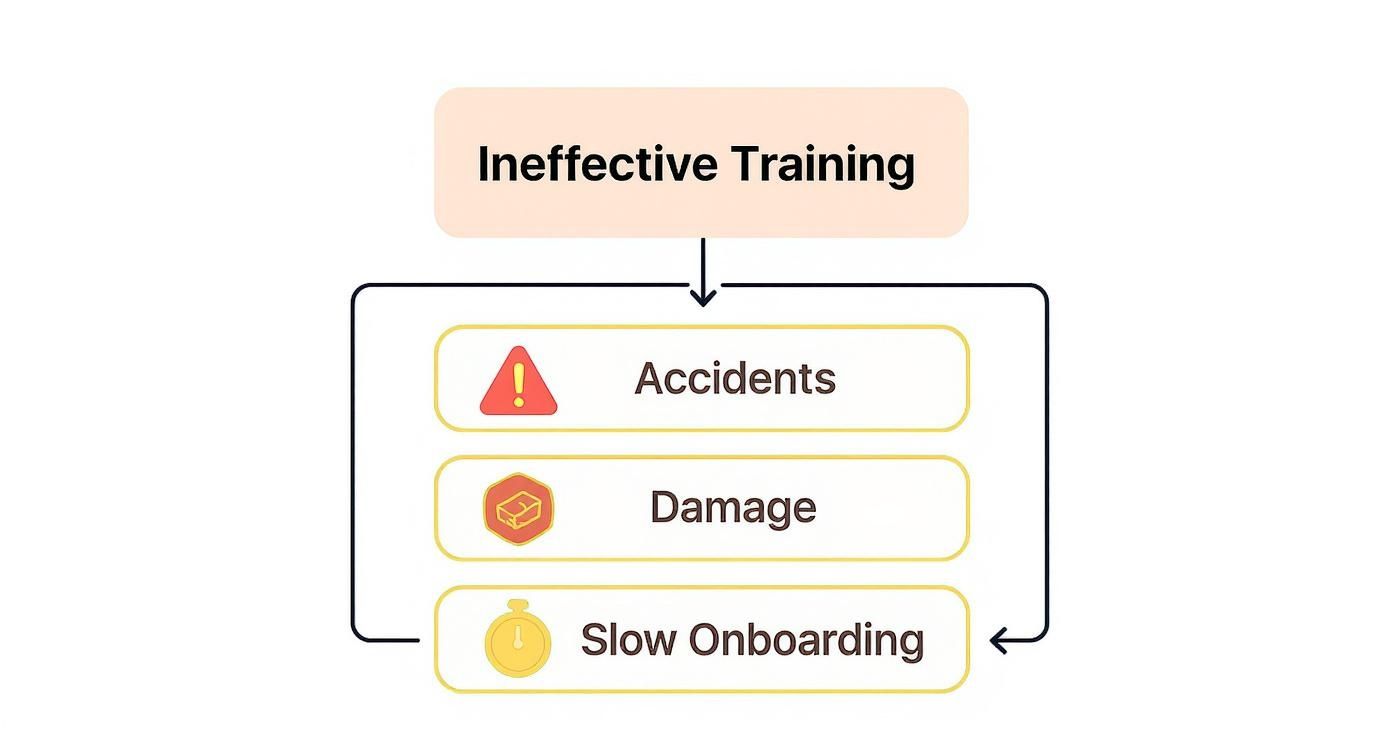
The data is clear: ineffective training leads directly to accidents, equipment damage, and slow onboarding, impacting both safety records and the bottom line.
Digital Learning And Physical Simulators
The first technological step up from traditional methods is e-learning. Online courses offer a flexible and consistent way to deliver classroom theory, allowing trainees to learn at their own pace and ensuring standardized information delivery across all shifts and locations.
Physical simulators represent the next major advancement. These are dedicated hardware rigs—complete with a seat, authentic controls, pedals, and screens—that replicate the experience of operating a forklift. They create a safe environment where trainees can practice fundamental maneuvers and build initial muscle memory without any risk to personnel or property.
A key benefit of simulators is the ability to expose trainees to common challenges, such as navigating narrow aisles or stacking pallets at height, in an environment where mistakes become learning opportunities, not costly accidents.
This technological evolution has been pivotal in creating safer, more standardized training protocols. As technology continues to advance, so do the tools available for building genuine operator competence.
The Power Of Immersive AR And VR Solutions
At the forefront of modern forklift training systems are immersive technologies like Augmented Reality (AR) and Virtual Reality (VR). If classroom instruction is the operator's manual and a physical simulator is a basic driving course, then VR training is the equivalent of a full-motion flight simulator.
VR places the operator inside a highly realistic, 360-degree virtual warehouse where they can confront complex, hazardous situations with zero real-world risk.
Immersive training excels in areas where other methods cannot. It enables operators to safely practice high-stakes, low-frequency events that are impossible to stage in a live environment:
- Emergency Situations: Operators can run drills for fires, chemical spills, or rack collapses until the correct response is second nature.
- Complex Environments: Trainees learn to navigate a busy, dynamic warehouse floor with unpredictable pedestrians and other moving vehicles.
- Precision Tasks: They can practice handling fragile, high-value, or irregularly shaped loads that would never be entrusted to a novice on the actual floor.
This level of realism accelerates learning and improves knowledge retention. The growing demand for such powerful training tools aligns with the industry's rapid expansion. The global forklift market was valued at $81.8 billion in 2024 and is projected to exceed $137.9 billion by 2034. As more equipment is deployed, the need for training that ensures both safety and efficiency becomes even more critical. You can read the full research about this market growth on gminsights.com.
To see what this level of training looks like in action, you can explore the details of our virtual reality training solutions.
Calculating the ROI of Immersive Training

Beyond the technology itself, the primary consideration for any business leader is the return on investment. Implementing advanced forklift training systems is a strategic financial decision that delivers measurable returns. Immersive solutions built with Augmented and Virtual Reality provide a powerful ROI by directly addressing the most significant operational costs.
The financial benefits are clear and tangible. Immersive training targets areas where costs typically accumulate—safety incidents, equipment damage, and slow onboarding—and transforms them into opportunities for significant savings.
Identifying Key Cost-Saving Areas
The most immediate impact of immersive training is seen in the direct costs related to safety and equipment. These metrics are typically easy to track and provide a clear baseline for measuring returns.
Key areas for cost reduction include:
- Fewer Workplace Accidents: When operators practice responding to emergencies in a zero-risk virtual environment, they build the muscle memory needed to prevent real-world incidents. This translates directly to fewer workers' compensation claims and can contribute to lower insurance premiums.
- Reduced Equipment and Facility Damage: A single forklift collision with pallet racking can cost thousands in repairs and cause operational delays. VR training allows novices to make mistakes virtually, where the cost of a collision is zero, preserving physical assets.
- Faster Operator Onboarding: Immersive training significantly shortens the learning curve. A new hire can gain dozens of hours of operational experience in their first few days, achieving productivity levels that might otherwise take weeks. This substantially reduces the cost-per-hire.
Together, these factors create a compelling financial case for adoption. These systems do more than patch problems; they address the root causes of operational expenses.
Building a Framework for ROI Calculation
To fully understand the financial impact, it is necessary to connect training improvements to the bottom line by evaluating both direct cost reductions and productivity gains. Start by calculating current expenses in key areas, then project the improvements expected from the new training system.
Consider these measurable metrics:
- Decrease in Repair Bills: Analyze your total monthly or quarterly spending on forklift and facility repairs. A 20-30% reduction is a realistic goal after implementing a robust VR training program.
- Improved Pick-and-Pack Speeds: Measure the time it takes for operators to complete standard tasks. Confident, well-trained operators are smoother and faster, leading to higher throughput for the entire operation.
- Lower Consumable Costs: Better operating habits, such as smoother acceleration and braking learned in simulations, result in tangible savings on fuel, battery life, and tire wear.
Quantifying these areas makes the value of advanced forklift training systems undeniable, drawing a direct line from the initial investment to ongoing, tangible savings.
The true power of immersive training is its ability to prepare operators for events that cannot be replicated safely or cost-effectively in real life. Simulating a sudden chemical spill, a catastrophic rack collapse, or navigation around unpredictable foot traffic builds a level of situational awareness that traditional methods cannot achieve.
Quantifying the Intangible Benefits
While hard numbers are compelling, some of the most significant returns are less tangible but equally important. Operator confidence, for example, not only leads to safer performance but also can improve employee retention, reducing turnover costs.
Furthermore, a reputation for investing in best-in-class safety and training provides a competitive advantage in attracting and retaining skilled talent in a tight labor market.
These "softer" benefits contribute to a more resilient and efficient operation over the long term. To better estimate your own potential return, you can use tools designed to help analyze the numbers. For a practical assessment, start estimating your savings with our interactive training ROI calculator. It provides a structured way to input your current operational data and visualize the financial impact.
How to Choose the Right Forklift Training System and Partner
Selecting a forklift training system is about more than purchasing technology; it's about forming a long-term strategic partnership. The right solution should not only address current training gaps but also scale with your business to meet future operational challenges. It is essential to look beyond product demonstrations and evaluate the core capabilities, support structure, and future vision of any potential vendor.
Making an informed decision requires asking critical questions to determine if a training program is a good fit for your specific warehouse environment, existing technology infrastructure, and long-term safety and productivity goals. A thorough selection process is the first step toward unlocking the full potential of immersive training.
Evaluating Technical and Hardware Requirements
Before evaluating software features, it is crucial to address the practical implementation aspects. A powerful training system is ineffective if it creates technical challenges or requires an infrastructure overhaul you are unprepared for. The first step is to understand the hardware and software footprint.
Here are the essential technical questions to ask any potential partner:
- Hardware Specs: What specific VR/AR headsets, computers, or other equipment is required? Does the system use off-the-shelf components or proprietary hardware that creates vendor lock-in?
- System Integration: How does the training software integrate with our current Learning Management System (LMS)? Without proper synchronization, tracking progress and maintaining unified training records can become a significant administrative burden.
- Space and Network Needs: What is the physical space requirement for a training station? What are the network bandwidth and connectivity requirements to ensure smooth operation and data synchronization?
Obtaining clear answers to these questions upfront will prevent costly surprises and implementation delays. A reputable vendor will provide a detailed breakdown of all technical requirements.
Assessing Software Customization and Content Relevance
Every warehouse environment is unique, with its own layout, equipment mix, and specific high-risk areas. A generic, one-size-fits-all simulation is insufficient. The most important feature of an advanced forklift training system is its ability to be customized to your real-world operations.
The objective is to create simulations so true-to-life that operators build muscle memory for your facility, not a generic one. This level of specificity is what transforms training from a compliance exercise into a practical, life-saving tool.
When evaluating a vendor's software, focus on its flexibility and relevance:
- Scenario Customization: Can training scenarios be modified to mirror our warehouse, including exact aisle widths, racking types, and typical pedestrian pathways?
- Equipment Matching: Does the software include virtual models of the specific forklift makes and models our team uses? Operating a stand-up reach truck is fundamentally different from operating a sit-down counterbalance forklift.
- Content Library and Updates: What is the process for adding new training modules or updating existing ones? A strong partner will have a clear content roadmap, ensuring the system remains current and relevant.
Judging Vendor Experience and Long-Term Support
Ultimately, you are choosing a partner, not just a product. A vendor’s industry track record, commitment to customer support, and vision for the future are strong indicators of the long-term value you will receive. The best technology providers act as consultants, guiding you toward the most effective implementation strategy for your business.
Consider their qualifications from a partnership perspective:
- Industry Expertise: Do they have a proven history of working with businesses in your industry? Request case studies or testimonials from companies facing similar operational challenges.
- Customer Support: What does their support model entail? Get specifics on response times, support channels (phone, email, on-site), and the process for resolving technical issues.
- Future Development: What is their long-term vision for the platform? Inquire about their plans for adding new technologies or features to understand their commitment to innovation.
Navigating the evaluation process can be complex, but expert guidance can make a significant difference. For a deeper dive into structuring a technology partnership, it is worth exploring the benefits of professional augmented reality consulting. An expert can help you build a clear strategy that covers everything from selection to a full-scale rollout.
To help organize your evaluation, we’ve put together a checklist to guide your conversations with potential vendors.
Vendor Selection Checklist for Forklift Training Systems
This checklist outlines the critical criteria to evaluate when choosing a training system vendor, ensuring a comprehensive assessment of technology, support, and business alignment.
| Evaluation Category | Key Questions to Ask | Importance (High/Medium/Low) |
|---|---|---|
| Technology & Hardware | – What specific hardware is required? – Can the system integrate with our LMS? – What are the space and network requirements? |
High |
| Software & Content | – Can we customize scenarios to match our facility? – Does the library include our specific forklift models? – How often is content updated or added? |
High |
| Vendor Experience | – Can you provide case studies from our industry? – How many years have you been in this specific market? – Who are your main competitors and what makes you different? |
Medium |
| Support & Training | – What are your standard support hours and response times? – What does the initial "train-the-trainer" program involve? – Is on-site support available if needed? |
High |
| Pricing & ROI | – What is the total cost of ownership (hardware, software, support)? – Do you offer flexible pricing models (e.g., subscription vs. license)? – Can you help us build a business case and project ROI? |
High |
| Future Roadmap | – What new features or technologies are on your development roadmap? – How does the platform adapt to new industry regulations? – What is your long-term vision for the product? |
Medium |
Using a structured checklist like this ensures you don't miss any critical details. It forces a consistent evaluation across all potential partners, making your final decision much clearer and more data-driven.
Getting Your New Forklift Training Program Off the Ground
A state-of-the-art forklift training system is only as effective as its implementation. Introducing new technology, especially immersive tools like AR and VR, requires a strategic, phased approach that secures buy-in from your team. This process is about building a foundation for lasting change in how your team learns and operates.
The first step is to assess your current training program. Identify recurring pain points, such as common safety incidents or long onboarding times for new hires. Answering these questions helps you set clear, measurable goals for the new system, which will be crucial for demonstrating its value later.
Start Small with a Strategic Pilot Program
Before a full-scale deployment, conducting a small, controlled pilot program is a prudent first step. This test phase allows you to evaluate the system's performance in a real-world setting and gather honest feedback from operators in a low-risk environment, ensuring a smoother company-wide launch.
A successful pilot should achieve several key objectives:
- Select a Target Group: Choose a small, representative sample of operators, including a mix of new hires and seasoned veterans.
- Gather Unfiltered Feedback: Create a simple process for operators and supervisors to provide their thoughts on the system's usability and effectiveness. This feedback is invaluable for refinement.
- Measure Early Impact: Begin tracking key metrics immediately, such as assessment scores within the virtual environment or the time required to master specific skills. This provides an early baseline for success.
This initial phase is focused on perfecting the implementation process—from scheduling training time to resolving minor technical issues—before they become larger problems during a full rollout.
Winning Hearts and Minds for a Smooth Transition
Following a successful pilot, the next step is to build momentum. Gaining the support of frontline operators and their direct managers is critical for overcoming resistance to change. The key is to communicate the why behind the new system, focusing on its benefits for them.
Frame the training in terms of its value to employees. For operators, it offers a safer way to build confidence and skills without the pressure of making costly mistakes on the live floor. For managers, it is a tool to reduce incident reports and help their teams achieve performance targets more quickly.
The greatest barrier to adopting new technology is often human inertia. When you demonstrate to an operator how a system enhances their safety and to a manager how it improves their team's performance, you can turn skeptics into advocates.
Finally, establish a clear and transparent schedule for the transition. Share the rollout timeline, provide supervisors with the "train-the-trainer" support they need to feel confident, and celebrate early successes to maintain positive momentum. A well-planned, open implementation ensures your new forklift training system becomes an integral part of your operational culture, not just another underutilized tool.
Measuring Success and Driving Continuous Improvement
Once you’ve rolled out a new forklift training system, how do you prove its effectiveness? Simply confirming course completion is not enough. To demonstrate real value and foster a stronger safety culture, you must connect training activities directly to operational outcomes on the warehouse floor.
This requires moving beyond basic completion rates to focus on metrics that truly matter. By combining the objective data from virtual reality simulations with on-the-floor observations, you can gain a complete picture of operator performance. This approach justifies the investment and initiates a cycle of continuous improvement.
Key Performance Indicators That Matter
The most effective KPIs are those that align with business objectives: safety, efficiency, and cost. These metrics prove that your training program is delivering a real-world impact. Before implementing the new program, establish a baseline for your current performance in these areas.
Critical KPIs to track include:
- Reduction in Safety Incidents: This is a primary indicator of success. Monitor the number of near-misses, minor collisions, and OSHA-recordable accidents. A significant decrease is the clearest sign of positive behavioral change.
- Lower Equipment Maintenance Costs: Well-trained operators use equipment more carefully. Track repair orders, spare parts consumption, and unscheduled downtime caused by operator error. A reduction in these costs provides hard evidence of improved operating habits.
- Faster Time-to-Productivity: Measure how long it takes for a new hire to become fully proficient and work independently. Immersive training can drastically reduce this ramp-up time, directly benefiting operational throughput.
Focusing on these practical outcomes allows you to build a business case supported by hard data.
Leveraging Data from Immersive Simulations
One of the most significant advantages of VR and AR forklift training systems is the wealth of objective data they collect. Every action an operator takes within the simulation—from cornering speed and turning angles to load stability and reaction times—is recorded and analyzed. This provides insights that are impossible to obtain through simple observation.
This granular data enables a shift from reactive coaching to proactive skill development. Instead of waiting for an incident to occur, you can identify risky behaviors in the safety of the virtual environment and correct them before they become real-world problems.
For example, the system might flag an operator who consistently takes corners too quickly or neglects to check blind spots. This data allows a trainer to provide highly focused feedback on that specific skill, making each coaching session more effective. This continuous feedback loop drives lasting improvement and helps build a true culture of safety from the ground up.
Answering Your Questions About Modern Forklift Training
Exploring modern forklift training systems often raises practical questions about their application and benefits. As you seek to enhance safety and efficiency, understanding the capabilities of these tools is essential. Here are answers to some of the most common questions.
Can VR Training Replace Hands-On Forklift Experience?
No, VR training is designed to complement, not replace, hands-on experience. It functions as an advanced simulator where operators can accumulate hundreds of hours of muscle memory and practice responding to hazardous scenarios in a 100% safe environment before operating real equipment.
This approach significantly reduces the time required on an actual forklift, making the hands-on portion of training more productive and substantially safer.
Is This Technology Suitable For All Operators?
Yes, a key strength of immersive training is its adaptability to various skill levels.
- For New Hires: It provides a safe, low-pressure environment to learn fundamentals without the risk of causing costly damage.
- For Experienced Operators: It offers a unique opportunity to practice responses to rare but critical emergencies, such as a rack collapse or equipment failure, which are impossible to replicate safely in a live warehouse.
The objective is to move beyond mere compliance and build deep, instinctual competence in every operator, regardless of their starting point. This philosophy is central to effective frontline employee training programs.
What Is The Typical Implementation Timeline?
While a full-scale rollout is typically phased, a pilot program can often be launched within a few weeks.
The process usually begins by identifying your most pressing training needs. From there, a small-scale pilot is launched with a select group of operators. This allows you to gather real-world feedback and refine the program before a wider rollout, ensuring a smooth integration with minimal disruption to your workflow.
Ready to see how a modern forklift training system can fundamentally change your warehouse safety and efficiency? AIDAR Solutions provides immersive VR and AR applications that build expert operators in a fraction of the time. Discover our solutions at https://aidarsolutions.com.