
Augmented Reality for Training Your Workforce
Modern workforce development presents significant challenges, from persistent skill gaps to the high costs of traditional employee education. Augmented reality for training is emerging as a powerful, practical solution. It moves beyond theory to deliver immediate, tangible value for businesses seeking to build a more capable and confident team.
The New Reality in Workforce Development
Traditional learning methods often rely on dense manuals, essentially flat, two-dimensional guides. The user must translate abstract diagrams into real-world action. Augmented reality (AR) for training functions differently. It acts as a dynamic, real-time guidance system that overlays instructions directly onto the user's view of the task at hand.
This technology creates a hands-on, learn-by-doing experience directly on the factory floor or in the field. Instead of only reading about a repair, a technician sees digital instructions, arrows, and checklists projected onto the actual equipment. This fundamentally changes how people acquire new skills.
Bridging Theory and Practice
AR training effectively closes the gap between knowing a task and doing it. It breaks down complex procedures into tangible, step-by-step actions that build genuine competence and muscle memory. The benefits are clear and immediate:
- Contextual Learning: Individuals learn skills in the exact environment where they will be applied, which improves knowledge retention and dramatically reduces errors.
- Reduced Cognitive Load: By showing instead of telling, AR simplifies intricate tasks. Workers can focus on performing the job correctly rather than struggling to recall the next step.
- Increased Safety: Trainees can practice on complex or hazardous machinery with digital safeguards and guidance, minimizing risks to personnel and expensive equipment.
The demand for these results is fueling significant market growth. The global AR training and education market was valued at $31.26 billion in 2024 and is projected to reach $51.34 billion in 2025. This represents an exceptional compound annual growth rate (CAGR) of 64.3%.
AR is not just a new method for displaying information; it represents a fundamental shift in how skills are transferred. It places expert knowledge on-demand, directly at the point of need, turning every task into a live learning opportunity.
Integrating AR into training programs is a strategic move to modernize the workforce and ensure seamless knowledge transfer. To maximize its impact, a solid strategy for effective knowledge management is essential. By embedding digital intelligence into the physical workspace, companies can solve their most pressing training challenges today while building a more resilient, adaptable workforce for tomorrow.
How AR Training Improves Learning and Retention
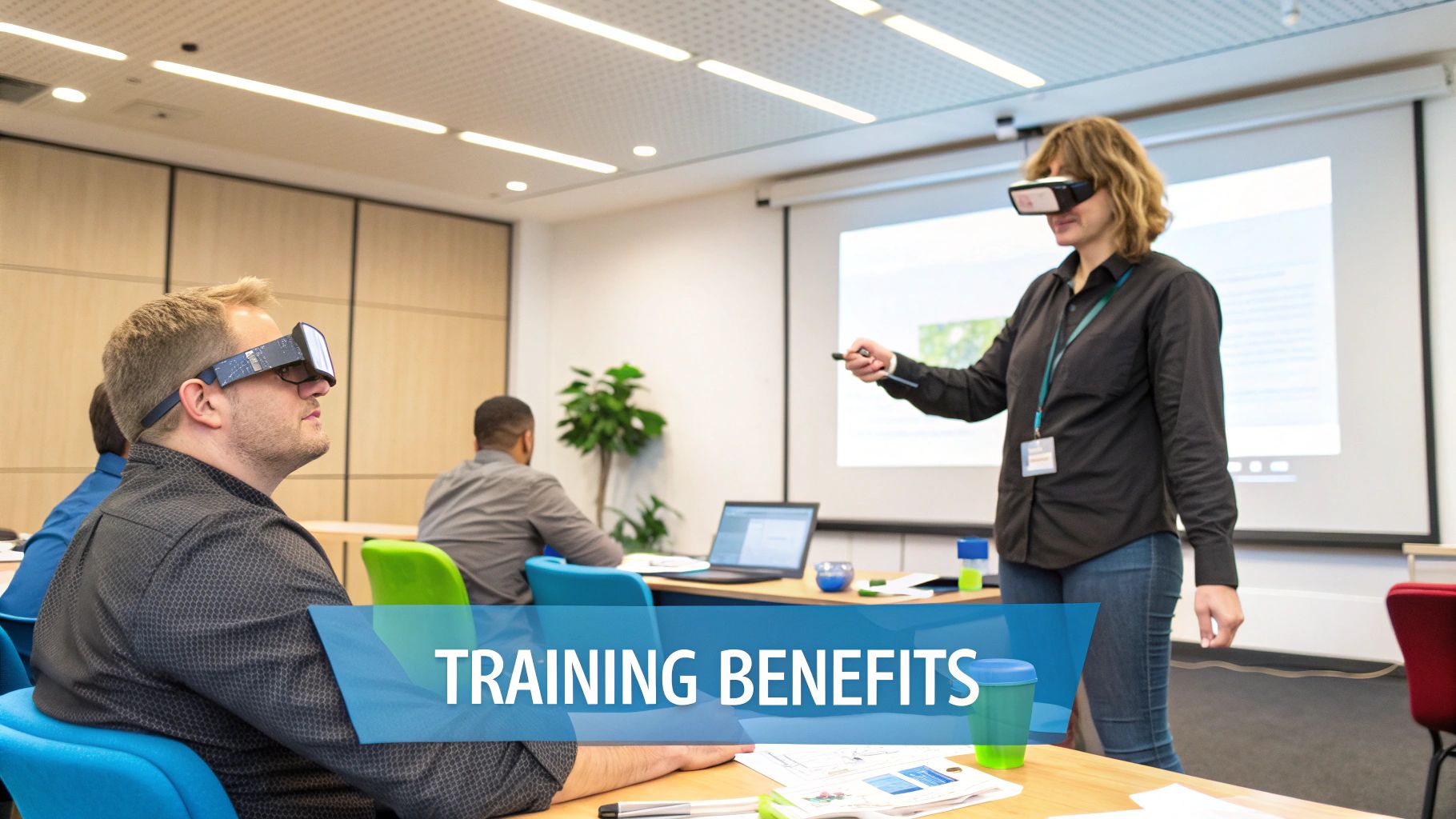
To understand why augmented reality is so effective for training, it is useful to examine how the brain learns. Traditional methods like reading manuals or watching videos are abstract. They require a significant mental effort to translate flat information into a three-dimensional, hands-on task. AR circumvents this process by blending digital instructions directly with physical action.
By layering digital guidance onto the physical world, AR forges an immediate link between what a trainee needs to know and what they need to do. It is a more efficient way to learn, tapping into the brain's natural ability to absorb skills faster and retain them longer.
Engaging Multiple Learning Styles
A key advantage of AR is its ability to cater to various learning styles simultaneously. While most training focuses on a single mode—visual, auditory, or kinesthetic—AR creates a multi-sensory experience.
- Visual Learners: They can watch complex procedures come to life with 3D animations and highlighted components, seeing exactly what to do.
- Auditory Learners: They receive clear, step-by-step audio instructions and real-time verbal feedback as they work.
- Kinesthetic Learners: This is where AR excels. Trainees perform the task with their own hands, guided by digital overlays every step of the way. This is "learning by doing" in its most effective form, building muscle memory and true competence.
This multi-sensory approach ensures that information is not just seen or heard, but experienced. This makes the training more memorable and effective than any single-channel method.
Reducing Cognitive Load
Attempting to perform a complex task while referencing a dense manual creates a high cognitive load. The brain is trying to read, remember, locate, and act all at once, which can lead to errors, frustration, and inefficiency.
Augmented reality training eliminates that mental clutter. By placing instructions directly in a person's line of sight—right on the machine they are working on—it frees up a massive amount of mental energy.
Trainees are no longer juggling information. They can focus their full attention on the task at hand because the guidance is available precisely when and where it is needed. This not only accelerates learning but also builds confidence.
The Power of Contextual Learning
We learn best when we learn in the actual environment where a skill will be used. This concept is called contextual learning, and it is what makes AR training so effective. It transforms the real workplace into a live classroom.
Consider a new mechanic learning to service an engine. Instead of a sterile classroom simulator, they are working on the real equipment. Their AR glasses project holographic instructions, highlight the exact bolts to turn, and display an animation showing the correct way to remove a component. This is an experience that a textbook diagram cannot replicate.
Data supports this approach. Studies have shown that immersive training can increase learning effectiveness by 76% over traditional methods. Furthermore, employees trained with AR can achieve proficiency up to four times faster than their classroom-trained peers.
This type of hands-on, in-the-moment training ensures that skills are truly learned, not just memorized and forgotten. The transition from trainee to capable employee becomes nearly seamless. Understanding how augmented reality changes our approach to work is key to realizing its full value. Ultimately, AR does not just show someone how to do their job—it guides them through it until they have achieved mastery.
Real-World AR Training Applications by Industry
The practical power of augmented reality training becomes clear when examining how it solves specific business problems. This technology is no longer theoretical; it is delivering tangible, measurable results in environments ranging from factory floors to operating rooms.
The versatility of the technology is impressive. Each application is tailored to a specific challenge, demonstrating how adaptable AR can be in boosting performance.
This image shows a common and highly effective use case: interactive instructions layered directly onto factory equipment.
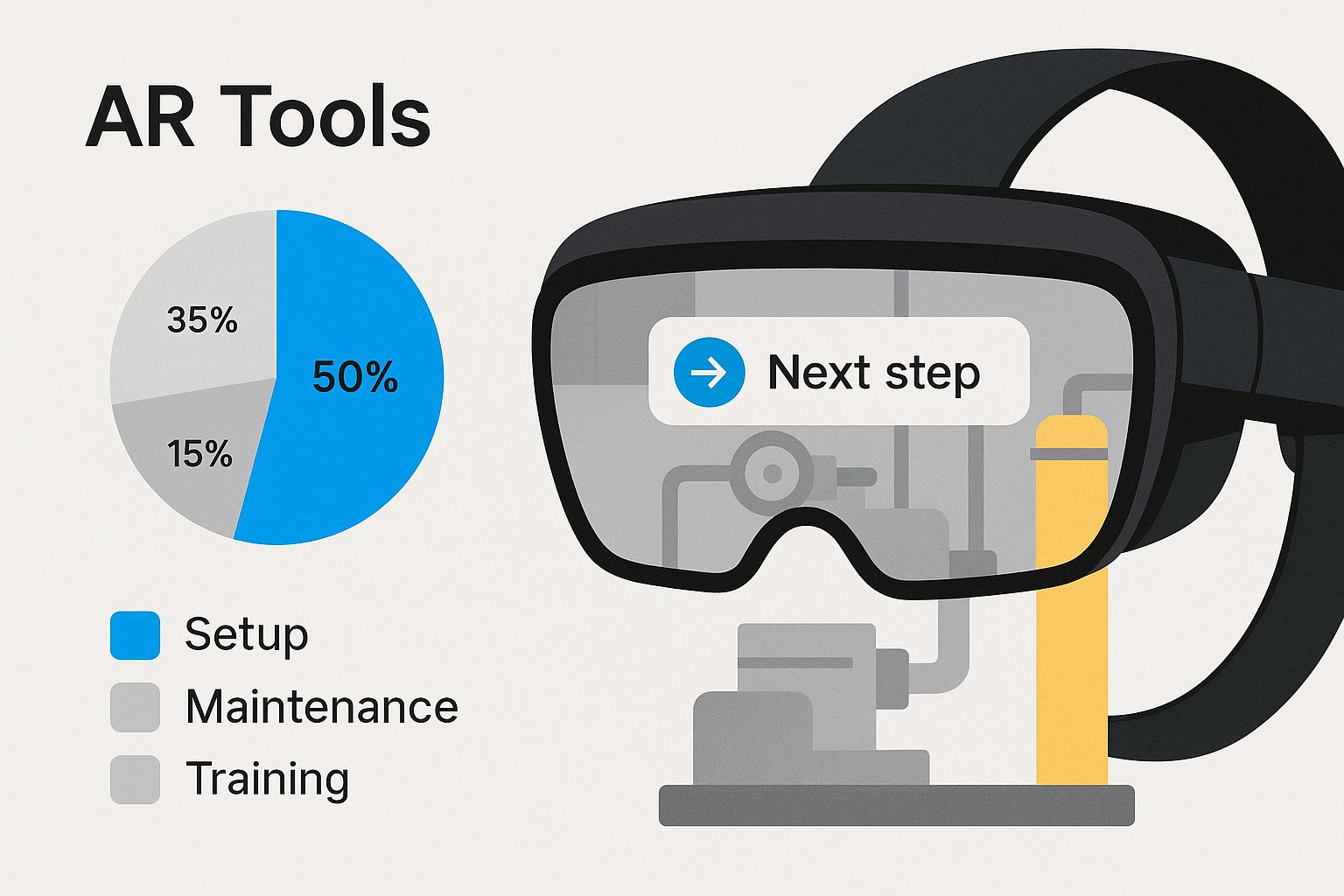
This visual demonstrates how a digital overlay removes the guesswork from a complex task, guiding an employee’s actions in real time without the need for paper manuals.
AR training is already making a significant impact across several key industries. The table below highlights specific applications and the direct benefits businesses are realizing.
| AR Training Application by Industry |
|---|
| Industry |
| Manufacturing & Assembly |
| Healthcare & Medical |
| Logistics & Warehousing |
| Field Service & Maintenance |
| Automotive |
These examples are just a starting point, but they illustrate how AR is being customized to solve specific, real-world operational challenges.
Manufacturing And Assembly
In manufacturing, precision and speed are critical. A single mistake on the assembly line can lead to costly rework, material waste, and significant downtime. Traditional training methods, relying on dense binders and static diagrams, struggle to keep pace with the complexity of modern machinery.
AR transforms the equipment itself into an interactive learning tool. An operator wearing AR glasses can see step-by-step instructions projected directly onto their workpiece.
- Problem: High error rates and long onboarding times for complex assembly jobs.
- AR Solution: Technicians receive holographic guidance showing the exact part to select, where to place it, and which tool to use. Animated instructions guide them through complex procedures, and digital checklists ensure every step is completed correctly.
- Measurable Outcome: Companies have reported error reductions of up to 40% and have slashed onboarding times by 50%. New hires become productive faster and work with greater confidence.
This approach builds a more agile workforce. When a new product line is introduced, training modules can be updated instantly and deployed to the entire team without requiring classroom sessions.
Healthcare And Medical Education
The stakes are highest in healthcare, where training must be flawless. Medical students and surgeons need to master incredibly intricate procedures where there is no margin for error. AR provides a safe, repeatable, and realistic environment for them to build these critical skills.
A surgeon, for example, can use AR to overlay a 3D model of a patient’s organs (from a CT scan) directly onto their body during a procedure, providing a form of "x-ray vision" that dramatically improves precision. A nurse can use an AR device to visualize a patient's veins, making first-attempt IV placement more likely.
In surgical training, AR allows students to rehearse complex operations on a virtual patient. They can practice visualizing anatomy and follow procedural steps in a realistic, zero-risk setting. This builds both skill and confidence long before they enter a live operating room.
This cross-industry adoption is driving major growth in the global augmented reality market. Advances in medical training are particularly noteworthy, with applications like surgical visualization directly improving patient outcomes. You can explore more about this growth in our interview about virtual and augmented realities.
Logistics And Warehouse Operations
A modern warehouse is a highly coordinated environment where every second counts. For an order picker, the core challenge is navigating a massive facility to find thousands of different items quickly and accurately. Traditional paper-based pick lists are slow and prone to errors.
AR smart glasses offer a hands-free solution that directs workers with maximum efficiency. The system displays the fastest route to the correct location, highlights the specific bin, and visually confirms the correct item has been picked.
- Initial Challenge: Slow picking times and high error rates in order fulfillment.
- AR Solution: Warehouse staff receive visual cues in their line of sight, guiding them through aisles and validating picks with integrated barcode scanning.
- Measurable Outcome: Logistics companies using AR have seen picking efficiency increase by 25% or more, while virtually eliminating picking errors.
One of the most powerful applications of this technology is in remote visual support, which allows an expert to guide a field technician through a complex repair from any location. As these examples show, AR is not a one-size-fits-all solution but a flexible tool that adapts to solve unique business needs.
Building Your First AR Training Program
Implementing an augmented reality training program may seem like a large undertaking, but it can be a manageable process. The key is to start small, prove the concept, and build from there.
By breaking the journey into clear, manageable steps, organizations can avoid being overwhelmed. A "crawl-walk-run" approach builds momentum and demonstrates tangible value from the outset, focusing on a single, impactful win to begin.
Start With a Pilot Program
Instead of attempting a massive, company-wide rollout, the most strategic first step is to launch a pilot program. This small, controlled experiment is designed to prove that AR training can work in your specific environment. This approach minimizes initial investment and risk while providing hard data to build a business case for a larger program.
The goal is not to solve every training problem at once, but to solve one problem exceptionally well. A successful pilot program becomes your best internal sales tool, showcasing real results that generate support.
Identify the Best Initial Use Case
Choosing the right task for your pilot is the most critical decision in the process. Look for a "sweet spot" where AR can make an immediate, undeniable impact.
Seek a task that fits these criteria:
- It's a high-value problem: Focus on a process that costs money, time, or creates safety risks. Complex assembly procedures with high rework rates or critical maintenance tasks that lead to downtime are ideal candidates.
- It has clear, repeatable steps: The process should be well-defined and procedural. This is where AR excels—guiding users through a structured sequence of actions.
- The outcome is measurable: It is essential to track key metrics before and after introducing AR. This data is what will prove your return on investment (ROI).
For example, a manufacturing firm could target a single, complex assembly station where new hires frequently make errors. A successful pilot would demonstrate a clear reduction in errors and a faster time-to-competency for new employees.
Choose Your Platform and Hardware
Once you have identified your use case, the next step is to select your tools. This involves two key decisions: software and hardware.
Software: Off-the-Shelf vs. Custom
- Off-the-Shelf Platforms: These are ready-made AR solutions that allow you to create and deploy training content without a development team. They are typically faster to implement and more cost-effective for standard procedures.
- Custom-Built Solutions: A custom solution provides complete control for highly specialized or proprietary processes. It is a larger investment of time and resources but may be necessary for unique operational needs.
For most pilot programs, an off-the-shelf platform provides the right balance of capability and cost.
The decision should be driven by the task itself. If your training follows a standard procedure, a platform is the efficient choice. For unique, complex machinery requiring specific integrations, a custom solution may be the better long-term investment.
Hardware: Glasses vs. Tablets
- Smart Glasses: These are the ideal solution for any task that requires the employee's hands to be free, such as performing a repair or assembling a product. They offer a truly immersive, first-person view.
- Tablets and Smartphones: Existing mobile devices are a highly accessible and budget-friendly way to begin. They work well for tasks where an operator can hold a device or set it on a nearby stand.
Many companies start with tablets to prove the concept. Once they have data demonstrating success, they can make a more confident investment in specialized smart glasses for their teams.
Gaining Buy-In and Integrating With Your LMS
With a solid pilot plan, the final steps are securing leadership support and ensuring the new technology integrates with existing systems.
You will need to build a compelling business case that clearly outlines the problem, the proposed AR solution, and the expected ROI. Use data from your identified use case to forecast tangible benefits like fewer errors, reduced downtime, and improved safety.
Finally, consider integration. Modern AR platforms can often connect with a company's Learning Management System (LMS). This is a significant advantage, as it allows you to track completions, manage user progress, and weave AR modules into broader training programs. This approach is key to empowering the workforce of tomorrow by blending immersive technology with established educational frameworks, turning your AR pilot from a siloed project into a cohesive part of your entire learning ecosystem.
Measuring the Business Impact of AR Training
Any significant investment must prove its worth, and augmented reality for training is no exception. Beyond the initial novelty, a solid framework for measuring its return on investment (ROI) is essential. The impact of AR is not just qualitative; it can be measured with clear, quantifiable metrics that are meaningful to business leaders.
To build a compelling case, you must translate the benefits of AR into the language of business: costs saved, productivity gained, and risks reduced. This requires moving from abstract ideas to hard data to paint a clear picture of how this technology directly improves bottom-line and operational performance.
Quantifying Direct Cost Reductions
One of the most direct ways to measure ROI is by examining cost savings. Traditional training involves numerous expenses that augmented reality for training can dramatically reduce or eliminate.
Consider these key areas for immediate savings:
- Decreased Travel Costs: AR reduces the need for instructors or senior technicians to travel for on-site support. By enabling remote expert guidance and on-demand digital instructions, you can significantly cut expenditures on flights, hotels, and per diems.
- Reduced Material Waste: Trainees can practice complex jobs on virtual models or with digital overlays on real equipment. This nearly eliminates the cost of scrap parts and materials often damaged during the learning process.
- Fewer Equipment Breakages: Allowing new employees to learn on expensive machinery creates a risk of costly mistakes. AR acts as a digital safeguard, providing step-by-step guidance that minimizes the risk of damage to critical assets, saving thousands in repair or replacement costs.
These savings are tangible and easy to calculate, providing a powerful starting point for your business case.
Analyzing Productivity Gains
Beyond cutting costs, AR training actively makes the workforce more productive. These gains create value by helping your team accomplish more, with greater accuracy, and in less time. Measuring these improvements adds another convincing layer to your ROI calculation.
The most impactful productivity metrics are those that directly link training to on-the-job performance. When a new hire becomes a productive team member in half the time, that is a clear and powerful win for the entire organization.
Key productivity metrics to track include:
- Faster Task Completion: AR-guided instructions remove guesswork from complex tasks. Technicians no longer need to stop and consult a manual, leading to a noticeable reduction in the time required to finish a job.
- Lower Error Rates: By showing exactly what to do and in what order, AR systems help reduce human error. A decrease of 40% or more in procedural mistakes is a commonly reported benefit.
- Accelerated Time-to-Competency: This is a significant benefit, particularly for new hires. AR can shorten the onboarding and skill-acquisition process dramatically, sometimes by over 50%. New employees begin adding value to the team much faster.
For a deeper analysis of evaluating these improvements, it is useful to consult resources that detail how to measure training effectiveness. A structured approach is key to ensuring your data is credible.
Assessing Intangible and Long-Term Benefits
Not every benefit fits neatly on a spreadsheet, but these "intangible" factors have a very real impact on a company's health and long-term success. While they may be harder to quantify, they are a critical piece of the AR training value proposition.
Consider the long-term impact on your workforce:
- Improved Safety and Compliance: Training in a controlled, digitally guided environment builds safer work habits from day one. This improves adherence to safety protocols, reducing workplace accidents and their associated costs.
- Higher Employee Engagement and Retention: Interactive and modern training tools are far more engaging than traditional manuals. This leads to higher job satisfaction and can be a significant factor in retaining top talent, which reduces the high cost of employee turnover.
These benefits, combined with the hard numbers from cost savings and productivity gains, paint the complete picture of AR's business impact. Much like the benefits of virtual reality training, its advantages extend beyond simple metrics to help build a more skilled, confident, and safe workforce.
The Future of Work and Immersive Learning
Augmented reality for training is not evolving in isolation. It is merging with other powerful technologies—especially artificial intelligence (AI)—to create the next generation of smart, responsive learning platforms. This combination is paving the way for training experiences that are not just interactive, but genuinely adaptive.
We are moving past simple, pre-programmed instructions toward an era where training content can adjust itself on the fly, reacting to each individual's unique learning pace and style. This shift is positioning AR as a core building block for the smarter, more agile businesses of tomorrow.
AI-Powered Adaptive Learning
An AR training program integrated with AI does not just guide; it understands. That is the promise of AI-powered adaptive learning. By incorporating AI, an AR application can analyze a user's performance in real time. It can detect hesitation, identify recurring mistakes, or recognize when a user is mastering the steps with ease.
Based on these observations, the system can instantly adjust the training's difficulty.
- If a user is struggling: The AI might offer more detailed instructions, slow down an animation, or provide extra visual cues to clarify a complex step.
- If a user is excelling: The AI could reduce the level of guidance, introduce a more complex scenario, or even challenge the user with a simulated fault to diagnose.
This creates a personalized learning path for every employee, ensuring they receive the exact support needed to master a skill without feeling overwhelmed or bored. It is analogous to having an expert mentor providing real-time feedback.
This fusion of AR and AI represents a significant leap forward. It transforms training from a one-size-fits-all model to a dynamic, one-to-one experience that enhances both efficiency and comprehension for every worker.
The Rise of Collaborative Immersive Spaces
The future of work is also becoming more collaborative, even when teams are geographically dispersed. The next wave of AR and VR technology is focused on creating shared collaborative virtual spaces, where multiple users can interact with the same digital models and environments simultaneously.
Imagine a team of engineers in different countries gathered around the same holographic 3D model of a new engine. They can walk around it, point to specific components, and solve a design challenge together as if they were in the same room.
This technology is also enabling remote expert assistance on a global scale. A seasoned technician in one continent can "teleport" into a junior technician's workspace on another, providing hands-on guidance within a shared augmented reality. These tools are breaking down geographical barriers, making expert knowledge instantly available anywhere, anytime. The future of training is not just immersive; it is interconnected.
Got Questions About AR Training? We’ve Got Answers.
Adopting augmented reality for training naturally raises several questions. When considering this technology for your operations, practical concerns about cost, usability, and hardware are often at the forefront.
Obtaining clear answers is the first step toward making an informed decision and setting your program up for success. Here are some of the most common questions from business leaders.
How Much Does an AR Training Program Actually Cost?
The cost of an AR training program varies depending on the scope and complexity of the project. A small pilot program, for instance, using existing company tablets, could be launched for a relatively modest investment.
Conversely, a fully custom solution for complex, specialized machinery that requires dedicated smart glasses for every technician will represent a more significant capital expenditure. The most effective approach is to start small. Identify a specific problem where a clear, measurable return on investment can be demonstrated. This makes it easier to justify the initial spend and scale the program over time.
Do My Employees Need to Be Tech-Savvy to Use This?
No, in fact, the opposite is true. Modern AR training platforms are designed to be highly intuitive. The primary goal is to make work easier, not to introduce another complicated tool.
Most solutions utilize familiar interfaces, such as a tablet screen, or simple voice commands for smart glasses. This design allows your team to focus on the task at hand—learning a new skill or performing a procedure—rather than struggling with the technology itself.
AR training should reduce complexity, not add to it. The technology works best when it feels almost invisible, seamlessly guiding the user through their tasks without causing frustration or confusion.
When the technology is unobtrusive, your entire workforce can begin to realize the benefits of augmented reality for training from day one, regardless of their technical proficiency.
How Do I Pick the Right Hardware for My Team?
The appropriate hardware depends entirely on the job it needs to support. The context of the work is the most important factor.
For any task that requires an employee's hands to be free—such as performing a complex repair or assembling a product—smart glasses are the clear choice. There is nothing to hold, and the information is presented directly in their line of sight.
However, for situations where mobility is less critical or for group training sessions, tablets are a powerful and cost-effective option. Many companies begin their AR journey with tablets. It is an excellent way to prove the concept, gather crucial ROI data, and build a business case before investing in more specialized equipment.
Ready to see how AR can sharpen your workforce's skills and boost efficiency? The experts at AIDAR Solutions can help you design and roll out an immersive training program that delivers real, measurable results. Discover our custom solutions.