
The Practical Guide to AR in Automotive: From Factory to Showroom
Augmented reality in the automotive industry is no longer a futuristic concept. It's a practical technology that overlays digital information—such as navigation arrows, step-by-step assembly guides, or critical diagnostic data—directly onto a user's view of the real world. This transforms a static engine block or a factory floor into a live, interactive workspace.
How AR Is Reshaping the Automotive Industry
Augmented Reality is on the ground today, solving real, persistent challenges across the automotive sector. The shift is comparable to moving from a paper map to a live GPS overlay on a smartphone. AR brings a similar leap in capability to how cars are designed, built, serviced, and driven by bridging the gap between a physical component and its associated digital information.
This technology is quickly becoming essential for maintaining a competitive edge. The global market for extended reality in automotive, valued at USD 43.03 billion in 2024, is experiencing steep growth. Within this market, AR is the clear leader, holding a substantial 45% market share, which underscores its central role in the industry's evolution. You can explore more about these projections to see why AR is pulling ahead in automotive innovation.
A Fundamental Shift in How Work Gets Done
At its core, AR in automotive is about delivering the right information to the right person at the exact moment of need. This isn't just a minor efficiency tweak; it’s a fundamental change in how people perform their jobs, from the assembly line to the service bay.
Instead of looking away to check a tablet or a paper manual, a technician wearing AR glasses sees instructions projected directly onto the engine they are servicing. This immediate, hands-free guidance is a game-changer, reducing cognitive load and drastically minimizing the potential for error.
By layering digital instructions and real-time data onto the physical world, AR removes ambiguity from complex processes. This simple yet powerful function drives significant improvements in accuracy, safety, and operational speed.
To better understand AR's impact, let's examine where it's making the biggest difference. The table below breaks down how this technology is being applied across key automotive sectors and the direct business benefits companies are realizing.
Table: AR Impact Across the Automotive Value Chain
| Automotive Sector | Primary AR Application | Key Business Benefit |
|---|---|---|
| Manufacturing & Assembly | Guided workflows & instructions | Reduced assembly errors, increased production speed |
| Technician Training | Interactive, on-the-job simulations | Faster onboarding, improved skill retention |
| Quality Control | Digital overlays for part inspection | Higher accuracy, faster defect detection |
| Field Service & Repair | Remote expert assistance | Lower travel costs, increased first-time fix rates |
| Sales & Marketing | Virtual vehicle showrooms & customization | Enhanced customer engagement, shorter sales cycles |
As you can see, AR is not a single-point solution. It's a versatile technology that delivers measurable value at nearly every stage, from the factory floor to the dealership.
Setting the Stage for Transformation
The applications are incredibly diverse, touching almost every part of the automotive lifecycle. This isn't a niche tool for one department; it's a foundational technology that unlocks new operational models. The benefits are tangible and significant:
- Flawless Assembly: AR provides visual cues for complex build sequences, reducing errors and maintaining production line momentum.
- Faster Training: New technicians get up to speed in record time with interactive AR tutorials for complex procedures, available on demand.
- Safer Driving: In-car AR head-up displays (HUDs) project critical navigation and safety alerts directly onto the windshield, helping drivers keep their eyes on the road.
Understanding these use cases is key to realizing the full potential of AR in automotive. It is becoming a cornerstone of modern manufacturing and a critical part of the customer experience. You can dive deeper into how AR is making an impact across these applications in our complete guide.
Boosting Efficiency on the Factory Floor
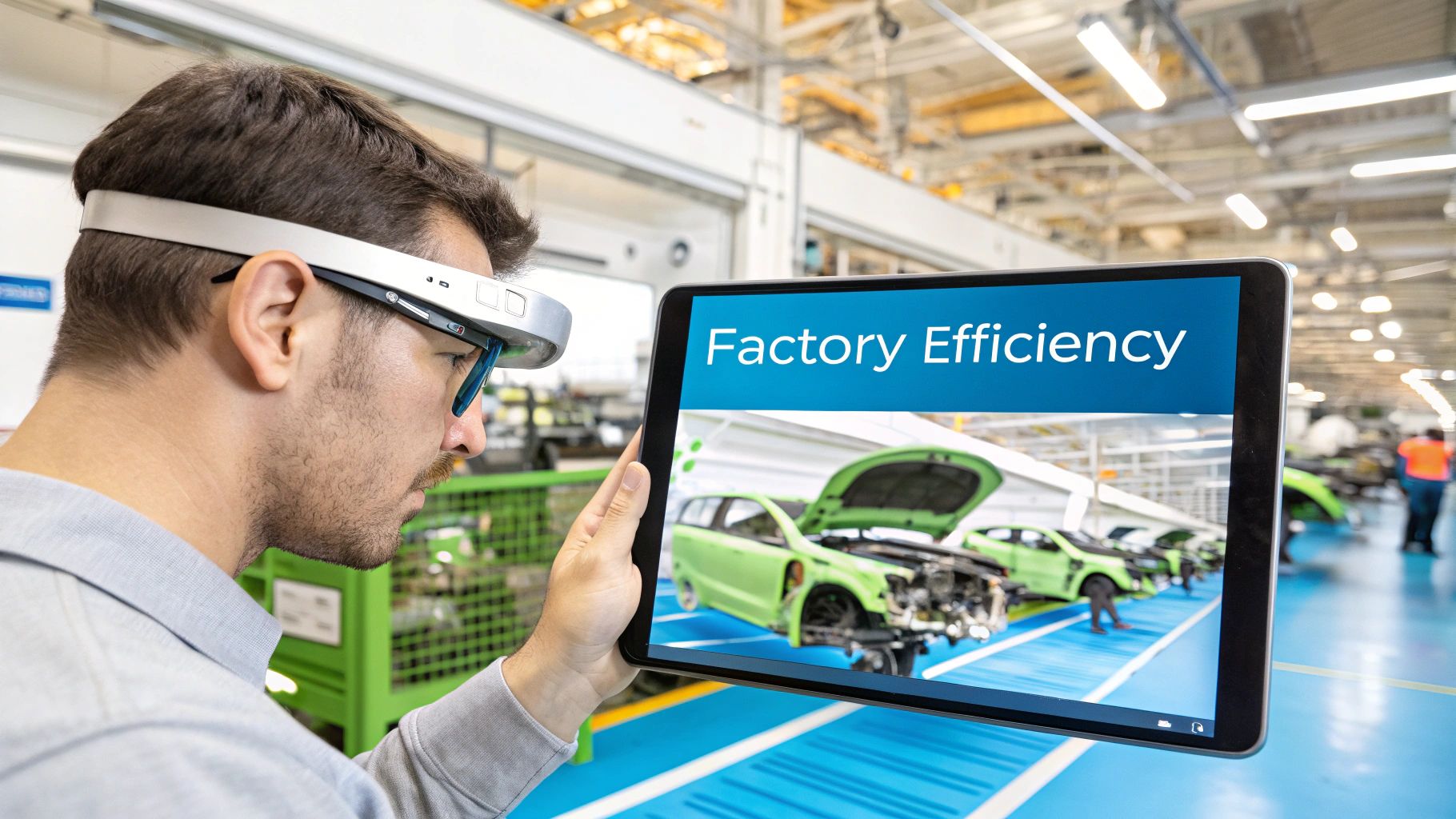
On the automotive factory floor, every second and every movement is critical. This is where the principles of AR in automotive translate into direct bottom-line impact by boosting precision, speed, and safety. AR serves as a strategic tool that transforms complex manufacturing processes into simple, guided, and error-proofed workflows.
Instead of consulting paper manuals or glancing at separate screens, technicians wearing AR glasses see digital instructions overlaid directly onto their view of the real world. For example, a worker assembling a dashboard would see the AR system highlight the exact screw to use, display the required torque, and confirm the step is complete before proceeding. This hands-free, in-context guidance demonstrates AR's true power on the factory floor.
Streamlining Complex Assembly with AR
Building a modern vehicle involves thousands of precise steps. A single mistake can lead to costly rework or quality issues. Augmented reality addresses this challenge by providing technicians with clear, visual instructions at every stage.
This approach dramatically reduces the "cognitive load" on workers, who no longer have to divide their focus between the task and a separate set of instructions. Studies show this can reduce assembly time by up to 25% and nearly eliminate errors from missed steps.
Augmented reality transforms the assembly process from one of recall and interpretation into one of direct execution. By overlaying the right information at the right time, AR removes ambiguity and empowers technicians to perform complex tasks with confidence and accuracy.
The applications are as varied as they are powerful:
- Guided Bolt Sequencing: For critical components like engine blocks, AR can project a numbered sequence onto the part, ensuring every bolt is tightened in the correct order and to the precise specification.
- Component Verification: Using integrated machine vision, an AR device can instantly verify that a technician has selected the correct part for a specific vehicle model, preventing incorrect installations.
- Wire Harness Installation: AR overlays can show the exact path for complex wiring, color-coding connection points to simplify one of the most error-prone tasks in the plant.
Transforming Quality Control and Training
Traditional quality control often relies on manual inspections, which can be slow and inconsistent. AR changes this by superimposing a perfect 3D model over a real-world part, allowing inspectors to spot microscopic deviations, misalignments, or missing components in seconds.
This digital comparison makes quality assurance a proactive, real-time process. A flaw can be identified directly on the line, preventing a defective part from advancing. The result is a significant reduction in rework costs and a substantial improvement in overall build quality.
Furthermore, AR in automotive training provides a safe, repeatable learning environment. New hires can practice complex or hazardous tasks—like installing a high-voltage EV battery—in a simulated AR environment. They can visualize internal components and learn workflows without occupying a physical vehicle or requiring a senior technician's time. This method accelerates skill acquisition and improves knowledge retention. The principles here are broad, and our guide on augmented reality for manufacturing explores these applications in more detail.
Enabling Real-Time Remote Expertise
When critical production line machinery fails, every minute of downtime incurs significant costs. Previously, the only solution was to fly in an expert or rely on challenging phone-based troubleshooting.
AR-powered remote assistance creates a "see-what-I-see" connection. A technician on-site wearing smart glasses can share their point of view with an expert anywhere in the world. The remote expert can then annotate the technician's live video feed with drawings, text, or diagrams to guide them through the repair.
This capability delivers several key benefits:
- Reduced Downtime: Problems are diagnosed and resolved in a fraction of the time, as the expert can guide the local technician as if they were physically present.
- Lower Travel Costs: The need for specialists to travel between facilities is largely eliminated, resulting in substantial savings.
- Knowledge Sharing: The on-site technician gains valuable skills with each guided repair, effectively upskilling the entire workforce.
By integrating these AR applications into the factory, automotive plants are building smarter, more efficient, and more resilient operations. To get a wider view on boosting productivity, which pairs nicely with AR initiatives, you can explore these general business efficiency techniques. The end goal isn't just to build cars faster, but to build them better with a more capable and connected team.
Elevating the Customer Journey with AR
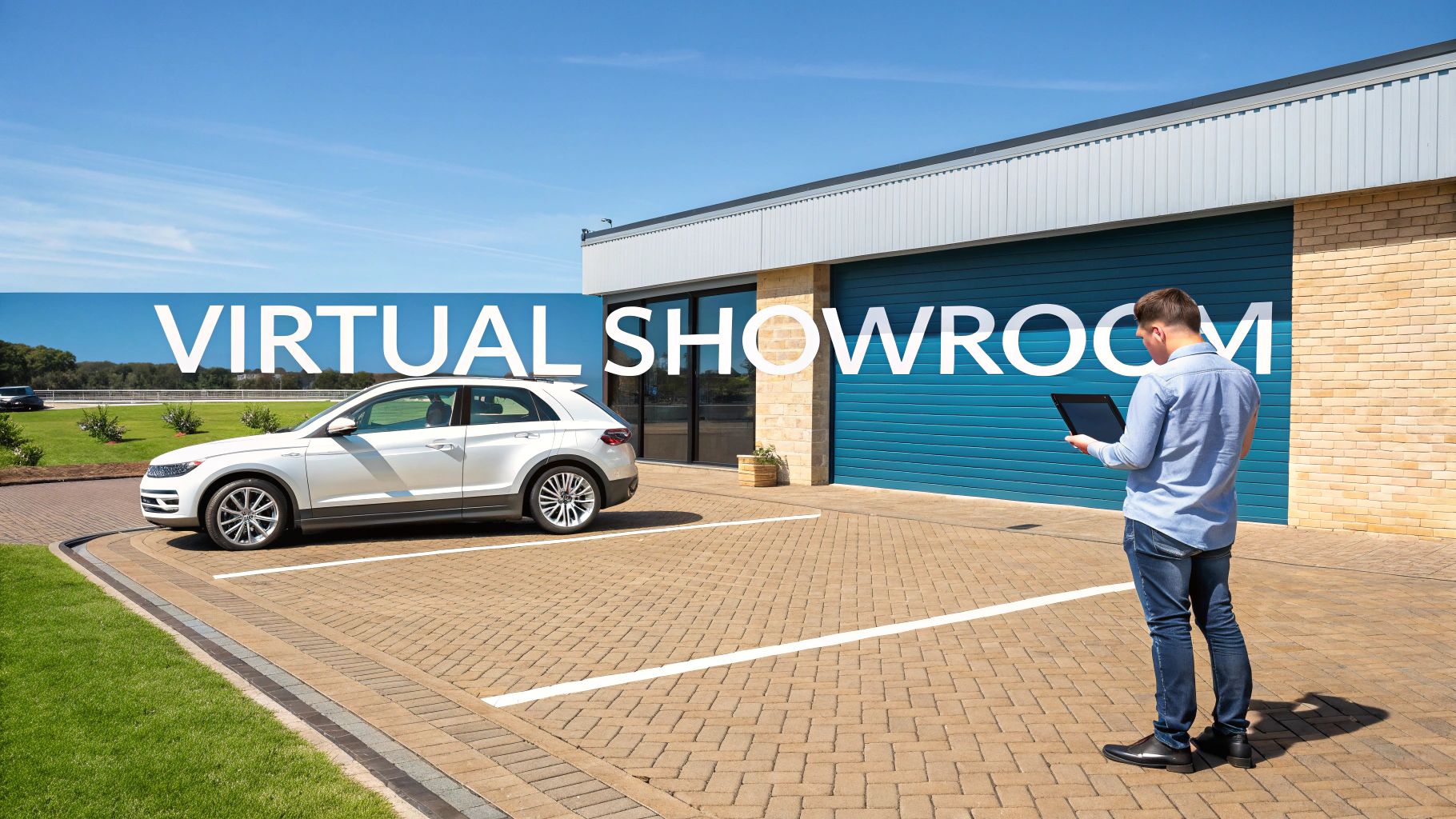
The impact of augmented reality extends beyond the factory, transforming how customers discover, evaluate, and interact with vehicles. AR bridges the gap between digital advertising and the physical showroom, creating a more personal, engaging, and convenient car-buying experience.
This technology also enhances the experience inside the car, making driving safer and more intuitive.
The days of relying solely on dealership visits are evolving. AR applications now allow potential buyers to bring the showroom into their own driveway. Using a smartphone, a customer can place a true-to-scale, photorealistic 3D model of a new car where it would be parked, viewing it in a real-world context.
The Virtual Showroom Experience
This virtual "try before you buy" model is highly effective. Customers can walk around the vehicle, open the doors, and inspect the interior, moving beyond imagination to direct visualization.
The interaction extends beyond static viewing. These AR experiences are designed for real-time customization, a critical part of the modern car-buying process.
- Color and Trim Selection: Buyers can instantly cycle through different paint options, wheel designs, and interior finishes, seeing how their choices appear in their own environment.
- Feature Exploration: Tapping on elements like headlights or the trunk in the AR model can provide information about lighting technology or cargo capacity.
- Fit and Sizing: Practical questions are answered instantly. Will the car fit in the garage? Is there enough cargo space for specific needs?
This immersive process builds customer confidence and an emotional connection to the vehicle, often before a test drive is scheduled.
Enhancing In-Car Safety and Awareness
Once the customer is behind the wheel, AR transitions from a sales tool to a safety co-pilot. The most prominent application is the AR Head-Up Display (HUD), which projects critical information directly onto the windshield in the driver's line of sight.
This represents a significant advancement over older HUDs that merely displayed speed. Modern AR HUDs integrate with the vehicle's GPS and safety sensors to create dynamic, responsive overlays that appear to be part of the road ahead.
By placing navigation arrows and safety alerts directly onto the driver's view of the world, AR HUDs cut down on the number of times a driver has to glance away from the road. This tiny change has a massive impact on reaction times and overall awareness.
For example, when approaching a complex intersection, animated arrows appear on the windshield, seemingly painted on the road, to guide the driver. This direct integration of digital guidance with the physical world makes navigation feel natural and less distracting.
The Future of the Connected Cockpit
Demand for these advanced systems is growing rapidly. The automotive AR market, valued at USD 8.22 billion in 2025, is projected to reach nearly USD 24.33 billion by 2030. This growth is fueled by the integration of AR with advanced driver-assistance systems (ADAS). You can explore more insights about the automotive AR market’s growth and its key drivers.
For leading automotive brands, particularly in the premium and semi-autonomous segments, AR HUDs are becoming a key differentiator. They deliver critical alerts in a highly intuitive way:
- Collision Warnings: Highlighting a vehicle ahead that is braking suddenly.
- Lane Departure: Projecting a visual boundary at the edge of the lane if the vehicle begins to drift.
- Blind Spot Detection: Displaying an alert on the side of the windshield corresponding to the hidden vehicle.
By enriching both the pre-purchase and in-car experiences, AR in automotive builds a smarter, safer, and more confident journey for every driver.
Calculating the Real-World ROI of AR
For any decision-maker, new technology is only valuable if it delivers measurable business results. The business case for AR in automotive is built on a solid foundation of efficiency gains, direct cost savings, and quality improvements that are reflected on the bottom line.
To accurately assess the return on investment (ROI), it is essential to break down the benefits into clear, measurable categories. AR's value is distributed across various operational areas, and the financial impact is cumulative. Every use case, from the assembly line to the service bay, contributes to a stronger, more profitable business.
Unpacking Operational Efficiency Gains
The most immediate returns from AR are generated by making existing processes faster and more accurate. When a technician can see digital instructions overlaid directly onto their work, the entire rhythm of production changes.
These efficiency gains are not abstract; they are measured by the same key performance indicators (KPIs) already tracked on the factory floor.
- Reduced Assembly Time: With hands-free, in-context guidance, AR can shorten the time required for complex tasks by up to 25%, leading to higher throughput without increasing headcount.
- Lower Error Rates: AR acts as a real-time error-proofing system by highlighting the correct parts and sequences. This precision can reduce assembly errors by over 90%, significantly decreasing costly rework and subsequent inspections.
Quantifying the time saved per vehicle and the cost of rework avoided provides a clear picture of AR's financial impact.
The core value of AR in manufacturing is simple: it turns confusion into clarity. By delivering the right information at the exact moment it's needed, AR cuts down on mental guesswork, reduces hesitation, and empowers technicians to get it right the first time, directly boosting productivity.
Identifying Direct Cost Savings
Beyond increasing speed, AR also leads to direct cost reductions, particularly in areas like workforce training and specialist support—both traditionally significant operational expenses. AR changes the economics of developing and deploying skilled workers.
Traditional training requires classrooms, physical materials, and dedicated instructors. With AR-based training, new hires can learn on simulated equipment, reducing material waste and allowing senior technicians to remain on the production line. To see how this could impact your own numbers, you can play around with tools like a comprehensive training ROI calculator that models these savings.
Additionally, AR-powered remote assistance slashes previously unavoidable expenses.
- Decreased Expert Travel: Instead of flying a specialist to a plant to fix a downed machine, their expertise is instantly available through an AR headset. This can cut expert travel costs by 75% or more.
- Optimized Training Budgets: AR training requires fewer physical materials, scrap parts for practice, and dedicated training machinery, resulting in a leaner and more cost-effective onboarding process.
Enhancing Quality and Reducing Risk
The final, and arguably most critical, piece of the ROI puzzle is AR’s impact on quality control and risk mitigation. Fewer defects lead to higher customer satisfaction, a stronger brand, and a significant reduction in the costs associated with recalls and warranty claims.
AR enhances quality assurance by enabling real-time verification directly on the production line. A technician can use an AR device to overlay a CAD model onto a finished part, instantly spotting minor deviations that the naked eye might miss. This proactive approach catches errors at their source.
This improvement is reflected in hard numbers:
- Fewer Defects Per Thousand Units: A direct, measurable improvement in build quality.
- Lower Warranty Claims: Cars assembled correctly the first time are more reliable, leading to fewer post-sale repair costs.
- Reduced Recall Exposure: By ensuring every component is installed correctly, AR helps minimize the risk of systemic issues that could trigger a costly recall.
When combined, the gains in efficiency, cost savings, and quality build a powerful business case for investing in AR.
Your Practical Roadmap to AR Implementation
Implementing AR in an automotive facility requires a focused, strategic plan. For leaders in manufacturing or field service, the process begins by identifying a specific, high-impact business problem. A phased approach is recommended, as it allows you to prove the value of an initial investment, which in turn builds the case for wider adoption.
The journey starts by targeting a single, costly bottleneck. Is it the time required to train new assembly technicians? The high error rate on a particularly complex installation? Or the expense of flying experts between plants for machine repairs?
Defining a clear challenge gives your pilot project a specific target, making success easier to measure and achieve.
Choosing the Right Tools for the Job
Once the problem is defined, you can select the appropriate hardware and software. This is not a one-size-fits-all decision; the best tools are dictated by the specific job. A technician performing quality control inspections requires a different device than someone working on a busy assembly line.
Consider these key factors when evaluating options:
- Hardware Selection: Options range from simple monocular smart glasses for displaying notifications to more immersive binocular headsets for complex, hands-on tasks. Factors to consider include battery life, durability for industrial environments, and comfort for all-day wear.
- Software Platform: The software is the core of the solution. It must allow for easy creation and deployment of AR-guided workflows and integrate with existing systems like your MES (Manufacturing Execution System) and PLM (Product Lifecycle Management) to access live data and work instructions.
- Integration Capabilities: A standalone AR solution has limited value. Real power is unlocked when the AR platform can communicate with your core operational software, ensuring digital instructions are always current and performance data is captured automatically.
An effective AR implementation is built on a foundation of interoperability. The goal is to create a seamless flow of information where the AR device acts as an intuitive front-end for the complex data managed by your backend systems.
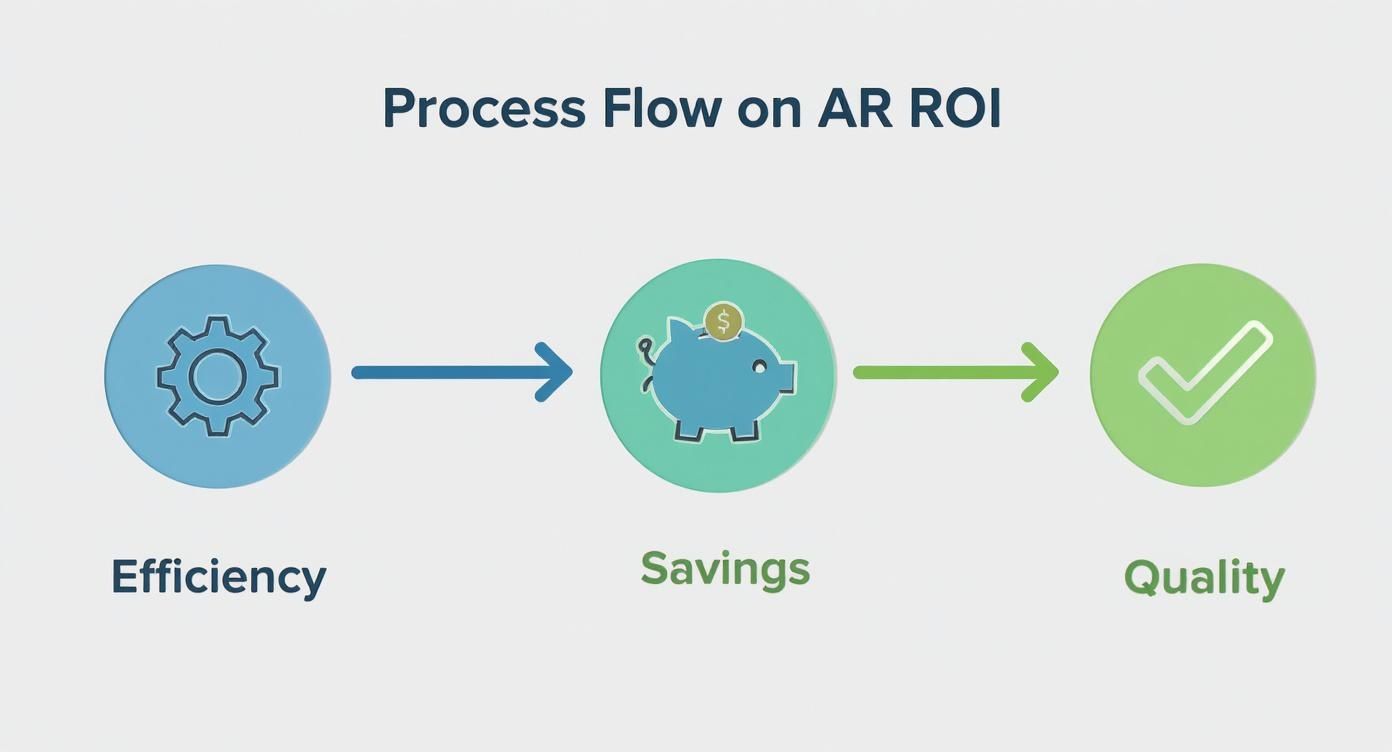
The process below illustrates how a well-integrated AR solution delivers tangible returns by improving efficiency, reducing costs, and enhancing quality.
This flow highlights how targeted AR applications translate directly into measurable business outcomes, creating a rock-solid case for the investment.
Managing the Human Side of Change
Technology is only half of the equation. The most critical factor is your people. Successfully integrating AR into daily workflows requires a thoughtful change management strategy that builds buy-in, facilitates training, and fosters a culture of continuous improvement.
To ensure success, adopt a structured approach:
- Start with a Pilot Program: Select a small, motivated team to test the AR solution on the identified use case. This creates a low-risk environment to refine the process and gather valuable feedback.
- Find and Empower Your Champions: Within the pilot group, identify individuals who are enthusiastic about the technology. These internal champions will become powerful advocates, helping to train their peers and demonstrate real-world benefits.
- Build a Scalable Training Plan: Use learnings from the pilot to create a standardized training program. This should cover not only hardware use but also how the new AR workflow fits into the larger production process.
- Broadcast and Celebrate the Wins: As the pilot delivers results—such as a 15% reduction in assembly time or a 40% drop in errors—share these successes widely. Communicating tangible wins is the most effective way to build momentum and generate organization-wide support.
By treating implementation as a strategic project that balances technology, process, and people, you can effectively scale your pilot from a small win into a company-wide competitive edge.
What's Next for AR in Automotive?
The augmented reality applications transforming factory floors and customer showrooms today are just the beginning. The true potential of AR in automotive will be realized through its convergence with other key technologies, including Artificial Intelligence (AI), 5G, and the Internet of Things (IoT). This integration is paving the way for a predictive and interactive automotive ecosystem.
Imagine a factory where AR is not just displaying a static checklist. By connecting AR headsets to IoT sensors on machinery, a technician could see a predictive maintenance alert overlaid directly onto a component, forecasting a potential breakdown hours or even days in advance. This would shift maintenance from a reactive process to a scheduled, zero-downtime event.
The Rise of the Intelligent Cockpit
This fusion of technologies will also redefine the in-car experience. We are moving beyond simple navigation overlays toward fully holographic windshields. These systems could project dynamic, 3D information across the driver's entire field of view, highlighting road hazards detected by vehicle sensors or pointing out available parking spots in real-time.
The financial momentum behind these innovations is clear. The global automotive AR market, estimated at USD 2.36 billion in 2024, is projected to grow to USD 63.55 billion by 2035, representing a compound annual growth rate of nearly 34.9%. This growth is largely driven by the broader adoption of advanced driver assistance systems (ADAS) that rely heavily on AR. You can dive into a more detailed analysis of the automotive AR market's future growth here.
The future of automotive AR isn't about the tech itself. It’s about AR becoming the foundational platform for mobility innovation—the intelligent interface through which drivers, technicians, and engineers will interact with the next generation of vehicles.
Your Strategy for Tomorrow Starts Today
The key takeaway is that AR is evolving from a niche tool into the central nervous system of both the connected vehicle and the smart factory. AI-powered virtual assistants will become commonplace, offering conversational help to drivers on the road and technicians in the service bay.
For leaders in the automotive sector, an AR strategy is no longer optional—it is essential for remaining competitive. The technologies discussed are proven and deliver measurable ROI in efficiency, quality, and safety. The time to transition from consideration to implementation is now.
Common Questions About AR in Automotive
When leaders in the automotive industry explore AR, several practical questions typically arise. Addressing these is the first step toward building confidence that this technology is ready for prime-time application.
A frequent question concerns integration: "How does this plug into our existing systems?" The key is to create a seamless data pipeline between core systems, like a Manufacturing Execution System (MES), and the AR platform. Proper integration ensures that digital work instructions are always up-to-date and that performance data is captured automatically.
Measuring Success and Proving Value
Another common question relates to ROI, particularly for applications like technician training. Value can be proven by tracking hard numbers:
- How much faster do new hires achieve proficiency?
- Is there a measurable reduction in errors among recently trained staff?
- What are the savings on travel and physical training materials?
For service technicians in the field, the clearest indicator of ROI is an increase in first-time fix rates. When a technician trained with AR can accurately diagnose and resolve an issue on the first visit, it represents a direct and powerful financial benefit.
The maturity of the technology is also a frequent topic. For specific, well-defined applications—such as guided assembly, remote expert support, and digital quality checks—the technology is proven and ready for full-scale rollout.
The most prudent approach is to start with a single high-impact area to demonstrate value before expanding enterprise-wide. This "prove and scale" method mitigates risk and builds organizational support for future initiatives.
Ready to see how AR can solve your biggest operational challenges? At AIDAR Solutions, we specialize in integrating immersive AR and VR applications that boost efficiency and slash costs. Discover our tailored solutions and start your transformation today.

