Mastering Manufacturing Knowledge Management
Picture this: your factory's collective wisdom is like a master craftsperson's entire lifetime of experience. Now, imagine that wisdom walking out the door every evening or, worse, for good when a seasoned expert retires. Manufacturing knowledge management is the system you put in place to capture this priceless asset, stopping critical operational insights from vanishing forever.
The Hidden Asset in Modern Manufacturing
Every factory runs on more than just machinery and raw materials; it runs on knowledge. This isn't just about the official procedures tucked away in a binder. It’s also about the intuitive "feel" an expert technician has for a machine that’s about to fail. When that expertise isn't systematically captured and shared, you get a "leaky bucket" effect.
With every shift change, employee departure, or retirement, that precious operational knowledge drains away. The consequences are very real: longer machine downtimes, mistakes that get repeated over and over, and a painfully slow onboarding process for new hires. Many companies are staring down the barrel of a massive experience gap as their most tenured employees head for retirement—a "brain drain" that can cripple operations for years. You can learn more about the risks of this "brain drain" and how to mitigate the loss of decades of company experience.
The Central Nervous System of Your Operation
Don't think of a knowledge management system as some static library of dusty documents. It’s the central nervous system of your entire facility—a dynamic network connecting your people, processes, and equipment in real-time. A well-designed system makes sure the right information gets to the right person at the exact moment they need it.
This system is built on four core pillars:
- Capturing Knowledge: This means actively documenting both the formal, written-down procedures (explicit knowledge) and the hands-on, "in-the-head" expertise of your skilled workers (tacit knowledge).
- Storing Knowledge: It's about organizing all this information in one central, easy-to-search place. It's time to move beyond scattered spreadsheets and disconnected departmental drives.
- Sharing Knowledge: This is how you break down the information silos that kill collaboration. Insights need to flow freely across teams and shifts.
- Applying Knowledge: The real magic happens when information becomes accessible right at the point of work, empowering employees to make smarter, faster decisions on the factory floor.
A strong knowledge management strategy turns individual expertise into a durable, accessible company asset. It’s the difference between relying on a few key people and building an entire organization that learns, adapts, and improves continuously.
This guide is your roadmap to building that kind of system. We’ll walk through how to identify and preserve your most critical knowledge, get past the common hurdles, and even use modern tools like Augmented and Virtual Reality to scale expertise in ways you never thought possible. When you start treating knowledge as your most valuable asset, you build a more resilient, efficient, and innovative manufacturing operation.
Decoding Tacit and Explicit Knowledge on the Floor
Every manufacturing plant runs on two different, but equally vital, types of knowledge. Getting a handle on the difference is the first real step in building a manufacturing knowledge management strategy that works. If you only focus on one, you're inviting inefficiency, errors, and stagnation.
First up, you have explicit knowledge. This is all the stuff you can easily write down, record, and save. Think of it as your factory’s official library—full of equipment manuals, safety protocols, schematics, and standard operating procedures (SOPs). It’s structured, tangible, and pretty straightforward to pass around.
Then there’s the other side of the coin: tacit knowledge. This is the secret sauce. It’s the gut-level, hands-on expertise your most seasoned technicians have picked up over years, or even decades. It’s the specific hum a veteran engineer hears that tells them a machine is about to fail, or the muscle memory a welder uses to lay down a perfect seam every single time.
This infographic really drives home how manufacturing knowledge is a blend of people, processes, and the machinery they run.
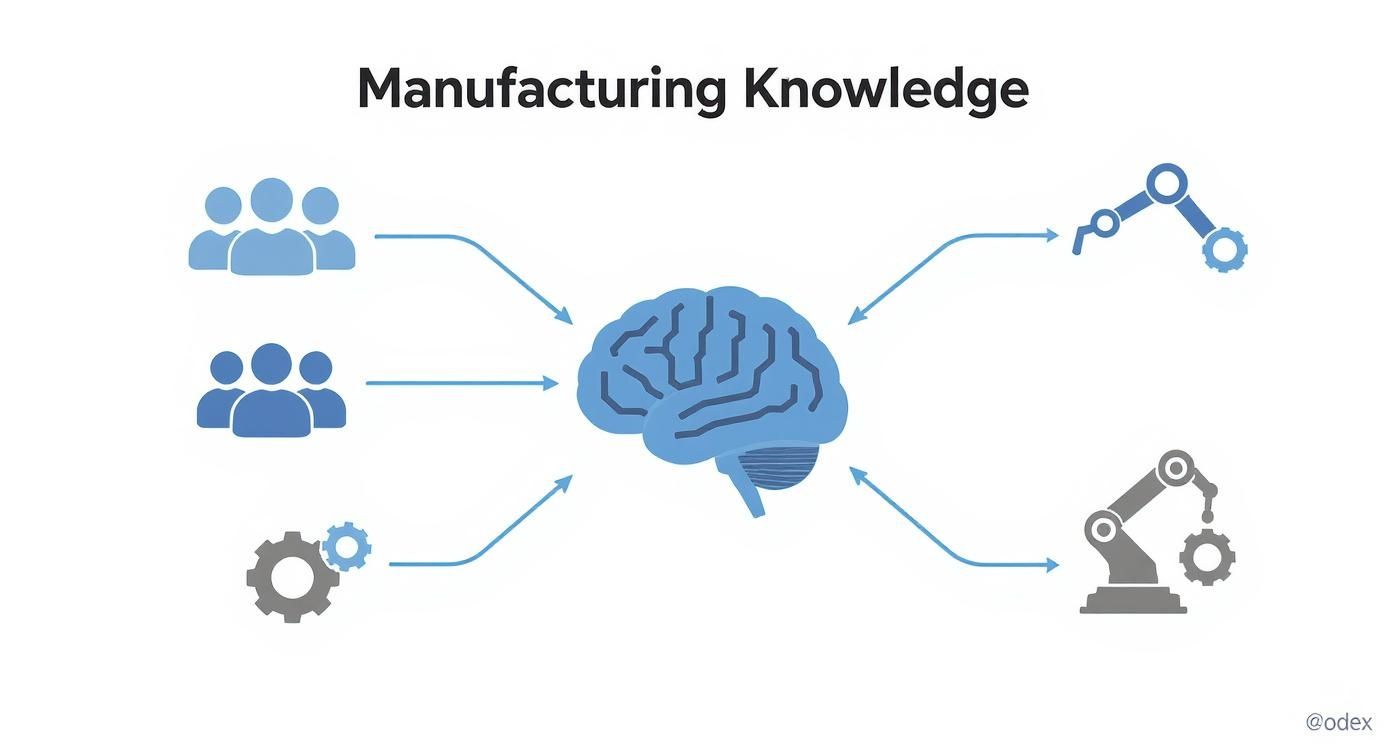
As you can see, a winning knowledge strategy has to connect the dots between your people's expertise, your documented processes, and the physical equipment on the floor.
Where the Two Knowledge Types Meet
Picture this: a complex CNC machine suddenly throws an error code that isn't in the manual. Your explicit knowledge (the manual) has just hit a dead end. A junior tech could waste hours poring over the documentation, racking up costly downtime.
A senior tech, on the other hand, might walk over, listen to the machine for a moment, and check a specific valve they remember causing a similar issue years ago. Problem solved in minutes. That’s tacit knowledge in action. The goal isn't to pick one type over the other—it's to build a bridge between them.
A solid system acts like a living, breathing digital library for your entire operation, built on four key pillars:
- Capture: Documenting not just the 'what' (explicit) but the 'how' and 'why' (tacit).
- Storage: Creating a single, centralized hub for all this information that’s a breeze to search.
- Retrieval: Making sure any employee can find the exact answer they need, right when they need it.
- Sharing: Spreading that hard-won expertise across shifts, teams, and even different facilities.
This isn't just another IT project; it’s a strategic move toward operational excellence. When you get this right, you turn that fragile "tribal knowledge" into a shared, reliable company asset that delivers real, measurable results.
Building a Framework for Knowledge
To start wrangling your explicit knowledge, a crucial first step is to create SOPs that actually get used. These documents are the backbone of your knowledge base. You can make them even more powerful by checking out our guide on creating effective work instructions for manufacturing.
The market is definitely waking up to this need. The global knowledge management sector was valued at around $773.6 billion and is expected to rocket past $3.5 trillion by 2034.
But here's the catch: while one survey found that 36% of manufacturers use three or more knowledge management tools, a whopping 31% weren't even sure how many tools they had. This highlights a huge disconnect—companies are buying tools without a unified strategy. It's clear that a more focused, integrated approach is desperately needed.
Driving Tangible Results with Knowledge Management
A great strategy is one thing, but the real test of manufacturing knowledge management happens on the shop floor, not in a boardroom slideshow. When you build a solid system, you move past abstract ideas and start delivering real, practical results that solve the nagging problems manufacturing leaders face every single day. The goal isn't just to feel more organized; it's to see a clear return on investment in your most important metrics.
Forget vague promises of "improved efficiency." Think about the real-world impact. When a machine operator can pull up digital work instructions on a tablet in seconds, they can cut complex machine changeover times by as much as 30%. That’s not a small tweak—it's a massive boost in production capacity without buying a single new piece of equipment.
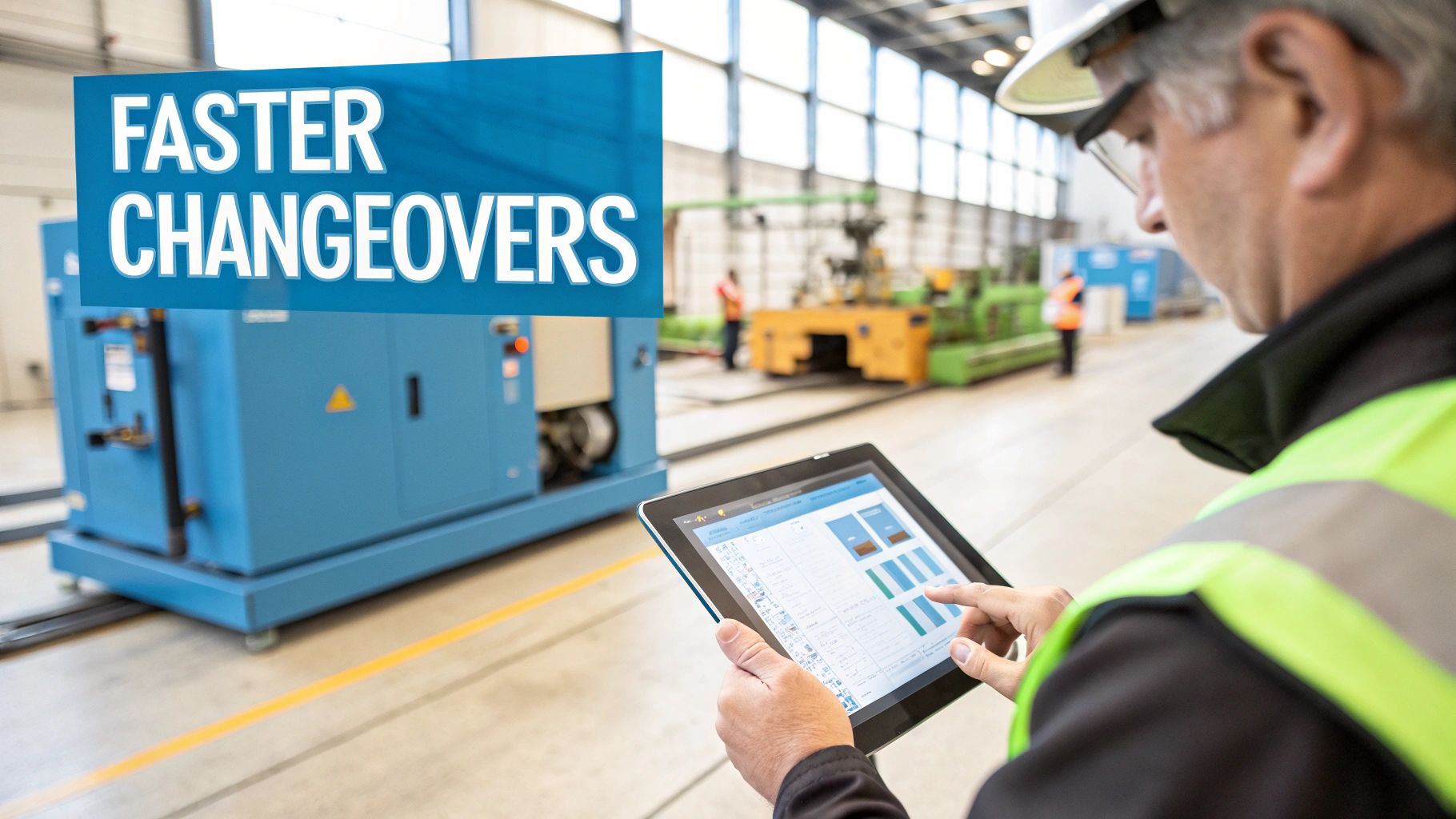
Every benefit of a strong knowledge management system is a direct solution to a common, costly problem.
Accelerate New Hire Onboarding
The old "shadow an expert" training method is slow, inconsistent, and, worst of all, it pulls your most skilled people away from their real jobs. A centralized knowledge base completely flips this script.
From day one, new hires get access to standardized training modules, video guides for tricky tasks, and searchable SOPs. This self-service model empowers them to find their own answers, building confidence and competence way faster. The result? You drastically shorten the time it takes for them to become productive, easing the burden on your senior staff and getting new team members contributing to the bottom line sooner.
Effective knowledge management can shrink the onboarding timeline from months down to weeks. It ensures every new employee is trained to the same high standard, every single time.
Minimize Costly Production Errors
Every mistake on the line means rework, scrap, and wasted material—all things that eat away at your margins. A surprising number of these errors happen for a simple reason: an operator didn't have the right information at the right time.
A knowledge management system becomes your single source of truth. It guarantees everyone is working from the latest schematics, quality standards, and procedural checklists. By making verified info instantly available right where the work happens, you eliminate the guesswork and slash the odds of human error. This directly boosts your first-pass yield and overall product quality. For an even more integrated approach, it’s worth looking into the role of ERP in Manufacturing to see how these systems can magnify the benefits.
Bolster Safety and Compliance
In a manufacturing plant, not following safety rules can have devastating consequences. A knowledge management system is one of your best tools for building a true safety-first culture.
When you centralize safety protocols, lockout-tagout procedures, and equipment instructions, you make it easy for everyone to stay compliant across all shifts. Digital checklists can even require operators to confirm safety steps before a machine will start, creating a clear audit trail. This doesn't just protect your people; it makes regulatory audits a breeze and lowers the risk of expensive violations.
Preserve Expertise and Ensure Continuity
This might be the most important long-term payoff: protecting the priceless knowledge locked in the heads of your veteran employees. When a senior expert retires, they can take decades of hard-won troubleshooting skills and operational instincts right out the door with them.
A focused knowledge management initiative is how you stop that brain drain. You actively capture their expertise through video interviews, detailed process documents, and expert-led tutorials. This knowledge becomes a permanent, searchable asset for the whole company, ensuring those critical lessons aren't lost to turnover. It builds operational resilience and creates a culture where the team's collective wisdom just keeps growing. A big part of this is knowing how to measure training effectiveness to confirm that the knowledge is actually being transferred and put to good use.
A robust knowledge management system directly strengthens your bottom line by tackling the very issues that keep plant managers up at night. The table below breaks down how this translates into measurable improvements across key manufacturing metrics.
Impact of Knowledge Management on Manufacturing KPIs
| Key Performance Indicator (KPI) | Before Knowledge Management | After Knowledge Management Implementation | Primary Benefit Achieved |
|---|---|---|---|
| New Hire Time-to-Productivity | 12-16 weeks | 4-6 weeks | Accelerated Onboarding |
| First Pass Yield (FPY) | 92% | 97% | Error Reduction |
| Machine Changeover Time | 45 minutes | 30 minutes | Increased Production Uptime |
| Reportable Safety Incidents | 5 per year | 1 per year | Improved Safety & Compliance |
| Scrap & Rework Rate | 4.5% | 1.5% | Reduced Waste & Costs |
As the data shows, the impact isn't just theoretical. By providing the right information to the right person at the right time, you create a more efficient, safer, and more profitable operation.
Navigating the Common Sticking Points
While the benefits of a great manufacturing knowledge management system look fantastic on paper, the road to getting one up and running is often bumpy. It’s a classic mistake to think you can just install new software and call it a day. The real challenge is navigating the messy human and technical roadblocks that can stop a project in its tracks. Knowing what these hurdles are ahead of time is half the battle.
One of the biggest barriers you’ll face is resistance from your veteran employees. These are the experts who carry decades of priceless, unspoken knowledge. To them, a new system can feel like an attempt to make their hard-won expertise irrelevant. You can almost hear them thinking, "Why should I just give away the skills I spent 30 years learning?" That kind of fear is a completely natural reaction to change, and you have to approach it with a smart, empathetic strategy.
The key is to flip the narrative. This isn't about replacing anyone; it's about preserving their legacy. A powerful way to get buy-in is to involve these experienced technicians directly in the design process, positioning them as "knowledge mentors" or subject matter experts. When they have a hand in shaping the tool, they become its biggest champions.
Getting Over the Technical and Procedural Hurdles
Beyond the people problems, the technical and procedural snags can be just as tough. A lot of manufacturers are working with a patchwork of disconnected systems—ERPs, MES, quality control software, and a mountain of spreadsheets. These data silos make creating a single source of truth a massive integration headache.
Another tricky part is the nature of unspoken, or tacit knowledge, itself. How do you document the intuitive "feel" a senior mechanic has for a machine that’s acting up? This is where modern tools and some creative thinking really come into play.
Here are a few practical ways to tackle these issues:
- Start Small with a Pilot Program: Don’t try to boil the ocean. Pick one specific area that’s a major pain point—maybe a machine with constant downtime or a really complicated changeover process. Focus your efforts there to prove the concept and build momentum.
- Use More Than Just Text: Go beyond simple documents. Capture the nuances of tacit knowledge with video recordings of experts doing their thing, photos with markups, and even audio notes explaining the little details that are tough to write down.
- Make the Interface Dead Simple: If the system is a pain to use, people will just fall back on their old habits. The interface has to be intuitive and easy to access right on the shop floor with a tablet or another mobile device.
The real goal here is to make finding information easier than tapping the person next to you on the shoulder. The system needs to fit into how people already work, not add another frustrating step.
The Make-or-Break Role of Leadership and Change Management
At the end of the day, a knowledge management project lives or dies by the support it gets from the top and a solid plan for managing the transition. Leadership has to be the project’s biggest cheerleader, constantly communicating why it’s so important and making sure it has the resources it needs. Without that backing, the initiative will likely fizzle out at the first sign of trouble.
This is where a real change management plan is essential. A growing number of manufacturers now report having formal plans to keep their teams engaged when new digital tools are introduced. It shows a wider understanding that managing the people side of technology is what matters most. You can find more insights into these manufacturing trends and see how others are handling it. A well-thought-out plan ensures the system isn't just installed, but is actually adopted, valued, and used by everyone.
Using AR and VR to Scale Expertise
The traditional approach to transferring knowledge—having a new hire shadow a veteran—is slow, inconsistent, and difficult to scale. With the skills gap widening, manufacturers need a method to multiply the expertise of their top performers and share that knowledge across the entire organization.
This is where Augmented Reality (AR) and Virtual Reality (VR) are transforming manufacturing knowledge management. These technologies serve as a direct bridge between your digital knowledge base and the physical reality of the factory floor. They deliver information in context, fundamentally changing how employees learn, work, and solve problems.
Augmented Reality for On-The-Job Guidance
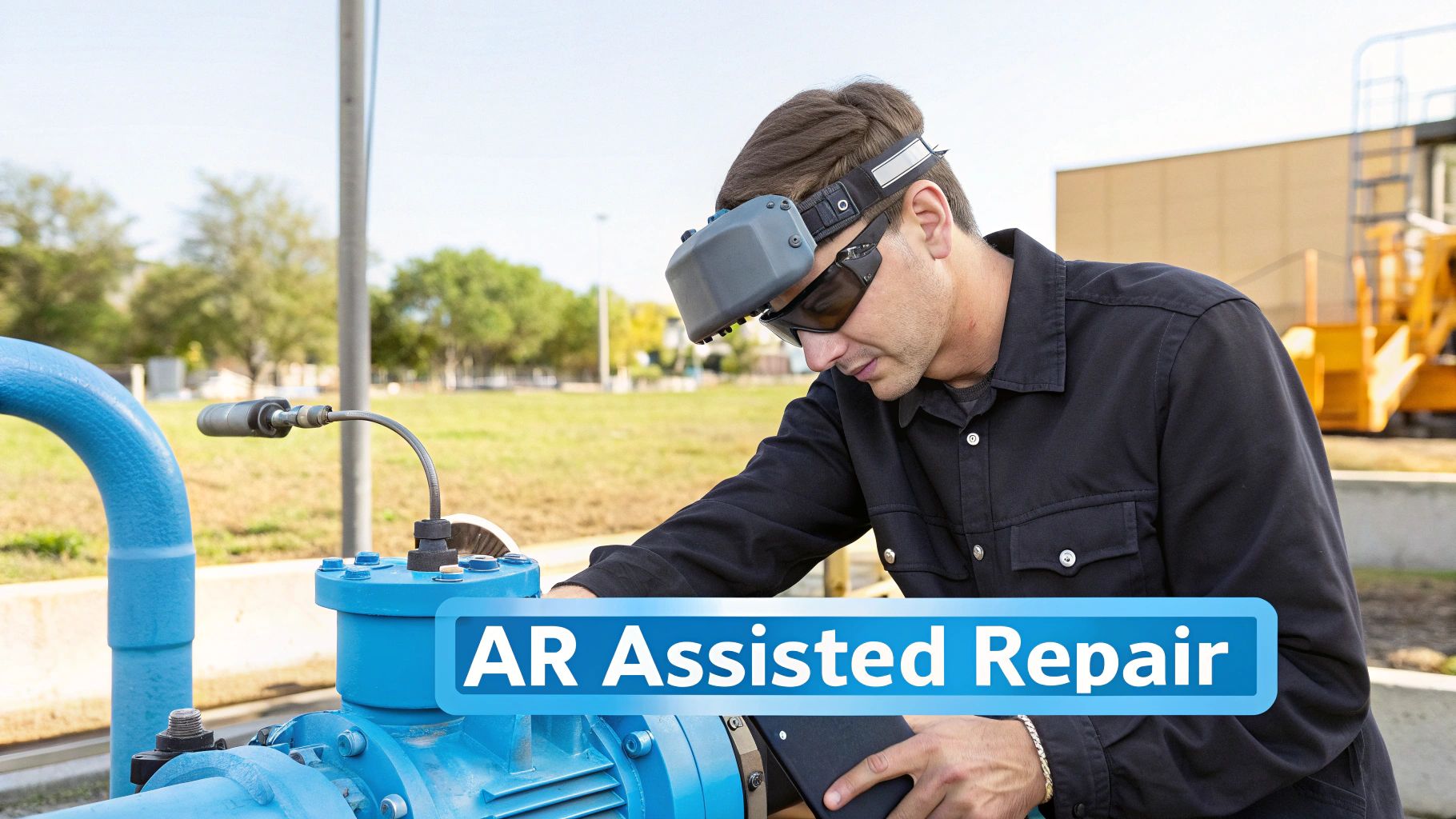
AR provides hands-free, expert guidance by overlaying digital information onto a technician's real-world view through smart glasses or headsets. This offers powerful, in-the-moment support for complex tasks.
Consider a junior technician performing a difficult repair on a hydraulic press. Instead of consulting a manual, she wears an AR headset. A step-by-step checklist appears in her field of view, with digital arrows pointing to the exact components. When she reaches a complex valve assembly, a 3D animation demonstrates the correct procedure, allowing her to complete the repair in half the time and with zero errors.
The practical benefits include:
- Reduced Cognitive Load: Visual, contextual information lets technicians focus on the physical task, not on interpreting complex diagrams.
- Minimized Human Error: Step-by-step digital work instructions ensure procedures are followed correctly, improving first-time fix rates.
- Instant Expert Support: A technician can initiate a remote assistance call, allowing a senior expert to see their view and provide real-time guidance by drawing annotations that "stick" to physical equipment.
AR doesn't just show someone how to perform a task; it actively guides them through it, making every technician more capable and confident.
To see how this technology is being applied on the factory floor, you can explore a deeper dive into augmented reality for manufacturing and its most effective applications.
Virtual Reality for Risk-Free Training
While AR excels in on-the-job support, Virtual Reality (VR) provides the ultimate risk-free training environment. VR immerses users in a fully simulated environment, allowing them to practice complex or hazardous procedures without real-world consequences.
This is invaluable for new hires. They can learn to operate heavy machinery, perform intricate assemblies, or run through emergency shutdown protocols in a safe, controlled setting. They can make and learn from mistakes without tying up production equipment or risking injury. This immersive training method has been shown to accelerate employee learning by up to 75%.
VR training is ideal for:
- High-Consequence Tasks: Safely simulate emergencies like chemical spills or equipment fires.
- Complex Machinery Operation: Allow operators to gain proficiency with expensive equipment before using the real thing.
- Standardized Skill Development: Ensure every trainee receives the same high-quality instruction, building consistent skills across the workforce.
By combining AR for real-time guidance and VR for immersive training, manufacturers can build a powerful system for knowledge transfer. These tools capture the wisdom of seasoned experts and transform it into interactive, scalable learning experiences that empower the entire workforce and future-proof the organization against knowledge loss.
Building Your Future-Proof Knowledge Strategy
A successful manufacturing knowledge management strategy isn't a project with a start and a finish line. Think of it more as a commitment to becoming a learning organization—one that constantly captures, shares, and builds on its collective wisdom to navigate the endless waves of change. To make your strategy future-proof, you have to move beyond just storing documents in a digital filing cabinet and start building a dynamic system that actually empowers your workforce.
This isn't just an IT problem. It requires a smart approach that mixes the right technology with a real understanding of how people actually work on the factory floor. The best strategies don't try to boil the ocean. They start small, prove their worth fast, and build momentum, creating a powerful cycle of continuous improvement.
Start with a Targeted Pilot Project
Instead of trying to launch a massive, company-wide overhaul from day one, find a single, high-impact problem to solve. Maybe it’s a complex machine that’s always down, a production line with a stubbornly high error rate, or a critical process that depends entirely on one expert who’s about to retire.
By focusing your initial energy on that one specific pain point, you can deliver tangible, quick wins. That success story becomes your best sales pitch for getting buy-in from both leadership and the frontline crew when it's time to expand.
Appoint and Empower Knowledge Champions
Great technology alone won't get people to use it. You need passionate advocates on the ground who genuinely believe in the mission. Look for enthusiastic employees from different departments and levels—from the seasoned engineer who’s seen it all to the tech-savvy junior operator—and make them your "knowledge champions."
These folks will be the go-to resources for their peers, give you priceless feedback on what’s working (and what’s not), and help foster a culture where sharing what you know is something to be celebrated. Their involvement makes sure the system is built for the people who will actually use it, not just for a checklist in an IT department.
A knowledge management system's true value is measured by its adoption rate. It has to fit into existing workflows so seamlessly that it's easier for an employee to find an answer in the system than to tap a coworker on the shoulder.
Use AI to Automate and Augment
Modern knowledge management runs on smart technology that works behind the scenes to make information more accessible and genuinely useful. Artificial intelligence is a huge piece of this puzzle, handling the tedious stuff and uncovering insights that would otherwise stay buried.
Put AI to work for you:
- Automate Content Tagging: AI can scan documents, videos, and images, automatically applying relevant tags so people can find what they need without a headache.
- Proactively Recommend Solutions: An intelligent system can anticipate what a worker needs. Imagine relevant safety alerts or troubleshooting guides getting pushed to their device based on the specific task they're doing, right when they need them.
- Identify Emerging Knowledge Gaps: AI can analyze search queries and operational data to flag areas where your knowledge base is thin or out of date. This helps you focus your efforts where they’ll make the biggest impact.
Using AI to manage employee skills and deployment is quickly becoming a core part of the manufacturing playbook. A Deloitte study found that manufacturers using AI-driven knowledge systems can slash new employee onboarding time by up to 40% and improve production planning accuracy by 25%. You can read more about the impact of AI on the manufacturing outlook on their site. This isn't just about storing information anymore; it's about turning your knowledge base into an active, intelligent partner in your operations.
Got Questions? We've Got Answers
Stepping into the world of manufacturing knowledge management can feel like a big leap, especially when you're talking about new tech and changing how people work. Let's tackle some of the most common questions we hear from leaders on the factory floor.
How Can a Small Manufacturer Even Get Started with This?
You don't need a huge budget or a massive IT overhaul to begin. The secret is to start small. Think about your biggest knowledge bottleneck right now—that one critical process that only one or two veterans truly know how to handle.
Your first move? Launch a small pilot project focused solely on documenting that one thing. Use the tools you already have: a smartphone to record a video walkthrough, step-by-step photos with simple notes, or even a basic checklist. Store it all in a shared cloud drive that everyone can access. This isn't about boiling the ocean; it's about proving the concept and building momentum without a heavy upfront investment.
How Do I Convince My Experienced Crew to Share What They Know?
This is all about trust and respect. It's crucial to frame this as preserving their legacy and building the company's future on their expertise—not as a way to make them redundant.
Bring your veterans into the process from day one. Treat them as the subject matter experts they are and ask for their help in designing the system. When they have a hand in building it, they become its biggest champions. Make sure to publicly recognize their contributions, and maybe even set up a small reward for great knowledge sharing. Nothing motivates more than seeing their expertise directly help a younger employee succeed. That creates a real sense of ownership and purpose.
Isn't AR and VR Technology Too Complicated for Most of Us?
That used to be a valid concern, but the technology has become much more user-friendly and accessible. Modern AR and VR solutions are often offered through a subscription model (SaaS), which removes the need for large capital investment and complex in-house technical support.
The best approach is to identify a specific, high-impact problem where this technology can deliver clear value.
Pick a single, tricky assembly step or a maintenance task that causes frequent headaches. A successful pilot project focused on a real business problem will deliver a clear return on investment (ROI) through fewer mistakes and faster work. That makes it a whole lot easier to justify bringing in more of the technology.
This approach transforms AR and VR from an abstract concept into a practical tool for improving your operations.
Ready to see how immersive AR and VR can lock in your company's knowledge and empower your workforce for years to come? AIDAR Solutions provides virtual training and remote assistance tools built to deliver real-world results. Discover how our experts can help you scale expertise and drive operational excellence.