
How to Train Staff for Impact and Retention
Effective staff training is not an HR checkbox; it is a powerful engine for business growth. When employee development is treated as a core business strategy—not just a line item expense—it creates a more competent, productive, and profitable workforce.
Why Smart Staff Training Is Your Best Investment
Successful companies understand that strategic employee development is a direct investment with a significant ROI. It is the engine that provides your team with the skills and confidence they need to achieve their goals, which directly impacts the bottom line.
When people feel competent and see that their employer is invested in their growth, they perform better. This is a measurable business reality. Companies that commit to comprehensive training see a ripple effect of positive results across all departments, from sales to operations.
The Clear Line from Training to Profitability
The data shows a strong connection between dedicated training and financial success. Brands that build out comprehensive training programs earn 218% higher income per employee compared to companies that do not. This lift occurs because well-trained employees are more efficient, make fewer errors, and are more effective at serving customers and identifying opportunities for innovation.
Furthermore, these organizations also experience 17% higher productivity and a 21% boost in profitability. This provides clear evidence that investing in your people's skills pays real dividends. When 59% of employees report that training improves their performance, it indicates the creation of a more valuable and engaged team.
Training is not just about addressing weaknesses; it's about building on strengths. It is the process of converting human potential into tangible business performance, creating a team that is not only skilled but also committed to the company's success.
Building a Culture Where Everyone Keeps Growing
A great training program does more than teach someone how to use new software; it embeds a culture of continuous improvement into the company. Such an environment is invaluable for long-term success, as it sends a clear message to your team: "We are invested in your career here."
This commitment creates a powerful cycle:
- Your team becomes more skilled: They grow more agile and prepared to tackle new challenges and adapt to market changes.
- Engagement increases: People feel valued, which boosts morale and encourages discretionary effort.
- Top talent is retained: Employees are less likely to seek opportunities elsewhere when they see a clear path for growth within the company.
For this culture to take hold, training must be an ongoing process. The most effective approach integrates training with proven knowledge management strategies. This ensures that new skills and insights are captured and shared, turning individual learning into a collective organizational asset. This is how you build a smarter, more resilient business.
Pinpointing Your Team’s Critical Skill Gaps

Before investing in a new training program, it is essential to identify the specific skills your team lacks. A common mistake is to develop content without this foundational step, which results in activity without meaningful performance improvement.
This is where a formal training needs analysis is crucial. This diagnostic phase provides a structured way to measure the gap between your team's current capabilities and the skills required to achieve company goals. The objective is not to assign blame but to build a clear path from where your team is today to where the business needs them to be.
Dig into Your Performance Data
Your own business data is a valuable resource and the best place to begin. Analyze key performance indicators (KPIs) that are not meeting targets.
Are sales dipping in a specific territory? The team might need updated product knowledge or improved negotiation skills. Are error rates high on a production line? This signals a gap in operational training. A spike in customer support tickets about a specific product feature indicates that both your team and your customers may be confused. This data provides objective evidence of where the real problems lie.
Get on the Ground and Talk to People
Data reveals what is happening, but it often doesn't explain why. To understand the root causes, managers should spend time observing their teams in their work environment. Look for moments of hesitation, difficulty, or inefficient workarounds.
These observations can initiate valuable conversations. Ask your employees directly:
- "What is the most challenging part of your job right now?"
- "If you could improve your proficiency with one tool, which would it be?"
- "What new skill would make the biggest difference for you?"
This direct feedback is invaluable. It not only helps uncover hidden needs but also fosters employee investment in the solution by making them feel heard and involved in their professional growth.
A common mistake is assuming you already know what your team needs. A thorough analysis often reveals surprising gaps that weren't on your radar, like a lack of soft skills in a technical team or digital literacy issues among veteran employees.
Use Focused Surveys and Assessments
To gather feedback at scale, a well-designed survey can be highly effective. Focus on specific competencies rather than generic satisfaction questions. Ask employees to rate their confidence level on key tasks or specific software.
For example, a logistics company could survey its dispatchers on their mastery of a new route optimization tool. A marketing team could assess their comfort level with the latest social media analytics platforms.
Combine these self-evaluations with manager reviews to obtain a complete 360-degree view of your team's strengths and weaknesses. This multi-pronged approach ensures that your training plan is built on solid evidence. For complex, hands-on jobs, this is also an ideal time to explore how immersive VR training programs can offer a safe, controlled environment for both assessment and skill development.
Designing a Training Program People Actually Want to Use
Once you have identified your team's skill gaps, the next step is to translate that analysis into action. This involves building a training curriculum that is not only compliant but also genuinely engaging for your employees. A program that people want to take is one that delivers measurable results.
The first step is to establish clear and focused goals. A vague objective like "improve manager skills" is not actionable. Instead, you need specific, measurable learning objectives for every module.
Consider this example: "By the end of this module, new managers will be able to conduct a structured, one-on-one performance review using the company framework with 90% accuracy." This level of clarity allows you to measure success and ensures that every piece of content has a distinct purpose.
Setting Clear and Measurable Objectives
The SMART framework is a classic tool for a reason—it is effective. Applying it to your training goals ensures they are grounded and focused on real-world outcomes.
- Specific: Clearly define the skill or knowledge the employee will gain.
- Measurable: Define how you will track progress and determine mastery.
- Achievable: Ensure the goal is realistic for the employee within the training context.
- Relevant: Confirm that the objective directly supports the employee's role and the company's broader goals.
- Time-bound: Set a clear deadline for when the skill should be acquired.
Defining these objectives upfront creates a blueprint for your entire curriculum. Every video, activity, and assessment should map directly back to one of these goals. This intentional approach keeps your program lean, effective, and free of scope creep.
Here's a pro tip: When designing a training program, take a look at established user onboarding best practices. The principles for guiding a new user to find value in a product are surprisingly similar to guiding an employee to master a new skill.
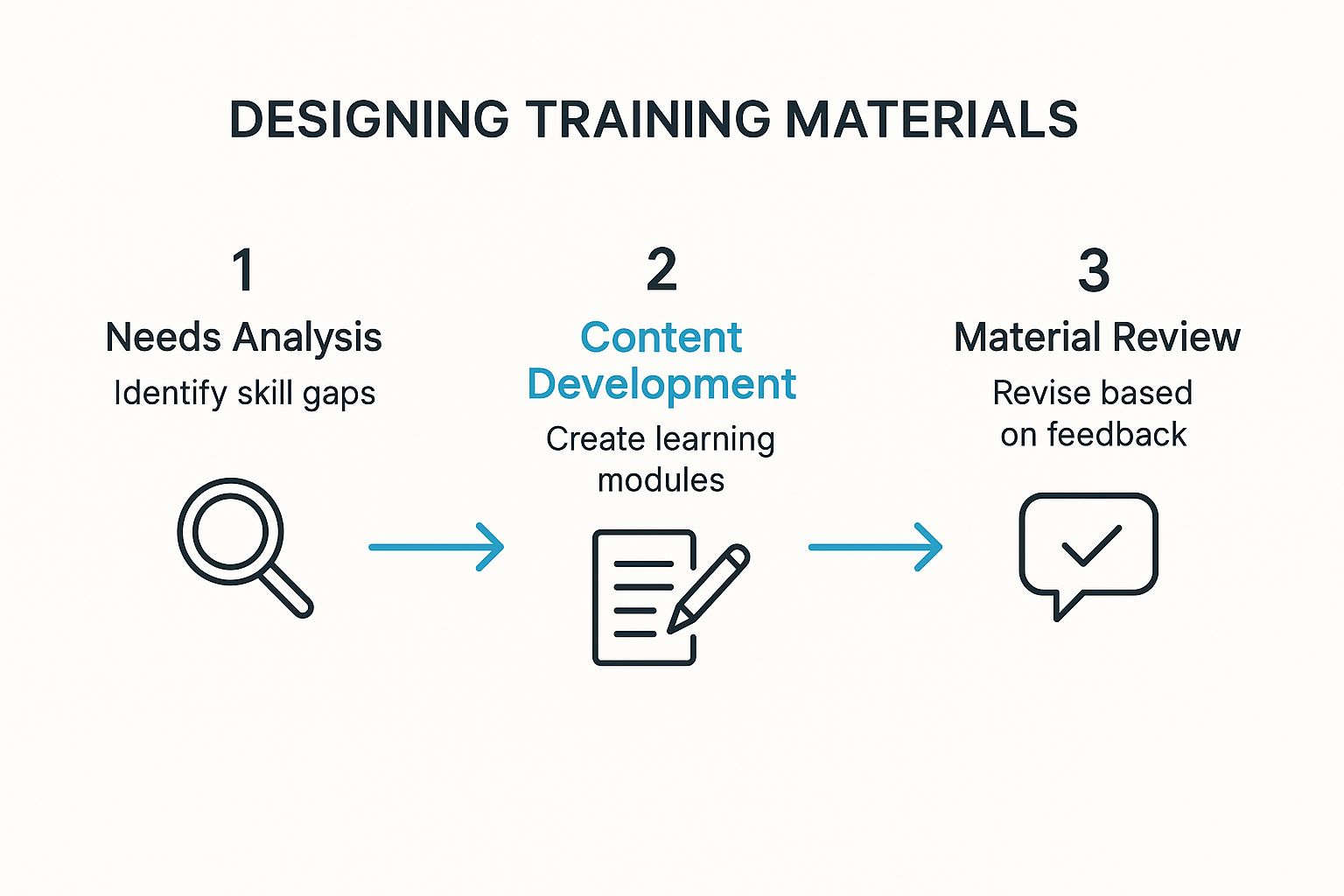
The key takeaway here is that great design is a cycle, not a straight line. The feedback you get during the review stage should constantly feed back into and refine your content development.
Choosing the Right Training Formats
Different skills require different teaching methods. The delivery method is as critical as the content, and your choice should be dictated by the learning objective. Memorizing product specifications is fundamentally different from learning how to de-escalate a tense customer situation.
This is why a blended learning approach is often the most powerful strategy. It combines various methods to cater to different learning styles and reinforces knowledge from multiple angles, keeping the material fresh and engagement high.
So, what should you include in your blend? Let's examine the options.
Choosing the Right Training Modality
This table will help you compare different training methods and identify where they excel. Consider your specific learning goals and which of these tools is the right one for the job.
| Training Method | Best For | Scalability | Example Use Case |
|---|---|---|---|
| Self-Paced Digital Modules | Foundational knowledge, compliance, software tutorials | High | Annual security awareness training for all staff |
| Collaborative Workshops | Team-building, brainstorming, soft skills | Medium | A workshop on creative problem-solving for a marketing team |
| Peer Mentoring & Coaching | Long-term development, applying skills on the job | Low | Pairing a junior developer with a senior engineer for code reviews |
| Immersive VR/AR Scenarios | Complex physical tasks, high-stakes decision-making | High | Surgeons practicing a new procedure in a risk-free VR environment |
This table is not exhaustive, but it demonstrates how different formats serve different needs. The real power lies in combining them.
For highly complex, hands-on skills or high-stakes environments, traditional methods often fall short. This is an ideal opportunity to explore powerful virtual reality training solutions. They allow employees to practice in a completely safe, yet hyper-realistic, simulated world.
Imagine a new technician practicing a complex repair on a virtual engine or a retail associate navigating a difficult customer interaction in a VR replica of your store. The learning is more effective because the experience feels real.
Building a Dynamic Curriculum: An Example
Let’s integrate these concepts into a real-world scenario: building a program for newly promoted team leads. A dynamic, blended curriculum might look like this:
- The Foundation (On-Demand): New leads begin with a series of self-paced e-learning modules covering fundamentals—management theory, company policies, and administrative duties.
- The Workshop (Live & Virtual): Next, they participate in a live virtual workshop focused on soft skills, such as giving constructive feedback, motivating a team, and managing conflict. This provides an interactive space for discussion and Q&A.
- The Practice Field (Immersive VR): Now it’s time to apply these skills. They enter a VR simulation to practice a difficult conversation with an underperforming "employee" avatar, receiving instant feedback on their tone, body language, and word choice.
- The Guide (Peer Mentoring): Finally, each new lead is paired with a seasoned manager for ongoing mentorship, allowing them to apply their new skills to real-world challenges with the support of a trusted guide.
This multi-faceted approach ensures that learning is a continuous journey, not a one-time event. It respects employees' time while providing the deep, practical experience that leads to true skill mastery. This is how you design a training program that people don't just complete—they use it to improve at their jobs.
Bringing Training to Life with Immersive Tech
It is time to move beyond traditional slideshows and manuals. A new frontier in staff training is delivering undeniable results. Immersive tools like Augmented Reality (AR) and Virtual Reality (VR) are no longer futuristic concepts; they are practical solutions for today's most challenging training needs.

These technologies transform learning from a passive activity into an active, hands-on experience. Instead of simply reading about a task, your employees can actually perform it. This "learning by doing" approach is what makes immersive training so effective, significantly reducing the time it takes for staff to master critical skills.
Virtual Reality: The Ultimate Practice Sandbox
With Virtual Reality, you can immerse an employee in a completely computer-generated environment. This creates the perfect sandbox for practicing high-stakes or complex tasks without any real-world risk. Consider scenarios where a single mistake could be costly, dangerous, or impossible to replicate on demand.
For example, a new surgeon can perform a complex procedure dozens of times in a hyper-realistic VR simulation before entering an operating room. Similarly, a heavy machinery operator can learn to handle a crane or excavator on a virtual job site, mastering emergency procedures and difficult maneuvers in complete safety.
This approach offers significant advantages:
- Zero Risk: Trainees can make mistakes, learn from them, and try again without any danger to themselves, their colleagues, or expensive equipment.
- Endless Repetition: Key scenarios can be practiced repeatedly for true mastery—something often too costly or impractical in the real world.
- Data-Driven Feedback: Every action in the simulation is tracked and analyzed, providing precise, objective feedback on performance without human bias.
Augmented Reality: Expert Guidance on the Job
Augmented Reality operates differently. Instead of creating a new world, AR overlays digital information onto an employee's view of their actual surroundings, typically through a smartphone, tablet, or smart glasses. This delivers instant, contextual assistance directly at the point of need.
Imagine a field technician arriving at a customer's site to repair an unfamiliar piece of equipment. Using an AR application, they can point their device at the machine and instantly see:
- Digital arrows indicating the exact panel to open.
- Step-by-step animated instructions for the repair.
- Real-time data readings from sensors within the machine.
This turns every task into a guided learning moment, dramatically reducing the need to consult manuals or call senior experts for help. This approach can significantly increase first-time fix rates and shorten the onboarding time for new hires. You can get a deeper look into the specific applications and benefits in this guide on https://aidarsolutions.com/augmented-reality-for-training/.
The real power of immersive tech lies in its ability to close the gap between knowing and doing. It shortens the learning curve by allowing people to build muscle memory and genuine confidence in a controlled, feedback-rich environment.
The Clear Business Case for Going Immersive
Adopting this technology is not just about appearing modern; it's about achieving a tangible return on investment. The cost savings and performance improvements are substantial. The corporate e-learning market is projected to reach $44.6 billion by 2028, a boom fueled by hard data. While traditional training often yields retention rates as low as 8-10%, immersive methods can increase that figure to between 25% and 60%.
Leading companies are already realizing these benefits. IBM saved $200 million by transitioning to e-learning, and Dow Chemical reduced its training cost per learner from $95 to just $11.
A Look at Tangible ROI: A Retail Case Study
Let's consider a practical example. A major retailer was struggling to train new associates on handling difficult customer interactions, such as de-escalating conflicts and managing returns for high-value items. Traditional role-playing was inconsistent and often uncomfortable for participants.
They switched to a VR training program. New hires used a headset to enter a perfect replica of one of their stores and interact with an AI-powered "customer" avatar that could simulate various emotions, from simple frustration to outright anger.
The results were impressive:
- Faster Onboarding: New associates mastered these situations 40% faster than with the previous method.
- Improved Confidence: Employees reported a 90% increase in confidence when handling real customer conflicts after the VR training.
- Reduced Escalations: Incidents requiring a manager's intervention dropped by over 30% in the first six months.
This is a clear example of how to train staff more effectively by creating realistic practice scenarios that build both skill and confidence. For a closer look at how advanced technology can elevate learning, it's worth exploring the role of AI in enhancing content delivery for business education. By investing in these immersive tools, businesses are not just improving training; they are building a more capable, resilient, and productive workforce.
Measuring Training Success and Proving Its Value
A training program is only as good as the results it delivers. To justify the investment and ensure you are on the right track, you need a robust method for measuring its impact. This is how you move from "I think it worked" to "I can prove it worked."
A data-first mindset is essential for any modern staff training strategy. It helps you demonstrate real value, secure future budgets, and gather the insights needed to continuously improve your programs.
A well-established framework for this is the Kirkpatrick Model. It breaks down the evaluation process into four distinct levels, each building on the last, to provide a complete, 360-degree view of your training's real-world effect.
Level 1: Reaction — What Did They Think?
This is your immediate pulse check. The goal is simple: gauge your team's initial reaction. Did they find the training engaging, relevant, and well-delivered?
While a positive reaction does not guarantee skill acquisition, it is a vital first step. If the training experience was poor, the learning is unlikely to be retained.
You can capture this with quick post-training surveys. A few key questions can suffice:
- On a scale of 1-10, how would you rate the quality of this training?
- Was the instructor knowledgeable and engaging?
- Did the training environment—whether a classroom or a VR headset—facilitate your learning?
Think of this level as a customer service check-in. It is quick, easy, and provides immediate feedback on whether the core experience was successful.
Level 2: Learning — What Did They Learn?
Now we move from perceptions to facts. This level measures the actual increase in knowledge or skills. Did your team absorb the information you intended to teach?
This requires more than a simple satisfaction survey. You can measure learning through:
- Pre- and Post-Training Assessments: Test knowledge before and after the course to measure the "lift."
- Practical Demonstrations: For hands-on skills, have them perform the new task to assess proficiency.
- Scenario-Based Quizzes: Test their ability to apply learning to hypothetical, job-relevant situations.
This is where immersive VR training excels. The system can automatically track task completion rates, accuracy, and decision-making quality, giving you precise, unbiased data on skill acquisition without additional effort.
Proving training value isn’t just about justifying budgets; it’s about creating a culture of accountability and continuous improvement. When you connect learning activities to real business results, training becomes an undeniable strategic asset.
Level 3: Behavior — Did They Apply It?
Knowledge is only valuable if it is applied on the job. This level focuses on whether your team is actually changing their behavior at work. It is the crucial bridge between knowing and doing.
Measuring behavior change requires more time and observation. Effective methods include:
- Manager Observations: Have supervisors look for new skills being used in daily work.
- Peer Feedback: Colleagues are often the first to notice changes in a teammate's approach.
- On-the-Job Audits: Review work outputs, such as customer service call recordings or completed reports, for hard evidence of new skills in action.
This is often the most challenging level to measure, but it is arguably the most important for achieving long-term, meaningful impact.
Level 4: Results — What Was the Business Impact?
This is the bottom line. This level connects your training directly to tangible business outcomes. Did the change in behavior lead to the desired results?
Here, you tie everything back to the business goals and KPIs identified in your needs analysis. The specific metrics will depend on your objectives, but they could include:
- A 15% reduction in production line errors.
- A 20% increase in customer satisfaction (CSAT) scores.
- A 10% decrease in the time it takes to resolve support tickets.
When you can present data like this, you are no longer just discussing training—you are discussing business performance. For a deeper dive, learning how to measure training effectiveness can offer more detailed guidance and a wider range of metrics.
By following this four-level model, you build a powerful narrative that proves the undeniable value of investing in your people.
Common Questions About Staff Training

Even with a solid plan, questions will arise. This is natural when launching a new staff training initiative. Here are answers to some of the most common questions from managers and HR leaders.
Addressing these concerns early will help you navigate potential challenges and make decisions with confidence.
How Long Should a Training Program Be?
There is no single correct answer. The appropriate length depends entirely on the learning objectives. A quick update on a new software feature might only require a 30-minute module, while a comprehensive leadership development program could span several months.
Instead of focusing on duration, concentrate on outcomes. The most effective approach is to break down the material into smaller, digestible pieces—a concept known as microlearning.
This method respects your team's time and improves knowledge retention. A series of concise, 15-minute interactive sessions will nearly always be more effective than a single, day-long lecture.
How Do We Address Employee Skill Gaps?
This is a significant challenge: ensuring that training meets individuals where they are. The data highlights a clear discrepancy: only 24% of workers feel confident they have the skills needed for career advancement. Furthermore, just 17% strongly agree that their employers are investing sufficiently in skill development.
These statistics, detailed in this worker confidence report from ADP, reveal a massive gap between employee needs and employer provisions.
The only way to bridge this gap is to personalize the learning journey. Use insights from your needs analysis to determine individual requirements, then create a blend of mandatory core modules and optional specialized training. This empowers employees to focus on what is most relevant to their roles and career aspirations.
What Is the Role of Managers in Training?
Managers are the linchpin of any successful training program. Without their active involvement, the initiative is unlikely to succeed. They are not just administrators; they are the coaches who ensure that new skills are applied on the job.
Their involvement includes:
- Before the training: They must meet with their team members to explain the importance of the training, both for the company and for individual and team success.
- During the training: They need to provide the necessary support to allow employees to disconnect and focus without being overwhelmed by their workload.
- After the training: This is where the real work begins. Managers must proactively create opportunities for their team to apply new skills and provide consistent, constructive feedback.
Remember: training is not a one-time event; it is the beginning of a new behavior. Without managerial reinforcement, even the most effective program will fail as people naturally revert to old habits.
Think of training as an ongoing conversation, not a lecture. By addressing these common questions proactively, you build trust and lay the groundwork for a program that not only teaches skills but also fosters a genuine culture of growth.
Ready to transform your staff training from a line item on a budget into a powerful performance driver? AIDAR Solutions specializes in immersive AR and VR applications that accelerate learning and deliver real, measurable results. Discover how our tailored solutions can boost your team's skills and efficiency at https://aidarsolutions.com.


Comment(01)