Aircraft Maintenance and Training: AR and VR for Modern Crew Readiness
Aircraft maintenance and training aren’t just line items in an airline’s budget; they are the absolute bedrock of aviation safety. Every single flight, every day, depends on the highest degree of mechanical integrity. This is a world of rigorous inspection, constant repair, and meticulous overhauls, all carried out by technicians whose education never really stops.
It’s a field where precision isn't just a goal—it's the only acceptable standard.
The New Frontier of Aviation Safety and Efficiency
In the high-stakes world of global aviation, the safety of millions of passengers rests squarely on the shoulders of skilled maintenance technicians. They are the true backbone of the industry, working tirelessly behind the scenes to guarantee every aircraft is airworthy. Their expertise is the final, critical check in a long chain of safety protocols that define modern air travel.
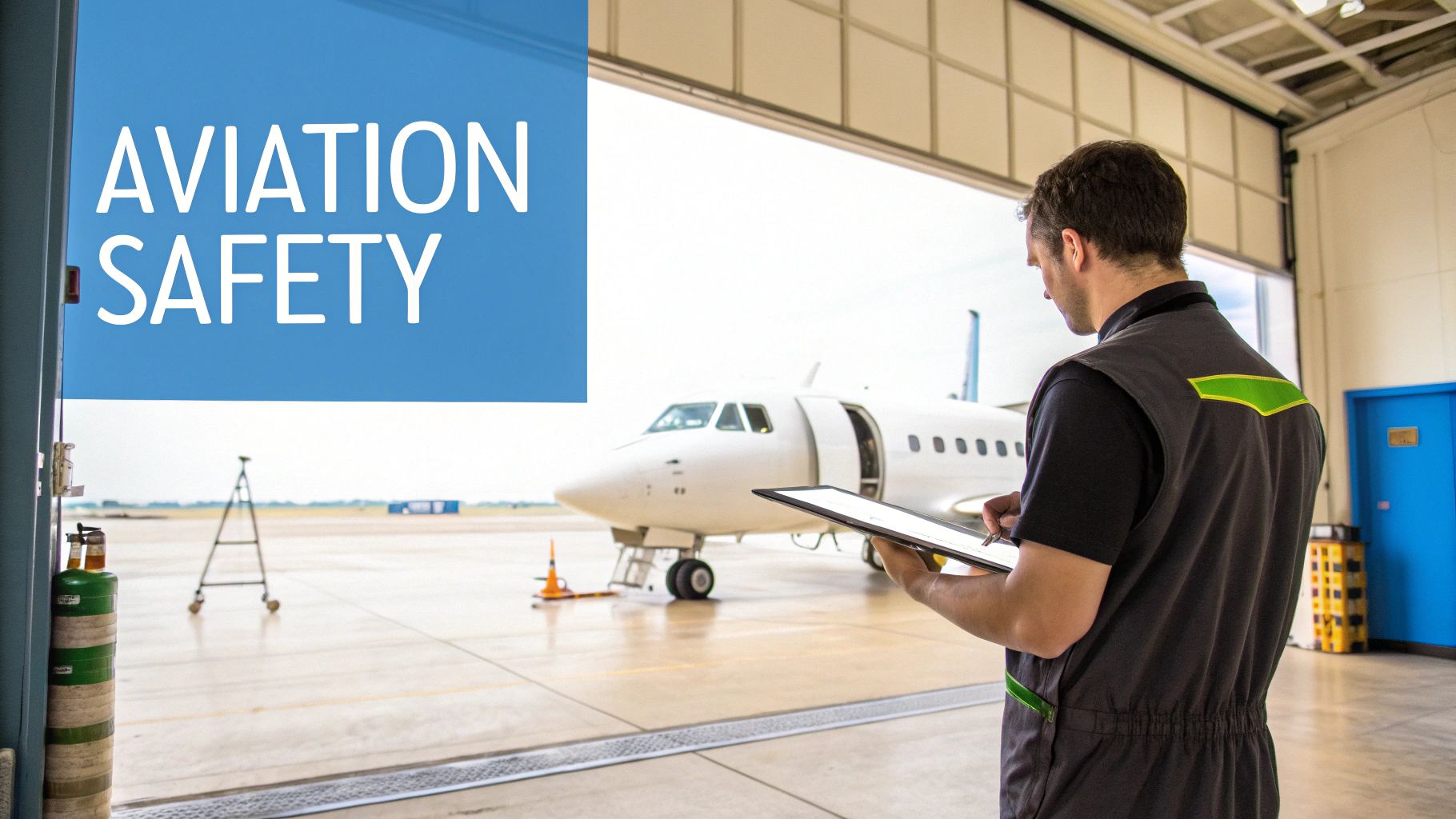
But right now, the aviation sector is facing significant operational headwinds. The global fleet is expanding and aging at the same time, putting an incredible amount of pressure on Maintenance, Repair, and Overhaul (MRO) operations. This mountain of work is made even harder by a critical problem: a growing skills gap, as veteran technicians retire and not enough new experts are there to take their place.
Navigating Modern Aviation Challenges
Traditional training methods—relying heavily on textbooks and limited access to actual equipment—are struggling to keep pace. Today's technicians have to master incredibly complex aircraft systems, from advanced avionics to new composite materials. This new reality demands a much more dynamic and effective way to learn.
The industry is feeling the squeeze from three main directions:
- An Aging Global Fleet: Older planes simply need more work. They require more frequent, intensive inspections and repairs, which puts a real strain on maintenance resources.
- A Widening Skills Gap: When experienced engineers leave, they take decades of priceless knowledge with them. Filling that vacuum with conventional training is proving incredibly difficult.
- Increasingly Complex Systems: Modern aircraft are technological marvels, but that sophistication demands a higher level of technical skill from the crews who maintain them.
When you mix these factors together, you get a perfect storm. The risk of human error goes up, operational costs climb, and aircraft spend more time on the ground instead of in the air. This situation makes it crystal clear that we urgently need a new way to train.
Before we can innovate, it’s important to understand the systems we already have. To get a better handle on the foundational elements of safety, this guide on air safety management systems (SMS) is a great resource.
This is exactly where immersive technologies like Augmented and Virtual Reality (AR/VR) come into play.
These advanced tools are perfectly positioned to tackle the core challenges facing aircraft maintenance and training. By creating realistic, risk-free virtual environments and giving technicians real-time digital guidance, they offer a powerful way forward. If you're curious about how it all works, our guide explaining what is extended reality breaks it down.
Ultimately, these technologies represent the next logical step in building a safer, smarter, and more efficient aviation industry.
Confronting the Headwinds in Modern Aircraft Maintenance
Anyone working in Maintenance, Repair, and Overhaul (MRO) today knows the feeling. It's like navigating a perfect storm. The global aviation fleet is getting bigger to meet travel demand, but it's also getting older, creating a tough two-front battle for maintenance crews. You're being asked to service a growing number of older, more finicky aircraft, but with a shrinking pool of expert technicians.
It’s a classic squeeze play. More complex work, fewer hands to do it. This isn't just a headache on a spreadsheet; it's a reality that hits the hangar floor every single day, creating a massive gap between what the industry needs and what it can actually deliver.
The strain has serious, real-world consequences that ripple through everything from an airline’s bottom line to a passenger’s travel plans.
The High Cost of Grounded Aircraft
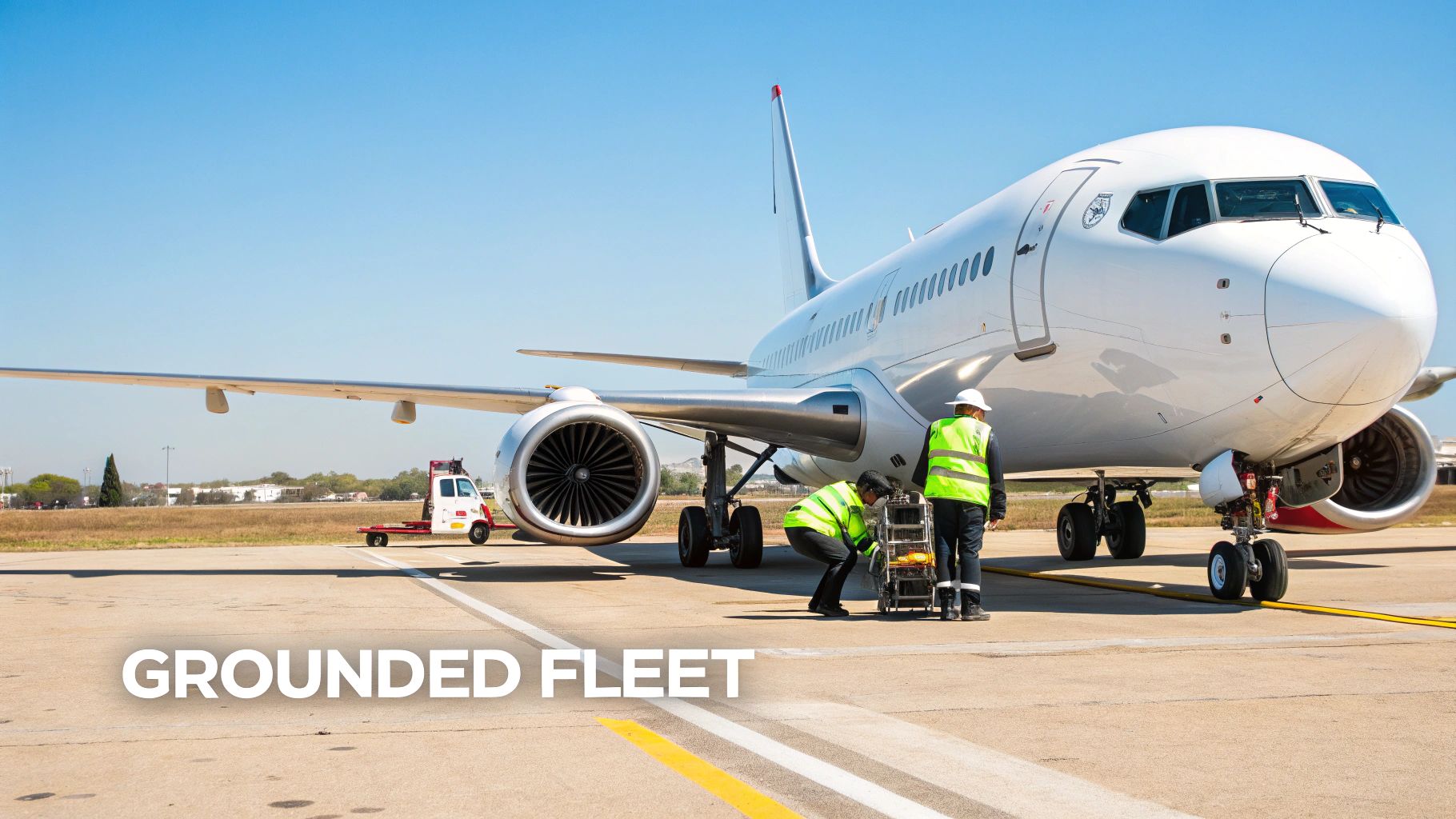
One of the most painful results of this maintenance bottleneck is the dreaded Aircraft-on-Ground (AOG) situation. When a plane is AOG, it’s grounded by a technical issue. Flights get canceled, schedules are thrown into chaos, and the financial bleeding starts immediately. Every hour that plane sits on the tarmac, it’s a non-earning asset, racking up costs for parking, crew, and missed connections.
These delays don't happen in a vacuum. They cascade through the entire network, causing a logistical nightmare of rebooking passengers and reassigning crews. The faster a technician can diagnose and fix the problem, the faster that multi-million dollar asset gets back in the air. This puts a huge premium on efficient aircraft maintenance and training.
An AOG isn't just an operational hiccup; it's a direct financial drain. A single grounded wide-body aircraft can easily cost an airline hundreds of thousands of dollars per day in lost revenue and spillover expenses.
Escalating Operational Costs and Human Error
The technician shortage is pouring fuel on the fire of rising operational costs. With fewer certified pros to go around, MROs are in a bidding war for talent, which drives labor costs through the roof. Worse, an overstretched and less experienced workforce is more likely to make mistakes. Those errors lead to expensive rework and even more delays.
This high-pressure environment is a breeding ground for human error, which can have devastating safety implications. A significant percentage of aviation incidents trace back to maintenance-related human factors. Inadequate training and on-the-job pressure are often key contributors. The industry has to find a way to train people better and faster, simply to maintain safety standards. Our article on the shift toward predictive vs preventive maintenance digs deeper into how maintenance strategies are evolving to tackle these challenges.
The Unsustainable Skills Gap
At the heart of it all is a skills gap that just keeps getting wider. We have a generation of seasoned, veteran technicians heading into retirement, taking decades of irreplaceable hands-on knowledge with them. At the same time, the pipeline of new talent isn't keeping up with the industry’s explosive growth and the sheer complexity of modern aircraft.
This isn’t just a feeling; the numbers back it up.
- Growing Fleet Demand: The world’s commercial fleet is set to grow massively over the next decade, piling even more work onto MROs.
- Aging Aircraft: Older planes don't just need regular checks; they need more frequent, more intensive inspections, which eats up maintenance capacity.
- Technician Shortage: Vacancy rates for certified mechanics are often in the double digits. In some markets, they're reporting rates between 8–15%. That shortfall directly hammers turnaround times and makes the need for better training solutions urgent. For a closer look at the data, this in-depth market assessment lays it all out.
Put it all together, and you have a model that's fundamentally unsustainable. The industry can't just hire its way out of this crisis. It needs a complete rethink of aircraft maintenance and training to close the chasm between the demand for service and the people available to do it.
How Immersive Tech Is Redefining the Hangar
The pressures on aviation maintenance are immense. We’ve got growing fleets, a wave of experienced technicians heading for retirement, and aircraft that get more complex with every new model. Tweaking legacy training playbooks is no longer sufficient.
To bridge this widening skills gap, the industry needs a fundamentally new way to build and maintain expertise. This is where immersive technologies like Virtual Reality (VR) and Augmented Reality (AR) come in, pulling training out of the textbook and into a world of interactive, hands-on experience.
These two technologies are a powerful combination. VR creates completely simulated environments for learning without risk, while AR delivers on-the-job digital support, completely changing how technicians learn and apply their skills in the real world.
Virtual Reality: The Digital Twin Hangar
Imagine a hangar that holds every major aircraft model you service—from a Boeing 737 to an Airbus A380—and it’s open for training 24/7. Now, imagine your new technicians can run through a full engine teardown, practice a tricky landing gear inspection, or troubleshoot an avionics fault, all without ever touching a real plane. That's the power of Virtual Reality.
VR essentially creates a 'digital twin' hangar. It's a completely safe, computer-generated space where trainees can practice procedures over and over again. For building foundational skills and muscle memory, this is a total game-changer. A junior tech can rehearse a complex repair dozens of times, making mistakes and learning from them with zero risk to multi-million-dollar equipment or their own safety.
This approach puts learning on the fast track. Instead of waiting for a specific aircraft to become available in the MRO schedule, trainees can jump into a virtual model anytime. They can master complex tasks before they even step onto the hangar floor, showing up on day one with far more confidence and competence.
Virtual Reality lets you compress months of passive, theory-based learning into weeks of active, hands-on practice. It's the flight simulator equivalent for maintenance technicians—it builds real proficiency through repetition in a controlled environment.
Augmented Reality: The Intelligent Co-Pilot
If VR is the flight simulator, then Augmented Reality is the intelligent co-pilot that joins the technician on the real job. Think of AR as a smart assistant that’s always there, guiding a technician working on an actual aircraft. Using a headset or even a tablet, AR overlays crucial digital information directly onto the technician's view of the physical equipment.
This completely changes how maintenance gets done. Instead of constantly looking away to check a paper manual or a laptop, the technician sees step-by-step instructions, 3D diagrams, or critical data points right in their line of sight. They can see a wiring schematic superimposed over the actual wires or have the correct torque values for bolts appear right next to them as they work.
This screenshot shows exactly what that looks like in practice—digital instructions are layered over the real-world component, providing immediate context and guidance.
This kind of real-time guidance is a lifeline, especially for less experienced technicians. It acts as a digital safety net, making sure procedures are followed correctly and drastically reducing the chances of human error.
Practical Use Cases in Aircraft Maintenance and Training
The application of VR and AR goes way beyond just basic instruction. These tools are being used to tackle specific, high-stakes challenges in MRO operations, and they’re delivering real, measurable improvements in efficiency, accuracy, and safety. The ability to integrate these tools is a core part of what modernizing aircraft maintenance and training looks like today.
Here are just a few real-world examples:
- Complex Assembly/Disassembly: A trainee uses VR to practice taking apart and reassembling an intricate component like an auxiliary power unit (APU). By learning the exact sequence and tool usage in a virtual space first, they reduce the time and potential for error on the real asset later.
- On-the-Job Guidance: A technician wearing AR glasses sees a visual overlay highlighting the exact bolts to remove for a panel inspection. This "see-what-I-see" capability dramatically lowers the mental load and makes routine tasks much faster.
- Remote Expert Collaboration: An AOG (Aircraft on Ground) situation gets resolved in hours, not days. A junior tech on-site streams their point-of-view to a senior expert thousands of miles away. The expert can then use AR to draw annotations and point to specific parts directly in the technician's view, guiding them through the repair in real time.
This kind of immediate, interactive support is exactly what the industry needs to fight the skills shortage. To see how these tools apply across different scenarios, you can find more detail on the benefits of augmented reality for maintenance and its impact on service workflows.
By delivering knowledge exactly when and where it’s needed, immersive technology is slashing error rates and boosting knowledge retention, paving the way for a safer and more efficient future for aviation.
Calculating the Real-World Value of Immersive Solutions
The technology behind immersive solutions is impressive, but for anyone running an MRO or managing an airline's maintenance budget, the conversation always comes back to one thing: tangible business impact. It's essential to move past the "wow" factor and translate these benefits into the hard numbers that drive operational and financial decisions.
The business case for bringing AR and VR into aircraft maintenance and training is built on specific, measurable improvements to the metrics that matter on the hangar floor and in the boardroom.
Quantifying the Gains in Training and Performance
The biggest value of immersive training is its power to accelerate learning and reduce errors. Traditional training often involves weeks in a classroom reviewing manuals before a technician ever touches an actual component. VR completely flips that model on its head.
From day one, trainees can jump into realistic, hands-on simulations. This digital-first approach lets them build critical muscle memory and master complex procedures in a totally risk-free environment. The result? They become proficient faster, with a much higher degree of competence right out of the gate.
The infographic below highlights the core benefits organizations see when they adopt these methods.
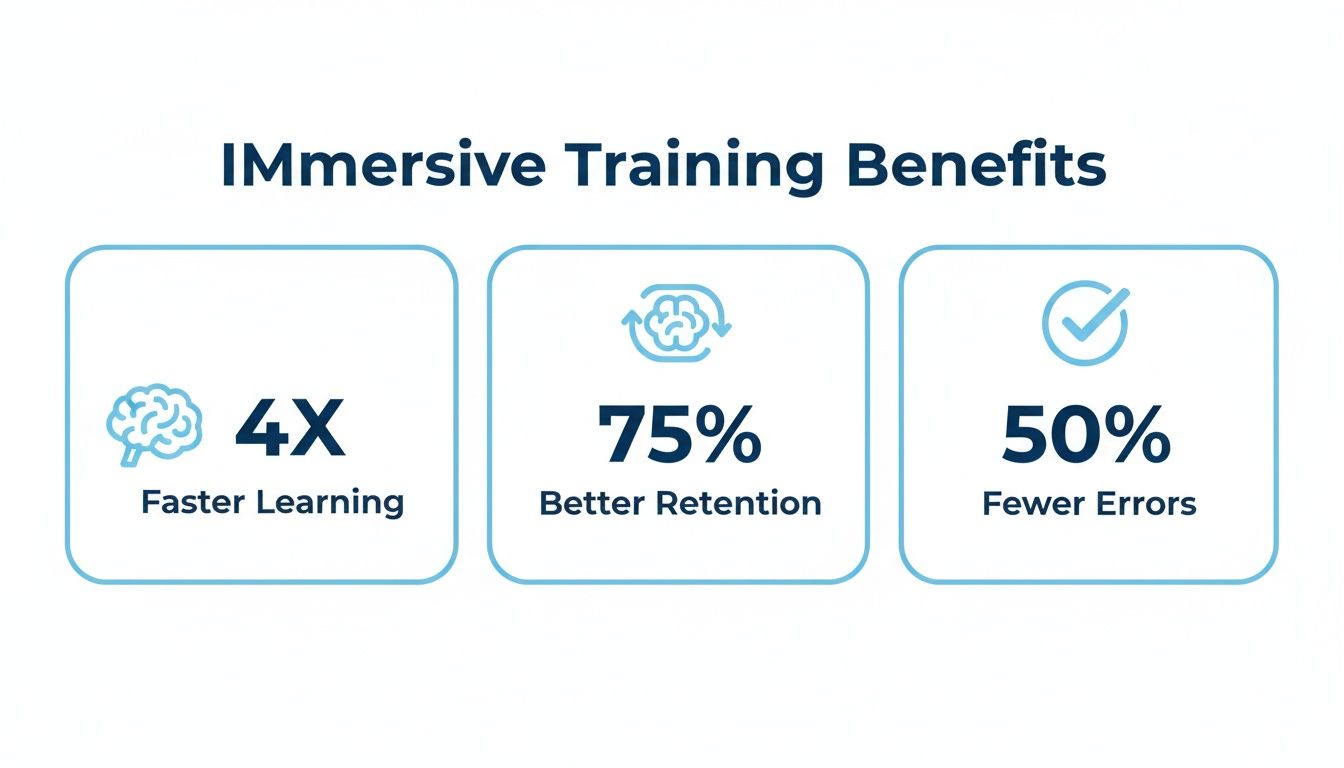
The pattern here is crystal clear. Technicians learn 4x faster, retain that knowledge 75% better, and make 50% fewer errors. These aren't small gains; they directly impact safety, operational costs, and overall efficiency.
Comparing Traditional vs. XR-Enabled Aircraft Maintenance Training
To truly grasp the shift, it helps to see a direct comparison. The table below breaks down how key performance indicators (KPIs) stack up when moving from legacy methods to immersive AR and VR solutions.
| Metric | Traditional Methods | XR-Enabled Solutions (AR/VR) | Potential Improvement |
|---|---|---|---|
| Time to Competency | 6-12 months | 2-3 months | 75% Reduction |
| First-Time Fix Rate | 75-85% | 95%+ | Up to 20% Increase |
| Error Rate | 5-10% | <2% | Over 50% Reduction |
| Training Cost per Tech | High (travel, equipment) | Moderate (one-time hardware) | 30-40% Cost Savings |
| Knowledge Retention | ~20-30% after one week | ~75-90% after one week | ~3x Better Retention |
The numbers speak for themselves. This isn't just an incremental improvement; it's a fundamental change in how we prepare technicians for the complex demands of modern aviation.
Translating KPIs into Financial Returns
So, how do these performance boosts hit the bottom line? They translate directly into serious cost savings and a real competitive edge. When your team learns faster and works smarter, the entire maintenance value chain becomes more efficient.
Here are the direct financial benefits:
- Reduced Training Time: Getting new technicians productive sooner is a huge win. It cuts down the time-to-competency, allowing you to scale your workforce to meet demand without the long ramp-up period.
- Lower Rework Costs: Human error is a factor in a significant percentage of maintenance incidents. AR guidance and VR practice can reduce error rates, meaning less time and money wasted on costly rework. Getting it right the first time is one of the biggest cost-savers in the business.
- Faster Maintenance Turnaround: Better-trained technicians with instant access to digital work instructions simply get the job done faster. This directly reduces aircraft-on-ground (AOG) time—a metric that can cost an airline hundreds of thousands of dollars for every day a single plane is out of service.
For organizations looking to build a concrete business case, you can even project these returns for your specific operations. A specialized training ROI calculator can help model the financial outcomes based on your own metrics.
The Invaluable, Hard-to-Quantify Benefits
Beyond the numbers that fit neatly on a spreadsheet, immersive solutions deliver crucial benefits that are just as important for long-term success. These "soft" benefits contribute to a healthier, safer, and more resilient organization.
Giving your technicians advanced tools shows a real commitment to their careers, which can massively boost job satisfaction and retention. In an industry fighting a severe skills shortage, keeping your best people is a powerful competitive advantage.
Immersive technology enhances more than just skill; it builds confidence. A technician who has practiced a complex repair ten times in VR will approach the real task with far greater assurance, leading to better outcomes under pressure.
Finally, these tools create a fundamentally safer work environment. Practicing hazardous procedures in a virtual world eliminates physical risk entirely. In the real world, AR overlays can highlight safety warnings and critical checkpoints during a live task. This focus on safety protects your people, strengthens regulatory compliance, and reduces the likelihood of costly incidents.
A Practical Guide to Implementing Immersive Training
Moving from the why to the how is where most immersive tech initiatives either take off or fall flat. For Maintenance, Repair, and Overhaul (MRO) providers and airlines, a smart, practical rollout ensures your investment in AR and VR pays dividends instead of becoming another piece of underutilized technology.
This isn't about flipping a switch and hoping for the best. It’s about a phased, strategic plan that proves its worth every step of the way. And that journey almost always starts small.
Starting with a Strategic Pilot Program
The best way to begin is by running a pilot program. Think of it as a test flight. It lets your organization learn the ropes and see what works without the pressure of a massive, facility-wide deployment. The key is to select a high-impact area where this technology can solve a real, nagging problem.
So, where do you point this new tech? Look for tasks that are notoriously complex, performed constantly, or carry a high risk of error. Zero in on the procedures that consistently cause delays or eat up your senior technicians' time with oversight. These are your golden opportunities for a quick, measurable win.
Excellent starting points for a pilot usually fall into one of these buckets:
- Complex Troubleshooting: Imagine letting a junior tech diagnose an avionics or hydraulic system fault in a VR headset. They can practice their logic and learn the system inside and out, all without tying up a real multi-million dollar aircraft.
- Frequent Component Replacements: Common jobs like swapping brake assemblies or an Auxiliary Power Unit (APU) are all about muscle memory and speed. Repetition in a virtual hangar builds both.
- Safety-Critical Procedures: Practicing engine run-ups or landing gear operations in VR removes every ounce of physical risk. Technicians can build confidence by reinforcing the correct protocols in a completely safe space.
By focusing on a single, high-value use case, you create a clear benchmark for success. This lets you gather hard data on reduced training time, fewer errors, and a jump in technician confidence—building a powerful internal case for rolling it out further.
Creating Content That Actually Works
Here's a hard truth: a simulation that looks amazing but doesn't mirror real-world procedures is worthless. The success of any immersive training program lives and dies by the quality and accuracy of its content.
This is why the best content comes from a tight partnership between the people who know the job—your seasoned technicians—and the XR developers building the experience. This collaboration is non-negotiable.
Your veteran engineers are the subject matter experts. They ensure every step, every tool, and every potential hiccup is captured perfectly. The developers then take that deep knowledge and translate it into a training experience that’s intuitive and engaging. It's this fusion that produces a tool that is both technically correct and genuinely useful for trainees.
Integrating with Your Existing Systems
For this technology to truly scale across your aircraft maintenance and training operations, it can't live on an island. Standalone tools create data silos and administrative headaches. You're aiming for a connected ecosystem, not just a cool collection of apps.
A massive piece of this puzzle is making sure your new AR/VR platforms talk to your existing Learning Management System (LMS).
When your LMS is integrated, you can:
- Assign Modules Seamlessly: Push VR training modules to your technicians' learning plans just like any other e-learning course.
- Track Progress and Completion: Automatically log when a tech finishes a simulation and capture their performance metrics right in their training record.
- Certify Competency: Use the data from simulations as concrete evidence for qualifications and official certifications.
This connection turns immersive training from a neat gadget into a core part of your credentialing and compliance workflow. It ensures every training activity is documented, tracked, and aligned with your bigger goals. By planning for integration from day one, you build the foundation for a scalable deployment that genuinely enhances your established processes, rather than disrupting them.
Where Aviation Maintenance Goes From Here
The aviation industry is standing at a crossroads. We're dealing with a perfect storm: a shrinking pool of seasoned experts and aircraft that get more complex with every new model. It’s clear that the old ways of handling aircraft maintenance and training just aren't cutting it anymore. We can't just tweak the existing system; we need a fundamental shift. Immersive tools like AR and VR aren't just a "nice-to-have"—they're a proven path forward, helping organizations move from constantly putting out fires to proactively preventing them.
When we talk about investing in this tech, it’s not just about patching up today's skills gap. It's about building a foundation for a more resilient, efficient, and safer aviation industry for the long haul. We're just scratching the surface of what’s possible, and what's coming next is even more exciting.
The Next Wave of MRO Innovation
The real magic happens when immersive technology starts talking to other advancing fields, creating a completely connected MRO ecosystem. The future isn't just about better training modules; it’s about making the entire operation smarter. We're heading toward a world where Artificial Intelligence (AI) will ping a technician’s AR glasses with a predictive maintenance alert, pointing out a potential component failure long before it ever becomes an issue.
This data-first approach won't be limited to one-off tasks, either. Picture a globally connected network where maintenance data from thousands of aircraft is constantly being fed into a central intelligence system. Every repair, every replacement, and every inspection would be informed by this collective knowledge, lifting the performance and safety standards for the entire industry.
The ultimate goal is to build a maintenance environment where information flows seamlessly from the aircraft to the technician, empowering them with the right knowledge at the exact moment of need. This proactive, data-rich ecosystem is the future of aviation safety.
As we look ahead, it's not just about digital tools. Advanced materials are also a huge piece of the puzzle. For example, new protective solutions like Graphene coatings are revolutionizing aviation by offering incredible durability and protection, which in turn extends the life and reliability of critical aircraft parts.
Your First Step Into the Future
Making the leap to immersive technology is a critical step in future-proofing MRO operations. The results speak for themselves: AR and VR don’t just speed up learning and slash error rates; they deliver a real, measurable return on investment.
The time to sit back and watch is over. The organizations that start exploring these powerful tools today are the ones that will lead the industry tomorrow. They'll be ready for whatever challenges come next, backed by a workforce that’s more skilled, confident, and efficient than ever before.
Common Questions We Hear About Immersive MRO Tech
When MROs and airlines start looking into immersive solutions, a few practical questions always come up. Getting a handle on what it takes to implement, how much it costs, and how it scales is the only way to make a smart decision. Here are the straight answers to the things we get asked most about AR and VR in aircraft maintenance and training.
Is This Really an Option for Anyone Besides the Major Airlines?
Absolutely. While large carriers were early adopters, this technology is incredibly scalable.
A smaller MRO or a regional airline can get started with a tightly focused pilot program. You could zero in on a single aircraft model or maybe one specific, high-frequency repair that’s always causing headaches. The key is to find a real pain point—like a recurring training bottleneck or a common, costly mistake—and point the technology right at it. That’s how you get a clear and fast return on investment.
How Many Tech Gurus Do We Need to Hire?
You don't need to hire a team of software developers to make this happen.
The best solution providers offer a complete service, from helping you pinpoint the best use cases to actually creating the custom training content. They’ll work right alongside your own subject matter experts—your veteran techs who know the job inside and out—to make sure every simulation is spot-on and genuinely useful. Think of it as a partnership, not a DIY project you’re left to figure out on your own.
What’s a Realistic Timeline to Get This Up and Running?
You can get a pilot program off the ground in a matter of months, not years. A typical rollout looks something like this:
- Discovery & Strategy (2-4 weeks): This is where we nail down the main use case and define what success looks like.
- Content Creation (6-12 weeks): The team gets to work building out the first VR training modules or AR-guided work instructions.
- Deployment & Training (2-3 weeks): Time to get the first group of technicians in headsets and start collecting their feedback.
This step-by-step approach gets you value quickly and lets you make improvements as you go.
The most successful rollouts always start by solving one critical problem, and solving it exceptionally well, before trying to expand. This proves the concept, gets people excited internally, and makes sure the technology fits into your existing workflows instead of disrupting them.
At the end of the day, it all starts with one strategic step. By tackling a specific, known challenge, an organization of any size can start building a more capable and efficient workforce with immersive tech.
Ready to see how immersive technology can transform your maintenance operations? AIDAR Solutions provides AR and VR platforms that accelerate learning and streamline service. Explore our solutions today.