12 Transformative Uses for VR That Are Reshaping Industries in 2025
Virtual reality has moved beyond the realm of consumer entertainment and is now a critical tool for generating tangible business ROI. From accelerating workforce upskilling to identifying critical design flaws before physical production begins, the practical uses for VR are fundamentally reshaping how industries operate. This technology provides a powerful platform for creating risk-free, immersive, and highly effective environments for training, collaboration, and operational planning.
This article moves past theoretical discussions to provide a comprehensive breakdown of 12 impactful VR applications that are delivering measurable results today. We will explore how leading organizations are leveraging virtual reality to boost operational efficiency, drastically improve safety outcomes, and unlock unprecedented levels of productivity. Each use case is examined not just for what it is, but for the strategic value it creates.
Readers will gain a clear understanding of the 'why' behind each application, supported by actionable insights and replicable methods for implementation. We will dissect how these immersive solutions work in real-world scenarios, from manufacturing and field service to corporate training and safety protocols. You'll learn how to apply these concepts within your own organization, including how our platforms can streamline adoption and maximize impact. The focus is on practical, data-driven examples that demonstrate how VR has become a present-day competitive advantage, not just a concept for the future. Let’s explore the specific ways this technology is driving real-world business value.
1. Employee Training and Corporate Learning
Virtual reality is revolutionizing corporate learning by creating simulated environments where employees can practice complex tasks and critical procedures without real-world risk. Unlike traditional methods, VR training provides an active, hands-on experience that significantly boosts knowledge retention and skill acquisition. This is one of the most impactful uses for VR because it directly addresses safety, efficiency, and scalability challenges.
Enterprises are successfully deploying VR training on a massive scale to prepare employees for everything from complex equipment operation to routine safety procedures. These programs standardize training, reduce on-the-job errors, and cut down on the costs associated with physical training setups and travel, delivering a clear return on investment.
Strategic Implementation
- Start with High-Impact Scenarios: Focus initial VR training modules on high-risk, high-cost, or frequently repeated tasks. This ensures a clear and measurable return on investment.
- Measure Performance Metrics: Track key indicators like completion times, error rates, and procedural accuracy within the VR environment to gauge employee progress and program effectiveness.
- Integrate and Scale: Begin with a pilot program and use the data to refine the modules before scaling across the organization.
By immersing employees in realistic scenarios, VR builds muscle memory and confidence that translates directly to improved job performance. To discover how custom VR training modules can enhance your workforce's capabilities, explore our VR training programs.
2. Real Estate and Property Visualization
Virtual reality is transforming the real estate industry by allowing potential buyers, renters, and investors to experience properties remotely. Through immersive 3D tours, users can walk through homes, offices, and commercial spaces from anywhere in the world, providing a true sense of scale, layout, and ambiance that photos or videos cannot capture. This is one of the most practical uses for VR as it saves time, reduces travel costs, and expands the potential market for any given property.
Virtual tours have become a standard, enabling agents to offer 24/7 open houses. Firms use VR to market high-end properties and unbuilt developments to an international clientele. This technology empowers buyers to make more informed decisions faster by visualizing furniture placement, assessing natural light, and getting an authentic feel for the space before committing to an in-person visit.
Strategic Implementation
- Capture High-Fidelity Scans: Use high-resolution 360-degree cameras to create detailed and photorealistic virtual models. The quality of the capture directly impacts the immersiveness and effectiveness of the tour.
- Include Environmental Context: Go beyond the property’s interior by capturing outdoor spaces, views, and even the immediate neighborhood to provide a complete picture of the location.
- Highlight Key Features: Use interactive tags or guided tour paths within the VR experience to draw attention to unique architectural details, premium finishes, or recent upgrades.
By offering a compelling and realistic virtual experience, real estate professionals can pre-qualify leads, accelerate sales cycles, and differentiate their listings in a crowded market.
3. Employee Training and Corporate Learning
Virtual reality is revolutionizing corporate learning by creating simulated environments where employees can practice complex tasks and critical procedures without real-world risk. Unlike traditional methods, VR training provides an active, hands-on experience that significantly boosts knowledge retention and skill acquisition. This is one of the most impactful uses for VR because it directly addresses safety, efficiency, and scalability challenges.
Enterprises are successfully deploying VR training on a massive scale to prepare employees for everything from complex equipment operation to routine safety procedures. These programs standardize training, reduce on-the-job errors, and cut down on the costs associated with physical training setups and travel, delivering a clear return on investment.
Strategic Implementation
- Start with High-Impact Scenarios: Focus initial VR training modules on high-risk, high-cost, or frequently repeated tasks. This ensures a clear and measurable return on investment.
- Measure Performance Metrics: Track key indicators like completion times, error rates, and procedural accuracy within the VR environment to gauge employee progress and program effectiveness.
- Integrate and Scale: Begin with a pilot program and use the data to refine the modules before scaling across the organization.
By immersing employees in realistic scenarios, VR builds muscle memory and confidence that translates directly to improved job performance. To discover how custom VR training modules can enhance your workforce's capabilities, explore our VR training programs.
4. Gaming and Entertainment
While commercial applications are expanding rapidly, gaming and entertainment remain the most widely recognized and mature uses for VR. This sector has driven hardware innovation and consumer adoption by offering deeply immersive experiences where players can physically interact with digital worlds. Unlike traditional screen-based gaming, VR places the user directly inside the action, delivering a level of presence and engagement that is simply unmatched.
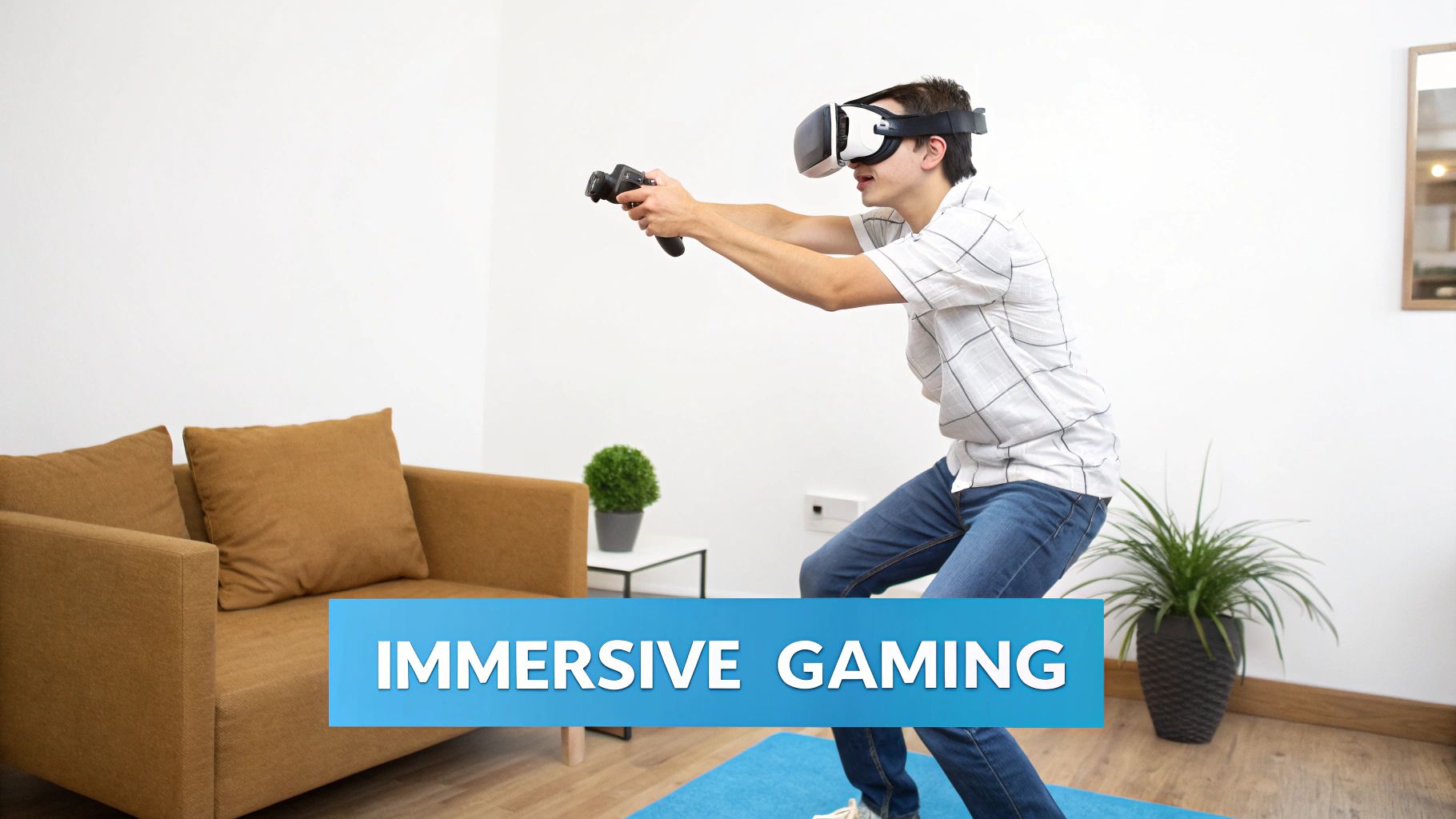
Pioneering platforms have introduced iconic titles that showcase the technology’s power. Popular games demonstrate how physical movement and intuitive controls can create compelling gameplay, while social platforms build entire communities in virtual spaces. These successes prove VR's ability to create powerful, memorable user experiences, a principle that directly translates to more engaging and effective enterprise applications like training simulations.
Strategic Implementation
- Prioritize Comfort: If new to VR, start with stationary or "sit-down" experiences to acclimate to the virtual environment and minimize the risk of motion sickness.
- Ensure a Safe Environment: Designate a clear physical play space, ideally at least 6×6 feet, to prevent accidental collisions with real-world objects during active gameplay.
- Invest in Quality Hardware: High-quality motion controllers and a comfortable headset are crucial for a seamless and immersive experience, as they directly impact user interaction and comfort.
The principles that make VR gaming so compelling, such as active participation and realistic interaction, are the same ones that drive knowledge retention in corporate training. To see how gaming-inspired mechanics can be applied to industrial learning, learn more about AIDAR.SKILLS.
5. Mental Health Therapy and Exposure Therapy
Virtual reality is transforming mental healthcare by creating immersive, controlled environments for therapeutic intervention. Therapists use VR to conduct exposure therapy for anxiety disorders, phobias, and PTSD, allowing patients to confront triggers in a safe and manageable way. This method stands out as one of the most powerful uses for VR because it offers a bridge between clinical safety and real-world exposure, accelerating patient progress.
Pioneering work by institutions demonstrates VR's clinical effectiveness. Patients with certain conditions can revisit and process traumatic events in a therapist-guided virtual space, while individuals with social anxiety can practice public speaking in a simulated auditorium. These applications provide replicable, customizable scenarios that are often impractical or impossible to recreate in traditional therapy, boosting treatment efficacy and patient engagement.
Strategic Implementation
- Professional Guidance is Essential: VR therapy must always be administered by a qualified mental health professional who can guide the patient and manage the intensity of the experience.
- Gradual Exposure Protocol: Begin with low-intensity scenarios and incrementally increase the challenge as the patient builds resilience and coping skills. This prevents overwhelm and reinforces progress.
- Integrate with Traditional Methods: Use VR sessions as a powerful supplement to conventional talk therapy, cognitive behavioral therapy (CBT), and other established treatment plans for a holistic approach.
By offering a safe space to practice coping mechanisms, VR therapy empowers patients to build confidence and transfer their skills to the real world. At the core of VR's impact on medical training is advanced 3D medical visualization, enabling detailed anatomical exploration and surgical rehearsal.
6. Manufacturing and Industrial Design
Virtual reality is transforming manufacturing and industrial design by enabling engineers and designers to create, test, and refine products in a fully immersive digital space. This approach allows for full-scale prototyping and workflow simulation without the costs and time constraints of physical mockups. As one of the most cost-effective uses for VR, it minimizes expensive errors, accelerates design cycles, and enhances cross-functional collaboration.
Leading automotive and aerospace companies use VR to conduct design reviews and optimize complex assembly lines. Engineers can walk around and interact with a virtual car or aircraft, identifying potential ergonomic issues or manufacturing bottlenecks long before a physical prototype is built. This digital-first approach ensures that designs are both innovative and manufacturable from the very beginning.
Strategic Implementation
- Start with Design Reviews: Begin by using VR for collaborative design reviews, allowing teams to visualize and interact with CAD models at a 1:1 scale to catch flaws early.
- Simulate Production Lines: Progress to simulating entire manufacturing processes to optimize workflow, train assembly line workers, and validate ergonomic safety before physical setup.
- Integrate CAD Software: Utilize VR platforms that integrate directly with existing CAD software to create a seamless workflow from design to virtual validation.
By bridging the gap between digital design and physical production, VR helps industrial teams build better products faster. To see how VR can streamline your product lifecycle, discover our industrial virtual reality solutions.
7. Travel and Tourism Experiences
Virtual reality is transforming the travel industry by offering immersive "try before you buy" experiences. It allows potential travelers to explore destinations, tour hotels, and preview excursions from their homes, creating a powerful marketing tool that drives engagement and bookings. This is one of the most compelling uses for VR because it overcomes geographical barriers and provides a rich, emotional connection to a place before a trip is ever planned.
Major brands are leveraging this technology to great effect. By creating virtual destination experiences, businesses can transport users to exotic locations and showcase their properties in an unforgettable way. Similarly, VR applications allow users to journey to remote corners of the globe, from mountain peaks to the depths of the ocean, fostering a new level of appreciation and wanderlust.
Strategic Implementation
- Focus on High-Fidelity Content: Use high-resolution, stereoscopic 360-degree video and photorealistic 3D models to create a truly believable and immersive preview.
- Integrate Interactive Elements: Allow users to interact with the environment, access historical information, or view different room types to enrich the experience and provide valuable information.
- Link to Booking Platforms: Seamlessly guide users from the virtual tour to a booking page, converting interest directly into reservations and measuring ROI.
By providing a tangible, captivating glimpse of a destination, VR helps build desire and confidence in the booking decision, ultimately boosting conversion rates. To see how immersive experiences can showcase your offerings, learn more about our visualization solutions.
8. Education and Academic Learning
Virtual reality is transforming education from a passive to an active experience, allowing students to step inside their subjects. Instead of just reading about ancient history or complex biological processes, learners can walk through historical sites or manipulate molecular structures in an immersive 3D space. These engaging experiences deepen understanding and improve knowledge retention, making this one of the most powerful uses for VR in shaping future generations.
Institutions from K-12 schools to universities are integrating VR to make learning more tangible. Immersive platforms enable virtual field trips to inaccessible locations, while specialized tools provide interactive 3D models for science and engineering classes. These applications turn abstract concepts into concrete, memorable encounters, allowing students to conduct complex experiments or explore human anatomy in a safe, repeatable, and cost-effective virtual environment.
Strategic Implementation
- Integrate with Curriculum: Align VR experiences directly with existing lesson plans and learning objectives to supplement, not replace, traditional teaching methods.
- Prioritize Teacher Training: Equip educators with comprehensive professional development to ensure they can effectively guide students and maximize the technology's pedagogical value.
- Measure Learning Outcomes: Use pre- and post-VR assessments to rigorously track student comprehension, engagement, and skill acquisition, providing clear data on the program's impact.
By immersing students in interactive educational worlds, VR fosters curiosity and a deeper connection to the subject matter. To see how immersive learning platforms can revolutionize your institution's approach, discover our educational VR solutions.
9. Fitness and Sports Training
Virtual reality is transforming personal fitness and professional sports training by creating immersive, motivating, and data-rich exercise environments. VR fitness apps turn workouts into engaging games, while advanced sports simulators allow athletes to hone their skills in a controlled, repeatable setting. This is one of the more accessible uses for VR as it effectively gamifies physical activity, which increases user consistency and provides detailed performance feedback.
Popular applications offer guided, full-body workouts ranging from boxing to dance, making exercise at home more dynamic and enjoyable. In professional sports, teams use VR simulators to analyze an athlete's form, improve reaction times, and practice strategic plays without the physical strain of a real game. These tools provide a safe space to drill fundamentals and build muscle memory for high-pressure situations.
Strategic Implementation
- Define Clear Fitness or Skill Goals: Start by identifying specific objectives, whether it's improving cardiovascular health, mastering a tennis serve, or enhancing reaction time. This helps in selecting the right VR application.
- Prioritize Safety and Space: Ensure a clear, safe workout area free of obstacles. Always use controller wrist straps to prevent accidents during high-intensity movements.
- Track Progress and Adjust: Use the in-app analytics to monitor performance metrics like calories burned, swing accuracy, or punch speed. Use this data to adjust routines and maintain motivation.
By blending physical exertion with digital engagement, VR makes training more effective and enjoyable for both consumers and professional athletes. To see how immersive technology can be adapted for skill-based industrial training, discover AIDAR.SKILLS.
10. Architecture and Construction Planning
Virtual reality is transforming the architecture, engineering, and construction (AEC) industry by allowing stakeholders to experience buildings and infrastructure projects before they are built. By converting BIM (Building Information Modeling) data into immersive virtual environments, teams can conduct full-scale design reviews, identify system clashes, and simulate construction phasing. This is one of the most cost-effective uses for VR because it moves expensive error detection from the physical construction site into a low-cost digital space.
Major architectural firms and construction companies now integrate VR for client walkthroughs and pre-construction planning. Clients can explore a proposed design, request changes to materials or layouts, and gain a true sense of scale and space that 2D drawings cannot convey. Similarly, construction teams use VR to visualize complex assembly sequences and identify potential safety hazards or logistical bottlenecks before a single shovel hits the ground, preventing costly rework and delays.
Strategic Implementation
- Integrate with BIM Workflows: Ensure your VR platform seamlessly integrates with existing BIM software to create accurate, data-rich virtual models.
- Conduct Collaborative Design Reviews: Host regular VR sessions where architects, engineers, clients, and contractors can meet inside the virtual model to review progress and resolve conflicts in real-time.
- Simulate Site Logistics and Safety: Use the virtual environment to plan site layout, material staging areas, and crane placements, while also training workers on site-specific safety protocols.
By enabling stakeholders to walk through a project at a 1:1 scale, VR closes the gap between design intent and physical reality, leading to better-designed buildings, safer construction sites, and more satisfied clients. To learn how immersive environments can streamline your design and build processes, see our custom VR solutions.
11. Hazardous Environment Training and Safety
Virtual reality offers a game-changing solution for training in high-risk professions by simulating dangerous scenarios without exposing employees to physical harm. In fields like mining, firefighting, or chemical handling, VR provides a safe yet realistic space to practice emergency response, hazard identification, and safety protocols. This is one of the most critical uses for VR as it directly prevents injuries and saves lives by building muscle memory for crisis situations.
Industrial giants in oil and gas, as well as fire departments, use VR to simulate equipment malfunctions, chemical spills, and fire emergencies. Trainees can experience the stress and complexity of these events, learning to make critical decisions under pressure in a controlled setting. These simulations allow for repetition and immediate feedback, which is impossible to achieve safely with traditional, hands-on training methods, ultimately reducing workplace accidents and improving overall safety culture.
Strategic Implementation
- Base Scenarios on Real Data: Develop training modules using historical incident reports and real-world accident data to ensure the simulations are relevant and address the most common risks.
- Integrate and Debrief: Combine VR sessions with traditional safety training and conduct thorough debriefs after each simulation to analyze decisions and reinforce correct procedures.
- Track Competency: Document completion rates and performance within the VR environment to ensure and certify employee competency in critical safety protocols.
By immersing personnel in high-stakes situations, VR builds procedural confidence and sharpens crisis-response skills that are directly transferable to the field. For creating and distributing such interactive safety modules, platforms like the Lumi H5P Cloud platform offer tools to author and share educational experiences across an organization.
12. Remote Collaboration and Virtual Workspaces
Virtual reality is transforming remote work by creating immersive digital offices where distributed teams can interact with a true sense of presence. Unlike standard video calls, VR workspaces allow for natural communication, non-verbal cues, and spatial interaction that foster deeper engagement and creativity. This is one of the most forward-thinking uses for VR as it directly addresses the isolation and "Zoom fatigue" common in modern remote work.
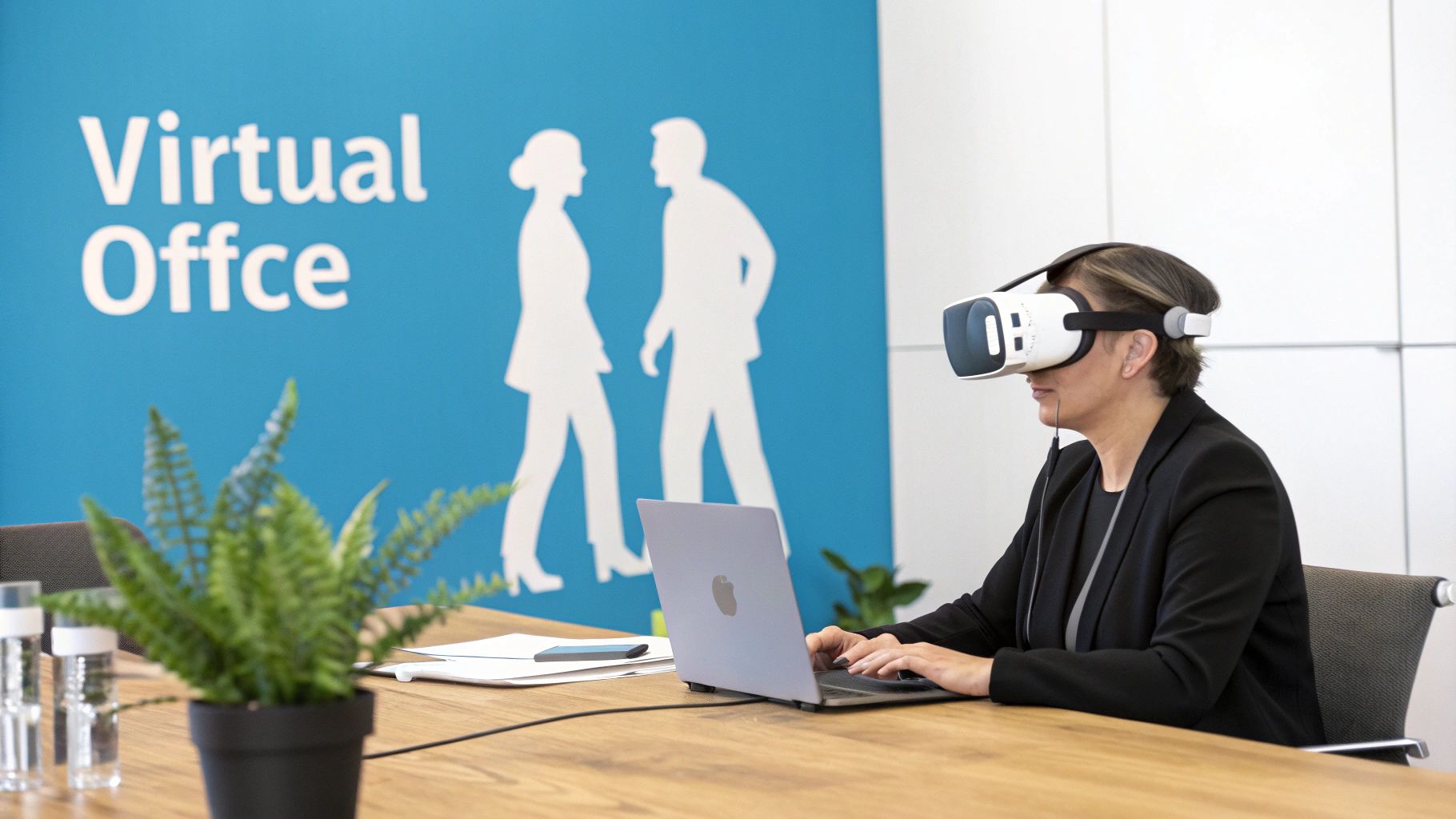
VR platforms are pioneering these environments, enabling teams to brainstorm on virtual whiteboards, review 3D models, and conduct meetings as if they were in the same room. These tools bridge geographical gaps, making global collaboration more seamless and effective. By replicating the dynamics of a physical office, VR helps build stronger team cohesion and facilitates more spontaneous, innovative discussions that are often lost in traditional remote setups.
Strategic Implementation
- Establish Virtual Etiquette: Create clear guidelines for avatar behavior, meeting protocols, and communication to ensure a professional and productive environment.
- Focus on Collaborative Tasks: Use VR for activities that benefit most from spatial interaction, such as design reviews, strategic planning sessions, and complex problem-solving.
- Integrate Hybrid Approaches: Combine VR meetings with traditional video conferencing to accommodate all team members and ease the transition into immersive technologies.
VR collaboration tools are powerful for connecting teams, but they also share principles with other remote assistance technologies. To understand how real-time visual guidance enhances teamwork, explore our insights on remote visual inspections.
12 VR Use Cases Comparison
| Use case | Implementation complexity 🔄 | Resource requirements ⚡ | Expected outcomes ⭐ / 📊 | Ideal use cases 💡 | Key advantages ⭐ |
|---|---|---|---|---|---|
| Medical Training and Surgery Simulation | High 🔄 — advanced haptics & realistic models | Very high ⚡ — specialized hardware, software, maintenance | Significant skill gains; reduced surgical errors 📊⭐ | Residency training, minimally invasive surgery practice 💡 | Risk‑free repetition; standardizes surgical training ⭐ |
| Real Estate and Property Visualization | Medium 🔄 — 3D capture and staging workflows | Medium ⚡ — 360/3D cameras, modeling, hosting | Faster decisions; higher listing engagement 📊⭐ | Remote showings, pre‑construction sales, rentals 💡 | Cuts travel/showings; boosts conversions ⭐ |
| Employee Training and Corporate Learning | Medium‑High 🔄 — scenario dev and scaling | High ⚡ — headsets for workforce, platform licensing | Shorter training times; higher retention 📊⭐ | Safety, equipment operation, compliance training 💡 | Scalable, consistent training across locations ⭐ |
| Gaming and Entertainment | Medium 🔄 — content creation with mature SDKs | Medium‑High ⚡ — consumer headsets, clearance space | Highest engagement and retention; social impact 📊⭐ | Immersive games, social VR, interactive experiences 💡 | Unmatched immersion and memorable experiences ⭐ |
| Mental Health & Exposure Therapy | Medium 🔄 — clinical protocols & customization | Medium ⚡ — therapist supervision, optional biometrics | Effective for phobias/PTSD; reduced treatment length 📊⭐ | Controlled exposure therapy, PTSD treatment settings 💡 | Repeatable, therapist‑controlled exposures in safety ⭐ |
| Manufacturing and Industrial Design | High 🔄 — CAD/BIM integration, simulation fidelity | High ⚡ — compute, CAD licenses, trained staff | Fewer prototypes; faster development cycles 📊⭐ | Full‑scale prototyping, assembly and ergonomic testing 💡 | Detects flaws early; reduces waste and cost ⭐ |
| Travel and Tourism Experiences | Low‑Medium 🔄 — 360 capture + narrative | Medium ⚡ — high‑res capture, streaming bandwidth | Increased bookings; accessibility and planning aid 📊⭐ | Destination previews, virtual tours for accessibility 💡 | Showcases attractions; aids trip planning and access ⭐ |
| Education and Academic Learning | Medium 🔄 — curriculum integration, assessment | High ⚡ — school hardware, teacher training, content | Improved comprehension & retention; engagement 📊⭐ | STEM labs, anatomy, historical recreations, field trips 💡 | Makes abstract concepts tangible; safe experimentation ⭐ |
| Fitness and Sports Training | Medium 🔄 — motion tracking & coaching logic | Medium ⚡ — headsets, sensors, safe play area | Higher adherence; improved technique and performance 📊⭐ | Home cardio, athlete drills, form analysis sessions 💡 | Gamified motivation and real‑time coaching feedback ⭐ |
| Architecture and Construction Planning | High 🔄 — BIM + large model rendering | High ⚡ — detailed BIM modeling, rendering compute | Fewer construction changes; faster approvals 📊⭐ | Design reviews, client walkthroughs, sequencing checks 💡 | Identifies conflicts early; improves stakeholder buy‑in ⭐ |
| Hazardous Environment Training & Safety | High 🔄 — realistic emergency scenario modeling | High ⚡ — development costs, scenario validation | Reduced incidents; better emergency response readiness 📊⭐ | Firefighting, mining, chemical handling, rescue drills 💡 | Safe practice of dangerous scenarios; consistent training ⭐ |
| Remote Collaboration & Virtual Workspaces | Medium 🔄 — avatars, spatial audio, tools | Medium ⚡ — headsets for team, bandwidth, integration | Improved engagement vs. video; stronger cohesion 📊⭐ | Distributed meetings, creative workshops, persistent offices 💡 | Better non‑verbal cues and immersive collaboration ⭐ |
Integrating VR: Your Next Steps Toward an Immersive Future
As we've explored, the landscape of practical, high-impact uses for VR has expanded far beyond its initial entertainment-focused applications. From simulating complex surgical procedures to designing next-generation manufacturing workflows and conducting high-stakes safety drills in risk-free environments, virtual reality is no longer a futuristic concept. It has become a powerful, accessible tool for driving tangible business outcomes.
The examples detailed throughout this article, from hazardous environment training to remote collaboration in virtual workspaces, all point to a unified theme: VR creates a bridge between theoretical knowledge and practical application. It dismantles the limitations of physical space, time, and resources, enabling organizations to build expertise faster, reduce errors, and foster innovation at an unprecedented scale.
From Possibility to Practicality: Core Takeaways
Reflecting on the diverse applications, several key strategic insights emerge for any organization considering VR integration. These principles are the foundation for a successful and scalable immersive technology program.
- Focus on High-Stakes, High-Repetition Tasks: The greatest initial ROI often comes from applying VR to train for scenarios that are either too dangerous, expensive, or complex to replicate in the real world. Think safety protocols, intricate assembly procedures, or critical equipment maintenance.
- Prioritize Skill Retention Over Information Delivery: Traditional training often struggles with the "forgetting curve." The true power of VR lies in its ability to build muscle memory and procedural fluency through active, hands-on participation, dramatically improving long-term knowledge retention.
- Data is the Bedrock of Improvement: A key advantage of VR training is the ability to capture detailed performance analytics. Track completion times, identify common error points, and monitor user gaze to understand precisely where individuals are struggling. This data provides invaluable, objective feedback for targeted coaching and process refinement.
- Integration, Not Isolation: The most effective VR solutions do not exist in a vacuum. They should integrate with your existing Learning Management Systems (LMS), digital work instructions, and enterprise resource planning (ERP) software. This ensures that immersive training is a cohesive part of your broader operational and developmental ecosystem.
Your Actionable Roadmap for VR Adoption
Moving from understanding the uses for VR to implementing a solution requires a clear, strategic approach. Waiting for the technology to "mature" is no longer a viable strategy; the competitive advantages are being seized now. Your organization can begin its journey by following a proven, phased implementation plan.
- Identify a Critical Business Challenge: Start small and focused. Pinpoint a specific, high-value problem within your organization. Is it reducing downtime for a key piece of machinery? Decreasing new hire ramp-up time? Improving safety compliance rates in a specific department?
- Define Measurable Success Metrics: Before you begin, establish clear Key Performance Indicators (KPIs). What does success look like? This could be a 20% reduction in on-site service calls, a 30% faster time-to-certification for new technicians, or a 50% decrease in safety incidents.
- Launch a Pilot Program: Select a small, motivated group to participate in a pilot. Develop a targeted training module for the business challenge you identified. This controlled test allows you to gather data, collect user feedback, and demonstrate value to key stakeholders without a massive upfront investment.
- Analyze, Iterate, and Scale: Review the data from your pilot against your predefined KPIs. Use the insights to refine the training modules and implementation process. Once you have a proven model and a clear ROI, you can develop a strategic plan to scale the solution across other departments or facilities, transforming a successful pilot into a true enterprise-wide advantage.
By strategically aligning immersive tools with core business objectives, you are not just adopting new technology. You are fundamentally building a more agile, knowledgeable, and resilient workforce prepared to meet the challenges of tomorrow.
Ready to move from theory to reality and explore how the powerful uses for VR can directly impact your bottom line? The team at AIDAR Solutions specializes in creating scalable, enterprise-grade VR and AR platforms that solve critical business challenges. Visit AIDAR Solutions to schedule a personalized demo and discover how we can help you build your immersive future today.