Predictive vs Preventive Maintenance: A Guide
At the heart of the predictive vs preventive maintenance debate is a fundamental question: should maintenance be driven by a predetermined schedule or by real-time equipment data? Preventive maintenance adheres to a fixed calendar, while predictive maintenance responds to an asset's actual condition. The choice depends on whether an organization prioritizes structured, routine service or data-driven interventions designed for maximum operational efficiency.
Choosing Your Modern Maintenance Strategy
For any industrial operator, the decision between scheduled upkeep and a dynamic, data-driven approach is a significant one. Understanding the philosophy behind each is the first step. One method operates like clockwork, following a calendar- or usage-based schedule. The other functions more like a continuous health assessment, listening to the actual condition of machinery before prompting action.
The optimal strategy often depends on an asset's criticality, its known failure patterns, and budgetary constraints. While each approach offers distinct benefits, many organizations find that a hybrid model—blending the strengths of both—delivers the most significant return on investment.
Core Distinctions and Performance Impact
Preventive maintenance has been a cornerstone of industrial operations for decades; it’s a straightforward approach based on time or usage. In contrast, predictive maintenance is a more recent innovation, enabled by digital sensors, the Internet of Things (IoT), and sophisticated data analytics. This technological shift allows teams to extend asset life, optimize maintenance schedules, and significantly reduce unplanned outages.
This chart highlights the performance differences between the two strategies across key operational metrics.
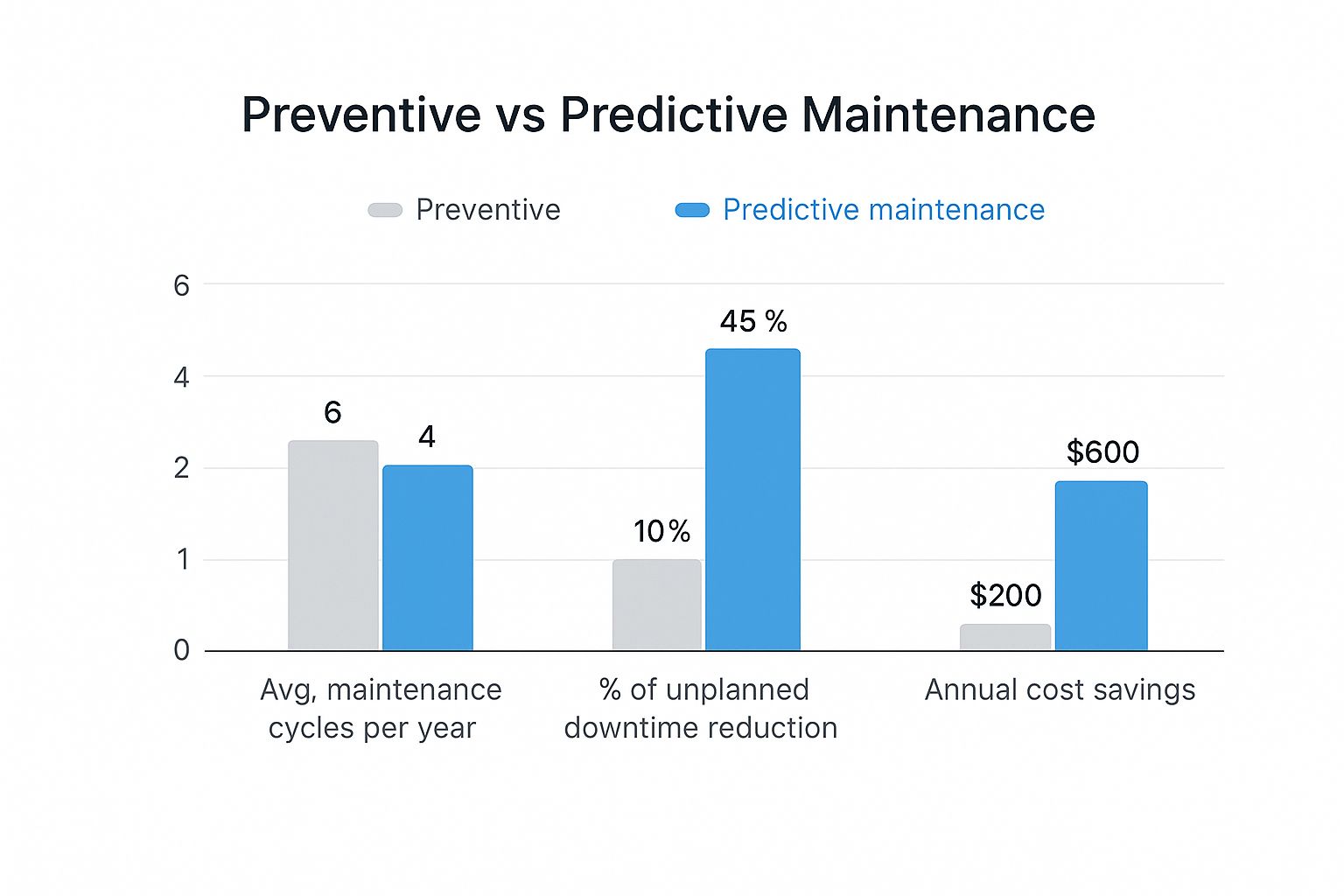
The data indicates that a predictive approach can lead to fewer maintenance cycles, a substantial reduction in unplanned downtime, and higher annual cost savings. This sets the stage for a deeper examination of how these outcomes are achieved.
The goal is to move beyond a one-size-fits-all mindset. Architecting an effective program means applying the right strategy to the right asset at the right time.
To clarify the concepts, this table provides a direct, side-by-side comparison of the core philosophies driving each maintenance type.
Predictive vs Preventive Maintenance: Key Differences at a Glance
This quick-reference table breaks down the fundamental differences between the two strategies, showing how they diverge on everything from triggers to cost.
| Criterion | Preventive Maintenance | Predictive Maintenance |
|---|---|---|
| Trigger | Time-based (e.g., monthly) or usage-based (e.g., every 1,000 hours) | Condition-based (e.g., vibration anomaly detected) |
| Data Reliance | Manufacturer recommendations and historical averages | Real-time sensor data (IoT), analytics, and AI models |
| Objective | Reduce failure probability through routine servicing | Prevent failures by forecasting them based on current health |
| Cost Structure | Fixed, predictable costs for scheduled maintenance | Higher initial investment, lower long-term operational costs |
As the table illustrates, the divergence is clear. Preventive maintenance is about predictable routines, whereas predictive maintenance is about proactive, intelligent intervention.
Comparing Foundational Maintenance Philosophies
To understand the core of the predictive vs preventive maintenance debate, it is essential to examine their operational DNA. These are not merely different tactics; they represent distinct philosophies regarding machinery health. One is based on adhering to a schedule, while the other focuses on interpreting data from the equipment itself.
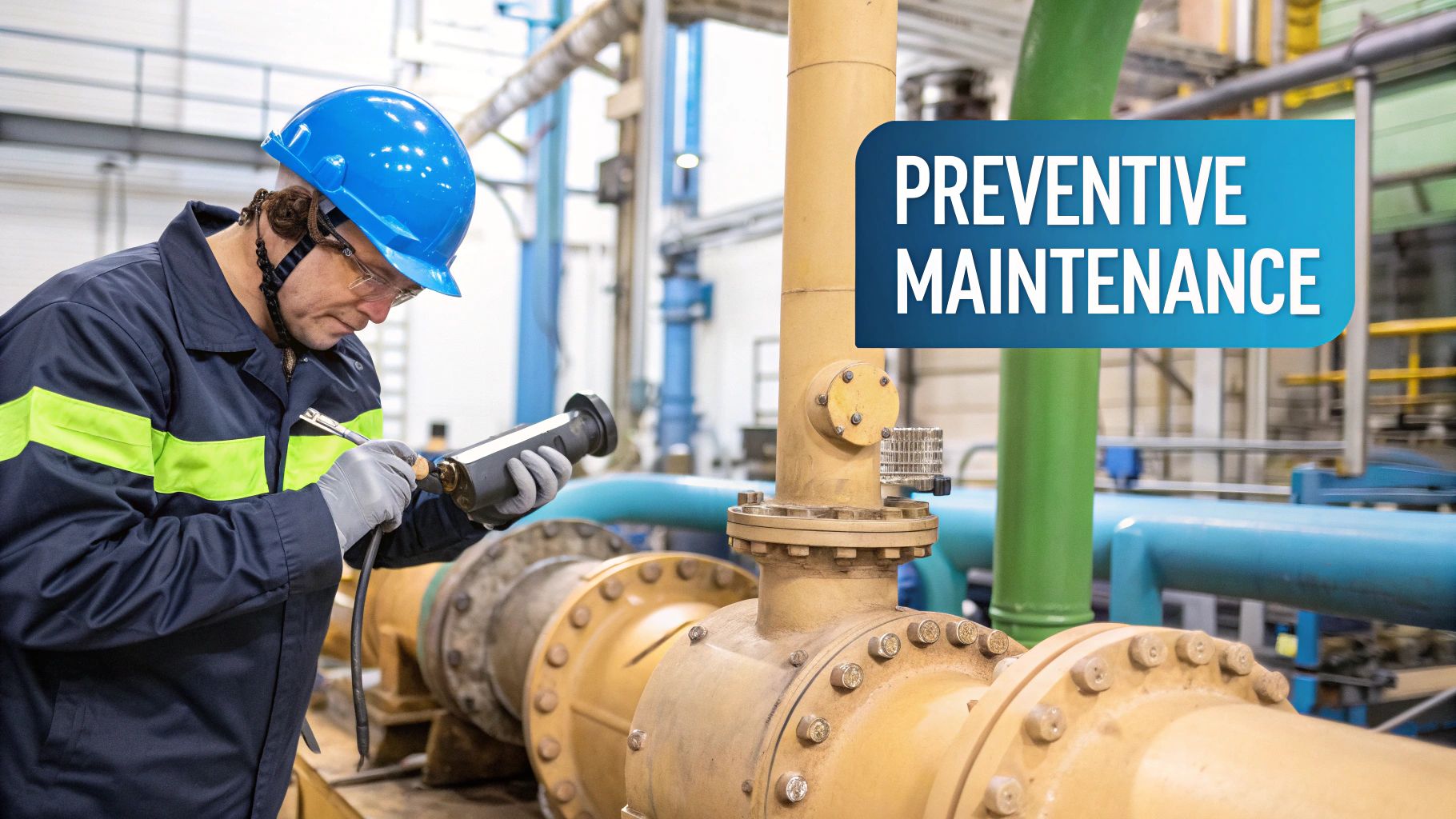
Preventive maintenance is built on a foundation of routine and regularity. Its triggers are fixed—either a certain amount of time has passed or a usage milestone has been reached. This is analogous to changing a vehicle's oil every 5,000 miles, regardless of its actual condition.
This approach relies heavily on manufacturer recommendations and historical data to establish service intervals. The goal is straightforward: service the equipment before it has a chance to fail, operating on the assumption that every part has a predictable lifespan.
The Proactive Time-Based Approach
Under a preventive model, a critical pump might be overhauled every 1,500 operating hours. This occurs whether the pump appears to be in excellent condition or is showing signs of wear. The strength of this method is its predictability. Budgeting is simplified, scheduling is clear, and the workflow is well-defined.
However, its primary weakness is a lack of real-time context. A component designed to last 1,500 hours could be in perfect working order, meaning that maintenance resources were spent on unnecessary parts and labor. Conversely, another identical part might be approaching failure at 1,200 hours due to unique operational stressors, and the scheduled check-in would be too late.
The Dynamic Condition-Based Model
Predictive maintenance fundamentally alters the approach. Instead of a calendar, it uses real-time, condition-based data to drive decisions. It doesn't ask "When is the next service due?" but rather, "What is the actual condition of this asset right now?"
This is where technology plays a crucial role, deploying a suite of monitoring tools:
- IoT Sensors to continuously track vital parameters like temperature and pressure.
- Vibration Analysis to detect subtle imbalances that often signal impending mechanical issues.
- Thermal Imaging to identify hotspots indicating electrical faults or friction.
- Acoustic Analysis to "listen" for abnormal sounds that suggest internal wear.
This continuous stream of data is the key differentiator. By collecting and analyzing equipment conditions, predictive maintenance utilizes statistical process control and machine learning to forecast failures with high accuracy. This is a significant departure from preventive methods, which adhere to a schedule regardless of an asset's health, and it enables organizations to control excess maintenance costs and the financial impact of unplanned downtime. You can learn more about how predictive models achieve this at kaizen.com.
Machine learning algorithms analyze these data streams, identifying patterns and anomalies that a human might miss. The system learns what "normal" operation looks like for each specific machine under various loads.
By detecting even minor deviations from that baseline, a predictive model can flag a potential failure weeks or even months in advance. This empowers teams to intervene at the optimal moment—not just the next scheduled one.
For example, a predictive system might detect a minor increase in vibration in a gearbox. While not an immediate emergency, the algorithm could project that, on its current trajectory, a key bearing will fail in approximately 45 days. This provides the maintenance team a substantial window to order parts, schedule the repair during a planned shutdown, and avoid a catastrophic, production-halting breakdown. This transforms maintenance from a routine chore into a precise, strategic action.
A Look at the Cost, Tech, and Skills You'll Need
Choosing between predictive and preventive maintenance extends beyond operational philosophy. It requires a practical assessment of the financial, technological, and human resources needed to implement each strategy successfully. Any serious discussion of predictive vs preventive maintenance must address what each approach costs to initiate and sustain.
One path has lower barriers to entry, but the other promises a much greater long-term return, fundamentally changing the total cost of ownership.
Preventive maintenance is relatively straightforward to implement. The initial financial and technological hurdles are comparatively low. Costs are primarily for labor, standard replacement parts, and a CMMS to manage schedules. This predictability facilitates budgeting, which is a significant advantage for smaller organizations or those managing less critical equipment.
However, this apparent cost-effectiveness can be misleading. This approach often leads to "over-maintenance," where parts are replaced and labor is expended based on a calendar, not on actual need. This practice of replacing fully functional components can accumulate significant and unnecessary costs over an asset's lifecycle.
The Great Tech Divide
The technology required for each strategy is a major point of divergence. Preventive maintenance can operate effectively with basic scheduling software and diligent record-keeping. The "technology," in this case, is primarily the maintenance plan itself, built on manufacturer guidelines and historical experience.
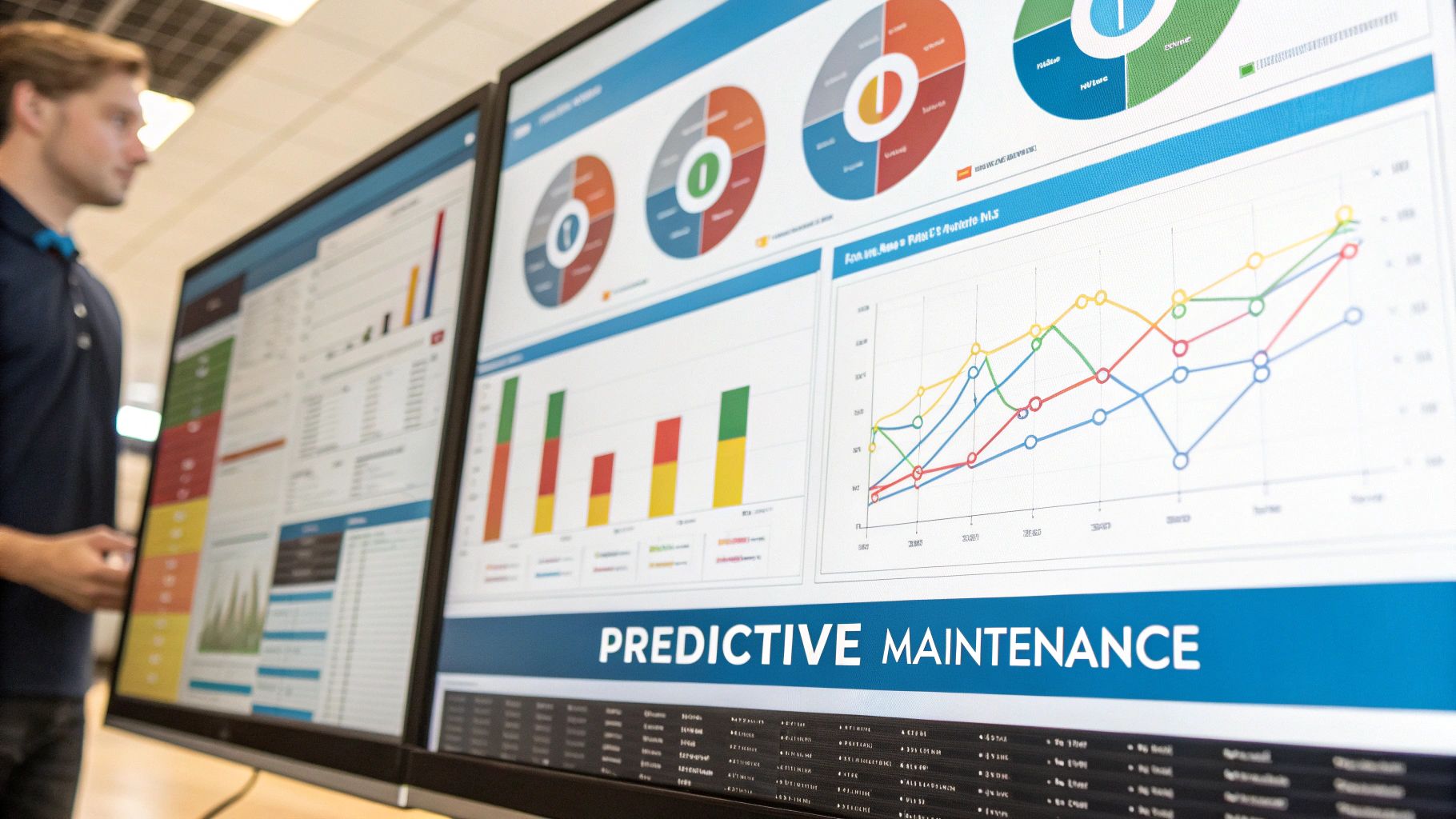
Predictive maintenance, on the other hand, demands a robust technological foundation. This is not merely an upgrade; it is a complete shift to a data-first operation. To establish a predictive program, several key components are necessary:
- Sensors and IoT Devices: These form the nervous system of the operation, continuously collecting real-time data on vibration, temperature, acoustics, and other vital signs.
- Data Transmission Network: A reliable network is required to transmit data from assets to a central hub for processing.
- Advanced Analytics Platform: This is the brain of the system, where machine learning algorithms analyze data streams, detect anomalies, and forecast potential failures.
- System Integration: The analytics platform must integrate with the CMMS to automatically generate work orders and provide a unified view of asset health.
While the upfront investment for predictive maintenance infrastructure is larger, it directly addresses the hidden costs of preventive maintenance—such as replacing parts prematurely and the risk of unexpected failures between scheduled services.
Your Team Needs to Evolve
The human element is just as critical as the technology. A preventive maintenance team is built around skilled technicians who are experts in their craft—executing scheduled tasks with precision and efficiency. Their expertise lies in hands-on mechanical and electrical repair, following established procedures.
Transitioning to a predictive model requires the team to evolve as well. Skilled technicians remain essential, but they must be augmented by professionals with different skill sets. The modern predictive maintenance team is a multidisciplinary unit.
Of course, a critical piece of any solid maintenance philosophy—preventive or predictive—is the meticulous tracking of a comprehensive drone maintenance log or similar asset records. This history provides the context needed to fine-tune preventive schedules and to properly train predictive algorithms.
This new operational model introduces roles not typically found in a traditional maintenance department:
- Data Scientists/Analysts: These professionals build, manage, and interpret the machine learning models that predict failures.
- IT/OT Specialists: Experts are needed to bridge the gap between operational technology on the factory floor (sensors) and information technology in the back office (analytics platform).
- Reliability Engineers: Their role is to analyze failure data to identify opportunities for improving asset performance and refining the overall maintenance strategy.
Frontline technicians must also adapt. Their role expands from simply closing work orders to interpreting data-driven alerts and providing feedback to improve the predictive models. This involves not just learning new tools but adopting a more proactive mindset toward asset health. Augmented Reality (AR) solutions can significantly aid this transition by providing technicians with real-time data overlays and guided instructions directly in their field of view, making complex data immediately understandable and actionable.
Measuring the True Business Impact

When evaluating predictive versus preventive maintenance, the conversation must shift from operational habits to quantitative results. The true value of any maintenance strategy is measured in cost savings, production gains, and extended asset life. Both approaches influence the total cost of ownership, but they do so in different ways, which can be tracked with the right key performance indicators (KPIs).
Preventive maintenance is based on a predictable, fixed-cost model. Budgeting is straightforward—the schedule, parts, and labor costs are known in advance. However, this simplicity can mask significant waste. Resources may be spent servicing a machine that is operating perfectly. More critically, a failure could occur between scheduled checks, leading to costly, unplanned downtime.
Predictive maintenance, conversely, requires a larger upfront investment in technology and training. The objective is to optimize every dollar spent by linking each maintenance task to a genuine, data-supported need. Ultimately, any shift in strategy is about improving operational efficiency, a primary goal for any business.
Key Metrics That Tell the Story
To accurately compare these two models, several core metrics must be monitored. These KPIs serve as the vital signs of your equipment and indicate the effectiveness of your maintenance program.
- Mean Time Between Failures (MTBF): This is the average time an asset operates without interruption between breakdowns. A higher MTBF indicates greater reliability.
- Mean Time to Repair (MTTR): This tracks the time required to repair a failed asset, from the moment of failure until it is back online. A lower MTTR reflects an efficient repair process.
- Overall Equipment Effectiveness (OEE): OEE is the gold standard for measuring manufacturing productivity. It is a composite score that measures availability (uptime), performance (speed), and quality.
With a preventive plan, MTBF may be consistent, but it is rarely optimized due to the inherent vulnerability to unexpected failures. OEE can also be negatively impacted by planned downtime for scheduled servicing, regardless of whether the maintenance was actually necessary. Excelling at maintenance problem solving is crucial for managing these challenges.
Quantifying the Predictive Advantage
A predictive maintenance model is designed to directly improve these KPIs. By anticipating failures, it can significantly increase MTBF. Repairs are no longer reactive emergencies but become planned, scheduled events. This alone reduces MTTR because the necessary parts and personnel can be ready before the machine fails.
The core financial benefit of predictive maintenance is its ability to convert unpredictable, high-cost emergency repairs into planned, low-cost maintenance tasks. This shift fundamentally alters the economic equation of asset management.
The data supports this. A well-executed predictive maintenance program can reduce maintenance costs by 25%–30% and decrease breakdowns by as much as 70%. This translates to a massive reduction in unplanned downtime. This precision also eliminates waste from unnecessary part replacements and labor, reducing inventory and operational expenditures.
Ultimately, this data-first approach drives a higher OEE score. Less unplanned downtime means greater availability, and properly maintained machines operate closer to their peak performance. This measurable lift in productivity provides a clear, numbers-based justification for the initial investment, often delivering a strong and rapid return.
How AR and VR Take Maintenance to the Next Level
The discussion over predictive vs preventive maintenance typically centers on data, timing, and cost. However, a transformative technology is enhancing both strategies: immersive tech. Augmented Reality (AR) and Virtual Reality (VR) are no longer futuristic concepts; they are practical tools providing maintenance teams with unprecedented clarity, precision, and expertise directly on the factory floor.
These technologies bridge the gap between digital maintenance plans and the physical equipment. Instead of a technician consulting a tablet, binder, or laptop, critical information is displayed directly within their line of sight. This transforms maintenance from a manual, reference-based process into a hands-on, data-rich experience that makes both preventive and predictive models more efficient and less prone to human error.
AR: Your Expert Guide for Preventive Maintenance
Preventive maintenance relies on consistency and procedural adherence. AR is ideally suited for this. It overlays the precise information a technician needs directly onto their view of the equipment.
Consider a technician wearing AR glasses to inspect a complex HVAC unit. Instead of looking down at a checklist, they see a digital version floating in their field of view. As they proceed through the inspection, the AR system can:
- Display step-by-step instructions directly on the components being serviced.
- Highlight the specific bolts that need tightening or the filters requiring replacement.
- Show required torque values or pressure readings next to the physical gauges.
- Automate compliance checks by requiring visual confirmation that a step is complete before proceeding.
This interactive guidance makes it extremely difficult to miss a step or perform a task incorrectly. It standardizes the workflow for all technicians, from seasoned experts to new hires, which improves first-time fix rates and ensures the procedural integrity essential for any effective preventive maintenance program.
AR doesn’t just tell technicians what to do; it weaves the procedure into their perception of the real world. Suddenly, the correct action becomes the most intuitive one. That's a fundamental change in how work instructions are delivered and followed.
VR: The Ultimate Training Ground
While AR serves as an on-the-job expert, Virtual Reality (VR) is the high-tech training environment where technicians can sharpen their skills in a completely safe, simulated setting. VR simulations can replicate any complex or hazardous repair scenario without risk to personnel or equipment. A new technician can practice a full teardown and reassembly of a million-dollar asset in VR multiple times before ever touching the physical machine.
This immersive training builds muscle memory for complex tasks and accelerates the learning curve. Technicians can face simulated equipment failures, learn to diagnose them, and practice the repair in a consequence-free environment. This level of preparation is invaluable for reducing Mean Time to Repair (MTTR) when a real breakdown occurs. Organizations leveraging VR training have reported significant improvements in team proficiency and a major reduction in on-the-job errors.
Making Predictive Data Crystal Clear
Predictive maintenance relies on real-time sensor data, but raw numbers on a dashboard may not always convey the full context. This is where AR excels. It can take that live data and visualize it directly onto the asset itself.
Imagine a technician looking at a motor and seeing a live overlay of its current temperature, vibration frequency, and power consumption.
Anomalies become instantly apparent. A temperature spike is no longer just a number on a screen; it is a glowing red hotspot on the motor's casing that the technician can see directly. This contextual data leads to faster, more accurate diagnostics. A maintenance professional can walk a production line and immediately identify a machine that is operating outside of normal parameters, making it easier to validate predictive alerts and determine the root cause of an emerging issue. You can get a deeper sense of its impact by exploring how augmented reality changes industrial work.
By bringing digital insights into the physical world, AR and VR are making both preventive and predictive maintenance strategies more powerful, intuitive, and effective than ever.
Choosing the Right Maintenance Mix for Your Assets
The predictive vs preventive maintenance debate is not about selecting a single winner. The most intelligent, resilient, and cost-effective strategies involve creating a maintenance ecosystem tailored to your specific operation. Applying a one-size-fits-all approach is inefficient—it can lead to wasted resources on low-impact assets or, more critically, catastrophic failures of essential machinery.
The primary objective is to build a hybrid model that applies the appropriate level of maintenance to the right asset at the right time. This requires a clear-eyed evaluation of your equipment and a practical decision-making framework to achieve the optimal balance.
A Framework for Smart Maintenance Decisions
To construct your ideal maintenance mix, the first step is to categorize your assets. Evaluate each piece of equipment through the lens of four key criteria to determine if a simple preventive schedule is sufficient or if a more sophisticated, data-driven predictive model is warranted.
This systematic approach ensures that time, money, and effort are focused where they will deliver the greatest returns.
- Asset Criticality: How essential is this equipment to your production process? A failure on a mission-critical packaging line justifies the investment in predictive monitoring. Conversely, a non-essential ventilation fan can likely be managed effectively with a simple preventive schedule.
- Failure Predictability: Does the asset have a known, repeatable failure pattern? Components with a well-documented lifespan, such as filters or belts, are ideal candidates for time-based preventive replacements. However, for complex systems with unpredictable failure modes, the continuous oversight of a predictive program is necessary.
- Safety Implications: Could a failure result in a safety incident? Any equipment where a breakdown could endanger personnel or the environment—such as high-pressure systems or chemical pumps—should be a top priority for predictive monitoring. The goal is to detect minor deviations long before they become serious hazards.
- Available Resources: What is your budget for new technology and skills? Implementing predictive analytics requires a significant commitment. A practical starting point is to apply it to your highest-value assets. Once a solid ROI is demonstrated, the program can be expanded while continuing to use preventive maintenance for other equipment.
The best strategy isn't about picking one philosophy over the other. It's about intelligently blending the deep insights of predictive oversight for your high-stakes assets with the cost-effective consistency of preventive schedules for the rest.
Building Your Hybrid Model in Practice
When this framework is applied, the path forward becomes clear. Low-cost, predictable assets like lighting systems or standard conveyor motors are well-suited for preventive maintenance. Their failure modes are understood, and routine checks are sufficient to ensure reliability without excessive cost.
On the other hand, high-value, complex machinery—such as CNC machines, industrial refrigeration systems, or robotic arms—are prime candidates for predictive maintenance. For these assets, the cost of a single unexpected shutdown is so high that the initial investment in sensors and analytics is easily justified.
Furthermore, modern tools are making this transition smoother. For example, exploring how augmented reality for training can help technicians quickly adapt to new data-driven workflows and diagnostic tools is a valuable step.
By thoughtfully combining these strategies, you create a robust maintenance program that aligns with your company's operational and financial goals. This balanced approach moves beyond the simple predictive vs preventive maintenance argument and places the focus where it belongs: achieving maximum asset reliability and performance.
Frequently Asked Questions
When weighing predictive vs preventive maintenance, several key questions frequently arise. Here are direct answers to the most common inquiries from organizations determining the best path forward.
How Do I Know Which Assets Are Right For Predictive Maintenance?
Consider the domino effect. The best candidates for predictive maintenance are assets where failure triggers significant consequences. This includes mission-critical equipment that can halt an entire operation, is extremely expensive to repair, or poses a serious safety risk if it fails.
Assets with complex, unpredictable failure patterns are also ideal for this approach. Instead of relying on a calendar-based guess, you get continuous, data-driven monitoring that detects problems before they escalate.
Can Preventive and Predictive Maintenance Work Together?
Not only can they, but they absolutely should. The most effective maintenance strategies do not choose one over the other; they build a hybrid model that optimizes the performance of every asset.
You can use cost-effective preventive schedules for lower-priority, more predictable equipment (e.g., changing HVAC filters or replacing worn belts). Simultaneously, you can reserve the more intensive, data-driven predictive approach for high-value machinery where unexpected downtime is unacceptable. This blended model is about smart resource allocation and maximizing return on investment.
The most mature maintenance strategies don't choose one method over the other; they strategically apply each where it delivers the most value, creating a balanced and resilient operational ecosystem.
What Is The Biggest Challenge When Adopting Predictive Maintenance?
While the technology is a consideration, the greatest hurdle is often cultural. Shifting from a familiar, routine-based schedule to a data-informed culture of proactive intervention requires a significant change in mindset.
The key is ensuring your team trusts the data, understands the meaning of alerts, and feels confident acting on predictive insights. This is where training is essential. To learn more about bridging this skill gap, you can explore effective workforce development strategies. Successfully navigating this change is what truly unlocks the power of a predictive program.
At AIDAR Solutions, we focus on transforming maintenance with AR and VR. Our immersive tools provide the hands-on training and real-time data visualization that enhance both preventive and predictive strategies. See how our solutions can elevate your team's performance at https://aidarsolutions.com.