
What Is Extended Reality and How It Works
Extended Reality (XR) is an umbrella term that encompasses all immersive technologies designed to merge the physical and digital worlds. It represents a spectrum of experiences, from layering digital information onto our real-world view to creating fully computer-generated environments.
At one end of this spectrum is our physical reality. At the opposite end is a completely digital, virtual world. XR comprises every technology that operates between these two points.
Understanding the Extended Reality Spectrum
Imagine a continuum. On the far left is pure reality. As you move to the right, you begin to overlay digital information onto your real-world view. Slide all the way to the right, and you are fully immersed in a virtual environment.
This concept provides a practical framework for understanding how different immersive technologies relate to one another. Each point along this continuum unlocks new opportunities for learning, problem-solving, and collaboration.
The infographic below helps visualize this relationship, showing how XR acts as the parent category for its most well-known components.
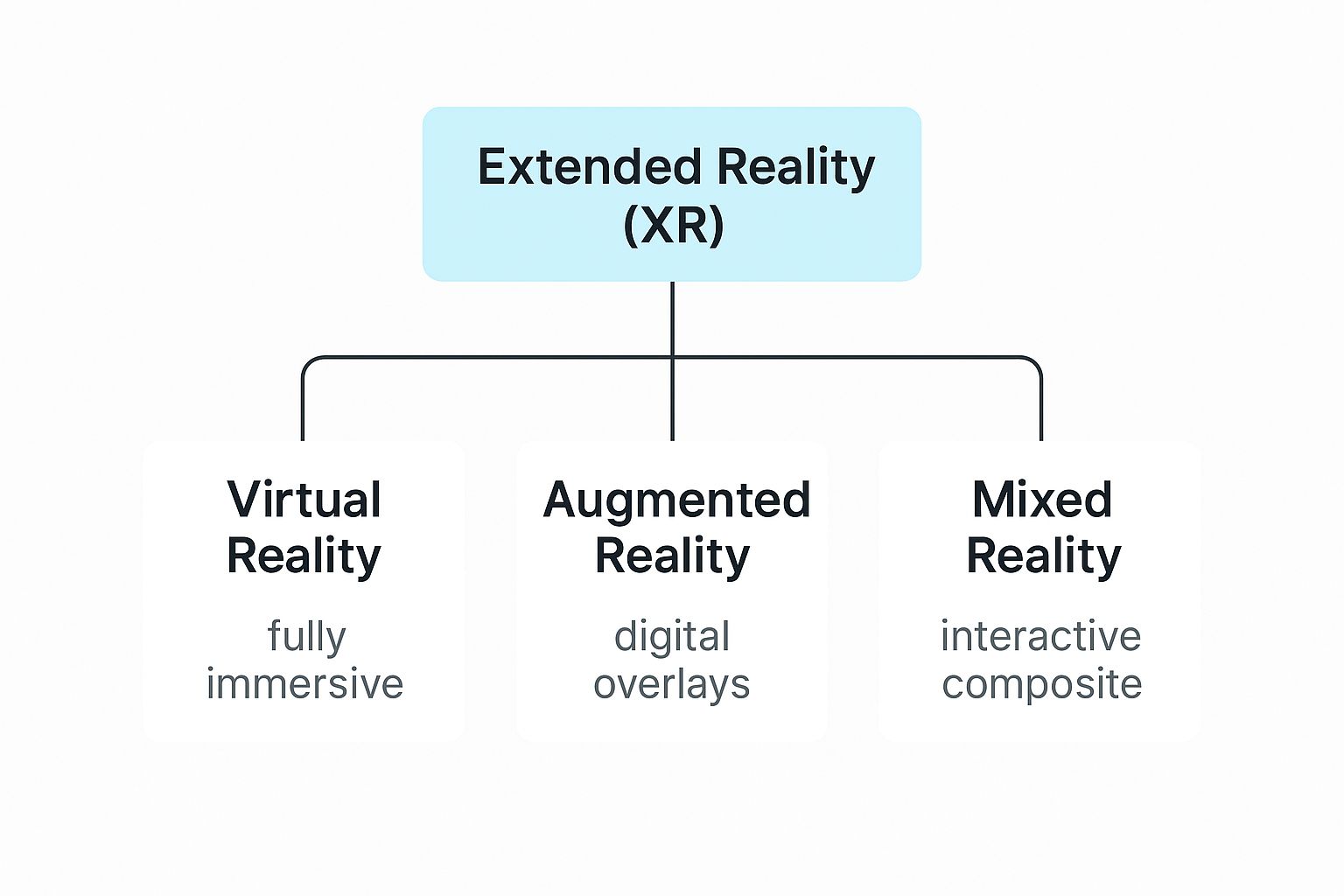
This illustrates that AR, VR, and MR are not competing technologies but rather different points on a single immersive journey, each suited for a distinct purpose.
To provide a quick overview of these core technologies, the table below breaks down the key differences at a glance.
The Spectrum of Extended Reality Explained
| Technology | Core Concept | Level of Immersion | Primary Device Example |
|---|---|---|---|
| Augmented Reality (AR) | Overlays digital information onto the real world. | Low | Smartphone or smart glasses |
| Mixed Reality (MR) | Places interactive digital objects into the real world. | Medium | Advanced smart glasses |
| Virtual Reality (VR) | Fully replaces the real world with a simulated one. | High | Headset |
As shown, each pillar of XR offers a unique level of immersion and interaction, making it suitable for different tasks and industries.
The Three Pillars of XR
Let's briefly break down the three core components. Understanding what makes each one unique is the first step to seeing how they all contribute to the broader XR landscape.
-
Augmented Reality (AR): This technology adds a digital layer to your existing reality. It acts as a heads-up display, placing relevant information—such as text, images, or 3D models—directly in your line of sight without obscuring your view of the world.
-
Virtual Reality (VR): This represents the most immersive end of the spectrum. VR completely replaces the physical world with a fully simulated environment. When you wear a VR headset, you are not just viewing a screen; you are transported to a different place.
-
Mixed Reality (MR): As its name suggests, MR is a hybrid technology. It doesn't just overlay digital objects; it anchors them to your physical space, allowing you to interact with them. A virtual engine component can appear to sit on a real-world workbench, and you can walk around it as if it were a physical object.
The core concept behind XR is to erase the line between our physical and digital lives. This fusion is creating powerful new ways to train personnel, enhance collaboration, and improve operational efficiency.
Why XR Is Gaining Momentum
The growth of XR is supported by significant market data. The global XR market was valued at $142.39 billion in 2023 and is projected to reach $1,069.27 billion by 2030, reflecting a compound annual growth rate (CAGR) of 32.9%.
This expansion is driven by practical applications delivering tangible value in demanding sectors like manufacturing, healthcare, and education.
For instance, companies are achieving significant success using these tools for training. Our complete guide to immersive learning explores this in depth, but the core benefit is straightforward: it allows personnel to practice complex or hazardous tasks in a completely safe, controlled virtual space. This helps people learn faster, operate more safely, and make fewer costly mistakes on the job.
So, What's the Difference Between AR, VR, and MR?
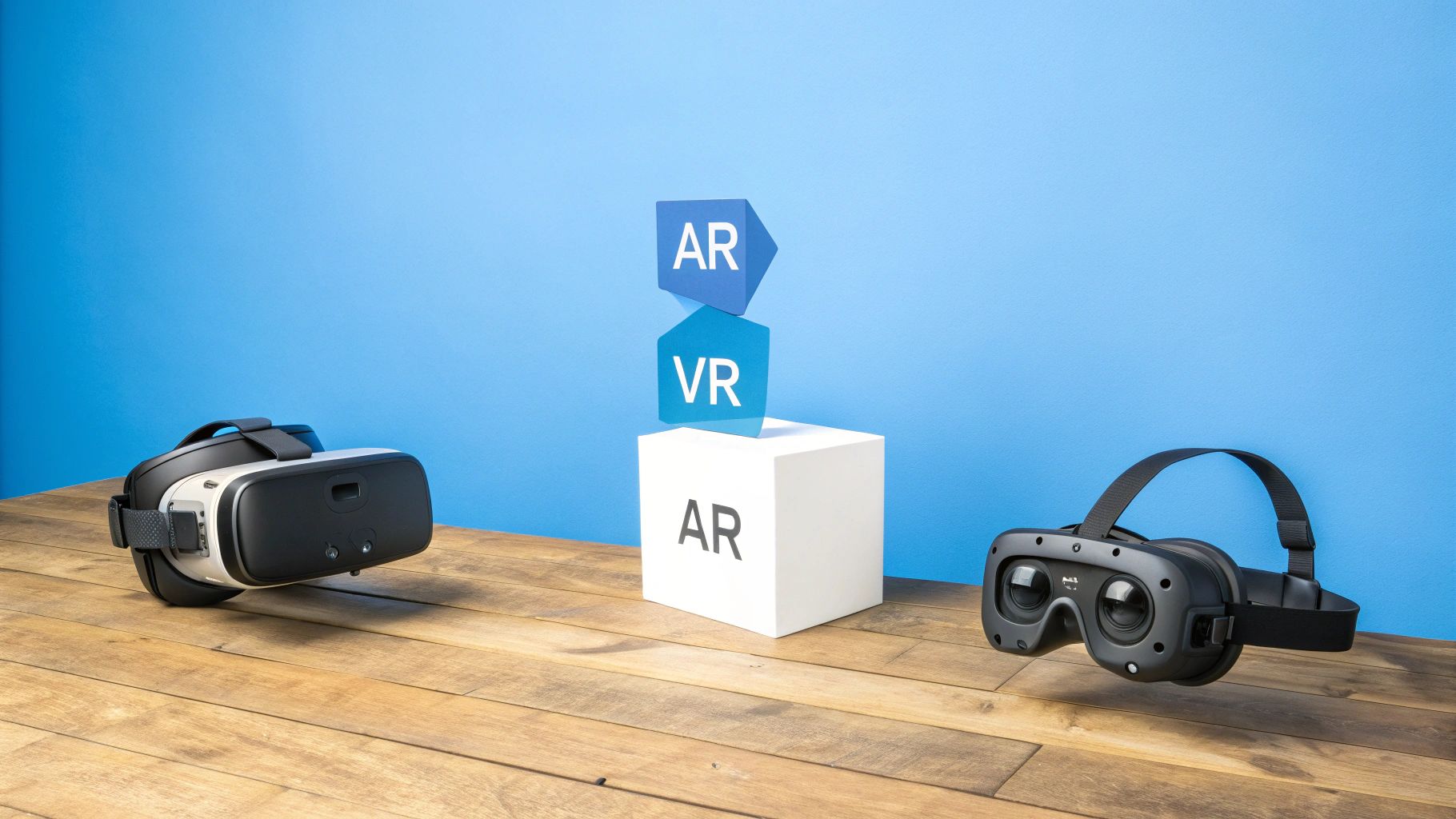
While Extended Reality (XR) provides the overarching framework, its practical power comes from its three core technologies. To fully grasp how they solve distinct business challenges, it is essential to understand the unique roles of Virtual Reality (VR), Augmented Reality (AR), and Mixed Reality (MR). Each offers a different level of immersion and interaction, making them suited for very different applications.
Selecting the right technology is about matching the tool to the task. One would not deploy a fully immersive VR simulation when a simple data overlay on a machine is all that is required.
Let's break down what makes each pillar of XR distinct.
Virtual Reality: Total Digital Immersion
Virtual Reality is defined by its ability to achieve full immersion. The moment you put on a VR headset, the physical world is replaced. Your sight and hearing are completely engaged by a computer-generated environment, effectively teleporting you elsewhere.
This complete separation from reality is VR's greatest strength. It allows us to create environments that would be impossible, too dangerous, or prohibitively expensive to replicate in the real world. This capability is why it has become a transformative tool for industrial training and complex simulations.
Virtual Reality is not about escaping the real world; it's about creating a new, controlled one where people can learn and practice without real-world consequences. It is the ideal sandbox for building muscle memory and confidence.
A technician, for example, can practice a complex maintenance procedure on a million-dollar piece of equipment hundreds of times without risking damage to the actual machine. They can run through simulated emergencies, learn from mistakes, and perfect their skills in a safe, repeatable environment. This approach has been proven to reduce learning curves and boost on-the-job performance. If you want to dive deeper, we break it all down in our article on what is virtual reality training.
Augmented Reality: The Smart Information Layer
Augmented Reality operates on the opposite principle. Instead of replacing your world, AR enhances it by layering digital information directly onto your real-world view. It functions as a smart, contextual heads-up display, viewed through a smartphone, tablet, or smart glasses.
The key is that the digital elements are there to assist, not to take over. They provide context and data without preventing you from seeing and interacting with your physical surroundings. A well-known consumer example is a mobile game that makes digital creatures appear on your sidewalk through your phone’s camera.
In an industrial setting, the applications are far more powerful.
- Step-by-Step Guidance: A field technician can look at a complex control panel and see digital arrows and text indicating the exact sequence of buttons to press.
- Data Visualization: An assembly worker can glance at a part and instantly see its serial number, torque specifications, or the next step in the process overlaid directly onto it.
- Remote Assistance: An expert can draw and place markers on a live video feed from a technician's smart glasses, guiding them through a complex repair from thousands of miles away.
AR is about delivering the right information at the exact moment it's needed, reducing cognitive load and minimizing the potential for human error. It makes workers more informed and effective in their physical workspace.
Mixed Reality: Where Digital and Physical Worlds Collide
Mixed Reality is the most advanced of the three, serving as a bridge between AR and VR. Like AR, MR overlays digital objects onto the real world. However, the critical difference is that in MR, those digital objects are spatially aware and interactive.
This means a digital object doesn't just float in front of you; it appears to be in the room with you. It recognizes the tables, walls, and floors of your physical space. You can place a 3D model of an engine on a real workbench, walk around it, and it will remain anchored to that specific spot.
This level of interaction unlocks powerful possibilities.
- Collaborative Design Reviews: Engineers across the globe can meet in a shared MR space to inspect a full-scale digital prototype of a new product, making notes and adjustments in real time.
- Factory Layout Planning: Managers can place virtual models of new machinery onto the actual factory floor to assess spacing, workflows, and safety clearances before ordering any equipment.
- Complex Spatial Tasks: A surgeon can overlay a 3D model from a patient's CT scan directly onto their body during an operation, enabling an incredible level of precision.
MR represents a true fusion of the digital and physical realms, where virtual objects adhere to real-world rules to create a seamless and highly effective interactive experience.
The Core Technology That Makes XR Possible
How does a headset determine its position in a room? How does an application place a digital engine component on a real workbench and ensure it stays there as you move around it? This is achieved through a sophisticated combination of hardware and software working in perfect harmony.
At the heart of this technology is a concept called spatial computing. This can be thought of as the "brain" that allows an XR device to see, map, and understand a physical environment in three dimensions. It is the critical process that transforms a simple camera feed into a dynamic, interactive space where digital and physical objects can believably coexist.
The Building Blocks of Immersion
To bridge these two worlds, XR devices rely on a suite of specialized components. Each part plays a vital role in creating a seamless and convincing experience, from visual rendering to motion tracking. If any single component lags, the entire illusion is compromised.
These core components include:
- High-Resolution Displays: These are the windows to the digital world. Modern XR headsets use displays with extremely high pixel density and fast refresh rates to present sharp, fluid images, making virtual content feel solid and real.
- Advanced Sensors: A powerful sensor array acts as the device's nervous system. Gyroscopes and accelerometers track head orientation and movement, while inside-out tracking cameras constantly scan the room to determine your position. This enables six degrees of freedom (6DoF), allowing you to not just look around but also walk, duck, and move through the space naturally.
- Powerful Processors: XR requires significant computational power. It needs dedicated processors (CPUs and GPUs) to render complex 3D graphics, process sensor input, and run applications simultaneously—all with near-zero latency. A delay of even a few milliseconds between a user's movement and the visual update can cause motion sickness and break the sense of presence.
The Growing Role of AI and Machine Learning
While hardware provides the raw capability, artificial intelligence (AI) and machine learning (ML) are what make XR experiences feel intelligent and intuitive. AI algorithms are essential for interpreting the constant stream of data from the device's sensors.
This is where the technology truly comes alive. Computer vision is crucial, with breakthroughs in AI-driven visual analysis tools for video segmentation constantly pushing the boundaries of what’s possible in real-time scene understanding.
AI doesn’t just improve XR's visual quality; it makes it smarter. It enables devices to understand not just where things are, but what they are—a hand, a table, a wall—and how to interact with them contextually.
This intelligence powers some of XR's most impressive features. For instance, AI enables hand and gesture recognition, allowing users to interact with virtual objects using their hands instead of controllers. It also drives more responsive and believable virtual characters and environments that can react to a user's presence and actions.
The partnership between XR and AI is so important that the underlying infrastructure is now a major focus. As we cover in our guide, AI-powered XR needs more than algorithms, robust systems are required to handle the massive computational demands.
This continuous technological advancement is fueling significant market growth. The XR market is projected to grow from $24.42 billion in 2024 to $84.86 billion by 2029, reflecting a compound annual growth rate of 28.3%. This rapid expansion is largely driven by the practical applications of AR in fields like advertising and education, coupled with rising demand for markerless AR technology. You can discover more insights about XR market growth in the full report.
How Industries Are Using XR for Real-World Results
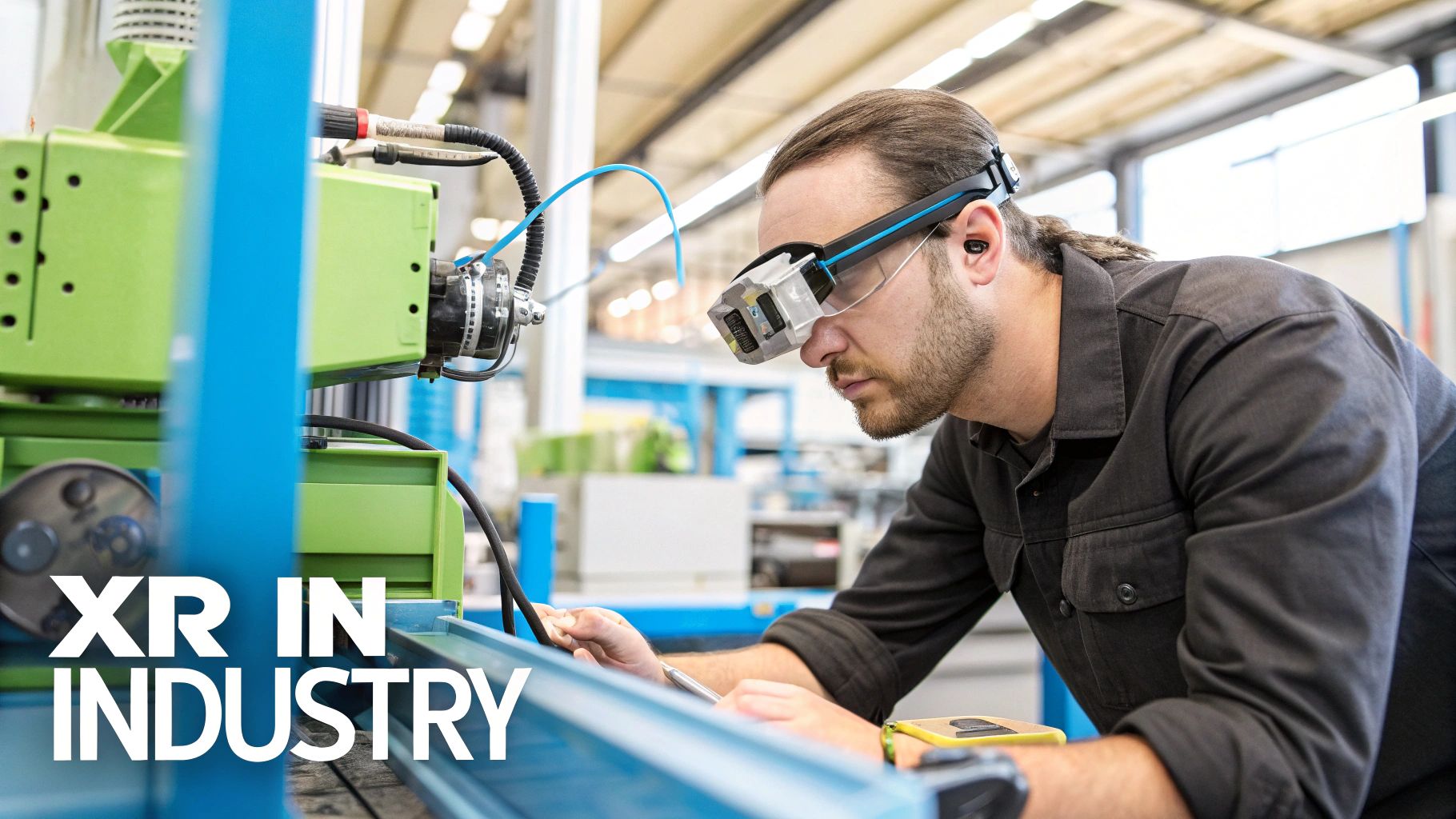
While the underlying technology is impressive, the true value of extended reality is realized when it is applied to solve real-world business problems. Across the industrial sector, XR is no longer a future concept—it is a practical tool being used today. Companies are deploying these solutions to work more intelligently, improve safety, and accelerate innovation, all while achieving a clear return on investment.
These are not just demonstration projects. We are seeing high-value applications that are fundamentally changing how people work, learn, and collaborate in some of the most demanding environments. The objective is to achieve practical results that address long-standing operational challenges.
Revolutionizing Training and Skill Development
One of the most immediate benefits of XR is in workforce training. Traditional methods—such as classroom instruction and on-the-job shadowing—can be slow, costly, and in some cases, dangerous. Virtual Reality completely changes this dynamic by creating a safe, controlled training environment that can be used repeatedly.
Consider a new technician learning to service a complex jet engine. Instead of putting multi-million-dollar equipment at risk, they can wear a VR headset and perform the entire procedure on a perfect digital replica. They can make mistakes, observe the consequences, and repeat the process until the muscle memory is second nature. All of this occurs without using any physical parts or exposing anyone to harm.
XR training transforms learning from a passive experience into an active one. It allows employees to learn by doing in a risk-free environment, which has been shown to dramatically increase knowledge retention and reduce on-the-job errors.
This approach not only accelerates learning but also makes it highly scalable. A single virtual simulation can be distributed to thousands of employees globally, ensuring that everyone receives the same high-quality, standardized instruction.
Enhancing Remote Collaboration and Support
In a global economy, a subject matter expert may be located on a different continent from the problem they need to solve. Flying them to a remote site is a slow and expensive solution that almost always results in costly downtime. Augmented Reality offers a powerful way to bridge that distance instantly.
Imagine a field worker encountering an unexpected machine failure. Using AR smart glasses, they can stream their first-person view directly to an expert thousands of miles away. That expert can then draw digital instructions, highlight specific components, and place diagrams directly into the worker’s field of vision, guiding them through the repair as if they were standing beside them.
This "see-what-I-see" capability provides a massive boost to efficiency.
- Reduced Downtime: Problems are resolved in hours instead of days, keeping production lines running.
- Lower Travel Costs: The need for expert travel is significantly reduced, saving on airfare and accommodation expenses.
- Knowledge Capture: These guided sessions can be recorded, creating a library of training videos for future use when the same issue arises.
This is a core benefit of industrial AR applications, which are designed to provide frontline workers with the exact information and expert assistance they need, precisely when they need it.
Accelerating Product Design and Prototyping
The journey from a digital blueprint to a physical product has traditionally been long and reliant on expensive prototypes. XR, particularly Mixed Reality, is streamlining this process by allowing designers and engineers to interact with their creations at full scale before any physical manufacturing begins.
Automotive design teams, for example, can "walk around" and inspect a full-scale digital model of a new vehicle. They can sit in the virtual driver's seat to check sightlines or simulate how components will fit together on the assembly line. This immersive review process helps them identify design flaws and make significant changes early when modifications are still inexpensive. For a practical example of how immersive VR experiences are constructed, consider the use of Virtual Reality Pod event hire services.
By shifting prototyping from the physical to the digital realm, companies can iterate faster, reduce material waste, and ultimately bring better products to market in a fraction of the time.
The table below summarizes some of the most common ways XR is making a tangible impact in industrial settings.
Industrial XR Use Cases and Their Business Impact
| XR Application | Primary Technology Used (AR/VR/MR) | Core Benefit | Example Scenario |
|---|---|---|---|
| Immersive Safety Training | Virtual Reality (VR) | Reduced workplace accidents and improved compliance | A new hire practices emergency shutdown procedures in a simulated factory fire without any real-world risk. |
| Remote Expert Assistance | Augmented Reality (AR) | Decreased machine downtime and lower travel expenses | A frontline technician uses smart glasses to get live, annotated instructions from a senior engineer to fix a complex machine. |
| Digital Assembly Guidance | Augmented Reality (AR) | Increased first-time accuracy and faster assembly times | An assembly worker sees step-by-step 3D instructions overlaid on their workstation, ensuring parts are installed correctly. |
| Virtual Prototyping | Mixed Reality (MR) / VR | Faster design cycles and reduced physical prototype costs | Engineers walk around a full-scale virtual model of a new aircraft to identify design flaws before manufacturing begins. |
| Skills Development | Virtual Reality (VR) | Accelerated learning and improved knowledge retention | A welder practices complex techniques on a virtual workpiece, receiving real-time feedback on their angle and speed. |
The consistent theme across these applications is that XR empowers workers with better information and more effective practice, leading directly to smarter, faster, and safer operations.
The Strategic Business Advantages of XR
Integrating extended reality into business operations is a strategic decision that delivers real, measurable results. Beyond the technology itself, XR's true power lies in its ability to solve persistent operational challenges, leading to tangible returns that impact the bottom line.
These benefits are not isolated; they create a ripple effect across an entire organization. By incorporating XR solutions into their workflows, companies are unlocking new levels of performance, safety, and innovation.
Enhancing Operational Efficiency
One of the most significant impacts of XR is a substantial increase in operational efficiency. This is particularly evident in areas like maintenance and field service, where a single delay can halt production. With augmented reality, a senior expert can virtually "look over the shoulder" of a frontline technician, guiding them through a complex repair from anywhere in the world.
This remote support model reduces problem-solving time from days to hours. The results are clear:
- Reduced Expert Travel: Companies can cut travel costs by up to 75% as senior specialists no longer need to be physically on-site.
- Faster Problem Resolution: Service times can be cut in half, minimizing costly equipment downtime and ensuring smoother operations.
- Increased First-Time Fix Rates: AR-guided instructions remove guesswork from repairs, leading to fewer errors and repeat visits for the same issue.
Improving Workforce Safety
In many industries, employees must work in hazardous environments where the training process itself can be risky. Virtual Reality addresses this challenge by creating a perfectly safe, risk-free digital twin of a dangerous worksite.
Within these simulations, employees can practice emergency procedures, familiarize themselves with complex machinery, and learn to navigate high-stakes scenarios without facing any real-world danger. This allows them to build critical muscle memory and confidence before ever setting foot on the actual site.
XR transforms safety training from a theoretical lecture into a practical, hands-on experience. It gives people a safe space to make mistakes and learn from them, directly leading to fewer workplace accidents and a much stronger safety culture.
Accelerating Knowledge Transfer
A company's most valuable asset is often its skilled workforce, but this expertise can be lost when an employee retires. XR offers a powerful solution for capturing and transferring institutional knowledge before it disappears.
Senior experts can record their repair processes using AR, creating a living, interactive library of best practices. New hires can then access these guided tutorials on demand, learning directly from the most experienced personnel. This significantly accelerates their learning curve and ensures that essential skills are passed down to the next generation of workers.
Driving Superior Customer Engagement
The benefits of what is extended reality also extend to customer interactions. Immersive product demonstrations allow potential buyers to interact with a product in ways that static images or videos cannot match. For example, a customer can use AR to see how a new piece of furniture would look and fit in their own living room.
This type of interactive engagement builds a stronger connection and helps customers make purchasing decisions with greater confidence. The extended reality market is growing rapidly, partly because retailers are using it to create these compelling, immersive shopping experiences. To get the full picture, you can read the complete research on the XR market's expansion. This approach not only boosts sales but also reduces product returns.
Where XR is Headed (and the Bumps in the Road)
To gain a realistic perspective on the future of extended reality, it is important to consider both its potential and the challenges that lie ahead. The road to widespread adoption involves clearing several practical hurdles that the industry is actively working to overcome.
Understanding these challenges provides a realistic view of XR today and highlights the incredible developments on the horizon. For any technology to achieve mainstream adoption, it must be affordable, comfortable, and easy to use—these are the key frontiers for XR.
The Obstacles on the Path to Mainstream Use
The vision of a fully XR-integrated world requires solving a few key problems. Hardware cost remains a significant factor. While prices are decreasing, high-end devices represent a substantial investment for many companies, which can slow large-scale deployment.
Another challenge is the creation of compelling content. Developing an effective, high-quality XR experience requires a unique blend of skills in 3D modeling, software development, and user experience design. While development tools are becoming more user-friendly, this remains a major consideration for businesses looking to build custom applications.
Finally, the user experience is under intense focus. Factors like device weight, battery life, and overall comfort are critical for long-term use. The push for lighter, more ergonomic designs is essential for making XR a tool that can be used comfortably throughout a full workday.
The Incredibly Bright Future of Extended reality
Despite these hurdles, the future of XR is exceptionally promising. Several key trends point toward a new paradigm for interacting with digital information.
One of the most significant developments is the move toward smaller, more powerful devices. The ultimate goal for many is a pair of lightweight AR glasses that look and feel like regular eyewear. This would seamlessly integrate digital information into our daily lives without bulky headsets, making XR a truly ubiquitous technology.
The next great leap for XR will be driven by artificial intelligence. AI is the engine that will transform XR from a tool we command into a partner that assists us, creating truly dynamic and adaptive virtual worlds that respond intelligently to our actions.
The integration of AI is another game-changer. Imagine virtual training simulations where AI-driven characters adapt to your skill level, offering personalized feedback and new challenges in real time. In AR, AI will enable devices to recognize objects with greater context, delivering more relevant and useful information.
Finally, the concept of the industrial metaverse—interconnected digital spaces—promises a more unified experience. This involves creating a persistent, shared digital layer over our physical world, where people can collaborate and move seamlessly between different virtual and augmented environments with shared digital tools and identities.
Still Have Questions About Extended Reality?
It is normal to have questions when first exploring this technology. To provide further clarity, here are answers to some of the most common inquiries from businesses starting their XR journey.
What’s the Real Difference Between AR and MR?
The simplest way to understand the difference is through interactivity. Augmented Reality (AR) overlays digital information onto your view of the real world, much like a futuristic heads-up display. You are essentially looking through a digital layer.
Mixed Reality (MR) takes this concept a significant step further. In MR, digital objects are aware of the physical space around them. You can place a virtual engine on a real table, walk around it, and even have it react to real objects in the room. It is no longer just an overlay; it is an interactive part of your environment.
Is XR Just for Gaming?
While gaming and entertainment were early adopters of XR, the most significant investment and growth are now occurring in the industrial and enterprise sectors.
Businesses are using XR to solve tangible problems and are seeing a major impact in areas such as:
- High-Stakes Safety Training: Allowing employees to practice dangerous procedures, like machinery shutdowns, in a virtual space where mistakes have zero real-world consequences.
- On-the-Spot Expert Help: Enabling an expert technician to see what a field worker sees and guide them through a complex repair from thousands of miles away.
- Virtual Prototyping: Permitting engineering teams to walk through and interact with a full-scale digital twin of a new product line before any physical parts are manufactured.
The true power of XR in a business context is not about entertainment. It’s about making workplaces safer, operations more efficient, and employees more skilled than ever before.
What's the Biggest Hurdle to XR Adoption Right Now?
Currently, the primary roadblocks are a combination of hardware cost, device comfort for long-term wear, and the effort required to create high-quality content. High-end headsets can represent a significant capital expenditure, and ensuring they are light enough for all-day use is a major focus for hardware manufacturers.
However, these barriers are diminishing rapidly. Hardware is becoming more affordable and powerful each year, and the tools for creating XR experiences are becoming more accessible, paving the way for wider corporate adoption.
Ready to see how XR can solve your operational challenges? AIDAR Solutions provides immersive training and remote support tools that deliver measurable results, from accelerating employee learning by up to 75% to cutting service times in half. Discover how our virtual and augmented reality applications can transform your business at https://aidarsolutions.com.