
Top 10 Workforce Development Strategies for 2025
In an era of rapid technological advancement and shifting market demands, building a resilient and skilled workforce is no longer a strategic advantage; it is a necessity for survival. The most successful organizations understand that talent is their most valuable asset and are moving beyond outdated, ineffective training models. Effective workforce development strategies are now critical for maintaining a competitive edge and fostering sustainable growth.
This article explores 10 powerful approaches that innovative companies are implementing today. We will delve into how modern methods, particularly the integration of immersive technologies like Augmented Reality (AR) and Virtual Reality (VR), are fundamentally transforming how employees learn, adapt, and excel. While traditional methods like mentorship and apprenticeships remain vital, their impact is amplified when combined with advanced digital tools.
Prepare to discover practical, actionable methods to close critical skills gaps, boost employee engagement, and drive measurable business growth. From reimagining apprenticeships with AR-guided instructions to deploying VR for complex, high-stakes simulations, these strategies provide a clear roadmap. The focus is on creating a future-ready team equipped to handle the challenges of tomorrow, today. This guide moves beyond theory to provide concrete examples and implementation details for each strategy.
1. Modernizing Upskilling and Reskilling with Immersive Simulations
Foundational workforce development strategies hinge on systematically enhancing existing employee skills (upskilling) or teaching entirely new ones (reskilling). The modern evolution of this approach moves training beyond static presentations into dynamic, hands-on learning environments. Immersive technologies like Virtual Reality (VR) create risk-free, hyper-realistic simulations for complex tasks, from operating heavy machinery to practicing intricate assembly procedures.

This method allows employees to build muscle memory and confidence without consuming physical resources or creating safety risks. For example, VR is used extensively for onboarding and technical skills training, immersing new hires in realistic workplace scenarios. These programs are designed to address evolving business needs, transforming the workforce to meet new technological demands while offering clear career advancement opportunities.
Key Implementation Steps
To effectively integrate this strategy, start with a detailed skills gap analysis to pinpoint critical training areas. Then, align VR training modules directly with clear career progression paths to motivate employees.
- Boost Engagement: Use microlearning and gamification within VR to improve knowledge retention and maintain high engagement levels.
- Reinforce Learning: Integrate immersive training with subsequent hands-on, real-world applications to solidify skills.
- Establish Support: Create mentorship programs where experienced team members can support and reinforce the concepts learned in virtual environments. This blend of virtual and human-led guidance is a core principle in how to train staff effectively.
2. Apprenticeship and Work-Based Learning
Apprenticeship and work-based learning models are enduring workforce development strategies that build talent from the ground up by combining paid, on-the-job training with formal classroom instruction. This earn-while-you-learn approach creates a direct pipeline of skilled workers tailored to a company’s specific needs. Modern apprenticeships have expanded beyond traditional trades into high-demand fields like technology, healthcare, and finance, offering a debt-free pathway to a professional career.
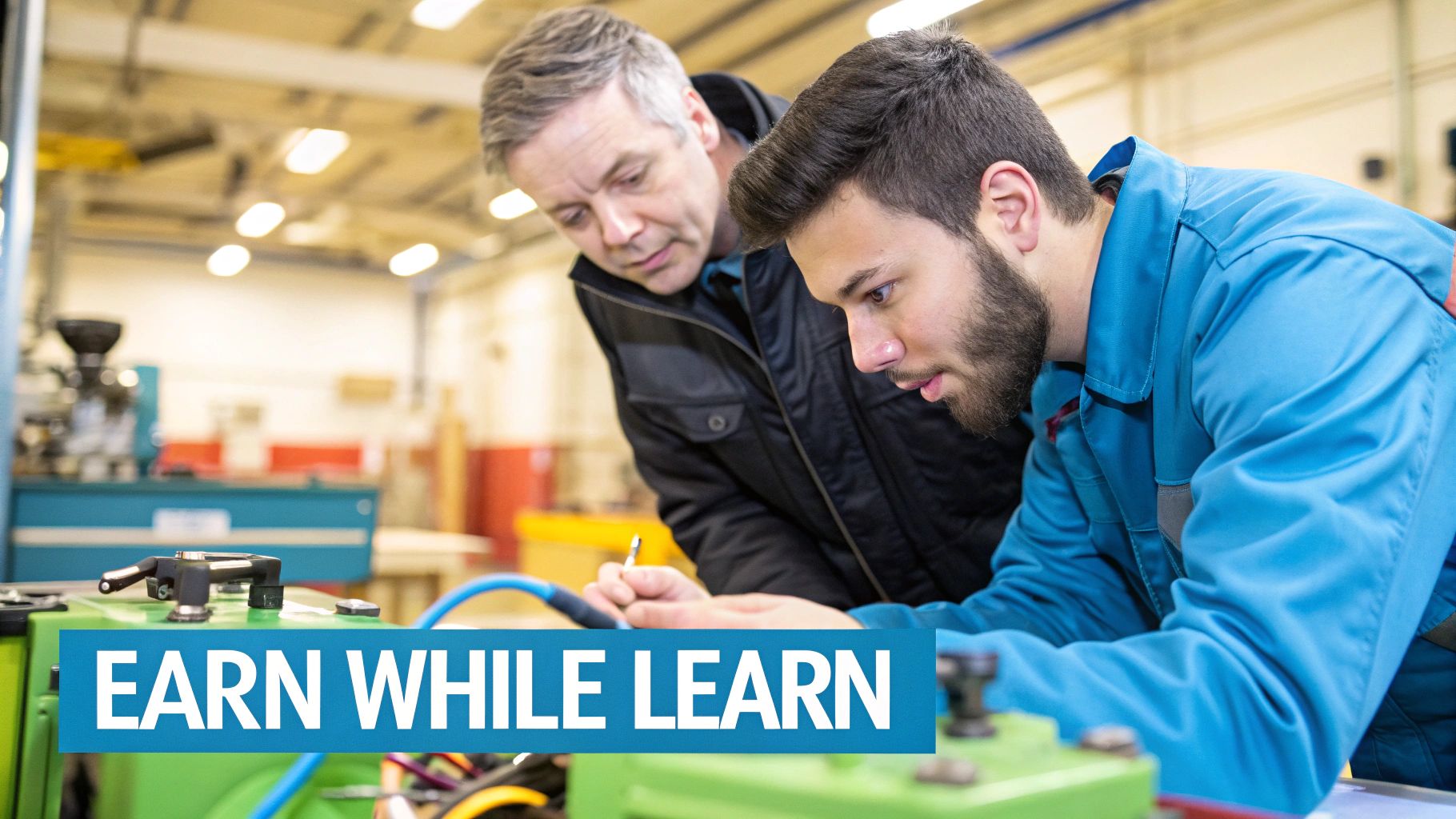
This strategy is exemplified by programs focused on developing talent for roles in cybersecurity, AI, and cloud computing, regardless of the candidate's formal degree. Such initiatives cultivate a loyal, highly skilled workforce by investing directly in its growth and providing clear, structured career trajectories. The integration of Augmented Reality (AR) can further enhance these programs by providing apprentices with real-time, digital overlays of instructions and schematics directly onto their work environment.
Key Implementation Steps
To launch a successful apprenticeship program, partner with local community colleges or vocational schools to co-develop a curriculum that aligns with your business objectives. Establishing clear progression milestones is crucial for keeping apprentices motivated and on track.
- Establish Mentorship: Create a strong mentorship matching process that pairs apprentices with experienced employees who can guide their professional development.
- Structure Compensation: Provide competitive compensation that increases systematically as apprentices achieve new skill levels and certifications.
- Leverage Incentives: Explore and utilize available government incentives and tax credits designed to support apprenticeship programs, which can significantly offset costs.
3. Internal Mobility and Career Pathways
A core component of long-term workforce development strategies involves creating transparent pathways for internal advancement. This approach focuses on developing and retaining existing talent by enabling employees to move laterally or vertically into new roles. By prioritizing internal mobility, organizations can fill skill gaps faster, reduce recruitment costs, and boost employee morale by demonstrating a commitment to their career growth.

This strategy transforms the company into a dynamic talent ecosystem rather than a collection of static roles. Pioneering companies use rotational leadership programs to build versatile leaders. Similarly, internal transfer programs empower employees to seek new challenges within the company, fostering innovation and preventing talent stagnation. These initiatives build a resilient, adaptable workforce capable of meeting future business demands from within.
Key Implementation Steps
To build a successful internal mobility program, start by mapping out clear career paths for various roles, detailing the skills and competencies required at each stage. This transparency is crucial for motivating employees to invest in their development.
- Implement Skills Assessments: Use modern tools to regularly assess employee skills and identify potential gaps, creating a data-driven foundation for personalized development plans.
- Establish Mentorship: Pair high-potential employees with experienced mentors who can guide their career progression and help them navigate internal opportunities.
- Promote Opportunities Widely: Ensure all internal job openings and development programs are communicated transparently across the organization, creating an equitable environment for advancement. This proactive approach to employee retention is a powerful workforce development strategy.
4. Strategic Partnerships with Educational Institutions
Effective workforce development strategies often extend beyond the company walls by building collaborative relationships with educational institutions. These partnerships with universities, community colleges, and trade schools create a direct talent pipeline by aligning academic curricula with specific industry needs. This approach proactively bridges the gap between theoretical knowledge and the practical, real-world skills required for immediate workplace contribution.

This model ensures a steady flow of qualified candidates prepared for critical roles. For instance, partnerships with community colleges can develop skilled technicians for specific industries, while co-op programs can integrate students into leading companies for hands-on experience. Such programs give organizations early access to emerging talent and the ability to shape future employees' skill sets, reducing onboarding time and recruitment costs significantly.
Key Implementation Steps
To launch a successful partnership, begin by identifying local or national institutions with programs relevant to your industry. Clearly define mutual benefits, such as student access to internships and company access to a pre-screened talent pool.
- Define Mutual Goals: Clearly outline expectations, responsibilities, and desired outcomes for both the company and the educational institution to ensure alignment.
- Involve Key Stakeholders: Engage hiring managers and department heads in curriculum development discussions to guarantee that the training directly addresses on-the-job requirements.
- Provide Meaningful Work: Offer students and interns substantive projects, not just administrative tasks, to provide genuine experience and a clear view of potential career paths within your organization.
5. Digital Learning and Technology-Enabled Training
Embracing digital learning and technology-enabled training is a cornerstone of modern workforce development strategies. This approach leverages digital platforms, AI-driven personalization, and immersive technologies to deliver scalable and engaging learning experiences. Unlike traditional one-size-fits-all training, technology-enabled learning offers flexible, just-in-time content that adapts to individual employee needs and learning styles, making it highly efficient.
This strategy allows companies to deploy sophisticated training programs globally. For instance, VR is used to prepare associates for complex customer service scenarios, while other virtual reality applications train drivers in a safe, controlled environment. These initiatives highlight how technology can create powerful, repeatable training that directly impacts performance and operational readiness. You can learn more about how XR is transforming industrial education to build a more capable workforce.
Key Implementation Steps
To effectively deploy technology-enabled training, begin by selecting platforms that can integrate seamlessly with your existing HR and L&D systems for a unified user experience. Then, focus on creating content that is both engaging and relevant to your employees' daily tasks.
- Balance Digital and Human Touch: While digital tools are powerful, complement them with human interaction like coaching or group discussions to reinforce learning and foster collaboration.
- Optimize for Accessibility: Ensure all training content is mobile-optimized to support learning anytime, anywhere, accommodating the needs of a flexible workforce.
- Keep Content Fresh: Regularly update your digital course library to maintain its relevance and impact. To efficiently produce high-quality instructional content, exploring advanced options such as AI video editing tools can be highly beneficial.
6. Mentorship and Coaching Programs
Effective workforce development strategies often rely on a human touch, formalizing knowledge transfer through structured mentorship and coaching. These programs pair seasoned professionals with junior employees or peers to accelerate skill acquisition, transmit institutional knowledge, and foster a supportive organizational culture. Rather than leaving career growth to chance, this approach creates a deliberate framework for professional development and leadership succession.
This strategy moves beyond informal advice, establishing clear goals and guidance. A powerful use case involves using AR-powered remote assistance tools, where a senior expert can virtually guide a field technician through a complex repair. This technology transforms mentorship from a scheduled meeting into on-demand, real-time coaching, ensuring critical expertise remains within the organization and is accessible when needed most.
Key Implementation Steps
To launch a successful program, start by clearly defining its purpose, whether for leadership development, technical skill transfer, or onboarding support. Gaining buy-in from senior leadership is crucial for demonstrating organizational commitment and securing necessary resources.
- Provide Structure and Training: Equip mentors with coaching techniques and communication skills. Provide both parties with structured guidelines, meeting agendas, and goal-setting templates to keep the relationship productive.
- Offer Flexible Formats: Accommodate diverse needs by offering various mentorship models, such as one-on-one, group, or reverse mentoring, where junior employees mentor senior leaders on topics like new technology.
- Recognize Contributions: Publicly and privately acknowledge the time and effort mentors contribute. Celebrating successful mentorship pairs reinforces the program's value and encourages wider participation.
7. Skills-Based Hiring and Assessment
Shifting focus from traditional credentials like degrees to demonstrable skills is one of the most transformative workforce development strategies. Skills-based hiring prioritizes what a candidate can do over their academic history or previous job titles, opening the talent pipeline to a wider, more diverse pool of qualified individuals. This approach allows companies to pinpoint the exact competencies needed for a role, ensuring a better fit and reducing ramp-up time.
Companies are championing this with initiatives that focus on skills acquired through bootcamps or on-the-job training rather than four-year degrees. Similarly, some organizations treat industry-specific certificate programs as degree-equivalents for certain roles, emphasizing practical, role-specific knowledge. This modernizes talent acquisition by concentrating on validated capabilities, creating a more agile and competent workforce ready to tackle real-world challenges.
Key Implementation Steps
To effectively transition to skills-based hiring, it's essential to implement modern strategies to improve your recruitment process. Start by working with subject matter experts to design valid assessments that accurately measure critical job-related skills.
- Diversify Assessments: Use a combination of methods, such as technical tests, portfolio reviews, and situational judgment scenarios, for a comprehensive evaluation.
- Train Hiring Teams: Equip managers with the tools and training needed to conduct effective skills-based interviews and avoid common biases.
- Validate and Iterate: Regularly review the effectiveness of your assessments to ensure they correlate with on-the-job success and adjust as needed.
8. Cross-Training and Job Rotation
A core tenet of resilient workforce development strategies involves creating operational flexibility and eliminating single points of failure. Cross-training and job rotation programs are a systematic approach to this, developing versatile employees by exposing them to multiple roles and functions within the organization. This strategy not only builds a more agile team but also provides employees with broader skill sets and clearer career perspectives.
This method fosters a deeper understanding of the entire business ecosystem, breaking down departmental silos and improving inter-team collaboration. For instance, cross-training a production line member to handle multiple stages of the manufacturing process enhances quality control and innovation. Similarly, cross-training a ground operations crew to handle various roles enables faster turnaround times and maintains operational efficiency even during staffing fluctuations.
Key Implementation Steps
To launch a successful program, begin by identifying critical roles that are most at risk of creating bottlenecks. Map out rotation paths that logically build upon an employee's existing skills before expanding into entirely new areas.
- Provide Robust Support: Ensure employees have adequate resources and mentorship during each transition. Use augmented reality guides to provide on-demand, step-by-step instructions for unfamiliar tasks.
- Document Everything: Create a centralized knowledge base with standardized operating procedures for each role, making it easier for rotating employees to adapt quickly.
- Set Clear Timelines: Establish clear expectations for the duration of each rotation and define the specific skills or competencies the employee is expected to gain.
- Gather Continuous Feedback: Regularly collect input from both rotating employees and their host teams to refine and improve the program over time.
9. Leadership Development Programs
A cornerstone of forward-thinking workforce development strategies is the creation of comprehensive programs to cultivate future leaders. These initiatives go beyond basic management training, focusing on identifying high-potential employees and equipping them with the strategic skills, emotional intelligence, and business acumen needed for senior roles. This ensures a robust leadership pipeline, which is critical for long-term stability and growth.
World-class organizations demonstrate the power of this approach by building their leadership ranks from within. These programs typically blend formal instruction with stretch assignments and mentorship, providing a holistic development experience. Investing in proactive leadership development often includes teaching essential skills like how to effectively delegate tasks, which empowers teams and scales operations.
Key Implementation Steps
To launch an impactful leadership program, first align its objectives directly with the organization's strategic business goals. Identify key competencies needed for future success and build the curriculum around them. Learn more about modern leadership challenges on aidarsolutions.com.
- Provide Real Challenges: Assign participants to solve actual business problems, allowing them to apply new skills in a high-stakes, practical environment.
- Include Diverse Models: Expose emerging leaders to various leadership styles and perspectives to build adaptability and inclusivity.
- Measure Impact: Track both short-term skill acquisition and long-term career progression of program graduates to demonstrate ROI and refine the curriculum.
- Create Alumni Networks: Foster a community among program graduates to provide ongoing peer support and collaborative problem-solving long after the formal training ends.
10. Performance Management and Continuous Feedback
Effective workforce development strategies must pivot from outdated annual reviews to a dynamic model of continuous improvement. This modern approach centers on ongoing performance conversations, real-time feedback, and agile goal-setting rather than infrequent, retrospective evaluations. It creates a culture where employee growth is a daily priority, directly linking individual development with evolving organizational objectives.
This shift fosters agility and resilience, allowing teams to adapt quickly to new challenges. Progressive companies have replaced traditional annual reviews with systems that encourage frequent, forward-looking conversations between managers and employees. A focus on a "growth mindset" that champions learning and development over internal competition aligns perfectly with modern workforce needs.
Key Implementation Steps
To transition successfully, organizations should prioritize creating a culture of psychological safety where open, constructive feedback is encouraged. Aligning individual Objectives and Key Results (OKRs) with broader company goals ensures every employee understands their contribution.
- Train for Quality: Equip managers with the skills to deliver effective, development-focused feedback that inspires action rather than defensiveness.
- Leverage Technology: Use dedicated platforms or communication tools to facilitate regular check-ins and track progress on development goals.
- Focus on Growth: Frame performance discussions around future growth and skill acquisition, not just past performance evaluation. This helps in understanding how to measure training effectiveness and its impact on an individual's career path.
Workforce Development Strategies Comparison Matrix
| Program Type | Implementation Complexity 🔄 | Resource Requirements ⚡ | Expected Outcomes 📊 | Ideal Use Cases 💡 | Key Advantages ⭐ |
|---|---|---|---|---|---|
| Upskilling and Reskilling Programs | Medium to High (multi-modal, continuous) | High (financial & time investment) | Enhanced skills alignment, workforce adaptability | Organizations facing tech change and skills gap | Reduces recruitment costs, improves retention |
| Apprenticeship and Work-Based Learning | High (employer commitment, compliance) | High (training & mentorship resources) | Skilled worker pipelines, high employment rates | Trade professions, tech, healthcare, finance | Earn-while-learn, strong ROI for employers/apprentices |
| Internal Mobility and Career Pathways | Medium to High (HR systems & transparency needed) | Medium to High (talent management tools) | Higher retention, internal talent utilization | Companies focusing on retention and agility | Preserves institutional knowledge, reduces hiring costs |
| Strategic Partnerships with Education | High (long-term coordination, admin overhead) | Medium (collaboration & coordination) | Access to talent, curriculum influence, innovation | Organizations wanting early talent pipelines | Cost-effective recruitment, enhanced employer branding |
| Digital Learning and Tech-Enabled | Medium to High (technology investment & updates) | Medium to High (platforms & tech) | Scalable learning, personalized and flexible delivery | Distributed or large workforces | Cost-effective, rich learner data analytics |
| Mentorship and Coaching Programs | Medium (matching, ongoing management) | Medium (time and coordination) | Accelerated learning, leadership development | Leadership growth, culture building | Knowledge transfer, improved retention |
| Skills-Based Hiring and Assessment | Medium (redesign of hiring processes) | Medium (assessment development) | Better hiring fit, diversity, faster recruitment | Organizations seeking skills over credentials | Reduces bias, improves job performance prediction |
| Cross-Training and Job Rotation | Medium to High (scheduling and coordination) | Medium (training and support) | Increased flexibility, resilience, broader skillsets | Operations needing flexibility and succession planning | Reduces dependency on key individuals |
| Leadership Development Programs | High (multi-modal, cohort-based, coaching) | High (time, coaching, projects) | Strong leadership pipeline, continuity | High-potential employee development | Improves leadership quality, reduces external hires |
| Performance Management & Continuous Feedback | Medium to High (culture shift, tech support) | Medium to High (training and systems) | Timely feedback, aligned goals, employee engagement | Teams needing agile performance management | Improves manager-employee relations and agility |
Activating Your Workforce Strategy for Tomorrow
Navigating the future of work requires more than just a passing acknowledgment of change; it demands a proactive, integrated approach to talent development. The ten workforce development strategies detailed in this article, from skills-based hiring to leadership programs, represent the building blocks of a resilient and competitive organization. They are not isolated tactics but interconnected components of a comprehensive ecosystem designed to empower your most valuable asset: your people.
The common thread weaving through these modern strategies is a fundamental shift away from static, one-size-fits-all training. The future belongs to organizations that embrace dynamic, personalized, and technology-driven learning. By focusing on practical application through apprenticeships, fostering agility via cross-training, and building clear career pathways, you create a culture where growth is continuous, not episodic. This is the cornerstone of effective workforce development strategies that deliver tangible results.
Synthesizing Strategy with Technology
A critical takeaway is the role of technology as an accelerator, not just a tool. The integration of immersive solutions like Augmented and Virtual Reality is no longer a futuristic concept but a practical reality for leading industrial and manufacturing enterprises. These technologies directly enhance several of the strategies discussed:
- Upskilling and Reskilling: Immersive platforms provide a safe, controlled virtual environment for employees to learn complex machinery operations or hazardous procedures without real-world risk. This accelerates competency and boosts confidence.
- Mentorship and Coaching: AR-powered remote assistance connects a junior technician in the field with a senior expert in another location, turning every service call into a live, hands-on coaching session.
- Performance Management: Digital tools can track progress within virtual training modules, providing objective, data-driven insights into skill acquisition and identifying specific areas needing improvement.
Your Actionable Path Forward
Building a robust workforce development plan is a journey, not a destination. The key is to begin with a clear assessment of your current landscape. Identify the most critical skill gaps and business objectives, then select a few high-impact strategies to pilot. Perhaps you start by formalizing an internal mobility program or by partnering with a local technical college to build a new apprenticeship pipeline.
Ultimately, investing in these workforce development strategies is an investment in your organization's future adaptability. You are not merely filling today's vacancies; you are building a deeply skilled, engaged, and agile workforce capable of meeting tomorrow's challenges head-on. By creating an environment where learning and growth are embedded in the daily workflow, you build an unstoppable competitive advantage.
Ready to supercharge your training and support initiatives with immersive technology? Discover how AIDAR Solutions can transform your workforce development strategies by providing powerful AR and VR platforms for risk-free training and real-time expert guidance. Visit AIDAR Solutions to see how our tools can help you build the skilled, resilient team of tomorrow.


Comment(01)