
What Is Tactile Learning and How Can It Reshape Your Workforce?
Tactile learning is all about learning through touch and direct physical interaction. It’s the difference between reading a manual on how to assemble a chair and actually picking up the screws, feeling the texture of the wood, and physically connecting the pieces yourself. This hands-on approach turns abstract concepts into real, tangible experiences, making it one of the most powerful ways to master physical skills.
Defining Tactile Learning: A Hands-On Path to Mastery
Have you ever tried to learn a new skill—like hitting a tennis serve or tying a complex knot—just by watching videos? While visuals certainly help, the real learning clicks into place the moment your hands grip the racquet or your fingers manipulate the rope. That fundamental process of using physical touch to understand and remember information is the very essence of tactile learning.
It's a method deeply rooted in our natural instincts. We explore the world through physical interaction from day one. Think of a young child learning about shapes by handling wooden blocks or an apprentice mechanic truly understanding an engine by taking it apart piece by piece. Touch creates a direct, unforgettable connection to the subject.
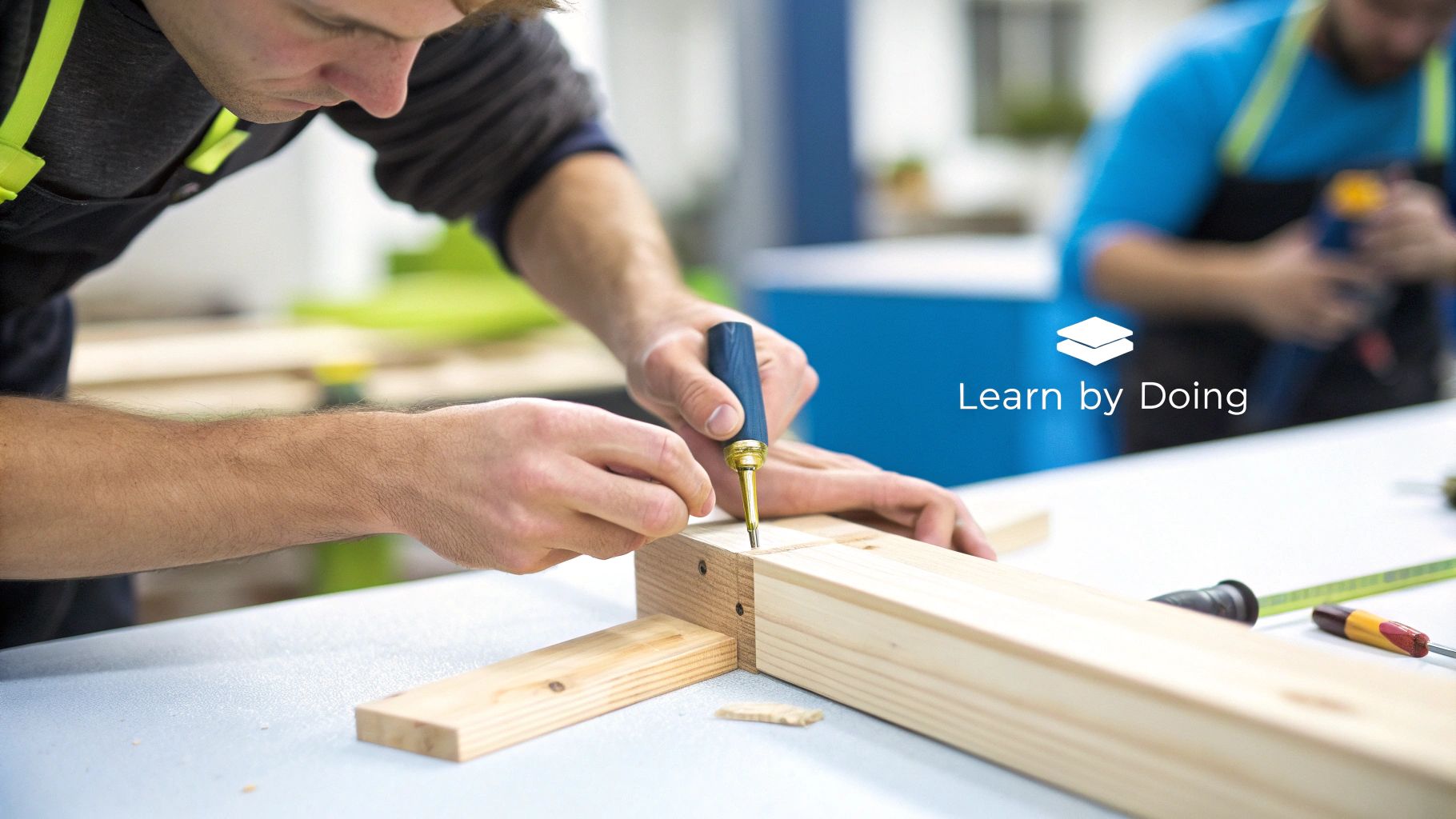
Where Tactile Learning Fits
To really get a handle on this style, it’s useful to see how it stacks up against other primary learning methods. Most people use a blend of styles, but often have a dominant preference that makes certain training far more effective. Tactile learning is one of the four main categories in most educational models.
The core idea behind tactile learning is that physical sensation creates stronger, more lasting neural pathways. When you physically perform a task, your brain encodes the information differently than when you only see or hear it. This leads to much deeper retention and faster recall under pressure.
This hands-on method isn't just a learning preference; it's a game-changer for skill development. Research from global bodies like the OECD confirms that multisensory activities, which lean heavily on tactile engagement, are critical for comprehensive and effective instruction.
Learning Styles at a Glance
How does tactile learning differ from visual, auditory, or even kinesthetic learning? The following table breaks it down, highlighting what makes the tactile approach unique. Understanding these differences is the first step toward designing training that works.
| Learning Style | Primary Method of Learning | Best For… | Example Activity |
|---|---|---|---|
| Tactile | Touching, feeling, and manipulating objects. | Mastering physical tasks and fine motor skills. | Assembling a small engine or soldering a circuit board. |
| Visual | Seeing information through charts, diagrams, and videos. | Understanding spatial relationships and complex data. | Studying a blueprint or watching a procedural video. |
| Auditory | Hearing information through lectures, discussions, and podcasts. | Learning languages and conceptual information. | Participating in a group discussion or listening to a lecture. |
| Kinesthetic | Whole-body movement and physical action. | Developing gross motor skills and physical coordination. | Learning a dance routine or practicing operating heavy machinery. |
Ultimately, tactile learning shines brightest in fields where doing is more important than just knowing. It’s why professions that demand practical skill—like becoming a dog trainer—rely on hands-on experience for true mastery. Some skills can only be learned through direct physical feedback and repetition, making a practical path to becoming a dog trainer absolutely essential.
The Science Behind Why We Learn Better by Doing
When you physically assemble equipment or practice a delicate procedure, something powerful happens inside your brain. It’s not just simple repetition; it’s a deep neurological process that hardwires skills directly into your memory. This is the core of why tactile learning is so incredibly effective.
Physical interaction fires up unique parts of the brain, especially the motor cortex and cerebellum—the areas responsible for movement and coordination. When you perform a task with your hands, these areas light up, forging neural connections that are far stronger and more complex than passive observation could ever create.
Think of it this way: watching a video is like looking at a map. But physically doing the task is like paving the road yourself, creating a permanent, reliable path for information to travel.
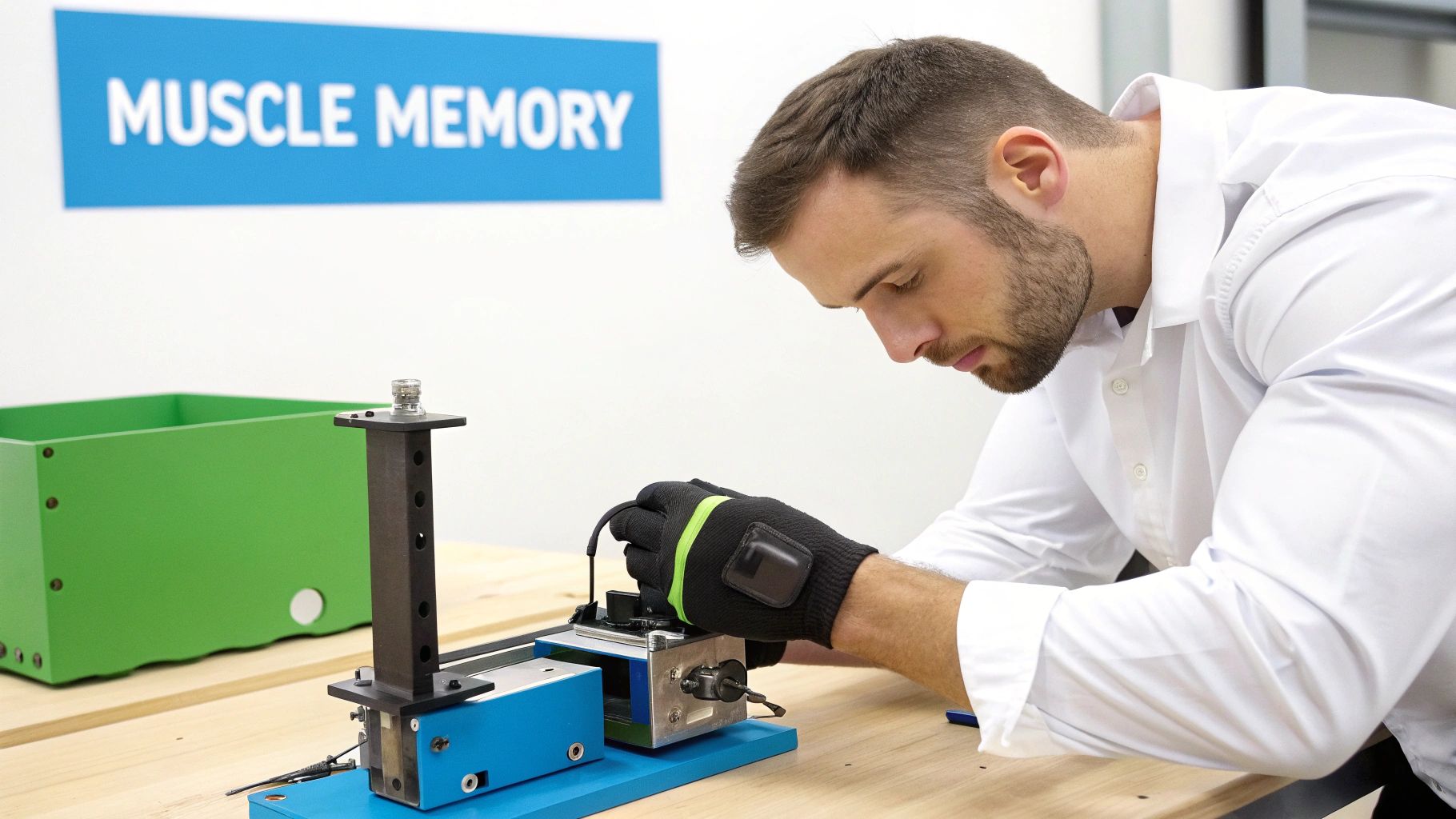
This is the process behind what we call muscle memory. It’s the reason an experienced technician can diagnose an issue just by the feel of a machine’s vibration or why a surgeon can perform a complex stitch with what looks like instinct. The skill becomes second nature, encoded not just in conscious thought but in the physical memory of the body itself.
Engaging the Senses for Deeper Understanding
Tactile learning isn’t just about the brain's motor centers; it creates a rich, multisensory experience. When you handle a tool, you’re not just moving your hands—you’re feeling its weight, texture, and temperature. Your brain processes all this sensory data at once, building a complete, contextual picture of the task.
This multisensory engagement is neurologically superior for long-term retention. Studies have consistently shown that the more senses you involve in the learning process, the stronger the memory becomes. The brain creates multiple pathways to the same piece of information, making it much easier to recall later. For instance, recent research confirms that lessons stimulating various senses create far richer and more interactive learning experiences. You can find out more about how tactile devices improve learning outcomes in recent research.
This scientific backing confirms what we’ve known intuitively for years: hands-on training isn't just a different way to learn, it’s a better way to master physical skills. Our brains are simply wired to learn by doing.
The Critical Role of Haptic Feedback
In modern training, especially in technical and industrial fields, the concept of haptic feedback is a game-changer. Haptics is any technology that recreates the sense of touch through forces, vibrations, or motions. This is where tactile learning truly comes alive inside a simulated environment.
Imagine a trainee learning to operate a sensitive piece of machinery in a virtual reality simulation. Without haptics, the experience is purely visual. But with haptic feedback, that trainee can suddenly feel the subtle resistance of a lever, the "click" of a switch, or the vibration of an engine.
This feedback loop is absolutely essential. It allows the brain to connect a physical action with a tangible consequence, dramatically improving fine motor skills and spatial awareness. The user isn't just seeing what to do; they are feeling it, which is the fast track to developing true muscle memory.
This has huge implications for workplace training. Haptics can provide:
- Realistic Resistance: Simulating the exact force needed to tighten a bolt or turn a valve, which helps prevent over-torquing on the real factory floor.
- Vibrational Cues: Alerting a user to an equipment malfunction or an incorrect procedure through simulated vibrations they can actually feel.
- Textural Recognition: Letting trainees identify different components by their virtual feel—a vital skill in low-visibility or hard-to-reach environments.
By integrating these elements, modern training solutions can replicate the physical sensations of real-world tasks. This approach makes learning safer and more scalable while aligning perfectly with how our brains are naturally designed to master complex physical skills.
Tactile vs. Kinesthetic Learning: What's the Real Difference?
When we talk about hands-on training, it’s easy to use terms like "tactile" and "kinesthetic" interchangeably. They both involve physical action, but they tap into completely different physical experiences. Understanding this distinction is key to designing training that delivers results.
Tactile learning is all about the sense of touch. It lives in the fine motor skills of our hands and fingers. Think about the feeling of a stripped screw, the subtle click of a locking mechanism, or the distinct texture of different wires. That’s your tactile sense gathering crucial information.
Kinesthetic learning, on the other hand, is about whole-body movement. This is where your gross motor skills come into play—the large muscle groups that control balance, coordination, and your position in space. It's about learning through doing on a much larger scale.
A Tale of Two Tasks
Let’s clarify this with two real-world industrial examples. One is a job of precision and feel, while the other is all about movement and spatial awareness.
-
Soldering a circuit board is pure tactile work. Your success hinges on the delicate dance between the soldering iron and the wire. You're feeling for the right amount of pressure and heat, a process guided almost entirely by the sensory feedback from your fingertips.
-
Learning to operate a forklift is a classic kinesthetic task. Here, you’re coordinating your arms to steer, your feet to work the pedals, and your entire body to judge distances and navigate a busy warehouse. You learn how the machine responds through big, physical movements.
The core idea is simple: Tactile learning is about manipulation. Kinesthetic learning is about motion. One is centered on the hands; the other on the whole body.
The Power of Working Together
In reality, most complex jobs aren't one or the other. They demand a seamless blend of both tactile and kinesthetic skills. True mastery means engaging fine motor control and large-scale body movements at the same time.
Take an aviation technician inspecting an engine. The job requires:
- Kinesthetic Actions: Moving around a massive engine, climbing ladders, and contorting their body to access hard-to-reach areas.
- Tactile Actions: Carefully guiding a borescope to see inside components, feeling for a loose connection with their fingertips, or using a specialized tool to measure a tiny tolerance.
The technician is only effective because they can integrate both. They need the gross motor skills to get into position and the fine motor skills to do the job right once they're there. Recognizing this blend is vital for building training that creates genuinely competent professionals. To dig deeper, check out our guide on the principles of the kinesthetic learning style.
The Tangible Benefits of Tactile Training in the Workplace
For any business, the real question is simple: what’s the payoff? When you bring effective tactile training into your operations, the results aren't just theoretical—they're concrete advantages you can see on the floor and in your bottom line.
When employees learn by doing, their skills become more reliable and their actions more precise. Their confidence soars, and that combination creates powerful, tangible outcomes for the whole organization.
The most immediate impact? A significant drop in error rates. Reading a manual or watching a video leaves plenty of room for guesswork, but physically running through a task builds real procedural accuracy. Think about it: an employee who has assembled a complex component ten times in a hands-on simulation is far less likely to make a costly mistake on the actual production line.
Fewer mistakes mean fewer product defects, less wasted material, and a much higher standard of quality control. Every single error avoided is a direct saving.
Accelerating Skill Acquisition and Competency
In today's market, the speed at which you can get your workforce skilled up is a huge competitive advantage. Traditional classroom learning can be slow, and there’s always a gap between knowing something and actually being able to do it well.
Tactile learning closes that gap by merging theory and practice from day one.
New hires and employees learning new roles can hit full productivity in a fraction of the time. A field service technician, for instance, can master a complex repair on a new piece of equipment through a hands-on simulation in a matter of hours, not weeks. This kind of speed means:
- Faster Onboarding: New team members become valuable, contributing assets almost immediately.
- Greater Workforce Agility: Your team can pivot to new technologies and procedures with minimal downtime, keeping you ahead of the curve.
- Increased Employee Confidence: Mastery breeds confidence. And confident employees are more engaged, proactive, and satisfied in their roles.
Tactile training isn’t just about learning a task; it’s about building an instinct for it. When an employee develops a genuine feel for the work, their performance becomes intuitive and dependable, especially under pressure.
This approach flips training from a passive event into an active, skill-building process. For those looking to explore modern ways to achieve this, augmented reality for training offers a powerful way to scale these hands-on experiences across your entire team.
Strengthening Safety and Compliance
In any industrial setting, safety is paramount. Tactile training offers a safe, controlled environment where employees can practice high-risk procedures without any real-world danger. A trainee can learn to handle hazardous materials or run through a lockout/tagout procedure in a virtual simulation, making mistakes where the consequences are zero.
This hands-on practice builds deep muscle memory for safety protocols. When a real emergency hits, employees don't have to pause and try to recall a manual—they react correctly because the right response has been drilled into them. The result is a dramatic improvement in safety metrics.
Organizations that make hands-on safety drills a priority see:
- Lower Incident Rates: Employees who have physically practiced emergency responses are simply better prepared to execute them flawlessly.
- Stronger Compliance: Consistent, repeatable training ensures every single employee meets and exceeds regulatory standards.
- Reduced Downtime and Costs: Fewer accidents mean less equipment damage, lower insurance premiums, and a healthier, more productive workforce.
Ultimately, tactile learning delivers a powerful return on investment. By slashing errors, speeding up skill development, and creating a rock-solid safety culture, it builds a more competent and resilient workforce. This isn't just another training method—it's a direct path to operational excellence and a real competitive edge.
Bringing Tactile Learning to Life with Immersive XR
Traditional hands-on training works, but it can be expensive, pose safety risks, and is difficult to scale across a distributed team. This is exactly where immersive extended reality (XR) technologies, like virtual and augmented reality, are completely changing the game.
XR dismantles the physical barriers that have held back hands-on training. It drops employees into hyper-realistic, interactive virtual spaces where they can get their hands on complex tasks safely and repeatedly—all at a fraction of the cost of traditional methods. More importantly, it makes tactile learning measurable, consistent, and instantly available to anyone, anywhere.
Scaling Hands-On Experience Without Limits
Picture a new technician tasked with servicing complex industrial equipment. The old way meant flying in an expert and taking a valuable machine offline. With XR, that scenario is obsolete.
Using a VR headset, that same technician can now step into a virtual workshop and assemble the equipment bolt by bolt. Or, with an AR solution, they can see digital instructions and 3D guides overlaid directly onto the physical machine right in front of them. They get real-time, hands-on guidance as they work, learning on the job without ever compromising safety or productivity.
This isn't just theory. The impact on key performance indicators is direct and clear.
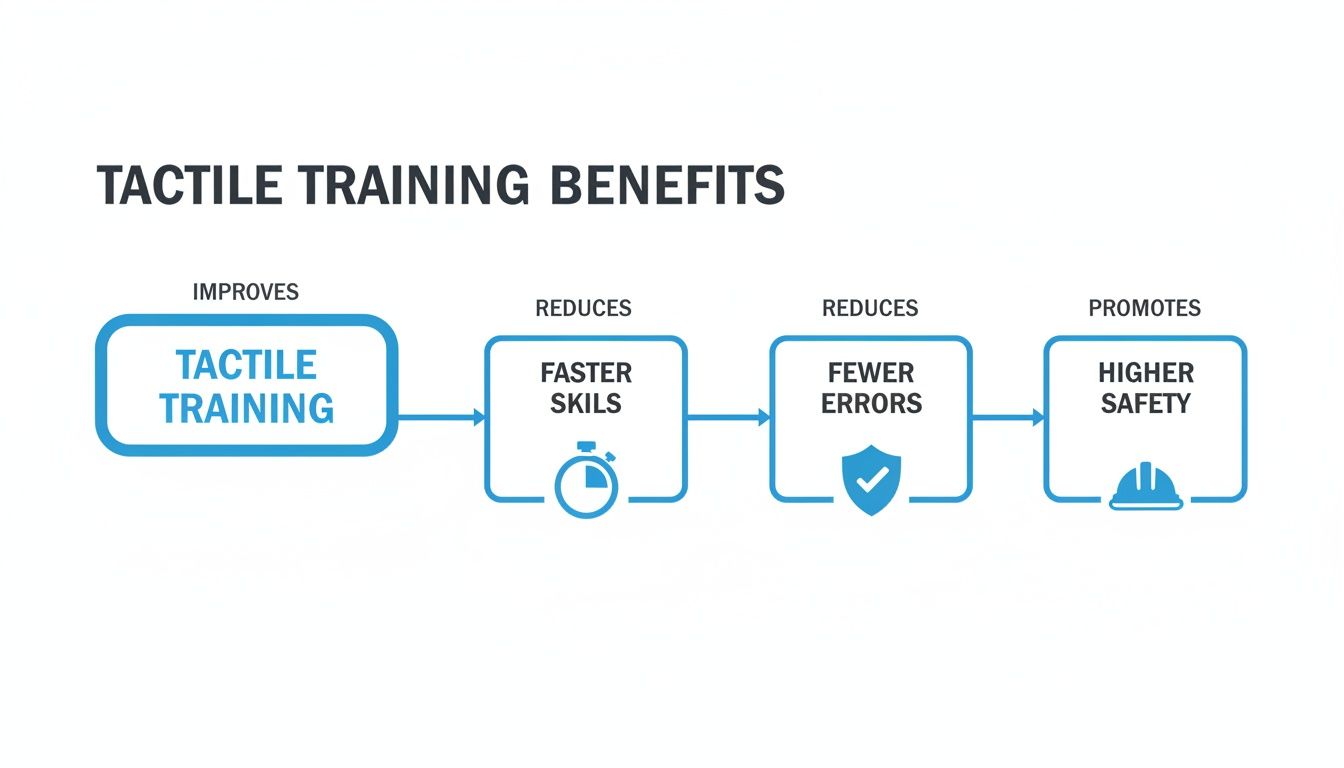
The data tells a simple story: hands-on virtual practice leads directly to faster skill development, fewer mistakes on the factory floor, and a much safer work environment for everyone.
The Power of Safe Repetition and Measurable Mastery
One of the biggest advantages of XR in tactile training is the freedom of infinite, risk-free repetition. An employee can practice a high-stakes procedure, like a high-voltage system shutdown, dozens of times until the motions are pure instinct. Every attempt builds muscle memory, turning potential mistakes into harmless learning moments instead of expensive accidents.
This unlocks a level of mastery that’s difficult to achieve in the real world. Modern XR platforms take it a step further by integrating analytics that track every single move with incredible detail.
Immersive XR platforms don't just teach a task; they measure proficiency. Every action, from the time taken to complete a step to the accuracy of a tool's placement, can be recorded and analyzed. This data provides objective proof of competency, replacing guesswork with hard evidence.
For corporate L&D teams, this is a profound shift. Training is no longer a check-the-box exercise. It becomes a data-driven strategy where you can:
- Track Skill Progression: See exactly how quickly your team is mastering new procedures and pinpoint where they need extra practice.
- Identify Common Errors: Sift through the data to spot common roadblocks and refine your training content to address them.
- Certify Competency: Use hard performance metrics to certify that an employee is 100% ready for a real-world task before they ever touch live equipment.
This level of insight drives a consistent standard of excellence across the entire organization. You can dive deeper into the principles behind this technology in our guide explaining what immersive learning is.
The value here is backed by extensive educational research. The Teaching and Learning International Survey (TALIS), which collected data from around 280,000 teachers worldwide, confirmed the power of tactile aids in engaging multiple parts of the brain. This has sparked a huge wave of interest in applying these proven methods in professional training. You can learn more about the global insights from the TALIS survey.
Ultimately, when you combine the fundamental principles of tactile learning with the sheer scale and power of XR, you’re building a more skilled, efficient, and safer workforce. It’s an approach that sidesteps old limitations and unlocks a whole new level of performance and a very clear return on investment.
Got Questions About Tactile Learning? We've Got Answers.
Even after seeing the benefits, it's natural to have a few questions about bringing tactile learning into your own organization. Let's tackle some of the most common ones we hear from teams looking to make the switch to hands-on training.
Is Tactile Learning Only for Certain Employees?
Not at all. While some people have a stronger natural preference for learning by doing, the research is clear: multisensory training gives almost everyone a boost. When you combine tactile, visual, and auditory elements, you create a far more engaging and effective learning experience for the whole team.
Think of it this way: incorporating physical interaction, especially for complex or procedural tasks, is what turns abstract ideas into real, concrete skills. It cements the knowledge for everyone, regardless of their go-to learning style.
How Do You Measure the ROI of Tactile Learning with XR?
This is where immersive technology truly shines. One of the biggest advantages of using XR for training is the incredibly powerful, built-in analytics. Modern immersive platforms can track precise metrics that are impossible to capture with traditional methods.
By tracking performance data like completion times, error rates, and procedural accuracy, you can draw a straight line from training activities to business outcomes. This data-driven approach gives you a clear, quantifiable return on your investment.
These aren't just vanity metrics. They tie directly to the numbers that matter most:
- Reduced equipment downtime
- Higher first-time fix rates
- Lower material waste
- Fewer safety incidents
Is Implementing VR and AR for Training Too Complex?
It's a valid concern, but modern XR solutions are more accessible and user-friendly than ever before. While there’s an initial investment, the long-term savings from reduced travel, fewer workplace accidents, and faster employee ramp-up times often deliver a surprisingly quick ROI.
The key is finding a solution that fits your operational needs and comes with a clear roadmap for integration. The right partner can make implementation a smooth process that grows with your organization instead of holding it back.
At AIDAR Solutions, our entire focus is on making tactile learning scalable, measurable, and effective through our immersive AR and VR applications. Our experts are here to help you design and roll out training programs that deliver real, tangible results—from faster onboarding to a huge leap in operational efficiency.
See how we can help transform your workforce at https://aidarsolutions.com.

