What Is Asynchronous Learning for Industrial Teams
Think about the difference between a seasoned mechanic's trusted repair manual—always there when you need it—and a rigid, fixed-schedule classroom lecture. That’s the heart of asynchronous learning. It’s a training model built to fit your team’s workflow, not the other way around.
This self-paced approach empowers employees to access training materials and complete learning objectives entirely on their own schedule, integrating skill development directly into their operational responsibilities.
What is Asynchronous Learning for Industrial Teams?
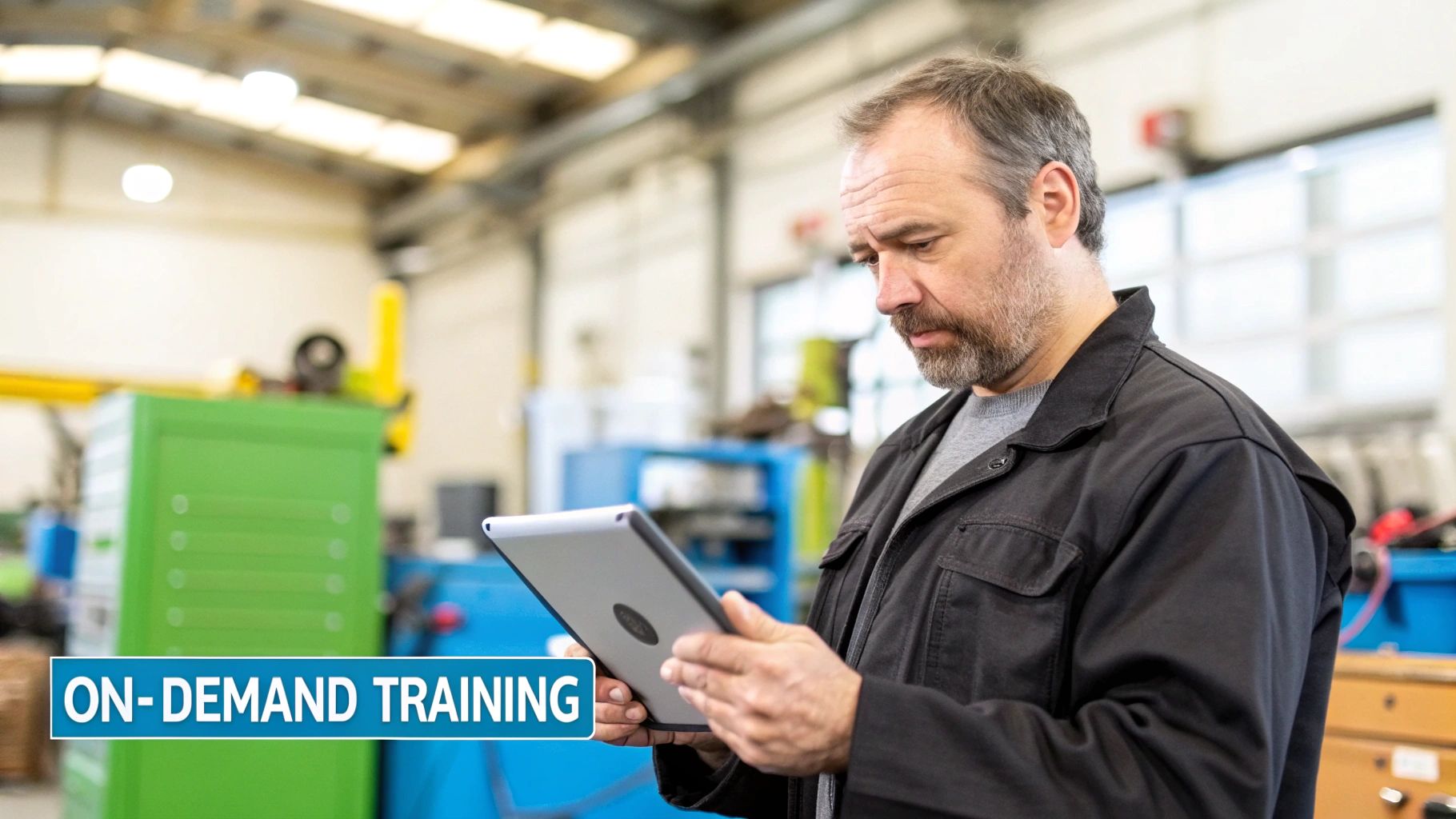
On a factory floor or out in the field, operations are continuous. With workers on different shifts, teams in remote locations, and urgent issues that arise without warning, pausing operations for live training is often impractical and costly. This is where understanding what is asynchronous learning becomes a significant strategic advantage.
Put simply, it's any learning that does not occur in a specific place at a predetermined time. Instead of halting production to gather everyone in a room, employees can access virtual courses, interactive modules, or quick-reference videos on demand. The model shifts from an instructor's schedule to the learner's immediate need, delivering critical knowledge precisely at the point of work.
Learning Models at a Glance: Asynchronous vs. Synchronous
To clarify the distinction, it is helpful to compare these two models side-by-side. One offers flexibility and on-demand access, while the other is defined by real-time, scheduled interaction.
| Characteristic | Asynchronous Learning | Synchronous Learning |
|---|---|---|
| Timing | On-demand; learners access content at their own pace and time. | Real-time; all participants learn at the same scheduled time. |
| Location | Independent; learning can happen anywhere with access. | Can be co-located (classroom) or remote (live webinar). |
| Pacing | Self-paced; controlled entirely by the individual learner. | Instructor-paced; the group moves through content together. |
| Interaction | Delayed; via forums, email, or comments. | Immediate; through live Q&A, discussions, and group work. |
| Best For | Foundational knowledge, skill refreshers, just-in-time support. | Complex problem-solving, team collaboration, immediate feedback. |
Each model serves a purpose, but for industrial settings where downtime is a critical cost factor, the flexibility of asynchronous training provides a distinct operational advantage.
Core Principles of Self-Paced Training
Effective asynchronous training is more than just recorded lectures hosted online. It is built on principles that make it highly suitable for complex industrial environments.
- Learner Autonomy: Employees control their learning path. They can progress through content at a speed that aligns with their comprehension, skipping familiar topics and dedicating more time to new or complex material.
- Just-in-Time Access: A technician can access a step-by-step augmented reality guide on a tablet directly beside the machinery they are servicing. This eliminates delays and the need to consult physical manuals, providing immediate, contextual knowledge.
- Flexibility and Scalability: A single program can train thousands of employees across different continents and time zones without logistical scheduling conflicts, removing the complexities of coordinating live sessions.
Market data validates this approach. The global e-learning market, largely driven by asynchronous formats, was valued at nearly $400 billion in 2024 and is projected to exceed $1 trillion by 2032. For industrial companies, this represents a proven path to enhanced performance. Asynchronous training, particularly when paired with immersive simulations that reduce physical risks and material waste, can accelerate skill acquisition by up to 75%. You can discover more insights about the rise of asynchronous formats and their market impact.
At its core, asynchronous learning is about delivering the right information to the right person at the precise moment of need. It transforms training from a disruptive event into a continuous, integrated component of the daily workflow.
Ultimately, this is a practical and powerful tool for building a more resilient, knowledgeable, and productive workforce. By decoupling learning from a fixed time and place, organizations can foster a culture of continuous improvement without interrupting the critical flow of operations.
Why Self-Paced Training Drives Better Business Outcomes
Transitioning from traditional, instructor-led classroom sessions to a self-paced learning model is a strategic decision that directly impacts the bottom line. By empowering teams to learn on their own terms, the entire organization becomes more agile, efficient, and resilient. The focus shifts from information delivery to genuine skill mastery.
The key to this transformation is learner autonomy. In a self-paced environment, employees control the "when" and "how" of their own training. This allows them to spend more time on complex concepts, re-watching or re-engaging with challenging material as often as needed without the pressure of keeping pace with a group.
This personalized approach is critical for knowledge retention. Studies consistently show that when individuals manage their own learning pace, their comprehension and long-term memory are significantly enhanced. They do not just "complete the course"—they achieve proficiency.
Boosting Operational Efficiency and Uptime
One of the most immediate benefits of self-paced learning is the reduction of operational disruptions. Traditional training often requires pulling entire teams off the floor, leading to production halts and costly downtime. Asynchronous training eliminates this conflict.
Consider a field technician encountering an unexpected equipment failure. Instead of waiting for an expert to be scheduled or travel to the site, they can access an on-demand AR guide immediately. A delay that could have lasted hours becomes a quick, efficient resolution. The asset is brought back online, and service level agreements are met.
By integrating learning directly into the workflow, asynchronous training evolves from a scheduled event into an on-demand utility. This empowers employees to solve problems autonomously, boosting both their confidence and the organization's overall productivity.
This model not only addresses immediate issues but also builds a more capable, self-sufficient workforce over the long term. When a team knows it can access the right information at the moment of need, its members become more proactive problem-solvers, reducing the burden on senior experts and support desks. To better understand how to structure these initiatives, review our guide on effective learning and development strategies.
Fostering a Culture of Mastery
Self-paced training provides an ideal foundation for a mastery-based progression model. In this framework, employees do not simply advance after completing modules; they practice and apply their knowledge until they demonstrate genuine competence. In industrial settings, where precision and safety are paramount, this is a non-negotiable standard.
For example, a new hire learning to operate complex machinery can use a risk-free virtual reality (VR) simulation to practice procedures repeatedly. They can make and learn from mistakes without real-world consequences or costly equipment damage.
This approach ensures that by the time they work on the actual factory floor, their skills are proven and reliable. It is a significant improvement over traditional training where all participants move on after a set time, regardless of individual mastery.
The key benefits of this mastery-focused approach include:
- Reduced Error Rates: Well-trained employees make fewer mistakes, resulting in higher-quality products and less material waste.
- Improved Safety Compliance: A confident and proficient worker is a safe worker, which dramatically lowers the risk of accidents and injuries.
- Increased Employee Engagement: When individuals feel skilled and supported, job satisfaction increases, leading to higher retention rates.
Finally, the flexibility of asynchronous learning positively impacts employee well-being. By eliminating the need for constant, back-to-back video calls and live sessions, companies are actively mitigating meeting fatigue, a significant drain on productivity. Granting individuals more control over their schedules allows them to dedicate focused time to both daily tasks and professional development, creating a mutually beneficial outcome.
Designing an Effective Asynchronous Learning Program
Understanding the value of self-paced training is the first step; building a program that delivers results is the next. A successful asynchronous program is not merely a repository of videos and PDFs; it is a carefully designed ecosystem built to engage employees, develop practical skills, and provide a measurable return on investment.
This ecosystem is founded on three pillars: compelling content, a powerful platform, and meaningful assessments.
The objective is to move beyond passive learning and create active, hands-on experiences that translate directly to on-the-job performance. This requires a strategic approach to both information delivery and competency validation.
Creating Content That Captures Attention
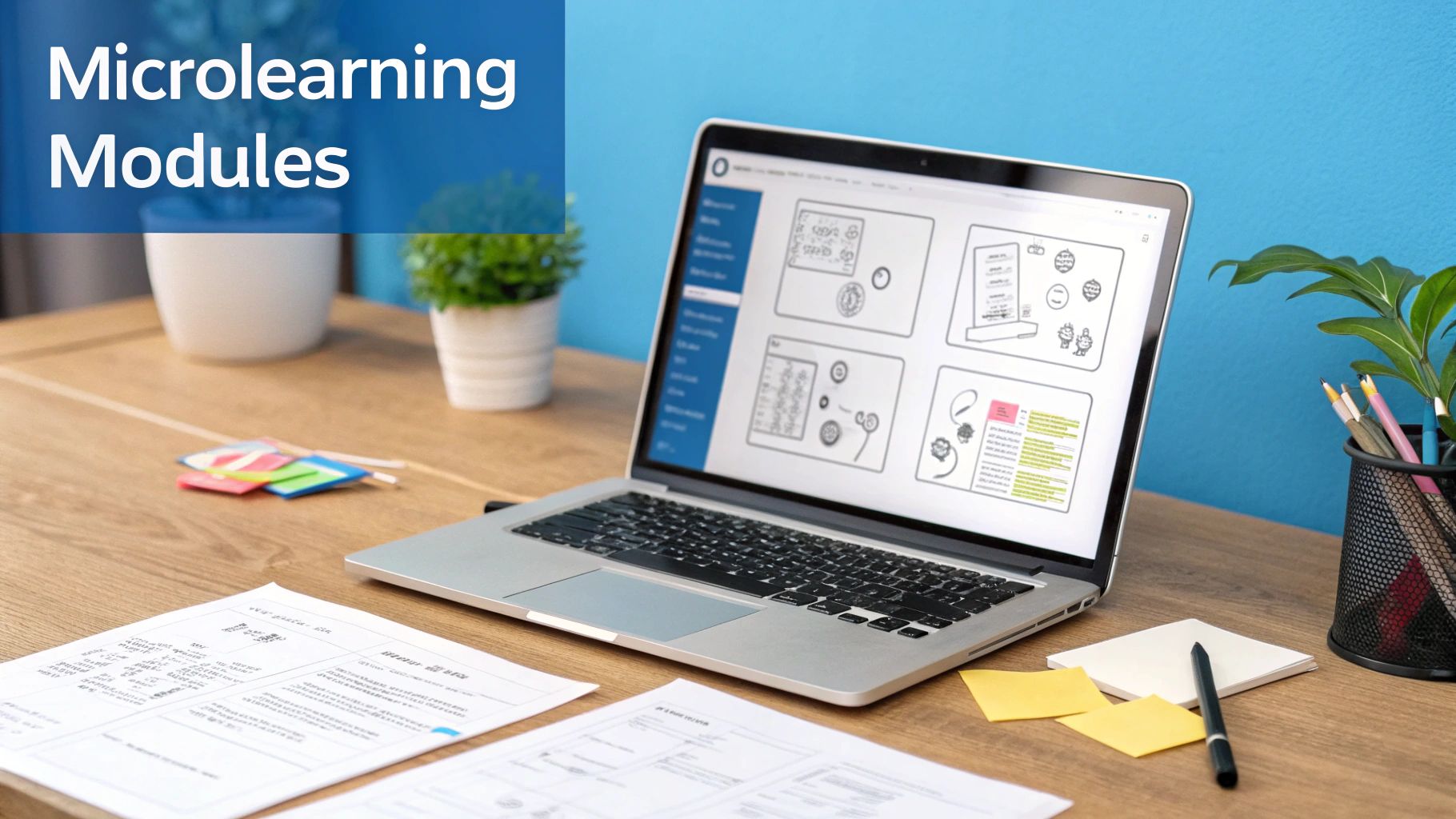
In a self-directed learning environment, content must be compelling enough to compete with daily work distractions. Lengthy videos and dense manuals are ineffective. The key is to break down complex topics into smaller, digestible segments that align with modern information consumption habits.
This is where microlearning is highly effective. Instead of a single, hour-long module, a well-designed program might include:
- Short, Focused Videos: Five-minute "how-to" clips that address a single, specific problem.
- Interactive Simulations: Allow employees to practice complex procedures in a risk-free virtual space using digital twins of actual equipment.
- Quick-Reference Job Aids: One-page checklists or infographics accessible on a tablet in the field.
This approach respects employees' time and transforms training from a scheduled chore into an on-demand resource. To further enhance this, techniques like adaptive learning can be incorporated, using AI to personalize the learning path based on individual progress.
Selecting the Right Learning Platform
Even the highest quality content will be ineffective if the delivery platform is cumbersome or outdated. The right technology forms the backbone of a scalable and effective asynchronous program. A modern platform does more than host files; it should act as the central system for tracking progress, integrating with other business tools, and providing deep analytical insights.
When evaluating platforms, look for these essential features:
- Seamless Integration: The platform must integrate with existing systems, such as your HRIS, to create a unified user experience.
- Robust Analytics: Track more than course completion. Seek detailed data on engagement, skill progression, and areas where learners may be struggling.
- Scalability and Accessibility: The system must support your entire workforce, from a small pilot group to thousands of global employees, on any device.
Choosing the right technology is foundational. For a deeper dive into modern platform features, you can learn more about enterprise learning management systems. A capable platform transforms raw data into actionable intelligence.
An effective learning platform provides L&D and operations leaders with the visibility needed to identify skill gaps, refine training content, and demonstrate a clear, quantifiable impact on business performance.
Designing Assessments That Measure True Competency
The ultimate goal is to build real-world skills, not simply to have employees check a box. Therefore, assessments must measure genuine competency. Traditional multiple-choice quizzes can test knowledge but are often poor indicators of a person's ability to perform a task.
A more effective approach is to use performance-based assessments that require employees to apply what they have learned. Examples include:
- Simulation-Based Challenges: Tasking a technician with troubleshooting a simulated equipment failure within a VR environment.
- Practical Application Reviews: Having a team member record themselves performing a key task for expert review and feedback.
These methods provide concrete evidence that an employee has mastered a skill. This shift—from a focus on completion to a focus on competency—gives leaders confidence that their training investment is creating a more capable, efficient, and safer workforce.
How Immersive XR Technology Supercharges Asynchronous Learning
Standard asynchronous learning offers scheduling flexibility, but often confines trainees to a two-dimensional screen. Videos and click-through modules have limitations in conveying complex, hands-on skills. This is where the model can be significantly enhanced with immersive technologies like Virtual and Augmented Reality (XR).
XR does not merely add an engagement layer; it fundamentally redefines what self-paced training can achieve. It transforms abstract concepts into tangible, interactive experiences that build muscle memory and true competency in ways traditional e-learning cannot.
From Watching to Doing: The VR Training Ground
Virtual Reality (VR) immerses learners in a completely digital, yet highly realistic, environment. For asynchronous training, this provides a perfect, on-demand practice space available anytime, anywhere, without consuming physical resources or introducing real-world risks.
Consider a new employee on an assembly line. Instead of watching a video of a complex procedure, they can wear a VR headset and perform the task themselves. They can handle virtual tools, work on a digital twin of actual machinery, and repeat the process until it becomes second nature.
- Risk-Free Mastery: In a VR simulation, mistakes are learning opportunities, not costly accidents. A trainee can cause a virtual machine to malfunction and learn from the experience without damaging equipment or jeopardizing safety.
- Zero Material Waste: Practicing intricate assembly or repair jobs in VR eliminates the consumption of raw materials, offering significant cost savings for industries that use expensive or specialized components.
- Accelerated Skill Acquisition: Physically performing tasks, even in a simulation, builds procedural memory much faster. This hands-on approach reduces the time required to achieve competency.
This shift is a core component of what is immersive learning, where the goal is to build genuine skill through direct experience, not just knowledge transfer.
Bridging the Digital and Physical Worlds with AR
While VR creates a new environment, Augmented Reality (AR) enhances the existing one. AR overlays digital information—such as instructions, diagrams, or live data—onto a user's view of their physical workspace, typically via a tablet or smart glasses. This makes it a powerful tool for on-the-job, asynchronous support.
Imagine a field service technician facing an unfamiliar piece of equipment requiring a critical repair. Instead of consulting a dense manual, they can use an AR device to see step-by-step instructions digitally anchored to the machine itself.
AR closes the gap between knowing what to do and actually doing it. It delivers on-demand expertise directly into the workflow, empowering employees to handle complex tasks with confidence and precision.
This approach is transforming maintenance and repair operations. Technicians can follow guided procedures, instantly identify correct parts, and receive expert assistance without leaving the job site. This not only reduces errors but also slashes the time and cost associated with dispatching senior experts for support.
The Measurable Impact of XR-Powered Asynchronous Training
Adopting immersive asynchronous training is not about technology for its own sake; it is about achieving tangible business results. This model is gaining traction because it solves persistent operational challenges and delivers a clear return on investment. The data supports this trend.
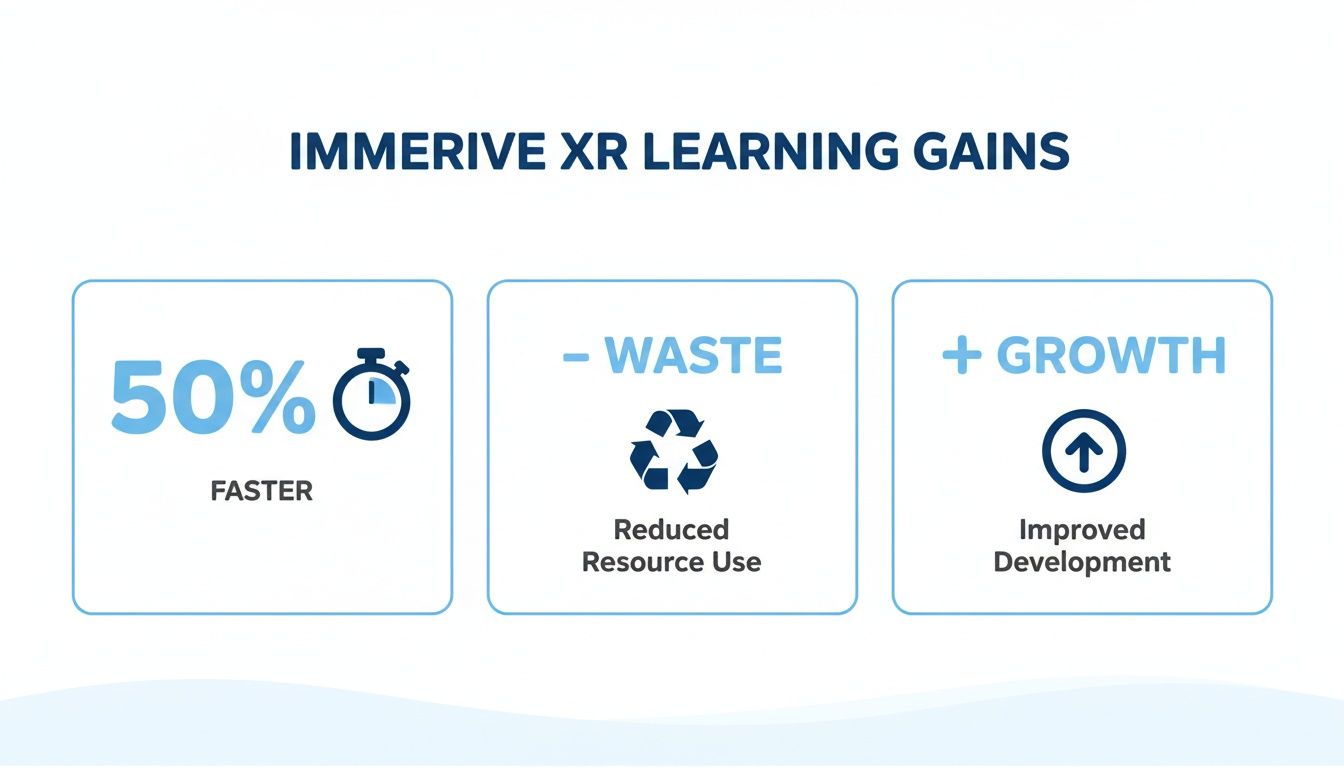
The growth of asynchronous learning is significant. In 2024, over 220 million people enrolled in online courses, a 37% increase from 2022. For industrial teams utilizing solutions like AR/VR platforms, this translates into measurable gains. These technologies can reduce service times by half with remote AR guidance and eliminate material waste through risk-free VR simulations. This aligns with the 15% annual growth in the corporate e-learning sector. You can read the full research on online learning growth for more detailed data.
Ultimately, integrating XR into an asynchronous strategy transforms it from a convenience into a powerful performance driver. It enables the development of a more skilled, confident, and efficient workforce at a scale and speed previously unattainable.
Calculating the ROI of Immersive Asynchronous Training
Any new technology investment must answer one critical question: what is the return? Immersive asynchronous training is no exception. It is essential to look beyond the novelty and focus on the hard metrics that drive business value. Operations and finance leaders require concrete data on how this technology reduces costs, boosts productivity, and enhances workforce efficiency.
The financial benefits become apparent when analyzing the ripple effects of on-demand, immersive learning. For instance, a technician mastering a complex repair in a risk-free VR simulation prevents a costly mistake on the factory floor. An expert using AR to guide a junior employee through a fix remotely eliminates an expensive travel request.
These individual efficiency gains accumulate quickly, leading to significant operational improvements.
Quantifying the Financial Impact
To build a solid business case, it is necessary to connect improved training with operational expenses. The real ROI is not just about faster course completion; it is about what a more competent and confident workforce can achieve for the business. Real-world applications tell a powerful story.
The most significant impacts are seen in these areas:
- Reduced Operational Downtime: When equipment is down, revenue is lost. Providing teams with on-demand AR guides for faster troubleshooting and repairs can significantly reduce downtime and maintain operational continuity.
- Lowered Training and Travel Costs: Immersive learning dramatically reduces the need for in-person instructors and expert travel. One practical use case saw an organization cut its expert travel budget by 75% by implementing remote AR support instead of flying specialists to job sites.
- Increased Training Capacity: Asynchronous models allow you to scale training without expanding the training department. It is possible to quadruple training throughput without hiring new instructors, enabling faster onboarding and upskilling of the workforce.
The objective is to accelerate performance while building more sustainable and efficient operations.
From Metrics to Monetary Value
The final step is to translate these operational improvements into financial terms. This is where the business case becomes compelling. For example, halving equipment service time directly boosts production output and helps meet service level agreements (SLAs). Eliminating material waste through VR practice saves real money on raw materials and scrap.
By focusing on measurable outcomes like reduced error rates and improved first-time fix rates, organizations can draw a direct line from their investment in immersive learning to higher profitability and a stronger market position.
The following table breaks down key metrics, demonstrating the quantifiable impact of transitioning from traditional methods to an XR-enhanced asynchronous model.
ROI Metrics for XR Enhanced Asynchronous Training
| Metric | Traditional Training Benchmark | XR Asynchronous Training Impact (AIDAR Example) |
|---|---|---|
| Training Time Reduction | Standard classroom/field training duration | 50% – 75% reduction in time to competency. |
| First-Time Fix Rate | Industry average of 75% | Improvement to 90%+ with AR-guided support. |
| Operational Downtime | Varies by industry (e.g., hours/month) | 30% reduction due to faster diagnostics and repair. |
| Travel Costs for Experts | Fully loaded cost per trip (airfare, hotel, etc.) | 75% reduction by using remote assistance. |
| Material Waste/Scrap Rate | 5% – 10% of materials used in training/early production | Reduced to near 0% for training exercises in VR. |
| Safety Incidents (LTI Rate) | Baseline Lost Time Injury rate | 40% reduction in safety incidents. |
These figures represent the tangible financial and operational advantages that result from adopting this technology.
To project what these numbers could mean for your own operation, a structured calculation is necessary. A good calculator allows you to input your current costs and see the potential savings. For a practical tool, you can explore our training ROI calculator to model the financial impact with your own data.
Building a Powerful Business Case
Ultimately, a convincing business case is a narrative supported by solid data. While there is an initial investment in technology and content, it is often quickly offset by sustained, long-term gains in efficiency, safety, and productivity.
When presenting to stakeholders, emphasize these three points:
- Productivity Gains: Demonstrate how quickly employees achieve full proficiency, leading directly to higher output.
- Cost Avoidance: Detail the savings from reduced travel, fewer on-site instructors, eliminated material waste in training, and fewer accident-related expenses.
- Strategic Advantage: Frame this not just as a training tool, but as a strategic asset for building a more agile, skilled, and resilient workforce prepared for future challenges.
By focusing on these clear financial outcomes, you can demonstrate that XR-powered asynchronous training is not a cost center—it is a powerful engine for business growth.
Your Enterprise Rollout Plan for Asynchronous XR
With a promising ROI analysis complete, the next step is implementation. Moving from a theoretical plan to a full-scale deployment requires a clear, structured framework. Launching an immersive asynchronous learning program is more than an IT project—it represents a fundamental shift in how your organization manages training, operations, and performance.
A methodical, phased approach is essential for building momentum, proving value, and achieving widespread adoption without causing disruption. This plan breaks down the process, translating the principles of what is asynchronous learning into an actionable, step-by-step framework.
Stage 1: Conduct a Thorough Needs Assessment
Before considering hardware or software, identify your most significant training gaps and operational pain points. The goal is to find high-value opportunities where immersive learning can deliver an immediate and undeniable impact.
Begin by asking targeted questions. Which procedures have the highest error rates? Where do safety incidents occur most frequently? What equipment downtime incurs the greatest cost? Answering these questions helps you focus on real-world problems, ensuring your initial XR modules are perceived as valuable solutions.
Stage 2: Secure Stakeholder Alignment
The success of a rollout depends on support from key leaders. This extends beyond securing a budget; it involves building a coalition across L&D, IT, and operations departments, ensuring they are all aligned.
Each group contributes essential expertise:
- L&D Leaders will champion the learning benefits and ensure content is pedagogically sound.
- The IT Department will ensure the technology integrates with existing infrastructure and complies with security protocols.
- Operations Managers provide a reality check, offering insights into actual workflows and helping measure real-world impact.
Align these stakeholders around a shared vision and agreed-upon metrics from the outset. This creates a robust support system capable of overcoming potential roadblocks.
Stage 3: Design a High-Impact Pilot Program
A pilot program is your opportunity to prove the concept in a controlled environment before committing to a full-scale rollout. Select a specific, high-impact use case identified in your needs assessment, such as onboarding new hires for a complex assembly line or a challenging maintenance task with a high failure rate.
This focused approach allows you to gather hard data, refine content, and collect honest feedback from end-users.
A well-designed pilot program is your most powerful proof of concept. It generates internal success stories and testimonials that are more effective at driving adoption than any presentation.
Your pilot must have clear objectives and KPIs, such as measuring the reduction in time-to-competency or the decrease in error rates. A successful pilot builds the confidence and internal support needed for the next stage.
Stage 4: Plan for Technology Integration and Scalability
With a successful pilot completed, it is time to plan for expansion. The final stage involves creating a phased rollout strategy that supports seamless growth. This requires mapping out the technical and logistical aspects of a wider deployment.
Address key questions: How will hardware be managed and distributed? How will content be delivered to different sites? Who will provide user support?
Create a timeline that expands the program department by department or region by region. This allows you to manage the change effectively, provide hands-on support where it is most needed, and ensure a smooth, positive experience for every employee. This methodical approach transforms a promising pilot into a sustainable, enterprise-wide strategic advantage.
Got Questions About Asynchronous Learning?
When considering a new approach to training, it is natural for L&D managers, IT leads, and operations heads to have questions. Here are answers to some of the most common inquiries about asynchronous and XR-based training to clarify its suitability for industrial teams.
How Is Asynchronous Different From Blended Learning?
This is an excellent question. While the two models share similarities, they are distinct.
Asynchronous learning is a model where the entire experience is self-paced and on-demand, with no mandatory live or real-time interaction. It functions as a comprehensive library of training modules that employees can access whenever needed, 24/7.
A blended learning model, in contrast, intentionally combines asynchronous, self-paced elements with synchronous (live) events. For example, a technician might complete a self-paced VR module independently and then participate in a scheduled live Q&A session with an expert to review the material and ask questions.
The key distinction is the mandatory live component. Purely asynchronous training prioritizes maximum flexibility, while blended learning combines self-study with valuable, real-time human interaction.
What Are the Basic IT Infrastructure Requirements?
Setting up a modern asynchronous training program, even one incorporating XR, is often more straightforward than anticipated. Extensive on-premise server infrastructure is typically not required.
The core requirements consist of three elements:
- Stable Network Connectivity: A reliable connection, such as Wi-Fi or 5G, is essential for streaming or downloading training content, particularly for larger immersive VR simulation files.
- Compatible Hardware: This refers to the end-user devices. It can be as simple as a standard tablet for AR-powered work instructions or a standalone VR headset like the Meta Quest series for fully immersive simulations.
- A Central Learning Platform: A robust Learning Management System (LMS) or Learning Experience Platform (LXP) is needed to host content, track progress, and manage user access securely.
How Can We Ensure Employee Engagement Without a Live Instructor?
This is a common concern, but engagement in an asynchronous environment is driven by the learning experience itself, not a lecturer.
Instead of relying on an instructor to maintain interest, you can build engagement directly into the training through strategies like:
- Interactive Content: Replace passive videos with hands-on simulations, gamified quizzes, and practical scenarios where learners must actively participate.
- Microlearning: Break down complex procedures into short, five-to-ten-minute modules that are easier to absorb and fit into a busy workday.
- Clear Progress Tracking: Dashboards that display progress and achievements provide a sense of accomplishment and motivate learners to continue.
Can Asynchronous XR Training Be Customized?
Absolutely. Customization is a key strength of this model, especially for industrial training. Platforms can create digital twins—highly realistic virtual replicas of your specific machinery, production lines, and facilities.
This means employees train in a virtual environment that mirrors their actual workspace, rather than on generic equipment. The skills they develop are directly and immediately transferable to their daily jobs, making the training exceptionally relevant and effective.
Ready to see how immersive, asynchronous training can be tailored to solve your specific operational challenges? At AIDAR Solutions, we specialize in creating virtual and augmented reality training that delivers results you can measure. Explore our solutions and book a demo today.