What Is Kinesthetic Learning Style Unlocking Hands-On Success
You can read a hundred books on how to ride a bike, but nothing clicks until you actually get on and start pedaling. That’s the kinesthetic learning style in a nutshell—it’s all about learning by doing.
For kinesthetic learners, information sticks best when it’s tied to physical movement, hands-on activities, and real-world application.
Understanding the Kinesthetic Learning Style
Forget sitting still through a long lecture or burying your nose in a manual. Kinesthetic learners need to get their hands dirty and actively engage with the material. They build understanding through touch, feel, and muscle memory, forging a powerful link between a physical action and a piece of information.
This isn't just a preference; it's how their brains are wired to process and store knowledge most effectively.
And the data backs this up. Often called tactile learning, this style thrives on physical activity. Research shows that when kinesthetic learners actively participate, they can retain up to 75% of what they learn. Compare that to just 10% retention from reading alone, and you start to see why this matters so much in a workplace setting.
The Core of Doing
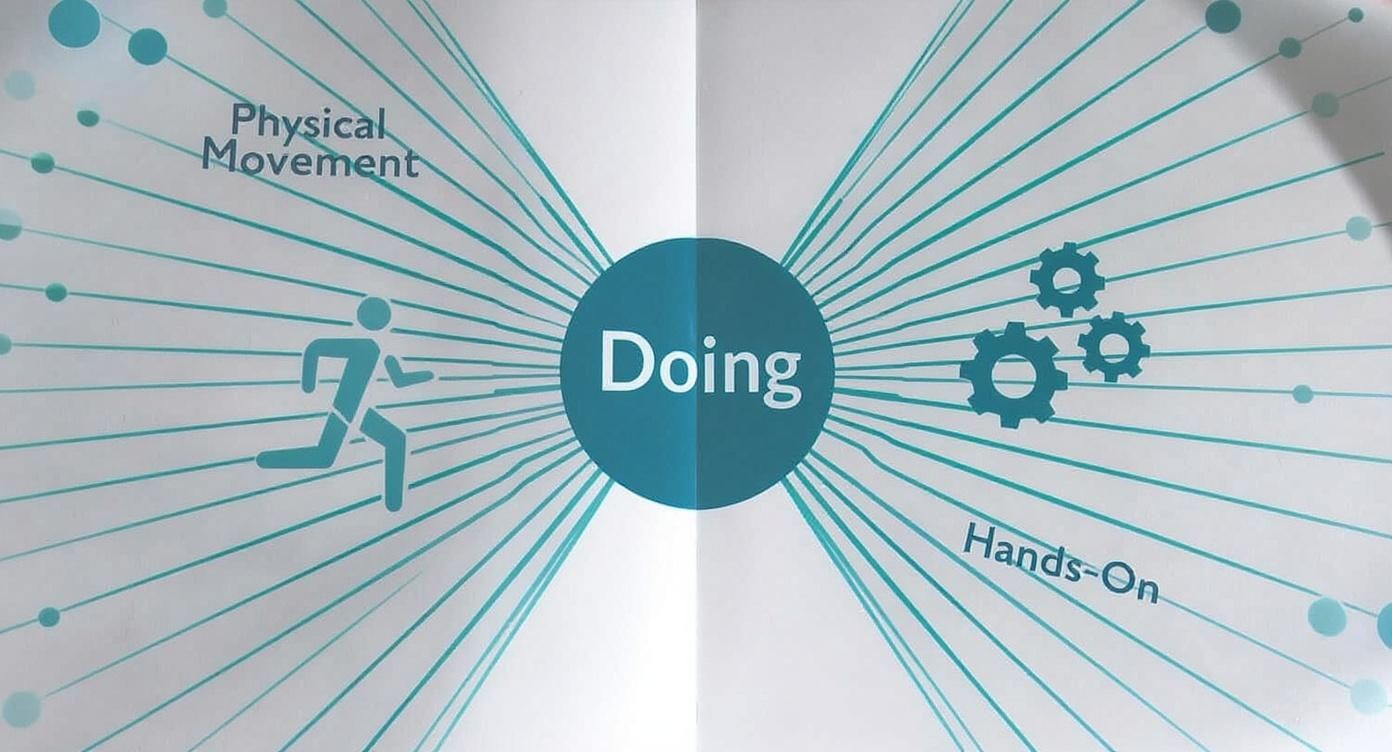
It all boils down to action. As the infographic shows, the idea of 'Doing' is built on two key pillars: physical movement and hands-on application.
For these individuals, true understanding only happens when abstract concepts become tangible actions. If you want a deeper dive into this practical approach, this guide on Hands-On Learning: A Guide for Building Real-World Skills is an excellent resource.
Kinesthetic learning creates a direct link between an action and a lesson. When the body is involved, the brain creates stronger, more durable neural pathways, making recall more intuitive and effective.
Grasping this is fundamental for creating training programs that actually work, especially in technical fields where skills are paramount. It’s the foundation for more advanced training methods, like immersive learning, which rely on physical practice to help employees achieve mastery. You can see how these concepts connect in our guide on what is immersive learning.
To really get it right, it's important to separate the real traits of a kinesthetic learner from the stereotypes. This table clears things up.
Kinesthetic Learner Traits vs Common Misconceptions
| Core Trait | What It Means | Common Misconception |
|---|---|---|
| Active Engagement | Needs to physically participate, manipulate objects, or move around to process information. | They're just fidgety or can't pay attention. |
| Trial and Error | Prefers to jump in and figure things out through experimentation rather than following step-by-step instructions. | They're impatient and don't like to read instructions. |
| Strong Muscle Memory | Excels at tasks that become second nature through repetition, like assembling a product or typing. | They're "all brawn, no brain" and struggle with complex concepts. |
| Good Hand-Eye Coordination | Naturally skilled at tasks requiring precision and physical control, such as surgery, mechanics, or sports. | They are only suited for manual labor or athletic careers. |
| Realistic Problem-Solving | Grasps abstract ideas better when they are linked to a tangible, real-world problem or simulation. | They can't handle abstract or theoretical thinking. |
Recognizing these genuine traits—and sidestepping the misconceptions—is the first step toward building training that truly resonates and delivers results.
How to Spot a Kinesthetic Learner in Your Team
Pinpointing the kinesthetic learners on your team has less to do with formal assessments and much more to do with simple observation. These are the people who reveal their learning preferences through action, not words. They're the ones who master new software by diving right in and clicking through every single menu, long before they'd ever dream of cracking open the manual.
This "learn by doing" mindset goes far beyond just technology. Kinesthetic learners often think on their feet—sometimes literally. You might notice them pacing during an important phone call or using big, expressive hand gestures to explain a complex idea. In a brainstorming session, they’re almost always the first to grab a marker and start mapping out a concept on the whiteboard, turning abstract thoughts into a physical diagram everyone can see.
Common Workplace Behaviors
If you want to spot these individuals, look for patterns in how they tackle tasks, solve problems, and communicate. Their deep-seated need for physical engagement is the common thread that runs through everything they do.
Here are a few telltale signs you're working with a kinesthetic learner:
- They prefer demos over documents: They’d much rather watch someone perform a task and then try it themselves than read a step-by-step guide.
- Movement helps them concentrate: This could be anything from tapping a pen and shifting in their chair to getting up and walking around when they're thinking through a tough problem.
- They excel at hands-on troubleshooting: When a piece of equipment breaks down, they’re the first to start physically inspecting it, checking connections, and tinkering with parts to figure out what’s wrong.
- They build prototypes and models: When hashing out a new product or process, they often create a tangible mock-up to test its real-world feasibility.
At its core, the kinesthetic learning style is all about turning ideas into action. These employees are often the crucial bridge between strategy and execution, gifted with a unique talent for making abstract plans concrete and workable.
Strengths in a Team Environment
This learning style is far from a weakness; it's a huge asset. And it's more common than you might think. Research shows that a substantial 30% to 45% of the population prefers to learn through physical engagement, making it a critical style to understand and support in any workplace. You can find more data on learning style prevalence in this research compilation from the National Math Foundation.
Once you know who these team members are, you can start assigning tasks that truly play to their strengths. They thrive in roles that demand real-world application, like product testing, on-site installations, or leading interactive training workshops. Their knack for quickly grasping physical processes makes them invaluable for training others on new equipment or demonstrating practical skills.
Figuring out how to spot a kinesthetic learner isn't just a management trick—it's the first real step toward unlocking their full potential.
The Science Behind Learning by Doing
Ever wonder why "doing" something is such a powerful way to learn? It's not just a matter of preference. The reason kinesthetic learning works so well is deeply rooted in cognitive science. When we get up and move, our bodies kickstart processes that directly support our brains.
Movement pushes more blood flow and oxygen to the brain. This simple biological fact has huge benefits—it sharpens focus, helps form memories, and can even fire up our creative problem-solving skills. For a kinesthetic learner, sitting still can actually be a roadblock. A little bit of action, on the other hand, primes the brain for peak performance.
Forging Stronger Neural Connections
The real magic, though, is happening at a neurological level. When you connect a physical action to a new piece of information, your brain builds stronger, more durable neural pathways.
Think of it like this: Reading a map of a forest gives you a general idea of the route. But actually walking the path—pushing aside branches and stepping over logs—carves that trail into your memory. The first is passive learning; the second is active, kinesthetic learning.
This process is what we often call muscle memory. It’s how an experienced mechanic can diagnose an engine issue by feel, or a surgeon can perform a complex procedure with what seems like pure instinct. The physical repetition has encoded the knowledge so deeply that it becomes second nature.
By connecting physical experience with abstract concepts, the brain doesn't just store information—it integrates it. This is why hands-on, experiential learning examples are so effective at building long-term competence.
This neurological reality is a total game-changer for corporate training. It proves that designing programs for the kinesthetic learning style isn't just about making people comfortable; it's about using proven brain science to make learning stick for good.
The Cognitive Boost from Movement
The benefits don't stop at memory. Study after study shows a clear link between physical engagement and better cognitive processing. For people who learn by doing, a traditional, lecture-heavy training session can feel like hitting a brick wall.
But when you introduce active involvement through movement and tactile tasks, comprehension and retention shoot way up. You can dive deeper into these findings and how movement enhances learning on Potomac.edu.
Understanding this science is the first step. By building programs around action, simulation, and real-world application, companies unlock a much more powerful and efficient way for their teams to learn and master new skills. The evidence is clear: when we learn by doing, we learn more deeply.
Designing Corporate Training for Hands-On Learners
To make training stick for kinesthetic learners, you have to move way beyond PowerPoint decks and dusty manuals. For these folks, engagement isn't just a nice-to-have; it's the absolute baseline for remembering anything. The entire goal is to build programs where doing is the main event, not a tacked-on activity at the end.
This means rethinking lessons entirely. Instead of just talking about a new process, why not have employees physically walk through a simulation of it? That kind of active participation cements understanding in a way that simply listening never will.
Building a Kinesthetic-Friendly Program
So, how do you design training that truly connects? L&D professionals have to weave action into the very fabric of every module. A great first step is to ditch the long, drawn-out lectures and replace them with short, energetic segments that keep people focused and moving.
Here are a few must-haves for any program built for hands-on learners:
- Integrate Physical Props: Get real tools, equipment, or models into their hands. Anything employees can touch, take apart, and work with creates a much stronger mental link to the material.
- Schedule Frequent Movement Breaks: Even a quick pause to stretch or walk around can completely reset focus. For a kinesthetic learner, this isn't just downtime—it's critical processing time.
- Gamify Problem-Solving: Turn learning goals into team-based challenges or friendly competitions. This plays directly into their natural desire to solve problems by getting involved.
- Prioritize Realistic Role-Playing: When it comes to soft skills or customer service, having employees physically act out scenarios is infinitely more powerful than just talking about hypotheticals.
Effective kinesthetic training is built on a simple principle: show, don't just tell. By allowing learners to physically experience a task, you anchor the knowledge in their muscle memory, leading to faster, more reliable recall on the job.
From Design to Measurable Impact
Creating an active learning environment is a fantastic start, but it's only half the battle. To make sure your hands-on training actually drives real improvement, it's wise to use tools that can track employee development. You can explore how employee performance management software helps connect training activities directly to tangible on-the-job outcomes.
The most effective programs are the ones that mix and match different hands-on methods. You might kick things off with a quick demonstration, then transition into an interactive simulation, and wrap up with a workshop where teams use their new skills to tackle a real-world problem. For more inspiration, you can explore a variety of methods by reviewing these top interactive learning strategies.
When you intentionally design programs with the kinesthetic learning style in mind, you're not just being inclusive—you're creating a far more powerful training experience for everyone. This approach doesn't just boost engagement; it speeds up skill acquisition, cuts down on errors, and makes sure what’s learned in the training room actually gets used in the workplace. The end result is a more competent, confident, and agile workforce ready for anything.
Using AR and VR to Supercharge Kinesthetic Training
Traditional training methods often miss the mark with kinesthetic learners. They're built on telling instead of showing, which is a major roadblock for people who need to physically do something to truly get it. For them, lectures and manuals are more like obstacles than resources.
Thankfully, modern technology is closing that gap. Augmented Reality (AR) and Virtual Reality (VR) are creating the ultimate hands-on training environments, moving beyond theory and into practical application. These are powerful, practical tools changing how we teach and learn skills.
AR and VR Practical Use Cases
Picture a field technician learning to repair a complex piece of machinery. Instead of wrestling with a dense manual, they slip on an AR headset. Suddenly, digital instructions, diagrams, and guiding arrows are overlaid directly onto the physical equipment. They learn by doing, with expert guidance appearing right in their line of sight.
Or think about a medical team practicing a high-stakes surgical procedure. In a VR simulation, they can run through the process dozens of times in a completely risk-free environment. This is where they build the muscle memory and confidence needed for the real thing, without any danger to a patient. That’s the power of immersive tech—it makes perfect practice possible.
Achieving Superior Training Outcomes
The benefits of using AR/VR solutions go far beyond just keeping people engaged. These tools deliver real, measurable improvements in performance, safety, and efficiency that old-school methods just can't touch. When you let kinesthetic learners interact with virtual objects and run through realistic scenarios, you see a direct impact on the metrics that matter.
The advantages are clear:
- Reduced Error Rates: Realistic simulations give employees a safe space to make mistakes and learn from them. The result? A 40% reduction in errors once they're on the job.
- Accelerated Skill Acquisition: Immersive, hands-on practice helps people master complex tasks up to four times faster than with conventional training.
- Improved Safety Outcomes: Training for hazardous situations in VR removes all physical risk. Teams can prepare for emergencies without ever being exposed to actual danger.
AR and VR solutions provide a direct bridge between knowledge and action, allowing kinesthetic learners to develop skills through realistic, repeatable practice. This approach dramatically shortens the learning curve and boosts long-term retention.
Bringing these technologies into your training program is a strategic move to build a more competent and agile workforce. To see exactly how this works in the real world, you can explore the applications of augmented reality for training and see the impact it's having across different industries.
The difference in effectiveness becomes crystal clear when you put modern solutions side-by-side with older methods.
Traditional vs AR/VR Training for Kinesthetic Learners
Let's break down how AR/VR stacks up against the old way of doing things, especially for hands-on learners.
| Training Aspect | Traditional Methods (e.g., Manuals, Lectures) | AR/VR Solutions |
|---|---|---|
| Engagement | Passive and often low for kinesthetic learners, leading to poor focus. | Highly active and immersive, capturing attention and motivating participation. |
| Retention | Relies on memorization, resulting in lower long-term knowledge retention. | Builds muscle memory through repetition, leading to 75% higher retention rates. |
| Practice | Limited to classroom exercises or requires access to costly physical equipment. | Provides unlimited, on-demand practice in realistic, risk-free virtual environments. |
| Feedback | Delayed and often provided by an instructor after the task is complete. | Instantaneous and data-driven, with real-time guidance and performance analytics. |
| Scalability | Difficult and expensive to scale, requiring physical classrooms and instructors. | Easily scalable across global teams, delivering consistent training to anyone, anywhere. |
Ultimately, AR and VR aren't just a novelty; they’re a fundamentally better way to train the doers on your team. By speaking their language—the language of action—you unlock faster learning, better performance, and a safer workplace.
Embracing the Power of Active Learning
We’ve covered a lot of ground in this guide—from pinpointing the core traits of a kinesthetic learning style to using brain science to build better training. We've also looked at practical design principles and the absolute game-changer that AR and VR technologies bring to creating truly hands-on learning.
The bottom line? A one-size-fits-all training model just doesn't cut it anymore in today's demanding workplace.
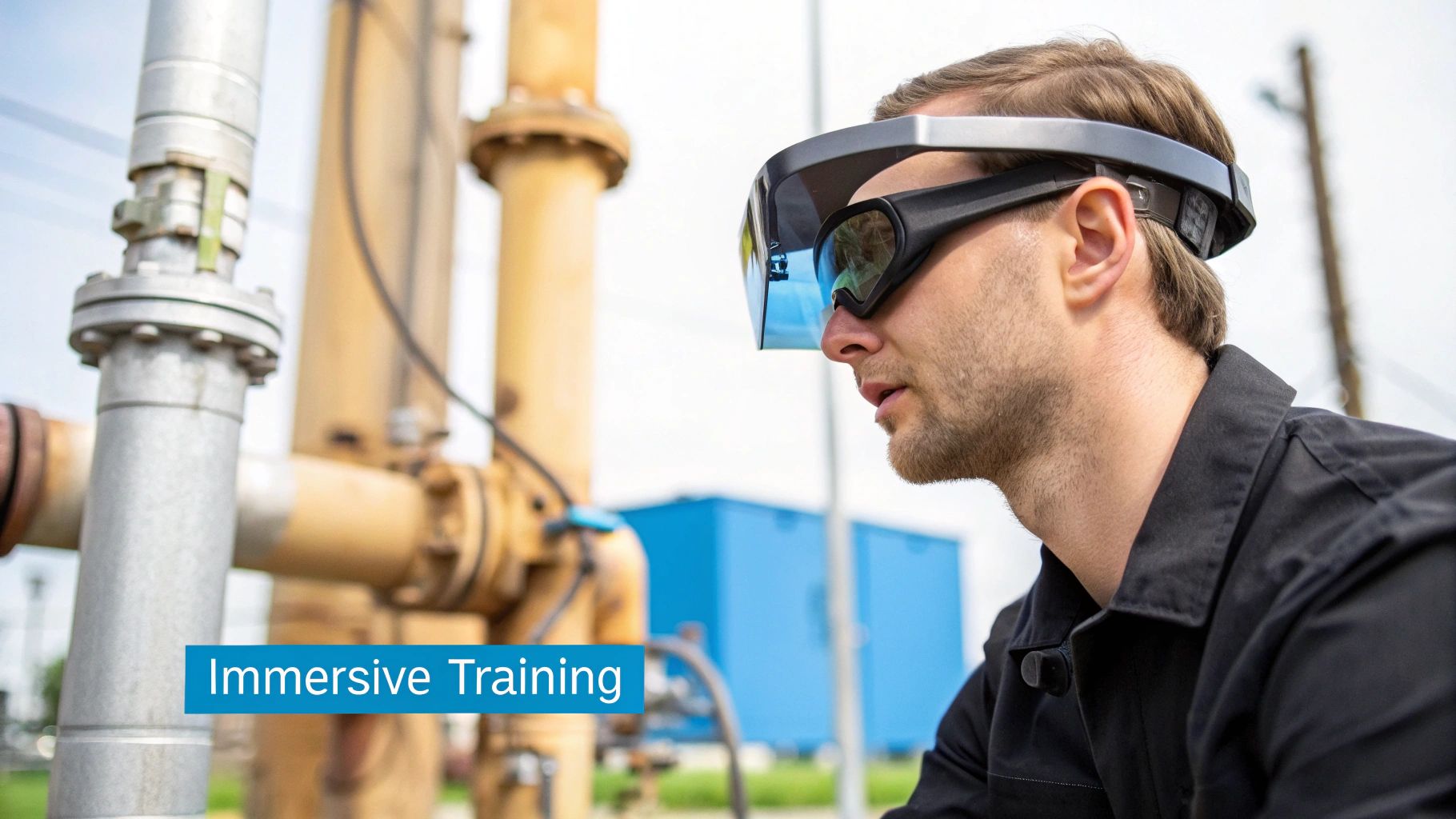
The key takeaway is simple: active, hands-on instruction isn't just a "nice to have" for some people. It’s a powerful learning accelerator for everyone. By genuinely embracing this approach, companies can unlock a ton of untapped potential and see a real boost in employee performance.
Empowering your team to learn by doing is the most direct path to building a more agile, skilled, and future-ready workforce. It transforms training from a passive requirement into an active driver of business success.
Getting people to move beyond just passively absorbing information is the only way to build real-world competence. This is where AR and VR solutions, like those from AIDAR.SKILLS, come in. They create the perfect platform for this shift.
These tools offer risk-free, repeatable environments where employees can practice, fail, and ultimately master skills through direct physical engagement. It’s time to move beyond the lecture hall and start empowering your team to learn by doing.
Frequently Asked Questions
Got questions about the kinesthetic learning style? You're not alone. Here are some quick, practical answers to the things managers and trainers ask us most often.
How Can I Support a Kinesthetic Learner in a Remote Work Setting?
Just because they're remote doesn't mean they've stopped being hands-on. The key is to create opportunities for physical engagement, even from hundreds of miles away.
Simple things help. Encourage them to take notes by hand during calls, use a real whiteboard to map out ideas, or even just stand up and walk around during virtual meetings. For formal training, interactive software simulations and AR/VR modules are a game-changer. These tools let remote employees practice real-world tasks in a digital space, effectively bridging that physical gap and keeping them locked in.
Is the Kinesthetic Learning Style a Sign of a Short Attention Span?
Not at all—this is a huge misconception. Kinesthetic learners aren't unfocused; they just focus best when their bodies are in motion. That pacing, fidgeting, or need for frequent breaks isn't a sign of distraction. It’s actually how they process information and stay sharp.
Forcing a kinesthetic learner to sit perfectly still is one of the worst things you can do. It can completely shut down their ability to learn. For them, movement isn't a distraction; it's a core part of their thinking process.
Can Someone Have More Than One Learning Style?
Absolutely. Almost everyone does. Most people have a mix of learning styles, with one or two that feel most natural. Someone might be a primary kinesthetic learner but still get a lot out of a well-designed visual aid (like an AR overlay) or clear verbal instructions (like the real-time feedback in a VR simulation).
This is why the best training programs don't just cater to one style. They use a "multimodal" approach, blending elements that appeal to visual, auditory, and kinesthetic learners all at once.
How Can I Measure the ROI of Training Designed for Kinesthetic Learners?
You measure it by tracking the metrics that matter on the floor—the ones tied directly to hands-on skill. Forget fuzzy numbers and focus on tangible improvements.
A few KPIs to watch:
- Fewer Mistakes: Are error rates dropping after the training? Track it.
- Faster Work: How long does it take an employee to complete a key task? Measure it before and after.
- Less Hand-Holding: Are they calling for a supervisor or expert less often? That's a huge win.
This is where AR/VR training platforms really shine. They automatically capture detailed analytics on everything a user does inside a simulation. It makes tracking progress and quantifying skill improvement incredibly straightforward.
Ready to see what immersive, hands-on technology can do for your corporate training? AIDAR Solutions builds AR and VR platforms that don't just teach—they accelerate skill acquisition and deliver results you can measure. Discover our solutions at https://aidarsolutions.com.