
Smarter Machinery Maintenance Services to Cut Downtime
Machinery maintenance services are the expert activities designed to keep your industrial equipment running smoothly, preventing unexpected breakdowns and ensuring your assets achieve their maximum lifespan. This isn't just about fixing things; it’s a strategic approach that becomes a core driver of operational stability and profitability.
Why Smart Maintenance Is Your Greatest Competitive Edge
Picture your production line, humming along without a single, costly interruption. That’s not just good luck—it’s the direct result of a smart, deliberate maintenance strategy. In today's industry, machinery maintenance services aren’t a necessary evil or a pesky line item on the budget. They're the backbone of your operational resilience and a massive competitive advantage.
The old "if it breaks, fix it" model is a recipe for disaster in any serious production environment. Every minute of unplanned downtime is money walking out the door, shipments getting delayed, and your brand's reputation taking a hit. Smart maintenance flips that script completely. It’s all about moving from a reactive, chaotic scramble to a proactive, controlled state of readiness.
The Evolution from Reaction to Prevention
The journey starts by simply stopping the habit of waiting for things to fail. Proactive maintenance is all about anticipating what your machines need and acting before a minor hiccup snowballs into a catastrophic failure. This foresight stops that costly domino effect where one tiny component failure grinds an entire assembly line to a halt.
This preventative mindset pays off almost immediately:
- Fewer Unplanned Stoppages: When you schedule maintenance, you’re the one deciding when equipment goes offline, keeping disruptions to your production schedule at an absolute minimum.
- Longer Asset Lifespan: Regular care is like a health and fitness plan for your machines. It ensures they perform reliably for years, often well beyond their expected service life.
- A Safer Workplace: It’s simple: well-maintained equipment is safer equipment. You drastically reduce the risk of accidents caused by mechanical failures.
A well-executed maintenance program doesn't just fix problems—it prevents them from ever happening. It turns a major operational risk into a predictable, manageable process that actually fuels growth and reliability.
The Financial Impact of Strategic Upkeep
The financial case for investing in top-notch machinery maintenance services is impossible to ignore. The global market for machinery and heavy equipment repair hit a staggering $167.5 billion in revenue in the latest 2025 reports, a clear sign of its critical role in the world economy. You can explore more insights on the machinery repair market size on Kentley Insights. This spending isn't just on repairs; it’s a direct investment in uptime, efficiency, and long-term profit.
By getting ahead of major breakdowns, you also sidestep the insane costs that come with emergency repairs, overtime labor, and rush shipping for replacement parts. Better yet, optimized equipment runs more efficiently, uses less energy, and produces higher-quality output, all of which directly boost your bottom line.
As you dig deeper into how to reduce downtime in manufacturing, you'll find that a strategic maintenance plan is your first and most powerful defense against lost productivity. Now, technologies like AI and AR are pushing the boundaries even further, completely reshaping what’s possible in asset management and operational excellence.
Understanding Your Maintenance Strategy Options
Choosing the right approach to machinery maintenance is a lot like deciding how to take care of your car. You could just wait for something to break, stick to a rigid service schedule, or use modern diagnostics to catch a problem before it leaves you stranded. The truth is, not all strategies are created equal, and the best game plan usually involves a smart mix of different approaches, tailored to your specific equipment and what you need to achieve.
To get a solid grip on your options, it's helpful to start by comparing predictive and preventive maintenance strategies, as these proactive methods are where the real value lies. By breaking down the four core types, you can build a playbook that cuts downtime and squeezes every bit of life out of your assets.
This flowchart shows how maintenance has evolved—moving from simple reactive fixes to proactive strategies, and finally to the intelligent, tech-driven approaches we see today.
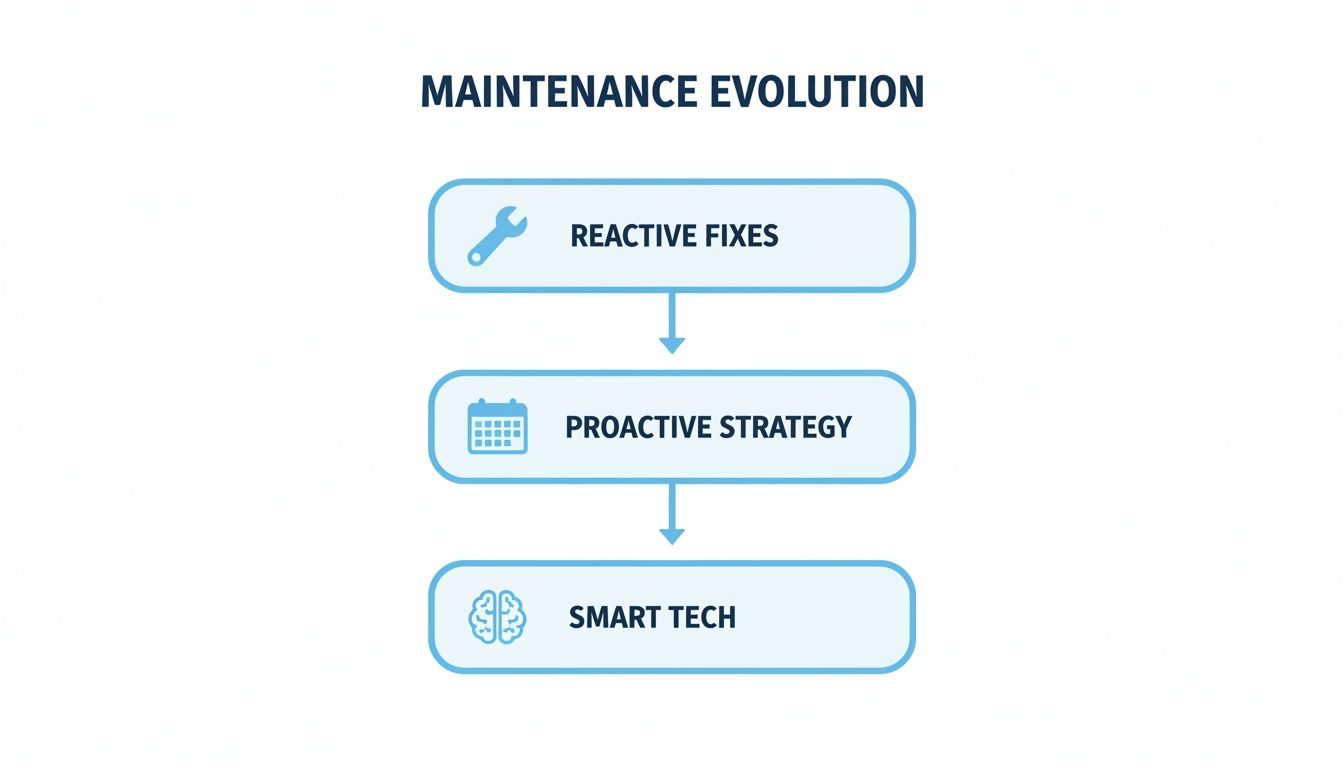
This progression makes one thing clear: as maintenance gets smarter and more informed by data, it stops being a cost center and becomes a powerful driver of operational excellence.
Corrective Maintenance: The "Run-to-Failure" Model
Corrective maintenance is the most straightforward strategy out there: you only fix something after it’s already broken. Think of it as dealing with a flat tire on the side of the highway. There was no plan; you’re just reacting to an unexpected failure.
This approach is purely reactive and, not surprisingly, often leads to the biggest and most expensive disruptions. While it might feel like the cheapest option—since you're not spending on upkeep—the real costs show up in unplanned downtime, emergency repair bills, and the ripple effect of damage across your production line.
That said, corrective maintenance isn't always a bad idea. It can be a perfectly sensible choice for non-critical, inexpensive, or redundant equipment where a single failure won't bring your entire operation to a halt. If a small, easily swapped conveyor belt motor dies and you have a spare on the shelf, waiting for it to break might actually be more cost-effective than scheduling regular checks.
Preventive Maintenance: The Scheduled Check-Up
Stepping up the ladder, we have preventive maintenance. This is a proactive strategy built around a fixed schedule, much like your car’s routine oil change every 5,000 miles or your annual physical. Maintenance tasks are performed at set intervals—based on time, usage hours, or production cycles—no matter what the machine's actual condition is.
The main goal here is to stop failures before they happen. This scheduled approach brings some serious benefits:
- Increased Predictability: You’re in control of when equipment goes offline, so you can plan production around maintenance windows.
- Extended Asset Life: Regular service keeps parts in good shape, preventing minor wear and tear from snowballing into major failures.
- Improved Safety: A well-maintained machine is a safer machine. It drastically cuts the risk of accidents caused by sudden equipment failure.
The biggest downside? The risk of "over-maintenance." You might end up replacing a part that still had plenty of life left in it, just because the calendar said so. This can lead to unnecessary spending on both labor and spare parts.
Condition-Based Maintenance: The Smart Alert System
Condition-Based Maintenance (CBM) takes a much smarter, data-first approach. Instead of following a rigid schedule, CBM uses real-time data from sensors to monitor the actual health of an asset. You only take action when the data shows that performance is slipping or a failure is on the horizon.
Think of this as the "check engine" light in your car or the brake wear sensor that tells you it's time for new pads. You aren't replacing the brakes every 20,000 miles; you’re replacing them when the sensor tells you they’re actually worn down.
CBM is a huge leap forward, shifting the focus from scheduled actions to informed interventions. It uses real evidence—not guesswork—to answer the question, "Does this machine actually need maintenance right now?"
Common CBM techniques include vibration analysis, oil analysis, and infrared thermography, all of which spot anomalies that signal a developing fault. This lets you schedule maintenance at the perfect moment—just before failure occurs—avoiding both unexpected breakdowns and unnecessary service.
Predictive Maintenance: The Data Forecaster
Predictive Maintenance (PdM) is the most advanced strategy of them all. It builds on CBM by using sophisticated data analysis and machine learning to forecast exactly when a failure is likely to happen. If CBM is the alert that your brakes are thin, PdM is the system that tells you, based on your driving habits and current wear rates, your transmission will probably fail in the next 1,000 miles.
This approach digs through historical and real-time data to find subtle patterns that come before a failure. By predicting breakdowns with a high degree of accuracy, you can schedule repairs with maximum efficiency, order parts just in time, and all but eliminate disruptions. As you explore these advanced methods, it's helpful to understand the nuances between preventive and predictive maintenance to see what fits your operation.
While PdM requires a real investment in technology and data science know-how, the payoff can be huge, getting you to near-zero unplanned downtime on your most critical assets. Ultimately, a blended approach—applying the right strategy to the right machine—is the secret to a world-class maintenance program.
To help you decide, here’s a quick breakdown of how these four strategies stack up against each other.
Comparison of Maintenance Strategies
| Maintenance Type | Trigger for Action | Primary Goal | Typical Cost Profile | Best For |
|---|---|---|---|---|
| Corrective | Equipment failure | Restore function | Low initial cost, high unexpected costs | Non-critical, redundant, or low-cost assets |
| Preventive | Fixed schedule (time, usage) | Reduce failure likelihood | Moderate, predictable costs | Assets with known failure patterns |
| Condition-Based | Real-time condition monitoring | Intervene at the optimal moment | Higher initial investment, lower long-term costs | Critical assets where data is easily collected |
| Predictive | Data-driven failure forecast | Prevent downtime by predicting failures | Highest initial investment, highest long-term ROI | Mission-critical, complex machinery |
Choosing the right mix from this table is key. You wouldn't use a predictive model on a lightbulb, but you also wouldn't wait for a critical production robot to fail before fixing it. The goal is to build a balanced, cost-effective program that keeps your operations running smoothly.
Measuring the Real ROI of Your Maintenance Program
So, how do you prove that your budget for machinery maintenance services is a strategic investment and not just another line item on the expense report? It all comes down to connecting your proactive maintenance work directly to tangible business outcomes.
A smart maintenance program does way more than just fix broken equipment; it builds a more resilient, profitable, and safer operation from the ground up.
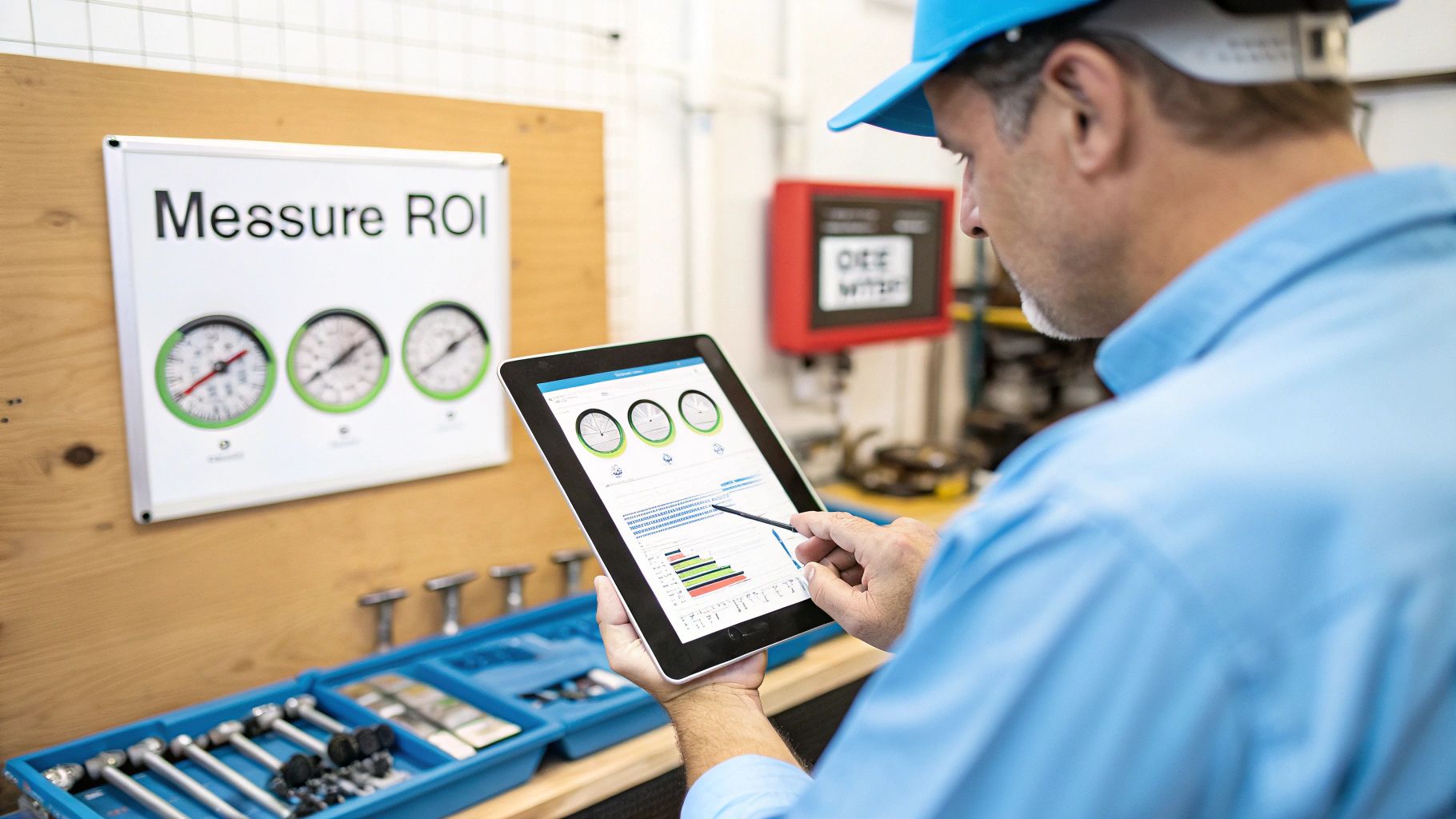
This shift in thinking is absolutely critical. Instead of seeing maintenance as a cost center, the most successful organizations view it as a direct driver of value. By moving from reactive, "firefighting" fixes to planned, intelligent upkeep, you're actively slashing the risk of catastrophic downtime, getting more life out of your most valuable assets, and creating a more secure workplace for your team.
And this isn't just a niche idea—it's a global movement. The industrial maintenance services market was valued at $58.04 billion in 2025 and is expected to climb to $76.96 billion by 2029. You can find the full research on this growth at ResearchAndMarkets.com. That kind of money doesn't lie; it shows a worldwide push for smarter, more dependable operations.
Key Performance Indicators That Tell the Story
To build a rock-solid business case for your maintenance program, you have to speak the language of the C-suite: numbers. Key Performance Indicators (KPIs) are your tools for translating your team's hard work into a clear story of financial return. They give you the proof you need to justify budgets and show real progress.
Here are a few of the most important KPIs to get on your dashboard:
-
Mean Time Between Failures (MTBF): Think of this as the average uptime between breakdowns for a specific asset. When your MTBF starts climbing, it's direct proof that your maintenance efforts are making equipment more reliable and stopping those surprise failures in their tracks.
-
Mean Time To Repair (MTTR): When something does break, MTTR tracks the average time it takes to get it back up and running. A shrinking MTTR shows your team is getting faster and more efficient at diagnosing and fixing problems, keeping downtime to an absolute minimum.
-
Planned Maintenance Percentage (PMP): This one is simple but powerful. It calculates how much of your team's time is spent on scheduled, proactive tasks versus unplanned, reactive chaos. A high PMP—with a target often around 80% or more—proves you're in control of your workflow, not the other way around.
Unlocking Deeper Insights with OEE
While individual metrics like MTBF and MTTR are great, Overall Equipment Effectiveness (OEE) gives you the complete, unvarnished truth about your production health. OEE is the gold standard because it combines three critical factors to give you a single, powerful measure of productivity.
OEE = Availability x Performance x Quality
Let's quickly break that down:
- Availability: This score tells you how much time your machine was actually running compared to when it was scheduled to run. It answers the question, "Did we lose production time due to stops?"
- Performance: This measures how fast the machine was running against its ideal speed. It asks, "Were we running as fast as we possibly could?"
- Quality: This one is all about defects. It accounts for any parts that didn't meet standards and had to be scrapped or reworked. It asks, "How many good parts did we make?"
A world-class OEE score is typically considered 85% or higher, but honestly, many facilities are running far below that. The good news? Improving your OEE by even a few percentage points can lead to huge gains in output and profit—all without buying a single new piece of equipment.
As you get more sophisticated, you can learn more about how to measure and improve these and other operational efficiency metrics in our detailed guide. By consistently tracking these KPIs, you can move the conversation from cost to value and show everyone the undeniable ROI of your machinery maintenance services.
How AR and VR Solve Critical Maintenance Challenges
What if your technicians could see every schematic and get expert guidance right in their line of sight, overlaid directly onto the machine they’re servicing? This isn’t science fiction anymore. It’s the reality that Augmented Reality (AR) and Virtual Reality (VR) are bringing to machinery maintenance, tackling some of the industry's most stubborn problems head-on.
From the widening skills gap to supporting technicians at remote sites, these immersive tools are changing the game.

This shift couldn't come at a better time. Heavy machinery maintenance and repair services already make up a huge 18% share of the global maintenance market. Valued at $182.9 billion in 2022, the sector is on track to hit $284 billion by 2032, according to a report from Fact.MR. This explosive growth screams for smarter, more efficient ways to keep equipment running.
AR for On-Demand Expertise and Guided Workflows
Augmented Reality lays digital information—text, diagrams, 3D models—right on top of the physical world. For a maintenance technician, this is a total game-changer.
Picture a junior tech wearing AR glasses, standing in front of a complex hydraulic pump. Instead of juggling a clunky tablet or greasy paper manual, they see step-by-step instructions floating right next to the parts they need to work on. Arrows point to the exact bolt to turn, and critical torque values appear right where they're needed. It's hands-free guidance that slashes errors and gets the job done faster.
But the real magic of AR is how it connects people. A field technician can stream their first-person view to a senior expert thousands of miles away. That expert can then "draw" on the technician’s screen, circling a faulty part or dropping a digital pin on the correct switch. This solves two massive problems at once:
- Bridging the Skills Gap: Less experienced techs get real-time, over-the-shoulder coaching from the best in the business.
- Eliminating Travel Delays: Experts no longer have to fly to remote sites for every complex issue, which cuts travel costs and gets equipment back online in a fraction of the time.
AR doesn't replace skilled technicians; it empowers them. It acts as an intelligent co-pilot, delivering the right information at the right time, turning every field operative into a more capable problem-solver.
By giving teams this instant pipeline to expertise, companies can boost their first-time fix rates significantly. A problem that once meant a prolonged shutdown can now become a quick, guided repair. To see how this works in practice, you can explore our in-depth guide to using augmented reality for maintenance.
VR for Safe and Repeatable Skills Training
While AR brings digital help to the real world, Virtual Reality builds entirely simulated worlds for training. Think of VR as the ultimate "flight simulator" for maintenance. It gives technicians a place to learn and practice high-stakes procedures in a perfectly safe, controlled digital twin of the factory floor.
Consider the challenge of training someone to work on high-voltage switchgear or a multi-ton press. A single mistake on live equipment can lead to serious injury or catastrophic damage. VR takes that danger completely off the table.
Inside a hyper-realistic virtual environment, trainees can disassemble and reassemble complex machines, diagnose simulated faults, and practice emergency shutdowns over and over again. This approach has some serious advantages:
- Risk-Free Learning: Trainees can make mistakes without any real-world consequences, building the confidence and muscle memory they need for critical tasks.
- Standardized Training: Every employee gets the exact same high-quality training, no matter who their instructor is or where they're located.
- Accelerated Competency: Immersive learning can improve knowledge retention significantly compared to traditional methods like reading a manual or watching a video.
From basic safety protocols to intricate engine rebuilds, VR helps organizations build a more skilled and prepared workforce. It ensures technicians have the experience they need before they ever touch a real piece of critical equipment, leading to safer operations, fewer mistakes, and a much more confident team.
How to Choose the Right Maintenance Services Partner
Picking a partner for your machinery maintenance services isn't just another item on a procurement checklist. It's a long-term strategic decision. The right provider doesn't just fix things when they break; they become an extension of your own team, a genuine ally in the push for operational excellence.
It's tempting to focus on the sticker price, but that’s a rookie mistake. Real value comes from a partner whose capabilities boost your uptime, extend asset life, and sharpen your processes. You need someone who can grow and innovate right alongside you, delivering the kind of rock-solid reliability your business depends on.
Evaluate Deep Industry Expertise
A maintenance provider has to speak your language. Whether you're in manufacturing, energy, or pharmaceuticals, they need to get the unique pressures, equipment, and regulations that define your world. Generic, one-size-fits-all knowledge just won't cut it when a highly specialized, critical asset goes offline.
Look for a team with a proven track record in your specific sector. Don't be shy—ask for case studies or references from companies that face the same operational headaches you do. Their people should have a deep-seated understanding of your machinery's common failure modes and know the best ways to get ahead of them. This is what separates a basic contractor from a true strategic partner.
Verify Safety and Compliance Standards
In any industrial setting, safety is the one thing you can't compromise on. A potential partner’s safety record and their commitment to compliance are deal-breakers. A single incident can spiral into serious injuries, crippling fines, and a hit to your reputation that's hard to come back from.
Your vetting process has to put their safety program under a microscope.
- Request Safety Metrics: Ask for their Total Recordable Incident Rate (TRIR) and other key safety stats. A low, consistently improving rate is a great sign of a mature safety culture.
- Check Certifications: Make sure their technicians have the right certifications and get regular training for the specific equipment they'll be working on.
- Review Compliance Protocols: They must have solid procedures for following all relevant industry and government rules, like OSHA standards.
A partner who puts safety first is a partner who values professionalism and is committed to protecting your most important assets: your people and your equipment.
Choosing a maintenance provider is like selecting a co-pilot for your operations. You need someone with the experience to navigate turbulence, the technical skill to manage the controls, and an unwavering commitment to getting everyone home safely.
Probe Their Technological Capabilities
Finally, take a hard look at their tech toolkit. A forward-thinking partner will be all over modern solutions that drive real efficiency, especially tools like remote assistance and AR-guided workflows that solve today's biggest maintenance bottlenecks.
Ask them directly about the tech they use. Can they provide remote expert support to walk your on-site team through a tricky repair, slashing travel costs and MTTR? Do they use AR to overlay digital work instructions onto equipment, cutting down on errors and speeding up service?
A partner who invests in this kind of tech is better equipped to support you in a fast-moving industrial landscape. Their ability to weave these tools into their service shows they're focused on giving you maximum value and efficiency, not just checking a box.
Your Top Questions About Modernizing Machinery Maintenance
Making the jump to a smarter maintenance strategy can feel like a massive project, but it’s really just a series of manageable steps. Let's tackle some of the most common questions that come up when teams decide to move from firefighting to a more forward-thinking approach.
We've designed these answers to be straightforward and give you the clarity you need to get started.
What’s the First Step to Get Away from Reactive Maintenance?
Don't try to boil the ocean. The best first move is a criticality analysis of your equipment. You simply can't roll out a preventive plan for every single machine at once, so figure out which assets would bring your operations to a grinding halt if they failed.
Once you have that high-priority list, start small. Build a basic maintenance schedule for just those machines, using the manufacturer's advice or your own historical failure data as a guide. This focused approach gives you the biggest win for the least amount of initial effort.
Can You Explain Predictive Maintenance in Simple Terms?
Imagine your car’s engine could send you a text saying, "Hey, based on my current vibration and oil temp, my main bearing is going to give out in about 750 miles." That’s predictive maintenance in a nutshell.
It works by using sensors to listen to your equipment in real-time—monitoring things like vibration, heat, or pressure. Smart software then analyzes all that data, hunting for tiny, invisible patterns that are early warning signs of a breakdown. Instead of reacting to a failure or sticking to a rigid schedule, you can predict problems and fix them with surgical precision before they ever happen.
Predictive maintenance changes the entire conversation. You stop asking, "What broke?" and start asking, "What's about to break, and when?" It lets you schedule repairs on your own terms, crushing downtime and slashing costs.
What’s a Realistic Timeline for Getting Started with AR Remote Assistance?
You can get an AR remote assistance tool up and running much faster than you might think. A small pilot project with one or two teams can be live in as little as four to eight weeks.
Here’s what that usually looks like:
- Weeks 1-2: Picking a vendor, defining the scope of the pilot, and getting the initial hardware set up.
- Weeks 3-4: Light software configuration and training the pilot group of technicians and experts.
- Weeks 5-8: Kicking off the pilot, getting feedback from the team, and tweaking the process for a bigger rollout.
The trick is to pick one specific, high-value problem to solve first—like helping a field tech with a common but tricky repair. Proving the value quickly builds the momentum you need to expand the program across all your machinery maintenance services.
How Do I Actually Calculate the ROI on a New Maintenance Program?
Calculating the ROI is all about weighing the costs of the new program against the money it saves or makes you. First, add up your costs: software licenses, new sensors or tools, and the time spent on training.
Then, you need to put a dollar value on the benefits. Track your key metrics before and after you make the switch, focusing on the clear financial wins:
- Reduced Downtime Costs: How much revenue did you save by avoiding unplanned shutdowns?
- Lower Repair Costs: Tally up the savings from fewer emergency call-outs and less overtime pay.
- Increased Production Output: What's the value of the extra product you were able to make because machines were running more?
Just subtract the total cost from the total benefit, then divide that number by the total cost. That's your ROI percentage. This kind of hard data makes an undeniable business case.
Ready to see how AR and VR can solve your most pressing maintenance challenges? At AIDAR Solutions, we specialize in immersive tools that reduce downtime, accelerate training, and connect your experts to your frontline teams instantly. Discover how our solutions can transform your maintenance operations.