
Preventive and Predictive Maintenance Guide
Think about your car for a second. The traditional approach is to change the oil every 5,000 miles, whether it needs it or not. That’s a classic example of preventive maintenance.
Now, what if your car had sensors that told you exactly when the oil was starting to degrade? That’s predictive maintenance. You’d only service it when it’s truly necessary, saving time and money.
Shifting from Schedules to Real-Time Insights
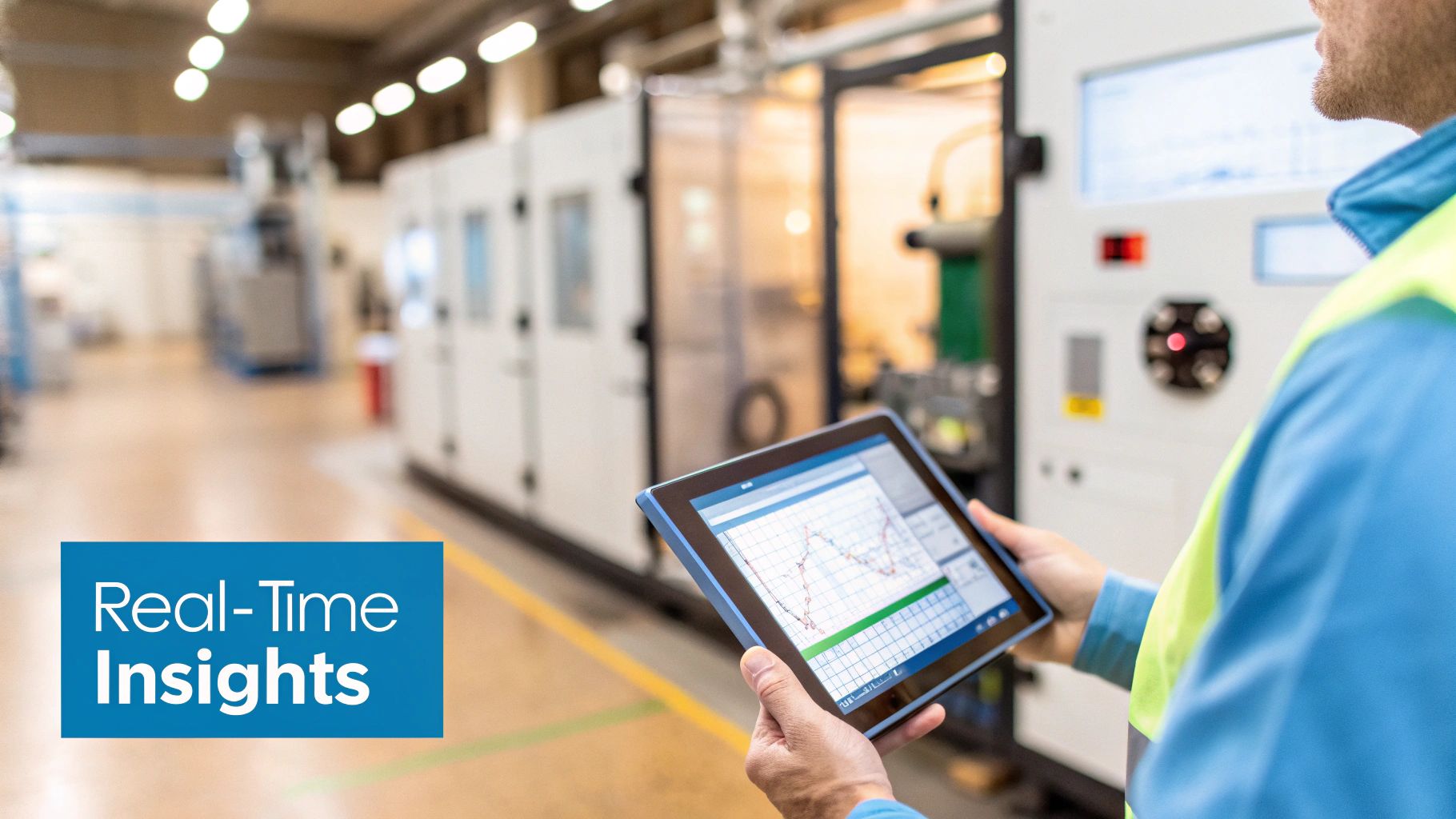
This isn’t just about semantics; it’s a fundamental shift in how we think about keeping equipment running. The industry is moving away from rigid, calendar-based checklists and toward smart, condition-based action. It’s the difference between blindly following a routine and listening to what your equipment is actually telling you.
The goal is no longer just fixing things after they break. It's about getting ahead of failures before they even have a chance to happen, transforming your operations from reactive chaos to proactive control.
Understanding the Core Approaches
Both preventive and predictive maintenance are proactive, but they come at the problem from different angles. Understanding the difference is the first step to building an asset management strategy that actually works.
-
Preventive Maintenance (PM): This is your foundational, scheduled approach. Think of it as routine check-ups. Maintenance happens at set intervals—every six months, for instance, or after 1,000 hours of operation—to keep the odds of failure low.
-
Predictive Maintenance (PdM): This is the more advanced, data-driven strategy. It uses sensors and analytics to monitor the real-time health of your equipment. Instead of a schedule, maintenance is only triggered when the data signals that a problem is on the horizon.
The real difference? It’s all in the trigger. Preventive maintenance is kicked off by time or usage. Predictive maintenance is kicked off by the actual, real-time condition of the asset.
The Strategic Advantage of Proactive Maintenance
Why does this matter so much? Because a proactive mindset delivers a significant operational advantage. When you can anticipate issues instead of scrambling to react to them, you slash expensive, unplanned downtime that can bring an entire production line to a screeching halt. This foresight also extends the life of your most critical equipment, giving you a much better return on your investments.
Even better, these strategies are getting a serious boost from new technologies in manufacturing that are making maintenance smarter and faster than ever before. Tools like Augmented Reality (AR) are bridging the gap between raw data and hands-on work, empowering technicians to do their jobs with more precision and speed.
This guide will walk you through both strategies, showing you how to build a robust program that protects your assets and boosts your bottom line.
The Foundations of Preventive Maintenance
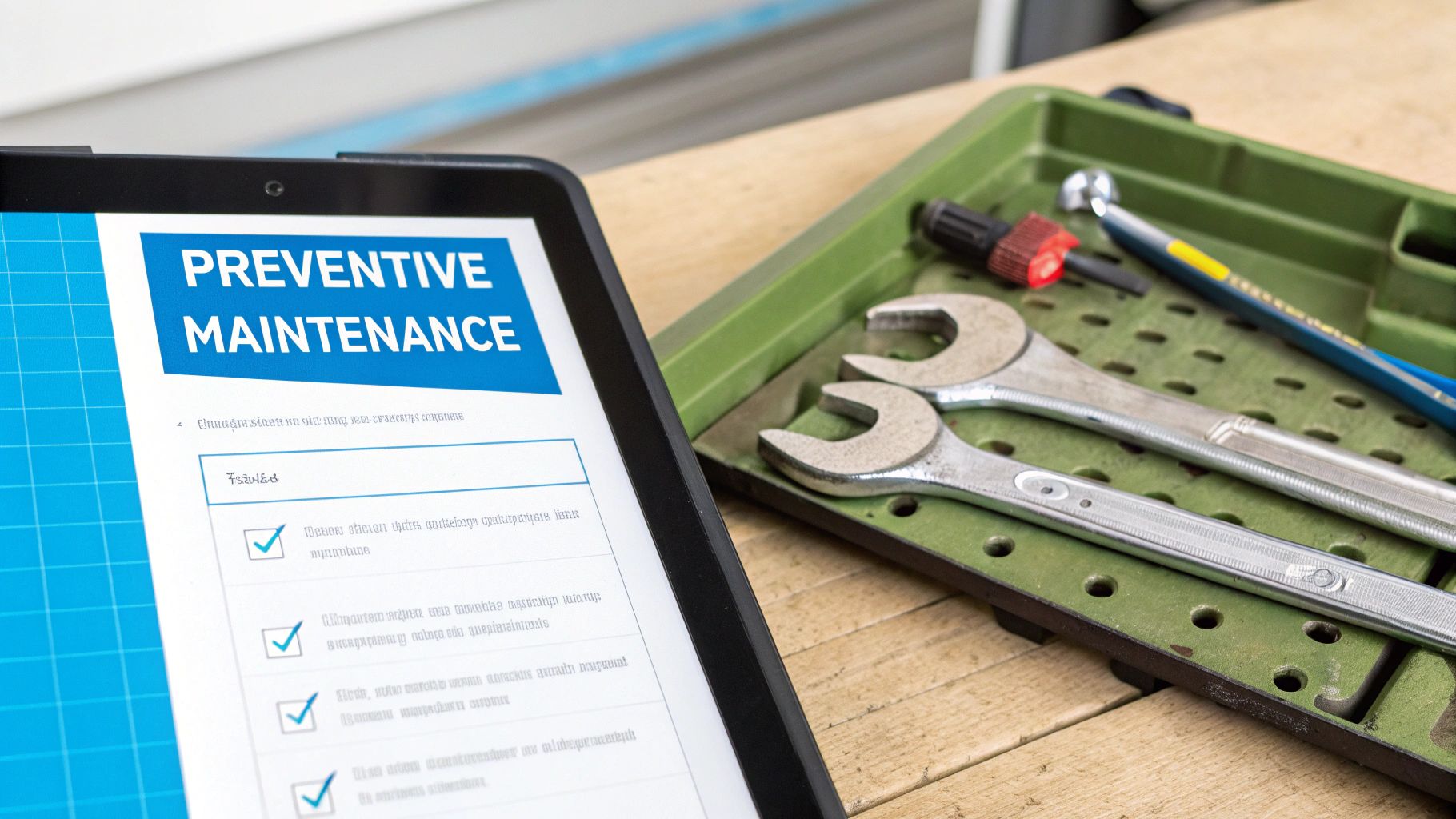
Think of preventive maintenance (PM) as the bedrock of any stable, reliable operation. It’s your equipment's regularly scheduled health checkup. Instead of waiting for something to go wrong and spiral into an emergency, PM is built on a simple, powerful idea: act before you’re forced to react.
This entire approach revolves around a predetermined schedule, whether it’s based on time or usage. An HVAC unit gets inspected every quarter, a conveyor belt gets lubricated after every 1,000 hours of runtime. The goal is simple: perform routine upkeep to stamp out the possibility of an unexpected breakdown, creating a predictable and controlled work environment.
Creating a Culture of Proactive Care
Rolling out a preventive maintenance program is the first real step away from the chaotic, “fire-fighting” mindset. It creates a rhythm of proactive care that systematically nips wear and tear in the bud before it can ever become a catastrophic failure.
This scheduled approach is incredibly effective for managing all sorts of assets. It guarantees that your essential equipment gets consistent attention, which is critical for keeping operations humming and maintaining safety standards. By sticking to a calendar, teams can plan for resources, manage inventory, and schedule labor with far more efficiency than they ever could by just reacting to emergencies. For a deeper dive, check out our guide on effective maintenance problem-solving.
Preventive maintenance is fundamentally about control. It exchanges the chaos of unplanned downtime for the predictability of a well-managed schedule, laying the groundwork for more advanced strategies.
The data backs this up. A look at industry trends shows that between 80-90% of industrial facilities currently rely on preventive maintenance, making it the dominant strategy out there. But things are changing. A good 30-40% of these places are now mixing in predictive methods, pointing toward a hybrid future. What’s driving the shift? A whopping 42% of manufacturers cite the burning desire to finally get a handle on downtime.
The Good and The Bad of a Scheduled Approach
The wins from a solid PM program are clear and tangible. By routinely servicing equipment, companies can dramatically extend the life of their assets, boost overall safety by spotting hazards early, and make their equipment far more reliable.
But this strategy isn't a silver bullet. Because maintenance is tied to a schedule instead of the actual condition of the machine, it has some built-in limitations.
- Potential for Over-Maintenance: Technicians might find themselves swapping out parts that still have plenty of life left in them, just because the calendar said so. This leads to wasted money on both labor and spare parts.
- Risk of Under-Maintenance: A rigid schedule can't always account for assets that are getting pushed harder than usual. A critical component could fail long before its next check-up, causing the exact kind of downtime PM is supposed to prevent.
- Doesn't Stop All Failures: While it definitely cuts down on breakdowns, PM can’t eliminate them. It simply doesn't account for those random, unpredictable failures that can and do happen.
Even with these drawbacks, preventive maintenance is an absolutely essential piece of any serious asset management strategy. It gives you a stable, organized framework that happens to be the perfect launchpad for bringing in more sophisticated, condition-based methods like predictive maintenance.
Tapping Into the Power of Predictive Maintenance
Predictive maintenance (PdM) is a major leap forward, moving us from rigid, calendar-based upkeep to a much smarter, condition-based strategy. Forget the old way of fixing things on a set schedule. With PdM, your equipment itself tells you when it needs attention. Think of it as a sophisticated fitness tracker for your most critical assets.
This approach relies on a network of sensors that continuously monitor the real-time health of your machinery. These sensors keep an eye on key vitals like vibration, temperature, acoustics, and even oil quality. This constant stream of data gives you a live, moment-by-moment look into how an asset is actually performing.
Armed with this data-driven foresight, maintenance teams can step in at the perfect time—not too early, and definitely not too late. It’s all about making surgical, well-timed repairs that stop failures before they can ever bring operations to a halt.
From Raw Data to Actionable Insights
The real magic of predictive maintenance isn't just in gathering data; it's in making sense of it. This is where advanced analytics, Artificial Intelligence (AI), and machine learning algorithms come into play. These systems sift through all the incoming sensor data, spotting subtle patterns and anomalies that would be completely invisible to a human.
For example, a tiny, almost imperceptible increase in a motor's vibration might not seem like a big deal. But an AI model, trained on tons of historical data, can recognize this as the very first sign of bearing wear. It can then forecast the component's remaining useful life, predicting a potential failure weeks or even months down the road.
Predictive maintenance turns maintenance from a reactive chore into a strategic, data-informed process. It lets you get to the root cause of a problem long before it snowballs into a catastrophic and expensive breakdown.
This ability to see into the future is a game-changer. Instead of wasting time and money on unnecessary maintenance for a perfectly healthy machine, technicians can focus their skills exactly where they're needed most. This "just-in-time" repair model slashes wasted labor, minimizes the need for emergency calls, and dramatically cuts down on unplanned downtime.
The Economic Impact and Market Growth
The move toward predictive maintenance isn't just a nice idea; it's creating serious economic value and fueling massive market growth. The global predictive maintenance market was valued at around USD 10.93 billion and is expected to explode to somewhere between USD 44 billion and USD 70.73 billion by 2032. That's a compound annual growth rate (CAGR) of up to 26.5%, with the manufacturing sector leading the way. You can dig into more stats on this trend by reading the full report on the growing predictive maintenance market.
Practical Applications of Predictive Analytics
So, what does this look like out on the factory floor? The applications are incredibly diverse and have a direct impact on keeping operations stable. Understanding the basics of condition monitoring and predictive maintenance is the key to unlocking its full potential.
Here are a few real-world examples of predictive maintenance in action:
- Vibration Analysis: On a large industrial pump, sensors can pick up on abnormal vibration patterns that point to misalignment or imbalance. An alert goes out, allowing technicians to fix the issue before it causes serious damage to the motor or seals.
- Thermal Imaging: Infrared cameras can scan electrical panels for their thermal signature. A hotspot can mean a loose connection or an overloaded circuit, letting a technician make a simple fix that prevents a potential fire or power outage.
- Acoustic Analysis: Specialized microphones can "listen" for changes in the sound of a gearbox. A new, high-pitched whine could be the first sign of a cracked tooth, prompting an inspection and replacement before the entire unit fails.
Each of these examples gets to the core benefit of predictive maintenance: it gives you early warnings based on solid evidence. By switching from a calendar to a condition-based schedule, companies are turning maintenance from a necessary cost into a strategic advantage that guarantees reliability and squeezes every last drop of performance out of their assets.
Choosing the Right Maintenance Strategy
Deciding between a time-tested preventive approach and a data-driven predictive one can feel like a tough call. But it really boils down to a single, critical question: what’s the real cost if this piece of equipment fails?
Not all assets are created equal. A catastrophic failure on your main production line is a completely different beast than a minor hiccup with a non-essential utility pump. Getting this distinction right is the key to building a maintenance program that actually works.
The smartest strategy isn’t about picking one method and ditching the other. It’s about being deliberate—applying the right level of attention to each asset based on its importance, complexity, and how badly things could go wrong if it breaks.
Preventive vs Predictive Maintenance: A Strategic Comparison
To make an informed decision, it's helpful to see how these two strategies stack up against each other. The following table breaks down the core differences, from the initial investment to the long-term operational impact.
| Attribute | Preventive Maintenance | Predictive Maintenance |
|---|---|---|
| Core Principle | Time-based or usage-based servicing (e.g., every 3 months) | Condition-based servicing (e.g., when a sensor detects an issue) |
| Data Requirements | Manufacturer recommendations, historical averages | Real-time sensor data (vibration, temperature, etc.), AI models |
| Upfront Cost | Low; requires basic scheduling tools and labor | High; requires investment in sensors, software, and analytics |
| Long-Term Cost | Moderate; can lead to unnecessary parts/labor on healthy assets | Lower; minimizes unnecessary work and catches issues early |
| Downtime | Scheduled and planned, but potentially more frequent | Minimized; maintenance only occurs when truly needed, avoiding surprises |
| Best For | Simpler, less critical assets with predictable failure patterns | Complex, mission-critical assets where failure is catastrophic |
| Risk of Failure | Reduced compared to reactive, but still possible between cycles | Significantly minimized; potential failures are flagged well in advance |
| ROI | Good; provides foundational reliability and stability | Excellent; delivers substantial savings by preventing major breakdowns |
This comparison makes it clear that there's no single "best" answer. The right choice is all about context—matching the strategy to the specific needs and risks associated with each asset in your facility.
Building a Hybrid Maintenance Model
The most effective—and financially sound—strategy for most operations is a hybrid model. It’s about strategically blending preventive and predictive maintenance to create a balanced, optimized program that just makes sense.
Think of it as creating a tiered system for your equipment.
By combining both methods, you can apply the right strategy to the right asset, achieving an optimal balance of cost, risk, and reliability across your entire operation.
Here’s how that might look in practice:
- Tier 1: Critical Assets. Your high-value, complex machinery—think turbines, main production lines, or CNC machines—gets the full predictive treatment. For these assets, failure is simply not an option.
- Tier 2: Important Assets. Secondary equipment that supports production, like pumps, motors, and conveyors, is put on a robust preventive maintenance schedule. It’s reliable without breaking the bank.
- Tier 3: Non-Essential Assets. For simple, low-cost equipment, basic inspections or even a run-to-failure approach can be the most practical choice, especially if a replacement is cheap and easy to swap in.
This infographic shows just how a predictive system turns raw data into a clear directive for your team.
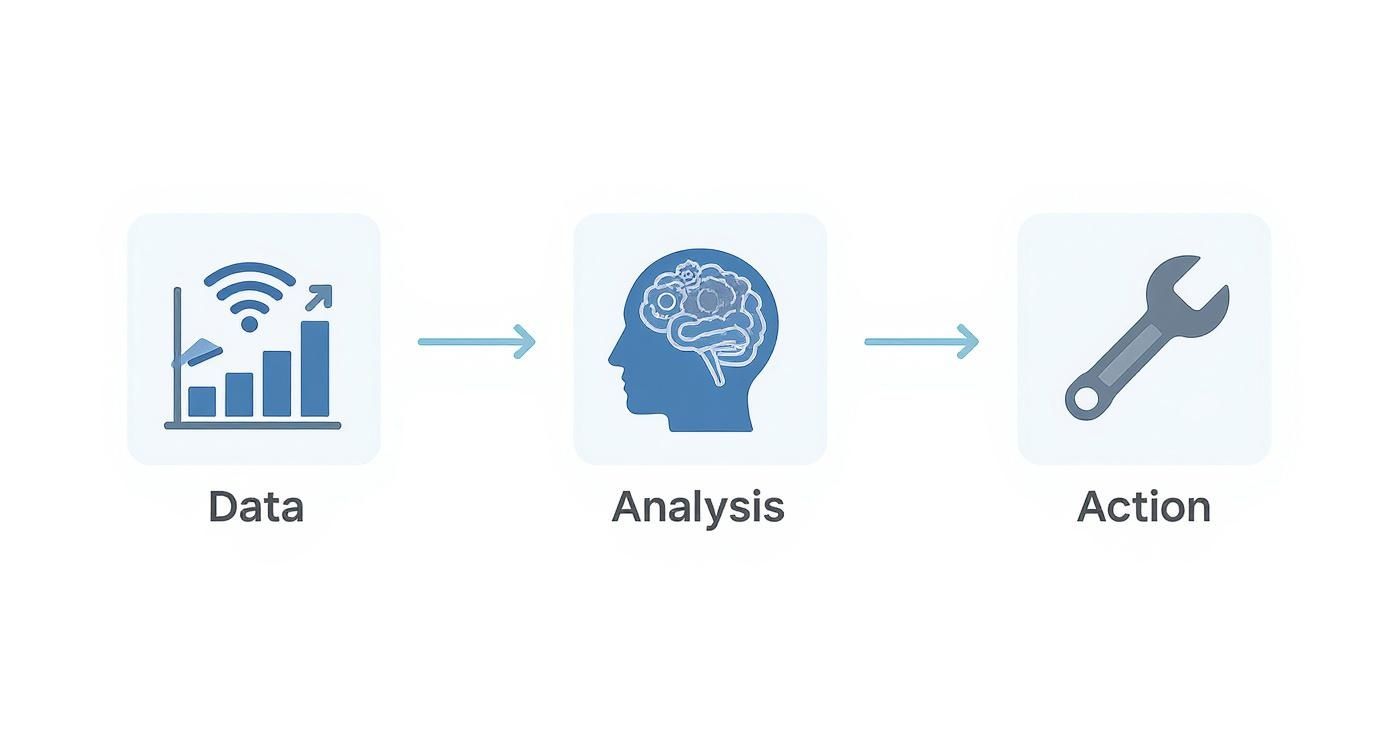
This blended strategy ensures your resources are focused where they’ll have the biggest impact, maximizing equipment uptime while keeping maintenance costs firmly under control. It’s a practical and scalable way to build a world-class maintenance operation without overspending.
The Business Impact of Advanced Maintenance
Investing in an advanced maintenance program delivers powerful, measurable results that go far beyond the factory floor. While the technical benefits are impressive, the real story is how preventive and predictive maintenance translate directly into business success, strengthening profitability and boosting operational efficiency.
This is where maintenance stops being a cost center and becomes a high-return investment.
Imagine a large manufacturing plant, humming along. Deep inside a critical piece of machinery, a bearing begins to show microscopic signs of wear. In a traditional setup, this goes completely unnoticed until it causes a catastrophic, multi-million-dollar production halt.
But with a predictive strategy, sensors detect that subtle change in vibration and temperature weeks in advance. An algorithm flags the anomaly, alerting the maintenance team to a probable failure. This foresight allows them to schedule a precise, low-cost repair during planned downtime, completely sidestepping the emergency.
Quantifying the Gains in Efficiency and Cost
This isn’t some far-off hypothetical; it’s the reality for businesses embracing data-driven maintenance. The financial impact is substantial, creating a clear competitive advantage. Organizations that adopt predictive maintenance can see cost reductions between 12% and 40%.
This shift proves a fundamental truth: modern maintenance is not an expense. It is a strategic investment in operational excellence that pays for itself through avoided disasters, optimized resources, and extended asset life.
The numbers consistently show a strong positive return. Studies reveal that 91% of businesses slash repair times and unplanned downtime, while 93% improve their ability to maintain aging infrastructure. These efforts can lead to a 9% improvement in equipment availability, a 20% extension of asset lifetimes, and up to a 50% reduction in unexpected machine downtime. You can explore more data on these powerful maintenance statistics and trends.
Optimizing Resources Beyond Repairs
The benefits of foresight extend well beyond just preventing failures. When you know a component will need replacement in three weeks, you can optimize both inventory and labor, creating a ripple effect of efficiency across the entire operation.
- Smarter Inventory: Instead of stockpiling expensive spare parts "just in case," you can order them just in time. This cuts down carrying costs and frees up capital that can be used elsewhere.
- Efficient Labor Scheduling: Technicians can be scheduled for specific, high-value tasks instead of being pulled away for chaotic emergency repairs. This alone dramatically improves overall productivity.
- Enhanced Safety: A well-maintained machine is a safer machine. By identifying and correcting potential failures before they happen, advanced maintenance reduces the risk of dangerous equipment malfunctions. Effective maintenance is a cornerstone of operational safety, impacting everything from forklift safety to complex production lines by ensuring equipment remains in reliable working condition.
Ultimately, this data-driven approach transforms how an organization functions. It replaces reactive fire-fighting with proactive control, allowing teams to manage assets with precision. This strategic management doesn't just save money on repairs—it builds a more resilient, predictable, and profitable operation from the ground up.
How AR and VR Modernize Maintenance Workflows

Augmented and Virtual Reality are no longer just for gaming—they're creating a powerful bridge between digital insights and physical action on the factory floor. These technologies take all the valuable data from preventive and predictive maintenance systems and put it right where it’s needed most: in front of the technicians doing the work.
This is a significant leap forward. We're moving away from static checklists and clunky manuals. Instead, technicians get real-time, context-aware information that completely changes how they interact with complex machinery and solve problems.
Augmented Reality for On-the-Job Precision
Augmented Reality (AR) works by overlaying digital information onto a technician's view of the real world, typically through smart glasses or a tablet. For example, a technician looks at a complex hydraulic pump. Instead of digging through a thick binder, they see digital arrows pointing to the exact valve needing inspection or a live readout of pressure data floating right next to the gauge.
This immediate access to information is a game-changer. It slashes the risk of human error and dramatically speeds up repair times because technicians aren't constantly stepping away to consult a diagram or phone a colleague. The instructions are right there, guiding their every move.
AR closes the gap between knowing what needs to be done and knowing how to do it. It equips every technician, regardless of experience level, with the insights of a seasoned expert.
This approach is perfect for guided workflows. A complicated, multi-step repair can be broken down into a sequence of simple, visual instructions that appear in the technician's line of sight. As they finish one step, the next one pops up, guaranteeing the process is followed correctly every time. This doesn't just boost first-time fix rates; it's also an incredible on-the-job training tool. Diving into the fundamentals of augmented reality and its applications shows just how much potential this technology has beyond the factory floor.
Virtual Reality for Risk-Free Training and Simulation
While AR adds to the real world, Virtual Reality (VR) creates a completely new digital one. VR is a powerhouse for training, letting technicians practice delicate or dangerous procedures in a 100% safe, simulated environment. They can learn to disassemble a critical engine or troubleshoot a high-voltage electrical panel without any risk to themselves or the actual equipment.
This kind of immersive training has some clear benefits:
- Accelerated Learning: In VR, you can practice a task over and over—something that’s often too costly or impractical in real life. This helps technicians build muscle memory and confidence way faster.
- Reduced Equipment Downtime: No need to take a critical asset offline for a training session. Training can happen anytime, anywhere.
- Improved Safety: Technicians can practice responding to rare but dangerous failure scenarios, preparing them to handle real emergencies calmly and correctly.
Capturing and Sharing Institutional Knowledge
One of the biggest challenges in the maintenance world is the "skills gap"—that moment when a veteran technician with decades of know-how retires, taking all that knowledge with them. AR and VR offer a fantastic solution.
Imagine a senior expert guiding a junior tech through a tough repair using an AR remote assistance tool. That whole session, complete with digital notes and instructions, can be recorded and saved. It becomes a permanent training asset. New hires can then pull up this library of real-world fixes, essentially learning directly from the best people in the company. The practical benefits of using augmented reality for maintenance are massive, especially when it comes to preserving that hard-won expertise.
By bringing AR and VR into maintenance, companies aren't just making repairs faster. They're building a smarter, more efficient, and more resilient workforce where critical knowledge is shared and every team member is empowered to perform at their best.
Frequently Asked Questions
Jumping into a modern maintenance strategy always kicks up a few practical questions. Let's tackle some of the common ones to clear up the challenges and opportunities you'll find when adopting preventive and predictive maintenance.
What’s the Biggest Hurdle When Switching to Predictive Maintenance?
You’re really looking at a two-part challenge: technology and culture. On the tech side, there’s the upfront investment. You'll need sensors, a solid data infrastructure, and the right analytics software to make sense of all the information your equipment is sending. That can feel like a steep hill to climb.
But honestly, the cultural shift is often tougher. Your team has to move from a familiar, calendar-based routine to actually trusting data-driven insights. It's a big leap of faith, asking experienced technicians to act on what an algorithm predicts instead of just relying on their gut and the old schedule.
The key to getting everyone on board is to build trust in the data. Start small with a pilot program on a few critical assets. When you can show the team how these new insights prevented a real-world failure and made their jobs easier, you’ll get the buy-in you need.
Is Predictive Maintenance Just for Big Companies?
Not anymore. While it’s true that enterprise-wide systems were once wildly expensive, things have changed. The explosion of affordable IoT sensors and cloud-based "Predictive Maintenance-as-a-Service" (PdMaaS) models has put this tech squarely within reach for smaller operations.
A small business doesn't need to go all-in from day one. The smart move is to start strategically. Pick a handful of your most critical machines—the ones that would bring everything to a screeching halt if they went down. Preventing just one of those catastrophic failures often pays for the initial investment, and then some.
How Does AR Fit in with My Existing Maintenance Software?
Modern Augmented Reality platforms are built to play nicely with the tools you already use. They're designed for seamless integration, connecting directly to your Computerized Maintenance Management System (CMMS) or Enterprise Asset Management (EAM) software through APIs.
This connection creates a seriously powerful, real-time workflow. Picture this:
- Your technician puts on AR glasses and scans a QR code on a piece of equipment.
- Instantly, the AR software pulls the work order, maintenance history, and digital schematics from your CMMS.
- All that critical info is displayed right in their line of sight, overlaid on the physical machine.
As the tech completes each step, they can update the work order with simple voice commands. That data shoots straight back to the CMMS in real time, guaranteeing accurate, hands-free records. It closes the loop between the digital world and the physical work, making the entire process of preventive and predictive maintenance faster and virtually error-proof.
Ready to see how AR and VR can bring your maintenance workflows into the modern era? AIDAR Solutions provides immersive tools that slash service times, cut down on expert travel, and get new hires up to speed faster than ever. Discover how our platforms can deliver a rapid return on investment for your operations.

