A Practical Guide to AR in Manufacturing: Boosting Efficiency and Safety
Augmented reality in manufacturing overlays digital information—such as instructions, 3D diagrams, or live performance data—directly onto a worker's view of the real world. This provides frontline teams with interactive, real-time guidance to execute assembly, maintenance, and quality checks with greater speed and precision.
Seeing Your Factory in a New Light
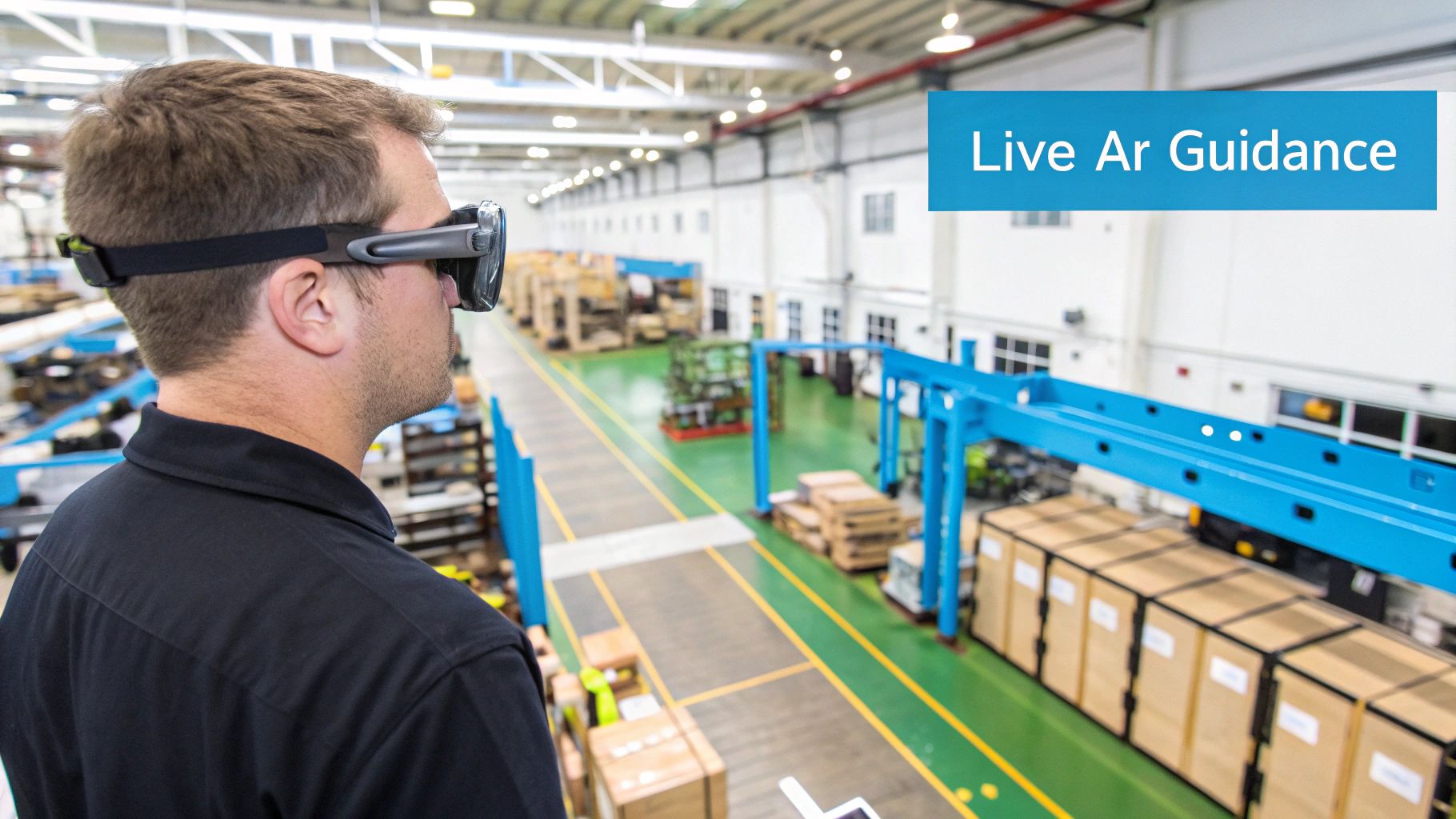
Consider your factory floor. Now, imagine equipping your team with a live, interactive guide for every task they perform. That is the practical power of AR. This technology puts crucial digital information directly into an employee's line of sight, typically through smart glasses or a mobile device.
This approach upgrades static, paper-based manuals to a dynamic, turn-by-turn guidance system for your most complex machinery. Instead of stopping work to consult a binder or find a laptop, an operator sees digital instructions, safety alerts, or quality checklists overlaid directly onto the equipment they are working on.
Empowering the Modern Workforce
This approach transforms how information is delivered and used on the shop floor. It provides your existing workforce with powerful digital tools, creating a smarter, safer, and more efficient manufacturing environment. The objective is to make expert knowledge instantly available at the point of action.
By bridging the gap between the digital and physical worlds, AR in manufacturing converts standard operating procedures into interactive, guided workflows. This direct integration of information helps reduce human error, decrease cognitive load, and accelerate decision-making where it matters most. To explore this topic further, you can learn more about how augmented reality in manufacturing is reshaping industrial operations.
AR does not replace skilled workers; it amplifies their abilities. It provides a digital co-pilot that offers real-time data, visual cues, and expert guidance, allowing them to perform complex tasks more accurately and confidently.
Core AR Capabilities in Manufacturing
So, how does this technology deliver value on a daily basis? AR enhances several key operational functions that work together to create a more connected and responsive factory.
The table below breaks down the fundamental ways AR technology enhances traditional manufacturing processes.
| Capability | Description | Impact on Operations |
|---|---|---|
| Guided Work Instructions | Step-by-step digital guides are projected into a worker's view, showing exactly where and how to complete a task. | Reduces assembly errors, shortens training time, and ensures process consistency. |
| Real-Time Data Visualization | Critical performance metrics, sensor readings, or live data from machines are displayed as an overlay. | Allows for immediate operational insight and faster responses to equipment issues. |
| Remote Expert Assistance | A technician shares their first-person view with an off-site expert who can annotate the live feed with instructions. | Drastically cuts downtime, reduces travel costs, and solves complex problems faster. |
These capabilities are foundational to how AR is making a tangible impact on the factory floor right now.
Here’s a closer look at what that means in practice:
- Guided Work Instructions: Instead of reading a manual, a technician sees animated arrows and text indicating exactly which bolt to turn next. This is ideal for everything from assembling a new product to performing routine maintenance checks.
- Real-Time Data Visualization: An operator can glance at a piece of equipment and instantly see its temperature, output rate, or efficiency—all without walking to a control panel or checking a separate monitor.
- Remote Expert Assistance: A junior technician on the factory floor can stream their point-of-view to a senior engineer located hundreds of miles away. The expert can then draw circles and add notes directly onto the live video to guide the on-site technician through a complex repair.
The Real-World Benefits of AR Adoption
Shifting to augmented reality is a strategic decision to address some of manufacturing's oldest and most persistent challenges. The benefits extend beyond novelty, delivering measurable results that impact the bottom line—affecting efficiency, quality, workforce training, and safety directly on the factory floor.
When you overlay digital information onto the physical world, workers have the exact data they need, right when they need it. This simple concept fundamentally changes how work is performed. It transforms complex assembly jobs into guided, error-resistant workflows and makes expert-level knowledge available to everyone, regardless of their experience level.
Boosting Operational Efficiency
One of the most immediate impacts of AR is a significant increase in operational efficiency. Consider complex assembly jobs that previously required constant reference to a paper manual or a diagram on a screen. This is now replaced with interactive, step-by-step 3D instructions that appear directly in the worker's field of view. They see exactly which part to select and where it goes, reducing the guesswork and hesitation that hinder productivity.
This guided approach leads to fewer mistakes and faster completion times. For example, a technician assembling a complex gearbox, instead of memorizing a torque sequence, sees a holographic overlay highlighting which bolt to tighten next and to what specification. This not only prevents costly errors but also ensures every unit is built to the exact same high standard. You accomplish more, and you do it correctly the first time. To learn more, check out our guide on how to improve manufacturing efficiency.
AR effectively enables every worker on the line to perform like a seasoned expert. By providing real-time, context-aware guidance, it eliminates the second-guessing that leads to errors and slowdowns, directly increasing first-time-right rates.
Bridging the Skills Gap
Manufacturing is facing a significant skills gap. As veteran workers retire, they take decades of experience with them, and training new hires requires substantial time and resources. AR is a powerful tool to bridge this divide, acting as a direct knowledge-transfer mechanism. It captures the expertise of your veterans and converts it into training modules and on-the-job support that anyone can follow.
New hires can achieve proficiency in complicated tasks much faster by following AR-guided instructions at their workstation. This reduces time spent in classroom settings and allows them to contribute to the production line sooner. The results are compelling:
- Faster Onboarding: We are seeing new employees reach proficiency in a fraction of the usual time, with some companies reducing training periods by over 50%.
- Increased Confidence: Guided instructions empower trainees to perform the job correctly from day one. This builds confidence and reduces their reliance on mentors for assistance.
- Knowledge Retention: People learn by doing. Interactive, hands-on learning with AR has been proven to be more effective for knowledge retention than reading a manual or watching a video.
Elevating Quality Control
In manufacturing, quality is paramount. There is no room for error, and AR provides quality assurance (QA) teams with a significant advantage. An inspector can use an AR device to overlay a perfect digital model of a product directly onto the physical one being checked. The smallest flaw or deviation from the specification immediately becomes apparent, turning what was once a subjective check into a precise, data-driven process.
This type of application is a key reason the AR market in manufacturing is expanding rapidly. The segment is projected to double in value between 2025 and 2030, reaching an estimated $90 billion to $110 billion by the end of the decade. This growth is driven by the integration of AR into critical processes like QA, where it provides technicians with real-time visual overlays of specifications and tolerances, making inspections more accurate and highly efficient.
Creating a Safer Workplace
Finally, AR helps make the factory floor a safer place. By providing real-time hazard alerts, it acts as a digital safety system. An employee wearing AR glasses can be warned about a high-voltage area they are approaching, a forklift moving just out of their line of sight, or a machine that is beginning to overheat.
Digital signs and warnings are overlaid directly onto their view of the real world, ensuring that critical safety information is impossible to miss. It’s a proactive approach that helps prevent accidents before they occur, creating a safer and more secure environment for the entire team.
Practical AR Applications on the Factory Floor
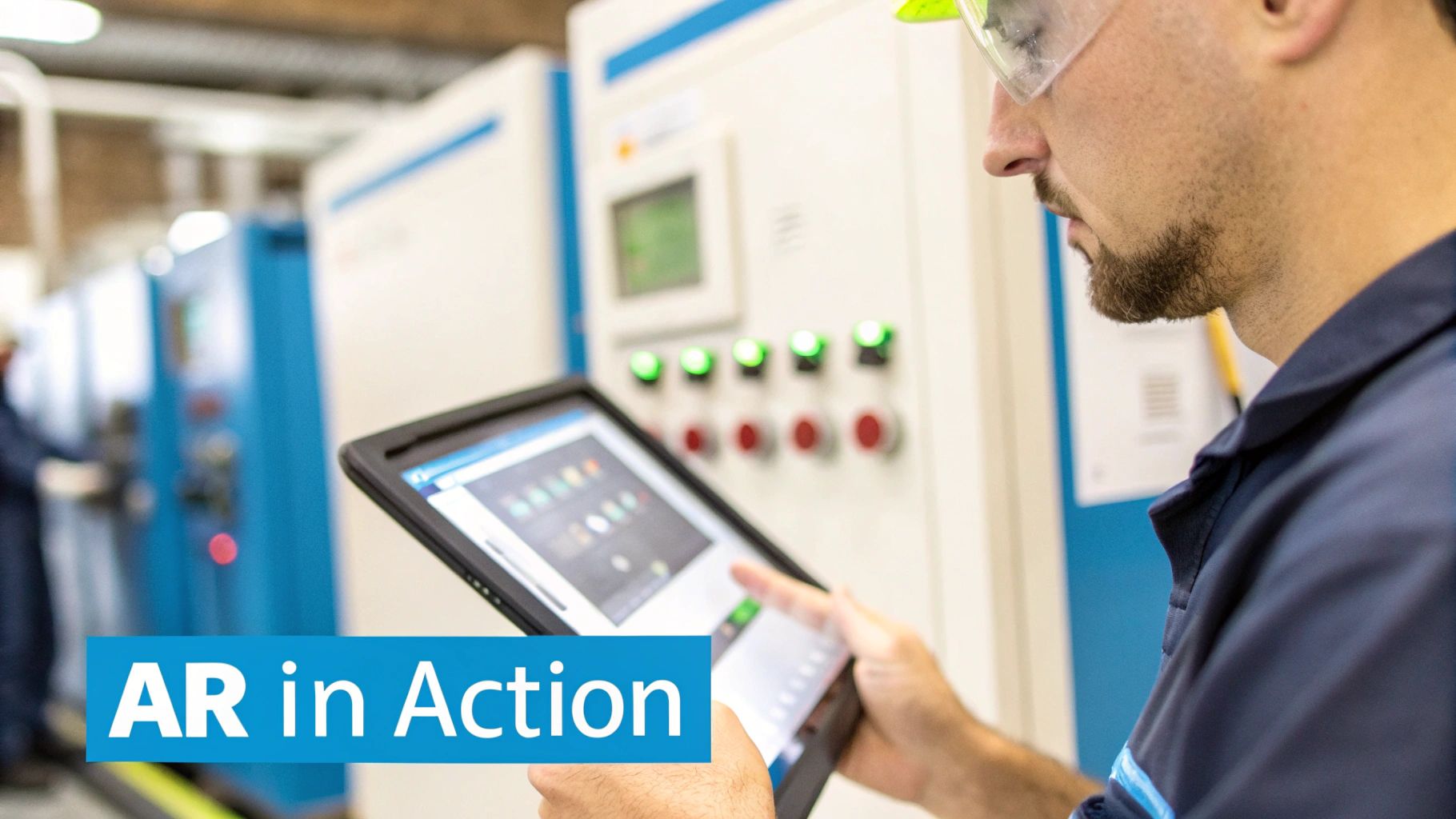
On today's factory floor, augmented reality is a hands-on tool solving real problems every day. From assembling intricate products to handling emergency repairs, AR adds a digital layer of intelligence that guides, verifies, and connects workers like never before.
Let's walk through four real-world scenarios where AR is already making a significant difference. Each one shows what happens when you overlay crucial digital information onto the physical workspace, turning complicated jobs into simple, guided steps.
Guiding Hands in Complex Assembly
Imagine an operator building a sophisticated aerospace part with hundreds of tiny components. The traditional method involved constantly glancing between the physical part and a thick binder or a 2D diagram on a screen. That back-and-forth process is slow and prone to mistakes.
AR fundamentally changes the process. The operator wears smart glasses and sees a holographic 3D model of the component floating right over their workstation. Step-by-step instructions appear in their direct line of sight, with digital arrows pointing to the exact part to grab and precisely where it needs to go.
- Error Reduction: The system can visually confirm when a part is installed correctly, catching mistakes before they happen. If a bolt needs a specific torque, the AR display can show a real-time gauge that turns green only when the correct pressure is applied.
- Increased Speed: By keeping the worker's eyes on the task, AR helps them maintain focus and finish assemblies much faster. This direct guidance reduces mental load and eliminates hesitation.
Transforming Quality Assurance Inspections
Quality assurance is absolutely critical but can be a major bottleneck. An inspector using calipers and a checklist to manually check a finished product against specifications is a process susceptible to human error and inconsistency.
AR provides QA inspectors with a powerful digital toolset. By pointing an AR-enabled tablet or wearing a headset, they can overlay a flawless digital CAD model directly onto the physical product. The software instantly flags any deviations, misalignments, or missing parts.
An inspector can walk around a massive piece of machinery and see every discrepancy between the design and the final build in real time. A weld that is a millimeter off or a misaligned bracket is immediately highlighted in red on their screen. The meticulous hunt for flaws becomes a quick, definitive check.
This makes inspections not just faster but far more accurate. It guarantees that every single unit leaving the factory floor meets the tightest quality standards, reducing rework costs and ensuring customer satisfaction. A deeper dive into these kinds of uses shows the breadth of augmented reality industrial applications that are becoming commonplace.
Providing Instant Remote Expert Assistance
What happens when a critical machine stops working and the only engineer who knows how to fix it is on another continent? Typically, this means costly downtime and significant travel expenses. AR-powered remote assistance eliminates this problem.
A local technician on the factory floor simply puts on a pair of smart glasses and streams their exact point-of-view to a senior expert anywhere in the world. The expert sees exactly what the technician sees and can guide them in real time.
The remote expert can:
- Annotate the live video: They can draw circles, arrows, or notes directly onto the technician's view to pinpoint a specific valve or wire.
- Share technical documents: Schematics and manuals can be sent and displayed directly in the technician's field of vision.
- Guide complex procedures: The expert can walk the technician through the repair step-by-step, ensuring it is done correctly the first time.
This immediate connection to expertise reduces machine downtime from days to hours, eliminates travel costs, and empowers the on-site team to tackle more complex problems with confidence.
Streamlining Equipment Maintenance and Repair
Working on complex industrial machinery can be a challenge, even for experienced technicians. Finding the right part and following the proper service protocol often relies on years of institutional knowledge that can be difficult to access.
AR acts as a digital co-pilot. A technician can look at a piece of equipment through an AR device, and the system instantly recognizes it. It then overlays all the key information they need, such as:
- Live sensor data like temperature, pressure, and vibration levels.
- The machine’s full maintenance history and upcoming service dates.
- Step-by-step visual guides for a specific repair procedure.
- The exact location of hidden internal components that need attention.
One of the most powerful uses for AR on the factory floor is when it's paired with AI-driven predictive maintenance, which provides real-time diagnostic overlays for equipment. This helps technicians not only fix what is already broken but also spot potential failures before they happen, moving from a reactive to a truly proactive maintenance strategy.
To tie it all together, here’s a quick look at how these AR applications fit across the entire manufacturing process.
AR Use Cases Across the Value Chain
| Manufacturing Stage | AR Application | Primary Benefit |
|---|---|---|
| Product Design | Virtual Prototyping & Design Review | Faster Iteration & Reduced Physical Prototypes |
| Assembly | Step-by-Step Guided Work Instructions | Increased Speed & Drastically Reduced Errors |
| Quality Control | Digital Overlay for Defect Detection | Higher Accuracy & Faster Inspection Times |
| Maintenance | Remote Expert Assistance & Guided Repair Procedures | Reduced Downtime & Lower Travel Costs |
| Training | Immersive On-the-Job Simulations | Safer Training & Better Knowledge Retention |
As you can see, AR is not a single-point solution. It is a versatile technology that delivers concrete benefits at nearly every step, from the initial design concept to the long-term maintenance of the final product.
How to Measure Your Return on AR Investment
Adopting augmented reality is a strategic investment that requires a solid business case. To get an AR project approved, you must move beyond the technology's novelty and focus on tangible, measurable results. A clear framework for calculating your Return on Investment (ROI) is essential to secure buy-in and prove that this technology delivers real value.
The process begins by identifying the right Key Performance Indicators (KPIs)—the vital signs of your factory floor. When you introduce AR, you expect these metrics to improve. Tracking them is how you demonstrate its effectiveness.
Fortunately, AR's impact is quantifiable if you know where to look. By focusing on direct cost savings and productivity boosts, you can build a powerful narrative backed by solid data.
Identifying Your Core AR Metrics
Before you can measure any improvement, you must establish a baseline of your current operational metrics. From there, you can track how AR influences performance across several critical areas.
Here are the most common KPIs to monitor:
- Reduced Error Rates: Start by tracking the number of defects or rework instances per shift. AR-guided assembly is a proven method for reducing human error, and a 20-30% reduction is a realistic target for many initial projects.
- Faster Training Cycles: Measure how long it takes a new hire to become proficient at a task. AR provides on-the-job guidance that can significantly reduce this "time-to-competency," often cutting training time in half.
- Improved Machine Uptime: For maintenance, Mean Time to Repair (MTTR) is a critical metric. It represents the average time a machine is down for repairs. With AR remote assistance, a technician can receive instant expert help, which drastically reduces downtime.
The goal is not just to collect data but to connect it directly to financial outcomes. A 15% drop in assembly errors is not just a production line improvement; it is a direct saving on wasted materials, lost labor hours, and potential warranty claims.
Quantifying the Financial Impact
Once you are tracking the right KPIs, the next step is to translate those operational gains into financial terms. This is where your business case becomes compelling, showing exactly how AR improves the bottom line.
Consider the direct cost savings you can calculate:
- Reduced Travel for Experts: Sum the costs of flights, hotels, and per diems for sending senior engineers to remote sites. Many companies report reducing expert travel by over 75% using AR for remote support—a significant and easily quantifiable benefit.
- Increased Production Output: When downtime decreases and assembly becomes faster, you can produce more in the same amount of time. Quantify this by measuring the value of the additional units produced per day or week.
- Lower Material Waste: Fewer mistakes mean less scrap. Track your material waste costs before and after AR implementation to see a direct reduction in raw material expenditures.
This laser focus on measurable improvement is what’s fueling the market’s explosive growth. By 2025, the market for augmented and virtual reality in manufacturing is on track to hit USD 14.4 billion, with a forecasted compound annual growth rate (CAGR) of 25.1%. That kind of growth shows a clear demand from manufacturers who want real solutions that boost productivity. You can discover more insights about AR's market growth on MarketResearch.com.
Your Step-By-Step AR Implementation Plan
Implementing AR in your manufacturing operations is a series of deliberate steps, not a single, high-risk leap. This roadmap can guide you from an initial concept to a successful, scalable rollout, making a complex technology feel achievable and genuinely impactful.
The key is to start small, prove the value, and then expand. By breaking the process into manageable phases, you build momentum, gather invaluable feedback from your team, and ensure your investment pays off.
Phase 1: Identify a High-Impact Use Case
First, you must select the right starting point. Do not attempt to implement AR across the entire factory floor at once. Instead, find a use case that is high-impact but relatively low in complexity.
Identify your most significant operational challenges. Are you experiencing high error rates in a specific assembly process? Does training new hires on a particular machine take an excessive amount of time? These are ideal candidates.
- Look for Repetitive, Complex Tasks: Manual assembly with numerous steps is often an excellent starting point. Guided AR instructions can deliver immediate, measurable improvements.
- Target Areas with High Rework Costs: Pinpoint where mistakes are most expensive. Reducing errors in these areas provides a clear and immediate financial return.
- Consider Maintenance and Repair: If a specific machine has a high Mean Time to Repair (MTTR), using AR for remote assistance could be a quick, undeniable win.
A successful initial project builds the business case for all subsequent efforts. A successful pilot not only demonstrates value but also gets key stakeholders excited about the possibilities.
This entire process is designed to connect AR implementation directly to measurable ROI—fewer errors, faster training, and better equipment uptime.
As the visual shows, focusing on these key areas creates a straight line to financial returns, making it much easier to justify further investment in the technology.
Phase 2: Choose the Right Hardware and Software
With a use case selected, it is time to choose your tools. Not all AR hardware is the same, and the right choice depends on your specific environment and the job at hand.
- Smart Glasses: For hands-free work like assembly or maintenance, devices such as the HoloLens 2 are ideal. They allow workers to keep their eyes on the task while digital instructions appear in their field of view.
- Tablets and Smartphones: For quality checks or mobile maintenance where a hands-free solution is not required, existing tablets and phones are a cost-effective and familiar option.
The software is equally important. Your chosen platform must integrate with your existing systems, such as your Manufacturing Execution System (MES) or Product Lifecycle Management (PLM) software. The goal is a seamless flow of data, not another isolated system.
Your software must be intuitive for everyone, from the person creating the content to the operator using it on the floor. If it takes an engineer weeks to build one guided workflow, the system will not be scalable. Look for platforms with simple authoring tools that allow your own experts to build and share AR experiences quickly.
Phase 3: Run a Focused Pilot Program
Before considering a full-scale rollout, run a small, focused pilot program with a handful of end-users. This is your opportunity to test everything in a real-world setting, prove its effectiveness, and gather direct feedback. The goal here is to learn.
During the pilot, you must:
- Define Clear Success Metrics: Track the KPIs you identified in phase one, like error rates or task completion times. You need quantifiable data.
- Gather User Feedback: Speak directly with the operators using the technology. Is it comfortable? Is it intuitive? Their input is invaluable and will help you refine the solution.
- Document Everything: Record the challenges, successes, and every lesson learned. This documentation will become your playbook for the broader implementation.
A well-executed pilot not only validates the technology but also creates a team of internal champions who will help advocate for the solution as you scale up.
Phase 4: Develop a Scaling Strategy
With a successful pilot completed, it is time to think bigger. Scaling your AR solution across the organization requires a clear strategy that goes beyond just purchasing more headsets. This is where many initiatives fail if not planned properly.
Your scaling plan needs robust change management and comprehensive training. Introduce the technology to new teams, explain the reasons for its adoption, and provide hands-on training so everyone feels comfortable and confident.
Understanding how to structure an effective augmented reality workflow is the key to building a process you can repeat and scale. By taking this methodical approach, you can successfully move from a single-point solution to a factory-wide digital upgrade.
The Future of AR in Smart Manufacturing
Augmented reality is now a foundational component of the next industrial evolution. The future of AR in manufacturing points toward a factory floor that is more connected, intelligent, and deeply immersive. These shifts are part of the larger movement toward fully integrated smart factories.
One of the most significant developments on the horizon is the integration of AR with artificial intelligence. This powerful combination is giving rise to predictive guidance systems that can anticipate a worker's next move or flag a potential mistake before it happens. This means an AR system that not only displays static instructions but actively adapts them based on live sensor data and the user's current actions.
Evolving Hardware and Connectivity
These experiences are only as good as the hardware that powers them. The technology is evolving at a rapid pace. The newest AR headsets and smart glasses are lighter, more powerful, and durable enough to withstand the demands of an industrial environment. This makes the technology practical for all-day use.
The arrival of advanced devices like Microsoft’s HoloLens 2, pictured below, accelerated adoption by offering solutions that are both powerful and user-friendly.
This constant improvement in hardware design is turning AR from a cumbersome accessory into a seamless part of a worker's everyday toolkit.
The future of AR is not just about seeing digital information; it is about interacting with it in a natural and intuitive way. As devices become less obtrusive and more powerful, the barrier between the physical and digital worlds will continue to dissolve.
This hardware evolution is a key factor behind the market's strong growth. In 2022, the global AR and VR market in manufacturing was valued at an estimated USD 8,010.8 million. It is projected to reach USD 62,707.8 million by 2030, growing at a compound annual rate of 29.3%. You can explore the full analysis of these manufacturing market projections from Grand View Research.
The Industrial Metaverse and 5G
Looking further ahead, the concept of the "industrial metaverse" is emerging. This will enable persistent digital twins of entire factories—perfect virtual replicas that can be used for complex simulations, training, and operational planning without affecting the real production line. This vision, however, requires a massive pipeline for data, which is where 5G comes into play.
The wider rollout of 5G is the linchpin for enabling more complex, collaborative AR experiences. It will allow multiple users to interact with a highly detailed digital twin simultaneously, without latency. As these technologies mature, the way we design user interactions becomes absolutely critical. For a deeper look at what’s next, this guide to futuristic user interface design is a great resource.
Got Questions About AR in Manufacturing? We’ve Got Answers.
As you begin to explore what AR could do for your operations, a few key questions often arise. Getting clear answers is the first step toward building a solid plan and moving forward with confidence.
Let's address some of the most common queries we hear from manufacturing leaders.
What’s the Real Difference Between AR and VR on the Factory Floor?
AR and VR are often grouped together, but in a factory setting, they solve different problems. The simplest way to distinguish them is: AR adds to your world, while VR replaces it.
- Augmented Reality (AR) overlays digital information onto your real-world view. For example, a technician looking at a machine can see step-by-step repair instructions hovering over the specific parts they need to fix. It enhances reality, keeping workers hands-on and connected to their physical environment.
- Virtual Reality (VR), on the other hand, immerses you in a completely simulated world, separate from your physical surroundings. This replaces reality, making it ideal for training in a zero-risk environment—such as teaching someone how to operate heavy machinery without any danger of real-world mistakes.
For day-to-day tasks like assembly, maintenance, and quality checks, AR is the preferred solution because it keeps your team grounded in the real work happening on the floor.
Is AR Technology Actually Ready for a Full-Scale Rollout?
Yes. AR has matured from an experimental technology to a robust, reliable tool for industrial use. Early adopters have already proven its value, and the hardware and software are now capable of supporting enterprise-level deployments across multiple facilities.
Today's AR devices are more rugged, the software platforms are far more stable, and there are numerous case studies demonstrating a clear, positive ROI.
The question is no longer "if" AR can work, but rather "where" can we achieve the greatest initial benefit? A thoughtful, large-scale deployment does not happen overnight. It begins with a few high-impact use cases and scales from there.
What Are the Biggest Hurdles to Getting AR Implemented?
While technical challenges exist, the most significant hurdles are often related to people and processes. Getting the technology to work is one thing; getting your team to embrace it is another.
Here are the top three roadblocks we observe:
- Change Management: People become accustomed to their routines. Introducing a new way of working requires a solid communication plan and, most importantly, involving end-users from the beginning. If they feel the change is being imposed on them instead of developed with them, you may encounter resistance.
- Creating and Managing Content: The digital work instructions and 3D models that power the AR experience must be created. This can be a significant undertaking. The key is to select a platform with authoring tools that are simple enough for your own subject matter experts to use, making the process scalable.
- IT Integration: For AR to be truly powerful, it needs to communicate with your existing systems, like your MES or PLM. Ensuring that data can flow seamlessly between the AR solution and your current infrastructure is what transforms a pilot project into a genuinely connected factory environment.
Addressing these three challenges directly will put you on the path to a successful, factory-wide transformation.
Ready to see how immersive AR and VR solutions can transform your training and service operations? At AIDAR Solutions, we specialize in creating practical applications that deliver measurable results, from cutting service times in half to quadrupling training throughput. Visit our website to discover how we can help you build a more efficient and capable workforce.