
Work Instructions for Manufacturing | Improve Shop Floor Efficiency
Effective work instructions for manufacturing are the bedrock of quality. They are the critical link between a company's high standards and the actions on the shop floor, ensuring every task is performed correctly, safely, and consistently every time.
Why Traditional Work Instructions Are Failing
For years, manufacturers relied on paper binders and static PDFs. In a slower, more predictable industrial era, this approach was sufficient. Today, however, it is no longer viable. The modern manufacturing floor is a dynamic environment defined by rapid change, complex assemblies, and significant workforce pressures. Legacy methods have become obsolete and are actively hindering progress.
A three-ring binder collecting dust on a shelf cannot keep pace with modern production. Every process update requires a logistical effort to locate, replace, and destroy every outdated paper copy. This process is inefficient and often results in operators using outdated instructions, leading directly to errors, rework, and safety incidents.
The Widening Skills Gap and Knowledge Drain
A significant demographic shift in the workforce compounds the problem. Experienced operators are retiring, taking with them decades of undocumented institutional knowledge. This "brain drain" poses a genuine threat to operational continuity. Concurrently, recruiting and retaining new talent has become increasingly challenging.
The manufacturing sector faces a potential shortage of 1.9 million jobs in the U.S. alone over the next decade if these talent issues are not addressed. As noted in Deloitte's 2025 Manufacturing Industry Outlook, this gap is driven by both an aging workforce and the demand for more advanced technical skills. Consequently, effective knowledge transfer has transitioned from a beneficial practice to an urgent business necessity.
This infographic highlights the cost of retaining outdated, paper-based instructions compared to adopting modern digital tools.
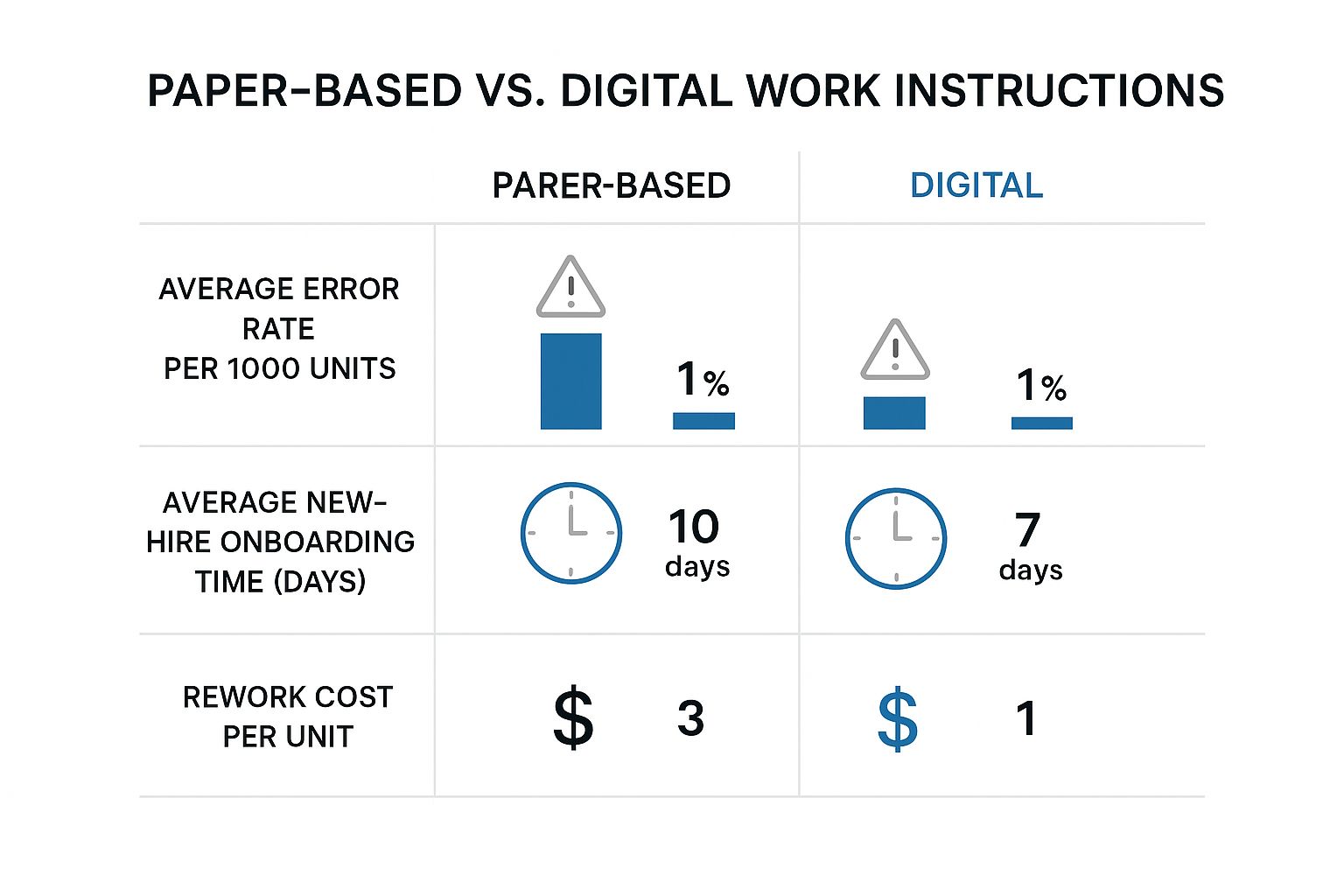
The data is clear. Digital instructions significantly reduce error rates and rework costs while dramatically accelerating the time it takes for new hires to become proficient and productive.
The Demands of Industry 4.0
The rise of Industry 4.0—characterized by smart factories, IoT devices, and complex automation—introduces processes far too sophisticated for static documents. Operators require dynamic, real-time guidance that can adapt to product variations and integrate live data from the machinery they operate.
Modernizing work instructions is no longer just about improving efficiency; it's a fundamental requirement for survival. Companies must transform these documents from simple procedural guides into active, intelligent assets that empower the workforce.
Static instructions create a dangerous gap between the operator and the complex task at hand. To maintain quality control, onboard new employees faster, and eliminate preventable costs, it is essential to evolve. We have witnessed firsthand the consequences of failing to capture expertise; you can learn more about the risks of losing institutional knowledge in our analysis on the topic.
The contrast between legacy and modern approaches is stark. This comparison highlights the fundamental differences.
Traditional vs Modern Work Instructions
| Attribute | Traditional Instructions (Paper/PDF) | Modern Instructions (Digital/AR/VR) |
|---|---|---|
| Format | Static text and 2D images. | Interactive 3D models, video, AR overlays. |
| Accessibility | Stored in binders or on local drives. | On-demand access via tablets, AR glasses, mobile. |
| Updates | Manual, slow, and prone to error. | Centralized, instant, and pushed to all users. |
| Interactivity | Passive. Operator reads and interprets. | Active. Guides users, confirms steps, collects data. |
| Data Integration | None. Completely disconnected from live data. | Integrates with MES, ERP, and IoT sensors. |
| Training | Requires shadowing; slow knowledge transfer. | Accelerates learning with guided, hands-on practice. |
The table clarifies that modernizing work instructions is not merely an upgrade but a complete transformation in how teams are empowered and quality is managed on the shop floor.
Building a Foundation for Clarity and Precision
Before implementing new technology, it is crucial to recognize that a sophisticated digital platform displaying flawed or confusing instructions will only enable teams to produce defective parts more quickly. The foundational work begins with creating robust work instructions for manufacturing from the ground up, viewing the task through the operator's perspective.
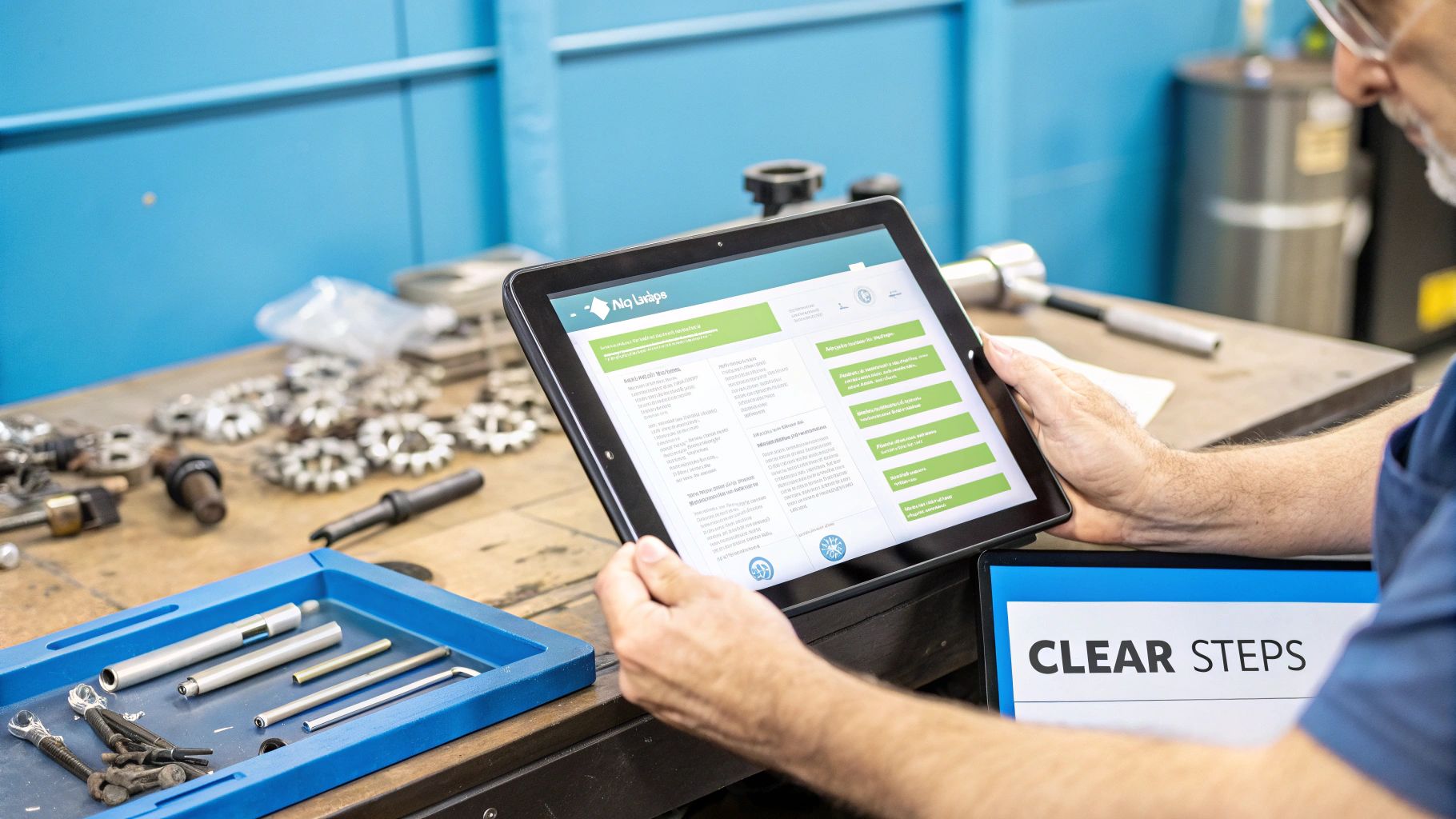
This requires abandoning passive, overly technical language in favor of simple, direct commands. Instead of, "The bolts should then be torqued," the instruction should be, "Torque the four mounting bolts to 25 Nm." This phrasing is direct, unambiguous, and leaves no room for interpretation.
Conducting a Thorough Task Analysis
The first practical step is a comprehensive task analysis. This process extends beyond simply listing steps from a manual; it aims to capture the unwritten, institutional knowledge of seasoned operators. By observing the process on the floor and asking targeted questions, one can uncover every critical action, safety warning, and quality checkpoint.
An effective task analysis includes:
- Direct Observation: Observe both a veteran and a newer operator. The veteran demonstrates efficient techniques, while the novice reveals areas where instructions are unclear.
- Stakeholder Input: Engage operators, quality inspectors, and maintenance staff in a review process. Their collective input will identify issues a single author might miss.
- Failure Mode Identification: Actively inquire, "What is the most common way this step goes wrong?" Then, author instructions specifically to prevent that failure.
This process ensures instructions reflect shop floor realities, not just engineering diagrams.
To truly build a foundation for clarity and precision in manufacturing work instructions, understanding and applying principles from Cognitive Load Theory is essential to optimize how information is presented and absorbed by operators.
The ultimate goal is to make the correct procedure the easiest one to follow. An operator should not have to decipher a complex sentence while handling heavy machinery. Every word and image should make the correct action intuitive.
Structuring Instructions for the Real World
On a busy and noisy factory floor, operators do not have time to read dense paragraphs. Information must be scannable for immediate comprehension. A clear blueprint for instructions should prioritize visuals and clean formatting.
From the operator's perspective, each step must instantly convey three things: what to do, what to use, and what it should look like.
- Actionable Steps: Use a numbered list with one clear action per step.
- Required Tools: List or show pictures of the exact tools needed at the beginning of the procedure.
- Visual References: Include high-quality photos or simple diagrams for every critical moment, highlighting the specific area of focus.
For example, instead of writing "Connect the red wire," provide a photo with an arrow pointing to the exact terminal. This simple visual can prevent a costly wiring error that might take hours to diagnose and repair. By building this clear, precise, and operator-focused foundation, you create a blueprint for excellence that technology can then amplify.
Standardizing Instructions Across Your Operations
Inconsistent instructions lead directly to inconsistent results—a fundamental truth in manufacturing. If one shift performs a task differently from another, or one facility follows a modified procedure, quality becomes a matter of chance rather than design.
The only way to guarantee consistent outcomes is by standardizing your work instructions for manufacturing across every team, shift, and location.
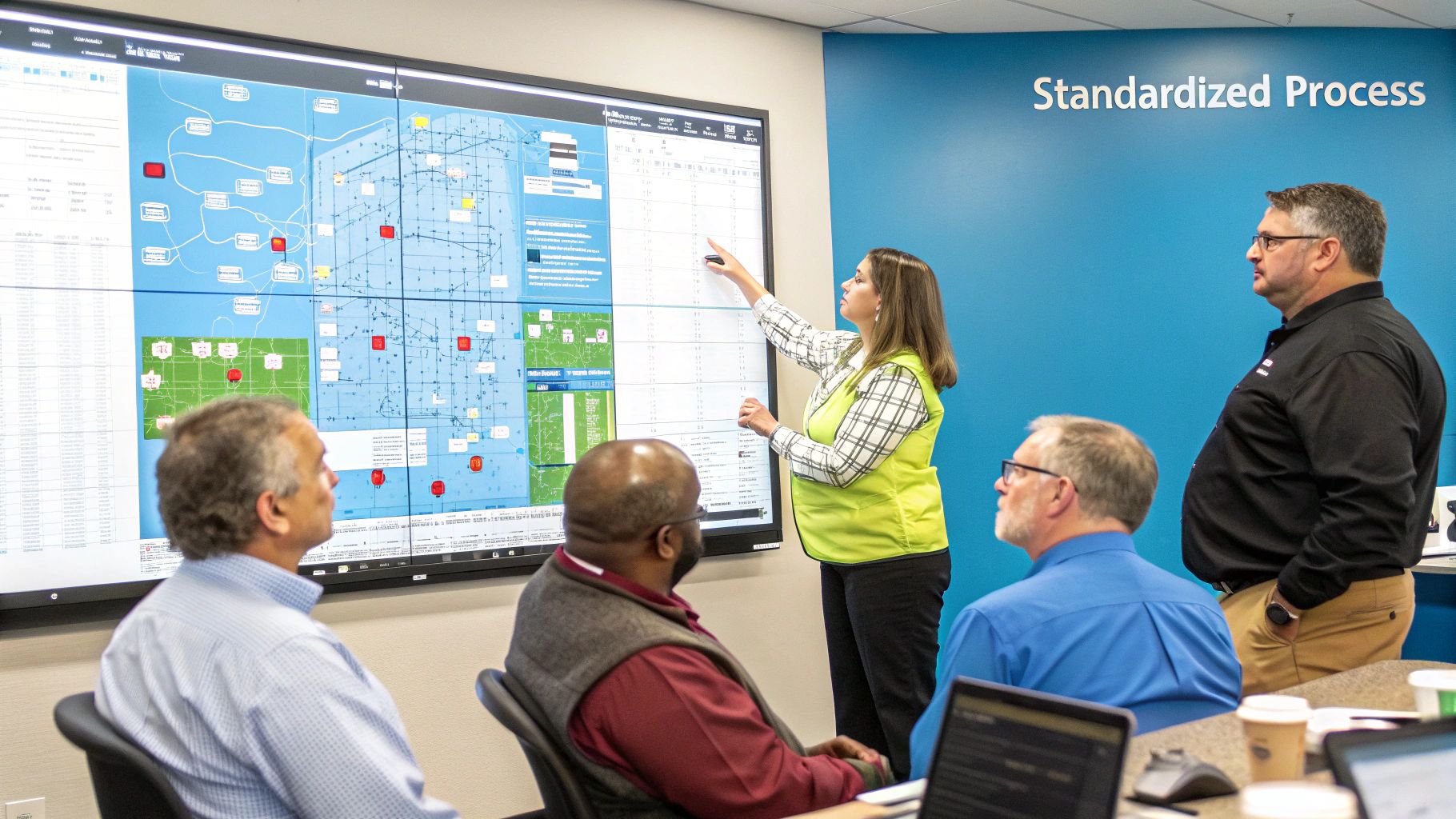
This process must begin with a single source of truth—a centralized digital repository for all approved procedures. When instructions are scattered across shared drives, local computers, and paper binders, control is impossible. A central hub ensures that any update is reflected everywhere, instantly.
Creating a Master Template
With a central repository established, the next step is to develop a standardized template that all instructions must follow. This is not merely about branding; it is about enforcing operational discipline. The master template should mandate the inclusion of critical information for every task, without exception.
A robust template should include these non-negotiable elements:
- Safety Protocols: What personal protective equipment (PPE) is required? What are the specific lockout/tagout procedures? This information must be prominent.
- Tool and Material Requirements: List the exact tools, parts, and consumables needed, specifying model numbers or settings to eliminate ambiguity.
- Step-by-Step Actions: The core procedure, written in clear, active language and supported by visuals wherever possible.
- Quality Checks: What are the critical-to-quality (CTQ) specifications? Include precise measurements, tolerances, and visual standards for pass/fail decisions.
By making these fields mandatory, you eliminate the risk of an author omitting a vital safety warning or a critical quality checkpoint. This standardized structure makes information predictable and easy for operators to locate, reducing cognitive load and the likelihood of errors.
Managing Version Control Effectively
One of the most significant failings of traditional paper-based systems is inadequate version control. It is impossible to be 100% certain that an operator is using the most current document. A digital system solves this by making outdated versions inaccessible.
The core principle of standardization is simple: ensure the right person has the right instructions at the right time, every single time. Effective version control is what makes this principle a reality on the shop floor.
Consider a global manufacturer that needs to adapt a master assembly instruction for different regions. While the core procedure remains the same, local safety regulations in Europe may require an extra verification step not mandated in North America.
A centralized digital system allows for the management of a single master instruction with regional variants. This approach provides global consistency while accommodating local requirements, all without creating dozens of separate, unmanageable documents.
For complex operations, integrating these standards into a broader digital framework is key. You can learn more about how this works with enterprise learning management systems that centralize both training content and procedural documents. Ultimately, standardization is the foundation for scaling excellence.
Enhancing Guidance with AR and VR Technology
Once a solid, standardized foundation for your work instructions for manufacturing is established, the next step is to bring that guidance to life. Even the best digital documents have a fundamental limitation: they require an operator to look away from their work to consult the instructions. This constant context-switching is a primary source of errors and inefficiency.
Augmented Reality (AR) and Virtual Reality (VR) are practical tools designed to close this gap. They transform passive instructions into active, immersive experiences that guide operators directly at the point of action.
Augmented Reality in Action
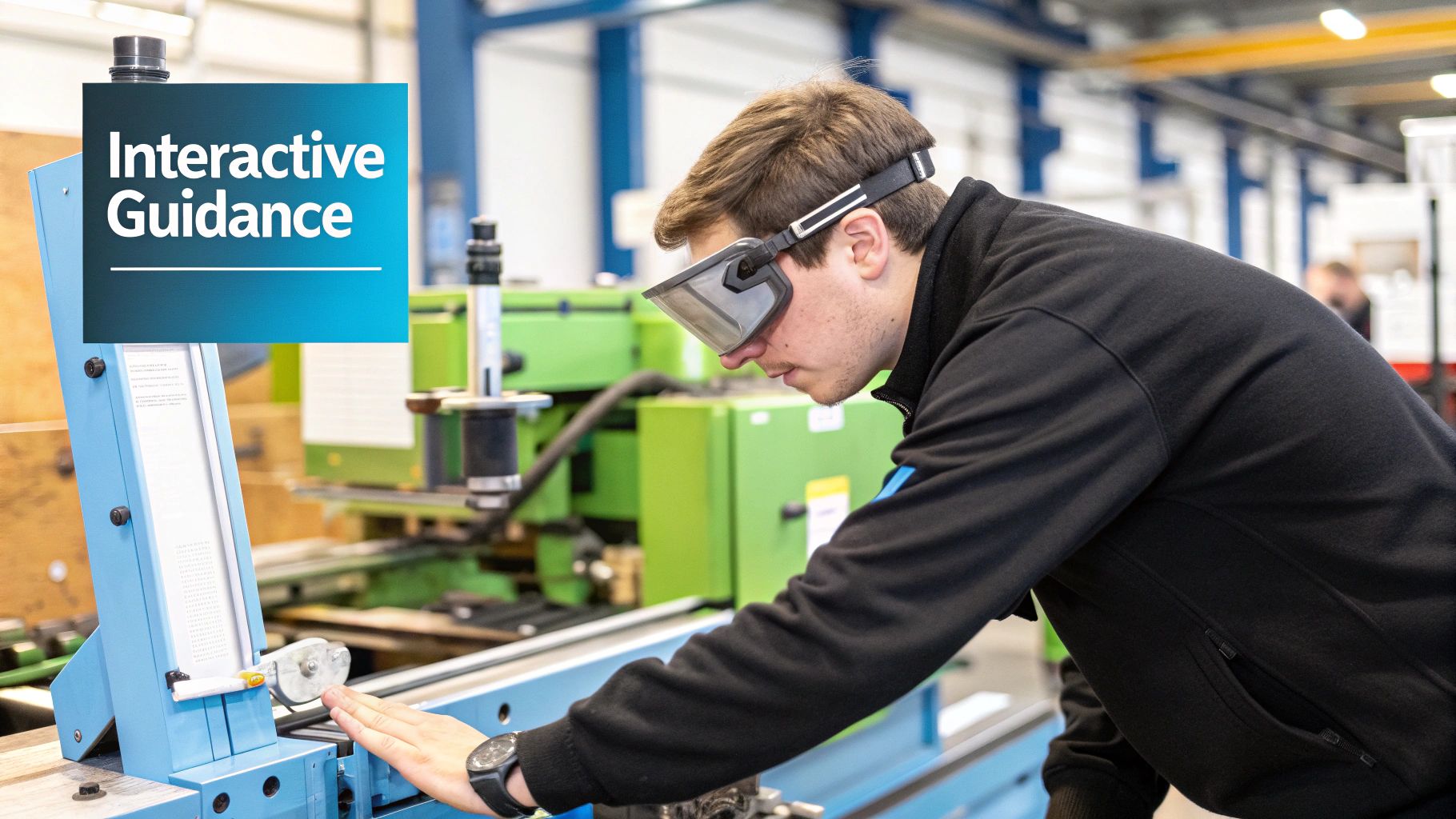
AR technology overlays digital information—such as instructions, warnings, or 3D models—onto the user's view of the real-world environment. For a manufacturing operator, this means seeing exactly what to do and where to do it without diverting their attention from the task. This bridging of the physical and digital worlds provides instantly understandable guidance, reducing cognitive load and human error.
Consider these practical use cases:
- Complex Assembly Guidance: An operator assembling a complex gearbox sees a 3D animation of the precise installation sequence for each component overlaid directly onto the physical unit. Critical information, like torque specifications and part numbers, appears at the exact moment it is needed.
- Real-Time Quality Control: During an inspection, AR can project a digital template of a perfectly assembled product onto the physical unit. Any deviations or missing parts are instantly highlighted, making quality checks faster and, in some cases, up to 90% more accurate than manual methods.
- Maintenance and Repair: A technician working on a machine uses AR to view a "ghost" image of the internal components overlaid on the machine's casing. The system can then provide step-by-step troubleshooting guidance, highlighting the exact part to inspect or replace.
The applications of augmented reality for manufacturing are extensive. The technology excels at delivering the right information to the right place at the right time, directly improving first-time-right rates and operational speed.
Virtual Reality for Safe and Effective Training
While AR enhances on-the-job performance, Virtual Reality is a transformative tool for training. VR creates a fully simulated environment, allowing trainees to practice complex or high-risk tasks in a safe, controlled digital space before handling expensive equipment.
This approach fundamentally changes knowledge transfer. A new hire can practice a high-consequence assembly dozens of times in VR, building muscle memory and confidence without consuming scrap materials or risking damage to production machinery. Studies have shown that this type of immersive learning can increase knowledge retention by as much as 75%.
By enabling operators to learn from mistakes in a virtual environment, you build a more competent and confident workforce. VR transforms training from a passive presentation into an active, hands-on experience that replicates the challenges of the shop floor.
For those considering VR implementation, understanding the content creation process is beneficial. You can find an in-depth guide on creating VR content for enterprise applications that details the process. This training method is invaluable for tasks that are too dangerous, expensive, or infrequent to practice on real equipment, ensuring every operator is prepared for any scenario. As a result, training shifts from a cost center to a strategic advantage.
Weaving New Systems into Your Quality Culture
Implementing a new system for work instructions for manufacturing is a significant cultural shift that extends far beyond technology. The most advanced AR platform is useless if operators do not trust it or view it as just another top-down mandate.
The success or failure of these initiatives hinges on the human element.
True adoption occurs when the team perceives the new system not as a replacement for their skills, but as a tool that makes their jobs easier, faster, and safer. Achieving this requires a dedicated focus on change management from the project's inception.
Getting Buy-In from the People Who Matter Most
Designing a system in isolation and then imposing it on the shop floor is a common mistake that guarantees resistance.
The most effective approach is to involve seasoned operators in the design and rollout process from the very beginning. As the true subject matter experts, they understand the nuances of each task that determine success.
When you empower them to help create the digital instructions, two positive outcomes emerge:
- The instructions become far more accurate and practical.
- These operators become powerful advocates for the new system, encouraging their peers to adopt it.
It is also essential to demonstrate immediate, tangible benefits. Show operators how an AR overlay eliminates the need to decipher a confusing diagram from a distance or how instant access to the latest procedure removes the frustration of using an outdated paper document.
Making Compliance and Safety Second Nature
Modern digital systems do more than guide operators; they provide an invaluable backbone for the entire quality and safety culture.
Built-in audit trails can automatically log when an instruction was accessed, which steps were completed, and by whom. This feature simplifies adherence to standards like ISO 9001 and strengthens documentation for safety audits. A robust digital system is an essential component of any serious manufacturing quality improvement strategy.
A new system is truly integrated when it becomes an indispensable part of the daily workflow—reinforcing the safety and quality standards that protect your people and your product. It should feel less like a new rule and more like a natural extension of your team’s expertise.
This becomes even more critical in a global operation. Outdated instructions pose a massive compliance risk. With nearly 76% of manufacturers concerned about regulatory uncertainty, a system that can be updated instantly across all sites is essential. Ambiguous instructions can easily lead to major safety incidents and compliance failures. The latest manufacturing regulation trends highlight the significant stakes involved.
By embedding these tools directly into the daily workflow, you make quality and safety an integral and unavoidable part of performing the job correctly.
Got Questions About Modernizing Your Work Instructions?
Adopting new technology for a core process like work instructions for manufacturing naturally raises questions. Leaders must understand the real-world impact of implementation, the associated costs, and how the team will adapt before committing to a change.
Here are the most common concerns we hear from manufacturers considering this transition.
How Do We Get Started Without Wrecking Our Production Schedule?
The prospect of overhauling an entire documentation system is daunting, and a "rip and replace" approach is rarely advisable.
The best strategy is to start small. Select a single production line or a particularly challenging assembly process for a focused pilot project.
This provides a controlled environment to thoroughly test the technology. You can gather candid feedback from operators and, more importantly, measure tangible results. Track key metrics—first-pass yield, training time, error rates—before and after implementation. A successful pilot not only proves the concept but also provides a powerful, data-backed case for wider rollout, while allowing you to resolve minor issues before they escalate.
Aren't These AR and VR Solutions Crazy Expensive?
While there is an initial investment, the conversation should focus on return, not just cost. Many modern AR and VR platforms now offer scalable, subscription-based models, which significantly lowers the upfront financial barrier.
The question you should really be asking is, "What is the cost of doing nothing?" Take a hard look at what you're spending right now on rework, scrap, long training cycles, and safety incidents. The ROI from cutting down on these persistent, nagging costs often pays for the investment way faster than you'd think, even for smaller operations.
What About Our Veteran Operators? Won't They Hate This?
This is a people challenge, not a technology one. The trick is to bring your most experienced folks into the loop right from the start.
Frame this new system as a tool designed to capture and amplify their expertise, not to make them obsolete. Position it as their way of passing down decades of hard-won knowledge to the next generation. Get them involved in creating the new digital instructions—who knows the process better than they do?
Once they see how a 3D model can explain a complex step better than a grainy photo, or how they no longer have to deal with coffee-stained, outdated binders, they often switch from skeptics to your biggest champions.
At AIDAR Solutions, our entire focus is on making this shift feel natural, not disruptive. Our AR and VR platforms are built to empower your workforce, capture that priceless expert knowledge, and deliver a clear, measurable return by cutting down on errors and speeding up training.
Discover how our immersive solutions can modernize your manufacturing operations today.