
A Practical Guide to Increase Manufacturing Efficiency with AR and VR
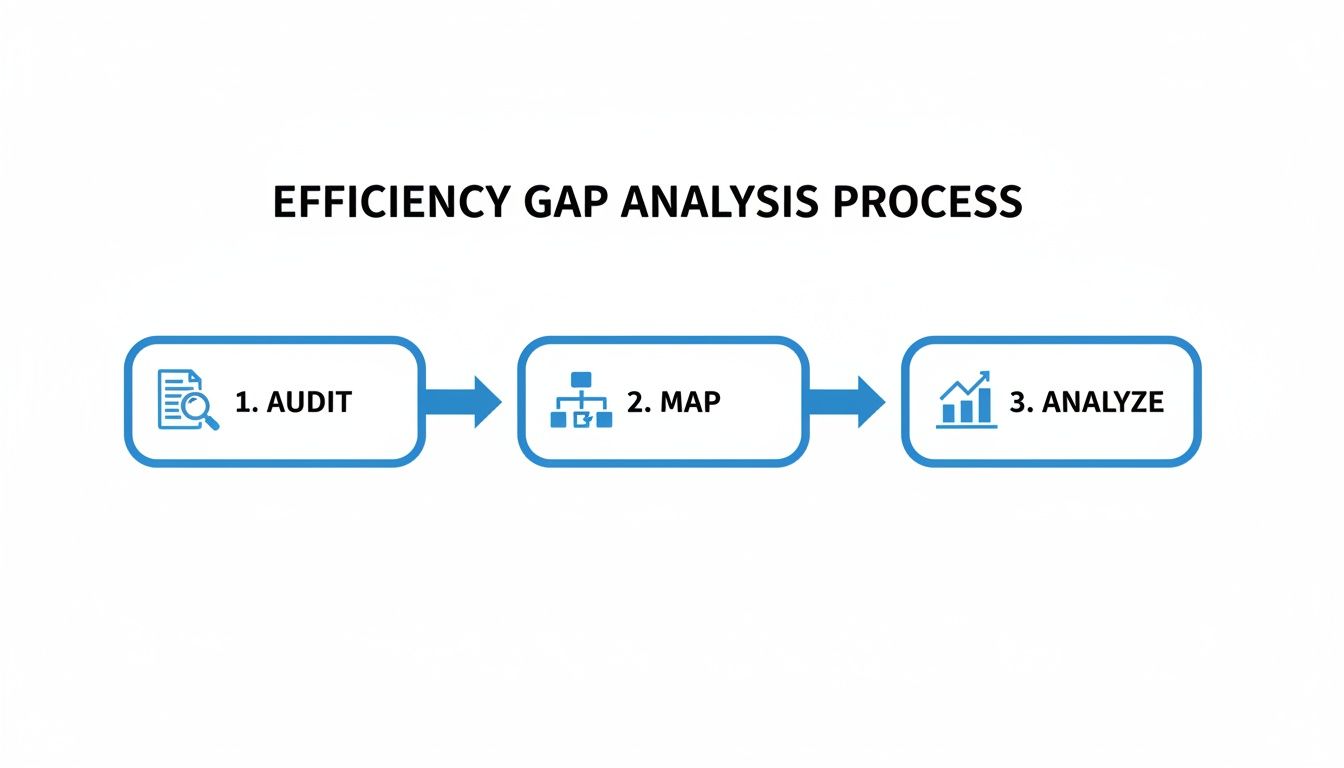
To meaningfully improve manufacturing efficiency, you must first identify where performance is lagging. While it’s tempting to adopt the latest technology, an investment without a clear target is unlikely to yield results. The key is a focused audit of your most critical workflows—the areas where bottlenecks, skill gaps, and delays silently erode productivity. This is where technologies like Augmented Reality (AR) and Virtual Reality (VR) can deliver a significant impact, but only when applied to the right problems.
Pinpointing Your Biggest Efficiency Gaps
Implementing new technology without a clear map of your operational landscape is a sure way to misallocate your investment. Before you can improve a process, you must understand it completely. This requires digging deeper than surface-level metrics and conducting a targeted audit to find the friction points that drain productivity and increase costs. The goal isn’t a complete operational overhaul. It's about identifying high-impact areas where a focused improvement will deliver the greatest return.
This initial analysis is foundational. A genuine commitment to continuous improvement in manufacturing is the bedrock you need to truly address these gaps and build a lasting culture of optimization.
Start with the Right Data
You can't improve what you don't measure. Generic production numbers are insufficient as they fail to tell the whole story. Instead, you need to focus on the Key Performance Indicators (KPIs) that reveal the true health of your operations. Consider these metrics your diagnostic tools, helping you understand not just what is happening, but why.
Before you introduce any new solutions, you need a solid baseline. Here are the essential metrics we recommend our clients track.
Key Efficiency Metrics to Track Before AR and VR Implementation
This table breaks down the core KPIs you should be monitoring. They will provide a clear "before" picture, making it easier to demonstrate the value of your AR/VR initiatives later.
| KPI | What It Measures | Why It's Critical |
|---|---|---|
| Overall Equipment Effectiveness (OEE) | The percentage of planned production time that is genuinely productive, combining availability, performance, and quality. | A world-class OEE is 85%, but many facilities operate closer to 60%. This single metric quickly reveals hidden capacity and major improvement opportunities. |
| Mean Time to Repair (MTTR) | The average time it takes to repair a piece of equipment after a failure, from breakdown to resumption of normal operation. | High MTTR is a direct indicator of lost production time, often pointing to skill gaps, poor documentation, or delays in getting expert support. |
| First-Time Fix Rate (FTFR) | The percentage of maintenance tasks completed correctly on the first attempt without needing a follow-up visit. | A low FTFR signals recurring problems, wasted labor, and extended downtime. It often highlights a need for better on-the-job guidance or training. |
| Scrap and Rework Rate | The percentage of materials wasted or products requiring correction during the production process. | This metric directly reflects the cost of quality. High rates can be tied to procedural errors, inconsistent training, or complex assembly tasks. |
Tracking these numbers provides a data-driven starting point. Now, it's time to connect that data to what is actually happening on the floor.
Map Your High-Impact Workflows
With your baseline KPIs in hand, the next step is to understand where those numbers originate. This involves mapping out your most critical workflows to visualize every step, handoff, and potential delay. Focus on the processes most vital to your output or those that are notoriously problematic, rather than attempting to map the entire factory.
Good places to start your mapping include:
- Complex assembly procedures that have high error rates or require specialized knowledge.
- Urgent maintenance and repair tasks where every minute of downtime costs thousands.
- New employee onboarding and training for crucial machinery or production lines.
- Changeover processes between different product runs, which are often a source of hidden delays.
By visually charting these processes, you can pinpoint the exact moments where technicians wait for instructions, where assembly steps are performed incorrectly, or where a lack of expert knowledge brings a production line to a halt.
Identifying these specific pain points is the most critical step. A thorough audit might reveal that a significant portion of downtime comes from junior technicians waiting for the one senior expert who knows the machine. That is not just a scheduling problem—it’s a knowledge-transfer bottleneck.
Once these nuances are clear, it becomes obvious where a tool like AR remote support could provide immediate value. To formalize this process and delve deeper into your team's capabilities, a structured approach like our guide to conducting a skills gap analysis is the perfect next step.
Designing a Strategic XR Pilot Program
Jumping headfirst into a full-scale XR rollout is a recipe for failure. A more intelligent, strategic approach is to design a focused pilot program first. This provides an opportunity to prove the technology's value on a small, manageable scale, gather undeniable data, and build internal momentum before requesting a larger budget.
The key is to anchor your pilot to one of those high-impact, high-pain workflows you have already identified. Instead of a vague goal like "improve efficiency," a successful pilot needs sharp, measurable objectives that directly solve a specific problem. Focus on tangible outcomes.
This initial step is about de-risking the investment and getting key stakeholders on board. It changes the conversation from a high-cost technology gamble to a strategic, data-backed operational upgrade.
Defining Your Pilot's Scope and Goals
A successful pilot is a focused pilot. You must resist the temptation to solve every problem at once. Instead, select a single, well-defined challenge where XR can make an immediate, measurable impact.
Keep your scope tight and crystal clear. For example, instead of trying to train all new hires, focus the pilot on training for a single, notoriously complex piece of machinery. If maintenance is your biggest bottleneck, target remote support for one specific type of recurring equipment failure.
Once you have your scope, set clear success criteria that tie directly back to the KPIs you benchmarked earlier. Here are a few practical examples of strong pilot goals:
- Reduce new hire training time for Machine X by 40% by replacing traditional manuals with immersive VR simulations.
- Cut machine downtime from hydraulic failures by 25% by using AR remote assistance to get your senior experts' eyes on the problem instantly, without travel.
- Boost the First-Time Fix Rate (FTFR) by 20% on a specific production line by giving technicians step-by-step AR-guided work instructions directly in their field of view.
This methodical approach ensures your pilot is set up to solve a real, quantified problem, not just to test new technology.
Assembling the Right Team
Great technology is only half the battle; you need the right people driving it. Your pilot team should be a small, hand-picked group of individuals who will be directly involved in using and evaluating the XR solution.
When selecting operators for the pilot, aim for a balanced mix. You'll want a tech-savvy early adopter who is genuinely excited about new tools. But you also need a seasoned veteran—someone who might be skeptical but knows the workflow inside and out. This blend creates a realistic test bed and provides much more credible feedback. A pilot's success depends on both enthusiasm and critical, real-world evaluation.
By bringing end-users into the process from day one, you are not just pushing technology on them. You are making them active partners in finding the solution. Their insights are invaluable for refining the process and proving it actually works on the floor.
This collaborative approach not only improves the pilot's outcome; it creates internal champions who will be your biggest allies when it's time for a broader rollout.
Establishing Success Criteria
How will you know if the pilot was successful? You need to define your success criteria before you begin. These metrics are the backbone of the business case you'll build to scale the program later. They should be a direct reflection of your initial goals.
For instance, if your goal was to reduce downtime, your success criteria might look like this:
- A measured 25% reduction in Mean Time To Repair (MTTR) for the specific equipment in the pilot.
- Qualitative feedback from technicians confirming that AR support made their jobs faster and less frustrating.
- A clear calculation of the cost savings from that avoided downtime.
When you combine hard data with compelling user feedback, you create a powerful narrative. Document every step, result, and piece of feedback. This is the evidence you'll need to convince leadership to invest further. Building a strong pilot isn't just about the technology—it's about proving how a digital augmented reality workflow delivers concrete financial and operational wins. This evidence-based approach turns a small test into a major strategic asset.
Putting Immersive Tools into Your Team's Hands
With your pilot designed and strategy in place, the exciting part begins: bringing this technology to life on the factory floor. This is where you start to see a real increase in manufacturing efficiency by providing your team with tools that fundamentally change how they learn, solve problems, and work.
Immersive tools like VR and AR are practical, powerful solutions to the persistent, everyday challenges in manufacturing.
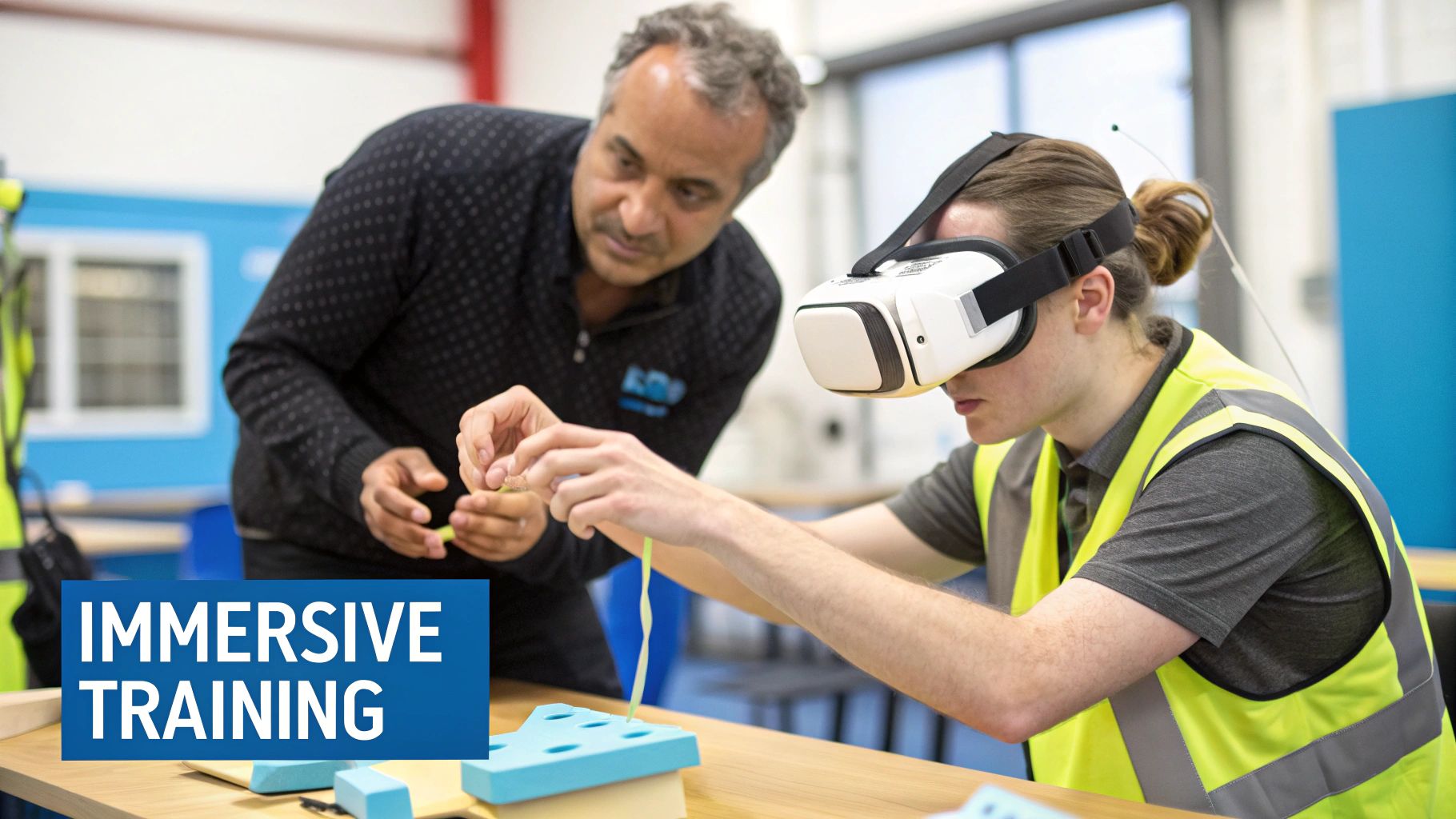
Whether it's getting new hires up to speed in record time or slashing downtime by fixing complex issues in minutes, these tools unlock significant productivity gains. Let's break down the two most impactful ways to get started: transforming training with VR and accelerating maintenance with AR.
Reinventing Training with VR Simulations
Traditional training methods have their limits. Expecting mastery from a dense SOP manual is unrealistic. On-the-job shadowing, while effective, pulls a senior expert away from their tasks and occupies a critical piece of live equipment.
Virtual Reality (VR) fundamentally changes this model by providing a safe, controlled, and endlessly repeatable training environment.
Imagine a new technician learning a complex, multi-step assembly. Instead of interpreting a diagram, they are performing the task with their own hands in a photorealistic digital twin of your factory floor. They can practice, make mistakes, and learn from them without any real-world consequences.
This hands-on approach aligns with how people learn best. It dramatically reduces the cognitive load of translating a 2D drawing into a 3D action. Your team builds actual muscle memory and deep procedural understanding in a simulation that mirrors their real workspace.
The benefits are not theoretical; they directly impact your bottom line:
- Zero Material Waste: Trainees can run a procedure dozens of times without touching a single physical component or using any raw materials.
- Increased Equipment Uptime: Your live production machinery remains online and productive, no longer serving as a classroom.
- Enhanced Safety: Need to practice an emergency shutdown or handle a simulated hazardous material spill? VR allows for training in high-stakes scenarios with zero risk.
This isn't just about knowledge transfer; it's about building confidence. When an employee finally steps onto the line, they are not just prepared on paper—they are competent and ready to perform. You can explore more ways to build a highly skilled and adaptable workforce with solutions like augmented reality for training.
Slashing Downtime with AR-Powered Remote Support
In manufacturing, downtime is the ultimate productivity killer. Every minute a critical machine is offline, revenue is lost. The classic problem is that the one expert who knows exactly how to fix it is often hundreds, if not thousands, of miles away.
Augmented Reality (AR) remote assistance closes that gap instantly.
It provides a direct, live connection between your on-site technician and your senior expert, regardless of their location. Using an AR headset or even a tablet, the local technician streams their exact point-of-view to the remote expert in real-time.
The expert sees what the technician sees and can guide them visually:
- Annotate the Real World: They can draw, circle, or place arrows directly onto the technician's field of view, pinpointing the exact button, cable, or component.
- Share Key Documents: If a schematic or work instruction is needed, the expert can push it directly into the technician's view, right where they need it.
- Freeze the Frame: They can pause the live feed to zoom in and discuss a complex part without the on-site tech having to hold perfectly still.
What was once a frustrating, time-consuming breakdown becomes a guided, collaborative fix. The impact is immediate. You solve problems in minutes that used to take days, eliminating travel costs and getting production back online faster than ever before.
These advanced digital tools are a key driver of modern operational excellence. For instance, integrated systems powered by artificial intelligence—the core technology behind advanced AR and VR—can reduce production line downtime by 30-40% and slash defect rates by up to 30%, delivering a clear return on investment.
Leading Your Team Through Technological Change
Introducing powerful tools like AR and VR is an operational decision, but ensuring their adoption is a people-first mission. The most sophisticated technology is ineffective if your team doesn't buy in. Real adoption is not about just distributing new hardware; it's about leading people through a genuine shift in how they work, learn, and solve problems.
Transitioning from traditional methods to these new immersive solutions requires a deliberate change management strategy. Without one, you will encounter resistance, low adoption rates, and a pilot program that fails to gain traction. The goal is to weave these tools into your operational DNA, making them a core part of how you operate.
Get to the "Why" Immediately
The first question on every employee's mind is, "What's in it for me?" Your communication must address this directly and honestly. Fear of the unknown, or worse, fear of being replaced, can derail a project before it starts.
Frame the conversation around the direct benefits for your frontline team. This isn't a top-down mandate; it's about providing them with tools to make their jobs better, safer, and less frustrating.
Focus on the practical, personal wins:
- Train with confidence, not fear: "Instead of learning on a live, high-pressure machine, you'll master the entire process in a completely safe virtual space. You can practice as many times as you need until you feel confident, with zero risk to yourself or the equipment."
- Get answers, not wait times: "When you're stuck on a tricky repair, you won't have to wait hours for a senior tech to show up. AR support connects you to an expert instantly, so you can solve the problem and get back on track."
- Slash rework and frustration: "Think of AR-guided instructions as your expert co-pilot. They walk you through complex assemblies step-by-step, cutting down on simple mistakes and the rework that everyone hates."
When people see the technology as a partner that helps them succeed, their mindset shifts from resistance to genuine curiosity.
Build a Feedback Loop You Actually Use
Your people on the floor have an unparalleled understanding of your workflows. Ignoring their insights is a significant mistake. A successful rollout hinges on creating a real, structured system for gathering, acknowledging, and—most importantly—acting on their feedback.
Establish clear channels for them to share their thoughts during and after the pilot. This could be a dedicated communication channel, regular stand-up meetings, or quick one-on-one check-ins. Ask open-ended questions that encourage detailed responses.
Treat your frontline team as co-creators of this new process. Their real-world feedback is the most valuable data you have for refining the solution and ensuring it genuinely helps to increase manufacturing efficiency.
When you act on their suggestions, you demonstrate that you're listening. It proves this is a collaborative effort. The moment an employee suggests a tweak to an AR overlay and then sees that change implemented, you have created your most powerful advocate.
Bake It into Your L&D Culture
For immersive tools to have a lasting impact, they cannot be a side project. They need to be fully integrated into your formal Learning and Development (L&D) structure. This is how you elevate VR and AR from a niche tool to a core part of how your company trains, develops, and promotes its people.
Involve your L&D team early. Work with them to officially build these new modules into your existing training curricula. This means updating skill matrices, certification requirements, and onboarding checklists to reflect the new way of learning. For example, completing a set of VR simulations could become a mandatory prerequisite before a technician is certified to work on a new piece of equipment.
This alignment sends a powerful message across the organization: immersive training is the new standard for excellence and a clear sign that you're investing in your team's future.
Measuring ROI and Scaling Your Success
Your pilot program is complete. You have collected the initial data. Now comes the moment of truth: turning that successful test into a rock-solid business case that can get your entire operation excited to increase manufacturing efficiency. It's time to connect the dots between your pilot's performance and the bottom line, painting a clear picture of value that resonates with stakeholders.
With hard data in hand, you can move past subjective assessments and build a data-driven argument for a wider rollout. This is not just about justifying the initial spend; it's about creating a roadmap for what comes next.
Analyzing Pilot Data Against Baseline KPIs
First, refer to the baseline KPIs you established before the pilot began. This allows for a direct, apples-to-apples comparison that proves the impact of the new technology. Did the key metrics move in the right direction?
You need to place your pilot results side-by-side with the old metrics to quantify the gains. For example:
- Mean Time to Repair (MTTR): Did MTTR for the targeted equipment decrease? If it went from an average of 4 hours down to 1.5 hours, that’s a 62.5% reduction. This is a number that gets attention.
- First-Time Fix Rate (FTFR): Perhaps your FTFR on complex repairs increased from 60% to 90%. This proves AR-guided support is eliminating frustrating repeat visits and wasted labor.
- Training Time: What if new hires achieved proficiency on a machine in just 10 hours using VR, versus the 25 hours it took previously? You have just reduced your onboarding time by 60%.
These hard numbers form the foundation of your business case. They are objective, undeniable proof that the solution is delivering results.
Calculating Your Return on Investment
Translating performance metrics into financial terms is what truly captures leadership's attention. ROI is not just a buzzword; it's the language of business. You must demonstrate not just that it worked, but how much money it saved or generated.
Focus on clear, defensible calculations. Let's walk through a common scenario using AR remote support.
Imagine you avoided flying a senior expert from Germany to your plant in Ohio for an emergency repair. The savings are immediate and substantial.
A Simple ROI Calculation Example
| Expense Category | Cost Without AR | Cost With AR | Savings |
|---|---|---|---|
| Airfare & Lodging | $4,500 | $0 | $4,500 |
| Expert's Travel Time | $4,000 (40 hrs @ $100/hr) | $0 | $4,000 |
| Lost Production (Downtime) | $120,000 (8 hrs @ $15k/hr) | $15,000 (1 hr @ $15k/hr) | $105,000 |
| Total Cost of Incident | $128,500 | $15,000 | $113,500 |
In this single incident, the $113,500 in savings could easily pay for the entire pilot program several times over. This is the kind of powerful, concrete data that makes your case for you. For a deeper dive, check out our guide on how to calculate return on investment for tech projects.
Developing a Phased Scaling Roadmap
Armed with positive results and a strong ROI, it's time to plan the expansion. A "big bang" rollout across the entire organization is almost always a mistake—it’s risky and impractical. A phased approach is far smarter, allowing you to build on your wins and manage the change effectively.
Your roadmap should lay out a logical sequence.
- Replicate the Win: Start by deploying the solution to similar production lines, teams, or plants facing the exact same challenges you just solved. This is the low-hanging fruit that lets you quickly replicate your success and build more momentum.
- Expand to New Use Cases: Once the original use case is running smoothly, look for adjacent problems. If AR remote support was a game-changer for maintenance, could you use it for quality control inspections? What about new equipment installations?
- Full Enterprise Integration: The final phase is about making this XR solution a standard part of your operational toolkit. This means integrating it with core systems like your MES or EAM and embedding it directly into your standard operating procedures.
This methodical strategy minimizes risk, keeps the wins coming, and gradually builds the institutional knowledge you need for long-term success. It’s how a successful pilot becomes a true operational transformation, delivering bigger and bigger efficiency gains as you go.
Common Questions About AR and VR in Manufacturing
Adopting new technology always raises questions. When it comes to immersive tools like AR and VR, we hear similar concerns from manufacturing leaders about complexity, integration, and the bottom line. It is crucial to get clear, practical answers before making any investment. This is about cutting through the hype to understand the real-world value these solutions bring to the factory floor.
Let's address some of the most frequent questions we receive from leaders who are ready to increase manufacturing efficiency but require more details first. The answers usually reveal that modern XR solutions are far more accessible and impactful than they might seem.
How Much Technical Expertise Do We Need to Manage This?
This is a primary concern, and the answer is surprisingly simple: less than you think. Modern XR platforms are designed for the end-user, not a team of software developers. With a fully-managed Software-as-a-Service (SaaS) model, the provider handles all the technical heavy lifting—updates, security, and maintenance. This frees you to focus purely on operational gains.
The user interface for an AR remote support tool is often as intuitive as making a video call, requiring minimal training for a technician to start receiving expert help.
The purpose of this technology is to simplify work, not to add another layer of technical complexity. You do not need an in-house development team to realize major benefits.
Content creation for VR training has also become much more accessible. Experienced partners can work directly with your team to convert your existing paper-based SOPs and training manuals into effective, immersive modules. This collaboration means you get top-tier training content without needing to build a VR development studio from scratch.
Can XR Tools Integrate with Our Existing Plant Software?
Absolutely. In fact, they should. Integration is not just a desirable feature; it is essential for maximizing the value of your investment. Standalone technology creates data silos, but integrated tools amplify the power of the systems you already rely on. The best XR platforms are built with robust APIs designed to connect with your core operational software.
This synergy means XR tools enhance your established workflows instead of disrupting them. Here are a couple of powerful examples of how this plays out:
- Manufacturing Execution Systems (MES): A VR training module can pull real-time data from your MES to create incredibly realistic simulations. This lets you train new hires on the exact processes and interfaces they will actually use on the job.
- Enterprise Asset Management (EAM): An AR remote support tool can pull an asset's entire maintenance history and relevant work orders from your EAM. That information is then displayed right in a technician's field of view while they are making a repair.
This deep integration gives your team a more complete picture of what is happening on the floor, turning raw data into actionable, in-the-moment guidance that helps them perform their jobs more effectively.
What Is the Typical Timeframe to See a Return on Investment?
The ROI can be surprisingly fast, depending on which high-impact use case you tackle first. The return is often measured in months, or in some cases, after the very first use.
With AR remote assistance, many companies see a return almost immediately. The savings from avoiding a single international trip for a key expert can easily run into the thousands. Add to that the massive cost savings from reducing equipment downtime by days, and the ROI can be instant.
For VR training, the return is calculated differently, through metrics like:
- Reduced material waste during the learning phase.
- Faster onboarding times, making new employees productive sooner.
- Fewer safety incidents and costly mistakes on the line.
Many businesses report a positive ROI on their XR investment within the first year. For high-impact use cases, such as those targeting critical machine downtime, it can be as quick as six months. A well-designed pilot program is the best way to determine what this looks like for your specific operations.
Ready to see how immersive technology can directly address your biggest efficiency gaps? The experts at AIDAR Solutions can design a tailored action plan to integrate VR training and AR support into your operations, delivering measurable results from day one. Explore our solutions and book a demo today.