
A Practical Guide to AR in Warehouse Operations
Augmented Reality (AR) in a warehouse is a practical technology that layers digital information directly onto an employee's view of the real world. Think of it as a see-through guide that gives workers real-time, hands-free instructions for everything from picking orders to performing maintenance. This digital overlay transforms complex manual jobs into guided, error-proof workflows, driving up both productivity and accuracy.
The Reality of Modern Warehousing and the AR Revolution
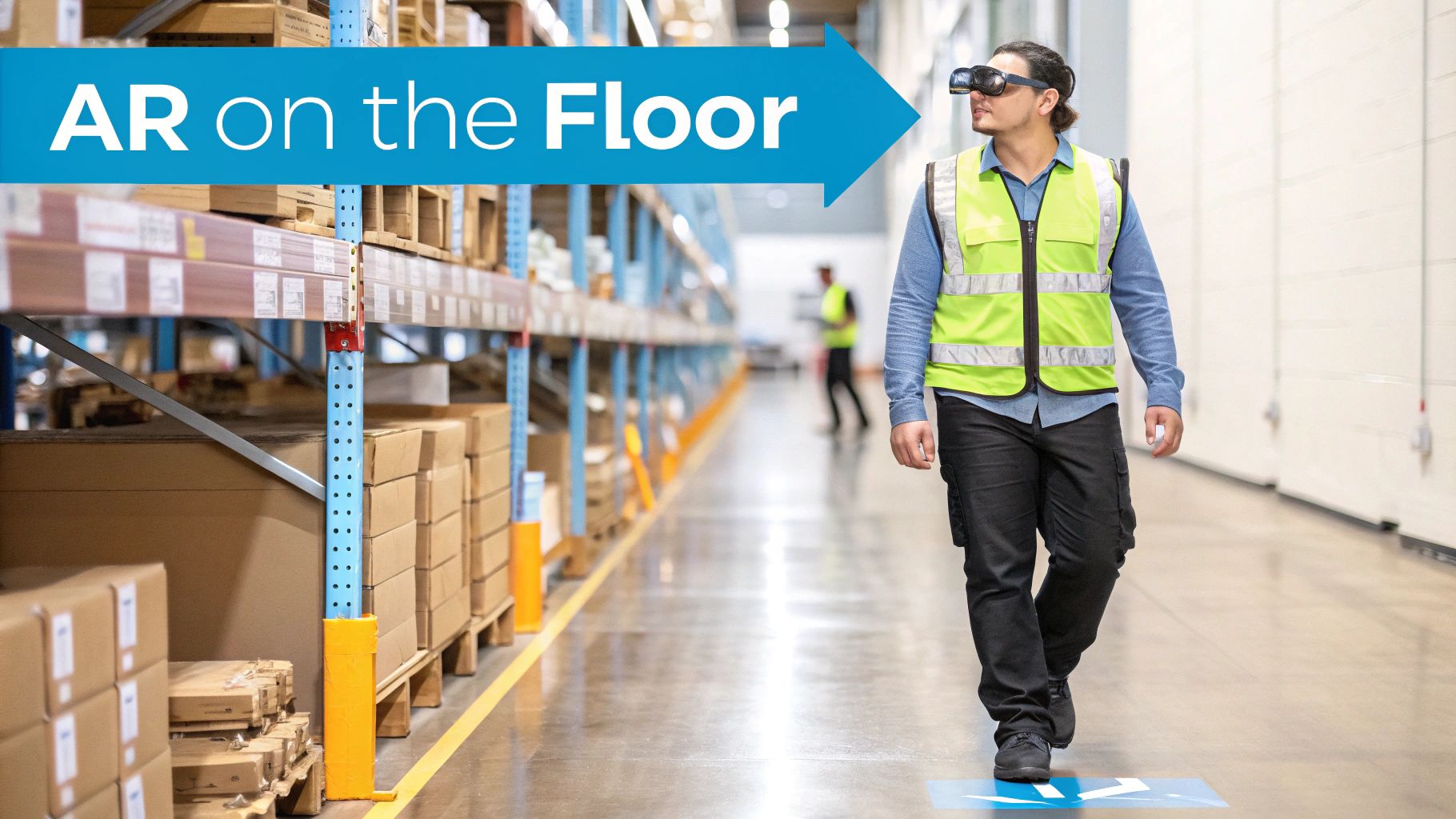
Warehouses today are under immense pressure. E-commerce has created an insatiable demand for speed, while labor shortages and ballooning operational costs are squeezing margins. Small, incremental improvements are no longer sufficient. Logistics leaders need a fundamental change in how work gets done.
This is where Augmented Reality steps in. Far from being a futuristic concept, AR in warehouse operations is a here-and-now solution that directly tackles these challenges. The best way to picture it is to imagine giving every single employee a digital expert who stands beside them all day long. Through a pair of smart glasses or a tablet, AR can project navigation cues, highlight the exact item on a packed shelf, or display critical data—all without the worker ever having to look down at a handheld scanner or a piece of paper.
From Manual Labor to Guided Workflows
The real value of AR is how it turns complicated, error-prone tasks into simple, step-by-step digital workflows. It bridges the gap between your physical warehouse floor and the rich data in your Warehouse Management System (WMS). This digital layer brings immediate, game-changing advantages:
- Reduced Cognitive Load: Workers no longer have to juggle item locations, SKU numbers, and order lists in their heads. They can just focus on the task right in front of them.
- Minimized Human Error: With visual cues guiding every step, the chances of grabbing the wrong product or miscounting inventory plummet.
- Accelerated Onboarding: Instead of weeks of shadowing and training, a new hire can be productive almost from day one because the AR system is their trainer, guiding them through every process.
This shift becomes even clearer when you compare it to traditional warehouse security measures, which often depend on manual checks and human oversight. AR adds a powerful layer of digital verification that boosts both efficiency and security simultaneously.
The global AR market is set to grow from $81.5 billion to $1,364.9 billion by 2032, expanding at a 36.8% CAGR. This growth reflects how essential the technology is becoming for filling critical gaps in automation and human-robot collaboration in logistics.
This guide will take you deep into the most impactful applications of AR in warehouse settings. We’ll break down specific use cases like order picking, inventory management, training, and maintenance, and show you exactly how to calculate the real-world return on investment for your own operations. For a bird's-eye view, you can explore the entire augmented reality landscape in our other article.
Transforming Core Operations: Top 5 AR Use Cases in the Warehouse
Augmented Reality becomes a powerhouse tool when applied to the biggest challenges on the warehouse floor. This isn't about replacing people with robots; it's about arming them with digital information layered right onto their physical workspace. Tasks that were manual, repetitive, and prone to mistakes become guided, efficient, and accurate.
By giving employees smart glasses or other AR-enabled devices, warehouses can unlock significant gains in speed, precision, and safety. Let's walk through the five most impactful ways AR is changing warehouse operations right now.
1. Vision Picking and Order Fulfillment
The classic order-picking process involves a worker with a paper pick list or a handheld scanner, walking the aisles, finding the bin, counting items, and confirming the pick. This process is full of small moments of friction—misreading a location, grabbing the wrong product—that add up to slower fulfillment and higher error rates.
AR-powered vision picking completely transforms this workflow.
- Before AR: A picker juggles a scanner and a cart, constantly looking down at their device, then back up to scan the aisle. This context-switching is a major drag on efficiency and a prime cause of errors.
- After AR: Wearing smart glasses, the picker sees the most efficient route highlighted in their direct line of sight. As they approach the location, a digital arrow points to the exact bin. An overlay shows a picture of the item and the quantity to grab, making confirmation instant. The built-in scanner verifies the barcode with a simple glance, leaving their hands completely free to pick items and push the cart.
This hands-free, heads-up approach is a massive leap forward. One study found that companies using AR see an average 32% boost in productivity and cut task completion times by a staggering 46% across their warehouse operations.
2. Rapid and Accurate Inventory Auditing
Inventory auditing is a necessary but disruptive process. Traditional cycle counting means sending teams out with clipboards or scanners to manually count every item in every bin. It’s slow, it disrupts daily work, and it's notoriously inaccurate. Even small miscounts can cause stockouts or overstocking, creating ripples throughout the supply chain.
AR turns this chore into a fast and precise digital process.
By projecting inventory data from the WMS directly onto the physical stock, AR enables workers to perform "visual counting." They can instantly spot discrepancies between what the system expects and what is actually on the shelf, reducing audit times from days to mere hours.
Instead of counting every single box one by one, an employee with an AR device just has to look at a pallet or a shelf. The device, tied into the WMS, overlays the expected count and flags any differences. This lets the worker zero in on problem spots, speeding up the audit while pushing accuracy to near-perfect levels.
3. Immersive Employee Training and Onboarding
Getting new hires up to speed in a busy warehouse is a significant challenge. Traditional training usually involves some classroom time followed by shadowing a veteran employee—a method that’s both slow and inconsistent. New team members can feel overwhelmed, and their initial productivity is often low while they learn complex layouts and procedures.
AR offers a dynamic, learn-by-doing training solution that speeds up learning and improves retention.
- Interactive Learning Modules: New employees can use AR glasses to get step-by-step digital instructions for tasks like picking, packing, or operating equipment. Visual guides walk them through each action, offering instant feedback and correcting mistakes as they happen.
- Safe Simulation: For more complex machinery, solutions like AIDAR.SKILLS create fully immersive virtual training grounds. Trainees can learn to operate a forklift or a conveyor system in a safe, digital environment without any risk to themselves, the equipment, or real inventory. It builds confidence and skill before they ever touch the real thing.
This approach dramatically shortens the learning curve. A new hire can become a productive part of the team in a fraction of the time, freeing up experienced staff from being full-time trainers. You can explore more about the broader industrial impact of AR in our guide to augmented reality industrial applications.
4. Real-Time Equipment Maintenance and Repair
When a critical piece of equipment like a conveyor or a sorting machine goes down, the entire warehouse can grind to a halt. The typical response is to wait for a specialist to arrive on-site or have an on-site mechanic spend hours consulting a thick paper manual to diagnose the problem. Either way, the operation is losing money to downtime.
AR instantly closes the distance between frontline workers and expert knowledge.
Using a remote assistance tool like AIDAR.SERVICE, a local technician can put on smart glasses and stream their exact point of view to an expert anywhere in the world. The remote expert sees what the technician sees and can guide them in real-time by drawing digital instructions and diagrams right onto their live video feed. This "see-what-I-see" support is like teleporting your best expert directly to the problem, eliminating travel costs and slashing downtime.
5. Enhancing Warehouse Safety Protocols
Safety is paramount in any warehouse. However, traditional safety measures like signs, floor tape, and long training sessions are passive. A worker focused on a task might not see a forklift coming around a blind corner or might forget a specific safety step in a rush.
AR creates an active, intelligent safety net that follows every employee.
Through smart glasses, workers can get real-time hazard alerts. For instance, a visual warning can pop up in their peripheral vision if a forklift is approaching. Geofencing can also be used to create virtual "no-go" zones, alerting an employee if they're about to step into an unsafe area. This proactive approach helps prevent accidents before they can happen, creating a much safer workplace for everyone.
To tie it all together, here's a quick look at how these AR applications directly address common warehouse pain points and deliver tangible results.
AR Use Cases and Their Operational Impact
| AR Use Case | Traditional Challenge | AR-Powered Solution | Primary Business Benefit |
|---|---|---|---|
| Vision Picking | High error rates, slow pick times from manual checks | Hands-free, heads-up visual guidance to correct bins | Increased productivity, 99%+ order accuracy |
| Inventory Auditing | Slow, disruptive, and inaccurate manual counts | Real-time visual comparison of physical stock vs. WMS data | 95% reduction in audit time, improved inventory accuracy |
| Employee Training | Long onboarding, inconsistent knowledge transfer | Immersive, on-the-job guided instructions and simulations | Faster time-to-productivity, higher knowledge retention |
| Equipment Maintenance | Costly downtime waiting for expert technicians | "See-what-I-see" remote expert assistance | Drastically reduced machine downtime and travel costs |
| Warehouse Safety | Passive safety measures, human error leading to accidents | Proactive, real-time hazard alerts and geofencing | Fewer accidents, improved compliance, safer work environment |
As you can see, AR is not a single solution but a versatile platform that can be applied to fundamentally improve the most critical aspects of warehouse management—from the individual worker's efficiency to the overall safety of the facility.
Measuring the Gains: Calculating the ROI of AR Implementation
Bringing any new technology into your operation requires a solid business case. For AR in warehouse operations, the path to proving its worth is paved with real, measurable improvements to key performance indicators (KPIs).
It's time to move past the "what" and get to the "why." Calculating the return on investment (ROI) cuts through the hype, turning abstract benefits into hard numbers that speak directly to your bottom line.
Think of AR not as an expense, but as an investment engineered to slash costs and boost revenue simultaneously. Its impact ripples across multiple parts of the warehouse, creating a powerful compounding effect on your profitability. The key is to break down these gains into metrics you can track.
Pinpointing Productivity and Accuracy Gains
The first and most dramatic returns you'll see from AR in warehouse environments come from massive boosts in worker productivity and order accuracy. Traditional methods are limited by human speed and our natural tendency to make mistakes. AR shatters these limits with heads-up, real-time guidance that makes your team faster and far more precise.
- Picks Per Hour: Imagine your pickers getting visual cues that guide them along the most efficient path straight to the right bin. They spend less time hunting and more time picking. This alone can drive a 25-40% increase in picks per hour—a direct and incredibly easy metric to measure.
- Error Rate Reduction: Mis-picks are a financial drain. They lead to costly returns, complex reverse logistics, and dissatisfied customers. AR vision picking can achieve accuracy rates of over 99.9%, practically eliminating picking errors and their associated costs.
"Organizations leveraging AR for remote expert assistance are reporting dramatic results, often halving service times and cutting expert travel expenses by as much as 75%."
This combination of speed and precision is the bedrock of the business case for AR, translating directly into higher throughput and less operational waste.
This concept map shows how a central AR platform can branch out to improve essential warehouse functions like picking, training, and safety.
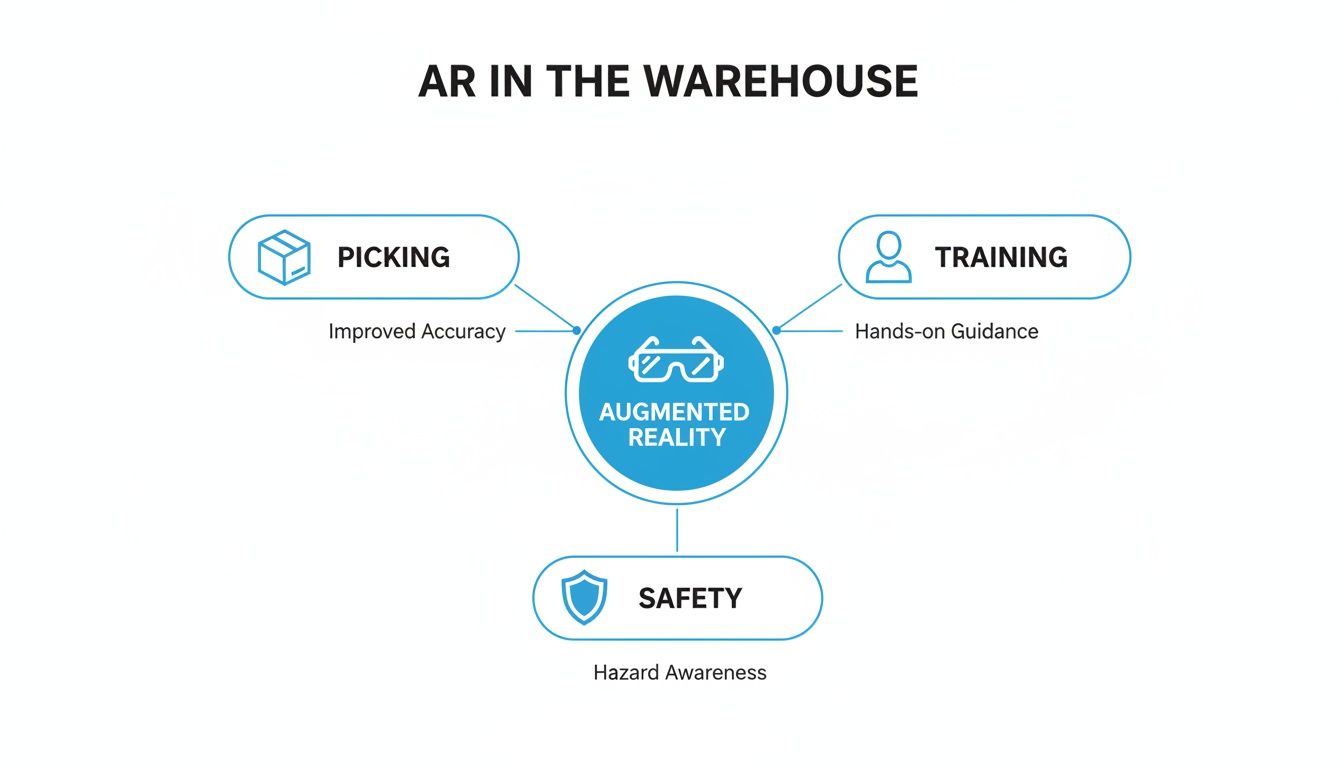
As you can see, AR isn't a siloed tool. It’s an integrated solution that lifts multiple operational areas from a single technology platform.
Quantifying Savings in Training and Maintenance
The savings don't stop in the picking aisle. AR also delivers significant returns in areas often written off as fixed costs: employee training and equipment maintenance. Traditional methods are notoriously slow and expensive, creating hidden budget leaks that AR can effectively plug.
Getting new hires up to speed is a slow, resource-intensive process. With immersive AR training modules, you can slash training time by up to 80%. New team members become productive in days, not weeks. This accelerated learning curve means you spend less on non-productive training hours and can fill critical staffing gaps much faster.
Then there's equipment downtime—the silent killer of profitability. Every minute a conveyor belt or forklift is offline, you're losing money. By using AR for remote assistance, an on-site technician can connect with a remote expert who guides them through complex repairs. This drastically reduces the Mean Time to Repair (MTTR), minimizing disruption and eliminating the high cost of flying specialists out to your facility.
For a more structured approach, take a look at our guide on how to calculate return on investment.
Choosing Your Tools: The AR Technology Stack Explained
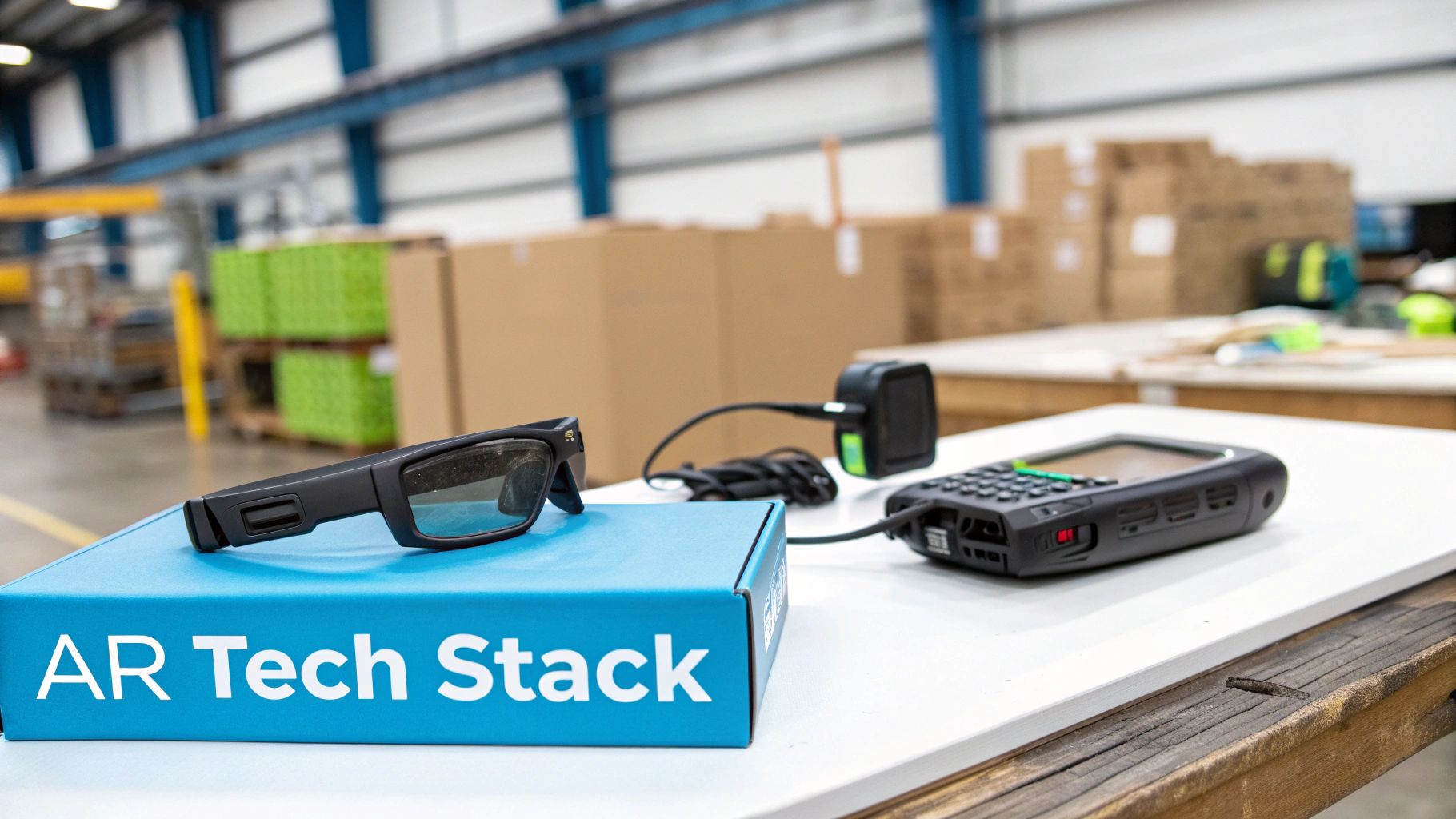
Rolling out an AR in warehouse strategy isn't about buying a single gadget. It's about building a complete technology stack where hardware, software, and your existing systems all work together. Think of it like building a high-performance car: you need a powerful engine (hardware), a smart navigation system (software), and a way to connect it to the road (integration).
Getting these three pieces right is what separates a frustrating experiment from a smooth, high-ROI deployment that your team will actually want to use. Let's break down each layer of the AR stack to help you make informed decisions.
Selecting the Right Hardware for the Job
The most visible part of your AR setup is the hardware—the device your employees will wear or hold. The warehouse floor is no place for delicate consumer electronics. You need to find the right balance between performance and practicality with gear that’s built for industrial environments.
There are three main categories to consider:
- Smart Glasses: These are the workhorses for hands-free tasks like vision picking. The device must be durable enough to handle occasional bumps, have a battery that lasts a full shift (or is easily swappable), and be comfortable. Ergonomics are critical; a heavy or awkward device will be left in the locker.
- AR Headsets: These are more powerful and immersive than smart glasses, making them ideal for complex maintenance jobs or in-depth training simulations. They offer a wider field of view and more processing power but are often heavier, so they are better suited for tasks where the worker isn't constantly moving.
- Mobile Devices (Tablets and Smartphones): Do not overlook the devices you may already have. For tasks like inventory audits or quick maintenance checks where a worker has one hand free, a rugged tablet can be a cost-effective way to get started with AR, overlaying digital information on the camera's view.
The Software: The Brains of the Operation
If hardware is the body, then software is the brain. This is where the real value of AR in warehouse operations is unlocked, turning raw data into clear visual instructions that guide your team. When it comes to software, you generally have two paths to choose from.
One option is to build a custom solution from scratch. This gives you a system perfectly tailored to your needs, but it often involves significant upfront costs and a long development timeline. The other, more common path is to use an established AR platform. These platforms provide a flexible foundation that can be configured for many different uses, getting you up and running much faster.
A versatile platform approach is key. Solutions like AIDAR.SKILLS and AIDAR.SERVICE are built on a core platform that supports diverse applications, from immersive training to remote expert assistance. This prevents you from being locked into a single-use-case tool and allows the technology to grow with your business needs.
Choosing a platform lets you start with a proven application, like remote assistance, and then expand into guided workflows or training down the road without having to start over. That scalability is what truly maximizes your long-term investment. If you want to get into the nitty-gritty of how it all works, our article on how does augmented reality work is a great place to start.
Integration: The Connective Tissue
This last piece is easily the most critical—and the most frequently overlooked. Your AR solution cannot operate in a silo. To deliver real value, it has to communicate with your core business systems, like your Warehouse Management System (WMS) and Enterprise Resource Planning (ERP) software.
This integration is what lets a worker’s smart glasses pull real-time order data from the WMS and then instantly update inventory the moment a pick is finished. Without that two-way data flow, AR is just a visual aid with no real power. A solid IT foundation is also a must, which includes having robust network and firewall solutions to keep data moving securely and without interruption.
When you're evaluating potential partners, make their integration capabilities a top priority. Ask them about their experience connecting to systems like yours, and look for solutions that use standard APIs to make the whole process smoother and more reliable.
Your Roadmap to a Smarter Warehouse
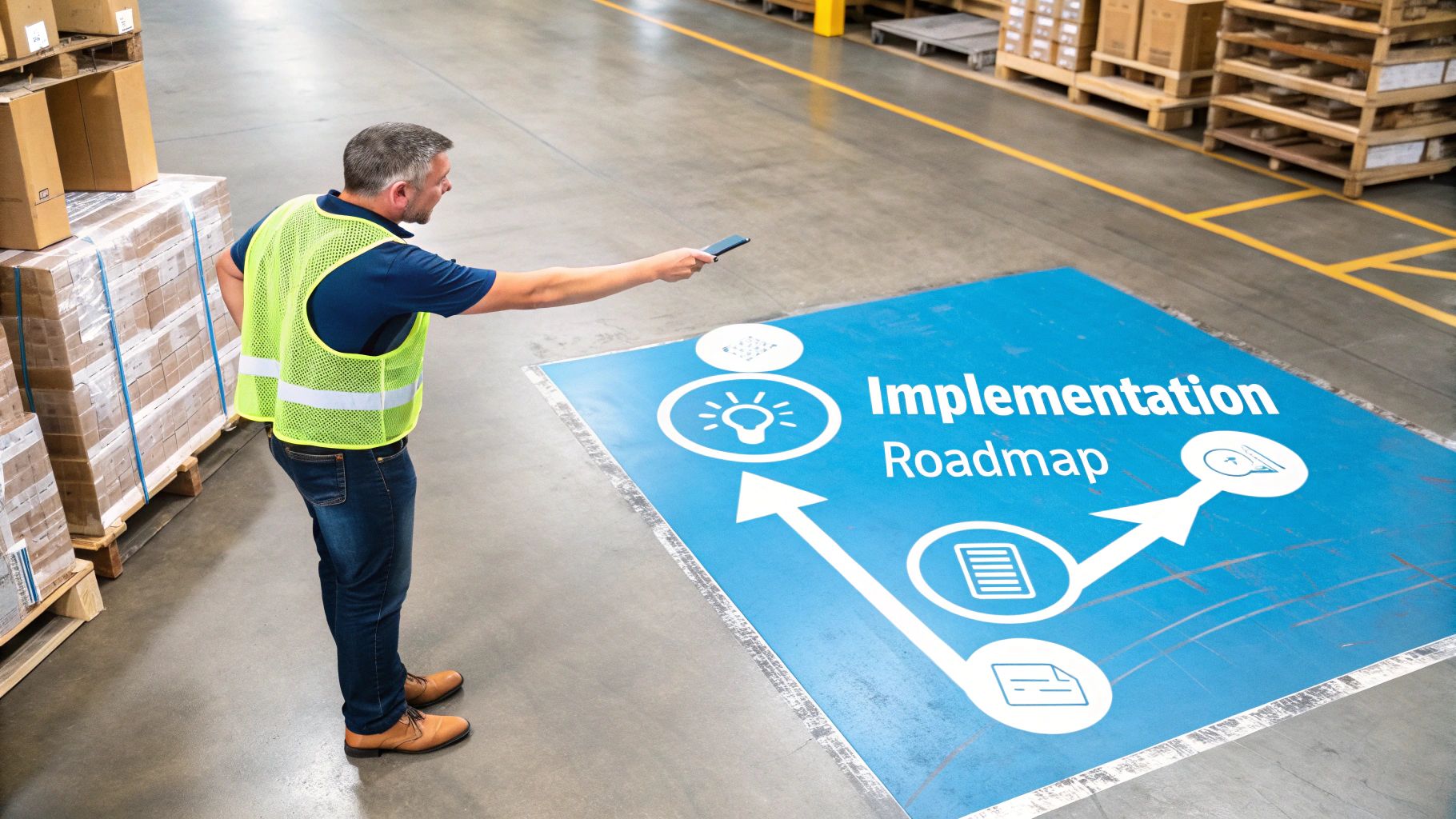
Implementing an AR-powered operation might feel like a massive undertaking, but the most successful projects follow a clear, step-by-step approach. It's less about flipping a giant switch and more about a strategic journey that proves its worth at every stage, minimizes disruption, and builds momentum for a full-scale rollout.
We’ve broken down the process into five manageable phases. Following this path makes adopting AR in warehouse technology more achievable and sets you up for a smooth deployment that delivers real results from day one.
Phase 1: Identify a Pilot Project
Your journey starts small, with a single, carefully chosen pilot project. The goal here is simple: achieve a quick win. You need to demonstrate the technology’s value in a controlled setting where you can easily measure the impact.
Order picking is a classic starting point for a reason. It’s a repetitive, high-volume task with clear metrics like picks per hour and error rates, which makes it easy to see the "before and after" difference AR makes. Employee training is another excellent candidate, as AR can slash onboarding times and help new hires become proficient faster and more effectively.
Traditional warehouse training has always been a bottleneck—it’s slow, expensive, and often inconsistent. A report from Getac on the future of warehousing highlights how AR is transforming this with immersive simulations that sharpen picking accuracy and boost productivity. The numbers speak for themselves, with some operations seeing error reductions of 15% and efficiency gains between 25-40%. You can dive deeper into AR’s impact on the industry by reading the full report on the future of warehousing.
Phase 2: Select Your Technology Partner
Once you've identified a pilot, it's time to find the right technology partner. This decision is about much more than just hardware or a slick software demo. You need a partner who understands the realities of an industrial environment and can guide you through the entire process.
As you evaluate your options, keep these points in mind:
- Platform Versatility: Can their solution grow with you? A partner like AIDAR Solutions, for instance, offers a unified platform that can handle both AIDAR.SKILLS for training and AIDAR.SERVICE for remote support. This lets you expand into new areas without having to find a new vendor.
- Integration Expertise: How well does their system play with your existing WMS or ERP? Seamless integration is a must-have for real-time information flow.
- Industry Experience: Look for a partner with a track record in warehousing or similar industrial environments. They’ll already know the common pitfalls and operational challenges you're likely to face.
Phase 3: Integrate and Deploy
This is where the plan becomes reality. A successful deployment comes down to careful planning and clear communication, making sure the new technology fits into your existing workflows instead of disrupting them. The best way to do this is with a gradual rollout, starting with a small group of enthusiastic "champion" users.
These early adopters can test the system in the real world, provide invaluable feedback, and become advocates for the technology with the rest of the team. During this phase, your partner should work closely with your IT team to ensure all system integrations are solid and data is moving smoothly between the AR solution and your WMS.
The goal isn’t just to install new technology; it’s to weave it into the fabric of your operations. This means creating a user experience so intuitive that the AR tools feel like a natural extension of a worker's own skills.
Phase 4: Train Your Team
A tool is only as good as the person using it. For AR adoption to be successful, you need effective change management and user training. The good news is that modern AR interfaces are designed to be incredibly intuitive, often requiring very little formal instruction.
The real focus should be on building confidence. Show your employees how these tools make their jobs easier, safer, and less frustrating. Emphasize the hands-free convenience and how it takes the guesswork out of complex tasks. This approach helps turn potential skepticism into genuine enthusiasm.
Phase 5: Measure and Scale
With the pilot up and running and your team on board, the final phase is all about measurement and growth. Keep a close eye on the Key Performance Indicators (KPIs) you identified back in Phase 1—things like picks per hour, error rate reduction, or time saved during training.
Continuously gather feedback from your users to find opportunities for tweaks and improvements. Once the pilot has clearly delivered a positive ROI, use that hard data to build your business case for scaling up. From there, you can expand to other departments, introduce new use cases, or roll it out to other facilities in your network, simply repeating the roadmap for each new deployment.
Your Top AR in Warehouse Questions, Answered
Taking the leap into a new technology always brings up questions. When it comes to implementing AR in the warehouse, logistics leaders are rightly curious about the real cost, if their teams can actually use it, and how it’s going to work with the systems they already have.
Let's address some of the most common questions head-on.
How Much Does It Cost to Implement AR in a Warehouse?
There's no single price tag for an AR implementation; it is a strategic investment tailored to your specific operation. The final cost boils down to a few key factors.
- Scale of Deployment: Are you starting with a small pilot program for one team, or are you planning a full-scale rollout across the entire facility? The number of devices and users is the biggest cost driver.
- Hardware Choices: There's a significant difference between rugged, industrial-grade smart glasses and using existing tablets. The right choice depends entirely on the job at hand.
- Software Model: You’ll typically see two models. A Software-as-a-Service (SaaS) subscription offers a lower upfront cost and more flexibility with a recurring fee. An on-premise license is a larger one-time investment but may be a better fit for some IT environments.
Will Our Existing Employees Be Able to Use AR Technology?
This is a common concern, but modern AR solutions are built from the ground up to be user-friendly. The entire point is to make complex jobs simpler, not to add another layer of technology for your team to learn.
The interfaces are intuitive, using simple arrows, highlights, and checklists that appear directly in the worker’s line of sight. It feels natural. Most people pick it up almost immediately because the technology is guiding them through a process they already understand. Teams often go from hesitant to confident and highly efficient in a very short time.
How Does AR Integrate with Our Existing Warehouse Management System?
This is non-negotiable. For an AR in warehouse project to succeed, it absolutely must communicate with your Warehouse Management System (WMS). AR tools cannot work in a silo; they need to pull live data from your WMS and send updates back the moment a task is complete.
This connection is usually handled through Application Programming Interfaces (APIs). Think of an API as a secure translator that lets the AR software and your WMS, ERP, or other systems speak the same language.
This is why choosing a partner with proven integration experience is so important. They'll work with your IT department to make sure the connection is seamless, secure, and reliable. Your AR headsets then become smart, mobile extensions of your core management platform.
What Is the Difference Between AR and VR in a Warehouse?
People often use AR and VR interchangeably, but in a warehouse context, they serve different—and equally valuable—purposes. The main difference is how they interact with the user's environment.
-
Augmented Reality (AR): This is all about enhancing the real world. A worker wearing AR glasses still sees the real warehouse—the racks, the aisles, their colleagues—but with digital information layered on top. This makes AR perfect for hands-on, on-the-floor tasks like order picking, maintenance, and inventory audits.
-
Virtual Reality (VR): This creates a completely digital, simulated world that replaces your view of reality. The user is fully immersed. This makes VR an incredibly powerful tool for training. A new hire can learn to operate a complex piece of machinery in a risk-free virtual warehouse without ever touching the real equipment.
Ready to see how AR can transform your warehouse operations? AIDAR Solutions provides expert guidance and cutting-edge platforms like AIDAR.SKILLS and AIDAR.SERVICE to deliver measurable improvements in efficiency, accuracy, and safety. Visit us to learn more and schedule a consultation.

