
How Does Smart Glass Work Unveiled
Imagine digital blinds built right into the glass itself. With the flick of a switch, a window can shift from being completely transparent to fully opaque, giving you instant control over light, privacy, and even heat. This isn't science fiction; it's made possible by applying a tiny electrical voltage that changes the glass's properties and fundamentally alters how light passes through it.
What Exactly Is Smart Glass?
Often called switchable or dynamic glass, smart glass is a category of materials that can actively change their transparency. Instead of being a passive part of a building, this technology turns windows into controllable elements that respond to electricity, light, or heat. Forget fumbling with physical curtains—you can manage your environment with a simple command.
This isn’t just about convenience; it’s a massive step forward in building design and personal comfort. The market certainly reflects this, with projections expecting it to be worth anywhere from USD 10.42 billion to USD 18.47 billion by 2030. This growth is all about the push for more energy-efficient buildings and dynamic architectural designs.
The Core Principle Behind the Magic
At its heart, smart glass works by manipulating tiny particles suspended in a thin film, which is then laminated between two panes of glass.
When you send an electrical current through it, these particles snap into a neat, uniform alignment. This lets light pass straight through, making the glass appear perfectly clear. Cut the power, and the particles scatter back into a random mess, blocking light and turning the glass opaque.
This simple on/off mechanism is the foundation for several different smart glass technologies, each with its own unique traits. For a great read on how this tech integrates into modern homes, check out this guide on Smart Glass UAE: The Ultimate Guide for Villa Innovation.
The real power of smart glass is its ability to create truly adaptable spaces. It seamlessly blends openness and privacy, connecting or separating environments without needing a single physical wall.
This same idea—augmenting our physical world with a layer of digital information—is a cornerstone of other powerful technologies. In fact, if this interests you, you should check out our guide on what is extended reality, which dives into how AR and VR are reshaping industries by overlaying data onto our surroundings.
Breaking Down the Core Smart Glass Technologies
To really get a handle on smart glass, you have to look under the hood at the different "engines" that power it. The final effect might feel like a bit of magic, but it’s all grounded in some fascinating physics and chemistry. Each core technology plays with light in its own unique way, giving it distinct advantages in speed, clarity, and control.
Think of them as different tools for the same job: managing light and privacy. Some are like dimmer switches, giving you gradual, subtle changes perfect for blocking out harsh sunlight. Others are more like an on/off switch, delivering instant privacy the moment you need it. Let's dig into the three main types.
This infographic gives a great high-level view of what’s driving smart glass adoption.
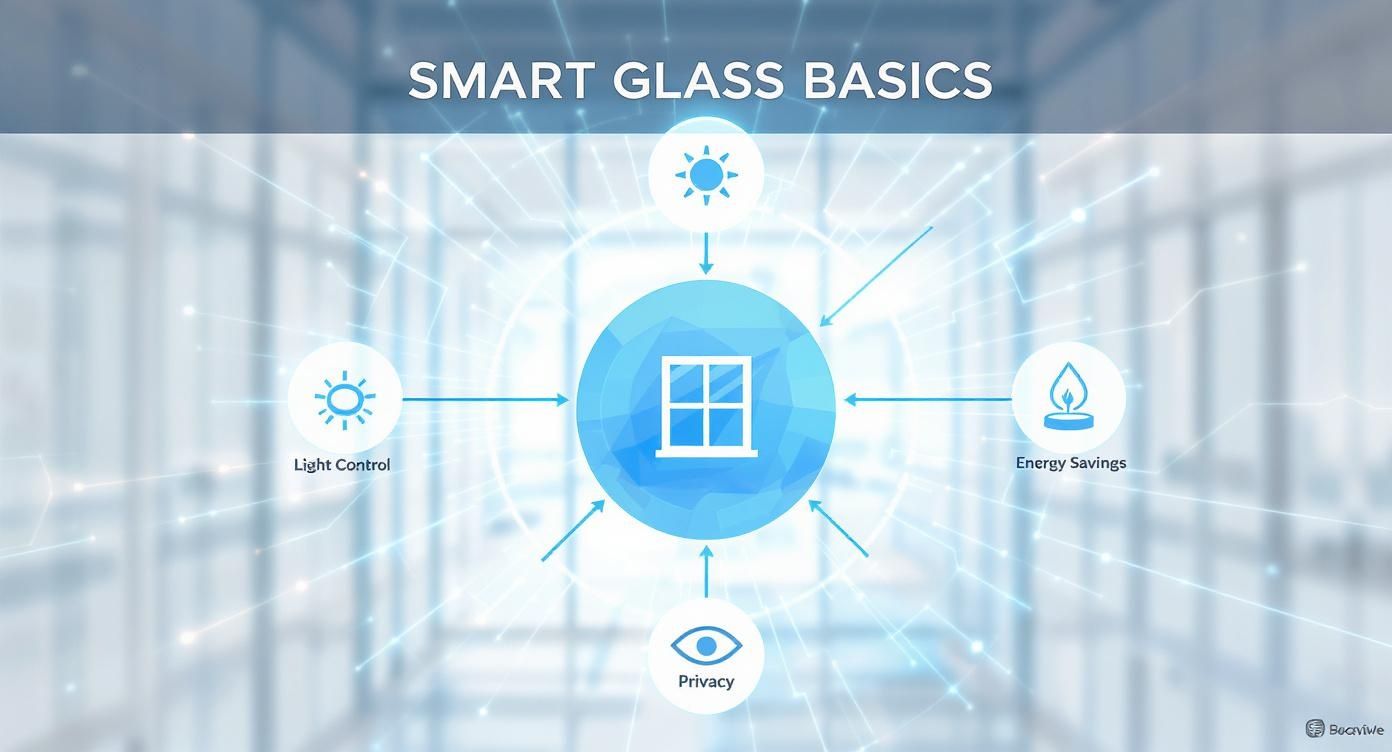
As you can see, the whole idea is to control light to deliver real-world benefits like privacy on demand and some serious energy savings.
Electrochromic Glass: The Slow-Fading Dimmer
Electrochromic (EC) glass is the patient powerhouse of the smart glass family. Think of a high-end pair of sunglasses that can slowly, elegantly darken when you step into bright sunlight. EC glass works on a similar principle, but you’re the one in control of the tint level.
It’s built with several microscopic layers, including two transparent electrodes that sandwich an ion storage layer and an electrochromic layer. When a tiny voltage is applied, ions—like lithium ions—shuttle from the storage layer into the electrochromic layer. This movement makes the glass absorb light, gradually shifting it from clear to a dark, shaded state.
Reverse the voltage, and the ions travel back to where they started, returning the glass to full transparency.
A standout feature of EC glass is its "state memory." It only needs a quick jolt of electricity to change its tint. Once it hits the state you want—clear, dark, or anywhere in between—it stays that way without constantly drawing power.
This makes it incredibly energy-efficient for big architectural projects, where it can make a huge dent in heating and cooling costs by managing solar gain.
Suspended Particle Device: The Instantaneous Shade
Next up is Suspended Particle Device (SPD) technology, which acts less like a gradual dimmer and more like an instant light switch. At the heart of SPD tech is a thin film filled with countless microscopic, rod-like particles floating in a liquid polymer.
In its natural, unpowered state, these particles are all jumbled up, absorbing and blocking light from getting through. This is what makes the glass look dark and opaque.
The magic happens the second you apply an electrical current. The electricity creates a field that snaps all those suspended particles into perfect, parallel alignment. This neat arrangement creates clear channels for light to pass straight through, making the glass transparent in a fraction of a second.
- Variable Control: You can fine-tune the particle alignment by adjusting the voltage. A lower voltage might only partially line them up, creating a semi-tinted effect. This gives you precise, real-time control over light and glare.
- Speed: SPD is known for its near-instantaneous switch, making it perfect for situations where you need rapid changes, like in automotive sunroofs or high-tech conference rooms.
This ability to dynamically control an environment is one of the key drivers behind many of the top innovations in the manufacturing industry guide. In that world, clear visibility and immediate privacy can be critical for monitoring processes or protecting proprietary work.
Polymer Dispersed Liquid Crystal: The Digital Frost
Finally, we have Polymer Dispersed Liquid Crystal (PDLC) technology, which is the go-to for on-demand privacy. If EC glass is a dimmer and SPD is a shade, then PDLC is like a digital frost that appears and vanishes in the blink of an eye.
Inside a PDLC film, you’ll find microscopic droplets of liquid crystals scattered randomly within a polymer. With the power off, these liquid crystals are in total disarray. Light hits these scattered crystals and bounces off in all directions, which is what gives the glass that milky-white, frosted appearance.
This frosted state is fantastic for privacy—you can’t see clearly through it, but it still lets plenty of diffused light into the room.
Flick on the power, and the liquid crystal molecules instantly snap into a uniform alignment. This orderly arrangement allows light to pass straight through without scattering, making the glass completely transparent. The change from frosted to clear happens in just milliseconds, which is why PDLC is so popular for office partitions, healthcare facilities, and retail displays.
Smart Glass Technology Comparison
To make it easier to see how these technologies stack up, here’s a quick comparison of their key features and performance characteristics.
| Feature | Electrochromic (EC) | Suspended Particle Device (SPD) | Polymer Dispersed Liquid Crystal (PDLC) |
|---|---|---|---|
| Primary Function | Light & Glare Control | Light & Glare Control | Privacy |
| Default State | Clear | Dark/Opaque | Opaque/Frosted |
| Switching Speed | Slow (minutes) | Very Fast (milliseconds) | Very Fast (milliseconds) |
| Power Consumption | Low (only during switching) | Medium (constant for clear state) | Medium (constant for clear state) |
| Clarity (Clear State) | High | Good (slight haze) | Excellent |
| Tint/Opacity Control | Fully Variable | Fully Variable | On/Off (Clear/Frosted) |
| Best Use Cases | Building windows, skylights | Automotive, aviation | Office partitions, meeting rooms |
Each technology clearly has its own strengths. The right choice really comes down to whether you need a slow, energy-sipping dimmer for a building facade, an instant shade for a vehicle, or on-demand privacy for an interior space.
Why Electrochromic Glass Is Taking Over Modern Architecture
Walk through any major city, and you're surrounded by an architectural masterclass where glass is the star of the show. In this world of towering facades and sweeping windows, one type of smart glass has clearly come out on top: Electrochromic (EC) glass. Its unique blend of energy efficiency, occupant comfort, and seamless control makes it the go-to choice for today's most ambitious projects.
Unlike other smart glass technologies built for instant privacy, EC glass plays the long game. It's all about creating a better, more comfortable environment over the course of a day. The slow, measured transition from clear to tinted isn't a bug; it's a core feature. This gradual change prevents jarring shifts in light, maintaining a pleasant and consistent atmosphere for everyone inside.
This focus on gradual light control is precisely why it’s a perfect fit for architecture. The goal isn't to abruptly block a view but to intelligently manage solar heat and glare without giving up the beauty of natural light.
The Heavy Hitter: Energy Efficiency
The single biggest reason for EC glass's dominance is its massive impact on a building's energy use. Windows have always been the weak link in a building's thermal armor, letting in brutal solar heat in the summer and leaking precious warmth in the winter. EC glass tackles this problem head-on.
By tinting on command, it can block a huge portion of the sun's infrared and UV rays—the main drivers of heat gain. This means air conditioning systems don't have to work nearly as hard, leading to major cuts in energy bills. In fact, its ability to improve commercial building energy efficiency is a primary factor in its widespread adoption.
This capability has made EC glass a cornerstone of modern green building, helping projects earn sustainability certifications and shrink their carbon footprint.
Maximum Impact, Minimal Power
Another killer advantage is how little energy EC glass actually uses. It runs on a simple principle you could call "set it and forget it." The glass only needs a small electrical charge to change its tint level—either to get darker or lighter.
Once it reaches the desired tint, it holds that state with zero continuous power. This "bi-stable" nature makes it incredibly efficient for buildings where the glass might only adjust a few times a day as the sun moves across the sky.
This low-power operation is a game-changer for large buildings with thousands of square feet of glass. It ensures that the solution for saving energy doesn't become an energy problem itself.
This incredible efficiency, paired with its durability, makes it a smart, long-term investment for building owners serious about sustainability. And the market data backs this up.
Electrochromic technology now leads the global smart glass market, commanding a massive 43.00% of the market share. Its ability to tint gradually delivers a great user experience while cutting down on air conditioning costs—a huge selling point as sustainability becomes a top priority in construction.
More Than Just a Lower Energy Bill
While the cost savings are compelling, the perks of EC glass go far beyond the utility bill. It brings some serious advantages to building design and the well-being of the people inside:
- Uninterrupted Views: EC glass gets rid of the need for clunky blinds or shades that completely block the view. People can stay connected to the outdoors without being blinded by glare.
- Better Natural Light: By dialing in the perfect amount of light, it maximizes usable daylight, which has been proven to boost productivity, mood, and wellness in offices and homes.
- Architectural Freedom: Designers can create stunning buildings with vast expanses of glass without worrying about the downsides of too much heat and glare. This opens the door to more open, visually dramatic structures.
At the end of the day, electrochromic glass creates a dynamic building skin that intelligently responds to its environment. It's a solution that perfectly balances aesthetics, comfort, and sustainability, locking in its spot as the premier choice in modern architecture.
When Speed and Privacy Matter Most with SPD and PDLC
While electrochromic glass offers a graceful, slow tint perfect for architectural vibes, some situations just can't wait. When you need an instant change, two other technologies steal the show: Suspended Particle Device (SPD) and Polymer Dispersed Liquid Crystal (PDLC).
Think of these as the sprinters of the smart glass world. They're built for rapid-fire transitions where immediate control over light and privacy is the only thing that matters. Instead of the slow dance of ions you find in EC glass, these technologies manipulate particles and crystals in milliseconds.
They're the answer for on-demand shade in a fast-moving car or instant privacy in a bustling office, proving just how versatile smart glass can be.
SPD Technology for Instant, Variable Shade
Suspended Particle Device (SPD) technology is the go-to for immediate and incredibly precise light control. It all starts with a liquid film packed with microscopic, dark, rod-shaped particles. When there’s no electricity, these particles are just scattered randomly, blocking light and making the glass dark and opaque.
But the magic happens when you flip the switch. An electric field instantly snaps all those particles into perfect, neat alignment. This creates clear pathways for light, turning the glass transparent in less than a second. The real killer feature of SPD is its variable control—by tweaking the voltage, you can fine-tune the particle alignment and dial in the exact level of tint you want, from a light shade to completely blacked out.
This makes it a perfect fit for dynamic environments:
- Luxury Automotive Sunroofs: Drivers can kill intense glare in a split second without ever taking their eyes off the road.
- Executive Boardrooms: A window can be tinted instantly to stop glare from washing out a presentation screen.
- Aviation: Cockpit windows and cabin dividers can be adjusted on the fly to handle changing light conditions during a flight.
The market is definitely taking notice of this speed and precision. SPD technology is currently the fastest-growing segment in the smart glass market, with projections showing it will hit the highest CAGR of 9.5% from 2025 to 2034. Its ability to offer near-total light blockage on demand makes it a premium choice. You can dig deeper into the numbers and learn more about smart glass market analysis to see the trends for yourself.
PDLC Technology as the Ultimate Privacy Switch
If SPD is all about variable shade, then Polymer Dispersed Liquid Crystal (PDLC) technology is the undisputed champion of instant privacy. It’s less of a dimmer and more of a digital on/off switch, flicking from clear to a frosted, opaque state in the blink of an eye. Instead of absorbing light, PDLC glass scatters it.
Inside a PDLC film are countless tiny droplets of liquid crystals floating in a polymer. With no power, these crystals are all jumbled up, scattering any light that hits the glass. This creates that classic translucent, frosted look—perfect for privacy because you can't see through it, but it still lets soft, diffused light fill the room.
Apply a little electricity, and those liquid crystals instantly align themselves, letting light pass straight through and making the glass perfectly clear. This lightning-fast switch from open to private has made it a staple in modern interior design.
A key feature of PDLC glass is its dual functionality. When in its opaque, frosted state, it becomes an excellent high-definition rear-projection screen, turning any glass partition into a dynamic display for presentations, videos, or advertising.
This extra layer of utility makes it incredibly valuable in a few key places:
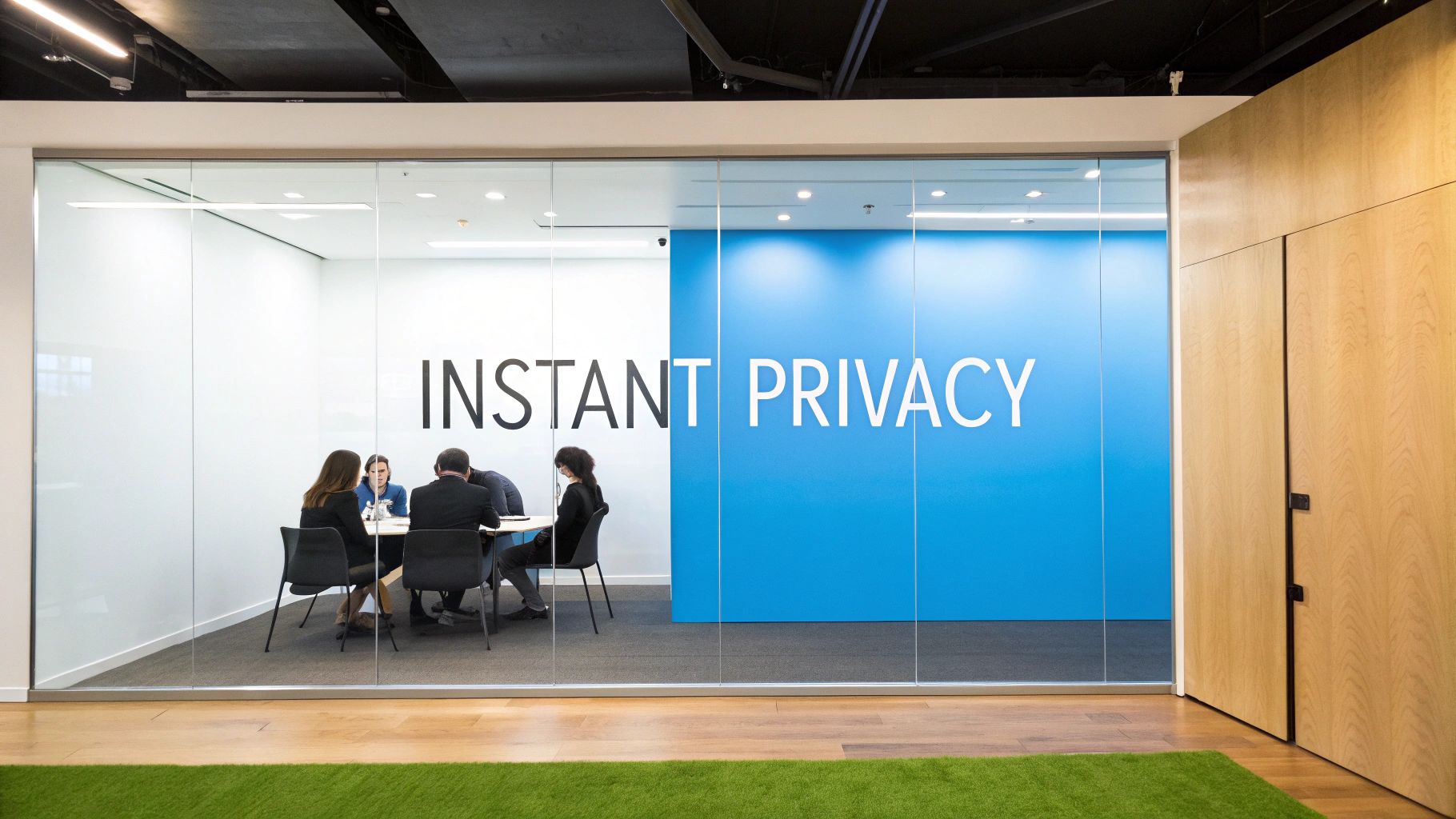
- Office Partitions: Create flexible meeting rooms that are open and collaborative one minute, then totally private for a sensitive discussion the next.
- Healthcare Facilities: Give patients immediate privacy in exam rooms or ICU cubicles at the touch of a button.
- Retail Storefronts: Use the glass for eye-catching projected ads after hours, then switch it to clear during the day to show off products inside.
Both SPD and PDLC prove that the way smart glass works really depends on the end goal. Whether it’s dialing in the perfect tint or throwing up an instant privacy shield, these fast-acting technologies deliver immediate control over any environment.
Smart Glass in Action Across Industries
Knowing the theory behind smart glass is one thing, but seeing it solve real problems on the ground is where things get interesting. This tech is moving past the "cool gadget" phase and becoming a genuinely practical tool in offices, factories, and hotels. By matching the on-demand privacy of PDLC and SPD glass to specific business needs, companies are building more flexible, secure, and impressive spaces.
The real magic is in its adaptability. A single room can wear multiple hats without any physical changes—all it takes is a flick of a switch to control the glass. This helps businesses get the most out of their existing space, smooth out their workflows, and give both employees and customers a much better experience.
The Modern Corporate Office Reimagined
The open-office debate has been raging for years. It's great for collaboration, but it’s terrible for deep focus or confidential meetings. Smart glass is proving to be the perfect middle ground.
Conference rooms are being completely transformed by PDLC partitions. A meeting space can stay visually connected to the rest of the office, which helps maintain a transparent, open culture. But when it's time for a sensitive discussion or a big presentation, the glass instantly turns opaque, creating a private, distraction-free bubble.
This on-demand privacy does more than just secure conversations. It allows for better space utilization, turning a single large area into a multi-functional hub that can be an open workspace one moment and a series of private offices the next.
This kind of flexibility is a game-changer for today's agile workplaces. Instead of putting up permanent, unmoving walls, companies can design dynamic environments that shift to meet their teams' needs in real time.
Enhancing Security and Oversight in Manufacturing
On a busy factory floor, keeping an eye on operations while protecting confidential projects is a tricky balancing act. This is especially true when you’re developing a new product or working on something proprietary. Smart glass offers a seriously clever solution.
Picture a section of the factory floor cordoned off for a top-secret prototype. With PDLC glass walls, managers can leave the area transparent for general observation during normal production runs. When it's time to work on the confidential project, the glass frosts over, shielding it from prying eyes without disrupting work elsewhere.
This simple use case delivers some huge wins:
- IP Protection: It stops trade secrets from being seen, accidentally or otherwise, by unauthorized staff or visitors.
- Flexible Monitoring: Supervisors can keep visual tabs on things for safety and quality control, then switch to private mode in an instant.
- Improved Focus: The team working on the sensitive project can get their work done without the distraction of people walking by.
This level of control is just one way new technologies are reshaping the industrial world. Many of these concepts are being pushed even further in various augmented reality industrial applications, where digital tools are also supercharging efficiency and security. Smart glass fits right into that trend.
Creating Unforgettable Experiences in Hospitality
The hospitality game is all about creating a memorable experience for guests, and smart glass is quickly becoming a go-to for adding that "wow" factor. Hotels and resorts are using it to blend luxury, tech, and practicality in some really impressive ways.
A popular spot for it in guest rooms is the bathroom wall. A PDLC glass panel between the bathroom and the main room can stay clear, making the whole space feel bigger and letting natural light flood in. When a guest wants privacy, they just press a button, and the wall goes opaque.
This single design choice hits multiple goals. It makes a smaller room feel more spacious, adds a modern, high-tech touch, and delivers practical privacy when needed. It’s a detail that shows guests the hotel is thinking about their entire experience. You'll also see it used for balcony doors and suite partitions, letting guests soak in the views while still having easy control over light and privacy.
The Future of Work: Where Smart Glass and AR Collide
While smart glass is changing the face of modern architecture, its most exciting frontier is in wearable tech—specifically when paired with Augmented Reality (AR). This combination transforms smart glass from a passive window into an active, intelligent interface for frontline workers in industry and field services.
This integration represents a complete shift in how work gets done, creating a powerful synergy between the physical environment and digital information.
https://www.youtube.com/embed/gZ9IsB72nVk
Picture a technician tackling a complex repair. Instead of fumbling with a tablet or flipping through a thick manual, they’re wearing smart glasses. Digital schematics and step-by-step instructions are overlaid directly onto the equipment they're fixing. This creates a hands-free, heads-up environment where critical data is always in their line of sight.
But this integration isn't just about displaying static information. It's about enabling powerful, real-time collaboration that solves problems faster than ever before.
Bridging Distances with Remote Expertise
The real value of AR smart glasses is realized when the technology connects frontline workers with off-site experts in an instant. A senior engineer, potentially thousands of miles away, can see exactly what the on-site technician sees through their smart glasses.
If the technician encounters an unexpected issue, the remote expert can provide guidance by drawing annotations or highlighting specific components. These digital markings appear right in the technician’s field of view, layered onto the real-world equipment. It’s the virtual equivalent of having an expert looking over your shoulder, no matter where they are.
This “see-what-I-see” capability dramatically slashes problem-resolution time. Instead of waiting days for an expert to travel, a company can deploy its top talent virtually, anywhere in the world, in minutes.
This synergy isn't just about convenience; it delivers clear, measurable business benefits that redefine what’s possible for industrial support and training.
Tangible Benefits of AR and Smart Glass Integration
By merging the physical and digital worlds, this technology offers a direct path to greater operational efficiency and safety. The impact is felt across the entire workflow.
- Accelerated Problem Solving: Issues that once required costly travel and long delays can be resolved in a single call, drastically cutting equipment downtime.
- Reduced Expert Travel: Many companies have successfully cut expert travel costs by 75% or more. This frees up senior staff to support multiple teams at once, improving knowledge transfer.
- Enhanced Worker Safety: With hands-free access to instructions and live support, technicians maintain full situational awareness, which helps reduce the risk of accidents.
This kind of integration is a cornerstone of the modern industrial metaverse, a concept that’s reshaping the future of work. For more on these advancements, you can find key insights in the summary of the Executive Summit 2022 with Nreal AR smart glasses. By equipping workers with intelligent tools, businesses aren't just improving processes; they're building a more connected, capable, and future-proof workforce.
Common Questions About Smart Glass
As you start to imagine smart glass in your own space, a few practical questions always pop up. It's one thing to understand the science, but it's another to know how it holds up in the real world. Let's tackle the big ones: durability, power draw, and installation.
How Long Does Smart Glass Last?
This is one of the first things everyone asks, and for good reason. The good news is that smart glass is built to last, with a lifespan right up there with high-quality, conventional windows. Most are rated for over 100,000 on/off cycles, which for most people, easily translates to decades of use.
The laminated design also gives it an extra layer of toughness. If the glass were to break, the film in the middle helps hold the shards together, much like a car's windshield. Certain types, like electrochromic glass, are especially durable since they only draw power when changing states, putting less long-term stress on the components.
How Much Power Does It Consume?
It's easy to assume that "smart" means power-hungry, but that's a common myth. In reality, smart glass is surprisingly efficient. PDLC and SPD films typically use about 3-5 watts per square meter—and that’s only when they’re switched on to their clear state.
Electrochromic glass takes efficiency to another level. It just needs a tiny bit of power to change its tint and then uses zero electricity to hold that state, whether it’s fully transparent or dark. This incredible efficiency is why it's becoming a go-to for green building projects.
Can Smart Glass Be Added to Existing Windows?
Absolutely, and this is where the technology gets really flexible. You don't have to rip out your existing windows to get the benefits. While you can order complete smart glass units for new construction, you can also retrofit any glass surface with a self-adhesive PDLC smart film.
This film is a game-changer. It can be cut to fit any window, door, or partition and applied directly to the clean glass. Once it's wired up, it gives you the same instant privacy as a brand-new smart glass panel, making it a fantastic and cost-effective upgrade.
How Private Is Smart Glass?
The privacy you get really depends on the technology you choose. PDLC glass is the top choice for total visual privacy. When you turn it on, it scatters the light passing through, completely blurring the view from both sides while still letting in soft, diffused light.
SPD technology, on the other hand, is more about controlling the tint. You can adjust the opacity from a light shade to nearly black. When it’s fully off, it becomes very dark and difficult to see through, offering a high degree of privacy by blocking the view rather than scattering the light.
Ready to see how intelligent tools can transform your operations? AIDAR Solutions integrates advanced AR systems to boost efficiency, enhance safety, and cut operational costs. Discover our remote assistance and virtual training platforms at https://aidarsolutions.com.