
Augmented Reality Automation for Modern Industry
Imagine giving your industrial equipment a voice—and eyes—that speak directly to your team on the factory floor. That’s the core concept behind augmented reality automation. It’s a practical technology that layers crucial digital information like instructions, warnings, and live data directly onto the physical world.
This isn't a far-off concept. It’s a smart assistant that sees what your technician sees and provides them with the exact guidance they need, right when they need it.
The Reality of Augmented Reality Automation
Augmented reality automation is the essential bridge connecting your complex backend data systems—the brains of your operation—with the frontline workers who are the hands. Think of it as a dynamic, interactive digital skin laid over your physical machinery and processes.
This technology isn't here to replace human skill; it’s here to amplify it. When a technician looks at a machine through an AR headset or tablet, they don't just see nuts, bolts, and wiring. They see the full context: live performance stats, the complete maintenance history, and clear, step-by-step repair guides. This blend of digital and physical worlds empowers every employee to perform with the knowledge of your most seasoned expert.
Fusing Digital Insights with Physical Tasks
The real power of augmented reality automation is its ability to pull together information from different systems and present it exactly where it matters most. It acts as a universal translator between the factory floor and the data center, making work flow more smoothly in a few key ways:
- Real-Time Data Visualization: It grabs live data from your industrial systems and displays it right on the equipment itself. This eliminates the need to consult a separate computer terminal or physical manual.
- Interactive Workflow Guidance: Complicated tasks get broken down into simple, visual steps that appear right in the worker's field of view. This takes the guesswork out of the job and slashes the risk of human error.
- Remote Expertise on Demand: Your top experts can "see through the eyes" of an on-site technician, no matter where they are in the world. They can offer immediate, hands-on guidance without the expense and delay of travel.
By putting data into context right at the point of action, augmented reality automation guarantees your team has the right information, in the right place, at the perfect time. This direct access is a game-changer for efficiency and accuracy.
The applications for immersive visualization technology are incredibly broad and impactful. For those curious about the wider world of immersive visualization, exploring how tools like virtual reality in interior design are used can offer fascinating parallels into how digital overlays are reshaping different industries.
Ultimately, this integration gives your team the power to work faster, safer, and with more precision than ever before. It makes complex jobs simple, gets new hires up to speed in record time, and completely changes how you manage your most critical physical assets.
To see how these ideas can solve specific industrial challenges, take a look at our dedicated solutions for augmented reality for industry. In the next sections, we'll dive deeper into exactly how this tech connects with the systems you already have and starts delivering real, measurable value.
How AR Connects with Industrial Systems
To truly understand what makes augmented reality automation effective, you have to follow the data. AR applications aren’t operating in isolation; they are a visual interface, a real-time window into the complex digital systems that already run your operations. This connection is what turns raw data into actionable, on-the-spot intelligence for your frontline team.
The whole process starts right at the machine level and flows upward. It creates a seamless link between your equipment, your production management, and your overall business planning. Think of it as creating a direct line of sight from the C-suite to the factory floor, with your technicians at the center of it all.
This infographic shows how augmented reality automation acts as the central hub, connecting digital data from backend systems with the physical world of the factory and the frontline workers who operate within it.
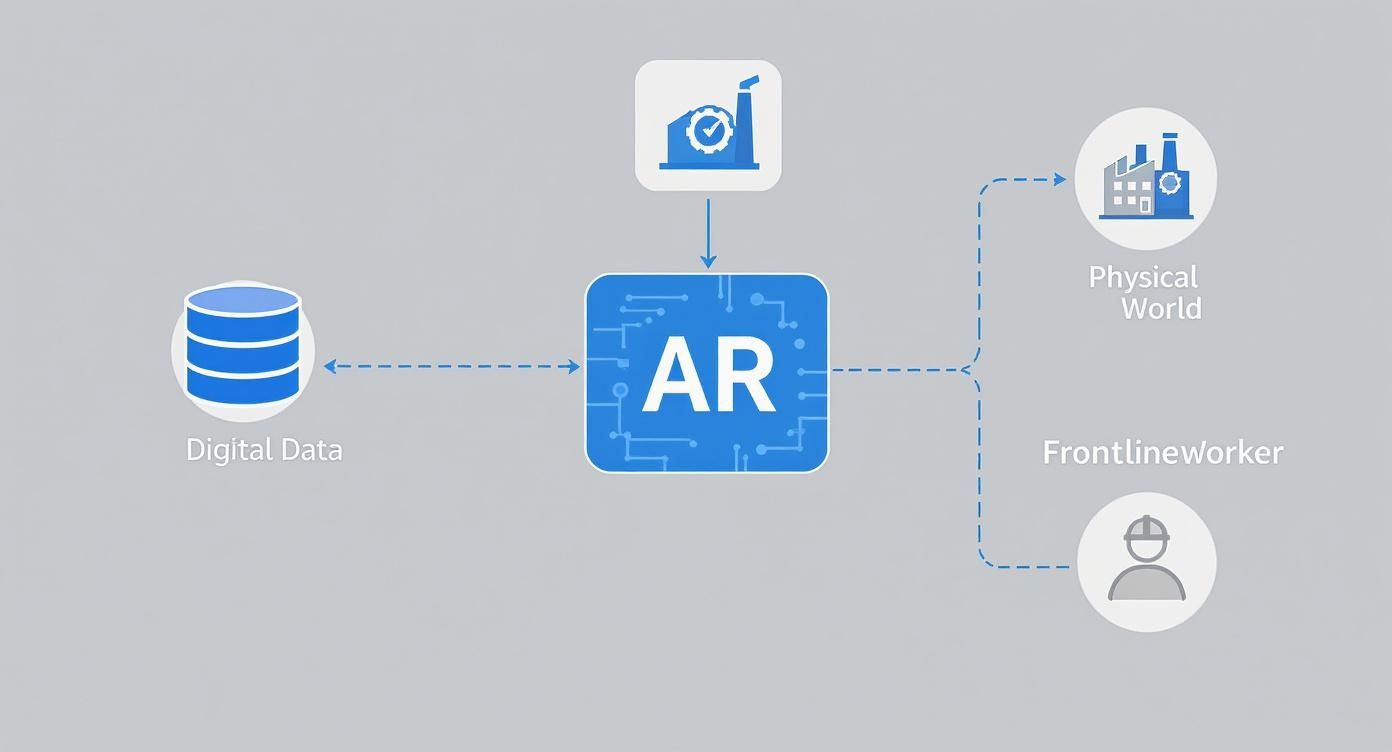
The key takeaway here is that AR’s true value comes from its ability to pull information from multiple sources and present it in a single, contextual view for the person on the ground.
Tapping into the Machine’s Nervous System with PLCs
The journey begins with Programmable Logic Controllers (PLCs). These rugged computers are the nervous system of your industrial equipment. They’re constantly monitoring and controlling specific functions like motor speeds, valve positions, and temperature levels. Essentially, they speak the language of the machine itself.
An AR application plugs directly into this nervous system. When a technician points their device at a piece of machinery, the app pulls live data straight from the PLC. Instead of seeing a static metal box, the technician sees dynamic, digital overlays showing things like:
- Live temperature readings fluctuating in real-time.
- Current pressure levels displayed right next to the corresponding gauge.
- Cycle counts ticking up with each completed action.
This immediate feedback loop turns preventative maintenance into a proactive, data-driven activity. It lets workers spot small issues before they become catastrophic failures.
Connecting to Production Workflows with MES
Moving one level up, we get to the Manufacturing Execution System (MES). If the PLC is the machine’s nervous system, the MES is the plant’s operational brain. It manages and monitors everything happening on the factory floor, from scheduling and resource allocation to quality control.
AR automation integrates with the MES to pull context-specific instructions and checklists directly into the technician's view. When a new work order pops up in the MES, the AR application can:
- Display the complete work order details the moment a technician scans the relevant machine.
- Guide them with interactive, step-by-step assembly or repair instructions.
- Provide digital checklists that can be completed hands-free with simple voice commands.
This integration ensures every action taken on the floor is perfectly aligned with the broader production schedule, which is critical for minimizing errors and maintaining high quality standards.
Closing the Loop with ERP Integration
Finally, the data flow connects to your Enterprise Resource Planning (ERP) system. Your ERP is the central command center for the entire business, managing high-level functions like finance, HR, and—most importantly for us—inventory and supply chain.
The link between AR and ERP is where augmented reality automation delivers massive, business-wide value. It closes the loop between physical actions and enterprise-level records, making sure your data is always accurate and up-to-date.
For example, when a technician replaces a part, they can scan the new component’s barcode with their AR device. That simple action can automatically trigger an update in the ERP, instantly adjusting inventory levels. This gets rid of manual data entry, cuts down the risk of stock discrepancies, and gives you real-time visibility into your supply chain. Of course, making these connections possible requires effective system integration with your existing industrial infrastructure.
Driving Business Value with AR Automation
Understanding the technology is one thing; seeing how it translates into real-world business results is where AR automation truly proves its worth. This isn't just about compelling visuals; it's a powerful engine for boosting efficiency, slashing costs, and empowering your entire workforce. It's about shifting from simply having data to using it to make smarter, faster, and safer decisions right on the factory floor.
The global augmented reality market is expanding rapidly, completely reshaping how major industries approach automation. The market is projected to leap from around USD 72.5 billion in 2025 to an incredible USD 1,121.6 billion by 2035, growing at a 31.5% compound annual growth rate. You can explore the full forecast on Future Market Insights to see the numbers for yourself.
This rapid adoption is fueled by clear, tangible benefits that tackle some of the biggest challenges in industrial operations today.
Boost Operational Efficiency and Accuracy
Think of AR-guided workflows as a digital co-pilot for your technicians. By overlaying step-by-step instructions, schematics, and critical specifications directly onto a piece of equipment, AR minimizes guesswork and drastically reduces human error.
This means tasks get done faster. Instead of stopping to locate a manual or supervisor, workers have all the information they need right in their line of sight. This allows them to tackle complex jobs with a new level of confidence and precision. In fact, studies show AR guidance can boost a worker’s performance on the first try by over 80%.
Slash Travel Costs and Downtime
When a critical piece of machinery goes down, the clock is ticking and every minute costs money. Flying in a specialist from another location is both expensive and slow, leading to significant production delays.
Augmented reality automation provides an instant solution. An on-site technician can simply put on an AR headset and share their real-time view with an expert anywhere in the world. That remote expert can then annotate the live video feed, circle the exact component to check, and talk them through the fix—as if they were standing right there.
This capability is a complete game-changer for maintenance. It means you can cut expert travel by up to 75% and get machinery back online in a fraction of the time, dramatically improving your Mean Time to Repair (MTTR).
Accelerate Training and Knowledge Retention
Onboarding new hires and upskilling your team is a constant challenge. Traditional classroom training often doesn't stick, resulting in a long, expensive learning curve once employees reach the production floor.
AR flips the script, turning training into an immersive, on-the-job experience. New employees can learn complex procedures by following interactive digital guides in a safe, controlled setting. This hands-on approach has been proven to skyrocket knowledge retention compared to just reading a manual. By empowering people to learn by doing, companies can trim training time by as much as 75% and get new team members productive far sooner. Understanding the core benefits of augmented reality for businesses is the first step toward building a more skilled and agile team.
Enhance Workplace Safety and Compliance
Workplace safety is non-negotiable. AR automation adds a powerful layer of protection for your team by making potential hazards impossible to miss. It can:
- Visually highlight danger zones, like areas with high voltage or moving parts.
- Display real-time sensor data to warn workers of unsafe temperatures or pressure levels.
- Overlay safety protocols and lockout/tagout procedures directly onto equipment before anyone even touches it.
By embedding safety directly into the workflow, AR helps ensure that the right procedures are followed every single time. It's a proactive approach that not only prevents accidents but also builds a rock-solid culture of safety and compliance across your entire organization.
Practical Use Cases of AR Automation in Action
It’s one thing to discuss AR automation in theory, but this technology truly comes alive on the factory floor. This is where digital intelligence meets physical action, turning complicated industrial jobs into simple, guided, and error-proof workflows. The real value is in how it solves the practical, everyday challenges that teams face.
The market’s explosive growth tells the story. Forecasts show the global AR market is set to grow by an astounding USD 826 billion between 2025 and 2029 alone, largely because it's being woven into automation in key sectors like manufacturing. You can see the full forecast on Technavio to grasp the scale of this shift. This growth is driven by real, measurable improvements.
Let's look at three core areas where this technology is already making a huge impact.
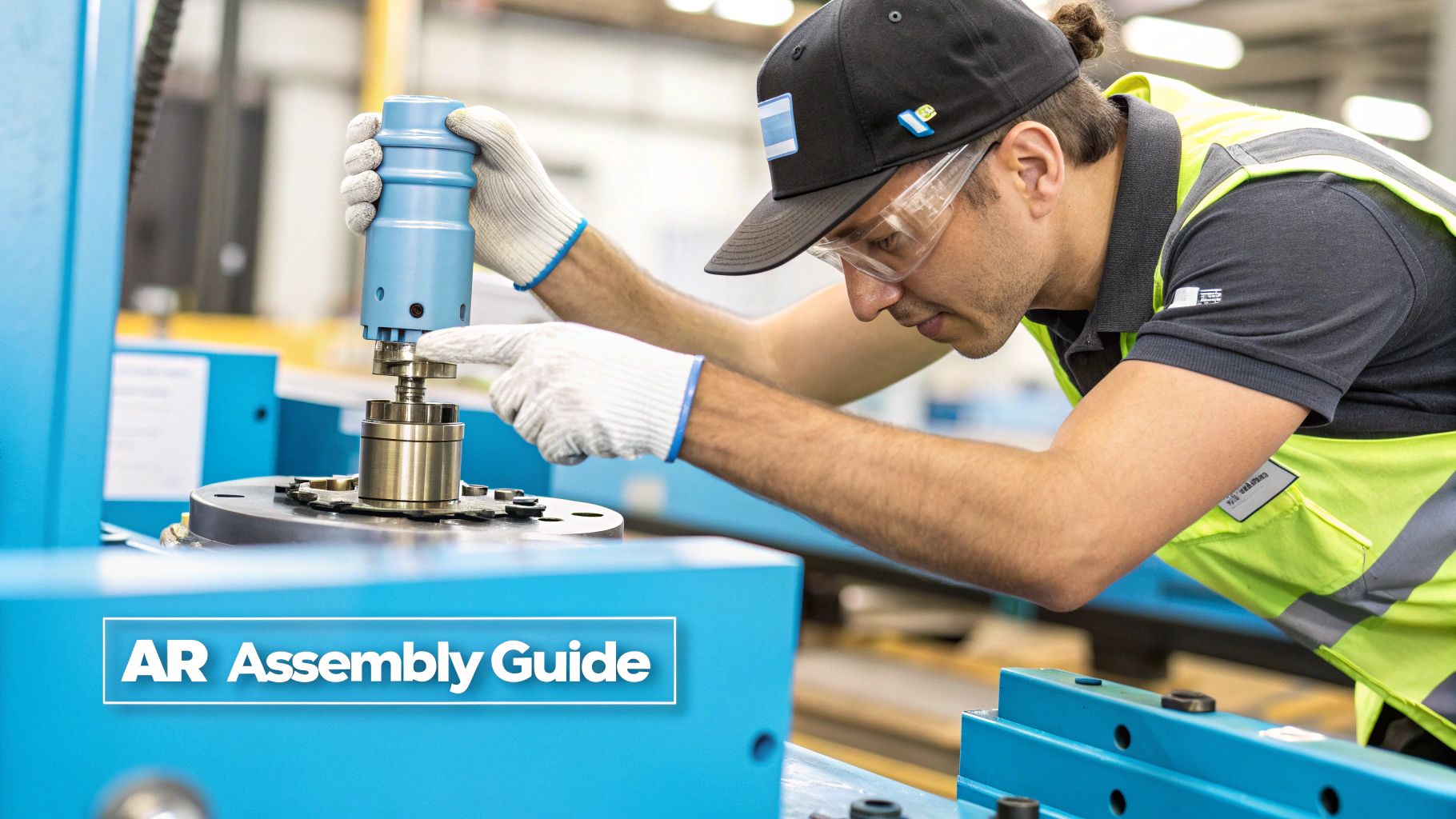
Putting a Stop to Guesswork in Manufacturing and Assembly
In complex manufacturing, one tiny mistake during assembly can snowball into expensive rework or a whole batch of defective products. Workers often juggle paper manuals or glance back and forth at a static monitor, constantly breaking their focus.
AR automation provides a much more direct and natural solution.
- The Problem: An assembly worker is trying to install a complex wiring harness with dozens of connection points. It’s slow work, the risk of crossing a wire is high, and a single mistake can cause a major quality control failure down the line.
- The Solution: Now, picture that same worker wearing AR smart glasses. A digital overlay appears right on the physical component. It highlights the exact port to use, shows which wire to connect next, and even displays the correct torque setting for each fastener.
- The Result: Assembly time drops, and errors practically vanish. A new hire can tackle a complex job with the confidence of a 20-year veteran. This slashes training time and sends first-pass yield through the roof.
When you put instructions directly in the worker’s line of sight, you eliminate guesswork and mental strain. It’s a surefire way to guarantee procedures are followed perfectly every single time, boosting both speed and quality.
Transforming How We Handle Maintenance and Repair
When equipment goes down, it’s a race against the clock. Every minute of downtime is money lost. Technicians are often faced with unfamiliar machines or complex problems, forcing them to sift through dense manuals or wait for a senior expert to become available.
With AR automation, every technician can perform like a seasoned pro.
- The Problem: A critical pump fails on the factory floor. The junior tech on site isn't sure where to start, and the only expert is at another facility. The clock is ticking, and downtime costs are piling up.
- The Solution: The technician simply points an AR-enabled tablet at the pump. The system instantly recognizes the equipment and overlays live data from its sensors, flagging an abnormal pressure reading. It then pulls up the machine's full service history and provides interactive, 3D instructions for disassembly and repair.
- The Result: The technician confidently finds and fixes the problem in a fraction of the usual time. The First-Time Fix Rate goes up, and equipment uptime is maximized. As a bonus, the whole repair is digitally logged, adding valuable data to the machine’s service record for the future.
For a deeper dive into these kinds of uses, check out our guide on key augmented reality industrial applications.
Taking Quality Control to the Next Level
The final inspection is the last line of defense before a product reaches the customer. But manual inspections can be slow and subjective—it’s easy for the human eye to miss a tiny flaw.
AR adds a layer of objective, digital precision, comparing the real-world product against its perfect digital blueprint.
- The Problem: A quality inspector has to verify that a freshly machined metal part meets its exact CAD specifications. This means pulling out calipers and taking manual measurements—a slow process where human error can easily creep in.
- The Solution: The inspector looks at the part through an AR device. The system instantly overlays the product’s "digital twin"—the original 3D CAD model—right on top of the physical object.
- The Result: Any difference is immediately obvious. Misaligned holes, surface blemishes, or incorrect dimensions are highlighted in red. The inspection process becomes up to 90% faster and infinitely more accurate, ensuring only perfect products leave the facility.
To put it all together, here’s a quick look at how AR automation tackles common challenges across these industrial functions.
AR Automation Impact Across Industrial Functions
| Industrial Function | Common Challenge | AR Automation Solution | Primary Benefit |
|---|---|---|---|
| Manufacturing & Assembly | High error rates and long training times for complex tasks. | Step-by-step 3D visual guidance overlaid on the workstation. | Increased first-pass yield and dramatically reduced worker ramp-up time. |
| Maintenance & Repair | Long equipment downtime waiting for expert technicians. | Remote expert assistance and guided 3D repair instructions. | Higher First-Time Fix Rates and improved equipment uptime (OEE). |
| Quality Control & Inspection | Slow, subjective, and error-prone manual inspections. | Digital twin overlays to instantly detect deviations from CAD models. | Up to 90% faster inspection cycles with near-perfect accuracy. |
As you can see, the theme is consistent: AR automation replaces ambiguity with clarity, empowering your team to perform at their best while driving tangible business results.
Your Roadmap for Implementing AR Automation
Bringing augmented reality automation into your facility isn't just about plugging in new hardware and software. A successful implementation requires a solid plan—a strategic roadmap that considers your technology, your processes, and most importantly, your people. A well-thought-out plan is the difference between a smooth transition and a chaotic one, ensuring you see measurable returns right from the start.
The best way to begin is with a focused, phased approach. Instead of a massive, company-wide rollout, the most successful projects start with a single, high-impact pilot. This lets you test the technology, refine the process, and build a rock-solid business case before you consider scaling up.
Designing Your Technical Architecture
The foundation of your whole AR strategy is its technical architecture. One of the first big decisions you’ll make is choosing a deployment model that fits your operational reality and security needs. This choice dictates how data moves and how the entire system is managed.
You really have two main paths to consider:
- Cloud-Based Deployment: This route offers flexibility and scalability, usually with lower upfront costs. Your AR applications and data live on remote servers, which means your team can access them from anywhere with an internet connection. It’s a great fit for teams that need to collaborate across different sites.
- On-Premise Deployment: If your organization has strict rules about data sovereignty or security, an on-premise solution keeps everything contained on your own physical servers. You get maximum control over your information, but it typically means a bigger initial investment in hardware and IT overhead.
No matter which model you choose, data security is non-negotiable in an industrial setting. Your implementation plan must include robust security protocols like end-to-end data encryption, locked-down network configurations, and strict device management policies. You can't afford to leave sensitive operational data exposed.
Integrating with Your Existing IT and OT Systems
For AR automation to be more than just a novelty, it has to communicate with the technology you already have. This means building clean connections between the AR software and your core Information Technology (IT) and Operational Technology (OT) systems—without disrupting daily operations.
A huge part of this is integrating with systems like:
- PLCs (Programmable Logic Controllers): Tapping into your PLCs lets the AR system pull live sensor data and overlay it right onto the physical machine. No more hunting for readings on a separate screen.
- MES (Manufacturing Execution System): Connecting to your MES allows AR applications to grab work orders, quality checklists, and production schedules, transforming them into interactive, step-by-step guidance for your team.
- ERP (Enterprise Resource Planning): An integration with your ERP can automate things like inventory updates and task logging, making sure data is consistent across the entire business.
The whole point is to create a single, unified data ecosystem where information flows freely from your backend systems straight to your frontline workers, giving them the real-time context they need to do their jobs better.
Managing Change and Empowering Your Workforce
Technology is only half the battle. The human element is what makes or breaks an AR automation project. Simply dropping new tools and workflows on your team is a recipe for resistance. You need thoughtful change management to get everyone on board.
The most effective strategy is to involve frontline workers early in the process. When your team understands the "why" behind the change and sees how the technology makes their jobs easier and safer, they become advocates for the solution.
Getting buy-in from key stakeholders from day one and providing comprehensive, hands-on training are absolutely essential. This builds confidence and makes sure everyone is ready to use the new tools to their full potential.
Defining KPIs and Proving ROI
To justify the investment and keep the project on track, you have to define clear Key Performance Indicators (KPIs) from the very beginning. These are the metrics that will help you measure the direct impact of AR automation on your operations and prove a clear return on investment (ROI).
Key metrics to keep a close eye on often include:
- First-Time Fix Rate (FTFR): What percentage of maintenance jobs are done right the first time?
- Mean Time to Repair (MTTR): How long does it take, on average, to get failed equipment back online?
- Reduction in training time: How much faster are new hires getting up to speed?
- Error rate reduction: Are you seeing fewer mistakes in assembly, inspection, or maintenance?
The financial case for this technology is getting stronger every day. In the United States alone, the augmented reality market is exploding. It was valued at USD 19.23 billion in 2024 and is projected to skyrocket to USD 114.82 billion by 2030. While hardware currently makes up a big chunk of that, it’s the software segment—the brains behind AR automation—that’s growing the fastest. This shows massive demand across manufacturing, logistics, and healthcare. You can read more about the U.S. AR market outlook on Grand View Research. This kind of growth doesn't happen by accident; it’s driven by the tangible value businesses are getting from AR right now.
Got Questions About AR Automation? We've Got Answers.
Stepping into the world of augmented reality automation can feel like charting new territory, and it naturally brings up a lot of questions. How does this actually work? What do we need to get started? Will it even connect to our older machines? These are the real-world concerns we hear all the time.
We want to cut through the noise and give you clear, practical answers. Let's tackle the key questions that are probably on your mind.
How Is AR Automation Different from VR?
This is easily the most common question we get. While people often lump augmented reality (AR) and virtual reality (VR) together, they serve completely different functions in an industrial setting. The simplest way to think about it is enhancing your current world versus creating a new one.
- Augmented Reality (AR): This technology overlays digital information onto your real-world view. A technician looking at a piece of machinery sees the actual equipment, but with critical data—like step-by-step instructions, live sensor readings, or safety warnings—layered right on top. This makes AR the perfect tool for getting things done on-site, where real-world context is everything.
- Virtual Reality (VR): This technology builds a completely digital, simulated environment. When you put on a VR headset, you’re fully immersed in a computer-generated world, totally cut off from your physical surroundings. This makes VR an incredible tool for risk-free training, like letting a new hire practice a complex repair sequence before they ever touch live, expensive equipment.
The bottom line? AR assists you in the real world, while VR transports you to a digital one. For the vast majority of hands-on industrial tasks, AR is the far more direct and practical solution.
What Hardware Do We Need to Start?
The hardware conversation is a lot less intimidating than you might think. You don't need a massive upfront investment; in fact, you can probably start with devices you already have in your facility.
The entry point for augmented reality automation is surprisingly accessible, which lets you scale up as you prove the value. Here’s the typical progression:
- Smartphones and Tablets: For a pilot project or simpler tasks, a standard smartphone or tablet is often all you need. They’re perfect for pulling up digital work instructions or walking through a quality check.
- Industrial-Grade Smart Glasses: For truly hands-free work, devices like the Microsoft HoloLens or RealWear headsets are the gold standard. They let a technician see digital guides while keeping both hands on the job, which is a game-changer for complex assembly or maintenance.
You don't need a massive upfront hardware investment to begin. Starting small with tablets allows you to test workflows and demonstrate ROI before committing to more specialized equipment. This phased approach minimizes risk and builds momentum.
Is Our Current Machinery Compatible?
This is a big one. Many companies worry that their existing—and often aging—machinery won't be able to connect to a modern AR system. The good news is that compatibility is less about the age of the machine and more about data accessibility.
Even legacy equipment that isn't "smart" out of the box can usually be integrated. The key is finding a way to get its operational data onto the network. Often, this can be done by retrofitting the machine with modern sensors, gateways, or PLCs. Once that data is flowing, an AR application can grab it and visualize it, effectively giving your old, reliable workhorse a new digital voice.
How Secure Is Our Operational Data?
Bringing new connected devices onto the factory floor is a serious topic, and it absolutely should raise security questions. Protecting sensitive operational data is non-negotiable. A strong AR automation strategy isn't just about compelling visuals; it's built on a rock-solid security foundation.
These aren't afterthoughts—they are core requirements for any industrial deployment:
- End-to-End Data Encryption: All data, whether it's sitting on a device or flying across the network, must be fully encrypted and unreadable to anyone who shouldn't see it.
- Secure Network Protocols: Using proven, secure communication standards is critical to prevent anyone from intercepting or manipulating the data as it moves between your equipment, AR devices, and backend systems.
- Robust Device Management: You need strict policies to control which devices can access your network, what they can run, and how they’re updated. This prevents a headset or tablet from becoming an unintended backdoor.
Ready to see how AIDAR Solutions can tackle your specific operational challenges and guide your move into augmented reality automation? Contact us today to schedule a personalized consultation and discover the path to a smarter, more efficient workforce.