
10 Digital Transformation Best Practices for Industrial Leaders in 2026
In today's competitive landscape, industrial and manufacturing enterprises are at a pivotal juncture. The path to sustained growth and operational excellence is no longer paved with traditional methods alone; it demands a strategic and holistic digital transformation. This isn't just about adopting new technology. It's about fundamentally rewiring how your organization operates, trains its workforce, and delivers value.
For leaders, the challenge is navigating this complex journey with clarity and confidence, avoiding common pitfalls that can derail progress. To effectively navigate the complexities and unlock true potential, many industrial leaders seek guidance from experienced digital transformation experts. A successful transition requires a clear plan, dedicated leadership, and the right tools to empower your teams.
This guide presents 10 essential digital transformation best practices, offering a prioritized and actionable blueprint for industrial success. We will explore how to build a robust strategy, manage the crucial human side of change, and integrate powerful technologies like Augmented Reality (AR) and Virtual Reality (VR) for tangible business outcomes. From accelerating employee onboarding and upskilling with solutions like AIDAR.SKILLS to slashing equipment downtime with remote expert assistance from AIDAR.SERVICE, you'll gain practical insights. Let's dive into the core practices that will define industry leaders in 2026 and beyond.
1. Establish a Clear Digital Transformation Strategy and Roadmap
A successful digital transformation journey begins not with technology, but with a clear and comprehensive strategy. This foundational step involves defining specific, measurable business objectives and creating a detailed, phased roadmap to achieve them. It acts as a blueprint, ensuring every digital initiative, from implementing IoT sensors to deploying XR training modules, directly supports overarching company goals like increasing operational efficiency, reducing downtime, or improving workforce safety.
This strategy must be more than an IT project; it's a core business initiative. It requires a thorough assessment of your current digital maturity, identifying gaps in technology, processes, and workforce skills. By mapping emerging technologies like Augmented and Virtual Reality (VR/AR) to specific operational workflows, you can create a clear path to value. A practical use case is integrating AR remote assistance to connect field technicians with centralized experts, immediately reducing travel costs and mean time to repair. This kind of targeted application demonstrates how a well-defined plan drives tangible results.
Actionable Implementation Tips
To put this into practice, focus on building alignment and momentum. A successful roadmap is a living document, not a static plan.
- Involve Cross-Functional Teams: Engage stakeholders from IT, operations, finance, and HR from the very beginning. This ensures the strategy addresses real-world operational challenges and gains buy-in across the organization.
- Prioritize Quick Wins: Start with high-impact, low-complexity projects. For example, implementing an AR-powered remote assistance tool like AIDAR can immediately reduce technician travel costs and resolve issues faster, demonstrating clear ROI and building support for larger initiatives.
- Integrate Change Management: Your roadmap must explicitly plan for workforce training and cultural shifts. Clearly communicate how new tools will empower employees, not replace them, and provide the necessary upskilling to ensure adoption.
Key Insight: A digital transformation strategy that isn't directly tied to business outcomes is destined to fail. The goal is not just to adopt new technology, but to leverage that technology to solve specific business problems and create a measurable competitive advantage.
By creating a robust framework, you ensure that investments are targeted, progress is measurable, and the entire organization moves in a unified direction. For a deeper dive into building this foundation, explore how to create a comprehensive digital transformation strategy framework.
2. Prioritize Change Management and Workforce Enablement
Ultimately, the success of any digital transformation best practice hinges not on the technology itself, but on the people who use it. Prioritizing change management and workforce enablement is critical because even the most advanced tools are useless if employees resist them or lack the skills to use them effectively. This means proactively addressing cultural shifts, managing job-related anxieties, and building digital literacy across the entire organization to ensure new solutions, from AR remote guidance to VR training simulations, are embraced and utilized to their full potential.

This people-centric approach turns potential friction into momentum. Instead of simply deploying technology, leading organizations invest heavily in preparing their workforce for the future of work. A powerful use case is using VR to create immersive safety training simulations, allowing employees to practice emergency procedures in a risk-free environment. This not only improves knowledge retention but also builds confidence. Similarly, when a robust change management plan accompanies the rollout of an AR training platform like AIDAR.SKILLS, adoption rates can more than double, accelerating ROI and ensuring the workforce is capable and confident with new digital tools.
Actionable Implementation Tips
To effectively manage the human side of change, focus on communication, empowerment, and continuous development. A well-executed plan ensures your team becomes an asset, not a barrier, to transformation.
- Create Peer Champions: Identify and empower influential employees to act as advocates for new technologies. These champions can demonstrate value to their colleagues, provide informal support, and build grassroots momentum far more effectively than top-down mandates.
- Personalize Learning Paths: Avoid one-size-fits-all training. Develop role-specific learning journeys that address the unique needs and skill gaps of different teams, such as using VR simulations for technicians or data analytics workshops for managers.
- Start Change Management Early: Begin communication and training initiatives before technology deployment, not after. This builds anticipation, addresses concerns head-on, and ensures your team is prepared and motivated from day one.
Key Insight: Digital transformation is fundamentally a human transformation. Investing in upskilling, clear communication, and a supportive culture is not an optional extra; it is the core mechanism that unlocks the value of your technology investments and drives sustainable adoption.
By putting your workforce at the center of your strategy, you build a resilient, adaptable organization ready to thrive in the digital era. To see how immersive technologies can play a key role, explore the benefits of augmented reality for training.
3. Embrace Cloud and Hybrid Infrastructure Models
Shifting from rigid, on-premise systems to a flexible cloud or hybrid infrastructure is a critical enabler of modern digital transformation. This move provides the scalability, agility, and computational power required to deploy advanced digital solutions rapidly. A hybrid model, in particular, offers an optimal balance for industrial settings. It allows companies to keep latency-sensitive or compliance-critical systems on-premise while leveraging the cloud for powerful data analytics, AI, and collaborative tools. This architectural flexibility is essential for creating a responsive and resilient operational environment.
This strategic shift is fundamental to enabling real-time data processing and global collaboration. For example, a global manufacturing firm can use a cloud platform to aggregate production data from various sites for centralized analysis, while keeping machine control systems on-premise for reliability. AR and VR solutions benefit significantly from this model; streaming complex 3D models from the cloud to an on-site headset provides high-fidelity experiences without requiring massive local storage. Solutions like AIDAR.SERVICE demonstrate this flexibility with both on-premise and cloud deployment options, ensuring that remote support can be delivered securely within any enterprise’s IT framework.
Actionable Implementation Tips
To effectively adopt cloud and hybrid models, focus on a deliberate and secure migration strategy. This ensures you maximize benefits while minimizing disruption and risk.
- Audit and Prioritize: Begin with a comprehensive audit of your current infrastructure and applications. Prioritize candidates for cloud migration based on their business impact and technical feasibility, targeting systems that will benefit most from cloud scalability.
- Implement Robust Security: Establish stringent security protocols from the outset. This includes end-to-end encryption, multi-factor authentication, and granular access controls to protect sensitive operational data in a distributed environment.
- Leverage Edge Computing: For real-time applications like AR-powered remote guidance where low latency is crucial, use edge computing. This involves processing data closer to the source (e.g., on the factory floor) before sending it to the cloud, ensuring smooth and immediate performance.
Key Insight: The choice is no longer just "cloud or on-premise." A successful industrial digital transformation leverages a hybrid approach, using the right infrastructure for the right workload to optimize performance, security, and cost-effectiveness across the entire operation.
By embracing a modern infrastructure model, you build the necessary foundation to support data-intensive technologies and scalable digital tools, future-proofing your operations for continued innovation.
4. Implement Data-Driven Decision Making and Analytics
Transitioning from intuition-based operations to data-driven decision-making is a cornerstone of modern digital transformation best practices. This involves establishing systems to collect, process, and analyze data from across your operations, turning raw information into actionable business intelligence. By leveraging analytics, you can move beyond reactive problem-solving to proactively optimize processes, predict equipment failures, and streamline supply chains.

The goal is to create a culture where decisions are supported by verifiable data, not just experience. For instance, analyzing sensor data to anticipate equipment maintenance needs can prevent costly downtime. A practical AR use case is capturing data on task completion times and error rates during AR-guided procedures. Analyzing this data can reveal workflow bottlenecks or training gaps. This data-first approach, which can show a 75% acceleration in learning with tools like AIDAR, provides tangible proof of ROI and replaces guesswork with precision, driving significant operational gains.
Actionable Implementation Tips
To effectively embed analytics into your organization, focus on creating accessible, reliable data systems and fostering a data-literate workforce.
- Start with High-Impact Use Cases: Begin with projects that offer clear value, such as predictive maintenance to reduce downtime or analyzing training data to measure and improve workforce competency.
- Establish Strong Data Governance: Before scaling your analytics platforms, implement clear policies for data quality, security, and accessibility. Clean, reliable data is the foundation of trustworthy insights.
- Empower Teams with Self-Service Tools: Equip operations and maintenance teams with user-friendly dashboards and analytics tools. This allows them to explore data and uncover insights relevant to their daily tasks without relying solely on data specialists.
Key Insight: Data is only valuable when it leads to action. The true power of analytics lies in creating a feedback loop where insights from the factory floor or training sessions are used to make immediate, measurable improvements to business processes and outcomes.
By building a robust analytics capability, you can unlock new levels of efficiency and innovation. To understand what to measure, explore these essential operational efficiency metrics that can guide your data strategy.
5. Adopt Agile and Iterative Implementation Methodologies
Traditional, rigid project management methods like waterfall are ill-suited for the dynamic nature of digital transformation. One of the most effective digital transformation best practices is to adopt an agile and iterative approach. This methodology breaks down large, complex projects into smaller, manageable cycles called sprints, allowing for rapid prototyping, continuous feedback, and the flexibility to adapt to changing business needs and technological advancements. It drastically reduces time-to-value and de-risks implementations, which is especially critical when integrating emerging technologies like VR and AR.
This shift empowers cross-functional teams to deliver value incrementally rather than waiting for a single, high-stakes launch. In the industrial sector, this means a new AR-powered maintenance procedure can be prototyped with a small group of technicians. Their feedback can then be incorporated in the next sprint, ensuring the final solution perfectly fits real-world workflows. This iterative process avoids lengthy development cycles that result in tools that are misaligned with user needs.
Actionable Implementation Tips
To successfully transition to an agile mindset, focus on building momentum through small-scale pilots and fostering a culture of continuous improvement. This approach prioritizes learning and adaptation over rigid adherence to an initial plan.
- Start with Pilot Projects: Begin with a single, high-impact project, like developing a VR training module for a specific machine. This allows a pilot team to build agile capabilities and demonstrate success before a wider organizational rollout.
- Create Rapid Prototypes for XR: For AR/VR initiatives, use agile sprints to create minimum viable products (MVPs). A basic AR overlay for a piece of equipment can be tested and validated by end-users quickly, providing crucial feedback before committing to full-scale development.
- Establish a Clear Product Vision: While sprints offer flexibility in execution, they must be guided by a stable, long-term product vision. Ensure every iteration and feature directly contributes to solving the core business problem you identified.
Key Insight: Agile is not about a lack of planning; it's about planning for change. By building, measuring, and learning in rapid cycles, you ensure that digital solutions evolve with your business and deliver sustained value, preventing costly missteps and ensuring high user adoption.
Embracing this iterative approach allows you to respond swiftly to new opportunities and challenges, making your digital transformation journey more resilient and effective. This is the core philosophy behind the development of platforms like AIDAR.SKILLS, which are refined through continuous feedback loops with industrial partners.
6. Invest in Cybersecurity and Data Privacy Infrastructure
As industrial enterprises become more connected through IoT devices and cloud platforms, the attack surface for cyber threats expands dramatically. One of the most critical digital transformation best practices is to build a robust cybersecurity and data privacy infrastructure from the ground up. This involves proactively protecting your intellectual property, operational technology (OT), and sensitive customer data, transforming security from a reactive measure into a core business enabler.
This isn't just an IT concern; it's a fundamental operational requirement. A breach in an industrial setting can lead to production shutdowns, safety incidents, and a catastrophic loss of trust. Proactively embedding security is essential. For instance, AR remote assistance tools that transmit live video feeds of proprietary equipment must use end-to-end encryption to prevent corporate espionage. Solutions like AIDAR.SERVICE are engineered with secure authentication and encrypted connections, ensuring that remote expert support for field technicians enhances productivity without introducing vulnerabilities.
Actionable Implementation Tips
To embed security into your digital fabric, adopt a defense-in-depth strategy that protects every layer of your organization. This approach ensures resilience and builds a security-first culture.
- Implement a Zero-Trust Model: Operate on the principle of "never trust, always verify." Every access request, regardless of where it originates, must be strictly authenticated and authorized before granting access to your network and applications.
- Prioritize OT Security: Industrial environments have unique security needs. Comply with industry-specific standards like IEC 62443 for industrial control systems and conduct regular security audits and penetration testing on both IT and OT networks.
- Foster Shared Responsibility: Train all employees on security best practices, phishing awareness, and their role in protecting company assets. Security is a collective responsibility, not solely the domain of the IT department.
Key Insight: In the era of smart manufacturing and remote operations, cybersecurity is not a cost center but a competitive advantage. A strong security posture enables innovation, builds customer trust, and protects your most valuable assets from an evolving landscape of digital threats.
By treating cybersecurity as a foundational pillar of your digital strategy, you create a secure environment where technologies like remote assistance and IoT can be deployed confidently, driving efficiency without compromising operational integrity.
7. Foster Innovation Culture and Experimentation Mindset
Technology alone cannot drive transformation; it requires a culture that embraces change and encourages exploration. Fostering an innovation culture means creating an environment where employees are empowered to experiment with new ideas, take calculated risks, and learn from failures without fear of reprisal. This mindset is crucial when exploring emerging technologies like AR/VR, where the most impactful use cases are often discovered through trial and error.
This approach moves beyond traditional R&D and embeds experimentation into everyday operations. It involves allocating dedicated resources for new initiatives and creating psychologically safe spaces for teams to test hypotheses. A practical example is setting up a pilot program where a maintenance team tests an AR headset for guided instructions on a non-critical asset. Their feedback can then determine the viability of a wider rollout. This type of hands-on experimentation is a core driver of sustainable digital transformation best practices.
Actionable Implementation Tips
To cultivate this mindset, you must build supportive structures and processes that make experimentation a systematic part of your operations.
- Allocate Dedicated Resources: Earmark a portion of your budget (e.g., 5-10%) specifically for innovation projects. This protects experimental initiatives from being deprioritized in favor of short-term operational demands.
- Create Innovation Labs or Teams: Form cross-functional teams with members from operations, IT, and engineering to tackle specific challenges. These teams can pilot new technologies, like testing different AR remote support workflows with a solution like AIDAR, in a controlled environment.
- Establish a "Fail Fast, Learn Faster" Mentality: Document and share learnings from all experiments, especially those that don't succeed. This reframes failure as a valuable data point and a necessary step toward breakthrough innovation.
Key Insight: A culture of innovation is not about pursuing every new trend; it's about creating a systematic process for testing novel ideas, validating their business value, and scaling the winners. It is the engine that turns technological potential into tangible competitive advantage.
By encouraging experimentation, you unlock your team's creativity and accelerate the discovery of transformative applications. For more strategies on this topic, read about driving innovation in the manufacturing industry.
8. Build Strategic Technology partnerships and Ecosystem Integrations
Digital transformation rarely succeeds in isolation; it thrives within a robust ecosystem of collaboration. This best practice involves moving beyond a simple vendor-client relationship to build strategic partnerships with technology providers, system integrators, and even startups. This approach accelerates capability development, mitigates implementation risks, and unlocks integrated value that no single company could achieve alone. It is a cornerstone of modern digital transformation best practices.
This collaborative model is particularly crucial for complex deployments like enterprise-wide XR solutions. Instead of building every component from scratch, companies can leverage specialized expertise. For example, a heavy equipment manufacturer might partner with an AR solutions provider to integrate digital work instructions directly with their existing PLM (Product Lifecycle Management) system. This seamless integration creates a far more powerful solution than either company could build alone, demonstrating that a well-orchestrated ecosystem is a powerful competitive advantage.
Actionable Implementation Tips
To effectively build and manage these relationships, focus on mutual value and clear governance. A strategic partnership should be a two-way street that drives innovation for all parties involved.
- Establish Clear Partnership Agreements: Define roles, responsibilities, data-sharing protocols, and success metrics from the outset. This ensures alignment and provides a framework for measuring joint performance.
- Prioritize Integration and Automation: Select partners whose technologies can be easily integrated via APIs. Understanding powerful low-code tools like the Microsoft Power Platform can be key for accelerating workflow automation and creating seamless connections within your partner ecosystem.
- Seek Industry and Technology Expertise: For specialized initiatives like XR, partner with domain experts like AIDAR Solutions, who combine deep industry knowledge with proven technological capabilities. This ensures the solution is not just technically sound but also solves real-world operational problems.
Key Insight: The goal of a technology partnership is not just to procure a service or product, but to build a symbiotic relationship that fuels continuous innovation. Your ecosystem is a strategic asset that extends your team’s capabilities and accelerates your transformation timeline.
By treating partners as extensions of your own team, you can tap into a wider pool of talent and technology, ensuring your digital initiatives are more resilient, scalable, and impactful.
9. Implement Comprehensive Performance Measurement and ROI Tracking
What isn't measured cannot be improved. A core tenet of digital transformation best practices is implementing a robust framework for measuring performance and tracking the return on investment (ROI) of every initiative. This goes beyond simple IT metrics and focuses on quantifying the tangible business impact of new technologies. It involves establishing baseline data before implementation and consistently monitoring key performance indicators (KPIs) to validate strategic decisions and guide future investments.
This systematic approach proves the value of digital tools and secures ongoing executive support. For example, manufacturing plants using AR for training can measure outcomes like a 75% faster learning curve and reduced material waste during assembly tasks. Field service organizations can track a 50% reduction in service times and a 75% decrease in expert travel by leveraging remote assistance tools like AIDAR.SERVICE. These concrete data points transform digital transformation from a cost center into a clear value driver.
Actionable Implementation Tips
To effectively measure your digital initiatives, integrate a data-driven mindset into every stage of the process. This ensures your efforts are aligned with strategic goals and optimized for maximum impact.
- Define Business-Aligned Metrics: Start by identifying KPIs that directly correlate with strategic business objectives, not just technology usage. Combine quantitative metrics (cost savings, efficiency gains) with qualitative ones (employee satisfaction, skill improvement).
- Establish a Pre-Implementation Baseline: Before deploying any new tool, capture current performance data. This baseline is essential for accurately measuring the "before and after" impact and calculating a credible ROI.
- Track XR-Specific Outcomes: For AR/VR solutions, focus on specific value metrics. For AR-powered training, track time-to-competency, knowledge retention rates, and first-time task success. For remote support, measure first-time fix rates, technician utilization, and customer satisfaction scores.
Key Insight: Without a dedicated measurement strategy, digital transformation becomes a series of disconnected, expensive experiments. Tying every technology investment to measurable business outcomes is the only way to prove value, justify expansion, and build a sustainable program.
By rigorously tracking performance, you create a feedback loop that informs continuous improvement and ensures your digital investments deliver a powerful competitive advantage. To learn more about how AIDAR provides detailed analytics, explore our solutions for training and remote assistance.
10. Prioritize User Experience (UX) and Establish Continuous Learning & Capability Development Programs
Even the most powerful technology will fail if it is difficult to use or if the workforce is unprepared to leverage it. One of the most critical digital transformation best practices is the dual focus on user-centric design and continuous skill development. This means creating intuitive, accessible solutions that integrate seamlessly into daily workflows and pairing them with robust learning programs that ensure long-term capability and mastery.
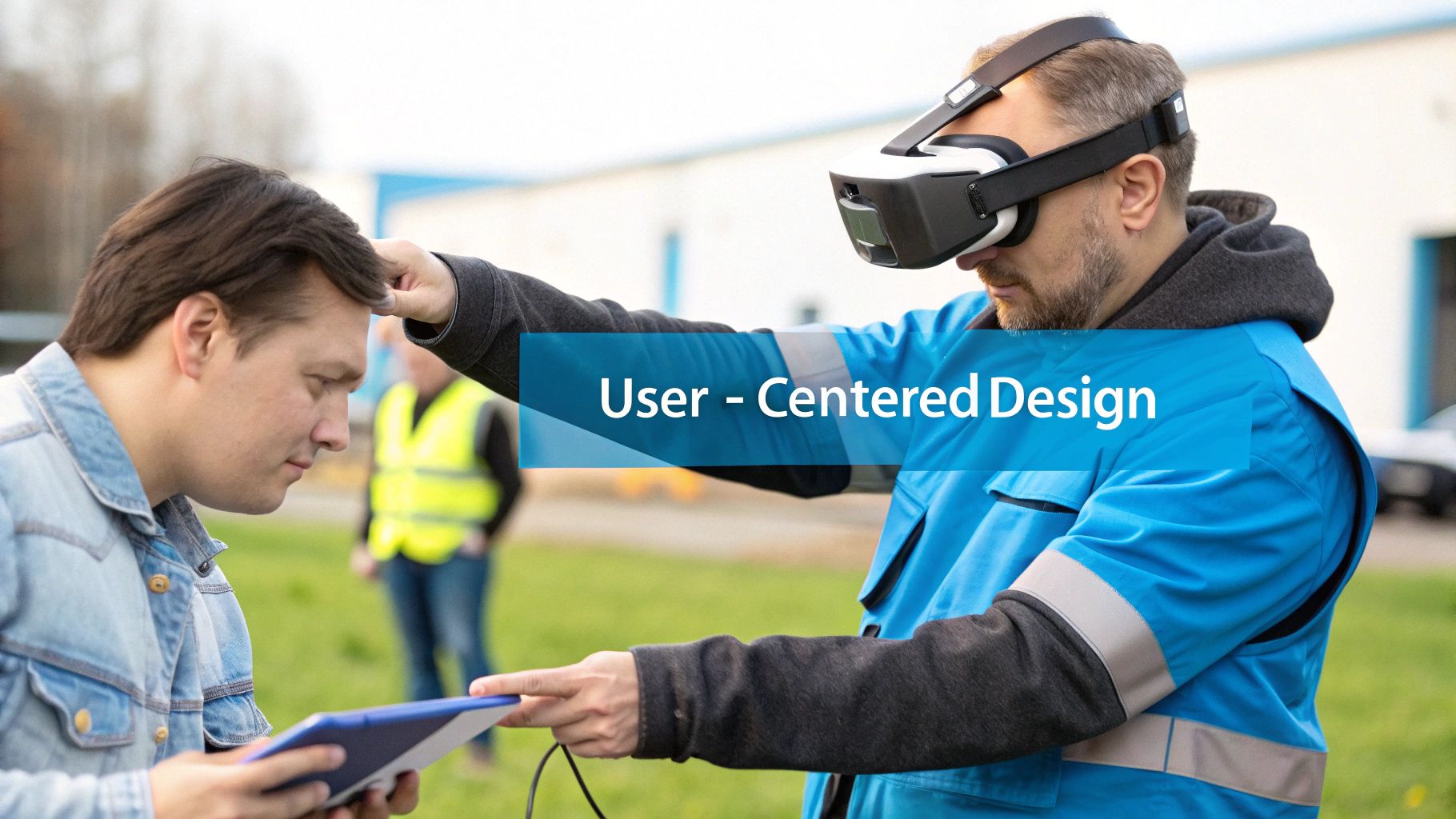
For industrial applications, this principle is paramount. An AR remote support tool must be operable by a technician wearing gloves in a noisy, poorly lit environment. A VR training module must be designed to minimize motion sickness and provide realistic, intuitive interactions. This focus on practical usability drives high adoption rates. When combined with a culture of continuous learning, it ensures that digital tools deliver sustained value as both the technology and the business evolve.
Actionable Implementation Tips
To embed this dual focus in your strategy, prioritize the end-user journey from initial design to ongoing professional development. A seamless experience accelerates adoption and maximizes ROI.
- Conduct User Research Early: Before development, engage directly with technicians and operators to understand their real-world workflows, pain points, and environmental constraints. Prototype and test designs iteratively with these end-users.
- Design for the Field: Ensure digital tools offer offline capabilities for disconnected sites, are compatible with gloved hands, and feature high-contrast interfaces for varying light conditions. For example, AR solutions like AIDAR.SERVICE are built with these field-specific UX considerations in mind.
- Create Clear Learning Pathways: Go beyond one-off training sessions. Establish continuous learning programs using tools like AIDAR.SKILLS to create clear pathways that link new digital competencies to career advancement, certifications, and performance incentives.
Key Insight: Technology adoption is not the finish line; it's the starting point. True transformation occurs when intuitive tools are placed in the hands of a continuously upskilled workforce, creating a cycle of improvement and innovation.
By treating UX and learning as interconnected priorities, organizations can ensure their digital investments are not just implemented but are also embraced, mastered, and fully leveraged to drive business outcomes.
10-Point Digital Transformation Best Practices Comparison
| Initiative | Implementation Complexity 🔄 | Resource Intensity ⚡ | Expected Outcomes ⭐📊 | Ideal Use Cases 💡 | Key Advantages ⭐ |
|---|---|---|---|---|---|
| Establish a Clear Digital Transformation Strategy and Roadmap | High 🔄 — governance, cross‑functional alignment | Moderate ⚡ — executive time, planning budget, consultants | ⭐⭐⭐⭐⭐ — clear goals, KPIs, phased milestones; measurable progress 📊 | Enterprise-wide modernization; multi-year digital programs | Direction and alignment; better ROI tracking; risk mitigation ⭐ |
| Prioritize Change Management and Workforce Enablement | Medium 🔄 — cultural change, ongoing engagement | High ⚡ — training programs, L&D resources, champions | ⭐⭐⭐⭐ — higher adoption; faster time‑to‑value; improved retention 📊 | Frontline adoption (field service, manufacturing); VR/AR rollouts | Increases adoption and skill readiness; reduces failures ⭐ |
| Embrace Cloud and Hybrid Infrastructure Models | Medium 🔄 — architecture, migration planning | Variable ⚡ — cloud subscriptions, network, edge devices | ⭐⭐⭐⭐ — scalability, faster deployments, cloud analytics 📊 | Distributed operations, IoT/AR workloads, global collaboration | Scalability; access to AI/analytics; improved continuity ⭐ |
| Implement Data‑Driven Decision Making and Analytics | High 🔄 — data governance, integration, model ops | High ⚡ — platforms, engineers, data pipelines | ⭐⭐⭐⭐⭐ — predictive insights, optimized operations, measurable ROI 📊 | Predictive maintenance, supply chain optimization, training ROI | Actionable insights; reduced downtime; quantifiable benefits ⭐ |
| Adopt Agile and Iterative Implementation Methodologies | Low–Medium 🔄 — process change, cross‑team practices | Moderate ⚡ — agile coaches, tooling, cross‑functional teams | ⭐⭐⭐⭐ — faster time‑to‑market; lower delivery risk; continuous feedback 📊 | Software/UX projects; evolving tech (VR/AR) pilots and iterations | Rapid iteration; better stakeholder alignment; improved quality ⭐ |
| Invest in Cybersecurity and Data Privacy Infrastructure | High 🔄 — continuous controls, compliance | High ⚡ — security tools, monitoring, specialist staff | ⭐⭐⭐⭐ — reduced breach risk; regulatory compliance; trust 📊 | IoT/connected factories, remote access, regulated industries | Protects IP and operations; enables safe remote services ⭐ |
| Foster Innovation Culture and Experimentation Mindset | Medium 🔄 — cultural shift, governance for pilots | Moderate ⚡ — R&D budget, labs, partnerships | ⭐⭐⭐ — new use cases; faster learning; employee engagement 📊 | Exploring emerging tech (VR/AR); pilot programs and R&D | Discovers opportunities; attracts talent; encourages learning ⭐ |
| Build Strategic Technology Partnerships and Ecosystem Integrations | Medium–High 🔄 — partner governance, integration work | Moderate ⚡ — partner management, integration effort | ⭐⭐⭐⭐ — accelerated capability delivery; reduced build time 📊 | Complex multi‑vendor deployments; ERP/AR integrations | Access to expertise; faster scale; shared investment ⭐ |
| Implement Comprehensive Performance Measurement and ROI Tracking | Medium 🔄 — metric design, baseline setup | Moderate ⚡ — dashboards, analytics, benchmarking | ⭐⭐⭐⭐ — demonstrated value; informed optimization 📊 | Justifying training/remote support investments; enterprise reporting | Validates investments; enables course correction; stakeholder reporting ⭐ |
| Prioritize UX and Continuous Learning & Capability Development Programs | Medium–High 🔄 — iterative design + ongoing training | High ⚡ — UX research, content, LMS, certifications | ⭐⭐⭐⭐ — higher adoption; reduced errors; sustained capability 📊 | Field tools, VR/AR training, low‑digital‑literacy teams | Improves usability and retention; accelerates proficiency ⭐ |
From Blueprint to Reality: Your Next Steps in Digital Transformation
The journey of digital transformation is not a single project with a finite end date; it is a fundamental, ongoing evolution of your organization's culture, processes, and technological capabilities. We have explored the ten cornerstone digital transformation best practices that separate industry leaders from the rest, moving from high-level strategy to the granular details of execution. The path forward is built on a clear vision, empowered by your people, and measured by tangible results.
Recapping the essentials, a successful initiative begins with a crystal-clear strategy and roadmap. It’s not about adopting technology for its own sake but about aligning every digital investment with specific business objectives. This strategic clarity becomes the North Star that guides every subsequent decision, from choosing a cloud infrastructure to defining key performance indicators. Perhaps the most critical, yet often underestimated, pillar is comprehensive change management. Technology is only an enabler; your workforce is the engine of transformation. By prioritizing training, communication, and creating a culture that embraces continuous learning and experimentation, you build the resilience and adaptability needed to thrive amidst constant change.
Turning Insights into Actionable Momentum
Moving from understanding to implementation requires a decisive shift in mindset and methodology. Embracing agile and iterative approaches allows you to build momentum, learn from small-scale deployments, and adapt quickly without the risks associated with massive, monolithic projects. This is particularly vital when integrating advanced technologies like Extended Reality (XR).
For industrial enterprises, the practical applications we've discussed are no longer futuristic concepts but present-day competitive advantages. Consider these immediate takeaways:
- De-risk Complex Operations: Instead of training new technicians on live, high-stakes equipment, use VR simulations to build muscle memory and procedural knowledge in a safe, controlled environment. This accelerates competency and dramatically reduces the potential for costly errors.
- Amplify Expert Knowledge: Leverage AR-powered remote assistance to allow a single senior expert to guide multiple junior technicians in the field simultaneously. This approach slashes travel costs, minimizes equipment downtime, and effectively scales your most valuable human resources.
- Empower Data-Driven Decisions: Every interaction, every process, and every piece of equipment can generate valuable data. The key is to implement robust analytics platforms that transform this raw data into actionable insights, enabling predictive maintenance, optimized supply chains, and smarter operational planning.
The ultimate goal of digital transformation is not just to become more efficient; it is to build an organization that is inherently more agile, intelligent, and responsive to the needs of its customers and the market.
The Power of Partnership in Your Transformation Journey
Ultimately, mastering these digital transformation best practices is about creating a symbiotic relationship between people, processes, and technology. It requires a commitment to investing in a secure and scalable infrastructure, fostering a culture of innovation, and establishing rigorous methods for measuring ROI. No organization has to navigate this complex landscape alone. Building strategic partnerships is not a sign of weakness but a strategic accelerant. The right technology partner provides more than just a software platform; they bring deep domain expertise, proven implementation methodologies, and a shared commitment to your long-term success.
By systematically applying these principles, you move your digital transformation from a theoretical blueprint to a living, breathing reality that delivers measurable value across your entire operation. The journey is challenging, but the rewards-enhanced safety, unprecedented efficiency, and a truly future-proofed workforce-are transformative.
Ready to see how immersive technology can accelerate your transformation efforts? AIDAR Solutions provides a comprehensive AR-powered platform designed to enhance workforce training, streamline remote support, and optimize industrial operations. Explore our solutions and book a personalized demo to discover how we can help you implement these digital transformation best practices today. Learn more at AIDAR Solutions.