Unlocking The Smart Factory With AR Industry 4.0
Augmented Reality in Industry 4.0 connects your people to your data. Think of it as the ultimate human-machine interface, taking all the complex information from a smart factory and translating it into simple, real-time instructions for your frontline workers. It's the technology that bridges the gap, making your entire operation safer, faster, and more efficient.
Understanding The Next Industrial Revolution
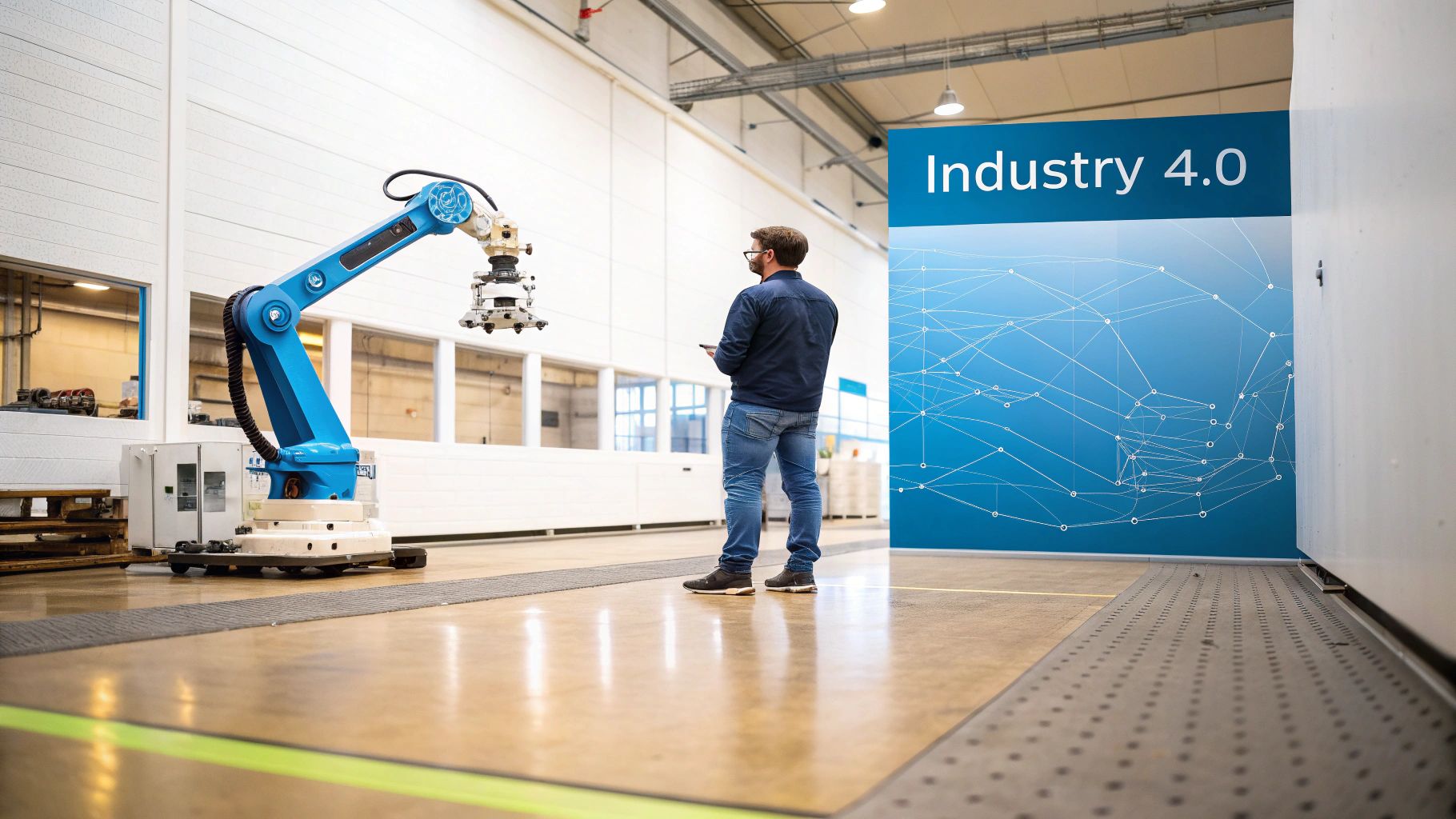
Welcome to Industry 4.0, the age of the 'smart factory.' This isn't just about adding more robots to the line; it’s about building intelligent, interconnected manufacturing environments where machines and systems communicate with each other and even make decisions on their own.
If Industry 3.0 was a standalone calculator, Industry 4.0 is a fully networked, cloud-connected computer that learns and adapts as it goes. We're talking about a massive leap forward, fusing the physical world of production with digital tools like the Internet of Things (IoT), artificial intelligence, and cloud computing.
To really grasp where Industry 4.0 fits in, it helps to see how we got here.
The Four Industrial Revolutions at a Glance
Each industrial revolution was defined by a game-changing technology. Here’s a quick rundown of how production has evolved over the centuries.
| Revolution | Key Technology | Primary Impact on Production |
|---|---|---|
| Industry 1.0 | Steam Power, Mechanization | Shift from manual labor to machine-based factories. |
| Industry 2.0 | Electricity, Assembly Line | Enabled mass production and greater efficiency. |
| Industry 3.0 | Computers, Automation | Introduced digital control and automated processes. |
| Industry 4.0 | IoT, AI, Cyber-Physical Systems | Creates interconnected, intelligent, and autonomous systems. |
As the table shows, the current shift is all about creating cyber-physical systems where machines don't just do things—they analyze massive amounts of data to get better at their jobs. This is exactly where Augmented Reality comes in, acting as the visual key that turns this digital information into clear, practical insights for your team.
From Automation to Interconnection
The real power of Industry 4.0 isn’t just one single technology but how they all work together. We’ve moved past simple automation and into an era of total interconnection and intelligence. For a great deep dive into this shift, check out this strategic guide to modernizing the industrial automation sector.
The global Industry 4.0 market is already expanding, projected to hit around $188.5 billion in 2025 and grow to as high as $1.2 trillion by 2035. That's a compound annual growth rate (CAGR) of 24% from 2026 onward.
This shift creates a fully integrated ecosystem where data flows seamlessly from the shop floor to the top floor, enabling smarter, faster, and more flexible production. AR is the key that unlocks human potential within this data-rich environment.
This new model breaks down the old silos between departments, creating a level of transparency and efficiency that was impossible before. You can learn more about how new technologies in manufacturing are already changing the game. At the end of the day, the goal is to build a resilient, adaptive, and human-centric production system where technology empowers workers, not replaces them.
How AR Connects People to the Smart Factory
So, what does Augmented Reality actually do in a smart factory? Think of it as the ultimate translator—the crucial bridge between the mountains of data churned out by Industry 4.0 systems and the skilled people working on your factory floor. It’s a powerful visualization tool that turns complex machine data into simple, intuitive, human-friendly guidance.
It's like giving every single technician a digital co-pilot. Armed with AR glasses or a tablet, they see real-time data, interactive diagrams, and clear, step-by-step instructions overlaid right onto the equipment they're working on. This isn't just about novel technology; it's about delivering the right information, at the right time, in the right place.
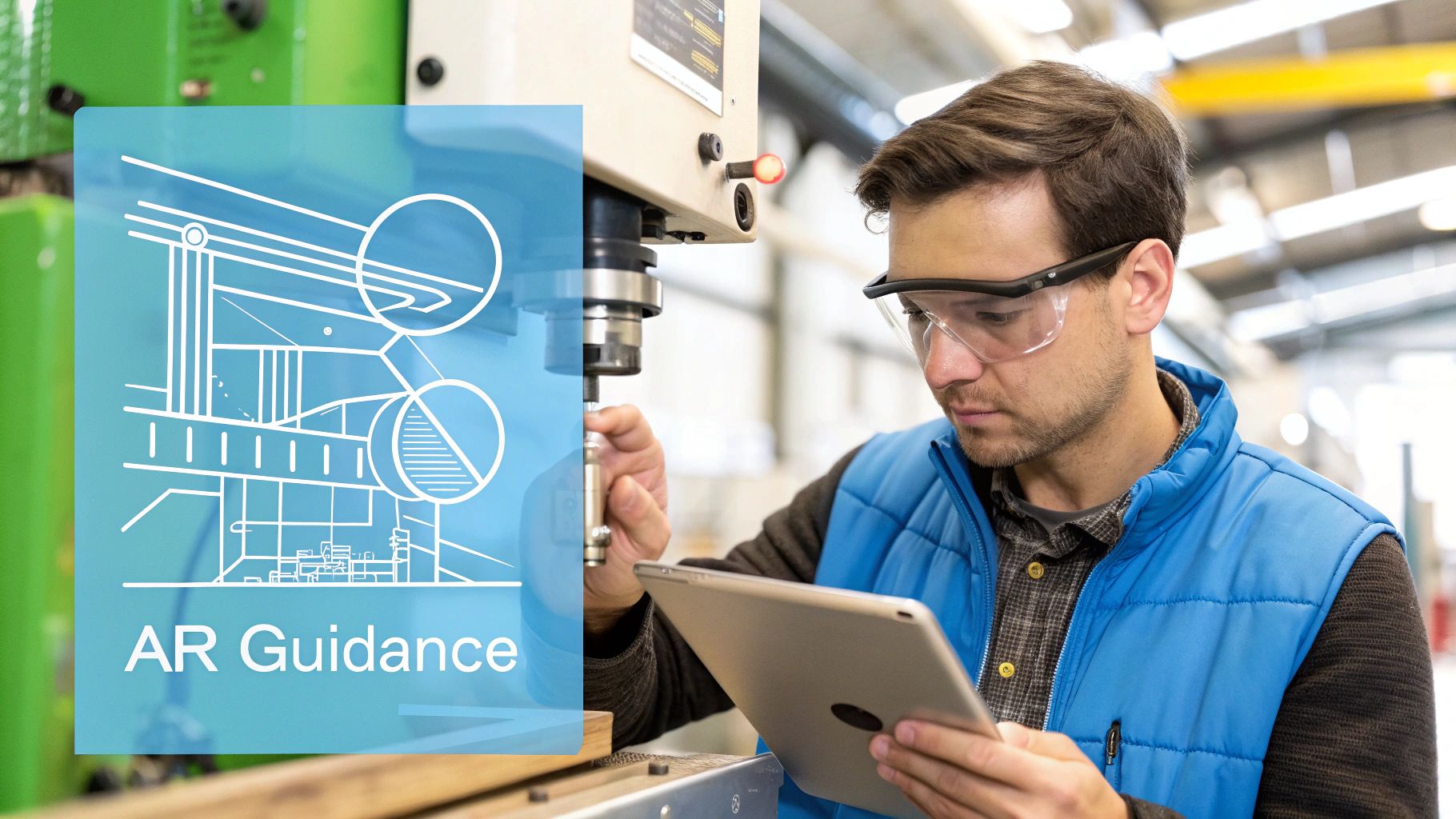
This direct link between the digital world and our physical reality is what makes the AR and Industry 4.0 partnership so powerful. It slashes the mental effort needed to do a job and drastically cuts down the risk of human error by showing people what to do in the most natural way possible.
Turning Data into Action
Industry 4.0 factories are swimming in data from IoT sensors, production lines, and business systems. A typical factory can generate over a terabyte of production data every single day, yet a staggering less than 1% of it is ever analyzed or used effectively. AR flips that script by making data immediately useful.
Instead of a technician having to stop what they're doing to consult a paper manual or try to make sense of numbers on a separate screen, AR puts that information directly in their line of sight. Decisions happen faster and more accurately, right where the work is being done.
For instance, an AR overlay can instantly highlight the specific part that’s about to fail, show its entire operational history, and walk the maintenance worker through the exact replacement procedure. This is a massive leap from the old days of relying on memory or digging through clunky PDF manuals.
Empowering Your People
The whole point of Industry 4.0 isn’t to replace people; it’s to supercharge their abilities. This human-centric approach is becoming the central focus as manufacturing continues to evolve, and AR is the perfect tool for the job. It’s all about making your workers more capable, confident, and effective.
Here’s how this technology boosts human potential:
- Faster Skill Development: New hires can tackle complex tasks with digital guidance from day one, cutting down the long shadow-training period.
- Better Safety: Critical warnings and safety procedures can be displayed right onto hazardous equipment, keeping workers constantly aware of risks.
- Higher First-Time Fix Rates: With instant access to expert knowledge and visual guides, technicians are far more likely to solve a problem correctly on the first try.
AR democratizes expertise. It puts the collective knowledge of your very best engineers into the hands of every single frontline worker, creating a more resilient, skilled, and adaptable workforce.
This isn’t just a passing trend. It's a fundamental shift in how we think about industrial work.
Building a More Resilient Operation
Beyond empowering individual workers, AR helps build a more flexible and resilient manufacturing operation. When a machine breaks down or a rush production order comes in, AR allows your teams to adapt on the fly.
A technician on the floor can get live support from an expert halfway across the world, who can see exactly what the technician sees and draw instructions right onto their screen. This kind of collaboration slashes travel costs and equipment downtime. You can learn more about how augmented reality revolutionizes training and support in our detailed guide.
By seamlessly connecting people to the digital heartbeat of the factory, AR ensures that your most valuable asset—your people—are fully plugged into your Industry 4.0 strategy. It closes that final gap between data and action, unlocking completely new levels of productivity and performance.
Putting AR to Work: Practical Use Cases
When we talk about AR in Industry 4.0, we’re not just talking about technology demonstrations. We're talking about practical, boots-on-the-ground tools that are solving real-world problems on the factory floor right now. This is where theory meets reality.
By laying digital instructions over the physical world, AR gives frontline workers exactly the information they need, right when they need it. Let’s break down the most powerful ways AR is changing manufacturing and industrial services.
Immersive Training and Upskilling
Traditional training methods—such as manuals and classroom lectures—are often slow, disconnected from the actual job, and result in low knowledge retention. This can even create safety risks when a new employee finally touches real machinery. AR and VR solutions transform this model.
Imagine a new hire putting on an AR/VR headset. They see 3D models and step-by-step instructions floating right on top of the actual equipment. They can practice a complex assembly or a tricky maintenance task in a safe, controlled way, without any risk of damaging a high-value machine or injuring themselves.
This hands-on, "learn-by-doing" approach is incredibly effective. Studies have found that training with AR and VR can boost employee performance by up to 34% compared to traditional methods. It builds real confidence and skill from day one.
This isn't just about getting new hires up to speed faster. It’s a powerful way to continuously upskill your entire team as new equipment and processes roll out.
Remote Expert Assistance
This is one of the most immediate and impactful uses of AR, and it’s a total game-changer for maintenance and repair. Before AR, if a critical machine went down, you had two difficult options: fly a specialist in (costing a fortune in time and money) or try to talk a local tech through the fix over the phone (a frustrating and often ineffective process).
AR resolves this dilemma. Now, a technician on-site can wear AR glasses and stream their point-of-view directly to an expert who could be thousands of miles away. The expert sees exactly what the on-site tech sees. They can draw, circle, and drop arrows right into the technician's field of vision to point out the exact part to check.
This "see-what-I-see" capability delivers serious benefits:
- Slash Downtime: Problems get solved in hours, not days. Critical machinery is back online in a fraction of the time.
- Reduce Costs: The savings on travel and accommodation expenses are often massive.
- Capture Expert Knowledge: As senior experts guide junior technicians through live repairs, they are actively transferring decades of experience. It’s a live-action knowledge transfer session.
For many companies, the quick ROI from this single use case makes it the perfect entry point into the world of AR industry 4.0.
Guided Assembly and Maintenance
In manufacturing, precision is everything. A single mistake in assembly can lead to a faulty product. A missed step in a maintenance checklist can lead to catastrophic failure. AR acts as a digital guide, ensuring tasks get done right, every single time.
Workers follow holographic instructions projected directly onto their workspace. The system can confirm they've picked up the right part or even verify that a bolt is tightened to the correct specification. It takes the guesswork out of the equation and reduces the mental strain of trying to remember complex procedures.
Think about aerospace manufacturing, where there is zero room for error. Technicians use AR to see the exact placement for thousands of individual wires and rivets. This has been shown to cut assembly time by 25% while bringing the error rate down to virtually zero. If you're curious about how this tech is applied elsewhere, there's a huge range of VR, AR, and MR applications across various industries worth exploring.
Enhanced Quality Assurance
The traditional quality assurance (QA) process often relies on manual inspection. But over a long shift, even the best inspector can make mistakes, leading to inconsistent quality checks.
AR gives QA teams enhanced capabilities. An inspector can look at a finished part through an AR device and see a digital blueprint of the perfect product overlaid on top of it. Any misalignments, missing screws, or incorrect parts are instantly highlighted. It makes spotting defects incredibly fast and reliable.
Take an automotive assembly line, for example. A QA inspector can use an AR tablet to quickly scan a car's interior, verifying that every component is installed and aligned perfectly against the original CAD model. If an issue is found, the system can automatically log it with a photo and notes, creating a perfect digital trail for reporting and process improvement.
To see more ways to level up your operations, check out our deep dive on augmented reality industrial applications. These examples make it clear: AR isn’t some far-off concept. It's a proven tool delivering real results today.
Building Your AR Technical Foundation
To get AR working on the factory floor, you need more than just a headset. You need a solid technical backbone. Think of your factory's entire digital ecosystem as a central nervous system—it's what allows AR to connect your people to the right data at the right moment, turning raw information into action.
IoT sensors act like the nerve endings, constantly pulling in real-time data from machinery and the shop floor. Enterprise systems, like your Manufacturing Execution System (MES) or Product Lifecycle Management (PLM) platform, function as the brain, crunching and organizing this flood of information. AR then serves as the visual cortex, translating all that complex data into clear, intuitive instructions for your workforce.
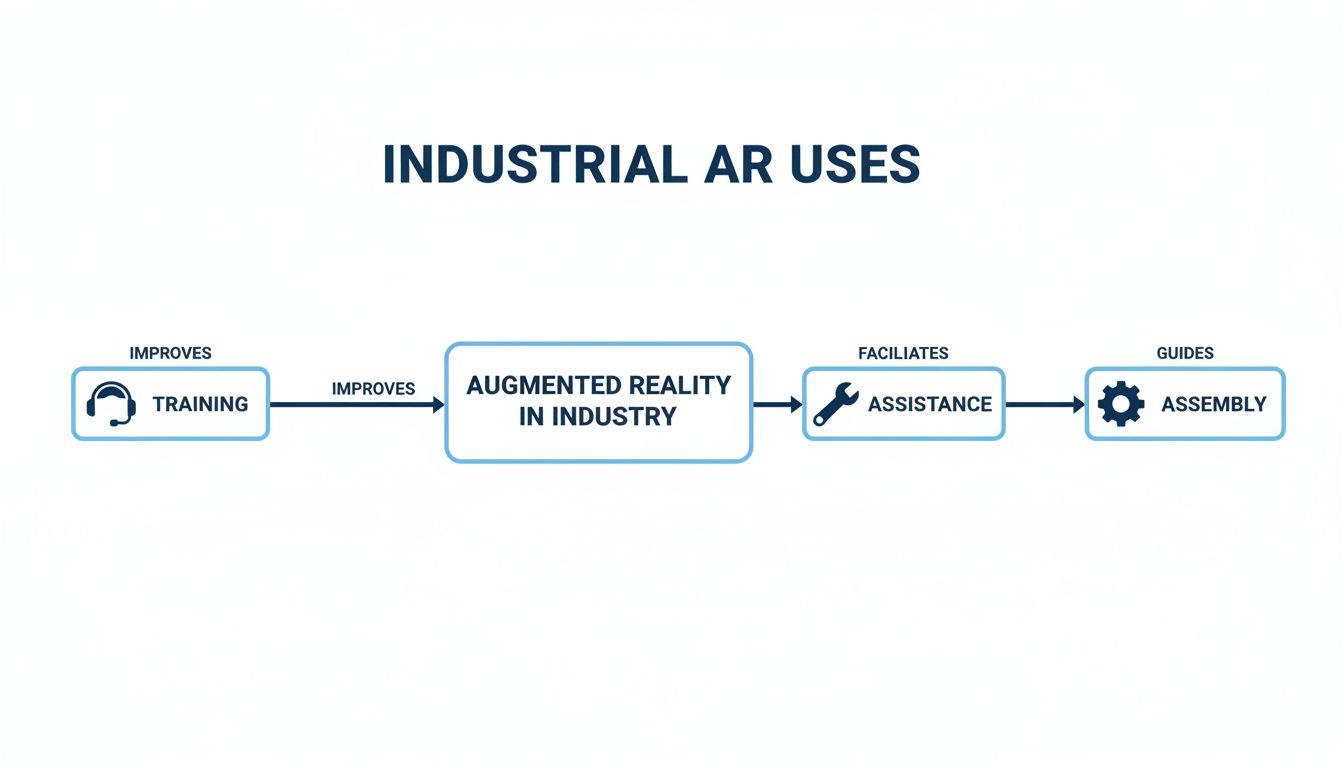
This simple breakdown shows how AR isn't just one thing; it's a multi-purpose tool that supports your team at every stage of the production cycle, from training new hires to guiding complex assemblies.
Integrating AR with Your Existing Systems
A smart AR Industry 4.0 strategy doesn't mean ripping out your current technology. It’s all about integration. The real magic happens when your AR solution can seamlessly communicate with the platforms you already rely on every day.
For AR to be truly useful, it needs to pull relevant information from your core systems and present it visually. For instance, when a technician points a device at a machine, the AR application needs to communicate with your MES to fetch its maintenance history or with your PLM to overlay the correct 3D CAD model for a repair.
Key integration points usually include:
- IoT Platforms: Streaming live sensor data like temperature, pressure, or vibration directly into the AR overlay.
- Manufacturing Execution Systems (MES): Accessing real-time production schedules, work orders, and quality control checklists.
- Product Lifecycle Management (PLM): Pulling accurate 3D models, bills of materials (BOMs), and official engineering specs.
- Enterprise Resource Planning (ERP): Connecting with inventory levels, supply chain data, and asset management records.
This web of connections is what ensures the digital instructions your team sees are always accurate and up-to-the-minute. If you want a deeper dive into how this all comes together, check out our guide on the augmented reality workflow.
Choosing Your Deployment Model: Cloud vs. On-Premise
One of the biggest technical decisions you'll face is where your AR platform and its data will live. You basically have two choices: a cloud-based setup or an on-premise one, and each has its pros and cons.
A cloud deployment means your AR software and data are hosted on remote servers managed by a third party. This model is incredibly scalable—you can easily add more users or handle more data without buying new hardware. It also tends to have lower upfront costs and gets you up and running faster.
On the other hand, an on-premise deployment means you host everything on your own local servers, tucked safely behind your own firewall. This gives you absolute control over your data and security, which is non-negotiable for companies in highly regulated industries like defense or aerospace.
There's no single right answer here. The best choice depends entirely on your company's specific needs for security, speed, and scale.
To help you weigh your options, here’s a quick breakdown:
| Factor | Cloud Deployment | On-Premise Deployment |
|---|---|---|
| Security | Managed by the provider; requires trusting their protocols. | Complete control over all security measures and data access. |
| Scalability | Highly scalable and flexible; you only pay for what you use. | Requires a significant upfront hardware investment to scale up. |
| Latency | Can be higher since data travels over the internet. | Extremely low latency, as data is all processed locally. |
| Maintenance | Handled by the provider, freeing up your IT team. | Your internal IT team is responsible for all server upkeep. |
Ultimately, laying the right technical groundwork is about building a connected, secure, and responsive ecosystem. When you thoughtfully plan your integrations and pick the deployment model that fits your operational reality, you're setting the stage for a successful and scalable AR rollout.
Your Roadmap To AR Adoption And Integration
Successfully weaving Augmented Reality into your industrial operations isn't a "big bang" event. It’s a journey, one best taken in smart, manageable steps. A solid strategy for bringing AR into Industry 4.0 starts small, proves its value, and then scales methodically across the organization. This phased approach keeps risk low and builds unstoppable momentum.
It all starts with a single, clear goal. Forget trying to boil the ocean; the real win comes from finding that one perfect starting point where AR can make a massive, immediate impact.
Phase 1: Identify A High-Impact Pilot Project
Your first move is to hunt down a specific, measurable problem that AR is perfectly suited to solve. Look for the real pain points in your operations—the things that are costly, soak up too much time, or are frustratingly prone to errors. A complex maintenance task that always seems to require a senior expert's intervention? That’s a fantastic candidate.
Think about a critical piece of machinery that brings everything to a halt when it goes down. If you create an AR-guided repair procedure for just that one asset, you can directly track improvements in first-time fix rates and how quickly you get it back online. Suddenly, you have a powerful, data-backed success story to justify putting more chips on the table.
Phase 2: Select The Right Partners And Tools
With a pilot project locked in, it's time to pick your tech. This means looking at both the hardware (like AR glasses or ruggedized tablets) and the software platform that will bring it all to life. When it comes to hardware, think practical: ergonomics and durability for the factory floor are non-negotiable.
Choosing a software partner is even more critical. Your focus should be on how well their platform can talk to your existing systems. A solution that can tap into your MES, PLM, and IoT data is going to deliver exponentially more value than a walled-off, standalone tool. You're not just buying software; you're looking for a partner who gets industrial workflows and can help you build a truly connected digital ecosystem.
The most successful AR implementations are built on a foundation of strong partnerships. Choose a provider that offers not just technology, but also strategic guidance and deep integration expertise to ensure your solution aligns with your business objectives.
Getting this part right sets the stage for everything that follows.
Phase 3: Develop And Deploy AR Workflows
Now for the fun part: building the actual AR experiences your team will use. This is where you translate paper manuals, the tacit knowledge from your most seasoned experts, and dense engineering data into interactive, step-by-step digital instructions. The goal is to create guidance so clear and intuitive that it actually reduces the mental strain on your technicians.
Once the workflows are built, you need to plug them into your live data streams. This is what makes the experience truly powerful. Imagine displaying real-time sensor readings from an IoT platform or pulling up the latest 3D CAD model directly from your PLM system, right in the technician's field of view. This connection is what transforms a static guide into a dynamic, context-aware tool.
Phase 4: Train Users And Scale For Impact
Great tech is useless if your people don't want to use it. The final phase is all about comprehensive user training. You need to get your technicians hands-on with the devices and software, building their confidence and making them comfortable with the new way of working.
After a successful pilot, you can start mapping out your expansion. Use the metrics and lessons from that first project to identify other high-value use cases. From there, you can roll out AR to other departments or facilities in a systematic way. This isn't just about adding more headsets; it's about making sure you maximize the return on your AR and Industry 4.0 investment and create operational improvements that stick.
Proving the Real-World Impact of Industrial AR
Rolling out new tech is one thing, but proving it was worth the investment is another game entirely. When it comes to AR in Industry 4.0, the real conversation isn't about fancy gadgets; it's about the cold, hard numbers that prove its value on the factory floor.
To get the green light, you need to build a business case on tangible results. This means tracking specific Key Performance Indicators (KPIs) that draw a direct line from AR adoption to real-world improvements in efficiency and cost savings. By benchmarking these metrics before and after you implement the technology, you can tell a powerful, data-driven story that calculates a clear Return on Investment (ROI).
The Metrics That Matter: Key Performance Indicators for AR
You can't improve what you don't measure. The table below breaks down the most critical KPIs that industrial AR solutions are proven to move the needle on. These aren't abstract concepts—they directly impact your bottom line by cutting costs and boosting productivity.
| KPI | Description | Typical Improvement with AR |
|---|---|---|
| First-Time Fix Rate (FTFR) | The percentage of repairs completed successfully on the first attempt without needing a follow-up visit. | Increases of 20-40% as technicians have instant access to expert guidance and correct procedures. |
| Mean Time to Repair (MTTR) | The average time it takes to diagnose and repair a faulty piece of equipment, from failure to restoration. | Reductions of 30-50% by eliminating time spent searching for manuals or waiting for expert support. |
| Technician Training Time | The time required for a new employee to become proficient in performing complex tasks independently. | Can be reduced by up to 75% by providing immersive, on-the-job training and guidance. |
| Human Error Rate | The frequency of mistakes made during assembly, maintenance, or quality inspection procedures. | Decreases significantly, often by over 90%, by providing clear, visual, step-by-step instructions. |
Ultimately, tracking these KPIs is how you connect the dots between the technology and its financial impact, making it easy to see exactly where the value lies.
Calculating Your Return on Investment
Figuring out the ROI for an AR Industry 4.0 project becomes surprisingly simple when you anchor it to these metrics. Think about it: a higher FTFR means fewer expensive truck rolls for your field service team. A lower MTTR translates directly into more production uptime and less revenue lost to broken machinery.
By halving service times and cutting expert travel by 75%, AR solutions can deliver a positive ROI in a matter of months, not years. The value is found in optimizing your most valuable resources: your people's time and your machinery's availability.
When you add up these direct cost savings and combine them with the productivity gains from faster training and fewer mistakes, you've got a rock-solid business case. AR stops being just another piece of tech and becomes a strategic investment in operational excellence.
Got Questions About AR in Industry 4.0? Let's Clear Things Up.
Stepping into new technology always brings up a few questions, and the world of AR in Industry 4.0 is no different. We get it. Business leaders often ask us about the practical side of things—from making it work with existing systems to getting the team up to speed. Let's tackle some of the most common concerns head-on.
A big one we hear all the time is about the alphabet soup of realities: AR, VR, and MR. In a factory setting, the difference is actually pretty simple. Virtual Reality (VR) drops you into a completely digital world, which is fantastic for training new hires safely away from the production floor. Augmented Reality (AR), on the other hand, keeps you in the real world but overlays digital instructions, diagrams, and data right where you need them. It's the perfect tool for on-the-job guidance.
Navigating Integration And Security
Another major question revolves around integration. "Is this going to be a nightmare to connect with our MES and PLM systems?" It’s a valid concern. While it can be a challenge, the right technology partner makes all the difference by providing solid, pre-built connectors and a clear roadmap from the start.
This approach cuts down on disruption and makes sure your new AR tools have the live data they need to be useful from day one.
Security is always top of mind, especially when you're dealing with sensitive manufacturing data. Modern industrial AR platforms are built with enterprise-grade security from the ground up. They offer both cloud and on-premise deployment, giving you total control over your data and intellectual property.
Finally, what about the learning curve for your technicians on the floor? The best AR solutions are designed to feel natural, not like another complex piece of software to master. With intuitive interfaces, most workers get comfortable with the tools after just one short, hands-on training session. The goal is to make the tech feel like a natural extension of their own skills.
Ready to see how AR can solve your biggest operational challenges? AIDAR Solutions provides the expert guidance and powerful tools to integrate AR into your workflow and deliver measurable results, fast. Explore our solutions and see what's possible.