Measuring the Real-World Augmented Reality Impact on Business
The real story of augmented reality in business isn't about science fiction possibilities—it's about solving real-world problems. For any modern enterprise, AR is a tool that directly impacts the bottom line by reducing expert travel costs, accelerating new hire training, and drastically cutting expensive equipment downtime. The initial hype has given way to measurable results.
Moving Beyond Buzzwords to Measure AR's True Impact
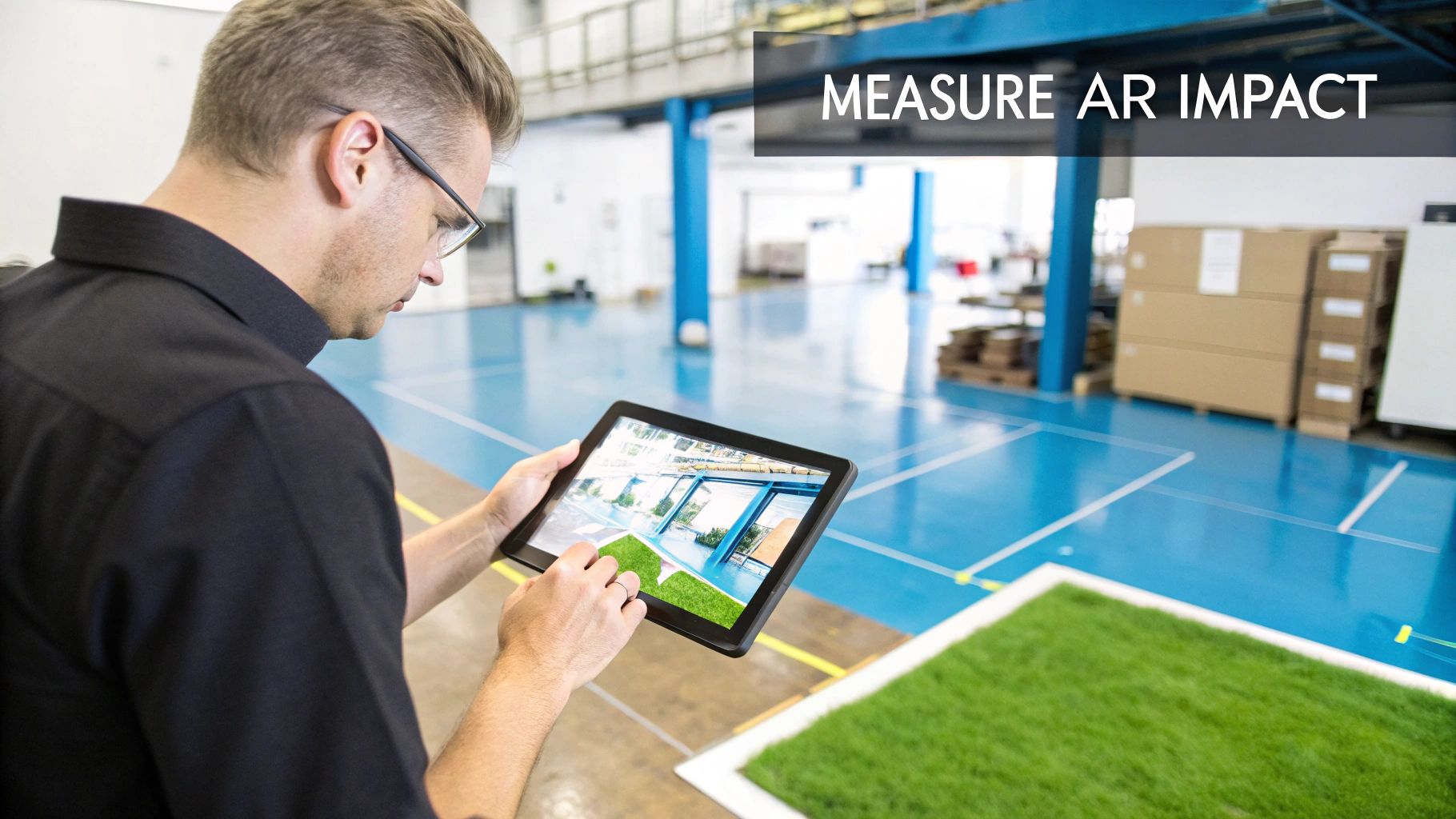
Augmented Reality has officially transitioned from a promising concept to an essential technology for modern industry. The conversation has shifted from if AR will be useful to how it is already creating measurable value today. This is a critical distinction for leaders in manufacturing, field service, and corporate training.
The real impact of AR is not an abstract idea. It's about moving the needle on your most important Key Performance Indicators (KPIs). Instead of flying a specialist across the country, a local technician can receive real-time, over-the-shoulder guidance from that same expert. That’s an immediate solution to an urgent operational challenge.
Defining Tangible Business Outcomes
To truly understand augmented reality's impact, you must focus on specific, measurable improvements. The business case for AR is built on its direct influence on operational efficiency and, ultimately, financial performance.
It all comes down to a few core areas where AR is delivering clear wins:
- Reduced Equipment Downtime: Faster diagnostics and guided repairs via remote assistance mean machinery gets back online quicker. Every minute of uptime saved is revenue protected.
- Accelerated Employee Training: Immersive, hands-on AR training modules allow new hires to practice in a safe, controlled environment. They become competent and productive in a fraction of the time.
- Lowered Operational Costs: The savings are immediate and significant when you reduce expert travel for service calls and training sessions. Associated expenses like flights and hotels can be eliminated.
This practical, problem-solving ability is fueling the technology's incredible growth. The global augmented reality market is on track to hit USD 169.97 billion by 2026, with head-mounted displays leading the charge. That's a significant vote of confidence from enterprises investing in immersive tools for remote support and training.
By focusing on the biggest pain points—like skills gaps and service delays—AR offers a clear path to a strong return on investment. The technology's success is tied directly to the concrete problems it solves.
The table below breaks down exactly how AR addresses common industrial challenges and what it means for your business.
Key Areas of Augmented Reality Business Impact
| Operational Area | Primary Challenge | AR-Driven Solution | Key Business Outcome |
|---|---|---|---|
| Field Service | High travel costs and long wait times for expert support, leading to extended equipment downtime. | Remote assistance with live video and AR overlays, enabling local technicians to perform complex tasks. | Up to 75% reduction in travel costs; faster first-time fix rates. |
| Manufacturing | Complex assembly processes that are prone to human error and require extensive paper-based instructions. | Step-by-step digital work instructions projected directly onto the equipment or workspace. | Up to 90% reduction in assembly errors; 30-50% increase in worker productivity. |
| Employee Training | Slow onboarding and knowledge transfer from retiring experts; training lacks real-world context. | Immersive, hands-on training simulations that replicate real equipment and scenarios safely. | Up to 80% improvement in knowledge retention; faster time-to-competency for new hires. |
Ultimately, AR is a powerful tool for building a more resilient and efficient operational framework. It's a key part of smart Digital Transformation Solutions that help businesses move beyond legacy systems and build for the future.
How AR Drives Excellence in Manufacturing and Field Service
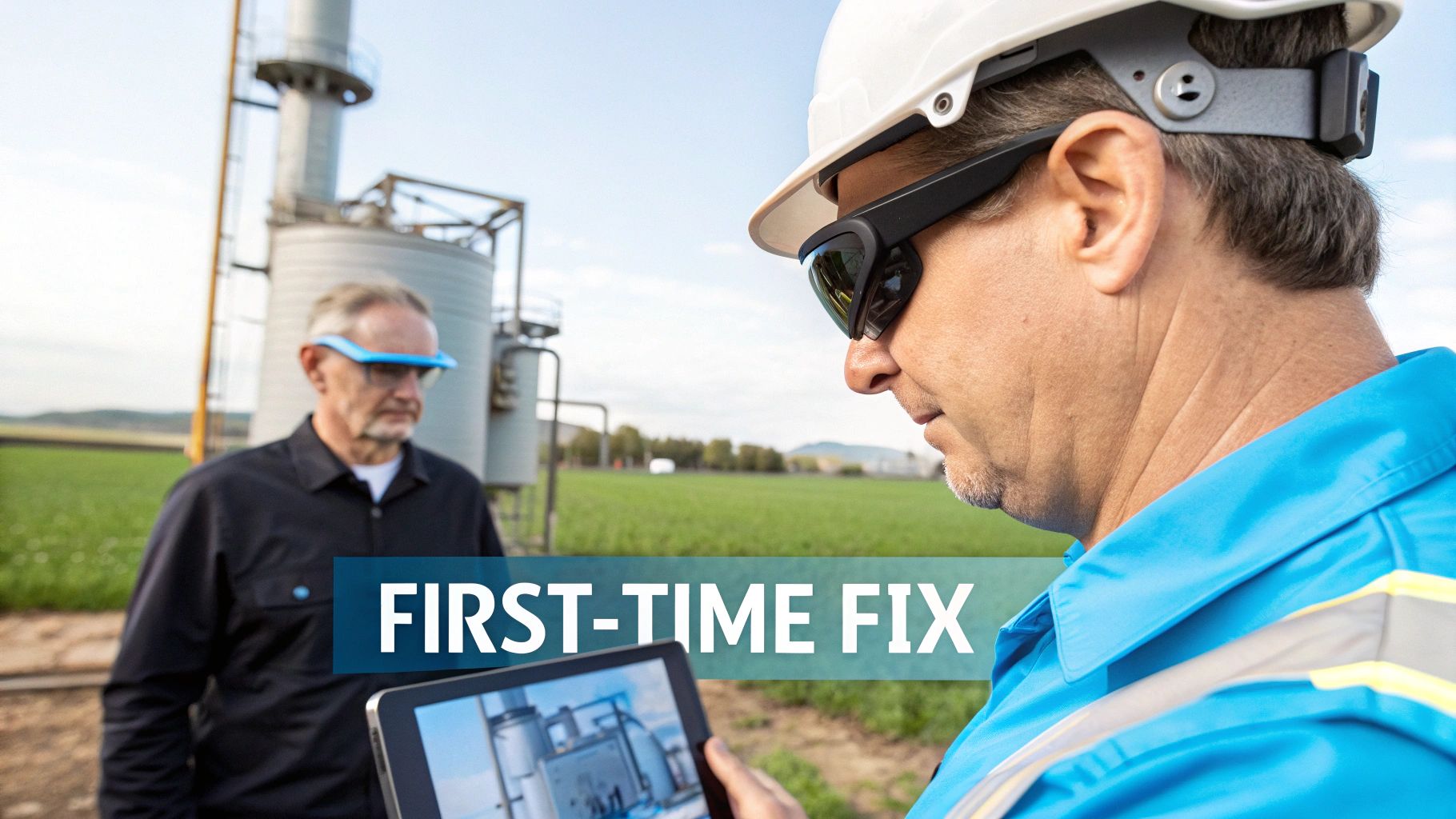
In high-stakes industrial environments, the smallest error or delay can create costly disruptions throughout the entire operation. This is where augmented reality becomes a strategic problem-solver, directly addressing long-standing challenges in both manufacturing and field service.
AR becomes a practical tool for excellence by overlaying a digital layer of expertise directly onto the physical world. It gives workers the ability to tackle complex jobs with more confidence and speed, much like having a seasoned expert looking over their shoulder at every step.
Transforming the Factory Floor with Digital Overlays
On any busy factory floor, precision is non-negotiable. However, complex assembly, quality checks, and machine changeovers often still rely on paper manuals or the institutional knowledge of a few senior employees. This traditional method is slow, prone to error, and difficult to scale effectively.
Augmented reality transforms this model by projecting digital work instructions directly onto the equipment. An assembly technician can look at a complex part and see animated guides, text prompts, and required torque values floating exactly where they need to be.
This visual, in-context guidance delivers significant advantages:
- Error Reduction: By showing people exactly where to place a part or which bolt to tighten, AR removes the guesswork. Studies show it can lead to a 90% drop in errors during initial use.
- Increased Productivity: Workers no longer have to stop to consult a manual or tablet. With instructions delivered hands-free, they stay focused on the task, boosting their output by 30-50%.
- Standardized Quality: Every worker, from the seasoned veteran to the new hire, follows the exact same best-practice procedure. This ensures consistent quality across every shift and production line.
AR acts as a dynamic guide, ensuring the right action is taken at the right time, every single time. It democratizes expertise, making your best engineer's knowledge accessible to everyone on the line.
Revolutionizing Field Service with Remote Assistance
The impact of AR extends beyond the factory. For any organization with a field service team, the logistics of getting the right expert to the right site is a constant challenge. Travel costs, scheduling complexities, and low first-time fix rates can drain profits and lead to customer frustration.
AR-powered remote assistance tools build a "see-what-I-see" bridge between a technician in the field and an expert at a central office.
Consider a common scenario: a junior technician is hundreds of miles from base, facing a critical machine failure at a client’s site. The traditional solution meant waiting days for a senior specialist to arrive. Now, they can put on a pair of AR smart glasses and start a remote session. An expert at headquarters sees their exact point of view and can walk them through the entire fix in real time.
That expert can:
- Annotate the live video stream with arrows and notes that "stick" to the real-world equipment.
- Push technical diagrams and schematics directly into the technician’s field of view.
- Verbally guide the technician through even the most complex diagnostic steps.
The result? A problem that once took days is now solved in minutes. This capability not only saves on travel expenses but also slashes customer downtime, protecting their revenue and building loyalty. For any leader looking to make their operations more agile, learning more about augmented reality for manufacturing and service is a crucial next step. It’s a clear example of technology solving immediate, real-world business problems.
Get Your Workforce Up to Speed with Immersive AR Training
Imagine the difference between handing someone a thick manual and providing a personal coach who guides their every move. That's the leap forward AR training provides. For learning and development leaders who are tired of classroom sessions where knowledge is quickly forgotten, this is a completely different way to approach skill-building.
Traditional training is often passive. Employees are brought into a room, presented with information, and are expected to retain it. This model has always struggled with engagement and, more critically, with applying that knowledge back on the job. AR flips this script by creating active, hands-on simulations where people learn by doing.
From Passive Learning to Active Doing
The true power of augmented reality in training is its ability to create a "learn-by-doing" environment without real-world risks. Instead of just reading about a complex machine repair, a new technician can wear a headset and see a digital twin of that exact machine right in front of them.
AR overlays walk them through every step—highlighting the right tool, showing the proper sequence, and giving instant feedback. This isn't just memorization; it's active participation. When you physically perform a task, it builds muscle memory and a deep, contextual understanding that passive learning cannot match.
This hands-on approach delivers powerful results:
- High Knowledge Retention: When learners are actively part of the process, the information sticks. Studies have shown that immersive learning can boost retention rates by up to 80% compared to traditional methods.
- Rapid Onboarding: New hires get up to speed and become productive in a fraction of the time. With guided, self-paced learning, some companies have reduced their onboarding times by as much as 75%.
- Safe Practice Environment: Mistakes are part of learning, but on million-dollar equipment, they can be catastrophic. AR allows employees to practice high-stakes procedures in a completely safe virtual space. An error becomes a learning moment, not a costly accident.
Capture and Scale Your In-House Expertise
One of the biggest challenges for industrial companies today is the pending retirement of veteran experts with decades of hard-won experience. This "tribal knowledge" is often unwritten and at risk of being lost.
AR offers a direct, powerful solution. It allows you to capture the exact processes and techniques of your most skilled employees.
An expert can perform a complex task while an AR system records every step, every movement, and every decision. This captured wisdom is then transformed into a standardized, repeatable digital training module that can be deployed globally.
This changes everything about how you manage and distribute expertise. Instead of relying on a few senior mentors, you can ensure every employee—no matter their location—is trained to the exact same high standard. You're essentially democratizing your best engineer's skills and making them the new baseline for the entire workforce. For a deeper look, you can learn more about how augmented reality for training is helping organizations build more resilient and capable teams.
This scalable model ensures consistency and quality across the board. An employee in your main production hub and one in a remote service outpost receive the exact same expert-led training. The end result is a more competent, confident, and agile team, ready for modern industry's challenges.
Building the Business Case for Augmented Reality
While the hands-on benefits of augmented reality are often intuitive, gaining leadership approval requires speaking their language: financial metrics. The decision to invest always comes down to a clear, data-driven argument that proves a strong Return on Investment (ROI). It's time to move past demonstrations and build a solid financial case grounded in metrics that matter.
The augmented reality impact on your bottom line is not just theoretical—it can be calculated with surprising accuracy. By focusing on key operational improvements, you can translate efficiency gains into tangible savings and project a clear timeline for seeing a positive return.
Quantifying Savings and Productivity Gains
The heart of your business case is pinpointing where AR delivers immediate, significant savings. These are not abstract figures; they are real-world numbers you can pull directly from your own operational data. Think of it as a simple equation where AR directly subtracts costs and multiplies productivity.
Start by looking at your most resource-heavy activities:
- Reduced Expert Travel: Calculate the total annual cost of sending specialists to job sites—flights, hotels, meals, and their valuable time spent in transit. AR remote assistance can eliminate a significant portion of these expenses, often cutting associated costs by up to 75%.
- Minimized Equipment Downtime: Determine how much revenue you lose for every hour a critical machine is offline. AR gets your equipment back up and running faster through guided repairs, directly protecting your bottom line.
- Lower Error Rates: Quantify what mistakes actually cost your business, from wasted materials and rework labor to warranty claims. AR guidance has been shown to reduce first-time errors by as much as 90%, leading to immediate material and labor savings.
Beyond just cutting costs, AR is a major productivity driver. When you can reduce service resolution times, one technician can become more effective. When you accelerate new hire training, you can onboard more people without adding more instructors.
This chart shows just how much AR moves the needle on critical training metrics.
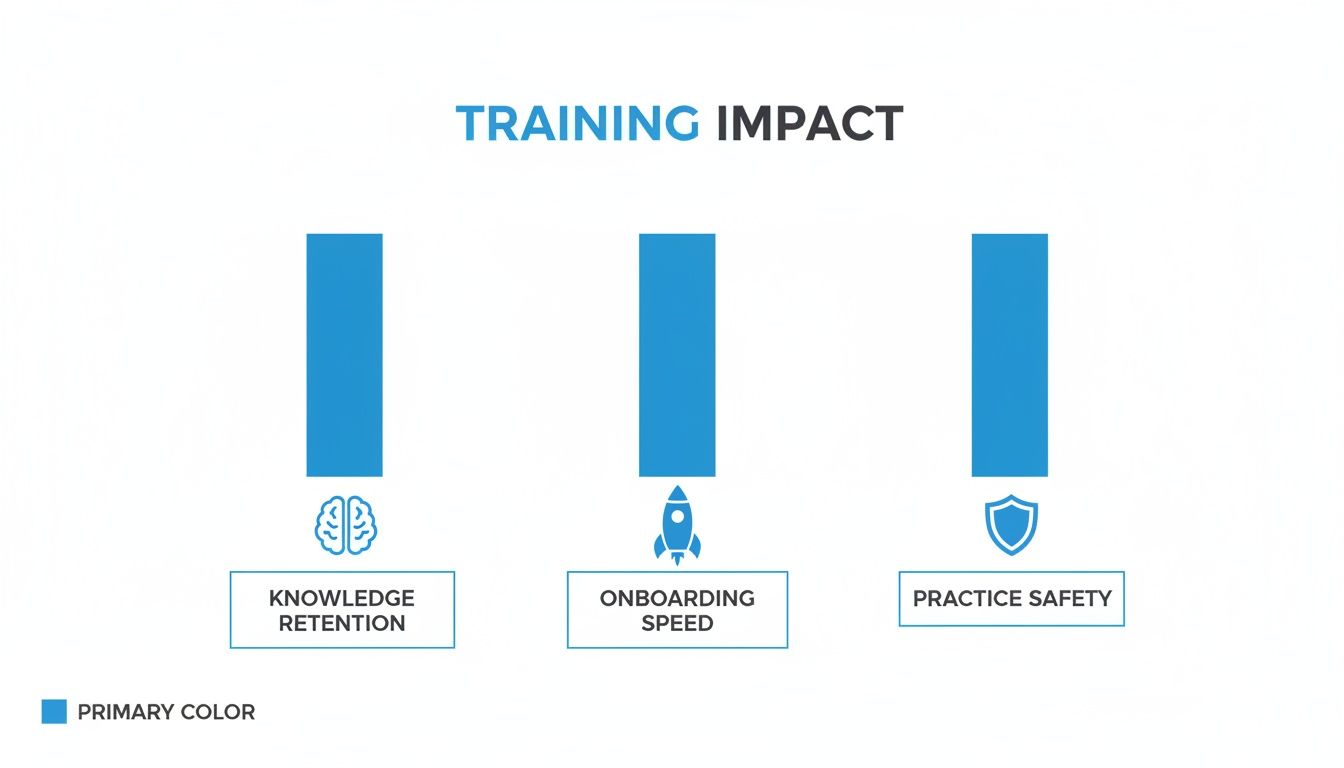
The data is clear: AR creates a safer, faster, and more effective learning environment. That translates directly into a more competent and productive workforce from day one.
Modeling Your Potential ROI
To make a truly convincing pitch, you need to bundle these metrics into a straightforward financial model. The framework below is designed to help you do just that. By plugging in your own numbers, you can start to build a powerful business case for AR adoption.
AR Implementation ROI Calculator Framework
Use this simple table to start calculating your own potential returns. Just swap the example data with figures from your own operations to get a preliminary look at the financial impact.
| Metric | Formula / Calculation | Example Data Input | Projected Annual Savings |
|---|---|---|---|
| Expert Travel | (Avg. Trips/Month) x (Avg. Trip Cost) x 12 | 10 trips x $2,500 | $300,000 |
| Downtime | (Downtime Hours/Year) x (Cost/Hour) | 200 hours x $10,000 | $2,000,000 |
| Error Costs | (# of Errors/Year) x (Avg. Cost/Error) | 500 errors x $500 | $250,000 |
| Training Time | (# New Hires) x (Hours Saved/Hire) x (Wage) | 100 hires x 40 hours x $30 | $120,000 |
Even with conservative estimates, the numbers often speak for themselves, revealing a clear and rapid path to significant returns.
This structured approach gives stakeholders the concrete data they need to make an informed decision. For those who want to dig deeper, our guide on how to calculate return on investment offers a more detailed breakdown. By focusing on these tangible financial wins, you can effectively demonstrate that AR isn't just another expense—it's a high-yield investment in your company's future.
Your Roadmap for a Winning Enterprise AR Rollout

Implementing augmented reality is a strategic journey, not a one-time purchase. To achieve the significant augmented reality impact you're looking for, a smart, phased approach is required. This means moving from a small-scale test to a full enterprise solution.
A successful rollout is about careful planning, making the right decisions at the right time, and, most importantly, bringing your team along for the journey. This roadmap breaks the process down into manageable stages, so you can build momentum without causing disruption. The goal is to prove AR's value at every step before scaling the implementation.
Stage 1: Nail the High-Impact Pilot Project
First, do not attempt to overhaul your entire operation overnight. The best place to start is by identifying a single, persistent pain point where AR can deliver a quick, obvious win. This pilot project is your proof of concept. It’s how you demonstrate real-world value to stakeholders and get your first users excited.
When selecting a pilot project, look for a problem that is:
- Clearly Defined: Focus on a challenge with clear boundaries, such as reducing errors on one specific assembly line or speeding up a routine maintenance task.
- Highly Visible: Pick a project where the improvements will be impossible to ignore. You want both management and front-line workers to see and feel the difference.
- Measurable: Ensure you can track the "before and after" KPIs. You need hard data to prove that AR is making a tangible improvement.
A great example is using remote assistance to support technicians working on one specific machine that is notorious for frequent, expensive downtime. When you solve that one problem, you will have the confidence—and credibility—to think bigger.
A well-executed pilot is your secret weapon for building a business case. It turns AR from an interesting idea into a proven solution for a real problem, making it much easier to get approval for expansion.
Stage 2: Pick the Right Tools for the Job
With a solid pilot in mind, it’s time to choose your technology. This is where you make key decisions on both the hardware your team will use and the software that will power the experience. Remember, there is no one-size-fits-all answer; the solution must fit the job.
Hardware Considerations:
The primary decision usually comes down to smart glasses versus mobile devices.
- Smart Glasses: These are ideal for any task where your people need their hands free, like intricate assembly work or hands-on repairs. They deliver an immersive, in-your-eyeline experience.
- Tablets and Smartphones: A great choice when a larger screen for viewing detailed schematics is beneficial, or when being hands-free isn’t an absolute must. They are also a more budget-friendly way to get started.
Software Integration:
Your AR software cannot operate in a silo. It must integrate with your existing systems. This means connecting to your ERP for work orders, your LMS for training records, and any other platform core to your operations. This is non-negotiable for creating a smooth, connected workflow and avoiding data silos.
For a deeper dive on this, check out our guide to building a connected augmented reality workflow.
Stage 3: Focus on People and Process
You can have the best technology in the world, but it’s only half the equation. The single biggest factor in your AR implementation's success is your people. If your team doesn't buy in, the initiative will fail.
This is where change management becomes critical. Start by getting your end-users involved from the very beginning. Let them test the hardware, give feedback on the pilot, and help shape the new workflows. This gives them a sense of ownership and can turn potential skeptics into your biggest advocates.
A comprehensive training program is also essential. You need to ensure every user feels confident and ready to use the new tools from day one.
Future-Proofing Your Operations with AR
Thinking about augmented reality as just another tool to solve today's problems is missing the bigger picture. Bringing AR into your operations is not a quick fix; it's a foundational investment in a more agile, resilient workforce. The real, long-term impact of AR is building a culture of continuous improvement, where knowledge is shared effortlessly and excellence becomes the standard. It’s about preparing your team for what's next.
This becomes clear when we talk about the skills gap. You have veteran employees with decades of hard-won experience who are nearing retirement. AR gives you a powerful way to capture their expertise before it walks out the door. Their specific techniques and troubleshooting knowledge can be recorded and turned into interactive, step-by-step guides for the next generation.
Building a Foundation for Continuous Growth
What you end up with is a living library of best practices, ready to be scaled across the entire organization. New hires no longer have to wait for a senior mentor to have a free moment. They get on-demand access to the collected wisdom of your most skilled people, right when they need it.
By digitizing the skills of your top performers, AR creates a training ecosystem that’s both scalable and evergreen. It effectively democratizes expertise, making your best engineer’s knowledge the new baseline for everyone.
This isn’t just a nice-to-have; it's essential for staying competitive. The industrial world is constantly changing, with new technology and new processes emerging all the time. This is especially true in major manufacturing hubs, which are adopting advanced digital tools faster than ever.
Staying Ahead in a Global Market
Take the Asia Pacific region, for example. It's become the fastest-growing market for augmented reality, with a projected 25.94% CAGR through 2031. That's a significant signal for industrial companies, as these markets are home to the world's largest concentration of manufacturing and have massive workforce training needs. For a company like AIDAR Solutions, this trend points to major opportunities for remote support and immersive training. You can dig deeper into these market shifts in this detailed industry report.
Ultimately, AR isn't just about small efficiency gains. It's about long-term survival and growth. When you embed this technology into your operational DNA, you’re creating a team that’s better trained, more adaptable, and ready to take on whatever challenges come next. You’re securing your company's future.
Got Questions About Enterprise AR? We've Got Answers.
As you get serious about bringing augmented reality into your operations, theoretical conversations quickly turn into practical questions. Moving from "what if" to "how to" means getting clear on everything from financial returns to team adoption.
Let's tackle some of the most common questions we hear from leaders in manufacturing, field service, and corporate training.
What's a Realistic Timeframe to See ROI?
This is a critical question, and the answer is often faster than you might think. Many companies start seeing a measurable return on their investment within 6 to 12 months. The speed really depends on the specific problem you're solving with AR.
- Remote Assistance: The payback here is almost immediate. The first time you use AR to guide a local technician instead of flying an expert across the country, you've started generating ROI. Every minute of downtime you prevent adds to those savings from day one.
- AR-Powered Training: With training, the returns build over a few quarters. You’ll see it in how quickly new hires become proficient and in a reduction in costly rookie mistakes. A pilot program for a high-turnover position can prove the financial case quickly by cutting training hours and material waste.
How Does AR Fit in with Our Existing Systems?
Modern enterprise AR platforms are built to integrate with your current IT setup, not force you to replace everything. Think of AR as a powerful new interface for the digital tools you already rely on.
They connect to your current infrastructure using APIs (Application Programming Interfaces), creating a seamless flow of information.
The goal is to make the technology feel like a natural extension of your workflow. It should pull work order details from your ERP, log training completions in your LMS, or grab a machine's service history from your CRM without manual intervention. It’s an enhancement, not a disruption.
Do My Employees Need to Be Tech Experts to Use This?
Absolutely not. It's a common misconception that you need a highly technical workforce to adopt AR. In reality, these tools are designed for everyone, from the 20-year veteran on the factory floor to the newly hired field technician.
The user interfaces are intentionally simple. This means straightforward voice commands, simple head movements to navigate menus, or scanning a QR code to pull up the right work instructions. This design keeps workers hands-free and focused on the real-world task in front of them.
The goal is for the technology to feel like a helpful guide, not a complex computer. Proper onboarding and training ensure every employee is comfortable and effective with the tools from day one, so you see the benefits across your entire team.
Ready to see how AR can solve your most pressing operational challenges? The team at AIDAR Solutions specializes in creating and integrating AR and VR applications that deliver measurable results, from faster training to more efficient field service. Discover our solutions and start building your business case today.