
A Practical Guide to Change Management in Digital Transformation
Change management, in the context of digital transformation, is the strategic process of guiding people, teams, and the entire organization from its current state to a desired future state driven by new technology. It’s a human-centric approach that ensures new digital tools aren't just installed—they're adopted, used, and embraced by the employees who determine their success.
Why Digital Transformation Depends on People, Not Just Tech
Organizations often invest significant capital into advanced technologies like augmented and virtual reality, expecting an immediate boost in productivity. Yet, many of these initiatives fail to deliver on their promise. The reason is straightforward: technology is only half the equation.
Consider this analogy: a world-class, high-performance engine for a race car is a masterpiece of engineering. But without a skilled driver, a coordinated pit crew, and a clear race strategy, that engine will not win any races. The same principle applies to change management in digital transformation. The most sophisticated software and immersive tools are ineffective if the people intended to use them are unwilling, unprepared, or unable to adapt.
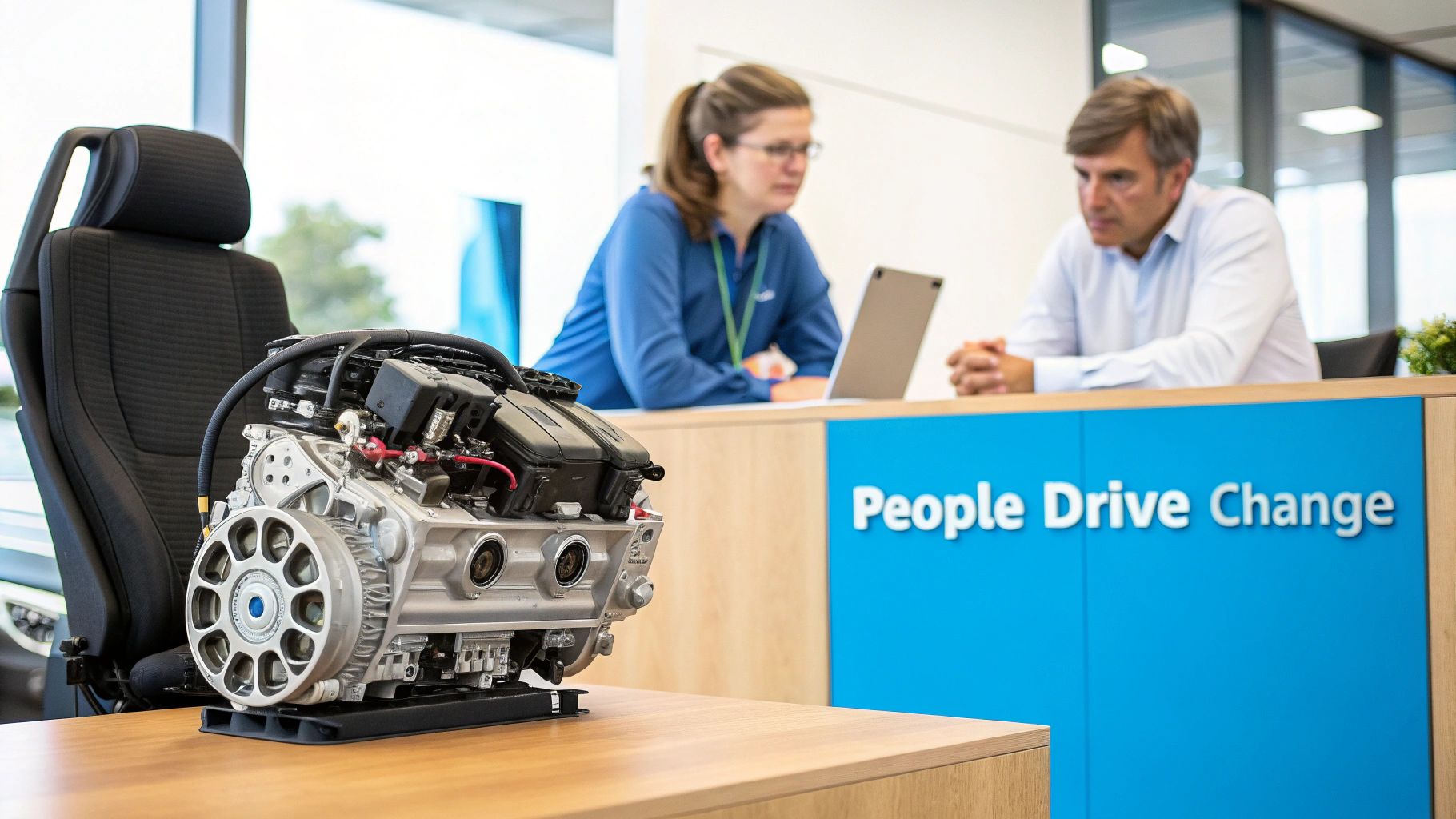
The Human Element as the Deciding Factor
The true return on digital investment—whether using AR for remote service or VR for accelerated training—materializes only when the workforce is fully aligned with the change. Deploying a new system without addressing the human side is a common cause of failure.
This disconnect is a major reason why an estimated 70% of change initiatives fail. Conversely, organizations that excel at change management are 47% more likely to meet their objectives. As digital transformation shifts from a competitive advantage to an operational necessity, mastering the human side of change is non-negotiable for survival and growth.
Technology doesn’t drive change; people do. The success of any digital initiative hinges on your ability to bring your people along for the ride, turning potential resistance into active participation and advocacy.
The difference between a successful and a failed digital transformation often comes down to whether a structured change management plan was implemented. The table below illustrates this contrast.
The Impact of Change Management on Digital Transformation Success
| Metric | With Effective Change Management | Without Effective Change Management |
|---|---|---|
| Project ROI | Meets or exceeds expected return on investment. | Significantly underperforms or results in a net loss. |
| Employee Adoption Rate | High and consistent across teams. | Low and sporadic, with many reverting to old methods. |
| Time to Proficiency | Accelerated; employees become skilled and productive faster. | Slow and frustrating, leading to extended productivity dips. |
| Employee Morale | Positive; employees feel supported, valued, and empowered. | Negative; employees feel confused, resistant, and overwhelmed. |
| Sustained Success | Long-term benefits are realized and built upon. | Initial gains fade as the initiative loses momentum and support. |
As shown, overlooking the people aspect doesn't just reduce the chances of success—it actively invites failure.
Connecting Technology to Business Outcomes
Effective change management bridges the gap between a technology's potential and tangible business results. Consider these practical use cases:
- Accelerated Learning with VR: A manufacturing company implements VR training simulations to upskill its technicians on new assembly line procedures. Without a change management strategy, employees might dismiss the technology as a novelty. With a clear plan that communicates the benefits—safer learning, faster skill acquisition, and reduced errors—technicians see it as a powerful tool to improve their performance, leading to high adoption and better on-the-job results.
- Enhanced Field Service with AR: An industrial firm equips its frontline workers with an AR-powered remote support tool. A technology-first rollout could lead to user frustration and low adoption. A people-first approach, however, frames the tool as an on-demand expert resource. This empowers technicians to solve complex problems faster, which directly reduces service times, improves first-time fix rates, and lowers travel costs.
Ultimately, automation is not a competitive advantage on its own; it’s the skilled, adaptable, and engaged workforce that creates true, lasting value. Neglecting the people side of the equation leaves the most critical part of your organization—your employees—on the sidelines. The goal is to prepare them to drive the change, not just react to it.
Understanding the Core Principles of Change Management
At its core, change management is about people. A change manager acts as a guide leading an expedition through unfamiliar territory. Their role is not just to point to a map and provide a destination, but to build trust, communicate the route, equip the team for the journey, and ensure everyone arrives safely and confidently.
This people-first mindset is what separates success from failure. The digital transformation market is projected to grow from $1.85 trillion in 2022 to nearly $4 trillion by 2027. Despite this investment, a low 34% of change initiatives fully succeed.
This gap exists because only 30% of organizations integrate change management as a core component of their digital efforts. This is a significant oversight, especially when digitally mature companies are 23% more profitable than their peers.
From Theory to a Simple Framework
To make this practical, we can break down the journey into a simple, memorable framework. It has three core stages that guide an organization from the initial planning to lasting success.
- Prepare: This stage is about laying the groundwork. It involves assessing the organizational landscape, defining the scope of the change, identifying who will be affected, and building a solid business case for why the transformation is necessary.
- Implement: This is the execution phase. Here, you deploy communication plans, roll out training, and actively manage resistance by listening to and addressing employee concerns.
- Reinforce: The final stage focuses on making the change permanent. It involves gathering feedback, celebrating early successes to maintain momentum, and integrating new behaviors into the company culture until they become standard practice.
This framework provides a clear roadmap, turning an overwhelming concept into a series of manageable, actionable steps.
Change management is the structured process of moving an organization and its people from a current state to a desired future state. Its goal is to minimize resistance and maximize the engagement of employees so that business changes are adopted quickly and effectively.
Preparing Your Team for What Is Next
The "Prepare" phase is arguably the most critical—it sets the tone for everything that follows. This is where you proactively address the fear of the unknown that accompanies major operational shifts. Modern immersive tools can be a game-changer in this stage.
Instead of only telling employees about a new workflow, you can allow them to experience it. Using VR training simulations, your team can step into a safe, virtual replica of their future work environment. They can practice new processes and use new digital tools, building muscle memory without the pressure of real-world consequences. This practical application demonstrates a clear advantage by demystifying the change, building genuine confidence, and helping turn anxiety into anticipation.
As you build out a successful change management plan, it’s vital to first define your overall digital transformation strategy to ensure every action aligns with your broader business goals. By focusing on these core principles—building trust, communicating clearly, and empowering your people through proactive preparation—you make change management a powerful driver of your digital success.
A Four-Stage Framework for Navigating Your Transformation
A solid change management plan is a structured, repeatable roadmap. To turn principles into action, we break the journey down into four distinct stages. This framework provides the clarity needed to guide your organization through digital transformation by dividing the process into manageable phases with clear goals.
This flow provides a high-level view of the journey: preparing your organization, implementing new systems, and then reinforcing new habits to ensure the change is sustainable.
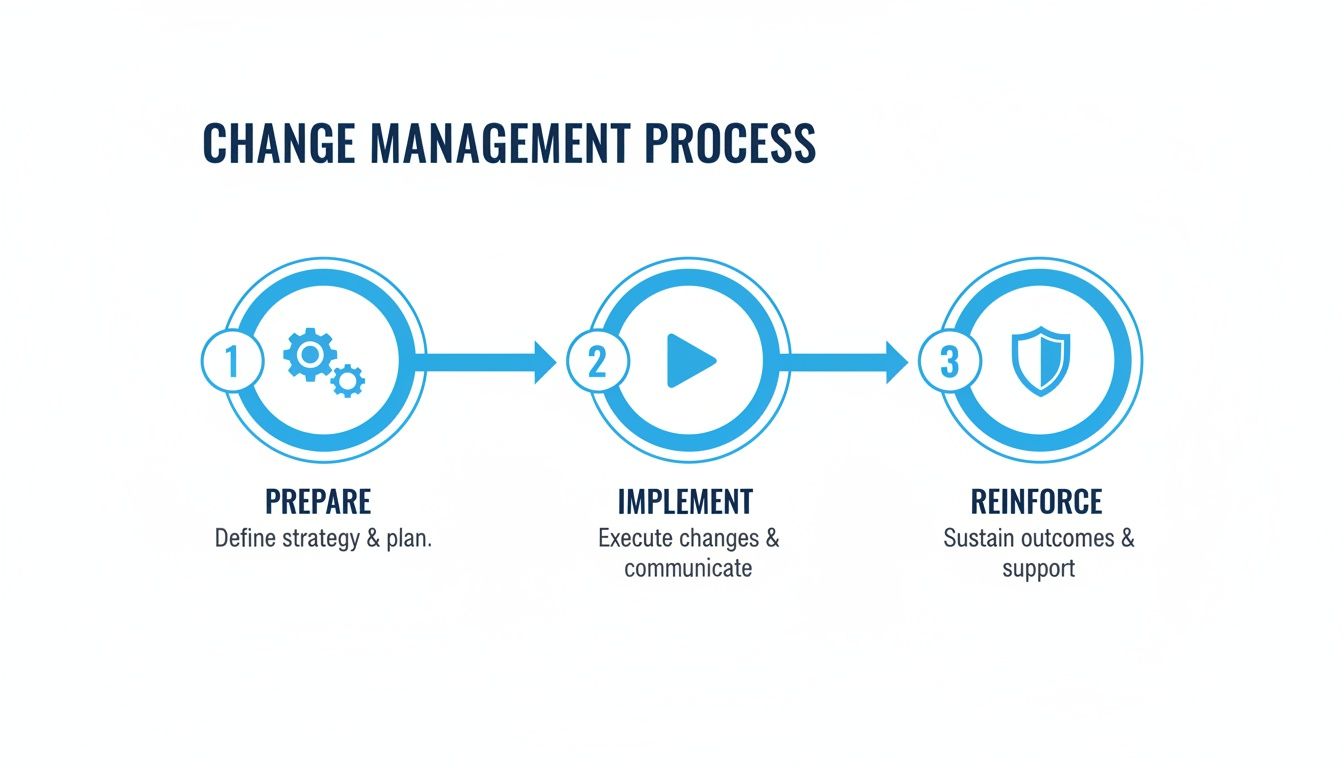
The key takeaway is that change is a cycle. Reinforcement is as critical as preparation and rollout for achieving lasting results.
Stage 1: Readiness
The real work begins long before any new software is installed. The readiness stage is about laying a solid foundation by assessing your organization's current state and building a compelling case for the future.
Your main goal here is to understand the organizational culture to anticipate potential friction. It’s also about identifying key stakeholders and, more importantly, the champions who will help drive the initiative forward. You need to answer critical questions: Are we truly ready for this change? Who will be most impacted? And who can help us lead the charge?
Stage 2: Engagement
Once you’ve mapped the terrain, it’s time to secure buy-in. The engagement stage is where you shift from a top-down mandate to a shared mission. You achieve this by creating a powerful vision that clearly explains the “why” behind the change.
A robust communication plan is non-negotiable. It must be transparent, consistent, and tailored to different groups across the organization. The goal is to build genuine excitement and ensure everyone understands their role in the transformation—and how it benefits them.
Effective change management isn't about pushing people through a process. It's about pulling them toward a shared vision of a better future, making them active participants in their own transformation.
Stage 3: Training
This is where the transformation becomes tangible for your team, and it is where many initiatives succeed or fail. Traditional training methods, such as passive lectures, are often insufficient for today's complex digital tools. Modern change management in digital transformation requires a more active, hands-on approach.
This is where immersive solutions offer a distinct advantage. Instead of just hearing about a new process, employees can step into a realistic VR simulation to experience it. For example, a technician can practice a new maintenance procedure on a virtual machine multiple times before ever touching the real equipment, building critical muscle memory.
This approach delivers significant benefits:
- Faster Learning: Active, experiential learning is proven to boost knowledge retention and can accelerate skill acquisition by up to 75%.
- Zero Risk: Your team can build confidence in a safe environment where mistakes have no real-world consequences. This dramatically reduces the chance of errors when they’re working on the live system.
- Greater Confidence: Hands-on practice with new digital tools before they go live reduces the fear and anxiety that often accompany change.
By transforming training from a lecture into an experience, you empower your people with the practical skills and confidence they need to be productive from day one.
Stage 4: Reinforcement
The final—and most frequently overlooked—stage is reinforcement. Launching a new system is the starting line, not the finish line. This phase is about maintaining momentum and embedding new behaviors into the fabric of your organization.
Here, you will focus on establishing continuous feedback loops to address issues as they arise. You will actively celebrate early wins and recognize individuals to maintain motivation. You will also use data to track adoption rates and demonstrate business impact. By consistently reinforcing the new way of working, you ensure the change delivers lasting value and becomes the new standard.
How to Overcome Employee Resistance to Change
Even the most well-designed digital transformation plan can fail if it ignores a fundamental truth: people are naturally resistant to change. This is not a matter of stubbornness but a human response. When you introduce new technology, your team often deals with fears of the unknown, anxiety over losing mastered skills, and uncertainty about their role in the new structure.
Instead of viewing resistance as an obstacle, effective leaders see it as a natural reaction and a source of valuable feedback. Pushback indicates that people are engaged enough to care and may be highlighting issues you haven't considered. The goal is not to silence resistance but to understand its roots and address it with empathy.
Addressing the Psychological Roots of Resistance
To manage resistance effectively, you must identify its source. Most often, it stems from one of three psychological drivers. Once you understand the driver, you can tailor your support.
These are the primary causes:
- Fear of the Unknown: People question if they have the capabilities to succeed. They ask themselves, "Can I learn this new system?" or "What if I can't keep up?"
- Loss of Mastery: Seasoned experts have spent years becoming proficient in existing processes. New technology can make them feel like novices again, which can impact their professional identity.
- Organizational Politics: Significant changes disrupt the status quo, routines, and power dynamics. Some resistance is rooted in a fear of losing influence, status, or control.
Data highlights this challenge: only 43% of employees feel their companies manage change well. Factors like internal politics and fear stop an estimated 26% of digital transformations. This underscores the importance of clear communication, which can boost success rates by 38%. You can explore more change management statistics to see the full picture.
Practical Tactics for Building Trust and Buy-In
Overcoming resistance is not about top-down commands; it's about creating an environment where people feel safe and have a sense of ownership. Your most effective tool is transparent communication. Relentlessly explain the "why" behind every change, connecting it not just to company goals but also to how it benefits each individual. This cuts through confusion and builds trust.
Resistance is not something to be overcome. It is something to be understood. The energy of resistance can be the source of a better solution.
Another effective tactic is to involve employees in the process from the beginning. When people help design and implement a new system, they transition from passive recipients to active co-creators. This sense of ownership is incredibly powerful. You should also identify and empower change champions—respected team members who can advocate for the project and provide peer support.
Using AR to Turn Anxiety into Empowerment
For frontline teams, particularly in field service, a major driver of resistance is the fear of encountering a problem they are not equipped to solve. This is where AR-powered remote support tools provide a distinct advantage for change management in digital transformation. Instead of leaving technicians to solve problems alone, you provide them with on-demand expert support.
Imagine a technician facing unfamiliar equipment. Rather than feeling anxious, they can connect with a senior specialist who sees exactly what they see through smart glasses and can guide them through the repair. This on-demand support turns a high-stress moment into a real-time learning opportunity. It directly addresses the fear of the unknown and the loss of mastery by providing a safety net that builds confidence and improves first-time fix rates. When you provide your team with tools that empower them, you demonstrate an investment in their success. As you explore building these capabilities, it's worth learning how to train your staff with effective, modern methods.
Measuring Success with KPIs and Clear Governance
A well-defined change strategy is a great starting point, but execution determines the success of a digital transformation. To ensure your initiative delivers real value, you must move from abstract goals to measurable outcomes. The business adage is true: what gets measured gets managed. Without a clear way to track progress, even the best plans can go off course, leaving you unable to prove a return on investment.
Simply completing tasks on a project plan is not enough. True success in change management in digital transformation is measured by how deeply teams embrace new tools and processes—and the tangible business results that follow. This requires a balanced set of Key Performance Indicators (KPIs) that tell the complete story.
Defining Your Key Performance Indicators
To get a full picture of your transformation’s impact, your KPIs should cover three crucial areas: adoption, proficiency, and business impact. This multi-layered approach ensures you're not just implementing new technology but are genuinely improving your organization.
A structured approach to measurement could include:
Adoption Metrics: These KPIs track how widely and consistently the new technology is being used. Are people logging in? Are they using core features? This indicates if the change is taking hold.
- Use Case: For an AR remote support tool, a key adoption metric would be the daily active usage rate among field technicians.
Proficiency Metrics: These metrics measure how well employees are using the new tools and whether their performance is improving. It's not just about using the tool; it's about using it effectively.
- Use Case: After deploying VR training modules for manufacturing, a crucial proficiency metric would be the reduction in error rates on the assembly line. This proves the training translates to better real-world performance.
Business Impact Metrics: These are the bottom-line indicators. These KPIs tie the change initiative directly to core business goals like cost savings, revenue growth, and efficiency gains.
- Use Case: A key business impact metric would be the decrease in expert travel costs by 75% due to the successful adoption of remote AR support, demonstrating a clear financial benefit.
For leaders looking to build a robust measurement framework, our guide on how to measure training effectiveness offers more detailed strategies.
To understand the health of your initiative, it's helpful to organize these metrics visually. A simple table can provide a clear snapshot of what you're tracking and why.
Key Performance Indicators for Change Management in Digital Transformation
| KPI Category | Example KPI | How to Measure |
|---|---|---|
| Adoption | Daily Active Users (DAU) | System logs or analytics dashboards tracking unique user logins per day. |
| Proficiency | Task Completion Time | Timing how long it takes a user to complete a standard process before and after training. |
| Business Impact | Reduction in Operational Costs | Tracking expenses in a specific area (e.g., travel, materials) over time. |
| Adoption | Feature Usage Rate | Analytics showing which specific features within the new tool are being used most frequently. |
| Proficiency | User Error Rate | Counting the number of mistakes made during a standardized task or process. |
| Business Impact | Customer Satisfaction Score (CSAT) | Customer surveys measuring satisfaction with service delivery after the change. |
This table serves as a dashboard for your transformation. It provides real-time feedback on what is working and where you need to increase support.
Establishing a Clear Governance Model
Effective metrics are only half the battle. You also need a clear structure for accountability and decision-making. A simple but effective governance model ensures everyone knows their role and that the initiative stays on track. Without it, accountability becomes ambiguous, and momentum can be lost.
Governance provides the framework for decisions, accountability, and communication. It transforms a loose collection of tasks into a coordinated, strategic initiative with a clear line of sight to its goals.
Your governance team should include a few key roles:
- Executive Sponsor: A senior leader who champions the project, secures resources, and removes high-level obstacles. Their visible support signals the importance of the initiative to the entire organization.
- Change Lead: The day-to-day manager of the change process. They are responsible for executing the plan, coordinating activities, and monitoring KPIs.
- Department Champions: Influential individuals within the impacted teams. They act as advocates, provide peer support, and channel on-the-ground feedback to leadership, helping to manage resistance and ensure new ways of working are sustained.
When you combine robust KPIs with a clear governance model, you create a powerful system for driving and sustaining change. This structure not only keeps your digital transformation accountable—it ensures it delivers the measurable business results you set out to achieve.
Choosing a Technology Partner to Guide Your Strategy
Embarking on a digital transformation is rarely a solo journey. The complexity of integrating new tools like AR and VR while navigating the human side of change requires specialized expertise. This is where a strategic technology partner becomes a valuable asset. They are more than a vendor; they can serve as a guide for your entire strategy.
A true partner understands that successful change management in digital transformation depends on both the technology and the people using it. They don’t just provide a software license. Instead, they deliver a comprehensive action plan covering seamless tool integration, robust training, and the ongoing support needed to ensure the process is sustainable.
What to Look for in a Partner
Selecting the right ally is a critical decision. The best partners operate as an extension of your team, bringing specialized knowledge that accelerates your path to success. Their value is measured not just by the technology they offer, but by their commitment to helping you achieve your business goals.
When evaluating potential partners, prioritize these key attributes:
- Industry Expertise: They need a deep understanding of your sector and its unique operational challenges. A one-size-fits-all solution is rarely effective.
- A Proven Track Record: Look for a history of successful projects and case studies with real, measurable results. Proof of ROI—such as reduced service times or decreased travel costs—is what matters.
- Commitment to Post-Implementation Support: The relationship should not end at launch. A great partner remains engaged, offering continuous support, training, and resources to ensure your team's long-term success.
The Value of a Partner Ecosystem
Beyond one-on-one support, the best technology providers often build a thriving partner ecosystem. This network can provide access to co-marketing assistance, advanced product training, and a community of experts. You are not just buying a tool; you are joining an ecosystem designed for shared growth and innovation.
A strategic technology partner doesn’t just provide tools; they provide a roadmap. They help you connect the potential of technology to the reality of your people, ensuring your investment delivers tangible, lasting value.
Ultimately, the right partnership makes successful change possible. As you consider different technology partners, look closely at their expertise in driving major advancements. Some firms, for instance, are leading the charge in business AI integration, which can completely reshape how you operate. By choosing a partner with both technical skill and a sharp understanding of human dynamics, you’re not just getting powerful tools—you’re getting the wisdom to use them effectively and secure a powerful return on your investment.
Your Top Change Management Questions, Answered
Any digital transformation journey is bound to raise questions. Below are answers to some of the most common queries from leaders and managers working to implement a change management strategy.
What Is the First Step in Change Management?
Before implementing any technology or planning a training session, you must define the “why.” The first step is to build a clear, honest business case for the transformation. This means articulating the current challenges and painting a vivid picture of the future state after a successful implementation.
This vision must be specific and tied to tangible business outcomes, such as a significant increase in efficiency or a measurable improvement in customer satisfaction scores. A strong, well-communicated vision acts as a guiding principle for all decisions and is crucial for getting key stakeholders on board from the beginning. Without this step, your initiative will struggle to gain momentum.
The real goal of change management isn't just to install new tech. It's to make the new way of working the only way of working. And that only happens when people genuinely understand, accept, and feel equipped for the shift.
How Do You Handle Resistance from Long-Term Employees?
When seasoned employees express resistance, it is often rooted in legitimate concerns rather than defiance. They have spent years, sometimes decades, mastering their roles, and they may worry that new tools will make their hard-won expertise obsolete. The best approach is to engage them with empathy and involve them in the process.
Turn these experienced team members into change champions. Actively seek their input on the implementation plan and listen carefully to their warnings about potential pitfalls. This demonstrates respect for their institutional knowledge and gives them a sense of ownership. Follow up with hands-on training in a low-risk environment where they can build confidence and see firsthand how the new technology will enhance their skills, not replace them.
How Long Does a Change Management Process Take?
There is no universal timeline. The duration of change management in digital transformation depends entirely on the scope of the project. A small process adjustment might be completed in a few weeks. A large-scale, enterprise-wide system overhaul could take a year or more.
It is more useful to view change management as a continuous cycle rather than a project with a fixed start and end date. The four stages—Readiness, Engagement, Training, and Reinforcement—are ongoing. Even after a successful launch, the Reinforcement phase is critical for making new habits permanent. It provides an opportunity to gather feedback, celebrate successes, and make adjustments for the future.
Ready to guide your team through its next digital evolution with confidence? AIDAR Solutions provides immersive AR and VR tools that make change feel less like a disruption and more like an opportunity. From hands-on VR training that builds skills safely to on-demand AR support that empowers your frontline, we provide the technology and the strategy to ensure your transformation succeeds. Discover how our solutions can de-risk your next project and drive rapid adoption.

