
Automated Manufacturing Processes Explained
When you hear “automated manufacturing,” you might picture a scene from a sci-fi movie—robots everywhere, no humans in sight. The reality is more grounded but no less impressive. At its heart, automated manufacturing is about using technology—robotics, smart software, and control systems—to handle production tasks with far less direct human involvement. It’s a shift from relying purely on manual labor to creating a smart, collaborative environment where machines tackle repetitive, heavy-lifting, and high-volume work with incredible speed and precision.
The Foundation of Modern Manufacturing
Think of a well-run factory floor as a perfectly tuned orchestra. In an automated setup, a central control system is the conductor, cueing each machine—the individual instruments—to perform its specific job at exactly the right moment. This synchronized performance replaces the natural variations of manual work with something consistent, reliable, and driven by data. It's the true backbone of what makes a modern factory competitive.
Consider a traditional assembly line for a car door. You'd have workers manually welding parts, another team installing components, and someone else inspecting the final product. Every step is limited by human speed, fatigue, and the unavoidable potential for error.
Now, picture the automated version. A robotic arm lays down a flawless weld every time. A conveyor whisks the door to the next station without missing a beat. A sophisticated vision system inspects the work in the blink of an eye, flagging imperfections a human might miss. The whole process is not only faster and more reliable, but it’s also constantly generating data you can use to get even better.
The Three Pillars of Automation
Automation isn’t a one-size-fits-all solution. It's always tailored to the specific job at hand. Understanding the three fundamental types helps show how these systems are put to work on the factory floor. Each approach is built to achieve different goals, whether that's producing millions of identical items or building custom orders on the fly.
You can break automation down into three main categories:
- Fixed Automation: This is your workhorse for high-volume, highly repetitive tasks where the product isn't going to change anytime soon. Think of a bottling plant or an automotive assembly line where specialized machines do the exact same thing, millions of times over. It’s incredibly efficient but completely inflexible.
- Programmable Automation: When you need to produce things in batches, this is the way to go. This type of automation lets you reprogram equipment to handle different product models or variations. A great example is in electronics manufacturing, where the same line might produce several different types of circuit boards in a single day.
- Flexible Automation: This is the most nimble and adaptable form of automation out there. It's designed to handle a huge variety of products with almost no downtime between changeovers. You'll often see computer-controlled machinery here, making it perfect for industries that need mass customization, like consumer goods or pharmaceuticals.
By picking the right approach, a manufacturer can build a system that perfectly matches their goals—whether that means cranking out a single product as fast as possible or being able to pivot on a dime to meet new customer demands. Getting this choice right is absolutely critical for success.
The Core Technologies Driving Automation
To truly understand what makes automated manufacturing work, you have to look at the technologies powering it all. These aren't just standalone gadgets; they’re pieces of a huge, interconnected puzzle. An automated factory can be thought of as a living organism—all the parts have to work together to create a single, intelligent production environment.
First, though, it's key to understand that not all automation is created equal. There are really three foundational types, each suited for different production needs.
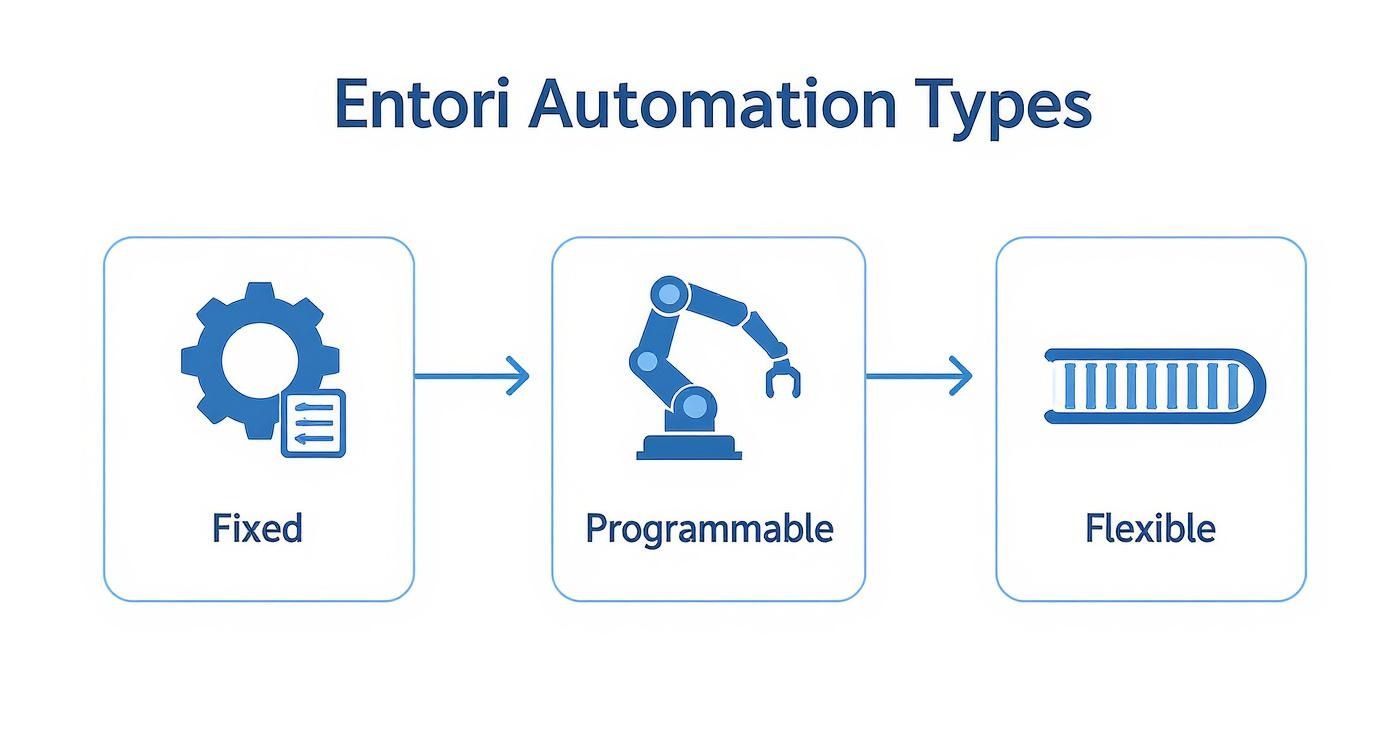
As you can see, the right strategy depends entirely on whether you're dealing with high-volume, low-variety production or the other way around. It’s a spectrum from rigid efficiency to nimble adaptability.
Robotics: The Hands of the Factory
When most people picture automation, the first thing that comes to mind is an industrial robot. That's a great starting point. They're the versatile "hands" of the factory, handling physical tasks with a level of strength, endurance, and precision that's impossible for humans to sustain.
But they aren't all one-size-fits-all. On any modern shop floor, you’ll see a few common types:
- Articulated Robots: These are those classic, multi-jointed arms you see welding car frames or lifting engine blocks. Their flexibility lets them reach awkward spots with perfect consistency, every single time.
- Collaborative Robots (Cobots): Lighter and specifically designed to work safely right next to human workers, cobots tackle the more delicate jobs. A cobot might hold a tricky component perfectly still for a technician or take over a mind-numbingly repetitive assembly step.
PLCs and SCADA: The Nervous System
If robots are the hands, then Programmable Logic Controllers (PLCs) and Supervisory Control and Data Acquisition (SCADA) systems are the factory’s central nervous system. These are the workhorses of command and control, making sure every machine follows its instructions to the letter.
PLCs are tough, industrial-grade computers that give direct orders to individual machines on the line. A SCADA system sits one level above, gathering data from all those PLCs and displaying it on a single visual interface. This gives a human operator a bird's-eye view of the entire production floor from a central control room.
This one-two punch of direct machine control (PLC) and centralized oversight (SCADA) is the bedrock of operational command. It allows for incredibly precise, repeatable actions while giving managers the visibility to catch problems before they spiral into costly downtime.
Manufacturing Execution Systems: The Brain
While PLCs and SCADA handle the immediate "do this now" commands, the Manufacturing Execution System (MES) is the operational "brain." It’s the crucial translator that connects the real-world shop floor to high-level business plans sitting in systems like Enterprise Resource Planning (ERP).
An MES tracks the entire production lifecycle, from the moment raw materials arrive to the second a finished product rolls off the line. It's constantly answering questions like: What are we building next? How many do we need? Which materials should we use? This real-time link ensures the factory floor is always perfectly in sync with bigger business goals like inventory levels and order deadlines.
It's no surprise that the global industrial automation market is projected to hit $378.57 billion by 2030. That's a massive jump from where it is in 2024, and it's driven almost entirely by the adoption of these kinds of sophisticated, interconnected systems.
The Industrial Internet of Things: The Senses
Last but not least, the Industrial Internet of Tings (IIoT) acts as the factory's sprawling network of "senses." Think of it as a vast web of sensors and smart devices, all constantly gathering incredible amounts of data about the health and performance of every piece of equipment.
These sensors can monitor anything and everything—from the temperature and vibration of a motor to the output rate of an assembly line. This constant stream of data is the fuel for smart, data-driven decisions. A pillar of modern automation is the ability to act on information the second it's generated, making effective real-time data processing an absolute must-have.
By collecting and interpreting this flood of information, manufacturers can finally shift from reactive maintenance ("fix it when it breaks") to predictive maintenance ("fix it before it breaks"). This capability alone can dramatically slash unplanned downtime and send equipment effectiveness through the roof.
To see how these and other advancements are completely reshaping the factory floor, check out our guide on new technologies in manufacturing. Each of these technologies is an essential building block in constructing the modern automated factory.
Just How Big Is the Payoff? Measuring the Tangible Benefits of Automation
While the tech behind automated manufacturing is impressive, it's the business outcomes that truly matter. Adopting automation isn't about chasing the latest shiny object; it’s a strategic move designed to deliver specific, measurable improvements across your entire operation. From the shop floor to the balance sheet, the impact is both direct and profound.
The most immediate win? A massive jump in productivity. Automated systems don’t need coffee breaks or clock out at 5 PM. They enable true 24/7 operation, which can dramatically crank up your throughput. This relentless pace, combined with the pinpoint precision of robotics, means you can make more, faster. The result is shorter lead times and a much better ability to keep up with customer demand.
Elevating Quality and Making the Workplace Safer
It's not just about speed, though. Automation brings an incredible level of consistency to product quality. A robotic welder lays down the same perfect bead every single time, and an automated inspection system can catch microscopic flaws the human eye would miss. This takes human variables like fatigue and error out of the equation, leading to higher-quality products, less rework, and fewer expensive returns.
At the same time, automation makes the factory floor a much safer place to be. When you hand off dangerous jobs—like handling hazardous chemicals, lifting back-breaking materials, or working in extreme heat—to robots, you're pulling your team out of harm's way. This doesn't just cut down on workplace accidents; it frees up your skilled people to focus on safer, more valuable roles that require critical thinking and problem-solving.
A core principle of successful automation is transforming the work humans do, not eliminating it. The goal is to shift people from repetitive, physically demanding tasks to roles focused on system oversight, maintenance, and process optimization.
Translating Gains into Numbers That Matter (KPIs)
To get anyone to sign off on a major automation project, you need to speak the language of data. Vague promises of "better efficiency" won't cut it. You have to track specific Key Performance Indicators (KPIs) to prove the return on investment (ROI). Understanding the overall benefits of business automation is a great start, but it's the hard numbers that secure buy-in from the C-suite.
To help you get started, we've put together a table of the most critical KPIs for gauging the real-world impact of your automation projects.
Key Performance Indicators for Measuring Automation ROI
| KPI | What It Measures | Impact of Automation |
|---|---|---|
| Overall Equipment Effectiveness (OEE) | The gold standard for manufacturing productivity. It combines Availability (uptime), Performance (speed), and Quality (good parts) into a single score. | Automation directly boosts all three OEE factors, increasing uptime, maximizing operational speed, and improving first-pass yield for a much higher overall score. |
| Cycle Time | The total time it takes to produce one complete unit, from the first step to the last. | Drastically reduces time by optimizing handoffs, eliminating bottlenecks, and performing tasks at a consistent, rapid pace. |
| Scrap Rate Reduction | The percentage of raw material that is wasted or becomes defective parts during production. | Minimizes errors and material waste through high-precision operations, leading to direct cost savings and more sustainable production. |
| First Pass Yield (FPY) | The percentage of products that are made correctly the first time, without needing any rework or repairs. | A high FPY is a sign of a stable process. Automation drives this number up by delivering unparalleled consistency and eliminating human error. |
By tracking these KPIs, you establish a clear "before" and "after" picture. This isn't just about showing improvement; it's about building a rock-solid business case.
By setting up a baseline for these metrics before you flip the switch, you can clearly show the financial and operational wins your automation efforts are delivering. To get an even deeper look at these and other crucial numbers, check out our detailed guide on key operational efficiency metrics. This data-first approach is how you turn an automation project from a major expense into a proven strategic investment.
A Practical Roadmap to Implementing Automation
Jumping into automated manufacturing can feel like trying to boil the ocean. It's a huge undertaking, but it doesn't have to be overwhelming. The secret is to break the journey down into a clear, methodical roadmap. Think of it less like a giant leap of faith and more like a series of deliberate, well-planned steps that build on each other.
This strategic approach makes sure your initial investment is sound, risks are managed, and the entire project is set up for success right from the start.
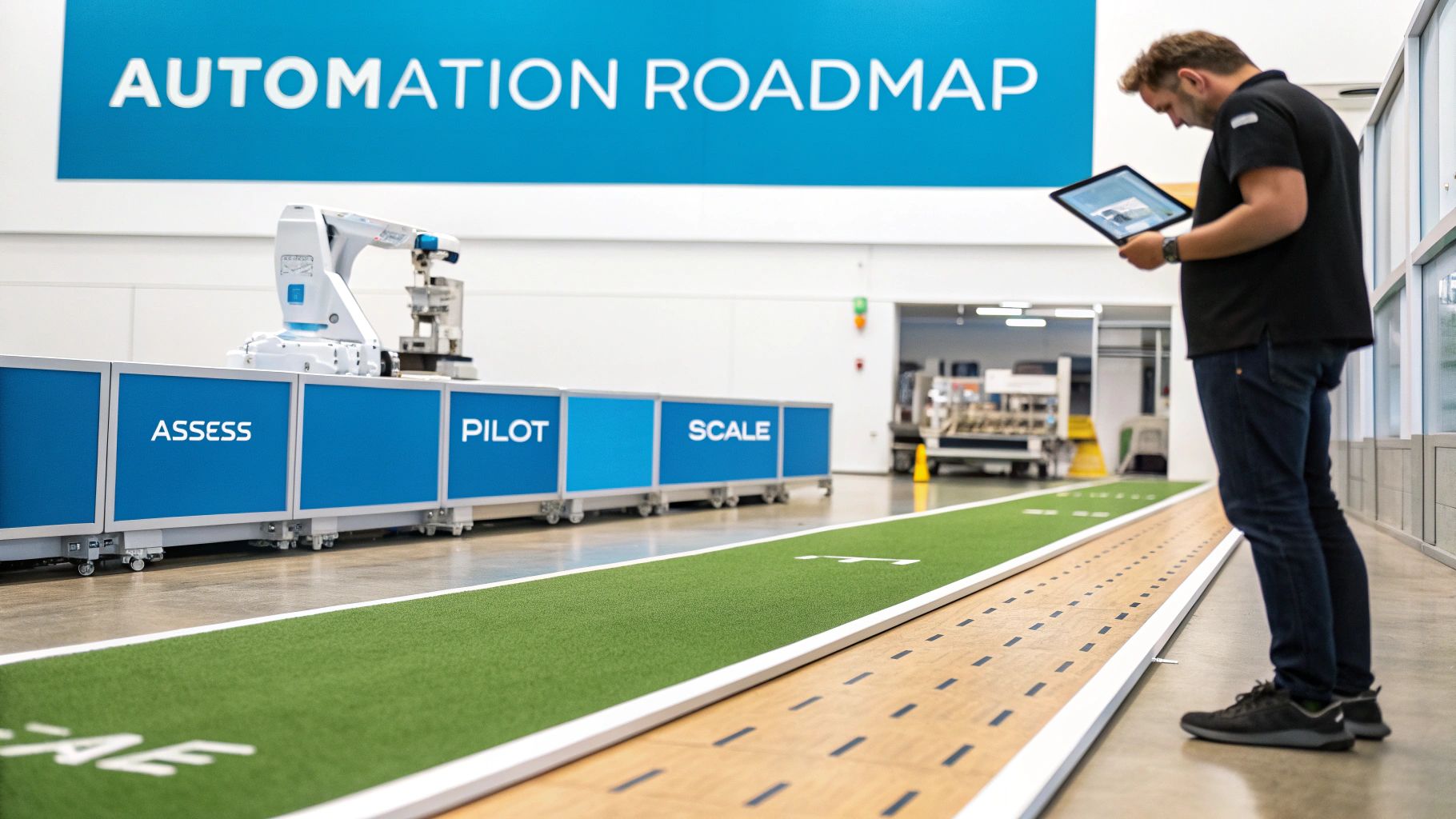
Phase 1: Assessment and Strategy Development
Before you even think about buying a single piece of equipment, the most important work happens: a brutally honest assessment of your current operations. The goal here is to get past assumptions and find the real opportunities where automation will have the biggest impact.
Start by hunting down your most significant production bottlenecks. Where do things consistently slow down? Which tasks are notorious for quality issues or creating safety concerns? These are your prime candidates.
Once you’ve zeroed in on these areas, you need to set clear, measurable goals. Vague ambitions like "improving efficiency" won't cut it. You need specific targets, like:
- Reduce cycle time for the main assembly process by 15%.
- Decrease the scrap rate on Line 3 by 20%.
- Eliminate manual handling of corrosive materials in the finishing area.
These concrete goals become your North Star, guiding your strategy and giving you a clear benchmark for measuring success down the road.
Phase 2: Technology Selection
With a sharp strategy in hand, you can start exploring the right tools for the job. This isn't about chasing the most advanced or expensive tech; it’s about finding the best fit for the specific problems you identified in phase one. You have to match the technology to the task's complexity, volume, and required flexibility.
For instance, a simple, repetitive pick-and-place task might be a perfect job for an affordable collaborative robot (cobot). But a complex assembly that involves multiple steps could demand a more sophisticated, fully integrated system with advanced vision sensors. Always consider the long-term picture—maintenance, scalability, and how it will play with your existing systems are just as important as the upfront cost.
A classic mistake is over-investing in technology that's way more powerful than what the initial problem calls for. The most successful automation projects often start small, with a targeted solution that solves one problem exceptionally well. That victory provides a strong foundation to build upon.
Phase 3: The Pilot Project
The pilot project is your chance to test-drive your strategy and technology on a small, manageable scale. This is arguably the most critical phase in the entire roadmap. It lets you prove the concept, iron out unexpected kinks, and build momentum without bringing your entire operation to a halt.
Pick a single process—ideally one of those bottlenecks you found earlier—and implement your chosen automated solution. This controlled trial is invaluable for a few reasons:
- It validates the ROI: You get real data to confirm the solution is delivering the benefits you expected.
- It uncovers integration headaches: You'll find technical or workflow challenges in a low-risk environment where they're easy to fix.
- It builds team confidence: It gives your crew hands-on experience and shows them the real-world value of the new system.
A successful pilot acts as a powerful internal case study, making it much easier to get buy-in for a wider rollout. For a deeper dive into the nitty-gritty, our guide on process automation in manufacturing offers some great insights.
Phase 4: Scaling and Continuous Improvement
Once your pilot project is a proven success, it’s time to scale. This means methodically expanding the automation solution to other similar processes or departments. The lessons you learned from the pilot are gold here, allowing you to replicate what worked and sidestep the mistakes you made the first time.
But implementation isn't the finish line. True optimization comes from a commitment to continuous improvement. The data streaming from your new automated systems is a goldmine. Use it to constantly monitor performance, find new areas for enhancement, and fine-tune your processes. Automation isn't a "set it and forget it" deal; it’s an evolving strategy that has to grow right alongside your business.
Integrating the Human Workforce in an Automated World
Every conversation about automation eventually turns to the people. There’s a common fear that it’s all about job displacement, but the reality is far more interesting. It’s not about replacing humans; it’s about elevating their roles—shifting them away from repetitive, back-breaking labor and into positions that demand creativity, sharp thinking, and technical skill.
This shift turns the factory floor into a truly collaborative space. While robots handle the grunt work, a whole new class of skilled jobs opens up. Suddenly, you need people for robot programming, data analysis, and advanced system maintenance to keep the whole operation humming. The trick is to see automation as a tool that empowers your workforce, not one that makes them obsolete.
Upskilling Your Team for the Future
So, the big question is: how do you get your team ready for this new reality? The answer is smarter, forward-thinking training. Old-school classroom sessions and thick binders just don't cut it when you’re preparing someone to maintain a complex, million-dollar piece of machinery.
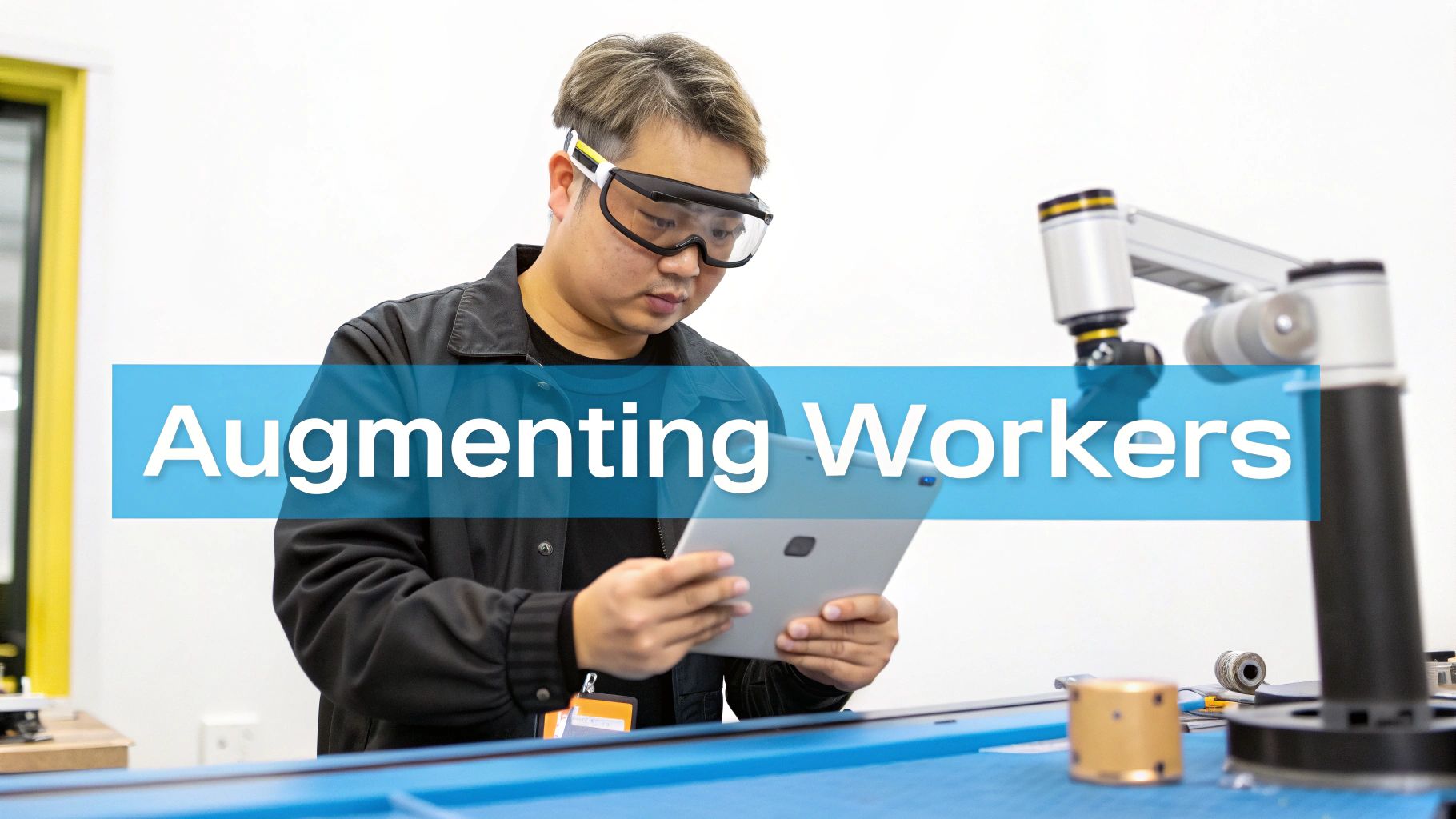
Your training methods need to be as advanced as the technology you’re installing. This is exactly where immersive tech like Augmented and Virtual Reality (AR/VR) comes into play, bridging the gap between knowing something in theory and being able to do it in practice.
The greatest return on your technology investment comes from investing in your people. Upskilling isn’t just a benefit; it's a fundamental requirement for maximizing the potential of automated manufacturing processes.
When you give your team the right skills, you’re making sure they can manage, troubleshoot, and fine-tune the very systems you brought in to boost the bottom line.
Training with Augmented and Virtual Reality
Imagine a new technician needs to learn how to operate a complex robotic cell. Instead of turning them loose on the real thing—where one mistake could be incredibly costly—they put on a VR headset. Instantly, they're standing in a photorealistic digital twin of your factory floor.
In this virtual space, they can run through complex procedures, react to simulated malfunctions, and build critical muscle memory, all in a completely safe, controlled environment. Data shows this kind of hands-on learning dramatically speeds up how quickly people master new skills.
- Virtual Reality (VR) Training: This drops your team into fully immersive, interactive simulations. It’s perfect for learning complex operational sequences or running emergency drills without any real-world risk.
- Augmented Reality (AR) Guidance: This is like having an expert looking over your shoulder. AR overlays digital information—instructions, schematics, performance data—directly onto a worker's view of the physical equipment for real-time, on-the-job support.
Practical AR and VR Use Cases
These tools are solving real-world manufacturing problems today. AR, for example, is a game-changer for maintenance and repair. A technician wearing smart glasses can look at a machine and instantly see highlighted components, step-by-step repair guides, and live sensor data floating in their field of view.
This eliminates the need to flip through paper manuals and drastically cuts down on human error. And when a tech encounters a tough problem? They can use AR to stream their exact point-of-view to a remote expert, who can then walk them through the fix visually, as if they were standing right there. This slashes travel costs and gets equipment back online in a fraction of the time.
The benefits of using augmented reality for training go far beyond just showing someone what to do. They create a more capable, confident, and efficient workforce that’s ready to handle the demands of a modern automated factory.
Real-World Examples of Automation in Action
Roadmaps and theory are great, but nothing beats seeing automated manufacturing in the real world. That's where the value really clicks. Across dozens of industries, companies are using automation to tackle stubborn, specific challenges and completely reshape their operations from the ground up. These aren't just feel-good success stories; they're blueprints for how the right automation delivers real, measurable results.
Take the automotive industry, a long-time pioneer in massive automation. Assembly lines are legendary for their swarms of articulated robots, handling everything from welding to painting with relentless precision. One major automaker was constantly hitting a bottleneck in its chassis assembly, where manual welding was dragging down the entire line. They brought in a system of coordinated welding robots and saw a 30% jump in throughput while practically eliminating inconsistent welds. It's a classic case of how fixed automation dominates in high-volume production.
Precision and Purity in Different Sectors
Now, let's flip to the other end of the spectrum: electronics manufacturing. Here, the game isn't just about speed—it's about microscopic precision. A circuit board manufacturer was struggling with sky-high defect rates from soldering tiny components by hand. The solution? A flexible automation cell built around collaborative robots (cobots) armed with high-resolution vision systems.
The impact was immediate. The cobots could place and solder components with an accuracy humans simply can't match, slashing product defects by a massive 50%. It’s a perfect example of how automation elevates quality where the margin for error is razor-thin.
These stories all point to the same core principle: the best automation projects directly attack a specific operational pain point, whether it's a speed bottleneck, a quality control nightmare, or a safety risk. The solution is always fitted to the problem.
Finally, look at the food and beverage industry, where automation is all about safety and consistency. A large bottling company decided to automate its quality control and packaging. Instead of relying on human spot-checks, they installed high-speed vision systems that inspect every single bottle for fill levels, cap seals, and label placement.
This system, working alongside robotic arms for packing, hit two home runs:
- Enhanced Consumer Safety: It guaranteed no improperly sealed products ever made it to a store shelf.
- Improved Efficiency: The packaging line’s speed shot up by 25%, which meant a huge boost in output.
You can see this shift happening everywhere. The adoption of industrial robots in manufacturing is exploding. By 2023, the global average hit 162 units for every 10,000 employees. As you can dig into with these manufacturing automation trends, the data just confirms what we see on the factory floor: automation is the engine of modern manufacturing. Each of these stories—from cars to circuit boards to soda bottles—proves that with the right strategy, automated manufacturing can solve just about any operational puzzle you throw at it.
Common Questions About Manufacturing Automation
Jumping into the world of automated manufacturing can feel like learning a new language. You’ve probably got a dozen questions swirling around, and getting clear, straightforward answers is the first step toward making a smart decision for your business. Let's tackle some of the most common ones we hear.
Is Automation Only for the Big Guys?
Not a chance. That might have been true a decade ago when only massive corporations could afford the investment, but the game has completely changed.
Today, thanks to more affordable and flexible tech like collaborative robots (or "cobots") and cloud-based control systems, automation is well within reach for small and medium-sized businesses (SMEs). You don't have to automate everything at once. The smart move is to start small—pick one high-impact process, automate it, and then build from there. You can get a fantastic ROI without a colossal upfront cost.
What's the Real Difference Between Automation and Robotics?
This one trips a lot of people up, but it's pretty simple when you break it down. Think of automation as the big-picture strategy and robotics as one of the most important tools in the toolbox.
Automation is any technology that lets a process run with less human help. That can be anything from sophisticated software to complex control systems. Robotics, on the other hand, is specifically about using programmable machines—robots—to do physical work. In a factory, robots are the muscle, but automation is the entire nervous system that includes the software, sensors, and data making it all work together.
How Do I Know Where to Start? What's the Best Process to Automate First?
The best place to start is almost always with the jobs that are repetitive, physically draining, or downright dangerous. We call these the "dull, dirty, and dangerous" tasks for a reason.
Another great place to look is at your biggest production bottlenecks. Where does the workflow always seem to grind to a halt?
Go after those specific areas first. Automating them almost always delivers the quickest and biggest payback. You’ll see throughput climb, safety improve, and best of all, you free up your people to do the creative, problem-solving work that only humans can do.
At AIDAR Solutions, we're all about getting your workforce ready for this shift. Our immersive VR and AR applications make employee training faster and more effective, while also enabling real-time remote support to keep your new systems running smoothly. We ensure your team isn't just ready for automation—they're empowered by it. Discover how our solutions can empower your team.

