
Augmented Reality in Warehouse Operations
Running a modern warehouse with manual processes is akin to navigating a bustling city with a paper map while competitors use real-time GPS. The relentless pressure from e-commerce, persistent labor shortages, and the demand for near-perfect accuracy are pushing traditional operations to a breaking point. This is where augmented reality in warehouse operations comes in, acting as the real-time navigation system your team needs to thrive.
Moving Beyond Manual Warehouse Methods
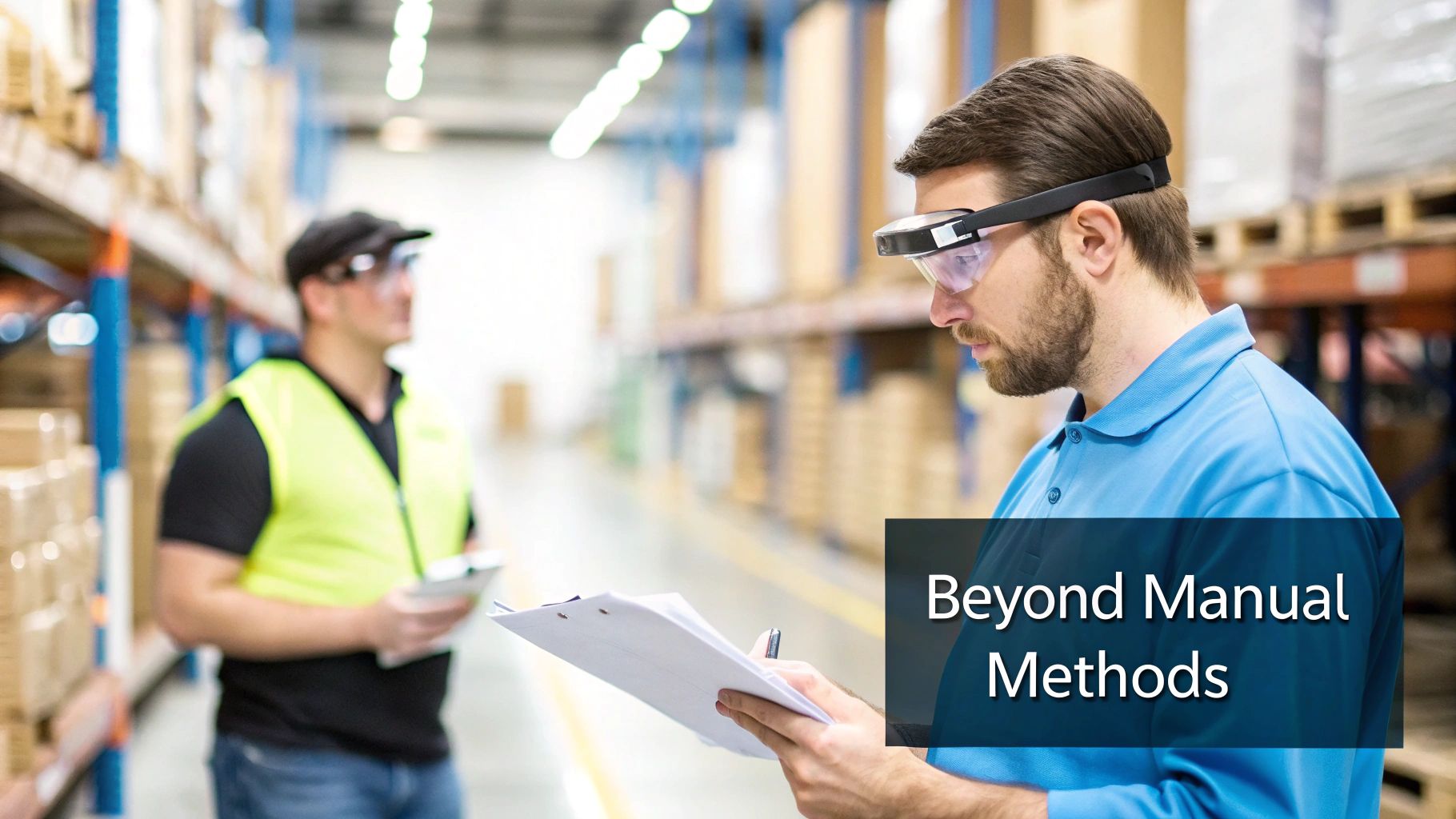
The modern supply chain moves at an incredible speed, yet many facilities are constrained by processes that haven't changed in decades. These include pen-and-paper checklists, lengthy memorization for new hires, and clunky handheld scanners. This friction slows operations, leading to costly errors and delays.
Every misplaced item or incorrect shipment impacts the bottom line and damages customer trust. These manual systems also place a significant cognitive load on employees, forcing them to constantly look away from their work to check a device or a piece of paper. This "context switching" is a primary source of inefficiency and human error. The challenge is clear: how can you empower your workforce to handle complex tasks faster and with greater precision?
The Shift to Guided, Visual Workflows
Augmented reality offers a powerful solution by overlaying digital information directly onto the physical environment. An operator wearing smart glasses can see picking locations, bin numbers, and item quantities highlighted in their field of view. Complex tasks are instantly transformed into simple, step-by-step instructions.
This approach immediately tackles several core operational bottlenecks:
- Reduced Mental Strain: Workers no longer have to translate abstract data into physical action; the instructions are presented in context.
- Increased Accuracy: Visual cues confirm the correct item is being picked or packed, significantly reducing error rates.
- Faster Onboarding: New employees become productive almost immediately because the AR system guides them through tasks that previously required weeks of training to master.
By presenting information visually and in context, augmented reality frees workers from clunky handheld devices. This allows for completely hands-free operation and a much more intuitive connection between digital instructions and physical work.
This shift to a guided augmented reality workflow is about fundamentally changing how work gets done. It provides every employee, from a seasoned veteran to a first-day hire, with the exact information needed to perform their job flawlessly.
This evolution is happening across industries. Just as AR helps warehouses move past manual checklists, other fields are seeing a similar progression, with tools like practical workplace safety apps replacing outdated paper systems. Ultimately, AR is the tool that closes the gap between operational demands and human capability, creating a more efficient, accurate, and productive warehouse.
How AR Moves the Needle on Warehouse Performance
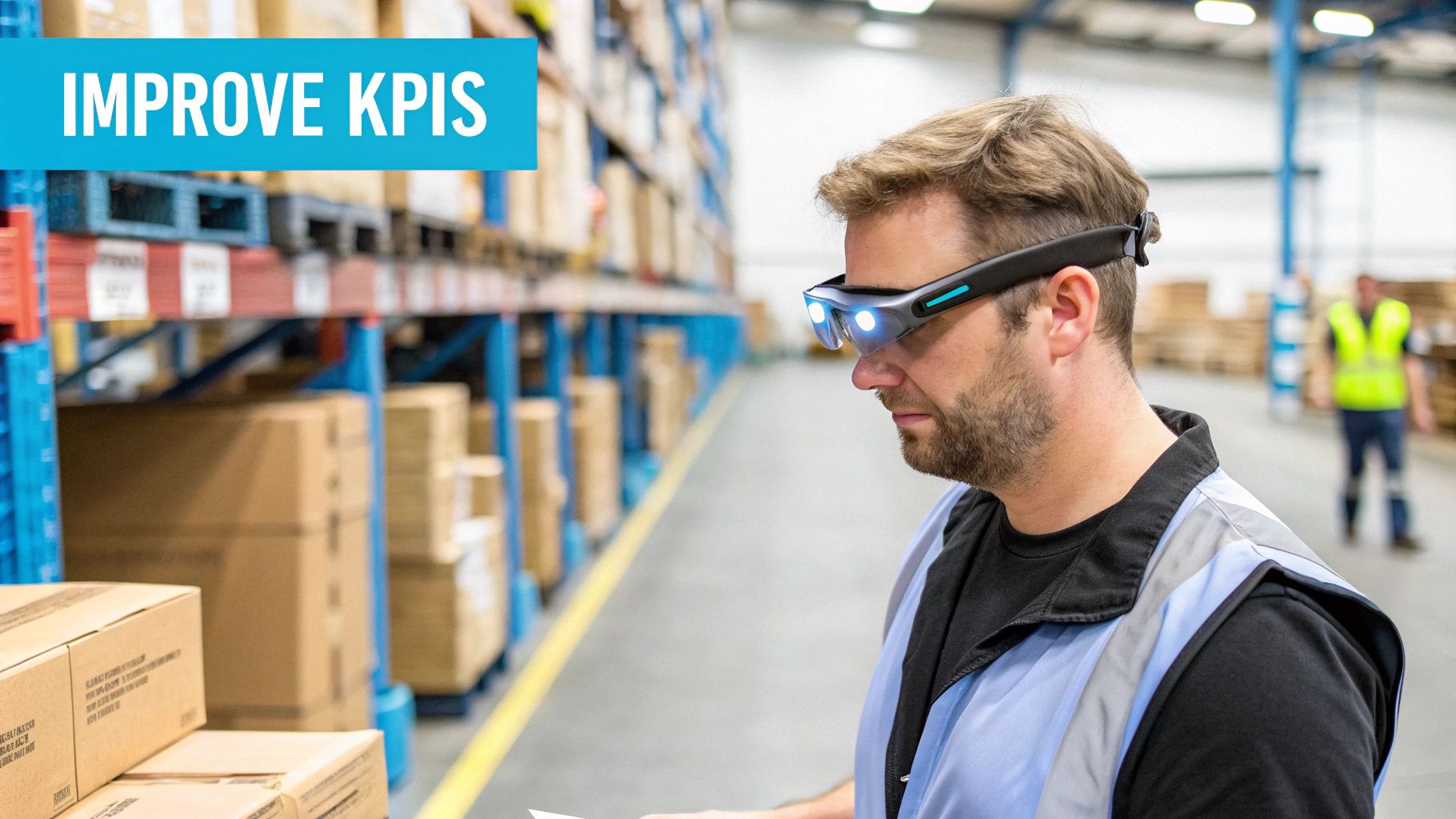
Implementing augmented reality in a warehouse is not about adopting futuristic technology for its own sake. It is about achieving a direct, positive impact on key business metrics. The focus is on measurable improvements that contribute to the bottom line.
AR technology closes the gap between digital information and the physical work happening on the floor. To understand its significance, one must consider the standard key warehouse performance indicators that every manager monitors. AR systematically targets these core metrics, turning operational challenges into major strengths.
Achieving Near-Perfect Picking Accuracy
Human error during order picking is one of the most persistent and costly problems in logistics. A single wrong item creates a ripple effect of reverse logistics, customer dissatisfaction, and wasted labor. Traditional methods that rely on reading from a screen or paper are inherently prone to mistakes.
Augmented reality tackles this head-on by delivering clear, visual directions directly into an employee’s line of sight. An employee wearing smart glasses sees a digital arrow pointing to the exact bin and a virtual box highlighting the precise item to retrieve. This makes it exceptionally difficult to pick the wrong product.
This simple change empowers every worker, new or experienced, to be a highly accurate picker. AR-guided picking has been shown to reduce errors by up to 90%, pushing operations toward near-perfection. The system confirms every action in real-time, catching potential mistakes before they occur.
Slashing Employee Training Time from Weeks to Days
Onboarding new hires in a warehouse is a significant investment of time and resources. It can take weeks for an individual to learn the facility layout, become familiar with thousands of SKUs, and match the pace of an experienced employee. This lengthy ramp-up period is a major drag on overall productivity.
AR fundamentally changes the onboarding process. Instead of requiring new employees to memorize workflows, the system guides them from their first shift. The AR solution acts as a personal coach, walking them through each task.
A new hire can follow instructions to pick a complex, multi-item order with the same accuracy as a ten-year veteran. The technology effectively shrinks the learning curve from weeks down to just a few hours, helping new team members feel confident and productive almost instantly.
This not only accelerates team productivity but also improves retention by reducing the stress and confusion often associated with a new warehouse position.
Systematically Wiping Out Operational Errors
Mistakes are not limited to picking. They occur in put-away, packing, and final shipping. Each error adds a layer of inefficiency that accumulates over time, leading to inventory discrepancies, shipping delays, and increased operational costs.
The growing interest in AR is a direct response to these challenges. Market trends reflect this: the global AR/VR market is expected to reach $89.82 billion in 2025, a significant increase from $62.75 billion in 2024. This growth is driven by AR's proven ability to resolve logistics issues, with AR device shipments projected to reach 43.2 million by 2025.
AR adds a layer of digital oversight that minimizes these systemic errors. During packing, for example, an AR application can instantly confirm that all items for an order are in the box. It might even suggest the optimal box size to reduce waste. This focus on detail is crucial for improving overall operational efficiency metrics.
To put it in perspective, here’s a straightforward comparison of how work gets done with and without AR.
Operational Impact of Augmented Reality vs Traditional Methods
| Metric | Traditional Method | Augmented Reality Method |
|---|---|---|
| Picking Speed | Relies on manual scanning and list-checking, which slows the process. | Hands-free operation with heads-up display guidance increases picks per hour. |
| Error Rate | Prone to human error from misreading lists or grabbing similar-looking items. | Visual confirmation and real-time validation reduce error rates dramatically. |
| Training Time | Weeks are often needed for new hires to reach full productivity and learn layouts. | Guided workflows enable new employees to be productive within a few hours. |
| Worker Safety | Requires constant context switching (looking at a device, then at surroundings). | A hands-free, heads-up display keeps the worker's attention on their environment. |
The differences are stark. AR doesn't just offer a marginal improvement; it fundamentally changes the efficiency and accuracy of core warehouse tasks, leading to a safer and more productive operation.
Where AR Gets Real: Practical Uses in Daily Operations
While high-level benefits are important, the true value of augmented reality in the warehouse is realized on the facility floor. This is not a one-size-fits-all gadget but a suite of tools that target the specific bottlenecks and challenges of daily workflows. Let's break down how AR makes a tangible difference in core warehouse areas.
This shift is part of a larger trend. The warehouse automation market was valued at $22.4 billion in 2021, and AR solutions are a significant component of its growth. The automated conveyor market, for example, is expected to grow from $10.4 billion in 2024 to $14.8 billion by 2030. This signals a clear industry-wide move toward smarter logistics. You can read more about how AR is shaping the future of warehouses on xrtoday.com.
Vision Picking, Reinvented
Order picking is typically the most labor-intensive and error-prone job in a warehouse. Workers constantly glance between a paper list or a handheld scanner and the shelves—a back-and-forth process that is slow and susceptible to mistakes.
Vision picking completely changes this dynamic. When workers wear AR smart glasses, critical information is layered directly over their real-world view.
- Follow the Digital Path: Arrows and highlighted pathways appear in their vision, guiding them on the most efficient route to the next item.
- Zero-Doubt Highlighting: A digital box or glow appears over the exact bin and the specific item they need to retrieve, nearly eliminating the possibility of picking the wrong product.
- Instant Confirmation: The required quantity appears in their display. An integrated scanner can then instantly confirm the pick, sending the update directly to the Warehouse Management System (WMS) in real-time.
This completely hands-free system not only accelerates the process but also dramatically boosts accuracy by allowing workers to keep their eyes and hands focused on the task.
Smarter Packing and Sorting
Accuracy doesn't end with the pick. Packing and sorting are the final checkpoints to ensure orders are correct, complete, and sent to the right destination. AR adds a powerful, final layer of verification.
A packer looking at a bin of items ready for boxing can have their AR display scan the products, check them against the order, and show a green confirmation or a red alert if something is incorrect.
This type of visual confirmation is incredibly fast and intuitive. The system can even suggest the optimal box size based on item dimensions, reducing shipping costs and material waste. For sorting, AR can illuminate the correct chute or conveyor for each package, simplifying a complex job and virtually eliminating mis-shipments.
Finally, Painless Inventory Management
Maintaining an accurate inventory count is vital for warehouse operations. However, manual cycle counts are slow, disruptive, and often inaccurate. AR-guided scanning transforms this task into a smooth, continuous process.
An employee can walk down an aisle, and their smart glasses will automatically scan barcodes. The system provides real-time feedback, flagging discrepancies between the physical count and WMS records on the spot. This eliminates the need for clipboards or manual data entry, resulting in faster, more frequent checks and a much more accurate picture of on-hand inventory.
These are just a few examples of a much larger trend. You can dive deeper into how this tech is being used across different sectors in our guide to augmented reality industrial applications.
Equipment Maintenance and Support, in Real-Time
When a forklift or a key piece of the conveyor system breaks down, downtime costs mount quickly. Waiting for a specialist can halt operations for hours or even days.
AR-powered remote assistance eliminates this waiting period. An on-site technician can wear smart glasses and share their exact point-of-view with an expert located anywhere in the world. That expert can then guide the repair by:
- Annotating the real world: They can add digital arrows, circles, and notes directly onto the live video feed.
- Displaying schematics: Technical diagrams or step-by-step guides can be overlaid directly onto the machine.
- Sharing key documents: Manuals or instructions can be sent directly to the technician's display.
This approach dramatically reduces equipment downtime, eliminates travel costs for experts, and empowers local teams to resolve complex problems with confidence.
Your Step-by-Step Guide to AR Implementation
Integrating augmented reality into your warehouse is a strategic process, not an overnight change. Optimal results are achieved by breaking the process into manageable phases, ensuring a smooth transition that delivers tangible value without disrupting operations.
The goal is to move methodically from a promising concept to a fully integrated system that genuinely improves your bottom line.
This flow illustrates how AR can enhance core warehouse tasks, creating a single, guided workflow that connects picking, packing, and inventory management.
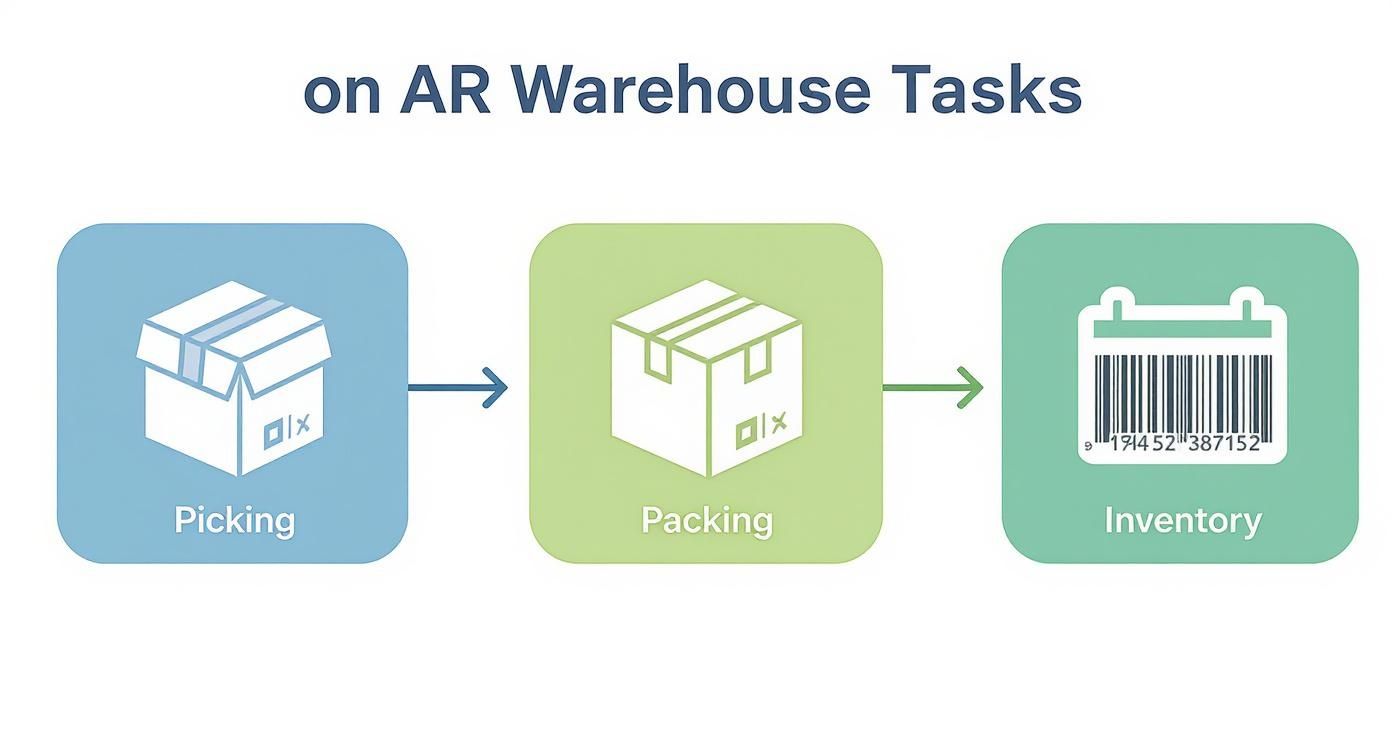
AR unifies these distinct steps, guiding workers seamlessly from one task to the next to boost both speed and accuracy.
Phase 1: Launch a Pilot Program
Always start small. A pilot program allows you to test the technology in a controlled environment, gather hard data, and build a solid business case before considering a facility-wide rollout.
This is a focused experiment. Do not attempt to implement augmented reality in the warehouse everywhere at once. Instead, select one high-impact area to prove the concept. A specific pick zone that struggles with complex orders or high error rates is an ideal starting point.
Your objectives for this phase should be clear and direct:
- Test the technology: Evaluate how the hardware and software perform on your floor, not just in a demonstration.
- Measure initial ROI: Collect baseline data on pick speeds and accuracy rates. Then, compare them to performance with AR.
- Gather employee feedback: Consult with the team using the technology. Their experience is crucial for identifying what works and what needs adjustment.
A successful pilot provides the concrete proof needed to gain buy-in for the next stage. It shifts the conversation from "what if" to "look at what we've already achieved."
Phase 2: Focus on Integration and Technical Planning
With a successful pilot, the next step is to plan for deeper integration with your existing systems. This phase addresses the technical details to ensure the AR solution is compatible with your current infrastructure.
Compatibility with your Warehouse Management System (WMS) is essential. Your AR platform must be able to pull order data from the WMS and push real-time updates back. This two-way communication is non-negotiable for maintaining a single, accurate source of truth for your inventory.
Choosing the right hardware is equally critical. The decision should be driven by the specific tasks your employees perform. Smart glasses are excellent for hands-free picking, but a rugged tablet might be better suited for quality control or receiving management.
This stage is about building a solid technical foundation. Answering these compatibility and hardware questions early prevents significant issues later and ensures the technology integrates seamlessly into your established workflows.
Phase 3: Scale for Full Deployment
The final phase involves taking the lessons learned from the pilot and scaling the solution across the rest of your operation. This is more than a technical deployment; it is a change management process that requires careful planning and clear communication to ensure employee adoption.
Map out a strategic deployment that introduces the technology in waves. You could roll it out department by department or focus on specific workflows. For more guidance on structuring such a rollout, you can find valuable insights on planning for augmented reality for businesses.
Most importantly, provide comprehensive employee training. Even the most intuitive AR systems require proper training to build confidence and overcome resistance. Show your team exactly how this new technology makes their jobs easier, safer, and more productive. By empowering your people and managing the transition thoughtfully, you position your organization for long-term success.
Measuring Your Return on AR Investment
Adopting any new technology requires a solid business case. Augmented reality in the warehouse is no different. Justifying the investment is about tracking the specific key performance indicators (KPIs) that prove its real-world value. A successful business case is built on hard data, not just enthusiasm.
To do this correctly, you must establish a performance baseline. Before implementing any AR devices, meticulously document your current operational metrics. This "before" snapshot is the critical benchmark against which all future improvements will be measured, creating an undeniable before-and-after story.
Defining Your Core Success Metrics
To build a compelling case, focus on the KPIs that directly impact your bottom line. These are the numbers that will capture the attention of stakeholders and clearly demonstrate the financial benefits of investing in AR.
Here are the essential metrics for your dashboard:
- Pick Rate Per Hour: A fundamental measure of productivity. Track how many items or orders an employee processes per hour using traditional methods versus with AR guidance.
- Error Rate Reduction: Calculate the percentage of orders shipped with mistakes (wrong item, wrong quantity) before AR. After implementation, this number should decrease significantly, saving costs on reverse logistics and customer service.
- Time-to-Proficiency for New Hires: Measure how many hours or days it takes for a new employee to reach the performance level of a seasoned veteran. AR systems can drastically shorten this learning curve, lowering training costs and allowing new team members to contribute more quickly.
By focusing on these concrete data points, you shift the conversation from potential benefits to proven performance gains.
Calculating a Simplified Return on Investment
Once you have your baseline and post-implementation data, you can build a straightforward ROI model. This model should clearly weigh the costs against the financial gains.
The core of your ROI calculation is simple: compare the total cost of the AR solution against the total value generated from improved efficiency, reduced errors, and lower training overhead. This provides a clear timeline for when the technology pays for itself and starts generating a positive return.
Let's break down the two sides of that equation.
1. Initial Investment (Costs)
This side includes all upfront and ongoing expenses. It is crucial to be thorough and transparent about the project's actual cost.
- Hardware: This covers smart glasses, tablets, or other AR-enabled devices for your team.
- Software: Includes licensing fees for the AR platform and any custom development or integration work needed for WMS compatibility.
- Training & Implementation: Factor in the time and resources required for team training and smooth system deployment.
2. Financial Gains (Returns)
This is where KPI tracking delivers value. It’s time to translate your operational improvements into real dollars and cents.
- Increased Productivity: Calculate the value of additional orders processed per hour due to faster pick rates. For example, a 15% boost in picking speed across 50 workers can translate into thousands of additional orders fulfilled each month.
- Fewer Costly Errors: Quantify the savings from reduced shipping mistakes, including the cost of returns, redeliveries, and any customer accommodations.
- Reduced Training Expenses: Calculate the money saved from shorter onboarding times, including the trainer's salary and the new hire's non-productive wages.
By presenting a clear, data-backed ROI, you are not just requesting a budget—you are providing the evidence needed to justify the investment and gain support for transforming your warehouse operations.
Getting Over the Common Adoption Hurdles
Bringing any significant new technology into the warehouse comes with its share of questions. Augmented reality is no different. While the benefits are substantial, a successful rollout requires anticipating potential challenges to ensure a smooth transition.
By tackling these common hurdles head-on, you can set your team up for success and ensure your investment pays off from day one. It starts with looking beyond the initial cost to see the long-term value.
Dealing with the Initial Investment
The upfront cost for hardware and software can seem steep. However, the most successful AR deployments do not begin with a massive, facility-wide overhaul. They start with a focused, data-driven pilot that proves the concept and builds an undeniable business case.
A phased pilot program is the best strategy for managing initial costs. Select one high-impact area—perhaps a picking zone where accuracy is a constant challenge—and use it to demonstrate AR's capabilities with a limited investment. This approach allows you to:
- Prove the ROI: The pilot will provide hard data on efficiency gains and error reduction. These numbers can be used to build a compelling forecast to secure the budget for a larger rollout.
- Test and Refine: You can evaluate different hardware and software in your actual work environment to see what best suits your team's needs before committing to a larger investment.
- Build Momentum: A successful pilot creates champions within your team and generates excitement for the technology's potential.
This shifts the conversation from a daunting upfront expense to a smart, calculated investment with proven returns.
Getting Your Team On Board
New technology is only as effective as the people using it. If your team is hesitant, even the most promising project can fail. The key to gaining adoption is clear communication and training that demonstrates how AR makes their jobs easier, not just different.
It is critical to frame AR as a tool that assists employees, not a machine that replaces them. It is there to reduce their mental load and eliminate frustrating aspects of their job.
When an employee understands that they no longer have to memorize thousands of SKU locations or struggle with a handheld scanner, they recognize the benefit. They see that AR is there to guide them, prevent mistakes, and boost their confidence—a direct improvement to their daily work.
Nailing the Technical Integration
An AR solution that cannot communicate with your other systems is not a solution—it's a problem. A major hurdle is ensuring your new AR platform integrates with your current Warehouse Management System (WMS) and other software. A disconnected system creates data silos and operational chaos.
To avoid this, look for AR platforms with robust Application Programming Interfaces (APIs) and a track record of successful integrations. You want the AR system to feel like a natural extension of your tech stack, pulling order information from your WMS and pushing real-time updates back seamlessly. When your AR solution enhances your WMS instead of conflicting with it, you maintain a single source of truth for all your data and ensure the entire operation runs more smoothly.
Answering the Tough Questions About AR in the Warehouse
When discussing the implementation of augmented reality into the warehouse, operations leaders consistently raise a few key, practical questions. It is one thing to see the potential on paper, but another to imagine it working on the floor. Decision-makers want to know if the equipment can survive the environment, if it will integrate with existing systems, and what the transition will actually look like for their team.
Addressing these questions directly is the first step toward ensuring that an AR implementation is a smooth upgrade, not a frustrating disruption.
How Durable Is This Stuff, Really?
This is often the first question, and for good reason. A warehouse is a demanding environment. Equipment gets dropped, bumped, and exposed to dust. The question is whether AR hardware can handle such conditions.
The answer is yes. This is not consumer-grade technology. Industrial smart glasses and AR devices are built specifically for these environments. They are ruggedized, with impact-resistant frames and lenses designed to withstand physical stress. Many models also carry IP ratings, certifying their resistance to dust and water. While no hardware is indestructible, enterprise-level devices are engineered for the realities of a busy warehouse.
Will AR Integrate with Our WMS?
Integration is not a feature; it's a requirement. An AR system operating in a silo is counterproductive, creating data islands and operational headaches.
For this reason, modern AR platforms are designed from the ground up to connect with your existing Warehouse Management System (WMS). They use robust APIs (Application Programming Interfaces) to create a seamless, two-way channel for data exchange.
This connection is what makes the technology so effective. The AR system pulls order information directly from your WMS in real time and, just as quickly, sends updates back as your team completes tasks. Your WMS remains the single source of truth, ensuring complete data consistency across all systems.
What’s the Learning Curve for My Team?
While one might picture weeks of classroom sessions and complex manuals, the reality is much simpler. The learning curve for AR is surprisingly short. Because the technology guides users visually within their real-world view, it is incredibly intuitive. New hires often become proficient and productive within a matter of hours, not weeks.
The purpose of the hands-free, heads-up display is to make work feel natural. Employees follow simple instructions overlaid on their field of vision, which is more like following a GPS than memorizing a complex process. This not only reduces mental strain but also makes the job more manageable, leading to quicker adoption and more confident, productive employees.
Ready to see how a guided visual workflow could transform your operations? AIDAR Solutions provides tailored AR applications that reduce errors, slash training time, and boost productivity. Discover our solutions.

