
Augmented Reality in Learning: A Guide to Corporate Training
Augmented reality in learning closes the gap between digital information and the physical workspace. It overlays interactive, computer-generated content onto an employee's view of the real world. Instead of digging through a dense manual, a technician can see step-by-step instructions projected directly onto the equipment they're servicing.
This simple shift makes complex tasks intuitive and turns corporate training from a passive, sit-and-watch experience into an active, hands-on one.
The Next Leap in Corporate Training
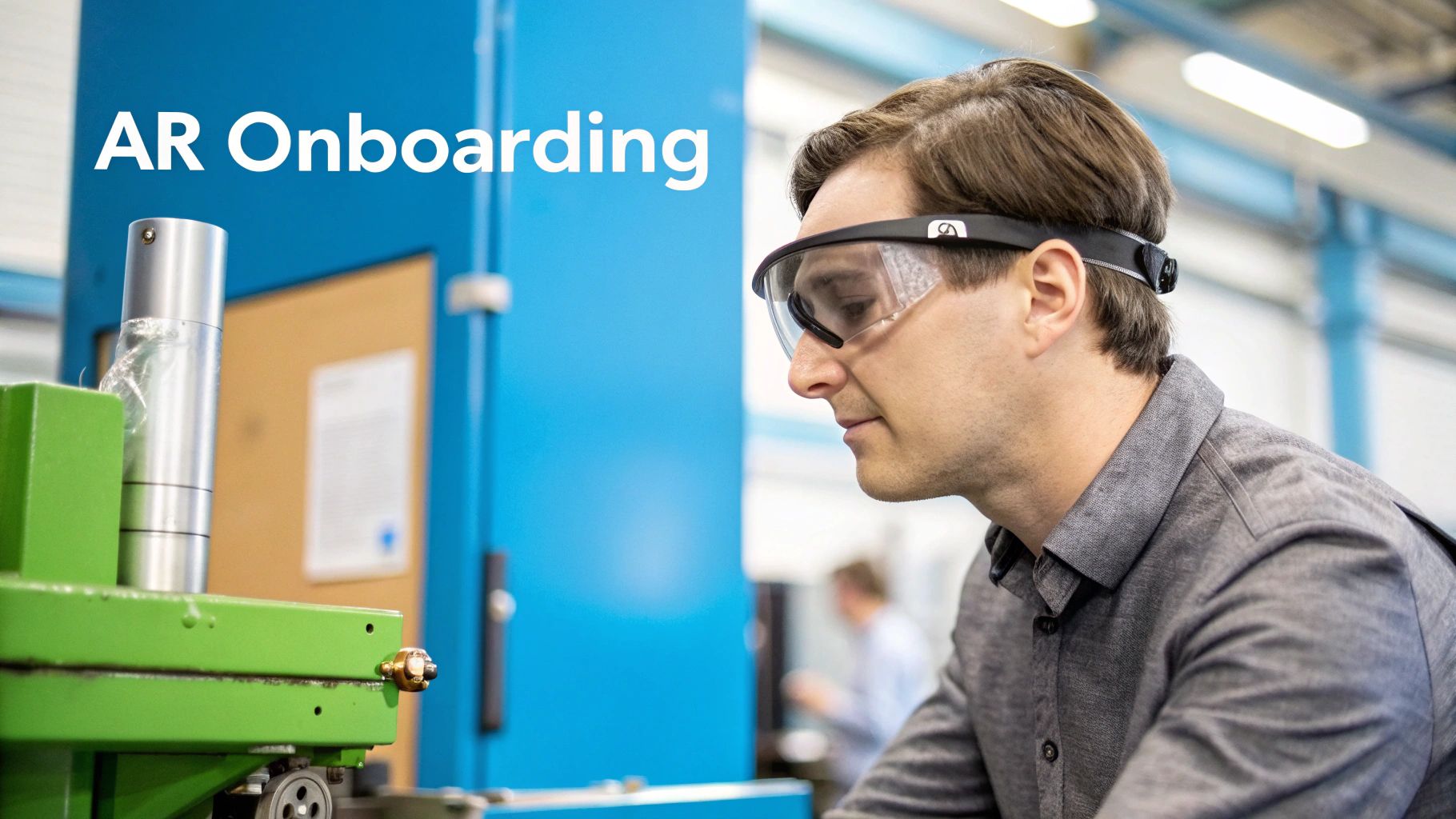
Picture a new hire on their first day, standing in front of a complex piece of industrial machinery. The traditional onboarding process would involve days of classroom sessions, thick binders, and shadowing a senior expert—a slow, expensive process that often fails to build real confidence and leads to high error rates.
This is exactly where augmented reality in learning flips the script. AR doesn't replace the real world; it enhances it. Think of it as a dynamic, digital mentor that’s there to provide guidance precisely when and where it’s needed most.
Moving Beyond Theory to Practice
The real value of AR is its ability to deliver "learning by doing" right in the actual work environment. By overlaying 3D models, animated instructions, and critical data points onto physical objects, AR makes abstract concepts completely tangible. This direct interaction is proven to boost knowledge retention far beyond what traditional methods can achieve.
It’s a powerful evolution, offering new ways to accelerate careers with professional development courses that are genuinely more engaging and effective.
This move from theoretical knowledge to applied skill directly tackles some of the biggest business challenges:
- Faster Onboarding: New employees get up to speed and become productive far quicker, dramatically reducing time-to-competency.
- Reduced Error Rates: Clear, contextual guidance minimizes mistakes, preventing costly rework, scrap, and equipment damage.
- Closing Skill Gaps: AR allows expert knowledge to be digitized and scaled, empowering less experienced workers to perform complex tasks with the confidence of a veteran.
The Key Difference from Virtual Reality
It's crucial not to confuse AR with its cousin, Virtual Reality (VR). While VR pulls you into a completely simulated digital environment, AR keeps you grounded in your physical workspace and simply enriches it with data. You can dive deeper into this in our guide on what is immersive learning.
VR is excellent for practicing high-risk scenarios in a safe, controlled space. AR, on the other hand, excels at providing real-time support during actual on-the-job tasks.
AR acts as an intelligent layer over reality, providing a context-aware guide that helps employees see, understand, and act with greater precision and efficiency. It transforms the factory floor or field site into a live, interactive classroom.
By directly addressing operational bottlenecks like slow training and frequent errors, augmented reality paves the way for a smarter, more capable workforce. This isn't just a futuristic concept; it's a practical tool for driving real, measurable business outcomes.
How AR Supercharges Skill Development
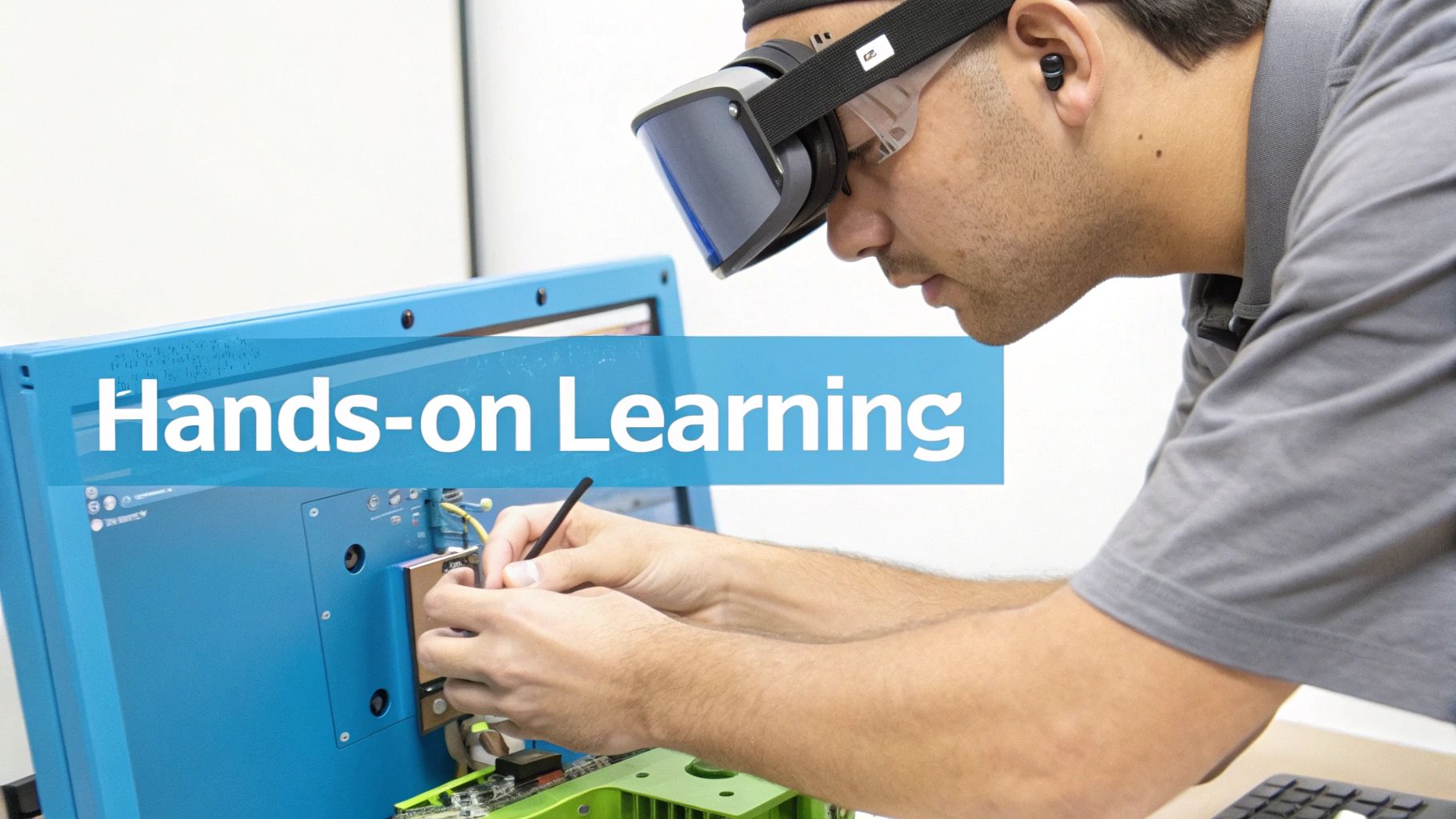
The power of augmented reality in learning lies in how it aligns with the fundamentals of human cognition. Traditional training methods often create a significant gap between classroom theory and practical application on the factory floor. AR closes that gap completely.
By overlaying digital guides, 3D models, and step-by-step instructions directly onto physical machinery, AR makes abstract concepts tangible and immediately applicable. This is "learning by doing" enhanced with an expert digital guide, showing exactly what to do next.
Instead of referencing a manual to match a diagram to a complex engine part, a technician sees precisely where a component fits in real-time. It transforms training from a passive memory test into an active, hands-on experience.
From Learning to Mastery
Confidence is a critical component of skill development. A hesitant employee is often an inefficient and potentially unsafe one. AR builds that essential confidence from the very first task.
When a trainee has clear, visual cues guiding their every move, the fear of making a costly mistake is mitigated. They are empowered to perform complex jobs correctly the first time, building muscle memory and reinforcing best practices from the start. This is how organizations build a resilient, agile workforce.
AR doesn't just teach skills—it instills the competence and self-assurance needed for employees to perform their best work safely and effectively from day one. It addresses the "confidence gap" that often hinders new hires.
This is not just a theory; the shift has a direct and measurable impact on business operations. The numbers speak for themselves: AR-powered learning can boost effectiveness over traditional training methods, helping employees master new skills up to four times faster. For high-stakes industries like manufacturing and field service, that speed is a competitive advantage. You can find more stats on immersive training’s impact in this 2024 report.
Translating Learning Benefits into Business Metrics
The advantages of augmented reality in training extend beyond individual employee development. They create a ripple effect across the entire organization, manifesting as tangible improvements on the balance sheet.
Making procedures easier to follow and understand with AR has a direct effect on your most important KPIs.
- Faster Time-to-Competency: New hires become proficient, productive team members in a fraction of the time, slashing the costs tied to long onboarding periods and constant supervision.
- Fewer Costly Mistakes: When you have real-time guidance, human error plummets. That means less material waste, reduced equipment downtime, and better product quality.
- A Safer Work Environment: AR can overlay critical safety warnings, procedural checklists, and emergency alerts right into an employee's line of sight, preventing accidents before they happen.
This technology fundamentally flattens the learning curve. Instead of a slow process of trial and error, skill development becomes a guided, efficient, and standardized journey. The result? A more capable, confident, and productive workforce ready for any challenge.
Comparing Traditional Training with AR Enhanced Learning
Let's break down exactly how AR stacks up against traditional methods. The difference in outcomes is significant.
| Metric | Traditional Training (Classroom, Manuals) | Augmented Reality (AR) Learning |
|---|---|---|
| Knowledge Retention | Low; often around 10-20% after one week. Relies heavily on memorization. | High; often over 75%. Learning by doing solidifies skills. |
| Error Rates | High, especially for new trainees applying theoretical knowledge. | Drastically reduced; real-time guidance and verification minimizes mistakes. |
| Time to Competency | Slow and lengthy; requires extensive shadowing and on-the-job supervision. | Up to 4x faster; employees become productive and independent much sooner. |
| Safety | Relies on procedural memory and awareness, which can fail under pressure. | Enhanced; overlays safety warnings and critical data directly in the user's view. |
| Scalability & Access | Limited by instructor availability and physical location. Inconsistent. | Highly scalable; standardized training can be deployed to anyone, anywhere, at any time. |
As the table makes clear, AR isn't just a minor upgrade. It represents a fundamental shift in how we transfer knowledge and build skills, delivering a more effective, efficient, and safer learning environment.
Seeing AR Training in Action Across Industries
The theory behind augmented reality in learning is compelling, but its real power becomes clear when you see it solving actual, on-the-ground operational challenges. AR is a practical tool being put to work today in manufacturing, logistics, and field service to make teams safer, smarter, and more efficient.
Let’s examine how AR training is tackling persistent challenges in these key sectors, delivering measurable results.
Revolutionizing the Modern Assembly Line
Manufacturing floors are an ideal environment for AR. Consider an assembly line worker building a complex piece of equipment with dozens of parts and a precise sequence of steps. Traditionally, they must look back and forth between a paper manual or a computer screen and their workstation. Each time they look away, the risk of error increases and the production line slows down.
Augmented reality transforms this dynamic entirely.
With a pair of AR smart glasses, the same worker now sees animated, step-by-step instructions floating right over their workspace. Digital arrows point to the exact part they need next, 3D models show how it fits, and digital checklists confirm each action is completed correctly. A complicated job becomes a simple, guided process.
- Error Reduction: With guidance appearing right where the work happens, assembly mistakes plummet. That means less expensive rework and less wasted material.
- Increased Throughput: Information is always in the worker's line of sight, so they can perform tasks faster and with more confidence, which directly boosts production numbers.
- Standardized Quality: It doesn’t matter if someone is a seasoned veteran or on their first day. Everyone follows the exact same best-practice workflow, ensuring product quality is consistent across every single shift.
Empowering Field Service Technicians
Field service is another area where AR’s impact is immediate and powerful. Imagine a technician arriving at a remote site to fix a complex, unfamiliar machine. The pressure is immense. Flying in a senior expert is slow and expensive, and every minute of downtime costs money and frustrates the customer.
AR provides a "see-what-I-see" remote assistance solution that instantly closes this expertise gap.
Through their smart glasses or tablet, a junior tech can stream their live point-of-view straight to a senior engineer sitting comfortably in the main office. That expert can diagnose the problem and guide the fix by drawing digital notes, sharing schematics, or highlighting components right on the technician's screen.
This is like teleporting your best expert to any job site, anytime. This capability is a huge reason the AR in Education market is expected to hit USD 28.95 billion by 2032. For industrial teams, the ability to overlay complex diagrams onto real-world machinery can help technicians get up to speed 75% faster—a massive driver for adoption. You can read more on this growth in the latest market research.
Optimizing Warehouse and Logistics Operations
In the fast-paced world of logistics, every second counts. Warehouse workers spend a significant portion of their day locating the right items for an order. A single wrong item can lead to a shipping error, a costly return, and a dissatisfied customer.
AR-guided "vision picking" makes this entire process seamless. Workers wearing smart glasses get visual cues that lead them on the most efficient path through the warehouse aisles. The system highlights the correct bin and shows exactly how many items to grab, all while keeping their hands completely free.
This technology overhauls the workflow by:
- Improving Picking Accuracy: Visual confirmation nearly eliminates picking errors, pushing accuracy rates toward 100%.
- Boosting Productivity: With optimized routes and hands-free guidance, the time it takes to fulfill an order drops dramatically.
- Accelerating Onboarding: New pickers can be trained in hours instead of days, because the AR system walks them through every single step.
From the factory floor to a customer site halfway around the world, these applications show how AR delivers direct solutions to long-standing operational problems. We cover more of these in our deep dive into augmented reality industrial applications.
Building Your AR Training Implementation Roadmap
Implementing augmented reality in learning can feel like a massive undertaking, but it doesn't have to be. The key is a smart, focused plan that proves its worth at every stage, rather than a large-scale, company-wide launch.
This is not about adopting new technology for its own sake; it's about solving real-world business problems. The journey begins by identifying the exact operational bottlenecks where AR can make the biggest and fastest impact.
Phase 1: Identify the Core Business Challenge
Before considering technology, conduct an honest assessment of your operational pain points. Where are inefficiencies occurring? Are you dealing with costly errors on a specific assembly line? Is the time required to onboard new technicians straining your budget? A successful AR project is laser-focused on a single, measurable problem.
Start by asking critical questions:
- Which tasks have the highest human error rates?
- Where are our most significant skills gaps?
- What specific processes are causing the most downtime or wasted materials?
- Which procedures consistently require intervention from senior experts?
Answering these questions provides a clear starting point. For instance, if a critical welding procedure has a 30% failure rate among new hires, you’ve identified a perfect candidate for an AR-guided training module. The goal is to find a problem where any improvement will be impossible to ignore.
Phase 2: Design the Pilot Program and Select Hardware
Once you have identified a problem, design a small-scale pilot program to test your AR solution. This is a validation phase, not a full deployment. A successful pilot builds the internal business case required for a wider rollout.
Your pilot program needs a few key ingredients:
- Define Success Metrics: What does success look like? Be specific. For example, a 25% reduction in assembly time, a 50% drop in errors, or getting new hires fully competent 40% faster.
- Choose the Right Tools: The hardware must be appropriate for the job. For hands-on work like maintenance or assembly, AR smart glasses are ideal as they keep the user's hands free. For simpler tasks like equipment inspections, a tablet or smartphone may be sufficient.
- Develop Focused Content: Do not attempt to address all issues at once. Create AR content for one or two critical workflows. This content must be simple, intuitive, and aimed squarely at the pain points identified in phase one.
The pilot is your controlled experiment. It delivers the hard data and success stories needed to win over stakeholders and turn skepticism into enthusiastic support.
The flow diagram below shows some of the most common high-impact workflows that companies target for their initial AR pilots across assembly, repair, and logistics.
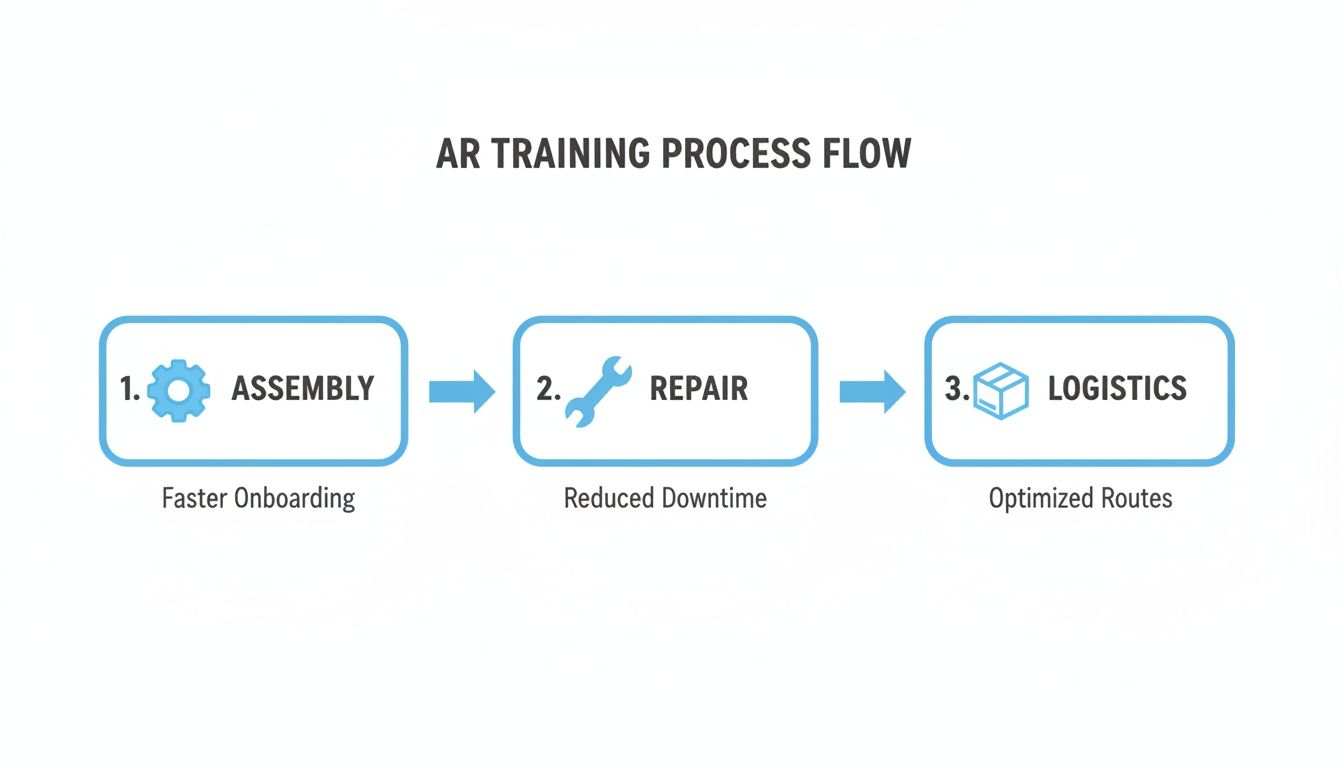
This process shows how AR training directly plugs into core industrial jobs, from the first steps of product assembly all the way to field repairs and keeping the supply chain moving.
Phase 3: Integrate and Measure
With your pilot up and running, the focus shifts to integration and measurement. An AR training tool cannot exist in isolation. To be truly valuable, it needs to connect with your existing systems, such as your Learning Management System (LMS), to track completions and map employee progress.
At the same time, you must relentlessly track the metrics defined earlier. Compare the performance of your AR-equipped pilot group against a control group using traditional methods. The data gathered here is your most powerful tool for proving the business case for augmented reality in learning.
After a successful pilot, you are no longer guessing. You have a proven model and a clear blueprint. This gives you the confidence to scale the solution, expanding to other departments or tackling even bigger challenges, all built on a foundation of real, measurable results.
Measuring the ROI of Your AR Investment
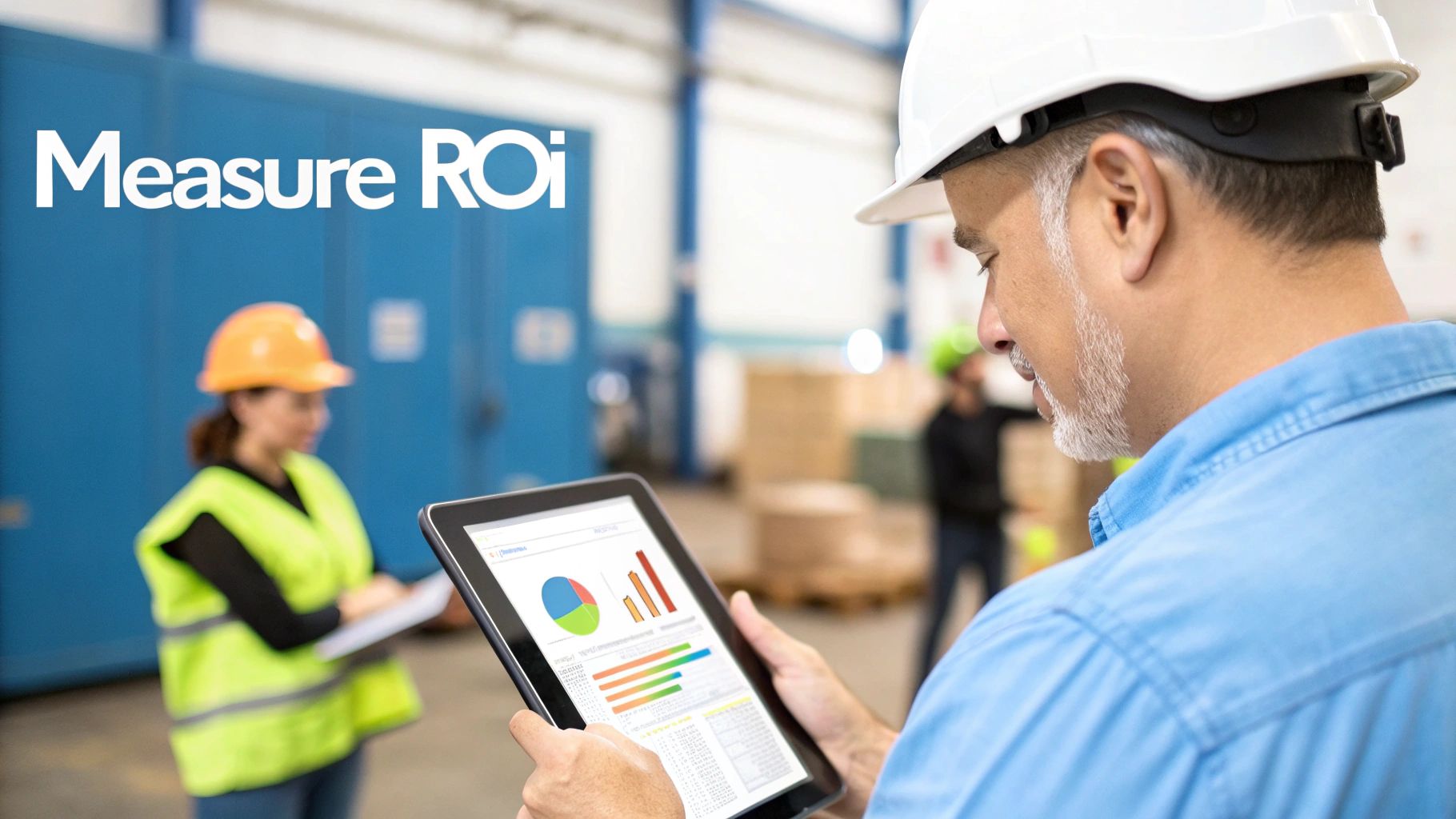
Adopting any new technology requires a solid business case, and augmented reality in learning is no exception. While the training benefits may seem obvious, the true value is realized when you connect those improvements directly to the bottom line. Proving the return on investment (ROI) is about tracking the right metrics and demonstrating tangible financial gains.
Building a compelling ROI model means moving beyond general concepts like "better learning" and into hard, operational metrics that leadership understands. This data-first approach shifts your AR program from a "nice-to-have" expense to a strategic investment that actively boosts productivity.
Key Performance Indicators for AR Training
To measure change effectively, you need to focus on metrics that reflect efficiency, quality, and safety. These numbers will paint a clear before-and-after picture, telling the story of how your AR training is delivering value.
Before you begin, establish a baseline. Here are the critical areas to benchmark:
- Time-to-Competency: How long does it take for a new hire to become a productive, confident member of the team? AR significantly reduces this time by putting guidance directly in their line of sight, cutting down on lengthy shadowing periods.
- Error Rates: Keep a close eye on the number of mistakes made during assembly or maintenance. AR’s step-by-step visual guides are incredibly effective at reducing human error, which means less rework, less wasted material, and higher quality output.
- First-Time Fix Rates: This is a critical metric for any field service team. AR remote assistance provides technicians with an expert on their shoulder, helping them solve tough problems correctly on the first visit. This leads to happier customers and fewer costly return trips.
- Safety Incidents and Compliance: Track every workplace accident and procedural deviation. AR can overlay critical safety warnings and interactive checklists directly onto equipment, reinforcing safe habits and ensuring protocol adherence.
Calculating the Financial Impact
Once you have established your KPIs, it's time to translate those improvements into financial terms. This is where your business case gains its strength. Your financial model should consider both direct cost savings and the significant productivity gains that result.
Consider the powerful financial levers AR can pull:
- Reduced Expert Travel Costs: When your most senior engineers can guide a junior technician remotely through an AR headset, the need for them to travel plummets. This results in thousands saved on flights, hotels, and per diems, not to mention the reclaimed productivity from travel days.
- Minimized Operational Downtime: Faster repairs and fewer production errors mean your most valuable machinery is operational more often. Calculating the value of even one hour of increased uptime makes the financial benefits crystal clear.
- Increased Workforce Productivity: When people learn faster and work more accurately, their output increases. Quantifying this boost in productivity per employee shows exactly how AR contributes directly to your company's revenue.
Tying training outcomes to hard financial data is how you build a narrative that gets attention. A 30% reduction in onboarding time isn't just a training stat; it's a direct improvement to labor efficiency that allows employees to contribute to the bottom line faster.
Building a solid business case isn’t guesswork; it requires a structured plan. To get a head start, you can learn more about how to calculate return on investment with a clear, step-by-step framework. Ultimately, a successful ROI analysis proves that augmented reality isn't just about better training—it's about building a smarter, safer, and more profitable business.
Finding the Right AR Technology Partner
Selecting an augmented reality partner is one of the most critical decisions you will make. This is not simply about purchasing software. You are seeking a strategic ally who understands the specific operational challenges of your industry and is invested in your success.
Your choice here will determine the ROI of your entire augmented reality in learning program.
Do not be swayed by a slick demo alone. A compelling presentation is meaningless if the underlying platform cannot handle the realities of your factory floor or a remote service call. You need a partner who can demonstrate that their solution is robust, scalable, and secure enough for enterprise use.
Looking Beyond the Tech Itself
A true partnership is built on real-world industry experience. You want a vendor who has a proven track record with companies like yours. They should understand the specific nuances of your workflows, speak your language, and have a portfolio of client results they are proud to share.
When vetting potential partners, ask specific questions:
- Proven Use Cases: Ask them to walk you through detailed case studies from your industry. How did they solve problems similar to the ones you're facing?
- Implementation and Integration: What is their plan for connecting to your existing systems, like your LMS or ERP? A clunky integration is a non-starter.
- Long-Term Support: What happens after implementation? A great partner provides ongoing training, reliable tech support, and a clear product roadmap.
What to Actually Look For
To cut through the marketing noise, focus on three key differentiators: platform flexibility, proven results, and a collaborative spirit. These are the pillars that ensure you're not just buying a tool, but investing in a solution that will grow and adapt with your business.
A critical technical point is the deployment model. Can they offer both cloud-based (SaaS) and on-premise options? For organizations with stringent data security protocols, the ability to keep proprietary information behind your own firewall is often non-negotiable.
Choosing a partner is a long-term commitment. Look for a team that is transparent, collaborative, and genuinely focused on helping you achieve your goals—not just on closing a deal.
Finally, demand proof. A partner confident in their solution will be eager to connect you with current clients. They should be able to show you the data—hard numbers that prove how they’ve cut error rates, sped up onboarding, and delivered real cost savings. That focus on tangible outcomes is the clearest sign you've found a partner who can deliver.
Your Questions About AR in Learning, Answered
As you explore augmented reality for training, many practical questions will arise. It’s a significant shift from traditional methods, so understanding the details—from implementation and content creation to security—is essential for making an informed decision.
Let’s address some of the most common questions from decision-makers who are new to augmented reality in learning.
What Hardware Do We Actually Need for AR Training?
The guiding principle is to use the right tool for the job, which does not always require a large investment in specialized equipment to get started.
For many tasks, such as digital checklists or accessing technical manuals, the smartphones and tablets your team already uses are more than capable. This approach is cost-effective, leverages familiar devices, and is an excellent way to begin exploring AR.
However, for work that demands hands-on precision—such as complex machinery assembly, delicate maintenance, or intricate repairs—AR smart glasses are the recommended choice. These devices overlay digital instructions directly into an employee's line of sight, providing real-time guidance without interrupting their workflow. Matching the hardware to the task is key to achieving the best results.
Is Creating AR Content as Hard as It Sounds?
The idea of building interactive, 3D training content can seem daunting. However, modern platforms have made the process surprisingly straightforward. You no longer need to be a software developer or have a team of them on standby.
Many leading AR solutions now feature no-code or low-code authoring tools. These platforms are designed to be intuitive, empowering your in-house subject matter experts—the people who truly know your equipment and processes—to create training guides themselves. They can:
- Import your existing 3D CAD models.
- Attach how-to videos, PDFs, or notes to specific steps in a workflow.
- Design step-by-step interactive guides to walk a user through a procedure.
For highly specialized or complex simulations, you can also collaborate with your AR partner to develop custom content perfectly tailored to your operations.
How Does AR Fit in with Our Existing LMS?
An AR training program should not exist in a silo. To be truly effective, it must integrate seamlessly with your existing learning and development systems.
Enterprise-grade AR platforms are built with integration in mind. They’re designed to connect to your current Learning Management System (LMS) using standard protocols like SCORM or xAPI, making sure all your training data talks to each other.
This connectivity means you can assign AR modules, track progress, and log completion data just as you would for any other e-learning course. It ensures that AR becomes a measurable and unified component of your corporate training strategy, not just a standalone initiative.
Is AR Training Secure Enough for Our Proprietary Info?
Security is non-negotiable, especially when dealing with sensitive intellectual property like equipment schematics or unique manufacturing processes.
Any reputable AR vendor will prioritize security and should offer multiple layers of protection. One of the most critical features to inquire about is an on-premise deployment option. This keeps all your sensitive data securely behind your own company firewall, giving you complete control.
If you are considering a cloud-based solution, ensure the provider has robust security measures like end-to-end data encryption, secure user authentication, and compliance with industry standards such as SOC 2. Always have a detailed security discussion with any potential vendor to ensure they can meet your organization's strict requirements.
Ready to see how immersive technology can solve your training and operational challenges? The experts at AIDAR Solutions can build a tailored action plan to integrate AR and VR into your workflows, delivering measurable results from day one. Learn more at aidarsolutions.com.

