
Virtual Reality in Education Explored
Virtual reality in education describes a fundamental shift in how people learn real-world skills. It's a method that uses immersive, computer-generated worlds to teach complex tasks in a realistic, risk-free setting. This is the difference between reading a manual and actually doing the job—it's learning by active participation.
The New Reality in Learning and Development
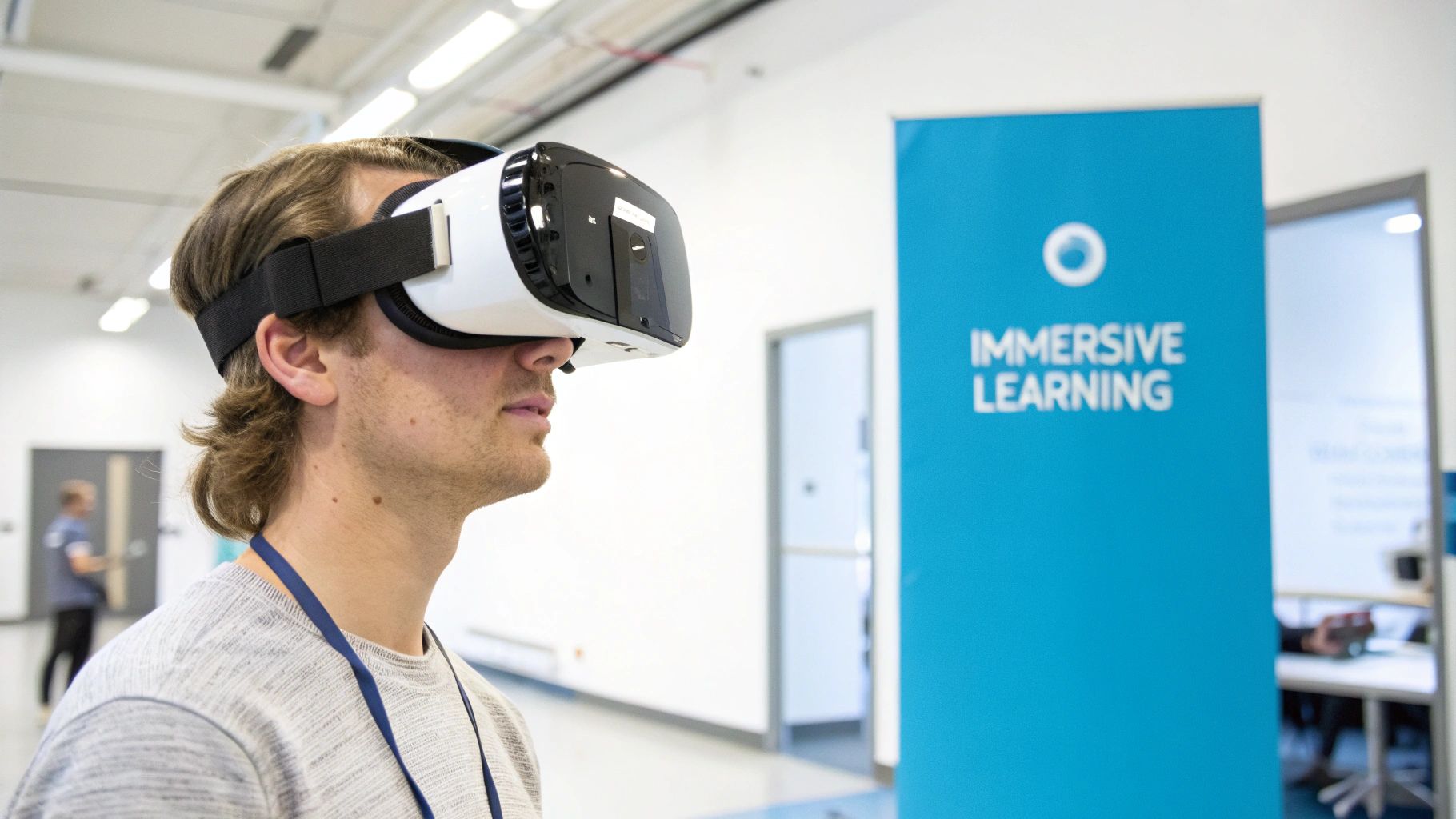
The days of seeing virtual reality (VR) as a far-off, sci-fi concept are long gone. Today, it’s a practical, powerful tool that’s actively reshaping corporate training and workforce development. This guide focuses on the real, measurable impact VR has on skill acquisition, safety, and operational efficiency.
Instead of sitting through a slide presentation or watching a video, employees can step inside their work environment. They learn by doing, which is one of the most effective ways for adults to master a new skill.
Bridging the Gap Between Theory and Practice
Traditional training methods often struggle to connect abstract classroom knowledge to hands-on, practical application. VR closes this gap by creating hyper-realistic scenarios that would otherwise be impossible, too expensive, or far too dangerous to replicate.
Consider these practical use cases:
- Medical students can perform intricate surgical procedures over and over, perfecting their technique without ever putting a patient at risk.
- Technicians can learn to maintain complex, million-dollar machinery without needing physical access to the equipment or causing costly production downtime.
- Frontline workers can drill for high-stakes emergencies, building the muscle memory they need to respond instinctively when it counts—all in a perfectly safe space.
These experiences are the heart of immersive learning, a method that enhances knowledge retention and engagement by completely absorbing the learner in the material.
By removing real-world consequences, virtual reality in education gives trainees the freedom to fail. They can experiment, make mistakes, and repeat complex tasks until they get it right, building true mastery and confidence along the way.
Solving Tangible Business Problems
Adopting VR is not about chasing the latest technology trend; it’s about solving specific, costly business challenges. It’s about creating a more effective, engaging, and scalable learning ecosystem that delivers a real return on investment.
As the training world evolves, other new tools are also changing how we deliver content. For instance, platforms that let you create presentations with AI are making it easier to develop engaging materials quickly. This relentless focus on practical application is precisely why VR is becoming an essential tool for building a workforce that's ready for anything.
Understanding Immersive Learning Technology
To fully grasp what virtual reality in education is all about, you have to think beyond the headset. This isn’t about replacing instructors; it’s about handing them a powerful new tool. Think of it as a hyper-realistic flight simulator for any complex task, or an on-demand virtual field trip that makes abstract concepts tangible.
At its core, immersive learning works by convincing your brain it’s somewhere else entirely. This sensory immersion is key. The moment a learner puts on a headset, the real world and its distractions fade away. What's left is a unique, focused environment where learning can happen efficiently.
The Spectrum of Immersive Technologies
You’ll often hear terms like VR, AR, and MR used in discussions about immersive learning, and they each serve different purposes in training. Each one offers a unique way to blend our physical world with digital information, creating a spectrum of experiences from fully simulated to digitally layered. Picking the right tool for the job starts with understanding these differences.
For a deeper dive, check out our article explaining what extended reality is and how these technologies fit together.
Here’s a simple breakdown to get you started:
Comparing Immersive Learning Technologies
This table lays out the core concepts and best-fit educational uses for each technology.
| Technology | Core Concept | Educational Use Case |
|---|---|---|
| Virtual Reality (VR) | A fully simulated digital environment that replaces the user's real-world surroundings. | Placing a trainee inside a virtual replica of a complex machine to practice maintenance procedures without physical risk. |
| Augmented Reality (AR) | Overlays digital information—like text, graphics, or animations—onto the user's real-world view. | Providing a field technician with step-by-step digital instructions that appear directly on the equipment they are repairing. |
| Mixed Reality (MR) | Blends the real and virtual worlds, allowing digital objects to interact with the physical environment in real time. | Allowing engineers to view and manipulate a 3D hologram of a new product design on a physical tabletop. |
Choosing the right technology depends on the learning goal. Do you need to remove the trainee from their environment entirely, or enhance it with helpful data?
Why Full Immersion Is a Game-Changer for Learning
The true power of virtual reality in education comes down to its ability to command a learner’s undivided attention. By completely blocking out external noise, VR creates a state of intense focus that’s nearly impossible to achieve in a classroom or a busy workshop. This isn't just about keeping people engaged; it's about how our brains work.
When the brain is fully immersed in a task without distractions, it forms stronger neural connections. This deep cognitive engagement significantly improves memory retention, allowing learners to not only understand a process but to recall and apply it effectively on the job.
This focused learning environment is why we’re seeing such huge adoption across industries. The augmented and virtual reality in education market, valued at $2.4 billion, is expected to skyrocket to $22.5 billion by 2030.
That kind of growth tells you something important. Immersive technology is no longer a niche concept—it’s becoming a core part of modern workforce development.
The Tangible Benefits of VR Training
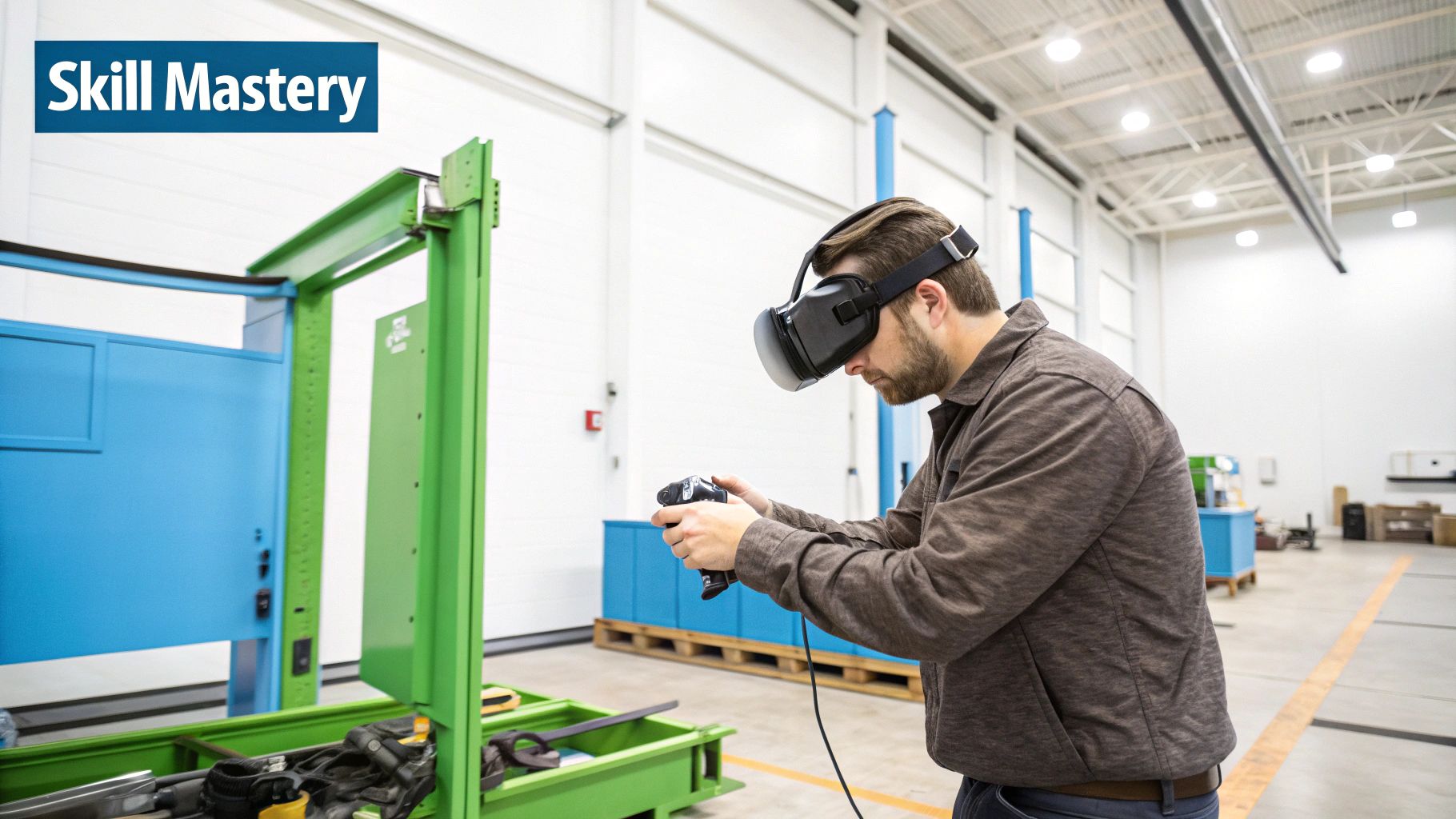
We've moved past "what if" and landed squarely on "what's next." The advantages of integrating virtual reality in education and workforce training are no longer just promising ideas; they're producing real, measurable results. These aren't abstract concepts but concrete outcomes that directly improve safety, accelerate skill mastery, and boost the bottom line.
This isn't just a new tool—it's a fundamental change in how we prepare people for complex, high-stakes work. VR provides a digital sandbox where learning happens fast and real-world consequences simply don't exist.
A New Era of Safety and Skill Mastery
The most immediate and powerful benefit of VR training is the ability to create a zero-consequence learning environment. Trainees can practice hazardous procedures, operate dangerous machinery, and run through emergency drills in a completely safe, controlled digital space.
This freedom to fail, learn, and repeat is where real competence is built. A new technician can practice de-energizing a high-voltage panel dozens of times, making every possible mistake in the simulation. By the time they step up to the real thing, their actions are second nature, dramatically reducing the risk of a costly or tragic accident.
Immersive training allows for unlimited practice on demand. This repetition builds not just knowledge but instinct, ensuring employees can perform critical tasks correctly under pressure, every single time.
This hands-on, learn-by-doing approach has a massive impact on retention. Studies show that learners in VR can achieve up to 75% higher retention rates compared to sitting through a traditional lecture. When you learn by doing, the knowledge sticks. You can dig deeper into the key benefits of virtual reality training and see how it drives performance.
Driving a Strong Return on Investment
Beyond just safety and skills, VR training delivers a powerful and measurable return on investment (ROI). Organizations are seeing significant cost savings that quickly justify the initial setup. The economic advantages are clear and come from a few key areas of operational efficiency.
The financial impact can be significant:
- Zero Material Waste: Trainees can learn to weld, paint, or assemble complex parts without using a single piece of physical material until they've perfected their technique.
- No More Travel Expenses: Subject matter experts and trainees no longer need to fly to centralized training facilities, saving thousands on airfare, hotels, and per diems.
- Minimized Equipment Downtime: Critical machinery can stay online and productive while employees train on its digital twin, preventing costly interruptions to operations.
A Growing Market Confirms the Value
These benefits are exactly why the adoption of immersive learning is exploding. The combined augmented and virtual reality in education market was valued at $27.1 billion in 2025 and is projected to hit $116.6 billion by 2035—a compound annual growth rate of 15.7%.
This kind of growth shows that enterprises no longer see VR as an experiment. It's becoming a core component of a modern workforce strategy. You can discover more insights about these VR training statistics and what they mean for the industry.
The business case is straightforward. By improving safety, accelerating skill development, and cutting operational costs, VR training is moving from a "nice-to-have" technology to an essential tool. The benefits aren't theoretical anymore—they are tangible, measurable, and already transforming industries.
How Industries Are Using VR Training Today
The true power of virtual reality in education comes alive when you see it working on the factory floor, in a hospital, or on a remote energy platform. This is where theory gets put to the test, and where VR proves it’s not just a novelty, but a core solution to serious operational challenges.
We’re not talking about small, incremental improvements here. We’re seeing fundamental shifts in how companies teach critical skills, protect their people, and drive efficiency. Each use case tells a story of a specific, tough problem that was solved with immersive learning. Let's dig into how some of the most demanding industries are putting this technology to work right now.
Manufacturing Precision and Safety
In manufacturing, a single mistake can spiral into massive costs, grind production to a halt, or worse, cause a serious injury. VR training hits these risks head-on by creating a perfect digital twin of the factory floor, a place where employees can master complex jobs in a totally safe and controlled space.
Consider what it takes to get a new employee up to speed on a multi-stage assembly line.
- The Problem: On-the-job training can be slow. It pulls experienced employees away from their work to mentor trainees, and it puts expensive equipment at risk. One wrong move, and the whole line could go down.
- The VR Solution: A new hire puts on a headset and is instantly standing at their virtual workstation. Guided by interactive prompts and instant feedback, they can practice the entire workflow—from picking the right parts to running final quality checks—as many times as they need. They're building real muscle memory and confidence without ever touching a physical machine.
- The Result: Companies are slashing onboarding times, seeing assembly errors drop by up to 90%, and watching workplace accidents plummet. New hires walk onto the floor on day one already competent, confident, and ready to work safely.
VR turns training from a passive, watch-and-learn exercise into an active, learn-by-doing experience. It’s the most powerful way to build lasting muscle memory for complex, hands-on tasks.
Transforming Healthcare and Medical Training
The medical world has embraced VR to completely change how professionals are trained, whether it’s for a delicate surgical procedure or a difficult patient conversation. The technology offers a zero-consequence environment to practice skills where, in the real world, a mistake could be devastating.
Surgical training is one of the most compelling examples. Surgeons can rehearse incredibly complex operations on anatomically perfect virtual patients, sharpening their technique and planning for any complication they might encounter. This gives them the freedom to practice endlessly, building a level of precision that used to take years of live procedures to develop. To get a better sense of these applications, you can learn more about industrial virtual reality and how it’s changing specialized fields.
But it’s not just about technical skills. VR is also a game-changer for building empathy.
- The Problem: It’s one thing to read about a patient's condition; it's another to truly understand what they're going through. How can a clinician grasp the daily reality of someone with impaired vision or mobility?
- The VR Solution: A training module lets a doctor or nurse experience the world through the eyes of a patient with macular degeneration or see how disorienting the after-effects of a stroke can be. They gain a profound, firsthand understanding of the patient's struggle.
- The Result: This visceral experience builds a much deeper sense of empathy. It leads to better communication, more compassionate patient care, and ultimately, more effective treatment plans.
Mastering Hazardous Environments in Energy
The energy sector operates in some of the most dangerous places on earth. Here, safety training isn't just a box to check—it's a lifeline. VR gives these teams the ultimate tool for emergency prep, letting them drill for worst-case scenarios in a way that feels intensely real but is 100% safe.
Imagine trying to train a crew for a critical failure on an offshore oil rig. A physical drill would be outrageously expensive, disruptive, and still couldn't replicate the true danger. In VR, the entire team can run through the emergency shutdown protocol, coordinate a response to a simulated fire, and practice evacuation procedures in a hyper-realistic, high-stress scenario. This kind of repetition builds the gut-level instincts they need to perform perfectly when it matters most.
A Practical Roadmap for Implementing VR Training
Jumping into VR training doesn’t have to feel like a leap into the unknown. Think of it as a well-planned journey with clear, manageable stages. This roadmap breaks down the process, giving you a practical framework to build a scalable and effective VR training program from the ground up.
Success starts with one critical first step: knowing exactly what you want to achieve. A powerful VR program is always built on specific, measurable learning objectives.
Phase 1: Define Your Learning Objectives
Before you even glance at a headset or a piece of software, you need to pinpoint the exact skills you want to teach and the business problems you’re trying to solve. Are you looking to slash safety incidents? Speed up new-hire onboarding? Improve the quality of complex technical repairs?
Your goals will dictate your entire strategy. For instance, a program designed to teach hazardous material handling is going to look completely different from one focused on customer service skills.
The most effective VR training initiatives are built on a foundation of clear, well-defined outcomes. Don't ask "What can we do with VR?" Instead, ask "What is our biggest training challenge, and how can VR solve it?"
This approach ties your investment directly to a real business need, which makes it much easier to get buy-in from stakeholders and prove the program’s value down the line. A structured approach to content is key, a principle that holds true across all learning platforms, as seen in expert guidance on creating and selling online courses.
Phase 2: Choose Your Content and Hardware Strategy
With your objectives locked in, it’s time to decide how you'll source your training content and the hardware to run it. This is a crucial fork in the road that will impact your budget, timeline, and ability to scale.
You really have two main paths for content:
- Off-the-Shelf Solutions: These are pre-built training modules for common skills, like forklift operation or basic welding. They’re a great way to get started quickly and cost-effectively for standardized tasks.
- Custom Development: When you’re dealing with proprietary equipment or highly specialized processes, custom-built content is the only way to go. This approach creates a perfect simulation of your unique work environment for maximum relevance and impact.
As the diagram shows, while the core technology is consistent, the application has to be tailored to solve specific industry challenges. Your hardware choices—from powerful PC-tethered headsets to convenient standalone devices—should be driven by how intense and demanding your content is.
Phase 3: Select a Deployment Model
Next, how will your employees actually use the training? Your deployment model has to fit your company’s structure and workflow. There's no one-size-fits-all answer here; the goal is to pick the path of least resistance for your team.
Here are the most common models:
- Centralized Training Lab: Think of a dedicated room with VR stations where employees come for scheduled training. This setup is perfect for controlled, instructor-led learning and makes hardware management a breeze.
- Distributed On-Site Access: This means putting VR headsets right where the work happens—on the factory floor or in the maintenance shop. It enables on-demand, "just-in-time" training and quick skill refreshers.
- Individual Remote Access: For a geographically scattered workforce, shipping headsets directly to employees for remote or at-home training offers the ultimate flexibility and scalability.
Phase 4: Integrate and Scale Your Program
The final piece of the puzzle is making sure your VR program plays nicely with your existing tech stack. This means integrating VR performance data with your Learning Management System (LMS).
This connection is vital. It’s how you track trainee progress, measure completion rates, and ultimately connect what happens in the headset to real on-the-job performance. Modern VR platforms can automatically sync this data, letting you manage users and pull reports from the systems your L&D team already uses every day.
Our advice? Start with a focused pilot program. It’s the best way to test your strategy, get real feedback from users, and build an ironclad case for a wider rollout.
Measuring Success and Proving ROI
Any training program worth implementing has to prove its value. When it comes to virtual reality in education, moving past success stories and into hard data is what secures long-term buy-in and helps you scale the whole operation. Proving a return on investment (ROI) isn’t just about making the finance department happy; it’s about demonstrating how this immersive approach builds a safer, faster, and more effective workforce.
The first step is to look beyond simple pass/fail grades. While it’s good to know who completed a module, the real power of VR is its ability to capture incredibly detailed performance data.
Key Metrics for Evaluating VR Training Programs
To build a compelling business case, you have to track the right key performance indicators (KPIs). These metrics should connect directly to your core business goals, turning training results into tangible, bottom-line impact.
Below is a breakdown of the kind of metrics you should be tracking to measure the true effectiveness and ROI of your VR initiatives.
Key Metrics for Evaluating VR Training Programs
| Metric Category | Key Performance Indicator (KPI) | Business Impact |
|---|---|---|
| Efficiency Gains | Time-to-Competency | Measures how quickly a new hire reaches full productivity, which directly cuts onboarding costs and gets them contributing sooner. |
| Quality Improvement | Error Rate Reduction | Tracks the decrease in on-the-job mistakes after training, leading to less wasted material, fewer reworks, and higher-quality output. |
| Safety and Compliance | On-the-Job Incident Reduction | Monitors the drop in safety violations or accidents, which can lower insurance premiums and prevent hugely expensive operational shutdowns. |
Framing your results with these KPIs helps shift the entire conversation. Training stops being seen as a cost center and starts being recognized for what it is: a strategic investment in your people and your performance.
Turning Data into Actionable Insights
Modern VR training platforms are data-gathering powerhouses. Every single action a trainee takes inside a simulation—every glance, every decision, every slight hesitation before flipping a switch—can be recorded and analyzed. This creates a crystal-clear picture of individual and team performance that is simply impossible to get from a lecture or a manual.
With this level of detail, you can:
- Pinpoint specific skill gaps across your entire workforce with surgical precision.
- Identify the exact procedural steps where people consistently get stuck or make mistakes.
- Give trainees targeted, personalized feedback that actually helps them improve.
This isn't just about training people anymore; it’s about constantly fine-tuning the learning process itself.
By capturing detailed performance analytics, VR training transforms learning from a one-time event into a dynamic, data-driven cycle of continuous improvement. This approach ensures your workforce is always operating at peak performance.
A Simple Framework for Calculating ROI
Figuring out your ROI doesn’t have to feel like advanced calculus. At its heart, the formula is simple: compare the total financial gains you got from the program to what it cost to run it. The key is in putting a real dollar value on the benefits your KPIs have uncovered.
Think about it. You can calculate the direct savings from a 50% reduction in new-hire onboarding time. You can quantify the value of avoiding even a single major safety incident. Or you can tally the increased revenue that comes from a 30% improvement in first-time fix rates for your field service technicians.
Once you add up these tangible gains and weigh them against the costs of hardware, software, and content development, the value proposition becomes undeniable. Investing in virtual reality in education isn't an expense; it’s a direct line to a more capable, efficient, and safer workforce.
Common Questions About VR in Education
When organizations first start looking into virtual reality in education, a few key questions always pop up. Getting clear, practical answers to these is the first step toward building a training program that works and can grow with you.
These questions from enterprise and institutional leaders usually boil down to cost, tech integration, and what VR can really teach. Let's break them down.
What Is the Typical Cost to Implement a VR Training Program?
There’s no single price tag—it all depends on the scale and complexity of your goals. The main cost drivers are the hardware (headsets), software licenses, and the training content itself. For general skills, like forklift safety, you can find off-the-shelf modules that are affordable and a great way to get started.
If you need training for your specific machinery or internal processes, you will likely be looking at custom-developed content, which requires a larger initial investment. The key is to weigh that upfront cost against the long-term ROI. Think about the savings from slashing travel budgets, eliminating material waste, and reducing wear and tear on live equipment—that return often shows up faster than expected. A smart move is to launch a focused pilot program to prove the value and manage initial costs before a wider rollout.
How Does VR Training Integrate with Our Current LMS?
This is a critical point, and the good news is that modern VR training platforms are built to play nicely with your existing systems. Most are designed to connect with your Learning Management System (LMS) using established standards like SCORM or xAPI. This isn't an afterthought; it's a core feature.
This connection makes everything smoother. You get unified user management, automated progress tracking, and centralized reporting, all within the system your team already uses every day. The integration usually involves configuring APIs so performance data flows from the VR platform straight into your LMS. Your VR solution provider typically handles this setup to make sure the experience is seamless for both your admins and your learners.
Is VR Effective for Training Soft Skills?
Absolutely. People often think of VR for technical and safety training, but it's an incredibly powerful tool for developing soft skills, too. Immersive simulations can drop employees into realistic, high-stakes scenarios that are almost impossible to replicate any other way.
Imagine a new manager practicing a difficult performance review, or a customer service agent learning to de-escalate a tense situation with an unhappy client.
VR provides a safe space to practice communication, empathy, and conflict resolution over and over again, with immediate, objective feedback. The emotional connection you get from these true-to-life scenarios makes virtual reality in education uniquely effective for building interpersonal skills that actually stick.
Ready to see how immersive learning can solve your organization's most pressing training challenges? The experts at AIDAR Solutions can help you design, deploy, and scale a VR program that delivers measurable results. Explore our solutions and book a consultation.

