
A Guide to Training with Virtual Reality in Your Business
Training with virtual reality shifts employees from being passive observers to active participants. It’s the difference between reading a flight manual and stepping into a hyper-realistic flight simulator. This jump into an immersive world unlocks powerful, hands-on learning experiences that are risk-free and can be repeated endlessly until a skill is second nature.
The Immersive Leap in Corporate Training
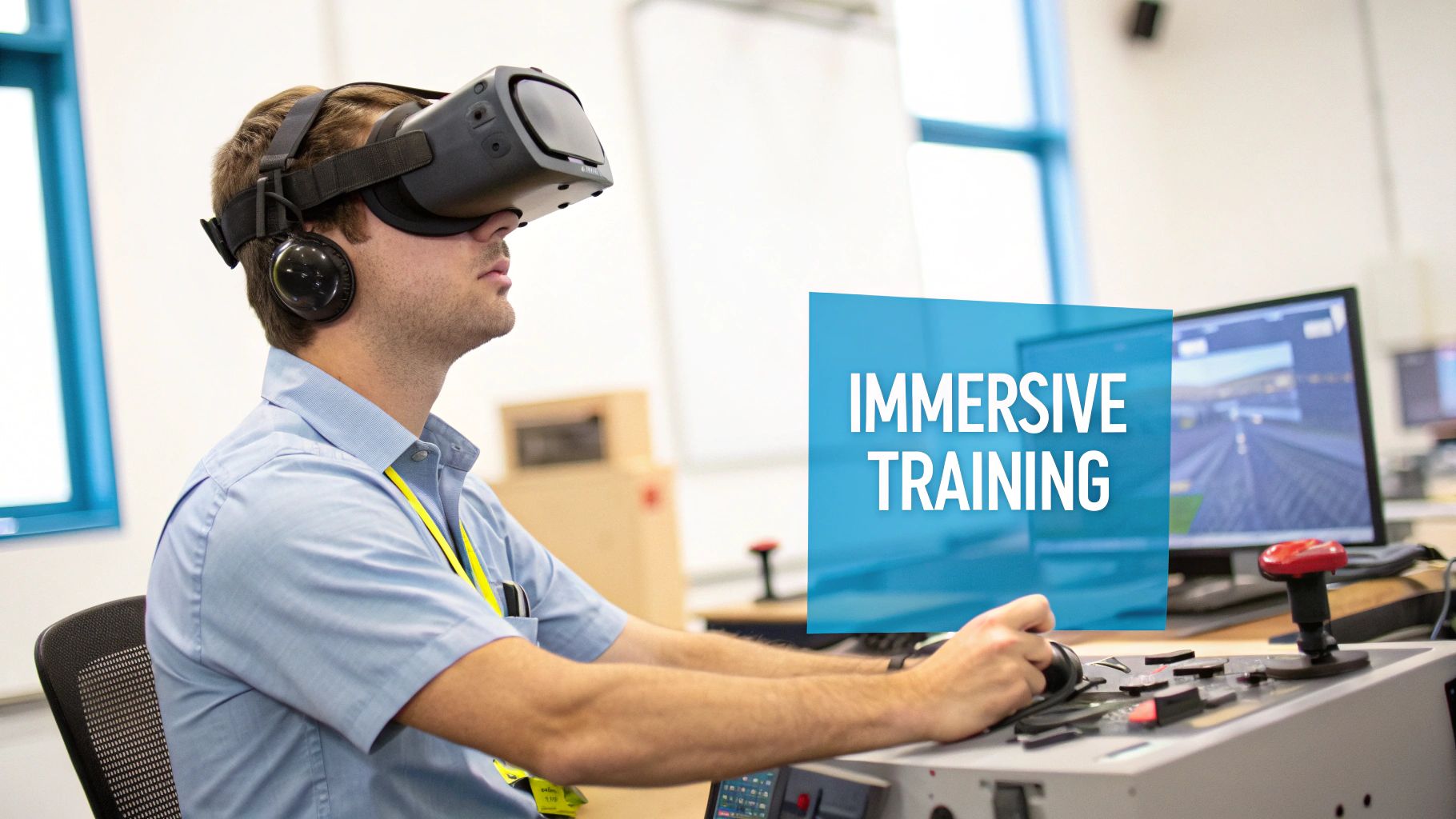
Traditional corporate training often leans heavily on slideshows, manuals, and classroom lectures. While these methods have their place, they don't always prepare people for the reality of the job, especially in high-stakes fields like manufacturing, healthcare, or field service. Information gets presented, but the hands-on application feels disconnected, often delayed until the employee is already on the floor.
VR training bridges that gap by creating a digital twin of the actual work environment. An employee doesn't just read about operating a complex piece of machinery; they put on a headset, step onto a virtual factory floor, pick up digital tools, and run through the exact sequence required for the job. This "learning by doing" approach is where real mastery begins.
From Theory to Practice, Instantly
The value of VR is how it fuses learning with doing. Instead of wrestling with abstract concepts, employees build muscle memory and procedural knowledge in a completely controlled setting. This creates an immediate feedback loop where mistakes become valuable learning opportunities, not costly real-world errors.
Here’s where it gets powerful:
- Risk-Free Environments: Trainees can practice responding to rare or dangerous equipment failures without any physical risk. This builds confidence and sharpens critical thinking for when it truly matters.
- Endless Repetition: A complex, multi-step procedure can be practiced over and over until it’s perfected. Trying to do that with expensive, mission-critical physical equipment is often impractical or costly.
- Standardized Instruction: Every single employee gets the exact same high-quality training experience, which guarantees consistency across the entire workforce, no matter who is leading the session.
By placing learners directly into a simulated environment, VR training transforms abstract knowledge into tangible skills. It flips the switch on learning, turning it from a passive activity into an active, engaging experience that drives deeper understanding and retention.
This method is a perfect example of immersive learning, where technology creates a simulated world that fully captures a learner's attention. The result is a more confident, competent, and well-prepared workforce, ready to tackle challenges from day one.
Why VR Training Drives Real-World Performance
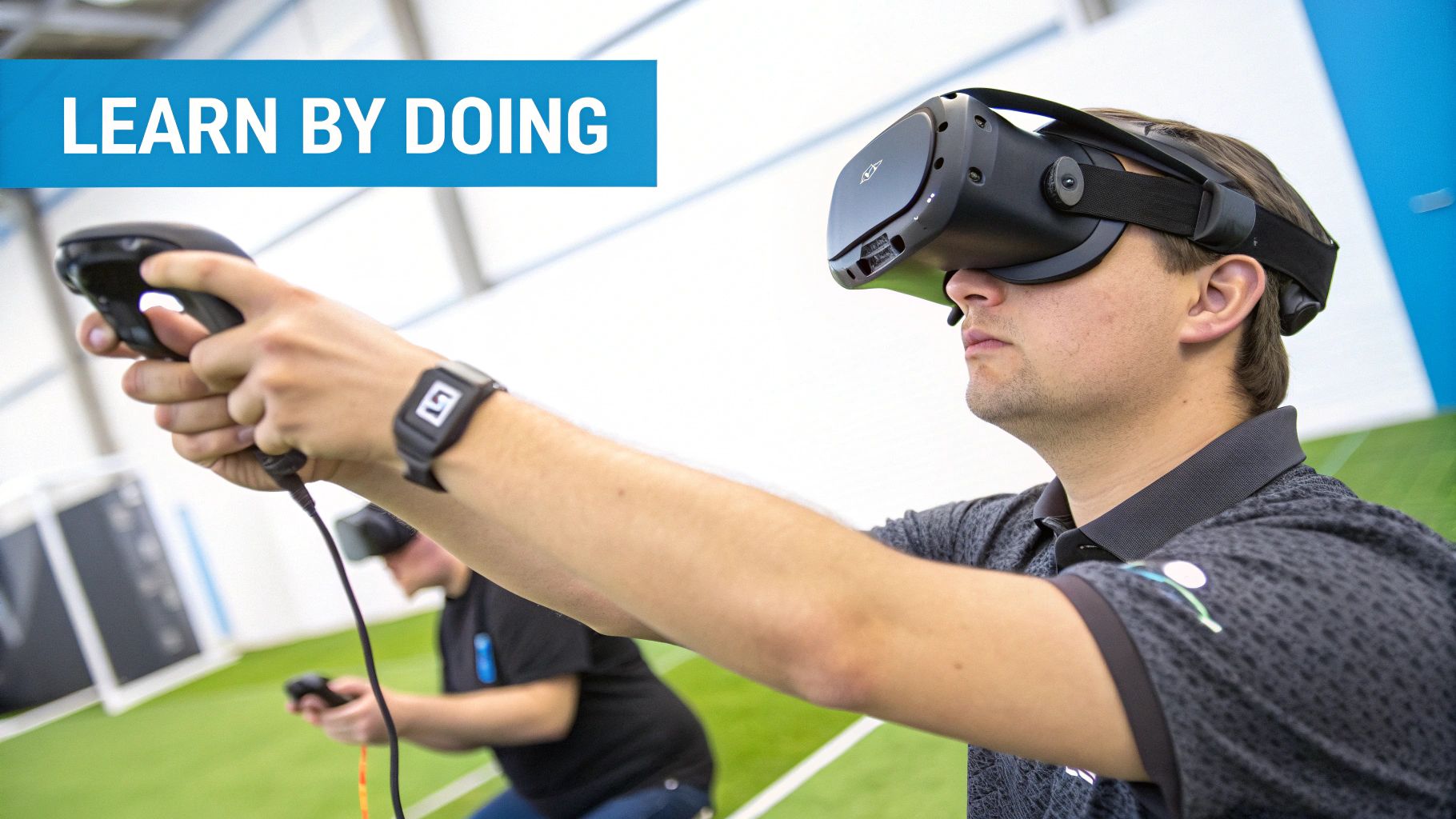
What makes training with virtual reality so effective? It all comes down to how our brains are wired to learn. Traditional methods often ask learners to read, listen, and memorize. VR flips that on its head by creating a hands-on environment where people learn by doing.
This approach is built on the science of experiential learning. When you engage multiple senses—sight, sound, even touch via haptic feedback—your brain creates much stronger, more permanent neural connections. Instead of just reading about how to fix a complex machine, a technician can actually perform the entire repair digitally. They build real muscle memory and procedural knowledge in a space where it's impossible to break anything.
This active participation is the secret. Mistakes become valuable lessons, not expensive real-world errors. This safe, repeatable practice builds confidence, preparing your team for complex or dangerous situations in a way classroom learning never could.
The Science of Doing and Remembering
The real power of VR is its ability to simulate reality so convincingly that the brain treats the experience as real. This forges a strong link between knowing something and actually being able to do it. It’s similar to learning to ride a bike—you can read all the books you want, but you only really learn once you get on and start pedaling.
VR's effectiveness isn't magic; it aligns perfectly with proven educational models like constructivist learning theory, which says people build knowledge through active experience, not by passively absorbing information. That’s exactly what a well-designed VR simulation delivers.
This hands-on method has a direct impact on two things every business cares about: how fast people learn new skills and how long they remember them. When learning is active and put in context, employees grasp concepts faster and retain them longer.
Accelerating Skills and Boosting Retention
The numbers back this up. Study after study shows that VR training doesn't just improve learning outcomes—it radically shrinks the time needed to get someone up to speed. Organizations using VR have reported a 76% increase in learning effectiveness compared to traditional methods.
This efficiency also translates into significant time savings, with some companies slashing training time by as much as 75%. Perhaps the most impressive statistic is about long-term recall. Employees who learn in VR can retain up to 80% of what they learned a full year later. That number significantly outperforms conventional training retention rates.
These figures aren't just interesting talking points; they build a rock-solid business case for VR by showing real, measurable performance gains.
VR training closes the gap between knowing and doing. It lets employees fail safely, practice endlessly, and master skills in a controlled digital environment, making sure they’re truly ready for whatever the real world throws at them.
This level of preparation is invaluable, especially in fields where a single mistake can have major consequences for safety, production, or customer relationships.
Building Confidence in Complex Scenarios
Beyond just teaching skills, VR is excellent at building situational awareness and confidence. An employee can face a simulated emergency—like an unexpected assembly line shutdown or a challenging customer issue in the field—and practice their response over and over again.
This offers several key advantages:
- Reduces On-the-Job Anxiety: New hires can walk onto the floor feeling like they've already done the job a dozen times.
- Improves Critical Thinking: By presenting varied and unexpected problems, VR trains employees to think on their feet and make smart decisions under pressure.
- Ensures Procedural Compliance: Complex safety protocols and multi-step procedures can be drilled until they become second nature, dramatically cutting the risk of human error.
Ultimately, training with virtual reality isn't just about teaching someone a task. It's about preparing your workforce for the dynamic and unpredictable nature of their jobs. You end up with a team that isn’t just skilled but is also confident, adaptable, and ready to perform at their best from day one.
Where VR Training is Making a Real Impact
The theory behind immersive learning is compelling, but where does it deliver practical value? The real power of training with virtual reality shines when you apply it to specific, costly operational problems. This is where we see the technology delivering measurable wins in high-stakes industries.
In fields like manufacturing, maintenance, and field service—where a single mistake can impact safety, quality, and the bottom line—VR is a strategic tool. It lets you front-load experience, turning a new employee into a capable professional faster than ever, without disrupting a single live operation.
Manufacturing and Assembly
Picture a new hire on a busy automotive assembly line. The old way of training involves shadowing a senior technician, a process that’s slow, often inconsistent, and takes a veteran employee off the floor. With VR, that new hire can step right into a perfect digital twin of their workstation.
They can run through a complex assembly sequence over and over, guided by visual overlays and instant feedback on their performance. This builds muscle memory and procedural confidence before they ever touch a real piece of equipment.
- Mastering Complex Processes: Trainees learn the exact sequence for putting together intricate components, slashing the risk of errors that lead to production bottlenecks or quality control issues.
- Improving Safety Compliance: Employees can practice critical lockout/tagout procedures and other safety protocols in a simulated environment, ensuring they know the rules by heart without any real-world risk.
- Accelerating Onboarding: New hires get up to speed in record time, arriving on the factory floor already confident and competent in their main tasks. To see just how effective this is, check out how the automotive industry trains employees in virtual reality and the impact it's having on production.
Equipment Maintenance and Repair
For maintenance technicians, troubleshooting a massive piece of machinery is a high-pressure job where downtime can cost thousands per minute. VR training gives them hands-on experience with a wide range of equipment and failure scenarios—many of which would be impossible or dangerously impractical to replicate on the shop floor.
A technician can put on a headset and find themselves staring at a malfunctioning industrial generator. They can safely take it apart, pinpoint the faulty component, and walk through the entire repair, all with interactive guidance. This builds the diagnostic skills they need for when they face the real deal.
In maintenance, VR acts as a playbook for every possible problem. It allows technicians to practice rare but critical repairs, ensuring that when an unusual breakdown occurs, they have already solved it virtually.
This proactive training directly boosts key metrics by cutting down equipment downtime and making first-time repairs the norm, not the exception.
Field Service Operations
Field service agents are the face of your company, and their performance is directly tied to customer satisfaction. Their job is a mix of technical skill and communication, especially when things go wrong. VR is a fantastic tool for sharpening both.
A junior agent can run through a tense conversation with a simulated customer, learning de-escalation techniques in a place where it’s safe to fail. They can also practice complex installation or repair jobs for specific products, making sure they show up at a customer’s site fully prepared.
This level of readiness leads to real results:
- Higher First-Time Fix Rates: Agents who have already performed a repair in VR are far more likely to get it right on the first visit, reducing the need for expensive follow-up trips.
- Enhanced Customer Satisfaction: A prepared, confident agent delivers a smoother, more professional service experience that builds customer loyalty.
- Standardized Service Quality: VR ensures every single agent, no matter their location or experience level, is trained to the exact same high standard.
Building Your VR Training Implementation Roadmap
Successfully rolling out training with virtual reality requires more than just buying headsets; it demands a clear, strategic plan. A well-thought-out roadmap turns technology into a core part of your workforce development strategy, ensuring your investment is tied directly to business goals and solves real-world operational problems from the start.
The journey begins not with the tech, but with your people and processes. Before considering hardware or software, you must pinpoint the specific business pain points you're trying to fix. Are you trying to accelerate technician onboarding? Reduce costly mistakes on a complex assembly line? Or do you need to improve safety compliance for high-risk procedures? Identifying these high-impact use cases is the first step.
From there, you can set clear, specific learning objectives. A vague goal like "improve maintenance skills" is insufficient. A concrete target is needed, such as "reduce the average time for completing Procedure X by 30%" or "achieve a 95% pass rate on the safety protocol simulation for all new hires." These specific goals guide the entire implementation and make it possible to measure your success.
The diagram below shows how VR training can be applied across key operational areas, from the factory floor to the field.
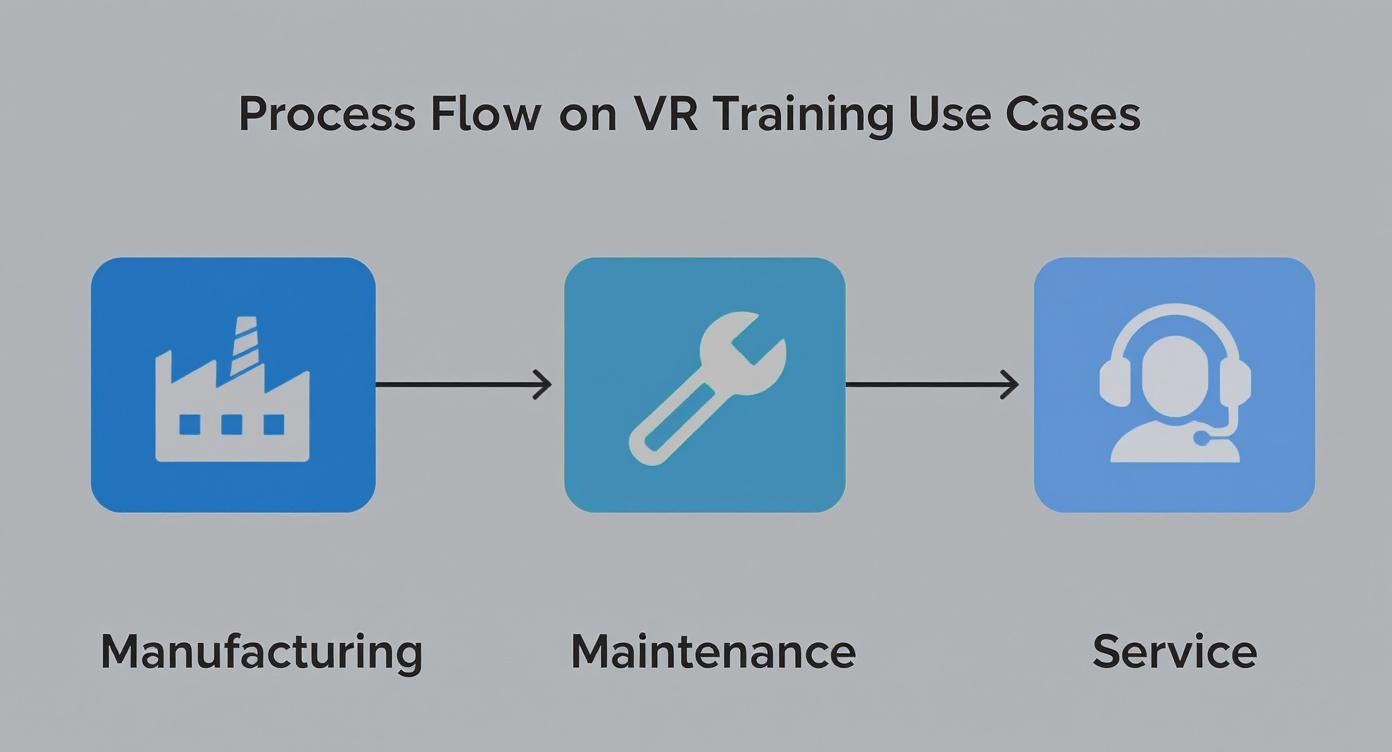
This visual highlights how a single technology can be adapted to solve distinct challenges in manufacturing, maintenance, and service, creating a unified approach to skill-building across the board.
Choosing Your Technical Path
Once your objectives are locked in, it's time to address the technical details. This phase boils down to two critical decisions: picking the right hardware and figuring out your software strategy. The hardware choice should be driven entirely by your use case. A simple, standalone headset might be perfect for individual procedural training, while more complex simulations with high-fidelity graphics and haptic feedback will likely demand a more powerful PC-VR setup.
When it comes to software, you face the classic "build versus buy" dilemma.
- Off-the-Shelf Solutions: These are pre-built training modules that are often faster and more budget-friendly to deploy for common tasks, like forklift operation or welding.
- Custom Development: If your processes are highly unique or proprietary, a custom-built simulation is the best approach. It offers a perfect fit but requires a bigger upfront investment in both time and money.
Many organizations end up taking a hybrid approach, using off-the-shelf content for general skills and investing in custom development for their most critical, unique operations.
The most effective VR training programs are those perfectly matched to a specific business need. The technology should always serve the learning objective, not the other way around.
VR Training Deployment SaaS vs On-Premise
One of the most crucial strategic decisions you'll make is how to deploy and manage your VR training platform. Choosing between a cloud-based Software as a Service (SaaS) model and a self-hosted on-premise solution has major implications for scalability, security, and your budget. This isn't a minor detail; it shapes how your program will run day-to-day.
An on-premise deployment gives you total control over your data and infrastructure. For companies with incredibly strict security or regulatory compliance needs, this is often a necessity. The trade-off, however, is that your internal teams are responsible for all hardware maintenance, software updates, and IT support.
On the other hand, a SaaS model offers significant flexibility and makes scaling easy. Your vendor handles all the backend infrastructure, updates, and support, letting you focus completely on the content and your learners. This subscription-based approach usually means lower upfront costs and makes it much simpler to scale your program up or down as your needs evolve.
This table breaks down the key differences to help you decide which path is right for you.
VR Training Deployment SaaS vs On-Premise
| Factor | SaaS (Cloud-Based) | On-Premise (Self-Hosted) |
|---|---|---|
| Initial Cost | Lower, typically a subscription fee. | Higher, requires hardware and software licenses. |
| Scalability | High, easily add or remove users. | Limited by your internal IT infrastructure. |
| Maintenance | Handled entirely by the vendor. | Managed by your internal IT team. |
| Data Control | Data is stored on the vendor's cloud servers. | Complete control over data on your servers. |
| Implementation | Faster deployment and setup time. | Slower, requires infrastructure setup. |
| Accessibility | Accessible from anywhere with an internet connection. | Access is restricted to the company network. |
Ultimately, the right choice hinges on your company's specific priorities around security, budget, and internal IT resources. A roadmap that carefully considers these strategic points from the beginning will set your VR training initiative on a clear path to success.
How to Measure the ROI of Your VR Training Program
For any business initiative to be sustainable, it must prove its worth. Training with virtual reality is no different. To move beyond impressive anecdotes and pilot program success stories, you need a solid method to measure its return on investment (ROI). This is how you translate operational improvements into a financial case that justifies the initial and ongoing costs.
Calculating ROI isn't just a numbers game for the finance department. It’s about proving the strategic value of your entire program. When you track the right metrics, you build a powerful business case, secure the executive buy-in needed to expand, and can fine-tune your strategy using hard data. This process turns your training program from a line-item expense into a documented value driver.
Identifying Key Performance Indicators
The first step is figuring out which key performance indicators (KPIs) directly tie your VR training to real business outcomes. These metrics generally fall into two categories: direct cost savings and operational efficiency gains. Getting a true picture of your VR training's impact means collecting solid data and using effective training measurement strategies.
You can start with the most straightforward cost reductions:
- Reduced Travel Costs: Calculate the savings from not having to fly instructors and trainees to central locations for in-person sessions.
- Lower Material and Equipment Expenses: Measure the cost of scrap parts, consumables, and wear-and-tear on real machinery that you’ve avoided by letting trainees practice in a virtual environment.
- Decreased Instructor Time: Quantify the hours your subject matter experts save by letting trainees learn asynchronously in VR. This frees them up for more critical tasks.
Quantifying Operational Gains
Beyond direct savings, VR training delivers major operational improvements that hold immense financial value. This is often where you'll find the most substantial ROI. To measure these gains, you need a baseline of your performance before VR was introduced.
The real story of VR training's impact is told through improved operational metrics. Faster onboarding, fewer errors, and enhanced safety don't just create a better workforce—they directly boost productivity and profitability.
Start tracking these operational KPIs:
- Time to Competency: How quickly can a new hire perform their job well without supervision? VR can slash this time, meaning new employees start adding value much sooner.
- Error Rate Reduction: Keep an eye on how often mistakes are made on the assembly line or in the field. A drop in errors means less rework, fewer warranty claims, and better product quality.
- Increased Safety and Compliance: Track the number of safety incidents or compliance violations. A reduction here leads to fewer accidents, lower insurance premiums, and a safer workplace for everyone.
This focus on measurable results is what's driving such widespread adoption. The global AR and VR training market was valued at around USD 15.84 billion in 2024, a number that shows how quickly companies are embracing immersive tech. And the growth isn't slowing down—projections show the market rocketing to USD 405.49 billion by 2034, all fueled by the clear ROI businesses are seeing.
A simple ROI formula brings it all into focus: (Net Profit / Cost of Investment) x 100. The "Net Profit" is the financial gain from your KPIs minus the program cost. To dive deeper, check out our comprehensive guide on how to measure training effectiveness and apply those same principles to your VR program. By meticulously tracking these numbers, you can confidently prove the financial and operational worth of your immersive learning strategy.
Finding the Right Partner for Your VR Training Program
The success of your immersive learning program hinges on more than just the technology; it comes down to the partner you choose to bring it to life. An ideal partner does far more than sell software. They become a strategic guide, helping you navigate the entire journey from your first idea to a full-scale deployment and beyond. Picking the right one is critical if you want your training with virtual reality program to deliver real results.
Start by looking past the demos and dig into their actual experience. A partner with a proven track record in your specific industry—whether it's manufacturing, field service, or another complex sector—will already understand your operational pain points and learning goals. This is the difference between a generic simulation and a powerful training tool that solves your real-world problems.
Evaluating a Potential Partner's Capabilities
When you start talking to potential partners, your evaluation criteria should be crystal clear and tied directly to your business goals. A true partner brings a mix of technical capability, strategic insight, and dependable support to the table. Their platform shouldn't just meet your needs today; it needs the flexibility to grow with you as your program expands.
Here are the essentials to look for:
- Platform Scalability: Can their solution grow from a small pilot group to an enterprise-wide deployment across multiple sites?
- Content Creation Process: Do they offer a library of ready-to-go modules, or can they support a fully custom development process for your unique, proprietary procedures?
- Hardware Agnosticism: Does their software run on a variety of VR headsets, or are you locked into a single hardware ecosystem?
- Post-Launch Support: What kind of technical support, training, and ongoing help do they offer after the initial sale is complete?
A great partner doesn’t just build what you ask for; they challenge your assumptions and bring new ideas to the table. They should function as an extension of your team, dedicated to achieving your business outcomes.
Integration and Long-Term Vision
Seamless integration is another non-negotiable. Your VR training platform must be able to communicate with your existing enterprise systems, especially your Learning Management System (LMS). Ask potential partners detailed questions about their API capabilities and their track record of integrating with systems like yours. This ensures all your learner data—from progress to completion—flows smoothly, making it simple to track performance and measure ROI.
Finally, find a partner with a clear vision for the future. The world of immersive tech is moving incredibly fast, and you want to be with someone who is committed to keeping up. Ask about their product roadmap and how they plan to incorporate future advancements. For organizations that need to create highly specialized simulations, understanding the process to develop VR applications is a must, and your partner should be able to guide you through that complex but rewarding journey. Choosing a forward-thinking partner makes sure your investment stays valuable for years to come.
Questions We Hear All the Time About VR Training
As leaders explore what training with virtual reality can do for their operations, the same questions often arise. It’s new territory for many. Getting straight answers is the only way to ensure your investment hits the mark. Let's tackle the most common ones.
How Much Is This Going To Cost?
There's no single price tag for a VR training program—it depends on what you need to accomplish. The investment is shaped by a few key factors: the complexity of your simulations, the hardware you choose, and whether you go with a SaaS or on-premise model.
Consider the components:
- Content Development: Building a custom digital twin of your proprietary assembly line will cost more than licensing a standard module for something like forklift safety.
- Hardware: This is your investment in the VR headsets themselves, plus any powerful PCs needed to run them.
- Platform Licensing: You'll also have fees for the software that runs, manages, and tracks all the training data.
While there’s an upfront cost, it must be viewed through the lens of long-term ROI. The real savings come from cutting travel expenses, eliminating material waste, and drastically reducing equipment downtime.
Can We Actually Scale This for a Large, Spread-Out Team?
Absolutely. In fact, scalability is where VR training truly shines, especially with modern SaaS platforms. Once you build a training module, you can deploy it to hundreds or even thousands of employees across the globe, and every single one of them gets the exact same experience.
It sidesteps the logistical challenges of trying to get everyone in a room for in-person training. A new technician in Singapore gets the same high-fidelity, standardized instruction as a seasoned pro in Ohio. Everyone is trained to the same precise benchmark, every time.
The power to deploy consistent, high-stakes training instantly and globally is a massive operational win. It ensures every person, no matter their location, masters critical procedures to the exact same standard.
How Does VR Plug Into Our Existing LMS?
This is a critical question, and the short answer is that any serious enterprise VR platform must integrate cleanly with your existing Learning Management System (LMS). This is usually handled with APIs that let the two systems communicate with each other.
This connection is non-negotiable for tracking progress and proving the training works. When a trainee masters a procedure, completes an assessment, or masters a skill in the headset, that data should flow right back into their profile in your LMS. This gives you a single, unified record of their entire development journey, blending immersive training data with all your other learning metrics.
The corporate market for training with virtual reality is moving fast, growing at a 23.57% CAGR. It’s on track to be as big as the academic market by 2030, all because the ROI is so clear and measurable. This trend highlights the importance of picking a solution that's built from the ground up for enterprise integration. You can discover more insights on the expanding VR education market and what’s driving this growth.
Ready to see how immersive learning can sharpen your workforce? AIDAR Solutions provides the expert guidance and powerful VR platforms needed to solve your toughest training challenges. Explore our solutions today.

