What is VR Training? Discover Its Impact & Benefits
Imagine learning to operate high-voltage equipment by reading a manual versus practicing in a safe, simulated control room. That is the core of VR training. It's a powerful learning methodology that immerses employees in a realistic, interactive simulation using a VR headset, allowing them to master complex skills without any real-world risk.
Stepping Beyond The Manual With VR Training
Traditional training methods have their place, but they often rely on passive learning—reviewing manuals, watching videos, or attending lectures. While these methods can provide a foundational understanding, they are less effective at building the practical, hands-on skills required for high-stakes jobs.
VR training inverts this model. It is designed to shift the focus from merely observing to actively doing.
This active approach is a key component of what makes immersive learning methodologies so effective. Instead of simply reading about safety protocols, an employee can navigate a virtual factory floor, identify hazards, and practice emergency shutdown procedures in real time. The brain processes these simulated experiences in a way that is remarkably similar to real events, which builds knowledge that is retained.
From Theory To Muscle Memory
Muscle memory cannot be developed from a slide presentation. One of the most significant advantages of VR training is its ability to do just that.
When a trainee physically performs a multi-step task—such as assembling complex machinery or calibrating a sensitive instrument—they are not just memorizing steps. They are encoding the physical movements, spatial awareness, and procedural flow into their long-term memory. It is about experiencing the process, not just thinking about it.
The freedom to fail and repeat the task is what solidifies this learning. A new surgeon can practice a delicate procedure dozens of times, refining their technique until the movements become second nature. This level of practice is simply not possible in a live operating room.
By allowing learners to make mistakes safely while still experiencing realistic consequences, VR training builds a unique combination of competence and confidence before they enter a live environment.
A Deeper Understanding of Complex Systems
VR also excels at making the invisible visible. For instance, a technician could virtually step inside an engine to see how its parts interact, or observe the flow of electricity through a complex circuit.
This type of spatial understanding is far superior to 2D diagrams and animations. It provides employees with a deeper, more intuitive grasp of how systems function, which is critical for effective troubleshooting and problem-solving on the job.
The infographic below highlights the core pillars upon which VR training is built.
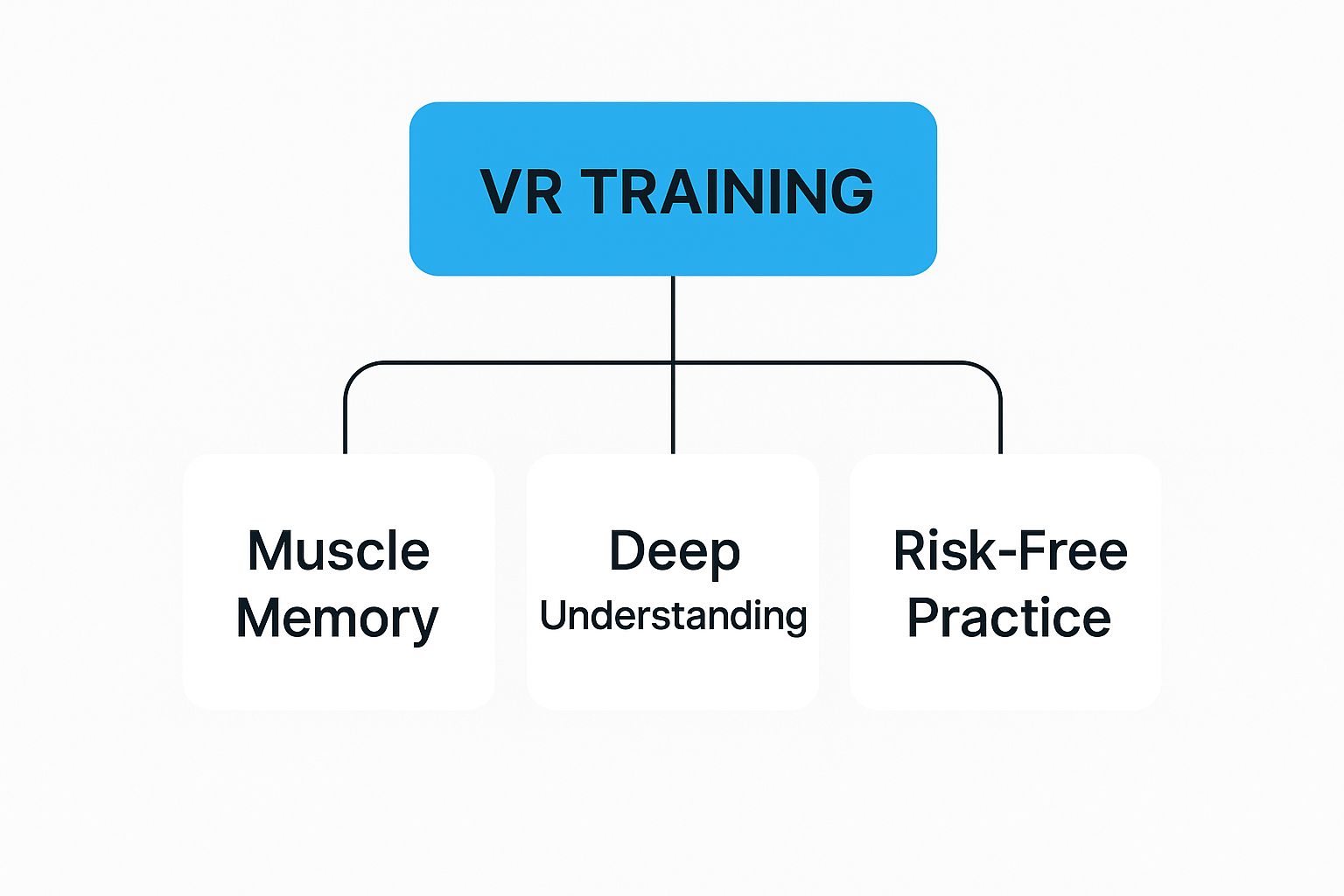
As you can see, the technology is not a gimmick. It directly connects risk-free practice with real, tangible skill development.
Traditional Training vs. VR Training At A Glance
To put this into perspective, let’s break down the fundamental differences between traditional training methods and what VR offers.
| Aspect | Traditional Training | VR Training |
|---|---|---|
| Learning Mode | Passive (reading, listening) | Active (doing, interacting) |
| Engagement | Often low; relies on learner motivation | High; fully immersive and engaging |
| Risk Factor | Can require on-the-job risk or be purely theoretical | Zero real-world risk; safe environment for failure |
| Skill Retention | Lower; "forgetting curve" is steep | High; builds muscle memory and deep understanding |
| Accessibility | Limited by physical location and schedules | On-demand; accessible from anywhere |
| Feedback | Delayed; often from instructors or peers | Instantaneous and data-driven |
While traditional methods lay a theoretical foundation, VR is where that theory is put into practice, building confident, competent teams prepared for any challenge.
The Building Blocks of an Effective VR Program
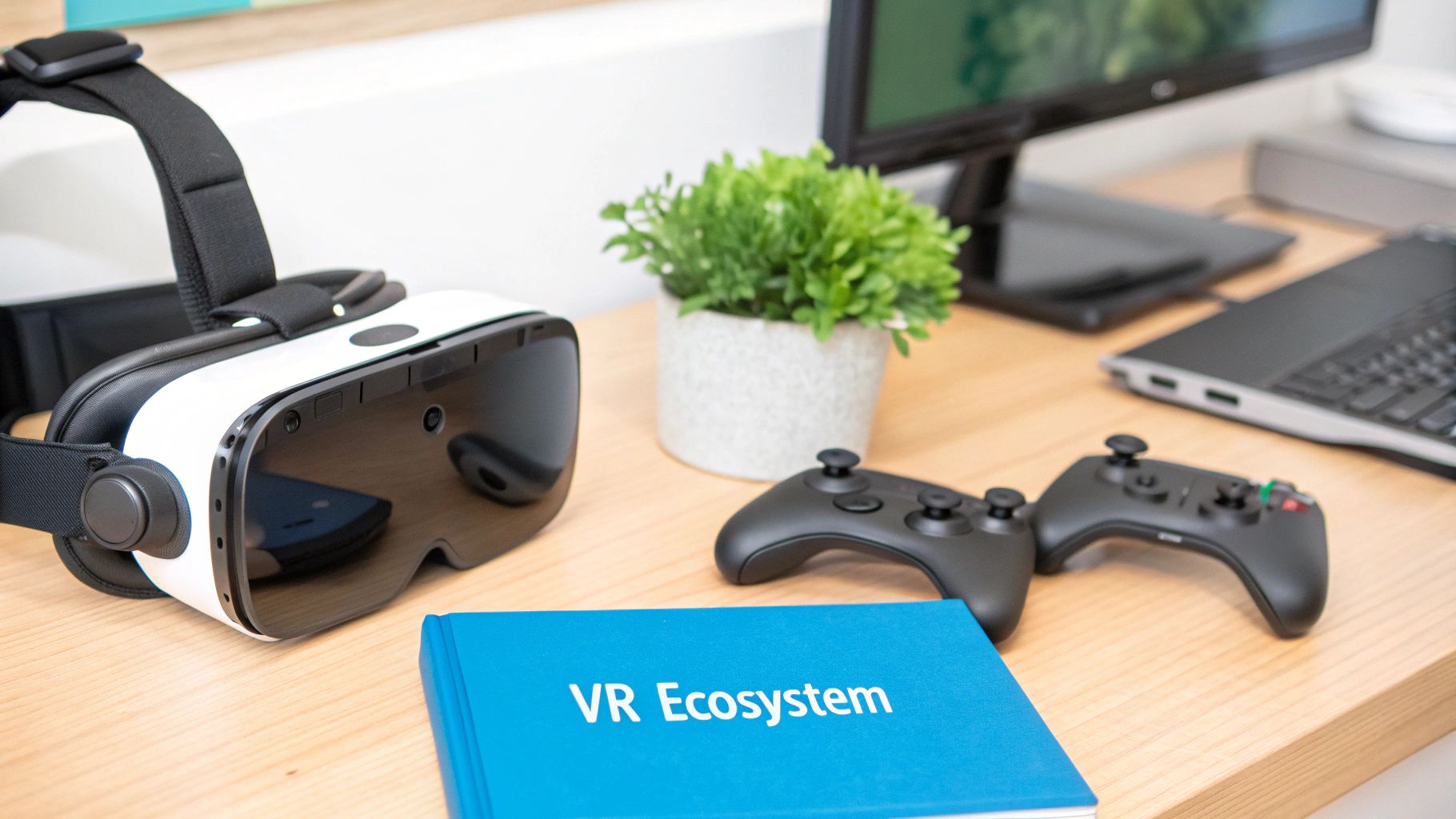
An effective VR training experience is more than just putting on a headset. It is a finely tuned system where hardware, software, and instructional design must integrate seamlessly to create a functional learning tool.
Consider the analogy of building a high-performance vehicle. It requires a solid chassis and engine (hardware), a sophisticated computer managing all systems (software), and a skilled driver with deep knowledge of the track (instructional design). If any one of these components is deficient, the vehicle's performance suffers.
Each part plays a distinct yet interconnected role. Let's examine how these components combine to transform a simple simulation into a data-driven, skill-building platform.
The Hardware: Your Gateway to the Virtual World
Hardware is the most tangible part of any VR setup—it is the physical bridge connecting a user to the digital learning environment. This includes not just the headset, but the entire suite of tools designed to make the experience feel realistic and interactive.
The market for this technology is expanding rapidly. In 2024, the global immersive training market was valued at USD 16.4 billion, with the hardware segment alone accounting for 48.2% of that revenue. This demonstrates the critical role of physical devices, with VR leading the technology share at 46.0%. You can find a more detailed market analysis on immersive training growth over at grandviewresearch.com.
Key hardware components typically include:
- VR Headsets: These are the core of the experience, providing the visual and auditory immersion that convinces the brain it is in another environment. They range from standalone units to more powerful PC-tethered systems.
- Controllers: These devices track hand movements, allowing users to interact with virtual objects naturally. They can be used to grasp tools, operate controls, or assemble parts with intuitive gestures.
- Haptic Feedback: This technology enhances realism. Advanced gear like haptic gloves or vests can simulate the sensation of touch, adding a powerful layer of immersion. Imagine feeling the vibration of a power tool in your hands.
The Software: The Engine of Reality
If hardware is the body, software is the brain. It is the engine that creates the virtual world, governs its physics, and executes the training scenarios. This is what brings the simulation to life, making it respond to every action and creating a believable, interactive space.
The software determines the fidelity of the experience. For a technician learning to repair an engine, the software not only renders the parts but also simulates how they fit together, their weight, and the consequences of incorrect assembly.
A well-designed software platform is the difference between a simple 3D video and a dynamic simulation that responds realistically to every decision a trainee makes. This is where the real learning happens.
This core software allows for extensive customization. Companies can develop scenarios that precisely mirror their specific equipment, workflows, and even the unique hazards their teams face on the job.
Instructional Design: The Blueprint for Learning
This is arguably the most critical component. Instructional design is the "why" behind the training. It is the educational strategy that ensures the virtual experience translates into tangible, real-world skills. Without it, VR training is merely an expensive game.
A robust instructional design framework defines success and maps out the path to achieving it. To build a truly effective virtual reality training program, designers focus on several key areas:
- Clear Learning Objectives: What, specifically, should the employee be able to do by the end of the session? The outcomes must be measurable.
- Guided Scenarios: The program should guide users through tasks, starting with simple steps and gradually increasing complexity.
- Performance Tracking: Every interaction—every click, movement, and decision—is measured. The system tracks metrics such as completion time, accuracy, errors, and procedural adherence.
- Instant Feedback Loops: When a mistake occurs, the software provides immediate, constructive feedback. This allows the user to correct their action on the spot and reinforces the proper technique.
When all three of these pillars—hardware, software, and instructional design—come together, the result is a complete training ecosystem that delivers consistent, measurable, and highly effective results.
Why VR Training Actually Works (And Often Beats the Old Ways)
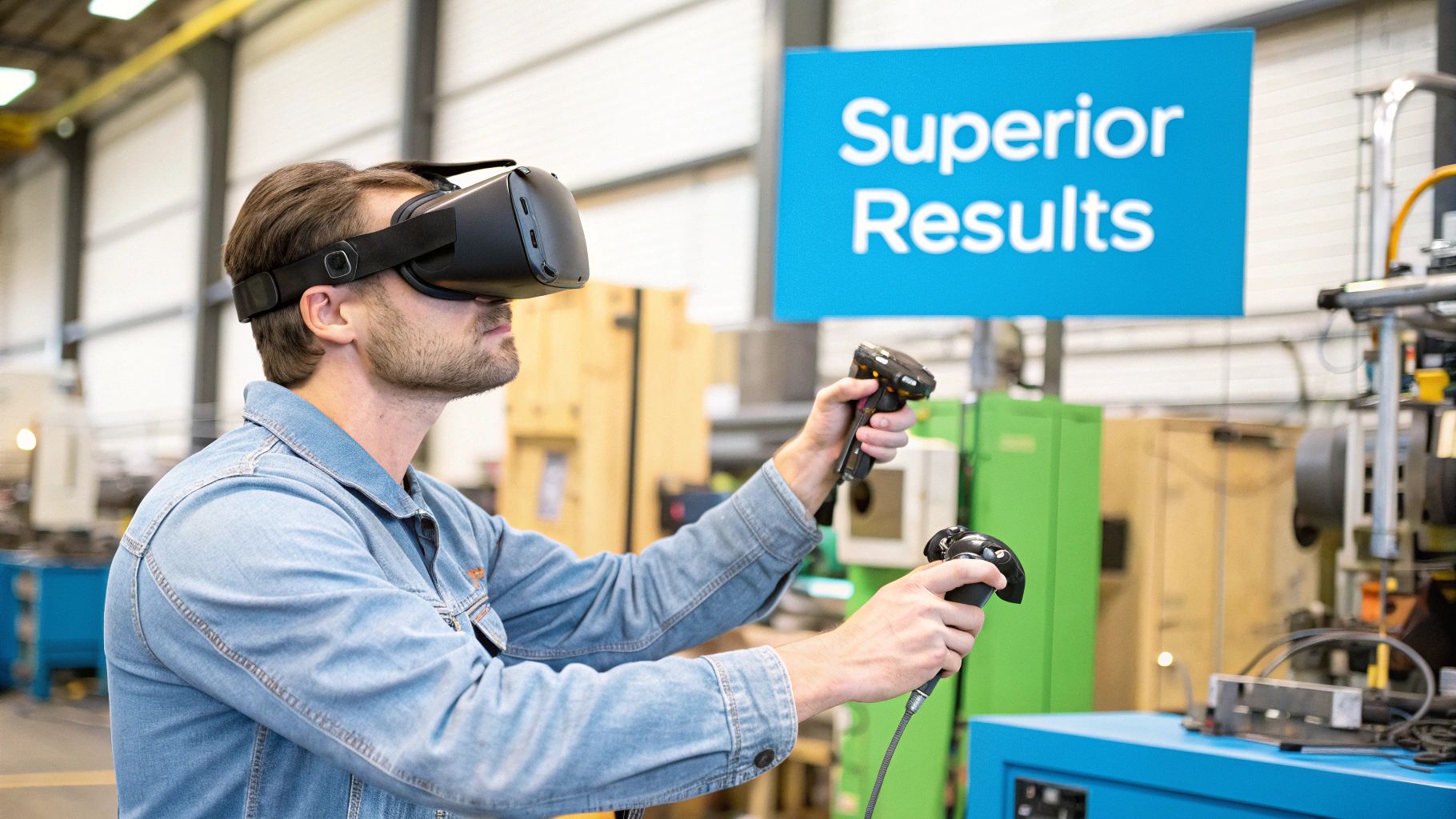
Understanding what VR training is is one thing. Understanding why it so often outperforms traditional methods is where the business case comes into focus. This is not just about innovative technology; it is grounded in the fundamentals of how our brains learn, retain information, and build real-world confidence.
VR transforms learning from a passive, "sit-and-listen" activity into an active, hands-on experience. That fundamental shift unlocks a powerful combination of benefits that manifest where it matters most: in improved safety, stronger skills, and a healthier bottom line.
Let's break down each of these advantages.
Radically Safer Learning Environments
In many industries, "hands-on" training comes with real-world risks. Consider a new technician working with high-voltage equipment, a new hire learning to operate heavy machinery, or a medical student performing a complex procedure for the first time. A single error can have severe consequences.
VR training eliminates that danger entirely.
It creates a zero-risk "digital twin" of the work environment, giving trainees a safe space to practice, fail, and learn from their mistakes. A utility worker can practice lockout/tagout procedures on a virtual substation without any threat of electrocution. This freedom to fail is crucial for building the competence and confidence needed to perform safely on the actual job site.
A Huge Boost to Knowledge Retention
Most people have experienced studying for an exam, only to forget most of the information a week later. That is the "forgetting curve" at work, and it is a major limitation of lecture-based training.
VR training flattens that curve by engaging the brain in a completely different way. Instead of just listening or reading, learners are actively doing. This experiential learning forges much stronger neural connections. When an employee physically performs a task in VR, they are building muscle memory and spatial awareness—elements that cannot be acquired from a textbook.
The immersive nature of the experience also minimizes distractions, leading to a more focused and effective learning session.
This hands-on approach is why studies show VR training can boost learning effectiveness by 76% over traditional methods. Trainees not only learn up to four times faster than in a classroom, but they also report being 275% more confident when it is time to apply those skills on the job.
Getting to Mastery, Faster
Mastering a skill requires significant practice. In the real world, opportunities for practice are often limited by equipment access, instructor availability, or the cost of materials. A multi-million-dollar manufacturing machine cannot be taken offline for hours to accommodate new hire training.
VR training overcomes these roadblocks by offering unlimited, on-demand practice.
A trainee can run through a complex assembly process dozens of times in a single afternoon, receiving instant feedback and refining their technique with each attempt. This dramatically shortens the time required to become proficient, reducing onboarding times and enabling employees to become productive much more quickly.
This rapid skill development is one of the most powerful benefits of virtual reality training for any business seeking to scale its workforce without sacrificing quality.
Real, Measurable Cost Savings
While there is an upfront investment to implement a VR program, that investment often delivers a powerful return by reducing or eliminating some of the largest costs associated with traditional training.
Consider the following potential expense reductions:
- Travel and Hotels: Teams can train from anywhere in the world, eliminating the need for flights, accommodations, and per diems.
- Physical Equipment: There is no need to purchase expensive, dedicated training machinery or consume costly raw materials for practice runs.
- Operational Downtime: Production lines can continue to operate without interruption. All training occurs in the virtual world, leaving real-world operations unaffected.
- Instructor Costs: A single VR program can train hundreds of people consistently, removing the recurring expense of paying multiple trainers for in-person sessions.
Over time, these savings accumulate, making VR a smart financial strategy that builds a more skilled workforce while protecting the bottom line.
VR Training In Action Across Key Industries
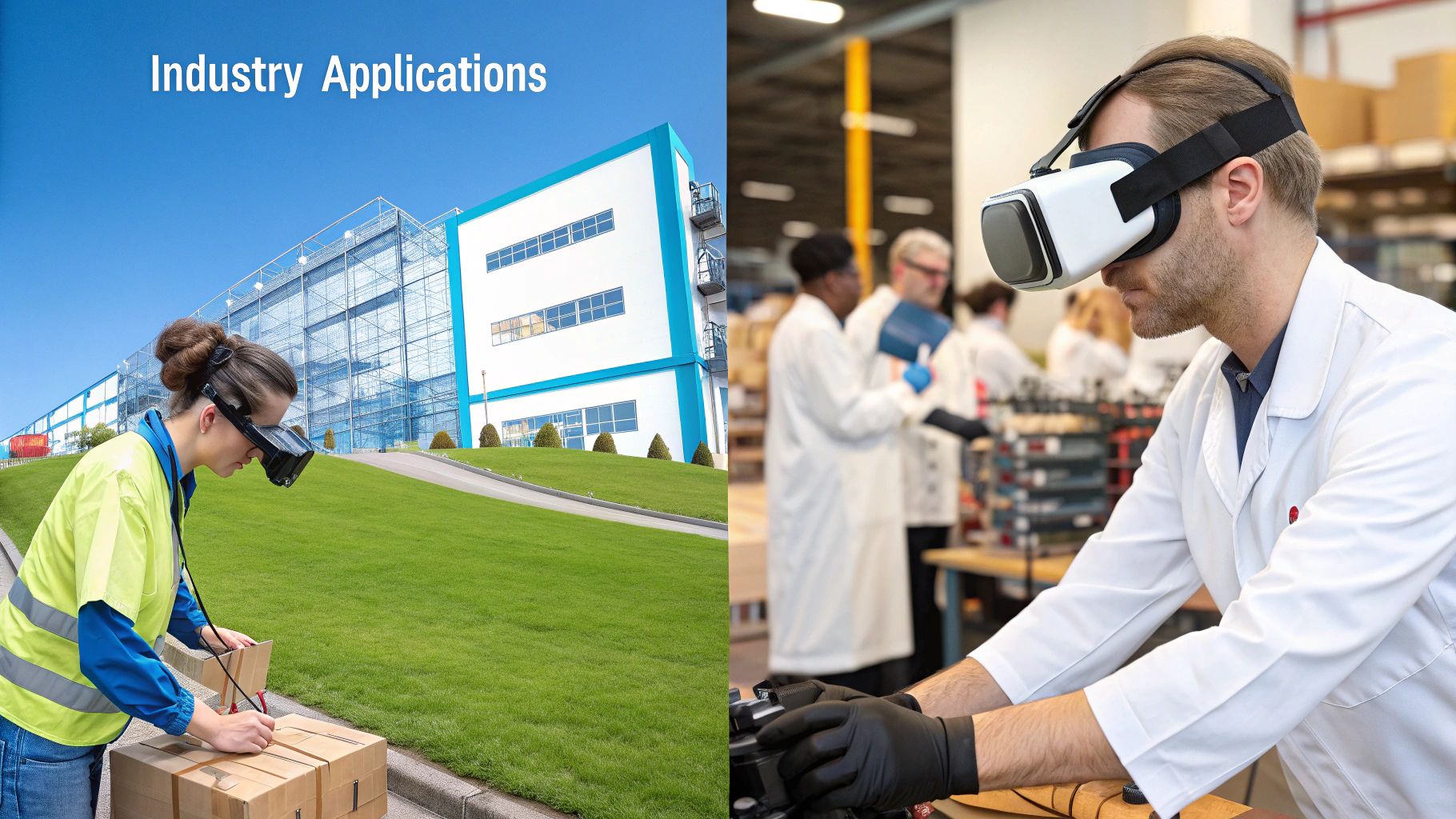
The true value of VR training lies not in theory, but in its practical application to solve real, high-stakes problems. Organizations are moving beyond the "what if" stage and into widespread, practical implementation.
VR is a flexible tool being adapted to fit the unique needs of diverse work environments, from a busy factory floor to the precise setting of an operating room. Let’s examine a few examples of how it is making a significant impact.
Precision And Safety In Manufacturing
Manufacturing requires precision. A single mistake on an assembly line can halt production or, worse, cause a serious accident. VR addresses these challenges by creating a digital twin of the entire production floor.
New hires can gain hands-on experience by practicing everything from complex assembly procedures to operating heavy machinery in a completely safe simulation. They build muscle memory and learn to identify hazards without ever touching a live machine or slowing down the production line. By the time they step onto the real floor, they are confident, competent, and prepared from day one.
VR allows trainees to navigate dangerous scenarios and make mistakes without real-world consequences. They experience the pressure, but the risk is removed. This is how instincts are built before facing a real situation.
This type of hands-on rehearsal significantly reduces the error rates and accidents often associated with traditional on-the-job training. The result is improved efficiency and a much stronger safety culture.
High-Stakes Rehearsal In Healthcare
In the medical field, there is no room for error. VR provides healthcare professionals with a way to practice and perfect their skills in a zero-risk environment. Surgeons can rehearse complex and delicate procedures on virtual patients, mastering new techniques long before they operate on a real person.
The technology is equally powerful for students. They can run through patient diagnoses, emergency response drills, and difficult conversations in immersive simulations. This is how they develop the clinical judgment and bedside manner needed to handle the pressures of a real hospital.
The demand for this technology is substantial. Medical and healthcare training now accounts for 29.7% of the entire AR and VR training market. Large organizations, which comprise 67.3% of the market, are investing heavily in these solutions because they deliver safer, more scalable training. You can get a closer look at the numbers in the full AR and VR training market report.
The table below breaks down how VR is being adopted across different sectors to solve specific training challenges.
Industry Applications Of VR Training
| Industry | Common Training Challenge | How VR Training Solves It |
|---|---|---|
| Manufacturing | High risk of injury and equipment damage during hands-on machinery training. | Creates a safe, simulated environment to practice on complex machinery without real-world consequences, reducing accidents and downtime. |
| Healthcare | Limited opportunities for surgeons and medical staff to practice rare or high-risk procedures. | Offers zero-risk surgical simulations and patient scenarios, allowing for unlimited practice to build mastery and confidence. |
| Logistics | Training forklift operators is slow, ties up valuable equipment, and poses a safety risk in a busy warehouse. | Allows new hires to master forklift controls and navigate warehouse layouts in a virtual space, preventing accidents and equipment damage. |
| Customer Service | It's difficult to prepare staff for emotionally charged or high-stress customer interactions. | Simulates difficult customer conversations, letting employees practice de-escalation and empathy in a controlled, repeatable environment. |
As you can see, the application is not just about learning a task; it's about building the muscle memory and instincts needed to perform under pressure.
Mastering Operations In Logistics And Warehousing
Logistics is about speed and safety. However, training new staff on forklifts and complex inventory systems often requires taking expensive equipment out of operation and dedicating a supervisor's time. This creates a bottleneck.
VR changes that dynamic completely. New operators can use a simulation to master forklift controls, navigate a crowded warehouse, and practice picking orders. They can even experience common hazards—like a blind corner or an unstable pallet—without any danger to themselves, their team, or the inventory. It is a straightforward way to reduce accidents and equipment damage.
Enhancing Soft Skills For Customer Service
VR is not limited to heavy machinery and technical skills. It has also proven to be an incredibly effective tool for developing soft skills. In customer service, for example, employees often have to navigate tense, emotionally-charged conversations.
With VR role-playing, a trainee can be placed directly into a scenario with a difficult customer. They can practice de-escalation, empathy, and problem-solving in a controlled environment and receive instant feedback on their choices. This type of practice builds the emotional resilience and communication skills needed to handle a wide range of customer interactions.
How to Get a VR Training Program Off the Ground
Adopting a new training technology can seem like a major undertaking, but it doesn't have to be. The key is to break the process down into simple, manageable steps. A successful VR training program is not built overnight; it starts with a clear purpose and develops from there.
This roadmap will guide you through the entire journey, from the initial idea to a full-scale rollout.
The first step has nothing to do with technology. It is about identifying a specific business problem you need to solve. A vague goal like "we want VR training" is unlikely to lead to a useful outcome. The entire project must be rooted in a well-defined need.
Perhaps you are trying to reduce forklift accidents, accelerate the onboarding of new assembly line workers, or provide your sales team with a safe space to practice tough negotiations. Pinpointing that specific pain point is the essential starting point.
Start With Clear Goals and a Specific Use Case
Once you have identified the problem, you need to define what success looks like. This means setting clear, measurable learning objectives. These are not vague goals; they are specific, trackable outcomes you expect participants to achieve.
For example, a strong objective might be: "After this VR module, trainees must complete the five-step safety shutdown procedure in under 60 seconds with 100% accuracy." This provides a hard benchmark against which to measure the program's success.
Without concrete goals, you have no way of knowing if the training is effective or calculating a meaningful return on investment.
Choose Your Content Strategy: Off-The-Shelf vs. Custom
With your objectives defined, the next major decision is where the training content will come from. There are two primary paths, each with its own advantages and disadvantages.
- Off-the-Shelf Solutions: These are pre-built modules for common skills like welding, forklift operation, or safety compliance. They are typically faster and less expensive to implement, making them an excellent entry point.
- Custom-Developed Content: If your work involves unique machinery or proprietary processes, you will likely need a custom-built simulation. This path requires a larger upfront investment in time and money, but the result is a training experience that perfectly matches your real-world workflows.
The right choice depends entirely on your specific needs, budget, and timeline. Many companies begin with off-the-shelf content for general skills. Once they see the value, they often invest in custom modules for their more specialized roles.
Run a Pilot Program to Validate Your Approach
Before considering a company-wide deployment, it is essential to run a pilot program. This is your opportunity to test everything with a small, select group of employees and gather their honest feedback. It is a low-risk way to validate the entire concept.
A pilot program is not just about testing the technology—it's about testing the entire process. It is where you will discover unexpected issues with hardware, user onboarding, or the training content itself before they become significant problems.
Use this phase to gather both quantitative data (like completion times and error rates) and qualitative feedback. Ask trainees what they liked, what was confusing, and what they would change. That on-the-ground input is invaluable for refining the program and ensuring a smooth rollout.
Scale Up Thoughtfully
Once your pilot has proven successful, you are ready to scale. This involves more than just purchasing additional headsets. A full-scale implementation requires careful planning around logistics, IT, and ongoing support.
Consider these key areas for a smooth expansion:
- Logistics and Hardware Management: Where will the headsets be stored, charged, and updated? A clear system for managing the devices is necessary.
- IT Integration: Involve your IT department early in the process. You need to ensure the VR systems are compatible with your network and meet all security requirements.
- User Onboarding: Create a simple, frustration-free process to help employees become comfortable with the equipment. The initial experience must be positive.
By following these steps, you can take VR training from a promising idea to a fully functional program that delivers real, measurable improvements in skills, safety, and overall efficiency.
Measuring the ROI of Your VR Training
Implementing a VR training program is an investment. To secure ongoing budget and stakeholder support, you must prove its value. This means going beyond simple metrics like completion rates.
The real impact is demonstrated when you connect your VR training to tangible business results. It is about shifting the conversation from "did they complete the course?" to "how did this training improve their job performance?" When you track the right metrics, you can build a solid case that shows immersive learning is not just an innovative tool—it is a strategic asset.
This focus on real, measurable results is why the market is expanding so rapidly. In 2023, the global VR training market was valued at USD 9.09 billion. Projections indicate it could grow to nearly USD 298 billion by 2033. This is not just hype; it represents a significant industry-wide shift toward training that delivers quantifiable benefits. You can find more statistics about the VR training market's exponential growth at takeaway-reality.com.
Identifying Key Performance Indicators
Before you can measure success, you must define what success looks like for your organization. The first step is to establish clear Key Performance Indicators (KPIs). These are not abstract training statistics; they are the core business metrics your VR program is designed to influence.
Think back to the specific operational challenges you initially set out to solve. Your KPIs should directly reflect improvements in those areas.
Here are a few powerful KPIs you can begin tracking:
- Reduced Employee Error Rates: Compare the number of mistakes made by VR-trained employees with those who underwent traditional training. A lower error rate translates to better quality, less rework, and tangible cost savings.
- Fewer Workplace Accidents: In high-risk environments, a reduction in safety incidents or near-misses is a powerful indicator of success. This provides a clear ROI, especially considering the significant costs associated with a single accident.
- Faster Task Completion Times: Measure how quickly employees can perform specific tasks after their VR sessions. Completing tasks faster without sacrificing quality is a clear sign of skill mastery.
- Improved Quality Metrics: Monitor metrics such as product defect rates or customer satisfaction scores. An improvement in these numbers demonstrates that the training is enhancing overall performance where it matters most.
Calculating Your Return On Investment
Once your KPIs are established, you can begin to calculate your financial return. The formula is straightforward: you compare the total cost of the program against the financial gains it generated. These gains are calculated by assigning a dollar value to the improvements observed in your KPIs. For a more detailed look, see our full guide on how to measure training effectiveness.
Calculating ROI is not just an accounting exercise; it is a strategic tool. It transforms your training program from a 'cost center' into a proven 'value driver' that directly contributes to the company's bottom line.
To build your calculation, start by summing all the costs—hardware, software development, licensing fees, and the time required for implementation. Then, assign a monetary value to the benefits. What are the savings from fewer accidents? The additional revenue from faster production? The money saved by reducing waste?
Subtract the total cost from the total benefit to determine your net return. This data-driven approach provides undeniable proof of your program's impact, making it much easier to justify future investments.
Common Questions About VR Training
As companies begin to explore immersive learning, a few practical questions consistently arise. Let's address them directly, as clarifying these common concerns helps to highlight the real value of a VR training program.
Is This Going to Be Expensive?
Naturally, leaders want to discuss costs. The cost of a VR program is not a single line item; it is a combination of hardware, software development, and any ongoing support required. And yes, there is an upfront investment.
However, this initial cost is often quickly offset by significant long-term savings. For example, you can eliminate travel budgets, reduce material waste from physical training exercises, and see a sharp decline in costly operational mistakes.
Is VR Good for Teaching Everything?
Another important question is whether VR is a universal solution for all training needs. The short answer is no—it is about using the right tool for the job.
VR is exceptionally effective for teaching procedural, spatial, and hands-on skills. It excels in any area where muscle memory and practical application are critical. It is also highly effective for developing soft skills, allowing employees to practice difficult conversations in realistic role-playing scenarios without any real-world risk.
However, for purely theoretical knowledge, such as memorizing company policies from a handbook, traditional methods may still be more efficient. The key is to align the immersive power of VR with the learning objectives that benefit most from hands-on, simulated practice.
What About Motion Sickness?
Concerns about motion sickness or user discomfort are valid, especially considering early VR technology. The good news is that modern hardware and intelligent software design have largely solved this issue.
Today’s professional-grade headsets feature very high refresh rates and precise tracking. This combination eliminates the lag and disorientation that previously caused problems. When this technology is paired with well-designed training modules and best practices—such as ensuring a proper headset fit and keeping sessions to a reasonable length—the experience is comfortable and engaging for nearly everyone.
When implemented correctly, a modern VR training program is designed from the ground up to be an effective, comfortable, and powerful learning tool that drives measurable results.
Ready to see how immersive learning can solve your specific training challenges? The experts at AIDAR Solutions can design a comprehensive action plan to integrate VR into your workflows, delivering rapid and measurable returns. Explore our solutions today.