
Real-World Application of Virtual Reality
While often associated with gaming, the business application of virtual reality is transforming industries. It is not about escaping the world—it's about building a better one.
Picture an aerospace engineer walking through a full-scale digital model of a jet engine, spotting design flaws months before a single piece of metal is cut. That's a practical use case where VR is making its mark, delivering tangible benefits in efficiency and cost savings.
Virtual Reality Is More Than Just a Game
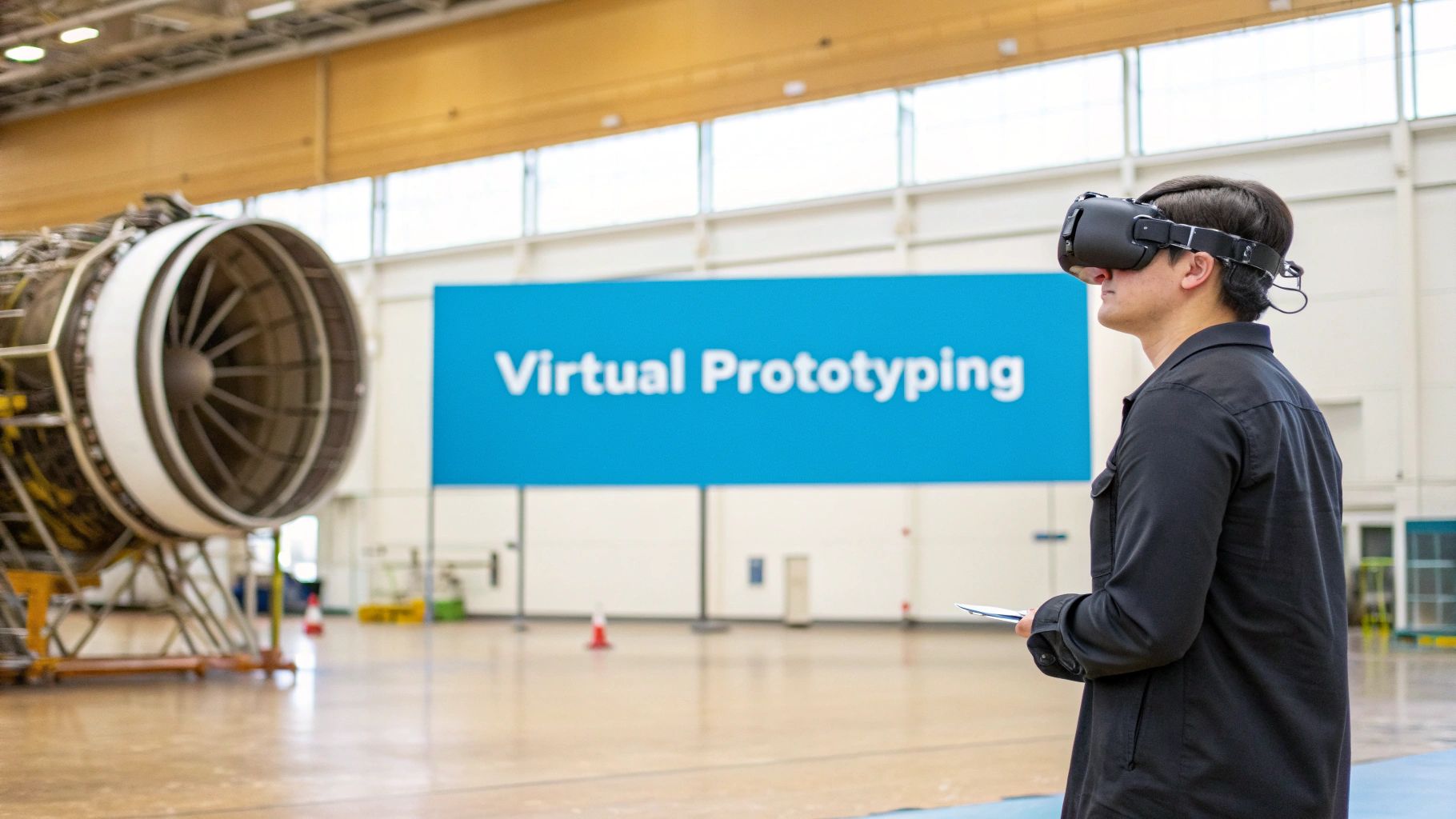
While its roots are in entertainment, VR has matured into a powerful enterprise tool built to solve complex operational problems. It creates completely immersive, computer-generated environments where employees can interact with digital objects and scenarios as they would in real life.
This capability fundamentally changes how organizations handle critical tasks. Instead of relying solely on textbooks or videos, teams can step directly into a risk-free digital twin of their workplace to learn and practice.
Redefining Business Operations
The core value of VR lies in its power to simulate reality without real-world consequences. This capability opens a world of new possibilities for improving how businesses operate, from initial design to final product delivery.
The practical benefits are immediate and measurable:
- Zero-Risk Training: Teams can practice complex or hazardous procedures—such as operating heavy machinery or performing intricate medical surgeries—without endangering personnel or expensive equipment.
- Accelerated Prototyping: Engineers and designers can collaborate in a shared virtual space to visualize, test, and refine products. This drastically reduces the time and expense associated with building physical mock-ups.
- Enhanced Safety Protocols: Organizations can run emergency drills and safety simulations in hyper-realistic conditions, building the muscle memory needed for situations that are impossible to replicate safely in the real world.
Virtual reality isn't here to replace human skill; it's here to accelerate it. It provides a digital environment where mastery can be achieved faster, safer, and more cost-effectively than ever before.
A Growing Strategic Imperative
Businesses are adopting VR for one simple reason: it delivers results. The application of virtual reality in enterprise settings is expanding because it provides tangible improvements in training, collaboration, and even customer engagement.
By 2025, it's estimated that 1 in 2 companies around the globe will be actively integrating VR into their core strategies. This reflects a fundamental shift in how organizations approach operational excellence.
Ultimately, VR provides a competitive edge by driving measurable improvements in safety, efficiency, and the bottom line.
Building a Safer, More Skilled Workforce
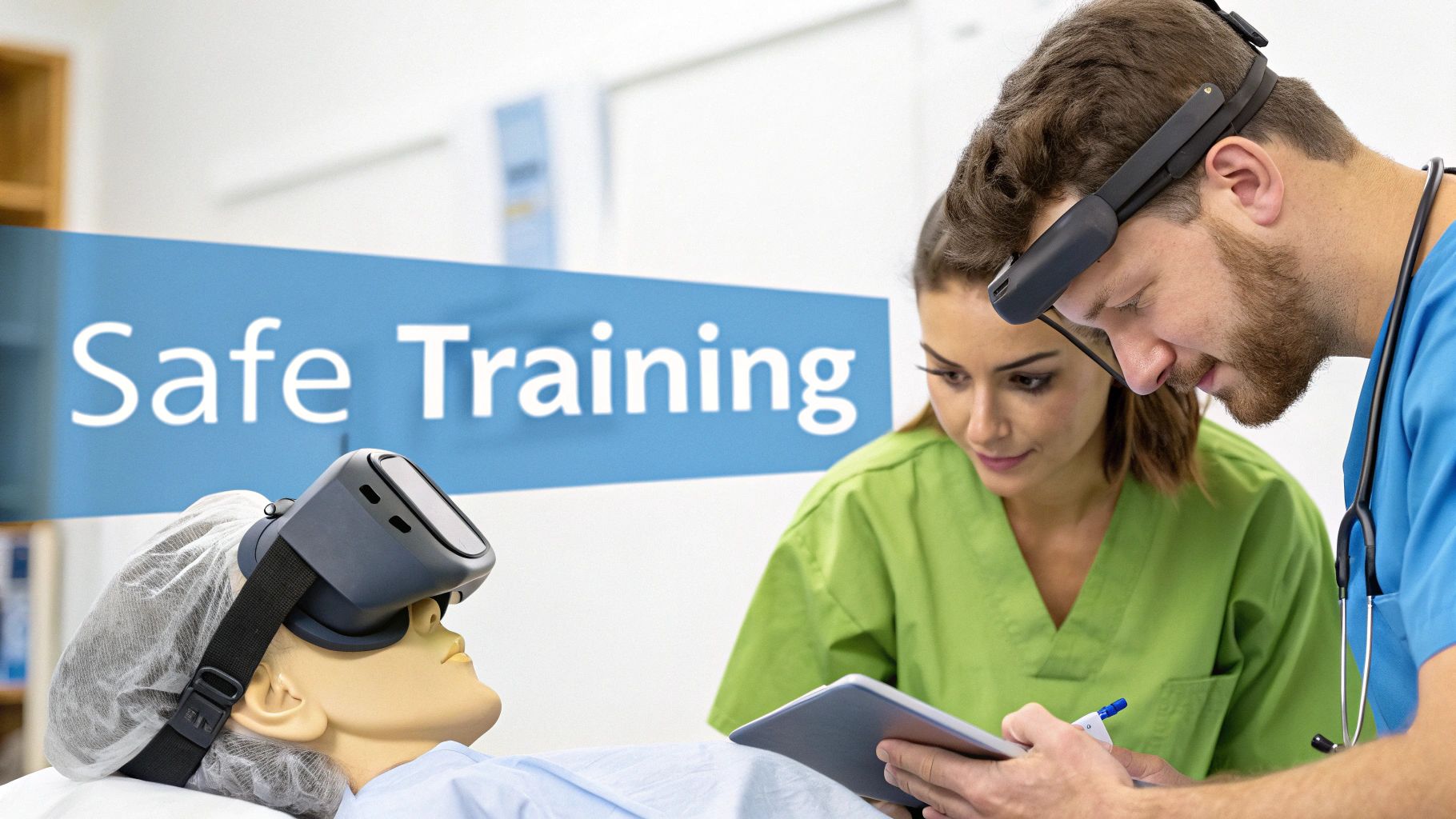
Consider a flight simulator, but for every high-stakes job in your company. That is the power of virtual reality in workforce development. It moves training out of the classroom and away from static manuals, placing employees into hyper-realistic scenarios where they learn by doing.
In this way, a surgeon can practice a complex procedure hundreds of times before entering the operating room. A technician can master a hazardous equipment shutdown sequence. All of this occurs in a completely safe, zero-risk environment. The focus shifts from passively absorbing information to actively mastering a skill.
This hands-on, immersive approach leads to significantly higher knowledge retention compared to traditional methods like presentations or printed guides. When people can physically perform tasks, their brains forge stronger neural pathways, building the "muscle memory" for actions that are critical to their roles.
Mastering Complex Procedures with Zero Risk
One of the most powerful applications of VR is in training for complex procedures. For any task that is intricate, dangerous, or involves expensive machinery, VR provides an ideal practice ground. It gives teams a space to fail, learn from mistakes, and repeat the process until it becomes second nature—all without real-world consequences.
This has a direct and immediate impact on both safety and operational readiness.
- Hazardous Materials Handling: Employees can run through drills for chemical spills or equipment failures, ensuring they react calmly and correctly during a real crisis.
- Complex Assembly: Manufacturing teams can assemble a digital twin of a new product, reducing errors and material waste when they begin actual production.
- Medical and Surgical Training: Healthcare professionals can sharpen their skills on virtual patients, building the precision and confidence needed for real-life medical situations. To see another angle on this, check out how Augmented Reality in Health Care is guiding surgical training in real time.
The core benefit is straightforward: VR training allows for unlimited repetitions in a controlled setting. This builds not just competence but deep confidence, which is invaluable under pressure.
The market for these solutions is growing as businesses recognize the clear return on investment. The enterprise VR market was valued at $6.37 billion in 2019 and continues to expand, driven by the demand for effective training. By 2034, VR in the training market is projected to reach $82.92 billion.
Developing Essential Soft Skills
Beyond technical skills, VR is also a remarkably effective tool for developing soft skills—the crucial interpersonal abilities needed for leadership, sales, and customer service. Traditional role-playing can sometimes feel artificial. VR, on the other hand, creates a sense of presence that makes interactions feel more genuine.
Teams can practice difficult conversations, de-escalate conflicts, or deliver presentations to a virtual audience that provides real-time feedback. These simulations help individuals build empathy and refine their communication skills in a private, non-judgmental space. For example, a manager can practice giving constructive feedback to a challenging virtual employee, learning to navigate the conversation with greater skill before applying it in their real role. This is all about building a more resilient, well-rounded, and capable workforce from the ground up.
Speeding Up Design and Engineering
The traditional process of designing and building products often involves a significant bottleneck: the physical prototype. Creating real-world models is time-consuming, expensive, and difficult to modify. A minor flaw discovered late in the process can trigger a cascade of costly rework, leading to timeline and budget overruns.
Virtual reality fundamentally changes this dynamic. It transforms the entire process from a slow, physical workflow into a fast, fluid, and digital one. VR gives engineers, designers, and architects the power to build, test, and perfect their creations in a full-scale, interactive virtual world before any physical parts are manufactured.
Instead of viewing a 3D model on a flat screen, teams can step inside their designs. This is a significant leap from passively observing something to actively experiencing it. This provides a much deeper, more intuitive understanding of a product's form, function, and usability.
From Blueprint to Being There
Imagine an automotive team distributed across three different continents. In the past, they would have had to ship a multi-million dollar clay model of a new car back and forth. Now, they can put on VR headsets and meet inside the virtual car. They can experience the driver's perspective, check the ergonomics of the dashboard controls, and identify blind spots from every angle.
This shared virtual space removes geographical barriers and transforms design reviews into hands-on, interactive collaboration sessions. An engineer in one country can suggest a change, and the entire global team can see and experience the implementation in real-time.
The benefits here are clear and measurable:
- Human-Centered Design: VR allows you to step directly into the end-user's shoes. For an architect, this means walking through a digital building to get a true sense of the space and lighting long before construction begins.
- Rapid Iteration: Changes can be made instantly in the digital model. Teams can test dozens of different material finishes or component layouts in a single afternoon—a process that would take months with physical models.
- Early Error Detection: A design flaw that is easy to miss on a 2D drawing becomes obvious when viewed at a 1:1 scale in VR. Identifying a maintenance access issue or a component clash this early can save millions in later stages.
The objective is to "fail fast and fail cheap." VR provides the ultimate digital environment where teams can experiment without constraints, identify all potential weaknesses, and perfect a design without consuming time and materials.
Driving Real Business Results
Adopting virtual prototyping is not just about creating better designs; it's about improving overall business performance. By reducing the time it takes to move from concept to a finished product, companies can launch faster and gain a significant competitive advantage. It is common for teams that fully adopt this approach to see a 30-50% reduction in prototyping costs.
Consider the complexity of laying out a new factory floor. With VR, planners can run workflow simulations, test machinery placement for maximum efficiency, and ensure all safety clearances are met—all within a digital twin of the building. This proactive problem-solving minimizes expensive on-site modifications and helps ensure the facility operates at peak performance from day one. You can learn more about how industrial virtual reality is transforming these types of complex operations.
Ultimately, VR serves as an innovation accelerator. By removing the cost and friction of physical prototypes, it empowers design and engineering teams to be more creative and take calculated risks. They can explore more ambitious ideas and push boundaries, knowing they can test everything thoroughly in the virtual world first. The result is not just a faster, more cost-effective process—it's better, more thoughtful, and more user-focused products.
Transforming Remote Support and Field Operations
What happens when a critical piece of equipment fails at a remote site, thousands of miles from your nearest expert? Traditionally, the solution involved expensive travel, long delays, and significant operational downtime. That model is slow, inefficient, and a major drain on resources.
Fortunately, a more effective approach is now available. Virtual reality can instantly connect your top expert directly to the problem, regardless of their physical location. This is a practical tool that is completely changing how field service and remote support are conducted.
The system works by creating a "see-what-I-see" connection. A technician on-site wears a headset, providing a senior expert back at the office with a first-person view of the situation. From there, the expert can guide the on-site technician through each step of the repair in real-time, highlighting specific parts and even overlaying instructions directly into their field of view.
Bridging the Knowledge Gap Instantly
This immediate transfer of expertise is a game-changer for restoring operations. It eliminates the logistical challenges of travel and reduces equipment downtime from days to hours. Problems are solved faster, customer satisfaction improves, and your most skilled personnel can support multiple sites in a single day without leaving their desks.
This directly improves the key performance indicators for field service teams:
- Higher First-Time Fix Rates: With expert guidance, on-site technicians are far more likely to diagnose and resolve the issue correctly on the first attempt.
- Reduced Travel Costs: It is not uncommon for businesses to reduce expert travel by as much as 75%, resulting in substantial savings on flights, accommodation, and related expenses.
- Improved Safety: An expert can remotely supervise complex or hazardous tasks, ensuring that all safety protocols are followed precisely.
The key benefit is turning every junior technician into an extension of your most experienced expert. This disseminates knowledge across your entire service team, ensuring consistent, high-quality work is performed everywhere.
For any business looking to implement this capability, exploring options for augmented reality remote assistance is an excellent starting point. It provides a clear overview of the platforms and features available today.
The iterative workflow that virtual reality enables is a continuous cycle of improvement—allowing teams to prototype, test, and refine solutions at a speed that physical methods cannot match.
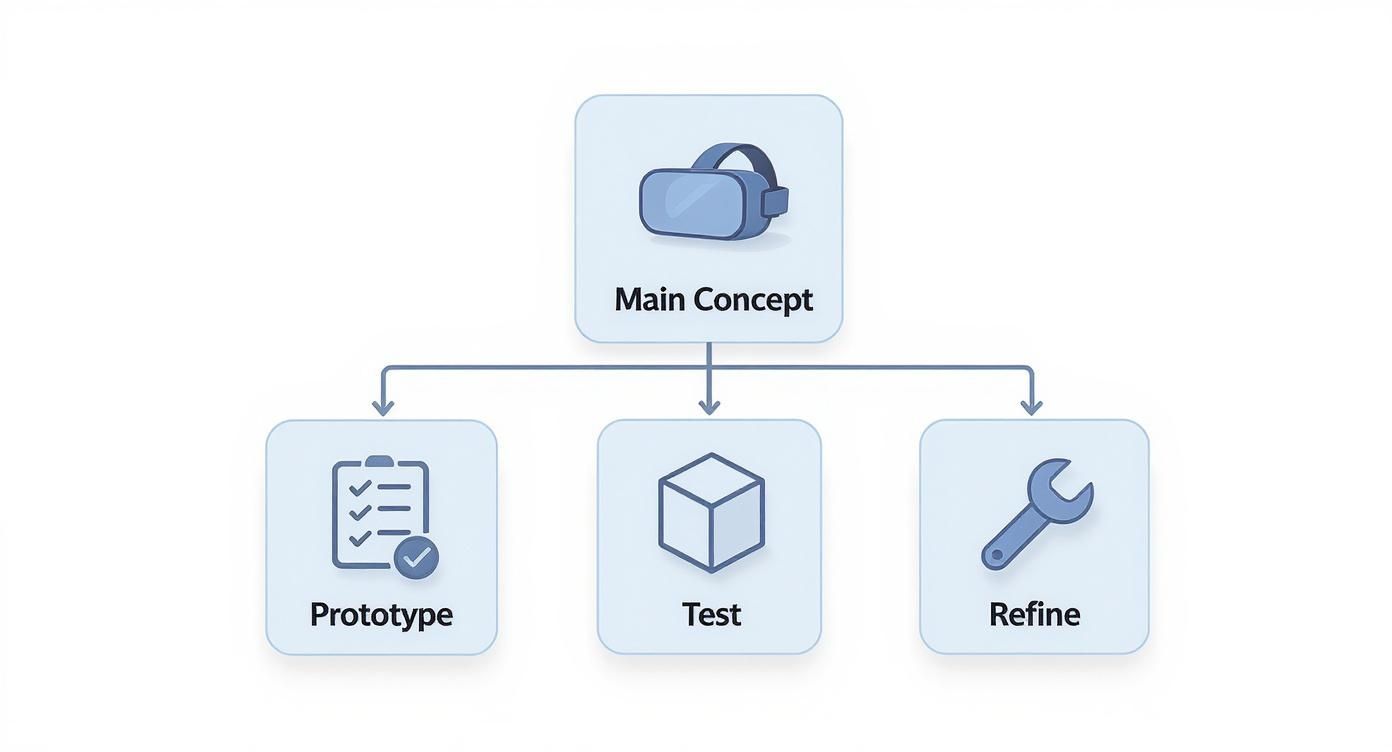
As illustrated, VR supports a loop where a concept can move to a fully tested and refined solution much faster than was previously possible.
Practice Perfect Repairs on Digital Twins
Beyond real-time support, VR also serves as an exceptional training ground. Technicians can practice complex repairs on a digital twin—a perfectly replicated 3D model of a machine—long before they ever touch the actual physical asset.
Inside the virtual environment, they can disassemble a machine, reassemble it, and run through every possible failure scenario in a completely safe space. This type of hands-on training builds deep familiarity and muscle memory.
By the time a technician faces the real equipment, they have already performed the repair dozens of times. They know exactly what to do, which tools to use, and how to anticipate common issues. That level of preparation is impossible to achieve with user manuals or classroom lectures alone, driving first-time fix rates even higher and reducing operational costs across the board.
Creating Immersive Customer Experiences
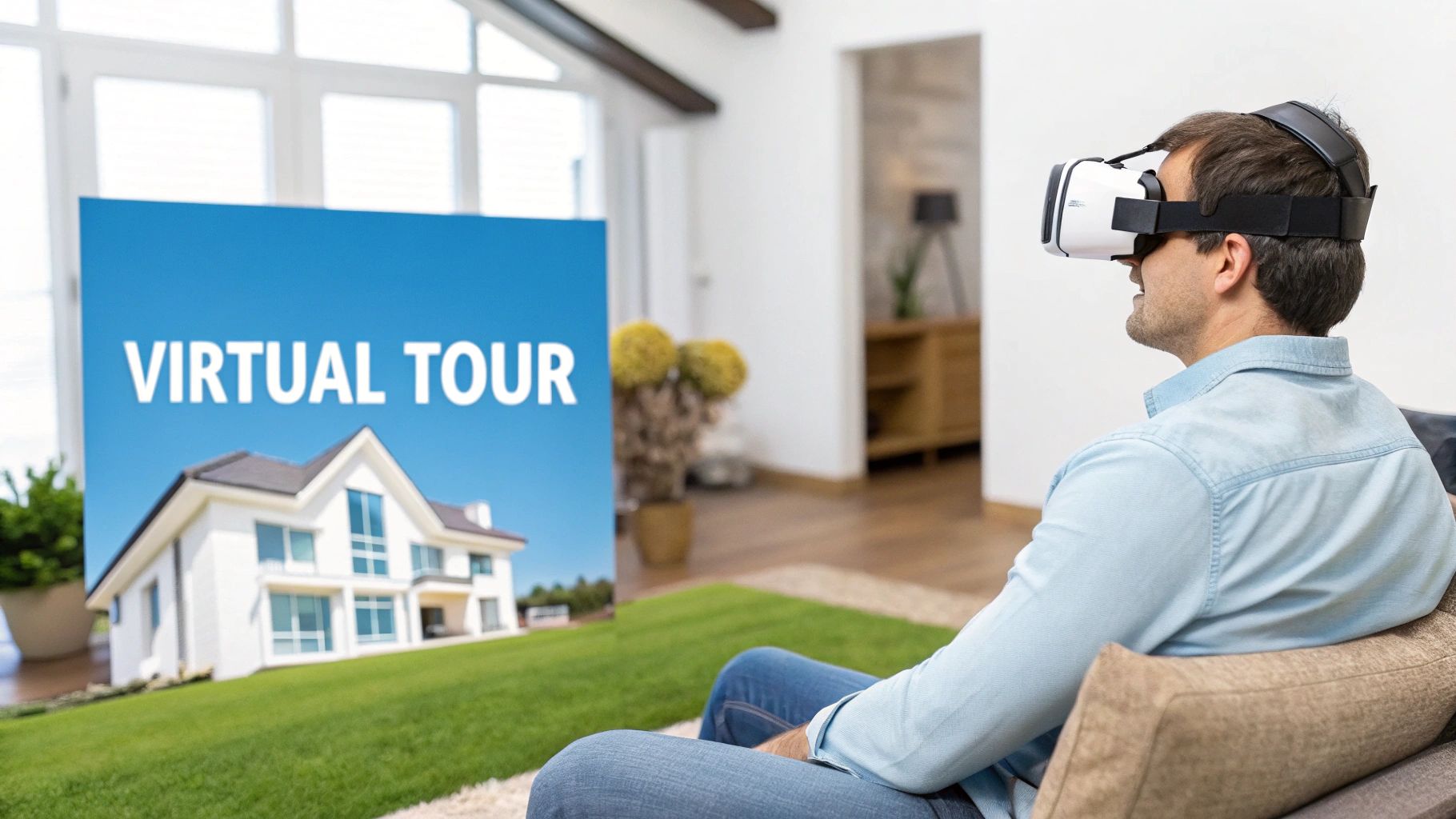
Thus far, we've discussed VR's internal applications. However, the application of virtual reality also unlocks a powerful way to connect with customers. Traditional marketing is two-dimensional, relying on photos and videos to tell a story. VR changes this by inviting customers to step inside the story.
This represents a significant shift from passive observation to active participation. It builds a deeper emotional connection and provides a spatial, intuitive understanding of your product that a brochure or website cannot replicate.
The consumer VR market is established, with over 171 million people using the technology worldwide. In the United States alone, that number is 77 million users. As more people become comfortable with headsets for gaming and entertainment, they are increasingly open to engaging with businesses in this medium. For those interested in these trends, it's worth exploring the wider insights into the spatial computing industry.
Letting Customers Try Before They Buy
Imagine trying to sell a complex piece of industrial equipment using only a PDF. It can be a challenge. Now, imagine allowing your client to walk into a virtual showroom, inspect the machine, configure it with different options, and see exactly how it will fit in their own facility.
That is the power of VR in the sales process. It removes guesswork and builds significant buyer confidence.
- Virtual Real Estate Tours: Potential buyers can walk through a property from their own home. They get a real feel for the space and can even experiment with furniture layouts, all without an in-person visit.
- Automotive Showrooms: Customers can sit in a virtual car, change the interior materials, select paint colors, and test-drive the features in a fully interactive environment.
- Product Configurators: In B2B sales, clients can build and test complex systems in VR, ensuring the final configuration perfectly meets their operational needs.
By giving customers a tangible, hands-on way to validate their decisions, VR can shorten the sales cycle and reduce the risk of post-purchase dissatisfaction.
Crafting Unforgettable Brand Interactions
VR marketing is not just about product demonstration; it's about creating memorable experiences. Instead of just telling customers your brand represents adventure, you can transport them to a virtual mountaintop and let them feel it for themselves.
A travel company could offer a brief virtual visit to a pristine beach. An outdoor gear brand could give customers the thrill of rock climbing a sheer cliff face. These moments are more potent than a simple advertisement because they tap into genuine emotion and create a lasting memory tied directly to your brand.
This direct engagement provides a significant advantage. While competitors may be using traditional digital marketing, you can offer something truly unique and captivating. It doesn’t just capture attention—it positions your brand as a forward-thinking leader in a crowded market.
Integrating VR Into Your Business Strategy
Understanding VR's potential is one thing; integrating it into your business is another. The transition from concept to execution can seem daunting, but a structured approach can remove the guesswork and ensure your initial investment in immersive technology yields positive returns.
The journey begins not with the technology, but with a real-world business problem. It is more effective to focus on a significant operational challenge, a recurring safety concern, or a persistent training gap rather than chasing new technology for its own sake. Identify an area where an immersive solution could have the greatest impact.
This approach allows you to build a solid pilot program. It lets you prove the concept on a small, manageable scale, collect data on its effectiveness, and build a compelling business case for a wider rollout.
Building Your Implementation Framework
Once you have identified a high-impact use case, it’s time to build a framework for your pilot. This involves planning for both the technology and the personnel required for a smooth launch. When considering VR, it is beneficial to view it as part of your company's broader digital transformation strategies to ensure alignment with larger goals.
A few key considerations at this stage:
- Partner Selection: Choosing the right hardware and software partners is critical. Look for a provider who understands your industry’s specific challenges and can offer a solution that integrates with your existing systems.
- System Integration: How will the VR platform connect with your Learning Management System (LMS) or Enterprise Resource Planning (ERP) software? Defining the data flow and system interoperability early on will prevent future complications.
- Data Security: VR applications can handle sensitive company information. Ensure any solution under consideration meets your organization's stringent security and data privacy standards from the outset.
The primary goal is to provide your team with a clear roadmap: launch a pilot, prove the ROI, and then scale the solution effectively. A successful outcome begins with a well-defined plan.
Managing Change and Securing Buy-In
Effective technology requires people to champion it. The human element of a rollout is often underestimated, but securing buy-in from leadership and end-users is essential for long-term success.
Start by explaining the "why." Clearly communicate how the application of virtual reality will make employees’ jobs safer, easier, or more effective. Involve future users in the selection and testing process. This fosters a sense of ownership and can turn them into advocates for the technology.
This is not about imposing a top-down mandate; it's about building a collaborative effort that dramatically increases the chances of a successful and impactful implementation.
Got Questions About Enterprise VR? We’ve Got Answers.
As leaders begin to explore immersive technology, a few practical questions typically arise. Addressing these is the first step toward making an informed decision about integrating virtual reality into your business.
We’re here to address the most common ones, providing clarity on implementation, costs, and the skills required to launch a VR program.
What’s the Real Difference Between AR and VR for Business?
Augmented Reality (AR) and Virtual Reality (VR) are often grouped together, but they address different business needs.
The simplest way to differentiate them is: VR creates a completely new, fully digital world, while AR overlays digital information onto your existing real world.
VR is ideal for training simulations where complete immersion is necessary to block out real-world distractions—such as a complex safety procedure or a high-stakes repair. In contrast, AR is suited for a field technician who needs to see digital schematics overlaid on the actual machine they are servicing.
How Much Does It Really Cost to Implement a VR Program?
There is no single price tag; the cost of a VR program depends on its objectives. The main factors include the complexity of the software, the number and type of headsets required, and the level of integration with your existing systems.
A pilot program is almost always the most sensible and cost-effective way to begin. It allows you to prove the ROI on a smaller, manageable scale before committing to a full-scale deployment. Many businesses experience rapid returns—for example, some companies have reduced expert travel costs by as much as 75% using remote assistance tools, which quickly offsets the initial investment.
What Kind of Skills Do We Need to Manage a VR Initiative?
You do not need to hire a team of video game developers.
A successful VR rollout depends more on solid project management and change leadership than on coding expertise. The most important role is a project lead who understands the business problem you are solving and can generate enthusiasm for the new approach.
The single most critical skill is linking the technology to a tangible business goal. The focus should always be on solving a problem—making a process safer, reducing operational costs, or increasing team efficiency—not simply adopting new technology for its own sake.
On the technical side, you will likely work with a specialized partner who manages the software development and hardware setup. Your team’s primary role is to direct the project, ensure it meets your operational objectives, and facilitate user adoption.
Ready to see how the application of virtual reality can genuinely reshape your training and support workflows? AIDAR Solutions provides the expert guidance and tailored immersive platforms that deliver measurable results.
Discover our solutions and start the conversation.

