What is Immersive Learning? Transform Training with AR/VR
Think about the difference between reading a manual on how to fix an engine and actually getting your hands dirty, step-by-step, in a guided simulation. That’s the leap from traditional training to immersive learning. It’s about using technology like Virtual and Augmented Reality (VR/AR) to place learners into realistic, interactive scenarios.
This isn’t just a new tool; it’s a fundamental shift from passive observation to active participation.
The Shift from Passive Learning to Active Doing
For decades, employee training has revolved around classrooms, manuals, and videos. These methods have their place, but they often leave a critical gap between knowing what to do and having the confidence and muscle memory to actually do it.
Immersive learning closes that gap. It’s a hands-on approach where employees learn by doing in a safe, controlled digital environment.
Instead of just watching a presentation, a surgeon can practice a complex procedure without risk to a patient. A technician can learn to assemble a new piece of machinery with holographic instructions overlaid on the real thing. This active engagement builds stronger neural pathways, making skills stick in a way that passive learning cannot.
Immersive learning fundamentally changes the training model from "tell me" to "show me, then let me do it." This move from passive consumption to active experience is exactly why it's so incredibly effective.
The performance gap between these two approaches isn't just theoretical. The data shows a stark difference in everything from knowledge retention to how quickly we master a new skill.
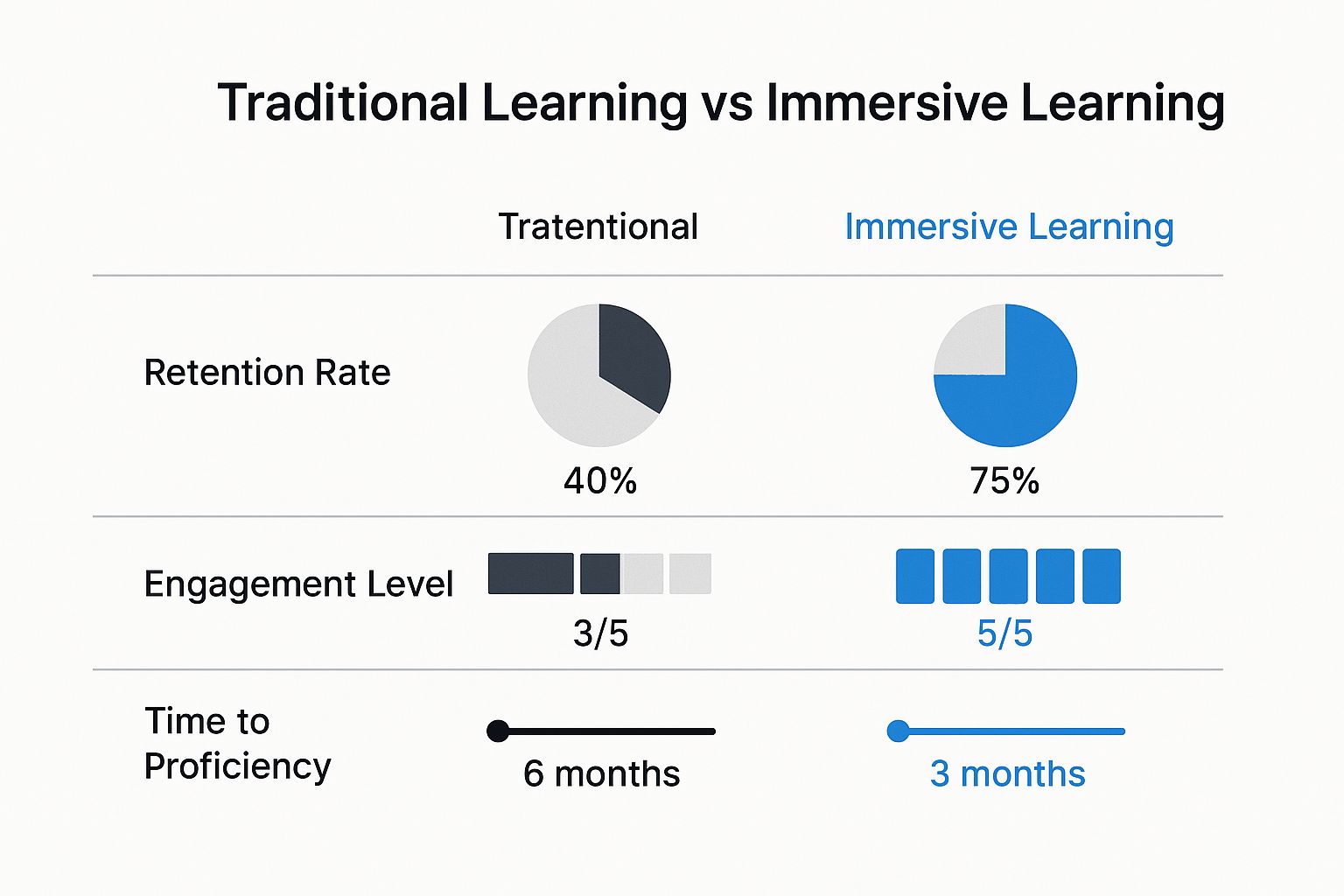
As you can see, the results speak for themselves. Immersive methods can boost retention rates by 75% and slash the time it takes to become proficient by more than half.
Traditional vs. Immersive Learning at a Glance
To put it in simple terms, here's a quick breakdown of how these two learning philosophies stack up against each other.
| Attribute | Traditional Learning (e.g., Classroom, Video) | Immersive Learning (e.g., VR/AR) |
|---|---|---|
| Learner Role | Passive Observer | Active Participant |
| Methodology | Information Transfer (Reading, Listening) | Experiential (Doing, Practicing) |
| Environment | Abstract (Classroom, Screen) | Contextual (Simulated Real-World) |
| Engagement | Low to Moderate | High to Very High |
| Feedback | Delayed or General | Immediate and Personalized |
| Retention | Lower (Forgetting Curve is Steep) | Significantly Higher |
| Safety | Real-world risks in practice | Completely Safe and Risk-Free |
This table highlights the core difference: one method is about absorbing information, while the other is about building real, applicable skills through direct experience.
The Technology Driving Immersive Experiences
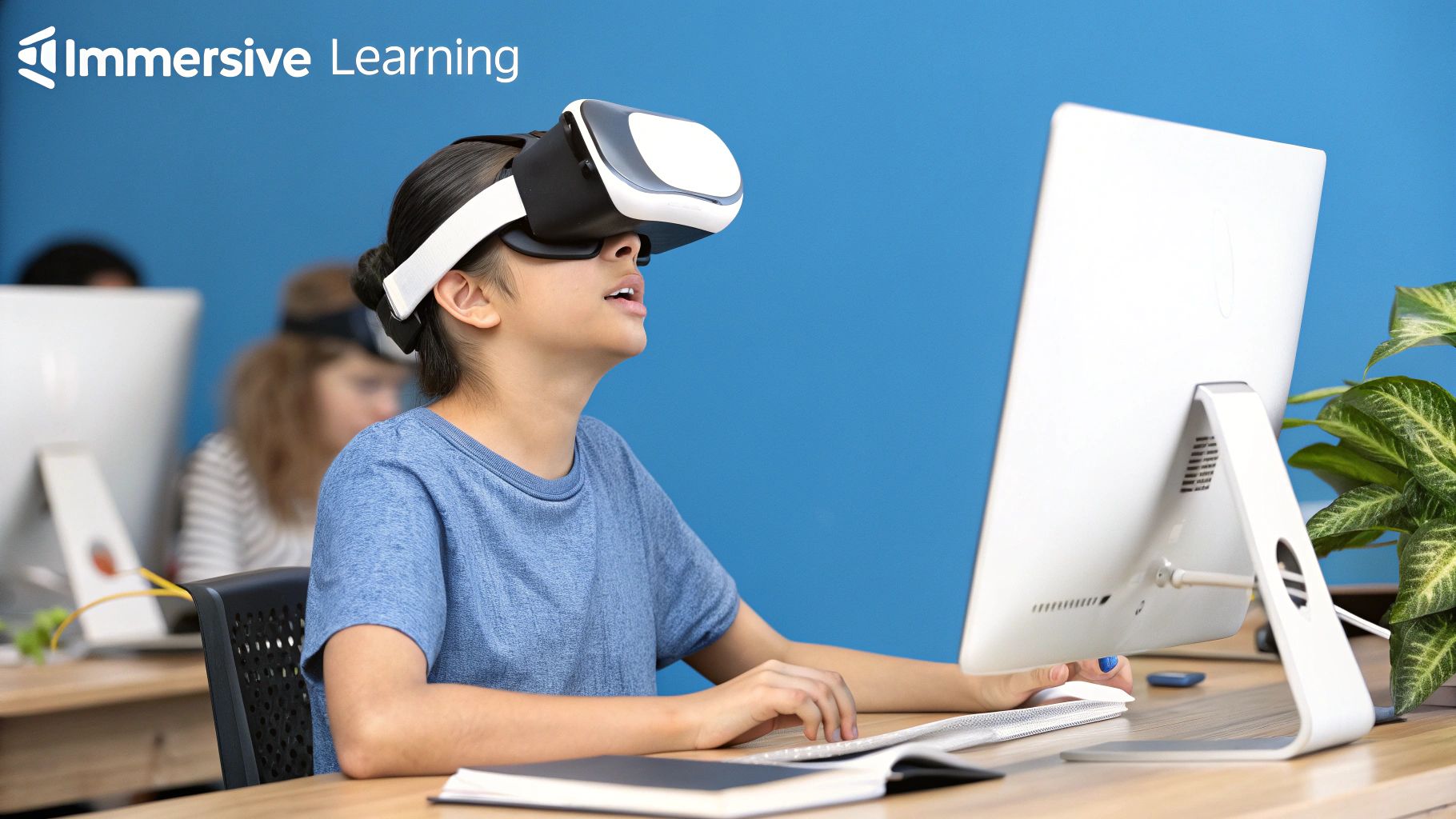
So, what's actually making these immersive learning experiences possible? The technology is a family of tools often bundled under the umbrella term Extended Reality (XR).
These aren't just novel ways to display information. XR tools create fully interactive environments that feel real, letting people build muscle memory and practical skills by doing, not just watching.
To select the right tool for a training challenge, you first have to understand what makes each one unique.
Virtual Reality (VR)
Virtual Reality is about total immersion. The moment you put on a VR headset, the real world vanishes, and you’re transported somewhere entirely new—a digital environment created by a computer.
This complete separation from physical surroundings is VR’s biggest advantage for focused, deep-level training.
- How It Works: A headset with two small screens (one for each eye) creates a convincing 3D image. Sophisticated motion tracking follows head movements, letting you look around and interact with the digital world just like you would in real life.
- Practical Use Case: Imagine training a new hire to operate a massive, complex piece of factory machinery. In VR, they can get hands-on experience in a simulated factory, practicing high-stakes procedures and making mistakes without any real-world danger to themselves or the expensive equipment.
Augmented Reality (AR)
Unlike VR, Augmented Reality doesn’t replace your world—it adds digital layers on top of it. AR overlays information like text, 3D models, or instructions onto your view of the physical world, usually through a smartphone, tablet, or smart glasses.
- How It Works: AR uses a device's camera and sensors to understand the space around you. It then projects digital content onto that live view, making it look like it's part of your environment.
- Practical Use Case: A field technician troubleshooting a complex engine can look at it through an AR device and instantly see digital arrows pointing to the problem part, along with step-by-step repair instructions floating right next to it. It’s like having an expert looking over their shoulder, providing guidance in real-time.
The integration of AI has pushed these capabilities even further, delivering dynamic and intelligent support. If you're curious about this, you might be interested in how AI revolutionized AR and VR technologies.
Mixed Reality (MR)
Mixed Reality is where the digital and physical worlds truly begin to merge and interact. It's the most advanced of the three technologies. With MR, a digital object doesn't just float in front of you; it can be "placed" on a real table, and you can walk around it, view it from different angles, and even interact with it as if it were a solid object.
This technological leap is driving serious market growth. For these learning platforms to work at scale, they need to be built on a solid foundation—a robust and scalable system architecture that can grow with demand.
The Business Case for Immersive Training
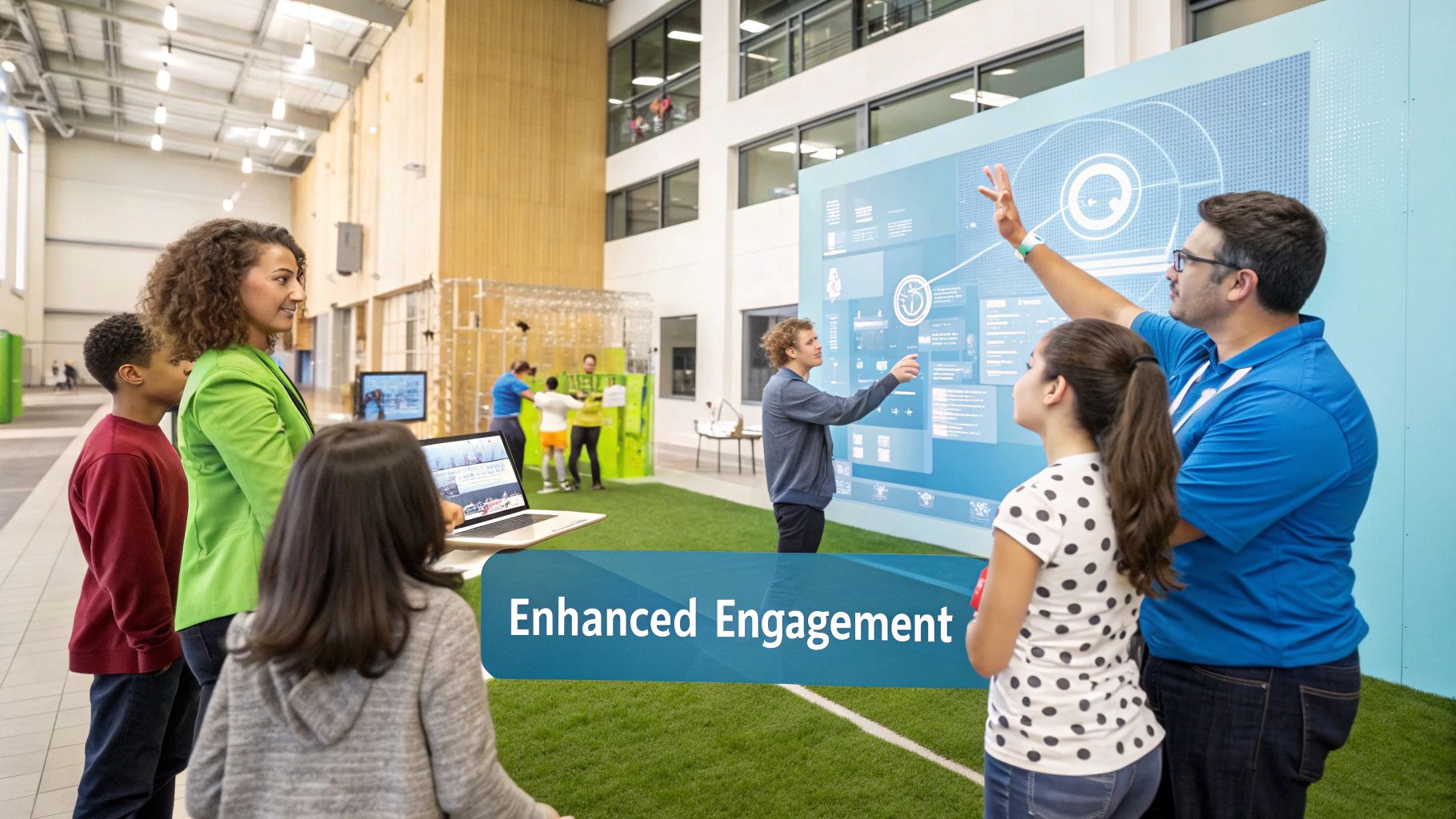
Beyond the technology, the real value of immersive learning is its impact on business outcomes. This isn't just about making training more engaging; it's about delivering real, measurable improvements in safety, skills, and efficiency.
That's exactly why the global immersive training market is expanding rapidly. Valued at $17.91 billion in 2025, it’s projected to rocket to $174.9 billion by 2035. This massive growth is being fueled by industries like manufacturing and healthcare, where having skilled, confident people is non-negotiable. You can dig into the immersive training market growth projections on meticulousresearch.com.
Radical Safety Improvements
Some jobs are inherently dangerous. In fields like energy or aviation, a simple mistake during a live training exercise can be catastrophic. This is where immersive learning offers a significant advantage—it provides a space to master high-stakes tasks in a totally safe, zero-consequence environment.
Using VR and AR, your team can practice shutting down a volatile system or handling hazardous materials over and over again. They can face equipment failures and emergencies, building the crucial muscle memory needed to act decisively under pressure, all without a single real-world risk.
Superior Knowledge Retention
People learn best by doing, not by passively observing. Traditional training is often a victim of the "forgetting curve," where crucial information evaporates over time. Immersive learning counters this by creating powerful, experience-based memories.
When you physically perform a task in a simulation and see the immediate results of your actions, that lesson sticks. Studies show this hands-on approach can boost knowledge retention by as much as 76% compared to just watching or reading.
Accelerated Performance and Scalable Training
This hands-on practice doesn't just make lessons stick; it builds confidence and skill at a remarkable pace. New hires can get up to speed in a fraction of the time, cutting down the onboarding process and making them productive much sooner.
Furthermore, immersive training is incredibly scalable. A single, well-designed VR program can be rolled out to an entire global workforce. Suddenly, everyone gets the exact same high-quality training, eliminating the logistical challenges and high costs of travel, physical equipment, and coordinating instructors. It’s consistent, efficient, and cost-effective.
Immersive Learning in Action Across Industries
The practical applications of immersive learning demonstrate its true potential. Across major industries, companies are using AR and VR to build workforces that are more skilled, confident, and safer.
It’s about learning by doing in a simulated space, and the results are tangible. From the factory floor to the operating room, these tools offer a place for repeatable, zero-risk practice that traditional training methods cannot match.
Manufacturing and Automotive
In a complex manufacturing environment, precision is everything. One error during an assembly or maintenance task can trigger costly downtime or a safety incident. This is exactly where Augmented Reality shines.
Technicians can use an AR headset or tablet to instantly see digital instructions, checklists, and 3D diagrams overlaid on the physical equipment in front of them. This real-time guidance reduces human error, accelerates complex repairs, and ensures procedures are followed to the letter, every single time.
For example, the automotive industry trains employees in virtual reality to master assembly line jobs before they even set foot on the production floor. The impact is significant: training time is reduced, and mistakes on the line plummet.
The core benefit here is contextual learning. The information appears exactly when and where it's needed, turning a complicated job into a guided, step-by-step process.
Healthcare and Medical Training
The stakes are highest in healthcare, where there is no room for error. Virtual Reality is giving medical professionals a new way to sharpen their skills. Surgeons can now walk through complex procedures in a hyper-realistic VR simulation, perfecting their technique and decision-making long before they enter the operating room.
The benefits are immediate and clear:
- Risk-Free Practice: A surgeon can face rare complications or practice emergency protocols without ever putting a patient at risk.
- Repetition Builds Mastery: The ability to repeat a procedure over and over until it becomes muscle memory is invaluable.
- Standardized Quality: VR ensures that every trainee receives the same high-quality, consistent instruction, regardless of location.
Logistics and Warehousing
In the world of logistics, efficiency and safety are paramount. VR is transforming how companies train for critical roles like forklift operation. A new hire can learn to navigate a busy warehouse, stack pallets, and follow safety rules in a totally realistic simulation.
This approach lets trainees make mistakes—and learn from them—in a completely safe space. They arrive for their first day on the job fully competent and confident behind the controls of heavy machinery. The results? Fewer accidents, less damaged inventory, and a more productive team from day one.
Your Framework for Launching an Immersive Program
Jumping into immersive learning can feel like a massive undertaking. But it doesn't have to be. Breaking it down into a practical roadmap turns a complex initiative into a series of clear, manageable actions. A successful launch isn't about adopting every new piece of technology at once.
Instead, it's about being strategic and starting with a well-defined plan. This approach ensures your first steps are impactful and build momentum for wider adoption.
The entire process boils down to four essential stages. Following this framework will guide you from the initial idea to a successful pilot program, all while keeping your business goals front and center.
Pinpoint Your Best Use Case
This is the most critical first step. You need to identify a single, specific training challenge where immersive learning can deliver a clear and measurable return on investment. Don't try to solve everything at once. Look for a problem area that’s known for high risk, high cost, or high complexity.
Good candidates for a first use case often involve:
- High-Stakes Tasks: Procedures where mistakes in the real world are dangerous or expensive.
- Complex Equipment: Training that requires hands-on practice with machinery that is difficult to access.
- Costly Onboarding: Roles that have a steep learning curve and high turnover rates.
Select the Right Technology
Once you have your use case, you can match it to the right tool—VR, AR, or MR. If your goal is to teach a complex procedure in a completely safe, simulated environment away from workplace distractions, Virtual Reality is almost certainly the best fit.
If, however, your employees need real-time guidance while working on physical equipment, Augmented Reality overlays are the more practical solution. The goal determines the technology, not the other way around.
Develop or Source Compelling Content
Your immersive content has to mirror the real-world scenarios your employees face every day. While generic modules can work for soft skills, for technical training, authenticity is key. This means creating simulations that accurately reflect your equipment, your processes, and the challenges your team will actually encounter.
The closer the simulation is to reality, the more effective the learning will be. The goal is to build muscle memory and confidence that transfer seamlessly from the virtual world to the physical one.
Execute a Pilot Program
Finally, before considering a company-wide rollout, launch a focused pilot program with a small, representative group of employees. This is your chance to test the technology, gather crucial feedback, and measure initial outcomes.
A successful pilot provides the hard data and success stories you need to build a strong business case for expansion. For a deeper dive, consider exploring a detailed guide on creating a virtual reality training program to ensure your pilot is set up for success from day one.
Proving the ROI of Your Immersive Training
An immersive learning program is a significant investment. To get—and keep—approval from leadership, you need to show it’s more than just a novel technology. You need to prove it works with hard, measurable data.
Anecdotes are helpful, but numbers build a rock-solid business case. This means moving beyond simple metrics like completion rates and focusing on the Key Performance Indicators (KPIs) that directly tie back to your business goals.
Key Metrics for Measuring Success
To truly determine the impact, you need a mix of quantitative and qualitative proof. Start with the numbers.
- Faster Time-to-Competency: How quickly are new hires becoming proficient? Measure the time it takes for them to become fully operational compared to traditional training methods. A shorter ramp-up means they’re contributing value sooner.
- Reduced Error Rates: This is a critical metric. Track the number of mistakes or safety incidents before and after the immersive training. A clear drop is one of the most powerful indicators of success.
- Direct Cost Savings: Calculate what you’re saving on travel, physical materials, and instructor time. These are the hard numbers that speak directly to the bottom line.
Beyond the Numbers
While data is crucial, don't underestimate the human element. Learner feedback and confidence surveys tell a compelling story that numbers alone can't.
When employees report feeling more prepared and confident to handle real-world challenges, that’s a direct reflection of the program’s value. Combining these personal insights with your performance data gives you a complete, undeniable picture of your return on investment. If you're looking for more strategies, we cover them in our detailed guide on how to measure training effectiveness.
This proven value is exactly why the market is expanding. The VR training sector alone jumped to USD 9.09 billion in 2023, a massive 40.3% increase from the year before. The reason? VR is incredibly effective at replicating real-life scenarios, which speeds up skill acquisition and cuts long-term training costs. You can discover more insights about VR training statistics on takeaway-reality.com to see the full trend.
Got Questions About Immersive Learning?
As leaders explore immersive learning and its strategic fit, a few common questions arise. Let's tackle them to clarify the practical side of bringing AR and VR into your training programs.
What's the Real Cost of Immersive Training?
This is a frequent question, and the answer is: it depends. The cost hinges on the scale and complexity required. A small pilot program can be launched for a few thousand dollars, while a full-scale, custom-built deployment is a more significant investment.
The key is to start strategically. Pick a use case where you can see a clear and measurable return, such as dramatically reducing costly on-the-job errors.
Is This Tech Just for Large Corporations?
Not anymore. While large corporations were the early adopters, the landscape has changed. The cost of hardware has dropped significantly, and there is a growing library of pre-built training modules available. This has made immersive learning accessible for mid-sized businesses.
Many providers now offer scalable solutions that can grow with your company's needs.
Immersive learning truly shines when it comes to teaching complex, hands-on skills—especially those that are dangerous, expensive, or difficult to practice in the real world. Think technical procedures, high-stakes emergency responses, and even soft skills.
Do My Employees Need to Be Tech-Savvy?
Absolutely not. Modern immersive learning platforms are designed to be as user-friendly as possible. The interfaces are intuitive, so you don't need to be a gamer or a tech expert to participate.
Most programs begin with a brief onboarding session to ensure everyone is comfortable with the controls before the training begins. This focus on accessibility is a huge part of ensuring the program is adopted widely and successfully.
Ready to see how immersive AR and VR solutions can elevate your team's skills and efficiency? AIDAR Solutions specializes in creating impactful training programs that deliver measurable results. Explore our offerings and book a consultation.