What Is Immersive Learning? Revolutionize Training Today
Imagine training a new technician to perform a complex, high-stakes repair. Would you prefer they learn by reading a manual, or by practicing the procedure in a hyper-realistic simulation where a mistake has no real-world consequences?
That's the core principle behind immersive learning. It’s a powerful training methodology that uses technologies like Virtual and Augmented Reality to place learners into interactive, simulated environments. You don't just learn about the task; you learn by doing it.
So, What Does Immersive Learning Actually Mean?
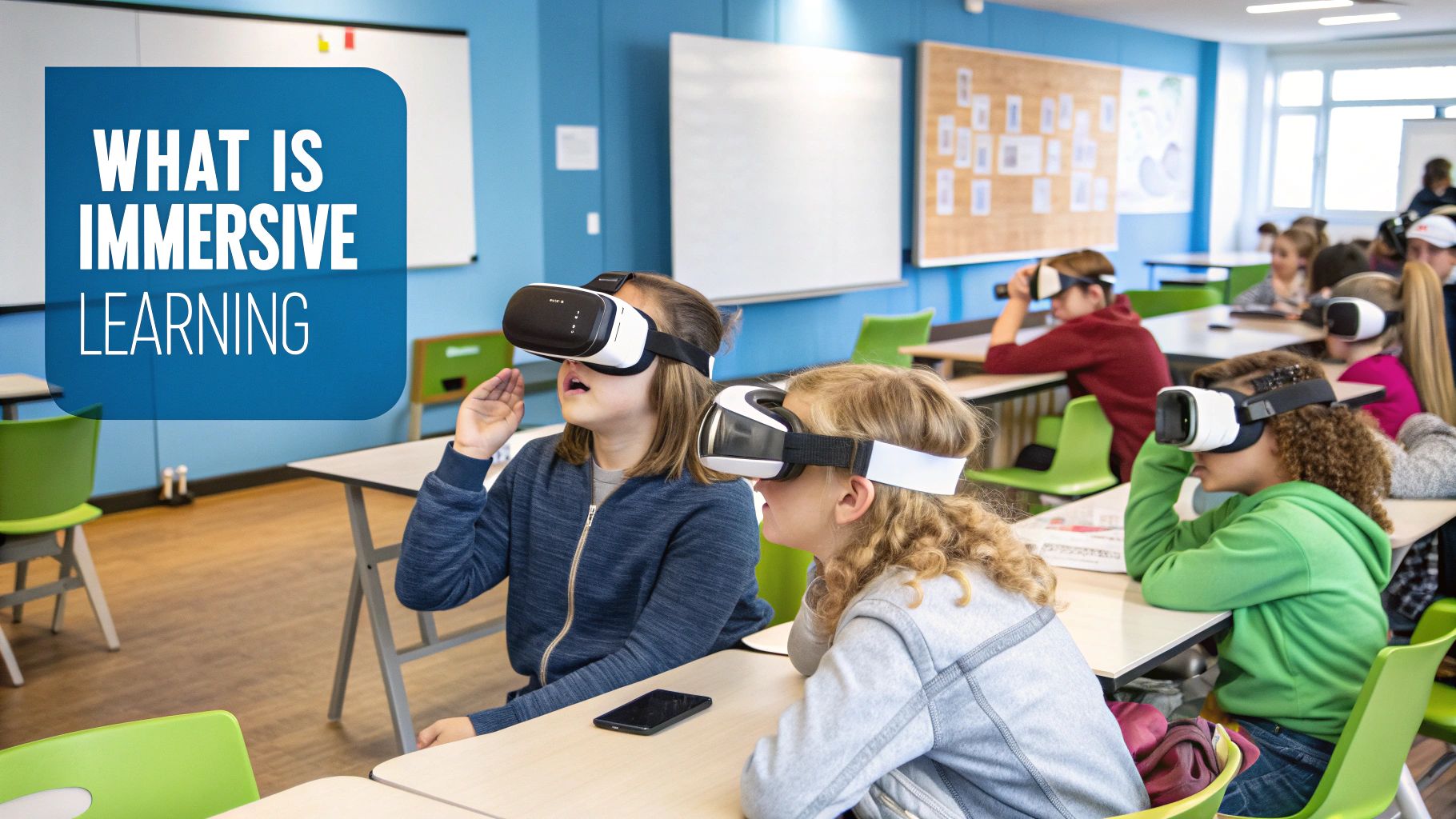
At its core, immersive learning represents a complete shift from passive observation—like reading a document or watching a video—to active participation. Instead of merely being told about a complex procedure, a trainee can step inside a virtual world to perform it themselves, gaining hands-on experience in a controlled setting.
This approach builds genuine understanding and muscle memory, all within a completely safe and repeatable space.
The goal is to mirror real-world scenarios so effectively that the skills acquired are instantly transferable to the job. For instance, a new technician could practice repairing a complex engine dozens of times in a simulation before ever touching the actual, expensive equipment. This ensures they are competent and confident from day one.
The Foundation of Truly Effective Training
Immersive learning is effective because it’s built on the proven principle that people learn best by doing. By engaging multiple senses and requiring physical interaction, it forges stronger neural pathways. The result is higher knowledge retention and significantly faster skill acquisition compared to traditional methods.
The key components that enable this include:
- Realistic Simulations: Crafting digital environments that accurately replicate real-world workspaces and their unique challenges.
- Interactive Content: Giving learners the ability to manipulate objects, make decisions, and immediately see the consequences of their actions.
- Guided Feedback: Offering real-time instruction and correction to help users master tasks efficiently and correctly.
This dynamic approach is rapidly gaining traction. The immersive training market was valued at nearly USD 16.4 billion recently and is projected to grow to around USD 69.6 billion by 2030. This growth demonstrates how quickly industries are recognizing its value. You can explore more data on this market from Grand View Research.
Understanding The Technology Behind Immersive Learning
To fully grasp what makes immersive learning so effective, it's essential to understand the technologies that bring these experiences to life. This isn't a deep dive into technical jargon, but rather a practical overview of choosing the right tool for a specific training challenge.
Each technology offers a unique way to bridge the gap between theoretical knowledge and practical application. The immersive learning ecosystem rests on three main pillars, each creating a different level of digital interaction.
The Three Pillars of Immersive Tech
First is Virtual Reality (VR). This technology completely replaces the user's real-world surroundings with a digital one. By putting on a VR headset, a user is instantly transported to a different environment, making it ideal for practicing complex, high-stakes procedures from start to finish without real-world risk. For example, a surgeon can rehearse a delicate operation in a simulated operating room before ever touching a patient.
Next is Augmented Reality (AR), which overlays digital information onto the user's real-world view. Think of it as having a digital expert providing guidance exactly when and where it's needed. A field technician wearing AR smart glasses could see step-by-step repair instructions displayed directly on the machinery they are fixing, reducing errors and increasing first-time fix rates.
Finally, there’s Mixed Reality (MR), which blends the real and digital worlds, allowing them to interact. This is a significant step beyond AR. For instance, an architect could place a 3D holographic model of a new building onto a physical boardroom table, allowing stakeholders to walk around it and suggest changes in real time as if it were a solid object.
This conceptual map helps visualize how all the key elements come together to create these powerful learning environments.
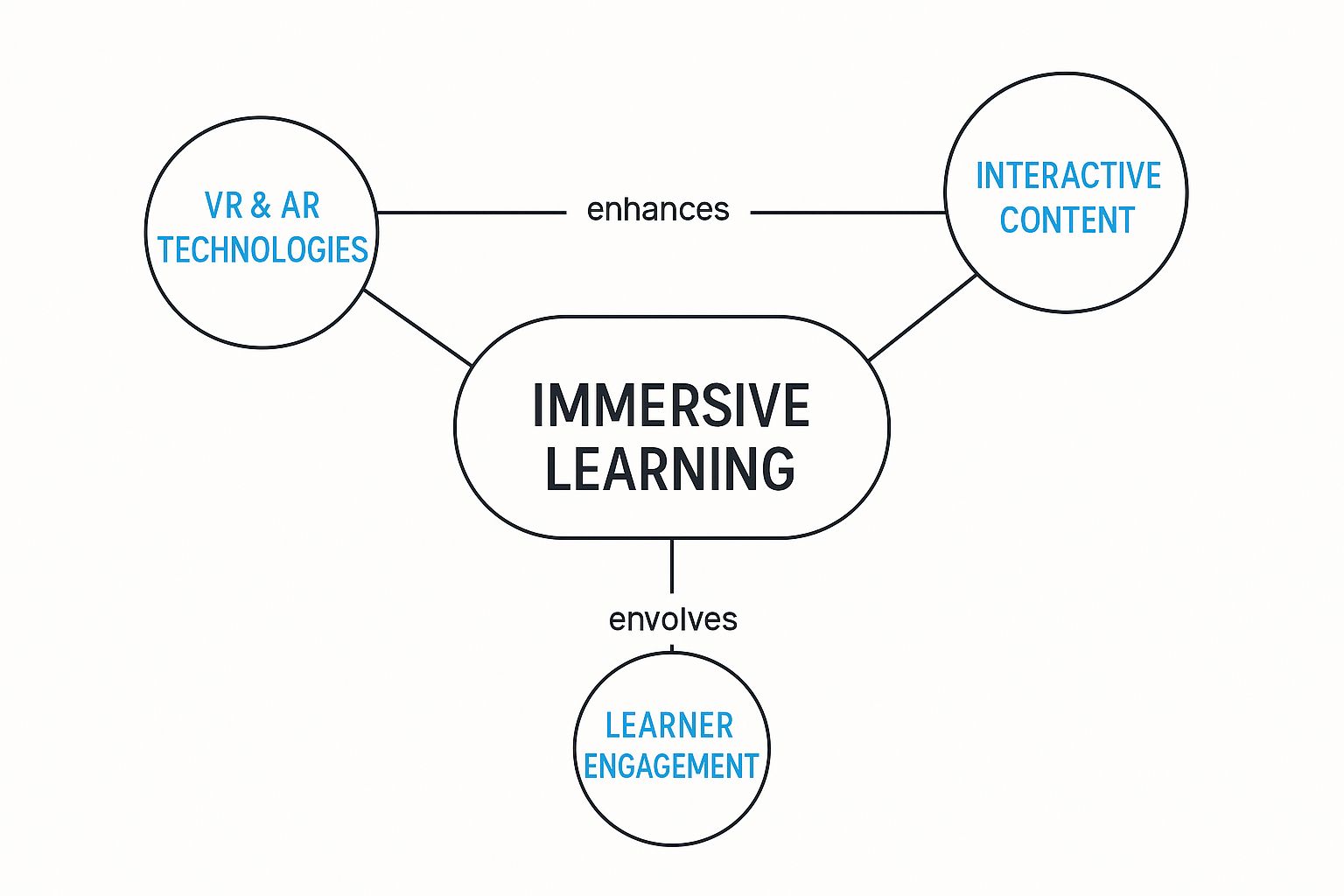
The image clarifies that technologies like AR and VR are just one piece of the puzzle. For immersive learning to succeed, this technology must be combined with high-quality content and a sharp focus on the learner's experience. To see how immersive tech fits into the broader training landscape, it's worth exploring the various educational technology tools for teachers available today.
As you consider adopting these tools, remember that long-term success requires a solid foundation. It's crucial to understand that AI-powered XR needs more than algorithms; the underlying infrastructure is what enables these projects to scale effectively.
To help clarify the differences, here’s a quick comparison of the three core technologies.
Comparing Immersive Learning Technologies
This table breaks down the distinctions between VR, AR, and MR to highlight their unique characteristics and best-fit applications.
| Technology | Definition | Key Characteristic | Example Use Case |
|---|---|---|---|
| Virtual Reality (VR) | A fully simulated digital environment that replaces the user's real-world surroundings. | Full Immersion: The user is completely isolated from the real world. | A pilot practicing emergency landing procedures in a realistic flight simulator. |
| Augmented Reality (AR) | Digital information or objects are overlaid onto the real world, typically through a smartphone or glasses. | Information Overlay: Enhances the real world with contextual data. | A warehouse worker seeing picking instructions overlaid on shelves through smart glasses. |
| Mixed Reality (MR) | Digital and physical objects co-exist and interact in real time. | Interactive Holograms: Digital objects are "anchored" to the real world and can be manipulated. | A team of engineers collaborating on a 3D holographic prototype of a car engine. |
Each of these technologies opens up a different set of possibilities for training and development. The key is matching the right level of immersion to the specific learning objective.
The Business Case for Immersive Learning
While the technology is impressive, the primary driver behind the adoption of immersive learning is its significant impact on business outcomes. Organizations are investing in these solutions not for novelty, but for the clear, measurable returns they deliver in solving critical operational challenges.
One of the most significant benefits is a substantial increase in knowledge retention. When employees learn by performing a task in a simulation, they build stronger, more reliable skills than they could by passively consuming information. This active participation leads to competencies that stick.

Driving Efficiency and Safety
Another core benefit is the dramatic reduction in workplace accidents. Immersive learning creates a zero-risk environment where employees can practice hazardous tasks—such as handling dangerous machinery or executing emergency shutdowns—until they achieve mastery. This realistic practice builds confidence and competence, leading directly to a safer workplace and potentially lower insurance premiums.
This hands-on approach also accelerates an employee's time to competency. New hires can master complex skills far more quickly through repeatable, on-demand simulations, becoming productive team members in a fraction of the typical time.
Immersive learning excels at bridging the gap between knowing and doing. It lets employees fail, learn, and succeed without any real-world consequences. This "safe-to-fail" model is a game-changer for high-stakes industries.
The market’s explosive growth reflects these tangible results. The global immersive training market, recently valued at USD 17.91 billion, is projected to reach approximately USD 174.9 billion by 2035. This surge is fueled by data showing that immersive environments can boost knowledge retention by as much as 76% over traditional methods.
Finally, this technology ensures that training is both scalable and consistent across a global workforce. Every employee, regardless of location, receives the exact same high-quality instruction. This eliminates the inconsistencies associated with different in-person trainers and guarantees a uniform standard of excellence across the entire organization. You can dive deeper into the many benefits of virtual reality training in our detailed guide.
Where Immersive Learning is Making a Real Impact
The true power of immersive learning lies in its practical application to solve real-world business problems. We are moving beyond theory and into the realm of measurable results.
By creating safe, hands-on training environments, companies are equipping their teams with the skills needed to handle complex, high-stakes jobs. The applications are as diverse as the industries using them.
Transforming High-Stakes Professions
In healthcare, immersive learning is a game-changer for surgical training. Surgeons can now practice complex procedures in VR repeatedly before entering the operating room. This is about more than just practice; it's about building the muscle memory and split-second decision-making that directly lead to fewer errors and improved patient outcomes.
A similar transformation is occurring in manufacturing. Augmented Reality (AR) provides technicians with critical support when performing complex machinery repairs. Instead of consulting a dense manual, they can wear smart glasses that overlay digital instructions, diagrams, and warnings directly onto the equipment. This approach slashes machine downtime and ensures the job is done correctly the first time. You can see more examples of how this works by exploring other powerful augmented reality industrial applications that are revolutionizing the sector.
The rapid adoption in these areas signals a major economic shift. The market for these technologies, recently valued at around USD 52.69 billion, is projected to expand to USD 631.8 billion by 2035. Such growth is fueled by one thing: a clear and compelling return on investment. You can discover more insights about the immersive learning market and its significant growth trajectory.
Nailing Safety and Soft Skills
Immersive learning is also making a significant impact in sectors like logistics and customer service, where safety and interpersonal skills are paramount.
Immersive learning provides a powerful platform for practice, allowing employees to face challenging scenarios and build confidence in a controlled environment where mistakes are learning opportunities, not costly failures.
Consider a busy warehouse environment. A new hire can learn to operate a forklift in a hyper-realistic VR simulation, practicing navigation in tight corners and handling heavy loads without any risk to inventory or personnel.
The technology is also effective for training human interaction. In customer service, employees can enter a VR scenario to practice de-escalating a situation with a frustrated or aggressive virtual customer. This allows them to sharpen their communication and problem-solving skills, so when they face a difficult conversation in real life, they can handle it with confidence and professionalism.
How to Build Your First Immersive Learning Program
Recognizing the potential of immersive learning is the first step. The next is translating that potential into a program that delivers tangible results. The key is not simply to acquire technology, but to use it to solve a specific, high-stakes business problem.
Start with a focused objective. Instead of a broad overhaul, zero in on a single pain point where this technology offers a clear advantage over traditional training methods. This could be a high error rate on a complex assembly line or the long ramp-up time for new hires to become proficient with specialized equipment.
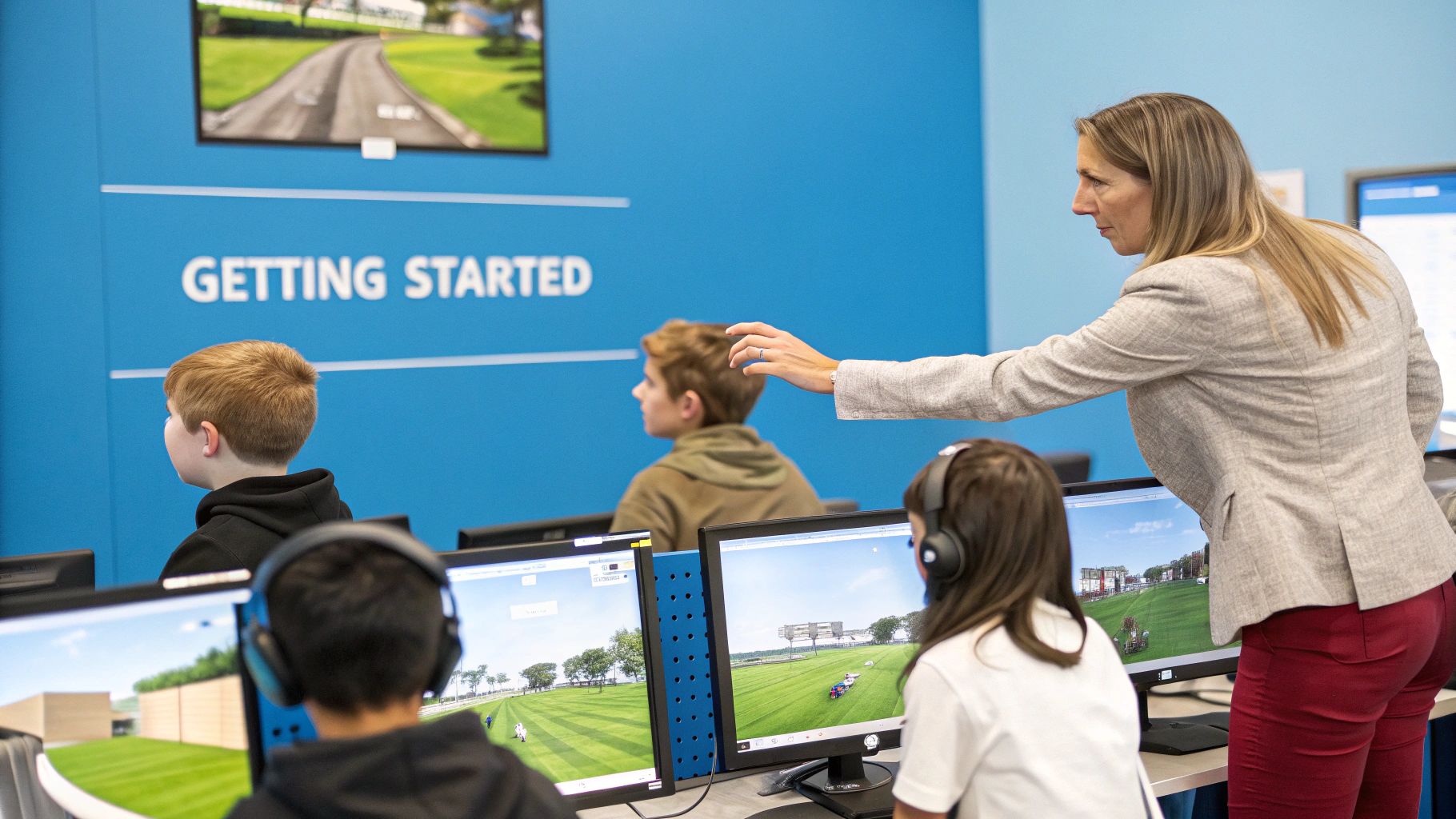
From Planning to Proving ROI
Once you have identified your target, you can begin to map out the program. This stage involves making practical decisions about technology, content, and deployment. Every choice should directly support solving the initial problem.
A solid plan typically involves a few key stages:
- Select the Right Technology: Should you use VR, AR, or MR? Let the task decide. If you need a fully simulated environment free from real-world distractions (like flight training), VR is the optimal choice. If you need to overlay digital instructions onto a real-world task (like guiding a technician through a repair), AR is the appropriate solution.
- Determine Content Strategy: You don't have to build everything from scratch. You can license off-the-shelf training modules for common tasks, or you can commission a fully custom simulation that mirrors your exact workflows and machinery.
- Plan for Deployment: Address the logistics. How many headsets are needed? Who is responsible for them? Crucially, how will you onboard your team to the technology before the training begins? A smooth introduction process is essential for user adoption.
The most successful immersive learning programs are built on a foundation of clear metrics. From day one, define what success looks like and how you will measure it.
Finally, and most importantly, measure what matters. To secure buy-in and demonstrate the value of your investment, you must track KPIs that are meaningful to your stakeholders. Define these metrics from the outset. Are you aiming for reduced error rates, faster task completion, or fewer safety incidents? This data provides proof of impact, turning a training expense into a clear return on investment.
If you're looking for a more detailed playbook, our guide on creating a virtual reality training program walks through these critical steps.
The Future of Corporate Training is Here
Immersive learning is not a futuristic concept; it is delivering real, measurable business results today. The key takeaway is that this technology moves teams beyond passive learning and into active practice, building a workforce that is more competent, confident, and safer on the job.
By allowing people to practice critical skills repeatedly in a zero-risk environment, companies can ensure their workforce has mastered a procedure long before they face it in the real world. This transforms training from a necessary expense into a strategic investment in operational excellence.
What Comes Next for Immersive Learning
The technology continues to evolve, with the next wave of innovation set to make these training tools even more powerful and accessible.
-
AI-Powered Scenarios: Imagine a training module that adapts to the learner in real time. AI will enable dynamic simulations that react to an individual's performance, presenting new challenges or reinforcing weak areas until mastery is achieved.
-
Lighter, Faster Hardware: The bulky headsets of the past are being replaced by the next generation of VR and AR devices that are lighter, more powerful, and more comfortable, removing a significant barrier to widespread adoption.
Investing in immersive learning is no longer just an option; it’s a strategic move to build a more resilient, agile, and skilled workforce. It offers a clear competitive advantage across all industries.
Ultimately, companies that embrace immersive learning are not just updating their training programs. They are fundamentally preparing their people for the challenges of tomorrow, ensuring they have the hands-on skills to not just compete, but to lead.
Have Questions About Immersive Learning? We’ve Got Answers.
Adopting a new training methodology naturally raises questions. Understanding what immersive learning is—and how it functions in a business context—is the first step toward realizing its potential. Let's address some of the most common inquiries.
What’s the Main Difference Between Immersive Learning and E-Learning?
The biggest difference comes down to active participation versus passive consumption. Traditional e-learning typically involves watching videos, reading PDFs, or clicking through slide decks. It is largely a one-way flow of information.
Immersive learning, by contrast, places you directly into a simulated 3D environment. You are not just watching; you are doing. You learn by physically performing tasks, making critical decisions, and even making mistakes in a safe space. This "learning by doing" approach is highly engaging and builds real muscle memory that translates directly to on-the-job performance.
Is Implementing Immersive Learning Expensive?
While there is an upfront investment, the return on that investment (ROI) is often rapid and significant. Immersive learning can reduce some of the largest training expenses, including travel costs, the need for physical equipment for practice, and lost productivity due to on-the-job errors.
In high-stakes industries, preventing even a single major safety incident can justify the cost of the entire program. Furthermore, with the rise of off-the-shelf platforms and more affordable hardware, these solutions are no longer limited to large corporations; they are becoming a practical option for businesses of all sizes.
Immersive learning shifts the training budget from a recurring operational cost to a strategic investment with measurable returns in safety, efficiency, and employee competence.
Do Employees Need to Be Tech-Savvy to Use It?
Not at all. Modern immersive training applications are designed with the user in mind, featuring intuitive interfaces and simple, guided instructions that appear when needed. The best technology feels invisible, allowing the learner to forget about the hardware and focus entirely on the task at hand.
In most cases, the solution provider manages the technical complexities behind the scenes. This frees up your learning and development teams to focus on what they do best: designing an effective curriculum and tracking performance outcomes.
AIDAR Solutions provides specialized VR and AR applications that make immersive training simple and effective. Our experts help you integrate powerful learning tools that boost efficiency and safety, delivering a clear return on investment. Explore our solutions and see how we can build a more skilled workforce for you.