What is Immersive Learning? A Guide to AR & VR in Corporate Training
Imagine the difference between reading a manual on surgical procedures and practicing in a realistic, simulated operating room. This is the core value of immersive learning—a hands-on training methodology that places learners in interactive, simulated environments using technologies like Virtual Reality (VR) and Augmented Reality (AR) to enable true learning by doing.
Moving Beyond Theory to Practice
Traditional training methods are effective at transferring knowledge, but often fall short in developing practical skills. Immersive learning bridges the gap between knowing what to do and knowing how to do it.
Instead of passively observing a presentation or reading a manual, learners actively participate, make decisions, and build skills in a safe, controlled environment. This approach is centered on building practical confidence and reinforcing skills through repetition.
Key elements of this methodology include:
- Active Participation: Learners are not spectators; they are active participants who directly engage with digital environments and tasks.
- Safe-to-Fail Environments: Employees can practice complex or high-risk procedures repeatedly without real-world consequences or material waste.
- Realistic Scenarios: Simulations are designed to mirror actual job conditions, preparing employees for the challenges they will encounter in their roles.
This fundamental shift from passive to active learning is a key reason the global immersive training market is projected to grow from USD 17.91 billion in 2025 to USD 174.9 billion by 2035. This level of investment signals that the technology delivers tangible results that conventional methods cannot match.
The data below illustrates how these methods compare in learner engagement and knowledge retention.
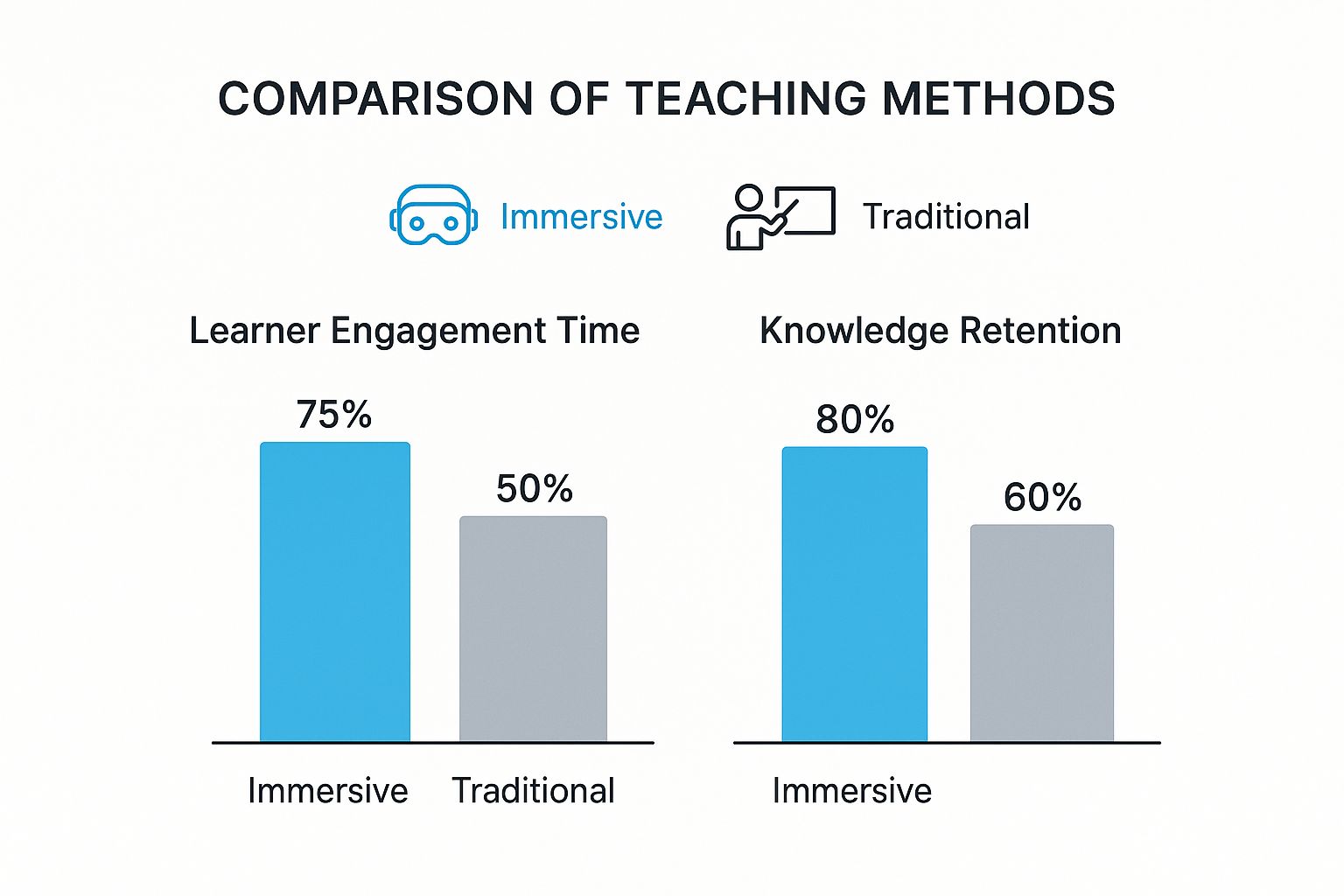
The metrics are clear: immersive experiences drive significantly higher engagement and improve long-term knowledge retention. To understand the specifics of how this is applied, you can learn more about AR for training in our detailed guide.
Immersive vs. Traditional Training at a Glance
To further clarify the distinction, this table compares the core attributes of traditional and immersive learning methodologies.
| Aspect | Traditional Learning (e.g., Classroom, eLearning) | Immersive Learning (e.g., VR, AR) |
|---|---|---|
| Learner Role | Passive observer | Active participant |
| Learning Method | Theoretical knowledge transfer | Practical, hands-on skill development |
| Environment | Abstract or classroom-based | Realistic, simulated real-world scenarios |
| Feedback | Delayed, often based on tests | Immediate, contextual, and in-the-moment |
| Failure | Often carries negative consequences | A safe, consequence-free learning opportunity |
| Retention Rate | Lower; often relies on memorization | Higher; builds muscle memory and experience |
This side-by-side comparison highlights the shift from a model of "telling" employees what to do to a model of letting them "do" it in a controlled setting.
The Technology Powering Immersive Experiences
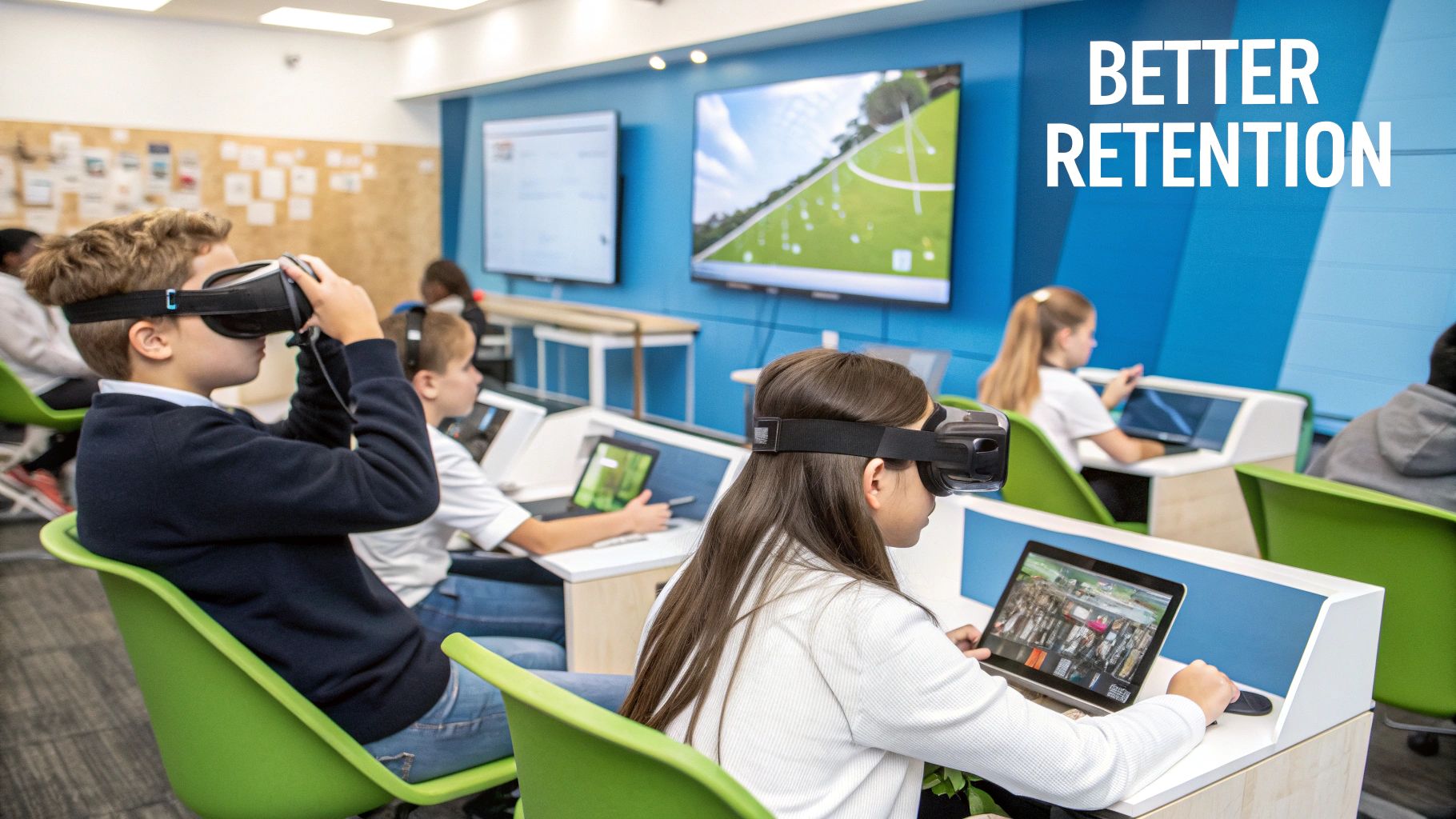
To fully understand what immersive learning is, it is essential to examine the technologies that enable it. These are not interchangeable devices but a specialized toolkit, with each technology suited for specific training applications.
The three primary technologies are Virtual Reality (VR), Augmented Reality (AR), and Mixed Reality (MR). Each offers a different way to integrate the physical and digital worlds, creating powerful and effective training scenarios.
Virtual Reality (VR)
Virtual Reality facilitates complete immersion. When a user wears a VR headset, their physical surroundings are replaced by a fully digital environment, transporting them to a different location or scenario.
This makes VR an ideal platform for high-stakes training, allowing employees to practice situations that would be too dangerous, costly, or impractical to replicate in the real world.
Practical applications for VR include:
- Hazardous Environments: Training employees to manage chemical spills or emergencies on an oil rig without exposing them to physical danger.
- Complex Procedures: Allowing surgeons to rehearse delicate operations multiple times in a simulated OR before treating a patient.
- Equipment Operation: Enabling technicians to learn to operate expensive machinery without the risk of causing costly damage.
Augmented Reality (AR)
In contrast to VR, Augmented Reality enhances the user's perception of the real world by overlaying digital information, such as text, graphics, or animations, onto their view. This is typically delivered through a smartphone, tablet, or smart glasses.
AR provides real-time, on-the-job guidance, functioning as a digital expert that assists employees exactly when and where they need it.
This technology is a powerful tool for on-the-job support and task guidance. For example, a field technician can view a complex engine and see digital labels identifying specific parts or follow step-by-step repair instructions that appear directly on the equipment being serviced.
Mixed Reality (MR)
Mixed Reality is the most advanced of these technologies, blending the real and virtual worlds so seamlessly that digital and physical objects can interact. In an MR experience, a digital object not only appears in a room but also understands and reacts to the physical space.
These powerful simulations require a robust technical infrastructure to function effectively. You can explore why infrastructure is the next frontier for AI-powered XR in our detailed article.
Furthermore, delivering these large, complex simulation files relies on efficient content delivery and file sharing solutions designed to handle the demands of immersive platforms.
Why Companies Are Investing in Immersive Training
The significant growth in immersive learning is driven by measurable business outcomes that organizations can no longer afford to overlook. Companies are investing in these methods because they solve long-standing training challenges in ways traditional approaches cannot. The global market, valued at USD 16.4 billion in 2024, is projected to reach nearly USD 69.6 billion by 2030, reflecting this trend.
This shift is primarily motivated by a substantial increase in knowledge retention. Learning-by-doing creates stronger neural pathways than passive observation. When an employee physically performs a task in a simulation, the experience solidifies both the skill and the confidence to apply it.
Creating a Fail-Safe Practice Ground
Beyond improved retention, immersive training provides a risk-free environment for mastering high-stakes roles. In industries like manufacturing or healthcare, where precision is critical, a single error can have severe consequences. VR simulations allow employees to practice complex procedures or emergency protocols repeatedly without real-world danger.
This fail-safe environment transforms mistakes from costly errors into valuable learning opportunities, building a more competent and confident workforce.
This methodology not only enhances operational safety but also reduces wear and tear on physical equipment used for training. For a deeper analysis of these advantages, please see our guide on the benefits of virtual reality training.
Boosting Engagement and Scalability
Immersive training captures learner attention far more effectively than conventional presentations. Through interactive scenarios and gamified elements, the learning process becomes engaging and motivating, which leads to higher completion rates.
This enhanced engagement is complemented by significant scalability:
- Global Consistency: A single VR program can deliver standardized, high-quality training to thousands of employees across different geographic locations.
- Reduced Logistics: It eliminates costs and complexities associated with instructor travel, physical classroom space, and shipping heavy equipment for hands-on practice.
The combination of better retention, improved safety, higher engagement, and scalability presents a compelling business case for making immersive learning a core component of L&D strategy.
Seeing Immersive Learning in Action
While the theory is compelling, the practical application of immersive learning in major industries demonstrates its true value. Companies are replacing traditional classroom models with realistic, interactive simulations to solve critical operational challenges and achieve measurable results.
In advanced manufacturing, for instance, precision is paramount. An incorrectly installed component can lead to costly recalls and significant safety risks. To mitigate this, companies use VR to train technicians on complex assembly line procedures.
A new employee can use a headset to walk through an entire assembly process step-by-step in a virtual environment. They can practice difficult steps repeatedly and make mistakes without damaging physical assets. This approach ensures teams are competent and confident before they handle real equipment, with some organizations reporting error reductions of over 80%. The automotive sector has realized substantial benefits, as detailed in our guide on how the automotive industry trains employees in virtual reality.
Transforming High-Stakes Professions
The impact is equally profound in other high-stakes fields. In healthcare, surgeons must master procedures with no margin for error. VR provides a risk-free operating room where they can rehearse complex surgeries, practice managing unexpected complications, and refine their skills. This hands-on practice translates directly to improved patient outcomes and greater surgical precision.
The logistics and warehousing sectors face challenges with order accuracy, where a single incorrect shipment impacts costs and customer satisfaction. Augmented Reality (AR) offers a powerful solution.
Warehouse workers equipped with AR glasses can see digital picking lists overlaid in their field of view. The system guides them to the correct aisle, highlights the specific item, and confirms the pick in real time, virtually eliminating human error.
These use cases demonstrate that immersive learning is a versatile tool that drives tangible gains in safety, efficiency, and accuracy. By applying the right AR or VR solution to specific business problems, companies are achieving a clear and rapid return on investment.
How to Launch Your First Immersive Learning Program
Transitioning from theory to implementation requires a strategic approach. Launching a successful immersive learning program involves more than procuring hardware; it is about designing a targeted solution for a high-value business problem.
The first step is to identify a compelling use case. Avoid broad goals like "improving training." Instead, pinpoint a specific operational pain point. This could be reducing assembly errors on a key product line, improving safety compliance in a high-risk environment, or decreasing the time required to onboard employees for a complex role.
Once the objective is clear, you can select the appropriate technology. The choice between VR, AR, or MR should directly address the learning objectives. For high-stakes safety drills without real-world risk, a fully simulated VR environment is the ideal solution. To guide a technician through an on-site repair, the real-time digital overlays of AR are most effective.
Designing for Impact and Measuring Success
With the problem and technology aligned, the focus shifts to instructional design. This is the most critical component of a successful program. A visually impressive simulation is ineffective without a solid educational framework. To deliver results, the program must have clear learning goals, realistic scenarios, and provide instant, actionable feedback.
Finally, define success metrics before beginning the project.
An effective pilot program is built on measurable outcomes. Tracking metrics like reduced error rates, faster task completion, or improved safety incidents provides the concrete data needed to justify broader investment.
This structured methodology helps organizations avoid common pitfalls and build a powerful business case from the outset. The potential for growth is immense, with the immersive learning market projected to expand to nearly USD 631.8 billion by 2035 from its USD 41.1 billion valuation in 2024. You can explore more data on this market's growth drivers on metatechinsights.com.
The Future of Corporate Training is Here
Immersive learning is not a future concept; it is a powerful tool that is reshaping workforce development today. Forthcoming technological advancements are poised to make these experiences even more intelligent and personalized.
A key driver of this evolution is Artificial Intelligence (AI). AI can function as a dynamic coach within a simulation, providing learners with personalized, real-time feedback. It adapts to user performance, creating a continuous feedback loop that accelerates learning and corrects errors as they occur.
The integration of biometric data is another significant development. By tracking metrics like eye movement and heart rate, it is possible to objectively measure a learner's focus and cognitive load. This provides instructional designers with data-driven insights into where an individual is struggling or excelling, enabling the creation of highly refined training modules.
As hardware becomes more accessible and cost-effective, immersive training is transitioning from a niche tool to a foundational pillar of corporate L&D.
Organizations that begin adopting these technologies now are not merely investing in new equipment; they are building a more agile, capable, and future-ready workforce, securing a significant competitive advantage.
Still Have Questions? We've Got Answers.
Where is the best place to start with immersive learning?
The most effective starting point is to identify a single, high-impact business problem. Focus on a specific challenge where a hands-on, risk-free simulation can deliver a clear and immediate return on investment. Examples include reducing costly workplace accidents or mastering a complex assembly process—areas with easily measurable outcomes. This targeted approach builds a solid business case from the beginning.
Isn't this type of technology prohibitively expensive?
The cost can vary significantly based on the project's scope. A custom-built, hyper-realistic VR simulation represents a higher-end investment. However, there are many accessible entry points, such as simpler AR applications or off-the-shelf software solutions. The recommended approach is to begin with a small-scale pilot program to prove ROI before committing to a larger deployment.
How can we measure the effectiveness of the training?
Success is determined by tracking key performance indicators (KPIs) tied directly to the initial business goal. Evidence of effectiveness includes:
- A measurable decrease in error rates on a production line.
- Faster onboarding times for new employees.
- Fewer safety incidents reported in the workplace.
- Higher knowledge retention scores compared to traditional training methods.
Ready to see how immersive learning can solve your team's specific training challenges? At AIDAR Solutions, we build AR and VR applications that deliver measurable results—from accelerating employee skills to cutting operational costs.
Start building your more capable workforce today.