What is Hands on Learning: The Definitive Guide to Learning by Doing
Think about the last time you learned a complex, practical skill. Say, learning to swim. You could read a dozen books on hydrodynamics and watch hours of videos on the perfect freestyle stroke. But until you actually get in the pool and practice, you don't truly know how to swim.
That is the core philosophy behind hands-on learning. It’s a powerful principle: we learn most effectively by doing, not just by observing or listening.
So, What Is Hands On Learning, Really?
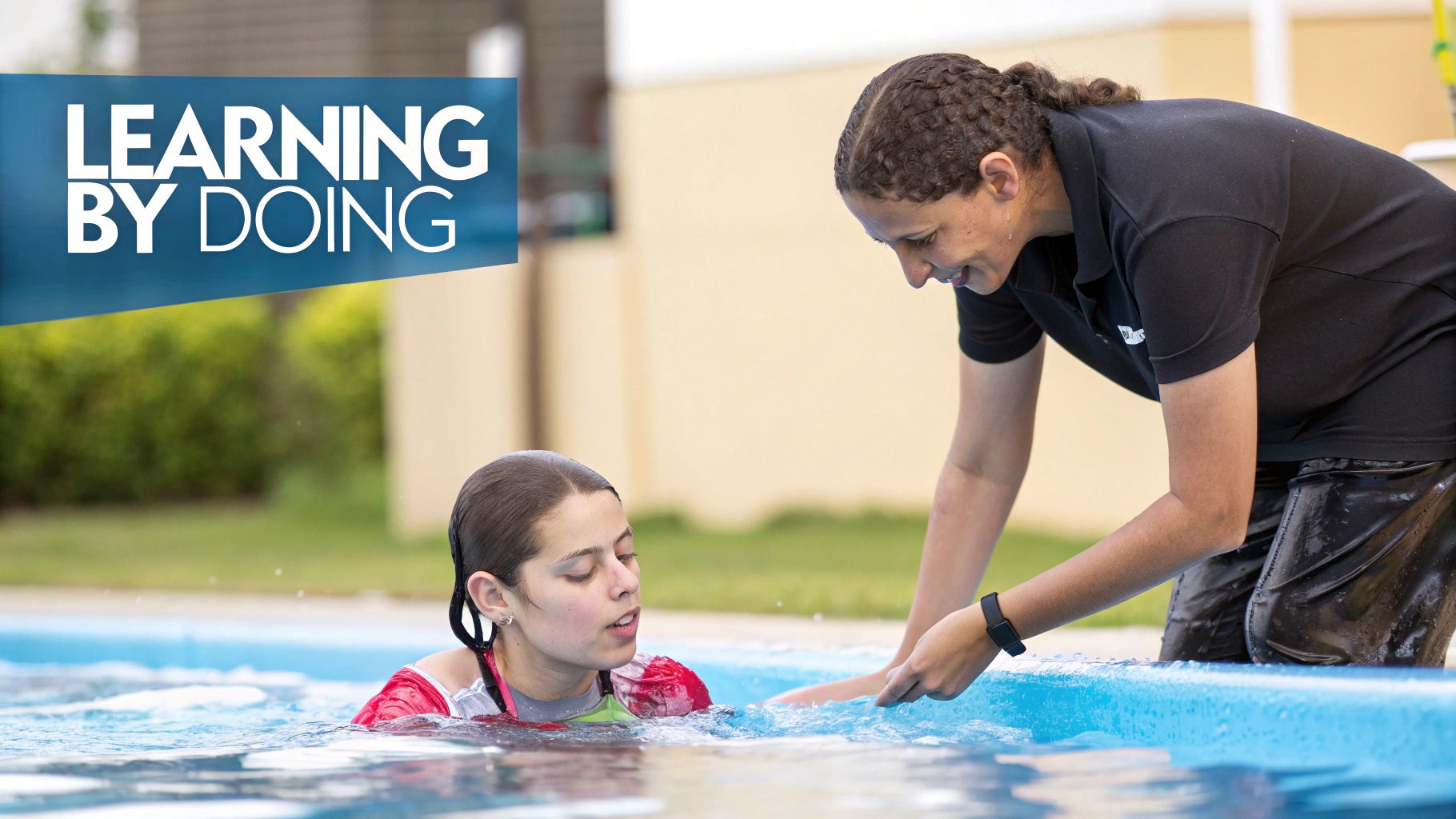
Hands-on learning moves the learner from a passive role to an active one. Instead of absorbing information from a lecture or a textbook, the individual becomes physically involved in the learning process. They are actively solving problems, building new skills, and gaining real, practical competence.
It’s the difference between seeing a diagram of a flat tire and feeling the steel of the lug wrench in your hand as you loosen the nuts yourself.
This approach engages both the mind and the body. When you perform a task physically, you forge a much deeper connection to the material. You're not just memorizing facts; you're building muscle memory and a genuine, intuitive understanding. This is especially powerful for people with a kinesthetic learning style, who are naturally inclined to learn best through physical experience.
From Passive Reception To Active Engagement
For centuries, the traditional educational model has often been a one-way transfer of information: the instructor speaks, the student listens. Hands-on learning fundamentally changes this dynamic. It turns learning into an interactive process between the individual and the task at hand.
Research from institutions like the University of Chicago and Cornell University consistently validates this approach. When we engage more of our senses and cognitive functions through direct experience, we retain information far better and understand it on a much deeper level.
Let's break down the core differences. It becomes clear why one method builds lasting skills while the other often fades.
Hands On Learning vs Passive Learning At A Glance
| Attribute | Hands On Learning | Passive Learning |
|---|---|---|
| Learner's Role | Active participant, problem-solver | Passive recipient of information |
| Engagement | High; involves multiple senses | Low; primarily auditory and visual |
| Skill Application | Immediate and practical | Theoretical, often delayed |
| Retention Rate | High (often up to 75% or more) | Low (as little as 10-20%) |
| Feedback Loop | Instant, based on direct results | Delayed, often via tests or grades |
The bottom line is simple. Passive learning might teach you the theory, but active, hands-on learning is what builds real-world competence.
At its heart, hands-on learning is about closing the gap between knowing what to do and knowing how to do it. It builds confidence and competence simultaneously, preparing individuals for real-world challenges where theory alone is not enough.
How The Brain Responds To Learning By Doing
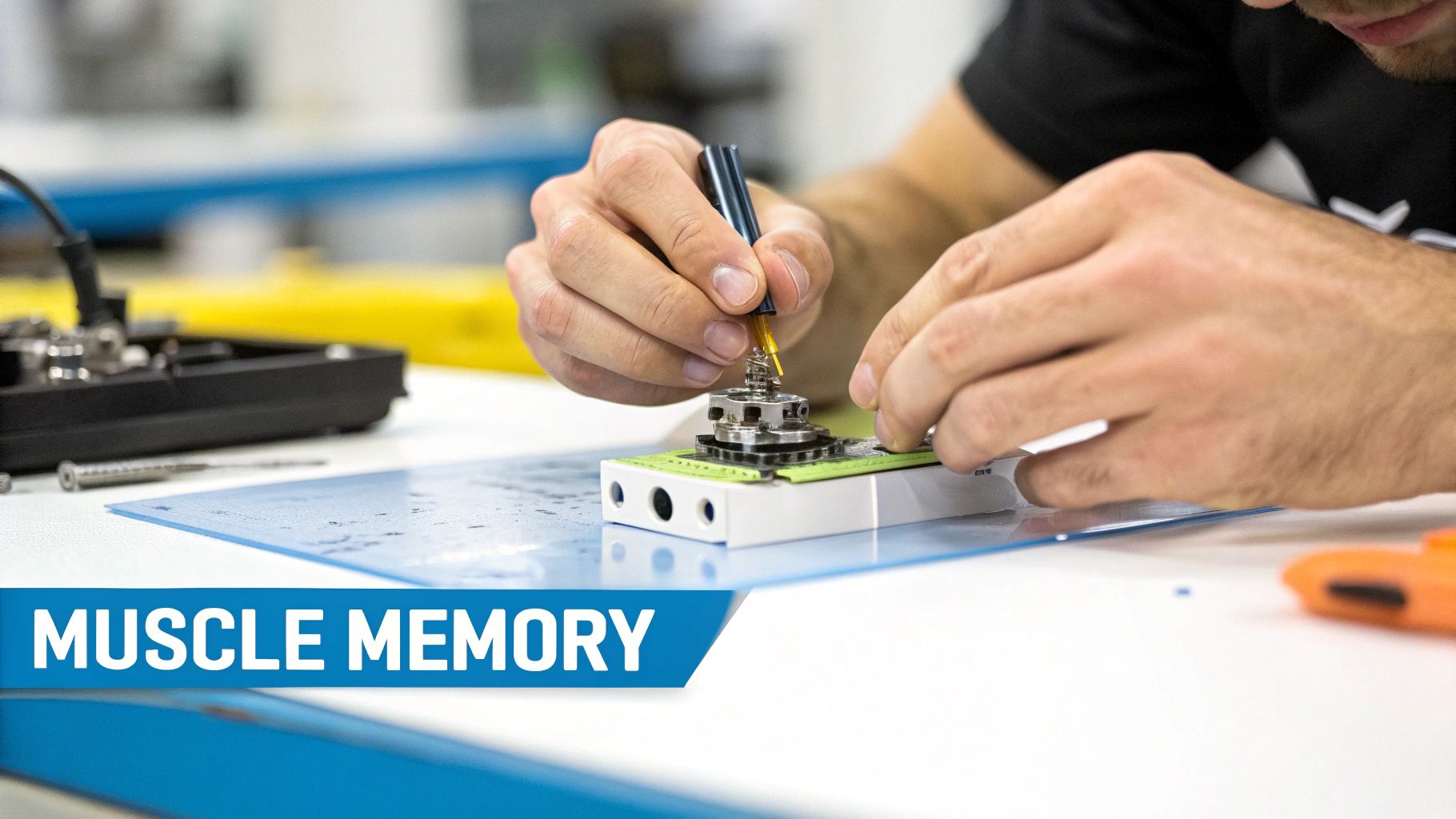
When you learn by doing, a remarkable process unfolds within the brain. This isn't just a different teaching style; it’s a biologically superior way to acquire and retain real-world skills. The brain is inherently wired for action, and hands-on learning aligns with its natural processes.
Think of your brain's neural network as a dense forest. Reading a manual is like looking at a map of that forest. Actually performing the task, however, is like physically walking through the forest and creating a well-defined path. Each repetition deepens that path, making it easier and faster to travel the next time.
This is the foundation of muscle memory. The repeated physical actions strengthen the neural pathways connecting the brain to the muscles. A process called myelination insulates these pathways, allowing nerve impulses to travel faster. Eventually, the skill becomes second nature, shifting from conscious effort to automatic execution.
Engaging Multiple Senses For Stronger Recall
Passive learning, like listening to a lecture, usually engages only one or two senses. Hands-on learning, on the other hand, is a multi-sensory experience. You see the components, feel their texture, hear the click as they lock into place, and may even notice the smell of machine oil.
This multi-sensory input creates a richer, more complex web of memory. Instead of a single data point, the brain forges multiple connections to the information, making that knowledge far more resilient and easier to recall under pressure.
- Visual Input: Seeing the task unfold provides critical spatial context.
- Auditory Input: The sounds of the process—clicks, whirs, and snaps—provide crucial feedback.
- Tactile Input: Physically touching and manipulating objects builds a concrete, undeniable understanding.
This integrated approach is precisely why you can often perform a physical task you haven't done in years, while a fact you memorized last week might already be gone. The memory is encoded more deeply across different regions of the brain.
The Psychological Boost Of Active Participation
Beyond the neurological wiring, there's a powerful psychological component at play. Every time you successfully complete a small step in a hands-on task, your brain releases dopamine—a neurotransmitter tied to reward and motivation. This chemical reward reinforces the learning process, creating a positive feedback loop that encourages further practice.
This cycle of action-and-reward builds momentum and confidence. It transforms learning from a chore into an engaging challenge. Instead of fearing failure, learners start to see it as immediate feedback—a puzzle to solve rather than a negative mark. That mindset is essential for developing the resilience needed for complex industrial roles.
Active learning fundamentally changes the brain's chemistry. The small victories achieved during hands-on practice don't just build skills; they build the intrinsic motivation required to master them.
Interestingly, a landmark 2019 study from Harvard University found that while students felt they learned more from traditional lectures, they actually learned significantly more when participating in active, hands-on classrooms. This highlights a key truth: the most effective learning methods aren't always the ones that feel the easiest. The cognitive effort involved in doing is what makes the knowledge stick.
Tangible Benefits For Corporate And Industrial Teams
While the science behind hands-on learning is compelling, the true measure of its value in a business context is its impact on performance. For industrial and corporate teams, this is not just a training philosophy; it is a direct investment in operational excellence that delivers measurable dividends.
The most significant benefit is the accelerated rate of skill acquisition. When a technician learns to repair a complex machine by actually doing it—rather than just reading a manual—they achieve competency far faster. This accelerated learning dramatically reduces the time it takes for a new hire to become a fully productive team member.
A faster learning curve creates a more agile and adaptable workforce, ready to handle new equipment or process changes without the costly downtime associated with traditional classroom training.
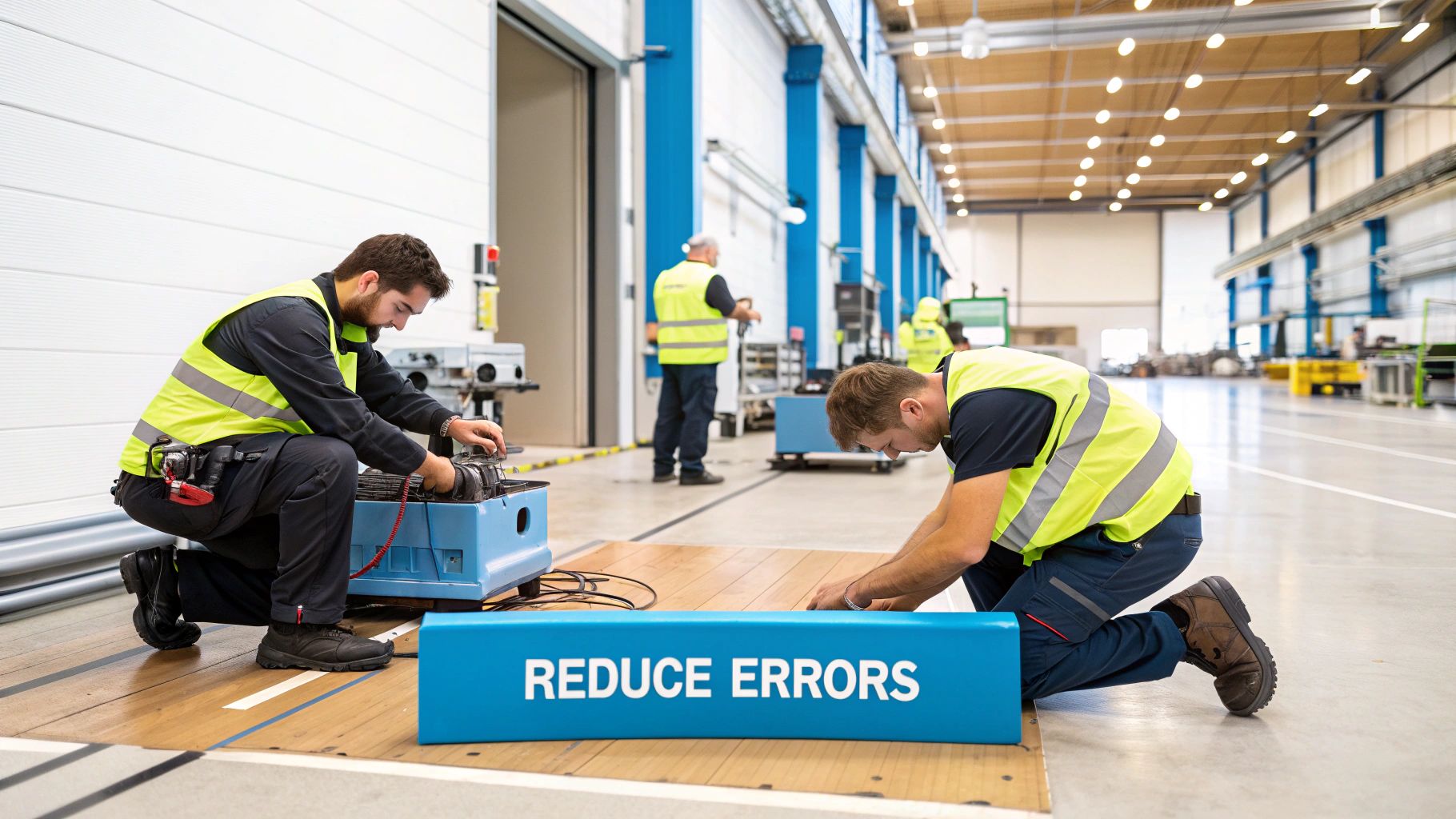
Drastically Reducing Costly Errors
In an industrial setting, a minor mistake can escalate into a major problem, resulting in wasted materials, damaged equipment, or a complete production halt. Hands-on learning is a powerful defense against these errors because it builds muscle memory and procedural discipline.
When an employee has physically performed a multi-step assembly process, the correct sequence becomes ingrained. They develop an intuitive understanding of the workflow that a manual could never provide, making them less likely to make mistakes under pressure. For example, a trainee who has run through a hazardous material cleanup in a simulation will be calmer and more effective during a real emergency.
This focus on practical application leads to significant operational improvements:
- Improved First-Time Quality: Tasks are completed correctly the first time, reducing rework and scrap.
- Greater Procedural Adherence: Employees follow protocols because they understand the physical "why" behind them.
- Increased Operational Confidence: Teams that practice for real-world scenarios are more decisive and confident when challenges arise.
Hands-on learning directly confronts the high cost of human error. By allowing teams to practice, fail, and master tasks in a controlled setting, it builds a workforce that is not only skilled but also consistently reliable.
Enhancing Workplace Safety And Engagement
Perhaps the most critical benefit is the impact on safety. Hands-on training allows teams to prepare for high-stakes procedures in a completely risk-free environment. This is where modern technologies like Augmented and Virtual Reality excel, enabling endless rehearsals of emergency shutdowns or complex lockout-tagout protocols without any real-world danger.
Simultaneously, this active approach to training significantly boosts employee engagement. Instead of passively observing a presentation, individuals become active participants in their own development. This sense of ownership and accomplishment is directly linked to better morale and lower employee turnover.
For corporate and industrial teams, hands-on learning can take many forms, from practical simulations to hands-on team building outdoor activities that strengthen collaboration and problem-solving.
By moving beyond theory, you build a culture where safety and skill aren't just taught—they're practiced. It transforms training from a compliance exercise into the foundation of a safe, efficient, and deeply engaged team.
Scaling Hands On Learning With AR And VR
Historically, the primary challenge for traditional hands-on learning has been scalability. One-on-one apprenticeship is incredibly effective, but it is difficult to replicate that experience for hundreds or thousands of employees across different locations. How can an organization provide consistent, high-quality practical training at scale?
This is where modern technology provides a solution. Augmented Reality (AR) and Virtual Reality (VR) are powerful tools that make hands-on training repeatable, safe, and scalable. They effectively digitize the expert and the environment, making critical hands-on experience available to anyone, anywhere, at any time.
Virtual Reality: The Perfect Practice Ground
Virtual Reality immerses a learner in a fully simulated, computer-generated environment. It functions like a flight simulator for any industrial task imaginable, providing a space for employees to practice complex or dangerous procedures with zero real-world risk.
Consider a new welder learning their craft. In a VR simulation, they can practice their technique hundreds of times without consuming any raw materials or expensive gases. The system can provide instant, precise feedback on their angle, speed, and consistency, allowing them to build perfect muscle memory in a completely controlled environment. There is no risk of injury, no wasted materials, and no need to occupy critical equipment on the production floor.
VR effectively decouples training from your daily operations. It allows for unlimited practice on multi-million dollar machinery or in high-stakes scenarios—like an emergency shutdown—without causing a single minute of actual downtime.
This type of training is ideally suited for tasks that are:
- High-Risk: Training for hazardous material handling or working at heights can be conducted in complete safety.
- Costly: Employees can master skills on virtual equipment, eliminating the cost of material waste and potential damage to live machinery.
- Rare or Inaccessible: Teams can drill for infrequent but critical events, like a plant-wide power failure, so they are prepared to act effectively when it matters most.
Augmented Reality: The Expert On Your Shoulder
While VR creates a new world, Augmented Reality enhances the real one. AR acts as a digital mentor, overlaying vital information, instructions, and 3D diagrams directly onto an employee’s view of their physical workspace.
Imagine a technician servicing complex aircraft landing gear for the first time. Wearing an AR headset, they could see a step-by-step checklist floating in their field of view. As they look at a specific bolt, an arrow might appear, showing the correct direction to turn it. A 3D animation could even demonstrate the precise method for connecting a difficult component.
This real-time guidance closes the gap between knowledge and action. The employee does not have to stop working to consult a manual or contact a senior expert. The expert’s knowledge is delivered directly to them at the point of need. This not only accelerates their proficiency but also dramatically reduces the likelihood of human error.
The combination of artificial intelligence and immersive technology is making these tools even more powerful. To see just how much, you can learn more about AI-driven augmented reality and its growing impact.
The Practical Use Cases Of Immersive Training
The applications for AR and VR in hands-on learning are vast and are already delivering measurable results across industries. These technologies shift training from a theoretical classroom exercise to a practical, performance-based activity.
| Technology | Use Case Example | Key Benefit |
|---|---|---|
| Virtual Reality (VR) | A team of medical professionals practices a new, complex surgical procedure in a simulated operating room before ever touching a real patient. | Risk Mitigation: Allows for mastery of high-stakes skills in a zero-risk environment, improving patient safety and surgeon confidence. |
| Augmented Reality (AR) | A field service technician uses AR glasses to receive remote guidance from an expert, who sees what the tech sees and can annotate their view. | Operational Efficiency: Halves service times by eliminating the need for expert travel and empowering frontline workers with immediate support. |
| Virtual Reality (VR) | New retail employees navigate a virtual store to practice stocking shelves, handling customer complaints, and responding to emergency scenarios like a fire. | Standardized Training: Ensures every employee across hundreds of stores receives the exact same high-quality, scenario-based training. |
Ultimately, AR and VR do not replace the principles of hands-on learning—they amplify them. By overcoming the physical limitations of traditional training methods, these technologies make it possible to deliver effective, hands-on training to every employee, ensuring the entire workforce is skilled, confident, and prepared for future challenges.
Measuring The ROI Of Your Training Program
To justify investment in any new training initiative, demonstrating a clear return is essential. While the operational benefits of hands-on learning are significant, proving its financial value requires tracking specific Key Performance Indicators (KPIs).
When AR and VR technologies are integrated, the return on investment (ROI) is not only compelling but also highly measurable. This data-driven approach shifts the conversation about training from a cost center to a strategic investment in operational capability.
Key Performance Indicators To Track
To build a solid business case, focus on quantifiable metrics. The right KPIs will provide a clear before-and-after picture, showing exactly where the investment is generating value.
Key areas to monitor include:
- Reduced Time to Competency: How quickly does a new hire become a fully productive team member? Immersive training can significantly shorten this period, meaning they begin adding value to the organization much sooner.
- Lower Error and Waste Rates: Track metrics such as scrapped materials, rework hours, or customer-reported defects. When an employee can practice a delicate task dozens of times in a simulation, they develop a level of precision that prevents costly mistakes on the production line.
- Fewer Safety Incidents: This is a critical metric. Track the number of workplace accidents, near misses, and all associated costs. Allowing technicians to practice high-risk procedures in a safe VR environment can lead to a dramatic and measurable reduction in safety-related expenses.
This data-first approach frames the discussion in the language of business performance. The positive effects are far-reaching. A multi-year analysis of a 'Hands on Learning' program in Australia found that 95% of participants not only finished school but moved straight into further study or employment, a testament to how these skills build real-world readiness.
Calculating Your Return On Investment
Once your KPIs are established, you can calculate the ROI. The formula is straightforward: compare the upfront investment in the program—such as VR hardware and content development—against the tangible savings it generates over time.
This is where the distinct roles of different technologies become clear.
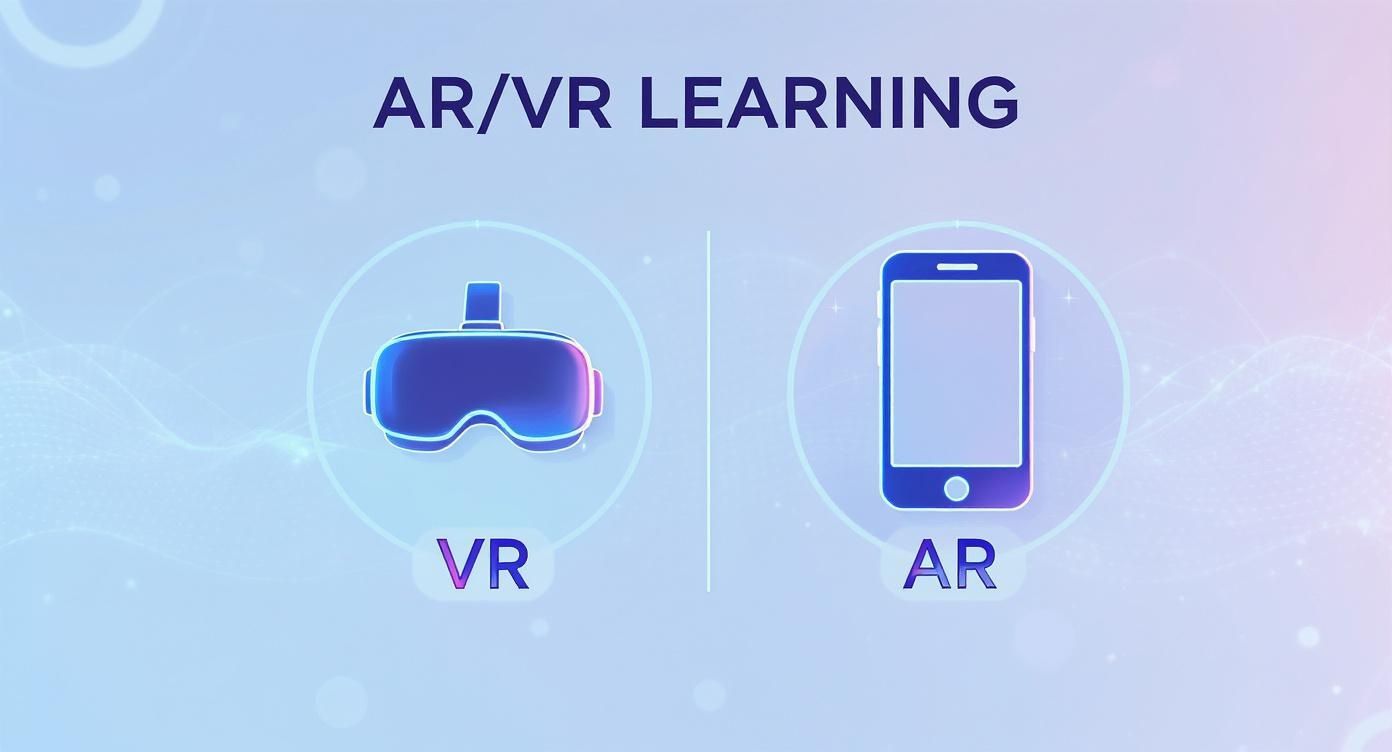
As the image shows, VR is ideal for deep, fully-immersive simulations, while AR excels at providing real-time, on-the-job guidance directly within the workspace.
Let's review a simple, hypothetical example.
Sample ROI Calculation For A VR Training Initiative
Here’s a look at how a company might calculate the ROI for a VR training program designed for 100 technicians over a single year. This example breaks down the initial costs versus the operational savings.
| Metric | Cost/Saving Category | Annual Financial Impact |
|---|---|---|
| Initial Investment | VR Hardware & Software | -$50,000 |
| Training Savings | Reduced Travel & Instructor Costs | +$40,000 |
| Operational Savings | Lower Material Waste/Rework | +$35,000 |
| Productivity Gains | Faster Time to Competency | +$60,000 |
| Safety Improvements | Reduced Incident-Related Costs | +$25,000 |
| Net Financial Impact | Total Savings – Initial Investment | +$110,000 |
This table illustrates a clear positive return within the first year, making a powerful case for the investment. Your specific figures will vary, but the methodology remains the same.
To run the numbers for your own situation, our Training ROI Calculator can help you model the potential savings based on your specific operational needs.
At its heart, a strong ROI case demonstrates that the cost of not adopting effective hands-on training—measured in errors, downtime, and safety incidents—is far greater than the initial investment.
A clear, data-backed financial justification is often the final element needed to gain executive buy-in and secure the resources for a program that delivers meaningful results.
Designing a Successful Hands-on Learning Program
Understanding the principles and ROI of hands-on learning is the first step. Building an effective program requires a strategic approach. A successful initiative is the result of a thoughtful design that closes the gap between learning goals and real-world performance.
The foundation of any great program is clarity. Before developing any content, you must define what success looks like. What specific, observable skills should a trainee be able to demonstrate upon completion? These outcomes must be measurable and tied directly to operational needs.
Establish Clear Learning Objectives
The most effective method is to work backward from the desired result. A vague goal like "improve maintenance skills" is insufficient. A more precise objective would be, "A technician will be able to successfully replace a hydraulic pump on the Model 3B press in under 30 minutes, following all safety protocols."
This level of detail serves as a guiding principle. It informs every decision, from the scenarios you create to the metrics you track, ensuring that your training is focused on developing practical, job-ready skills. An excellent way to structure this is through competency-based training programs, which prioritize mastering specific skills over simply logging course hours.
Once your objectives are clear, the next step is to build realistic scenarios.
Build Realistic Scenarios
The effectiveness of hands-on learning lies in its authenticity. Training scenarios should mirror the pressures, complexities, and unexpected challenges of the actual work environment. This is not just about replicating the task; it's about replicating the context.
For instance, a VR simulation for a field technician should not just show a broken machine in a quiet, well-lit room. It should include background noise, dim lighting, and perhaps a time-sensitive alert—all the environmental factors that impact performance on the job. This approach builds not just technical skill but also the resilience and critical thinking needed when conditions are not ideal.
The goal is to create a controlled environment where it's safe to fail. A mistake in a simulation is a powerful learning moment, not a costly operational disaster. This is how you build real confidence and prepare employees for a genuine crisis.
Balance Guidance With Self-Discovery
An effective program strikes a careful balance between guided instruction and self-directed problem-solving. Overly prescriptive, step-by-step instructions can stifle critical thinking. Conversely, too little guidance can lead to frustration.
A well-designed program often follows a "see one, do one, teach one" model, even in a digital format:
- Guided Instruction: The learner first observes the correct procedure. This could be an AR overlay pointing out key components or an expert in VR demonstrating the process.
- Independent Practice: Next, the learner performs the task on their own. The system provides feedback or correction only when a mistake is made.
- Problem-Solving: Finally, the scenario introduces a new variable or an unexpected fault, forcing the learner to apply their knowledge to solve a novel problem.
This progressive method builds a solid foundation of knowledge and then layers on the critical thinking skills needed for adaptation. By structuring your program around clear outcomes, realistic scenarios, and a strategic blend of instruction and exploration, you create a hands-on learning experience that delivers lasting impact and measurable results.
Got Questions? We’ve Got Answers.
Here are some of the most common questions about implementing hands-on learning in a professional environment, from getting started to measuring success and ensuring team adoption.
How Do I Even Begin Implementing Hands-On Learning?
The key is to start small and prove the concept. Instead of attempting a large-scale overhaul, select a single, high-impact task where mistakes are frequent or the learning curve is steep. A practical first step is to convert one module from your existing training into a hands-on exercise or a simple VR simulation.
This "pilot program" approach allows you to demonstrate value quickly. By focusing on a known pain point, you can collect undeniable data on improvements in learning speed or reductions in error rates. This success story can then serve as the foundation for wider adoption.
What's The Best Way To Measure Success?
Success must be tied to tangible business outcomes. While metrics like "engagement" are valuable, the KPIs that command attention are those that affect the bottom line.
Focus on these Key Performance Indicators (KPIs):
- Time to Competency: How long does it take for a new hire to perform a task correctly and without supervision? Track this metric.
- Error Rate Reduction: Measure the decrease in mistakes, wasted materials, or rework required after the implementation of the new training.
- Safety Incident Frequency: For critical procedures, monitor the decline in safety incidents or near-misses.
How Do I Get My Team To Actually Use AR and VR Training?
Team adoption starts with demonstrating the benefits, not just describing them. Frame the technology as a tool that makes their jobs easier, safer, and less stressful. Most individuals are naturally curious about new tools, especially when they see a direct positive impact on their work.
There's a common myth that older employees will resist new technology. Our experience shows the opposite: most people welcome training that feels more like the real job and lets them build confidence without the fear of breaking expensive equipment.
Identify a few enthusiastic team members to be your "early adopters." Let them try the technology first. Their positive feedback and success stories will be more persuasive to their peers than any top-down mandate.
Ready to see how immersive, hands-on training can change the game for your operations? AIDAR Solutions builds scalable AR and VR platforms that speed up learning, slash error rates, and deliver a clear return on investment.
Explore our industrial training solutions at https://aidarsolutions.com to get started.