How to Reduce Employee Turnover: Proven Retention Strategies
Reducing employee turnover requires more than competitive pay. While compensation is important, the most effective strategies address the core reasons skilled employees leave: inadequate management, a lack of growth opportunities, and a disconnect from the company’s purpose.
The key is to proactively solve the root causes of attrition, rather than reactively making counteroffers.
Why Your Best Employees Really Leave

High turnover is a direct threat to productivity, morale, and financial stability. When a skilled technician or an experienced floor manager resigns, they take years of irreplaceable, hands-on knowledge with them.
This "brain drain" creates a domino effect, leading to production delays, new safety risks, and increased strain on the remaining team. We've seen firsthand how a company can lose 330 years of experience in just 5 years, and the operational impact is significant.
The costs are both direct and indirect. Recruiting, hiring, and training are expensive and time-consuming. However, the hidden costs—such as declining team morale, disrupted customer relationships, and a damaged employer reputation—can inflict the most long-term damage.
The Disconnect Between the Office and the Floor
Many retention strategies fail due to a significant gap between leadership's perception and the daily reality for frontline workers. While the C-suite may focus on compensation packages, employees on the floor often contend with more immediate frustrations.
Common patterns include:
- Ineffective Management: A supervisor who fails to communicate, offer support, or provide recognition is a primary driver of voluntary turnover.
- Lack of Career Growth: If employees see no future for themselves at the company, they will naturally seek opportunities elsewhere.
- Inadequate Tools and Training: Expecting employees to perform complex tasks without the proper training or equipment leads to burnout and disengagement.
Employee turnover is the #1 workforce challenge on a global scale. According to Gallagher’s Workforce Trends Report, 66% of HR executives identify retention as their top concern. Significantly, half of the employees who quit cite their manager as the primary reason.
This data underscores a clear point: trust in leadership and effective day-to-day management are often more influential than salary.
Before exploring solutions, it is crucial to distinguish between common turnover myths and operational reality. Misdiagnosing the problem leads to investing in "fixes" that fail to address the underlying issues.
Common Turnover Myths vs. Reality
| Common Myth | Underlying Reality | Effective Strategic Focus |
|---|---|---|
| "People only leave for more money." | Compensation is a factor, but rarely the only one. A toxic culture, poor management, and lack of growth are the real drivers. | Focus on leadership training, building a positive culture, and creating clear career paths. |
| "Turnover is just a cost of doing business." | High turnover is a symptom of deeper organizational issues. Top-performing companies treat retention as a key performance indicator. | Actively measure retention, conduct exit interviews, and use the data to pinpoint and fix systemic problems. |
| "We can't stop good people from leaving." | While some turnover is natural, a "helpless" attitude is self-defeating. Most voluntary turnover is preventable. | Proactively engage with employees through regular check-ins, stay interviews, and by addressing their feedback. |
Understanding these realities helps shift the focus from reactive damage control to proactive, strategic planning.
Moving Beyond Reactive Fixes
Making a counteroffer to an employee who has already resigned is a temporary solution that fails to address the root cause of their dissatisfaction.
Even if they accept, the employee is likely to depart within a year. Furthermore, the gesture can negatively impact team morale when other employees become aware of it.
Truly effective retention begins with understanding the day-to-day experiences of your workforce. It demands a commitment to solving the root causes of disengagement, not just masking the symptoms. Exploring a wide range of proven retention strategies that address the problem from multiple angles is a foundational first step toward building a workplace people do not want to leave.
Pinpointing the Root Causes of Turnover in Your Facility
To effectively address your turnover problem, you must move beyond speculation. A vague sense that "people aren't happy" is not a basis for a solution. You need to gather concrete evidence to identify the precise reasons employees are leaving your manufacturing or industrial facility.
This investigative phase is the most critical part of your retention strategy. Without a clear, data-backed understanding of your specific challenges, any attempted solution will be a shot in the dark, wasting time, money, and employee trust.
Go Beyond the Standard Exit Interview
The exit interview can be a valuable source of information, but only if conducted in a way that encourages honesty. Often, they become a polite formality where departing employees offer generic reasons like "a better opportunity" to avoid burning bridges.
To uncover the real story, create a process that feels safe and neutral.
Consider having a third party, such as an HR business partner who was not the employee's direct contact, conduct the interview. This can make individuals more comfortable sharing candid feedback about a manager or team dynamics.
It is also essential to ask better questions. Move beyond a checklist and probe deeper:
- "What was the specific event or factor that prompted you to start looking for a new job?"
- "Could you describe a time when you felt highly motivated here? And a time you felt particularly frustrated?"
- "If you were in charge of this facility for a day, what is the first change you would implement?"
These open-ended questions encourage narrative responses, revealing nuances of the employee's daily experience that provide richer insights than a standard survey.
Use Targeted Surveys to Uncover Hidden Patterns
While exit interviews provide depth, engagement and pulse surveys offer breadth. They allow you to assess the sentiment of your current employees, which is crucial for identifying problems before they lead to resignations.
However, a generic, 50-question annual survey may not yield the specific data required for effective action.
A more effective approach is to use shorter, frequent pulse surveys focused on a single topic. For instance, this month's survey could focus solely on manager effectiveness. Next month, it could address team communication or the quality of tools and equipment. This method provides more immediate and relevant feedback.
The goal of a survey is not just to collect data—it is to demonstrate that you are listening. If you solicit feedback and then fail to act on it, you will erode trust more quickly than almost any other action.
Analyze Your Data with a Critical Eye
Once you have qualitative feedback from interviews and quantitative data from surveys, it is time to analyze the numbers. Your overall turnover rate can mask the real trouble spots. You must segment the data to identify where the problem is most severe.
Start by breaking down your turnover rate by these key variables:
- Department or Team: Is the attrition rate on the second-shift welding team triple that of any other? This is not a coincidence; it points directly to a specific manager or a localized issue with working conditions.
- Tenure: Are you losing a disproportionate number of new hires within their first 90 days? This is a strong indicator that your onboarding and initial training processes are failing.
- Manager: This is often the most revealing variable. Mapping turnover data to individual supervisors almost always reveals patterns. A manager with consistently high team turnover requires immediate support and intervention.
This level of analysis transforms raw data into a clear action plan. It tells you exactly where to focus your energy—on the specific managers, teams, or processes driving your retention problems.
This deep dive often uncovers critical skills gaps that lead to employee frustration and burnout. To get a structured look at this, a skills gap analysis template can help you pinpoint exactly where your training and development efforts need to go. With this evidence in hand, you're ready to build a retention plan that actually works.
Designing a Retention-Focused Hiring and Onboarding Program
You cannot solve a retention problem with exit interviews alone. If your hiring and onboarding processes are flawed, you are systematically feeding the turnover machine. The effort to retain great employees begins the moment a potential candidate sees your job description.
A disorganized, vague, or misleading first impression is a direct cause of early-stage turnover, particularly within the first 90 days. When a new hire's daily reality does not align with the expectations set during recruitment, trust is broken, and they begin to seek other opportunities.
Crafting Job Descriptions That Attract the Right Fit
Your job description is your first line of defense against turnover. It must function as a retention tool, not just a recruitment tool. This means abandoning generic templates in favor of an honest, detailed depiction of the role.
Avoid meaningless phrases like "fast-paced environment." Instead, be specific about what that means on your shop floor.
A retention-focused job description should include:
- A "Day in the Life" Snapshot: Briefly describe a typical shift, mentioning the specific machinery they will operate and the common challenges they will need to solve.
- Must-Haves vs. Nice-to-Haves: Clearly distinguish non-negotiable skills from those that can be trained on the job. This helps candidates accurately assess their fit and prevents you from hiring someone who lacks the core competence to succeed.
- Team and Reporting Structure: Inform candidates about their direct supervisor and the teams they will collaborate with. This sets clear expectations for communication and workflow from the outset.
This level of transparency acts as a powerful filter. It encourages candidates who are not a good fit to self-select out, meaning those who do apply are far more likely to be a genuine match for the job and your company. It is a simple, proactive way to reduce turnover before it starts.
Building a Structured and Immersive Onboarding Experience
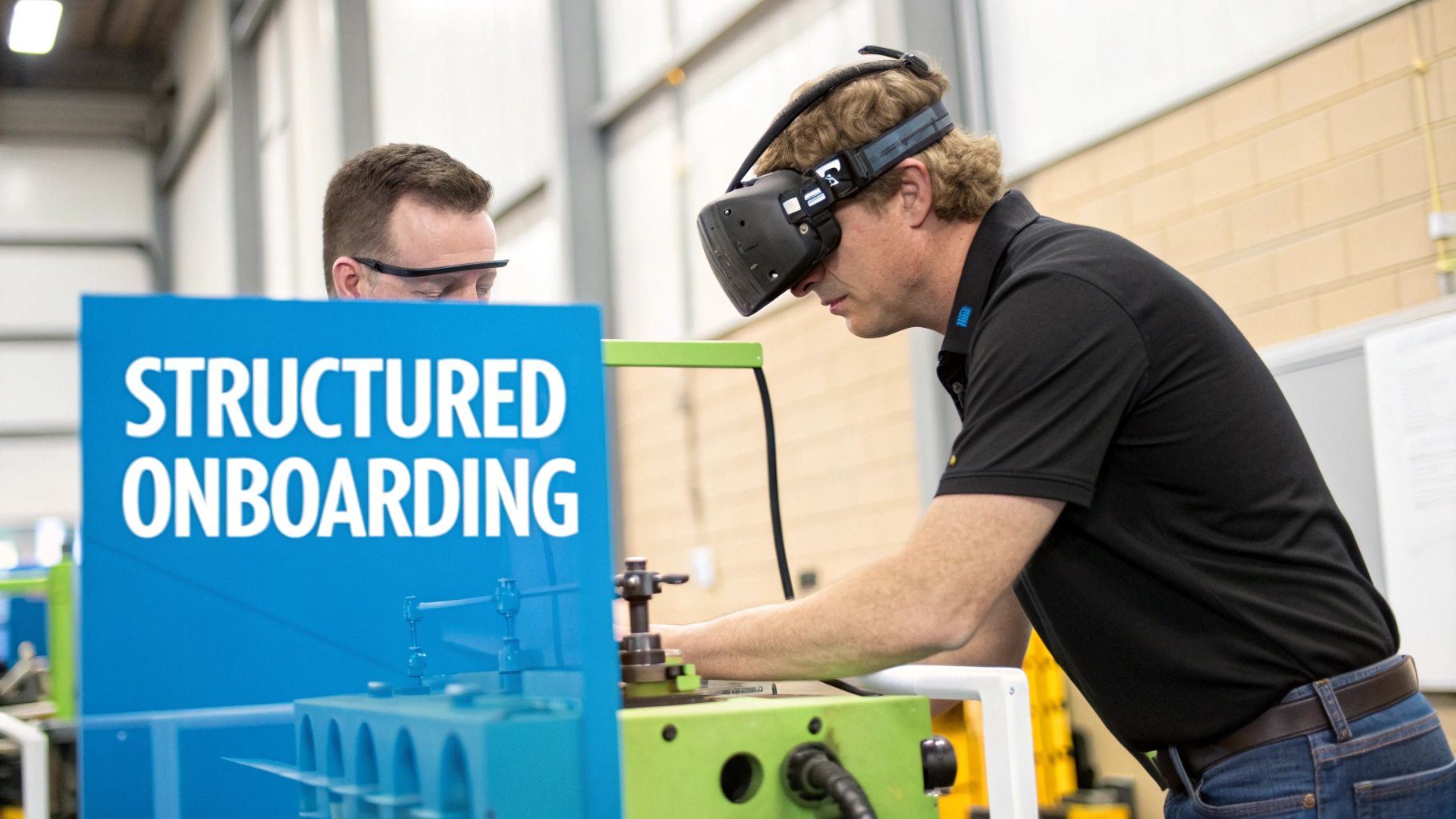
Once you have hired the right person, the onboarding process is your greatest opportunity to validate their decision. For many industrial companies, however, "onboarding" consists of HR paperwork, a safety video, and informal shadowing.
This sink-or-swim approach is detrimental. It fosters anxiety, hinders productivity, and makes new hires feel undervalued. A successful onboarding program must be structured, supportive, and engaging.
A great onboarding program signals to new employees that you are invested in their long-term success. It's not just about compliance; it's about building competence, confidence, and a sense of belonging from their very first day.
To optimize this critical period, a modern approach is necessary. The goal is to shift from passive learning to active, hands-on experiences that prepare new technicians for their roles in a safe, controlled environment.
Using AR and VR for Safer, Faster Onboarding
Immersive technologies like Augmented Reality (AR) and Virtual Reality (VR) can transform the onboarding experience. Instead of having a new hire read a dense manual about a complex machine, they can put on a VR headset and learn to operate it inside a perfect, zero-risk digital twin of your facility.
This type of virtual training offers significant advantages:
- Accelerated Learning: Immersive training can improve learning retention rates by up to 75% compared to traditional methods. Complex procedures become muscle memory in a fraction of the time.
- Enhanced Safety: New employees can practice emergency shutdowns or troubleshoot dangerous faults in a virtual environment without any risk to themselves, their colleagues, or your equipment.
- Increased Confidence: By the time they step onto the actual factory floor, they have already performed the job multiple times. This reduces the hesitation and anxiety that often lead to early mistakes.
Furthermore, AR can be used directly on the job. A new technician can wear smart glasses that overlay digital instructions, checklists, or diagrams onto their view of the machine they are working on. This provides real-time, on-the-spot guidance, bridging the gap between training and real-world application.
Investing in a modern, tech-driven onboarding process sends a clear message: you are a forward-thinking company that provides its team with the best tools for success. For a deeper look into structuring these initial weeks, explore our detailed guide on employee onboarding best practices. This strategic investment in your people pays long-term dividends by building loyalty and reducing turnover.
Building Career Pathways and Modern Upskilling Opportunities
When an employee cannot envision a future for themselves at your company, it is only a matter of time before they seek one elsewhere. A dead-end job is a primary driver of attrition, especially in industrial roles where skill progression is paramount. To prevent this, you must create tangible, visible career pathways that demonstrate your investment in their long-term growth.
This requires more than a vague promise of future promotions. It involves mapping out a clear, achievable journey. An entry-level machine operator should know exactly what skills, certifications, and performance goals they need to achieve to become a senior technician, a team lead, or a maintenance supervisor. When people can see the path forward, they are motivated to follow it.
While voluntary turnover is projected to dip from 17.3% in 2023 to 13.0% in 2024-2025, the competition for skilled talent remains intense. Developing internal talent is one of the most effective defensive strategies. Providing clear opportunities for advancement fosters a powerful sense of loyalty, making employees far less susceptible to recruitment by competitors. You can dive deeper into these workforce turnover trends and their impact to see the bigger picture.
Charting Clear and Attainable Career Maps
A career map is more than a glorified organizational chart. It is a roadmap that details the potential journeys an employee can take within your facility, connecting roles and specifying the competencies and training required for advancement.
Consider a potential path for a junior maintenance technician:
- Level 1 (0-1 year): The focus is on preventative maintenance routines and basic equipment troubleshooting. Advancement requires completing initial safety and equipment-specific VR training modules.
- Level 2 (1-3 years): This stage involves mastering diagnostics on key production lines and obtaining certification on more advanced machinery. It also introduces responsibilities like mentoring junior staff and leading small repair projects.
- Level 3 (Senior Specialist): This level requires deep expertise in areas like PLC programming or specialized hydraulics. The role shifts to complex problem-solving, training others, and contributing to new equipment acquisition decisions.
When you present the journey this clearly, you transform a "job" into a "career." This simple visualization gives employees a powerful reason to stay and grow with your company, not away from it.
Upskilling with Immersive AR and VR Training
Once you have mapped out the pathways, you must provide the necessary tools for advancement. Traditional training methods—such as shadowing senior employees or reading dense technical manuals—are slow, inconsistent, and often unsafe for complex tasks. Modern upskilling requires modern solutions.
Augmented Reality (AR) and Virtual Reality (VR) platforms can revolutionize this process. They create a safe, repeatable, and highly effective training environment for employees to acquire new skills. Instead of attempting a dangerous new welding technique on the shop floor, a technician can practice it dozens of times in a VR simulation until it becomes second nature—with zero risk and no wasted materials.
Investing in modern training technology is a direct investment in your people. It's a tangible signal that you are committed to their professional development, which is one of the most powerful retention magnets you can have.
Immersive tools address the core reasons skilled employees become frustrated and leave: a lack of support and feeling stagnant. A platform like AIDAR.SKILLS allows you to deliver on-demand, interactive training that integrates seamlessly into the daily workflow, eliminating the need to pull employees off the floor for extended classroom sessions.
A comparison of traditional and modern training methods highlights the benefits:
Traditional Training vs. AR Enabled Training
| Metric | Traditional Training (e.g., Manuals, Shadowing) | Immersive AR Training | Impact on Retention |
|---|---|---|---|
| Safety | High-risk for complex tasks; mistakes have real-world consequences. | Zero-risk virtual environment; practice dangerous procedures safely. | Higher. Employees feel safer and better prepared, reducing on-the-job anxiety. |
| Knowledge Retention | Low (often <30% after one week); passive learning. | High (often >75%); active, hands-on learning builds muscle memory. | Higher. Confident, competent employees are more engaged and satisfied. |
| Time-to-Competency | Long and inconsistent; dependent on mentor availability and quality. | Reduced significantly (often by 40-60%); standardized, self-paced learning. | Higher. Faster skill acquisition leads to quicker career progression and fulfillment. |
| Error Rates | High initially; learning curve is steep and public. | Dramatically lower; employees build confidence and precision before touching live equipment. | Higher. Reducing errors boosts morale and eliminates a key source of job stress. |
The data is clear. Transitioning to an immersive training model is not just about efficiency; it is about building a more resilient, capable, and loyal workforce.
Enhancing On-the-Job Performance and Satisfaction
Beyond formal upskilling, AR technology can alleviate the daily friction and stress that lead to burnout. Consider a technician facing a complex piece of equipment for the first time. Instead of searching for a manual or making a frustrating call for help, they can put on an AR headset.
This allows them to see digital work instructions, checklists, and 3D diagrams overlaid directly onto the machine. If they encounter a significant issue, a tool like AIDAR.SERVICE enables them to instantly connect with a remote expert who sees what they see and can guide them through the repair step-by-step.
This transforms a high-stress moment into a supported learning experience. It empowers employees, increases their confidence, and helps them complete the job correctly the first time. By removing these daily frustrations, you create a work environment where skilled individuals feel equipped to succeed—and have little reason to look elsewhere. If you're building out a more comprehensive plan, these learning and development strategies can provide a solid framework.
Fostering a Supportive and Appreciative Work Environment
Beyond career maps and training programs, the day-to-day atmosphere in your facility is a critical factor in retaining employees. A workplace that feels unsafe, unsupportive, or unappreciative will drive away even the most skilled and motivated individuals.
Creating a positive environment is a core business strategy with a direct, measurable impact on your bottom line.
The financial cost of turnover is substantial. Globally, companies lose an estimated $2.9 trillion annually due to voluntary departures. Replacing a single employee can cost between 30% to 400% of their salary. Despite this, a startling 47% of companies have no formal retention strategies, and only 42% measure the effectiveness of their efforts. You can find more of these eye-opening global employee retention statistics on Secondtalent.com.
Enhancing Workplace Safety and Support
For industrial teams, a supportive environment begins with physical and psychological safety. This means going beyond compliance and actively working to reduce the daily stress and friction that lead to burnout. Small ergonomic improvements to workstations can significantly reduce physical strain, while clear, consistently enforced safety protocols build a culture of genuine care.
Technology can also be a powerful tool for mitigating on-the-job stress. A technician facing an unfamiliar machine alone on the factory floor can feel isolated and anxious. An AR-powered remote support tool like AIDAR.SERVICE can instantly connect them with a senior expert who sees their view and can guide them through the repair step-by-step.
That immediate access to expertise transforms a high-stress, potentially dangerous situation into a supported, confidence-building experience. It sends a clear message to your employees: we’re investing in tools that make your tough job easier and safer.
Cultivating a Culture of Recognition
Feeling invisible is a primary reason great employees seek other opportunities. Building a robust culture of recognition is one of the most cost-effective ways to boost morale and loyalty. This does not require expensive bonus programs; small, consistent gestures are often the most meaningful.
Consider these simple yet powerful strategies:
- Peer-to-Peer Shoutouts: Implement a simple system—a dedicated communication channel or a whiteboard in a common area—where team members can publicly thank colleagues for their assistance.
- Celebrating Milestones: Acknowledge work anniversaries, the successful completion of major projects, or the achievement of new certifications. Public recognition demonstrates that you value commitment and growth.
- Specific, Timely Praise: Encourage managers to provide specific feedback instead of generic praise. For example, "Sarah, the way you diagnosed that recurring fault on Line 3 saved us hours of downtime. Incredible work."
Practices like these make employees feel seen and valued for their unique contributions. For a deeper dive into these kinds of changes, you can explore various proven strategies to reduce staff turnover that help foster a more appreciative workplace.
When you intentionally cultivate a supportive and appreciative workplace, you create a powerful defense against attrition.
Know If You're Winning: How to Measure Success and Keep Improving
Implementing new retention strategies without measuring their impact is ineffective. To determine what is working, you must establish clear Key Performance Indicators (KPIs) and a system for continuous improvement.
This discipline separates companies that significantly reduce turnover from those that merely go through the motions. It involves integrating retention into your core operational strategy, allowing you to adapt, refine, and celebrate data-backed successes.
The process below illustrates how a supportive environment—one that is safe, communicative, and values its people—directly contributes to these measurable outcomes.
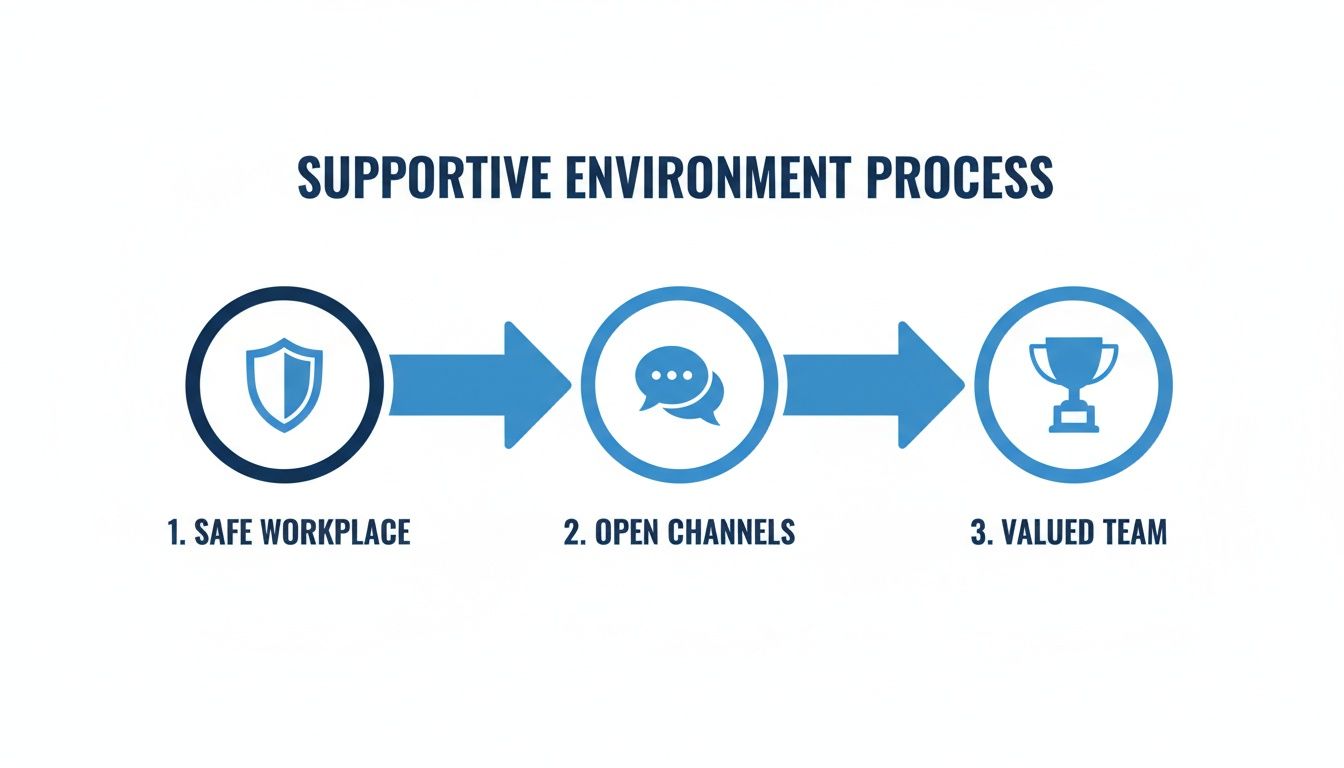
Measurable success is not just about numbers; it is built on the foundation of tangible support that your employees experience daily.
Look Beyond the Basic Turnover Rate
Your overall turnover rate is a starting point, but it lacks the detail needed for actionable insights. To understand the why and the who behind the numbers, you must track more specific metrics.
Consider a balanced scorecard for retention that includes:
- First-Year Attrition: This KPI is a critical indicator of problems with your hiring and onboarding processes. High turnover within the first 12 months suggests a disconnect between the expectations you set and the employee's actual experience.
- Employee Net Promoter Score (eNPS): This provides a quick, powerful snapshot of employee sentiment. Asking, "On a scale of 0-10, how likely are you to recommend our company as a place to work?" reveals significant information about loyalty.
- Internal Promotion Rate: The percentage of open roles filled by internal candidates is a strong indicator of employee engagement. A healthy rate shows that your team sees a future with the company.
Track these metrics quarterly to connect your actions to outcomes. Did your eNPS increase after launching a new recognition program? Did first-year attrition decrease after implementing VR onboarding? This is the data that proves your efforts are effective.
Measuring the Real-World Impact of AR and VR
When you integrate technologies like Augmented and Virtual Reality, you gain access to a new layer of highly specific performance data. These are not just training tools; they provide hard numbers that link directly to job satisfaction and retention.
The objective is to measure how these tools reduce the daily friction, stress, and frustration that cause your best employees to leave.
Key metrics to track include:
- Error Rate Reduction: Compare the number of mistakes or rework orders before and after implementing AR work instructions. Fewer errors lead to less frustration and more confident, capable employees.
- Faster Task Completion: Measure the "time-to-competency," or how long it takes a new hire to perform their first solo maintenance task. When VR training significantly reduces this time, you are boosting an employee's sense of accomplishment from day one.
- Improved Safety Records: Log near-misses and safety incidents. VR allows your team to practice hazardous tasks in a completely safe environment, which translates to a safer shop floor and greater peace of mind.
These are not abstract metrics. This is concrete data that demonstrates a direct return on your investment, proving how technology creates a more supportive, efficient, and safer workplace—all factors that contribute to employee retention.
A continuous feedback loop is non-negotiable. It’s about consistently looking at your data, sharing the wins with your team to build momentum, and using what you learn to fine-tune your approach.
Building Your Continuous Improvement Loop
Data is only valuable if you act on it. The next step is to establish a simple, repeatable process to ensure your retention efforts continuously improve.
Schedule a quarterly review meeting with key stakeholders—HR, operations managers, and frontline supervisors. In this meeting, review your KPIs, discuss what the data reveals, and agree on one or two small adjustments to implement for the next quarter.
This cycle of measuring, analyzing, and refining drives sustainable change. It ensures your strategies are always based on what is actually happening on your floor, helping you build a workplace where your best people not only stay—they thrive.
Ready to see how immersive technology can drastically improve your training and support workflows? AIDAR Solutions offers AR and VR applications that deliver measurable results, from accelerating employee learning to cutting service times in half. Discover how we can help you build a more skilled and loyal workforce by visiting https://aidarsolutions.com.