A Guide to Virtual Reality Training Programs
Traditional training manuals and click-through slideshows are becoming obsolete in a rapidly evolving business landscape. Virtual reality training programs offer a modern, effective alternative, placing employees directly into immersive, simulated environments. These experiences are safe, repeatable, and genuinely engaging, solving real-world business challenges in a way conventional methods cannot.
How VR Is Redefining Corporate Learning
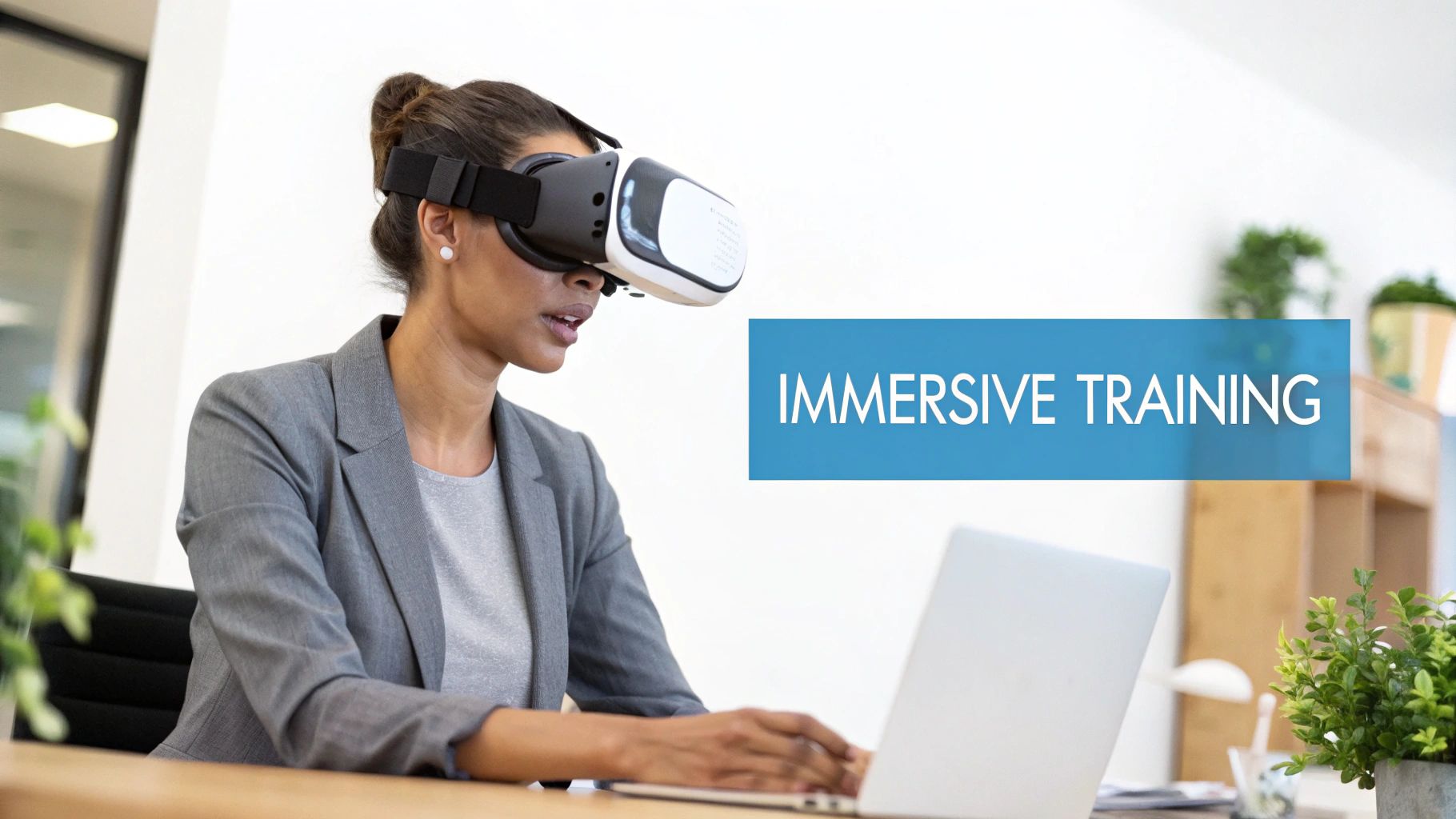
The landscape of professional development is shifting away from passive learning, where employees are expected to absorb information from lectures or static content. Modern learning methodologies emphasize active participation, an area where traditional methods often fall short, leading to disengaged teams and poor knowledge retention.
Virtual reality training programs address these shortcomings by creating realistic, interactive 3D environments that transform abstract concepts into tangible experiences. Instead of merely reading about how to operate complex machinery, an employee can practice the entire procedure in a precise digital replica, eliminating all real-world risk.
Building Skills Through Doing
The primary advantage of VR is its capacity for experiential learning. This hands-on approach builds muscle memory and a deep, intuitive understanding that passive observation cannot replicate. The practical benefits are significant:
- Learning from Mistakes, Safely: Trainees can make errors, analyze outcomes, and repeat tasks without causing equipment damage, production downtime, or safety hazards.
- Practice Makes Perfect: A complex or dangerous procedure can be rehearsed repeatedly until it becomes second nature, ensuring all team members meet a consistent, high standard of performance.
- Realistic High-Stakes Scenarios: VR can simulate emergency situations or high-stress events that are impossible to replicate in real life, preparing teams to respond calmly and correctly when it matters most.
By immersing learners in a controlled environment, virtual reality training closes the gap between knowing what to do and truly knowing how to do it. It transforms theoretical knowledge into a practical, skill-building powerhouse.
This shift is particularly impactful for businesses in high-risk sectors or those with intricate operational tasks. Virtual reality training programs offer a direct solution to some of the most persistent challenges in corporate education. By providing a safe space to practice and refine skills, VR is not just another technological tool; it is a fundamental evolution in how we prepare employees for success.
Why Immersive Learning Is So Effective
Virtual reality training is more than an advanced simulation; it represents a fundamental shift in how the brain processes and retains new information. Its effectiveness is rooted in a powerful psychological concept called presence—the genuine feeling of being inside the simulated environment, which VR achieves by engaging multiple senses simultaneously.
When a learner puts on a headset, the brain is encouraged to accept the virtual world as real. This deep immersion means they are not just passively observing a screen but are an active participant. Learning transitions from a theoretical exercise to a practical, lived experience.
From Passive Viewing to Active Doing
Consider traditional e-learning, which primarily involves reading text or watching videos, engaging the brain's memorization centers. Immersive learning, in contrast, activates the same neural pathways used when performing tasks in the real world. It is the difference between reading a recipe and actually cooking the meal.
The real power of virtual reality training is its ability to facilitate learning by doing. It offers a space for unlimited, risk-free practice that builds not just knowledge, but genuine skill and confidence.
This hands-on approach dramatically increases information retention rates. Studies consistently show that learners in VR can retain significantly more information compared to those in a traditional classroom or e-learning module. When you physically perform an action, even a virtual one, the brain forges stronger, more durable memories.
Building Muscle Memory Without the Risk
One of the most significant advantages of virtual reality training programs is the ability to build muscle memory for complex, physical tasks. For example, a technician learning to service a wind turbine can use a VR simulation to practice intricate repairs on a virtual turbine hundreds of feet in the air, using digital tools.
They can repeat the procedure dozens or even hundreds of times until every step is ingrained. This is how procedural memory for true mastery is built, all without the real-world dangers of working at heights or the significant cost of damaging actual equipment.
This type of safe, repeatable practice is transformative across industries:
- Surgeons can rehearse delicate operations, refining their skills with zero risk to patients.
- Welders can practice complex welds repeatedly, receiving instant feedback on their technique.
- Forklift operators can navigate a dynamic, simulated warehouse, learning to handle unexpected hazards before encountering them on the job.
This experiential learning model is fundamentally more powerful than passive observation. By creating a direct link between an action and its outcome, VR builds a much deeper understanding of cause and effect. To see more of the tangible results, you can explore our detailed article on the benefits of virtual reality training.
Engaging the Brain for Lasting Impact
The psychology is straightforward: active engagement forces the brain to problem-solve, make decisions, and observe the immediate consequences. This constant feedback loop accelerates the learning curve and ensures that new skills are not just memorized but deeply understood.
Ultimately, immersive learning is effective because it mirrors how humans learn best: through trial, error, and experience. By providing an ideal environment for this process, VR prepares employees for real-world challenges with a level of confidence previously unattainable. The result is a more competent, capable, and safer workforce.
Measuring the Business Impact of VR Training
While the immersive nature of a virtual reality training program is impressive, its true value is measured in tangible business results. The conversation must move beyond features and focus on key performance indicators (KPIs) that impact the bottom line. Investing in VR is not about adopting a trend; it is a strategic decision to enhance workplace safety, employee skills, and operational efficiency.
The global VR training market is expanding rapidly for this reason, with forecasts projecting it could reach nearly $300 billion by 2033. The data supports this growth. Studies indicate that VR training can increase learning effectiveness by approximately 76% compared to traditional methods, and trainees report a 275% increase in confidence when applying those skills. For a deeper analysis of the data, you can review this detailed statistical overview.
This infographic breaks down the psychological pillars that make VR so powerful: presence, retention, and muscle memory.
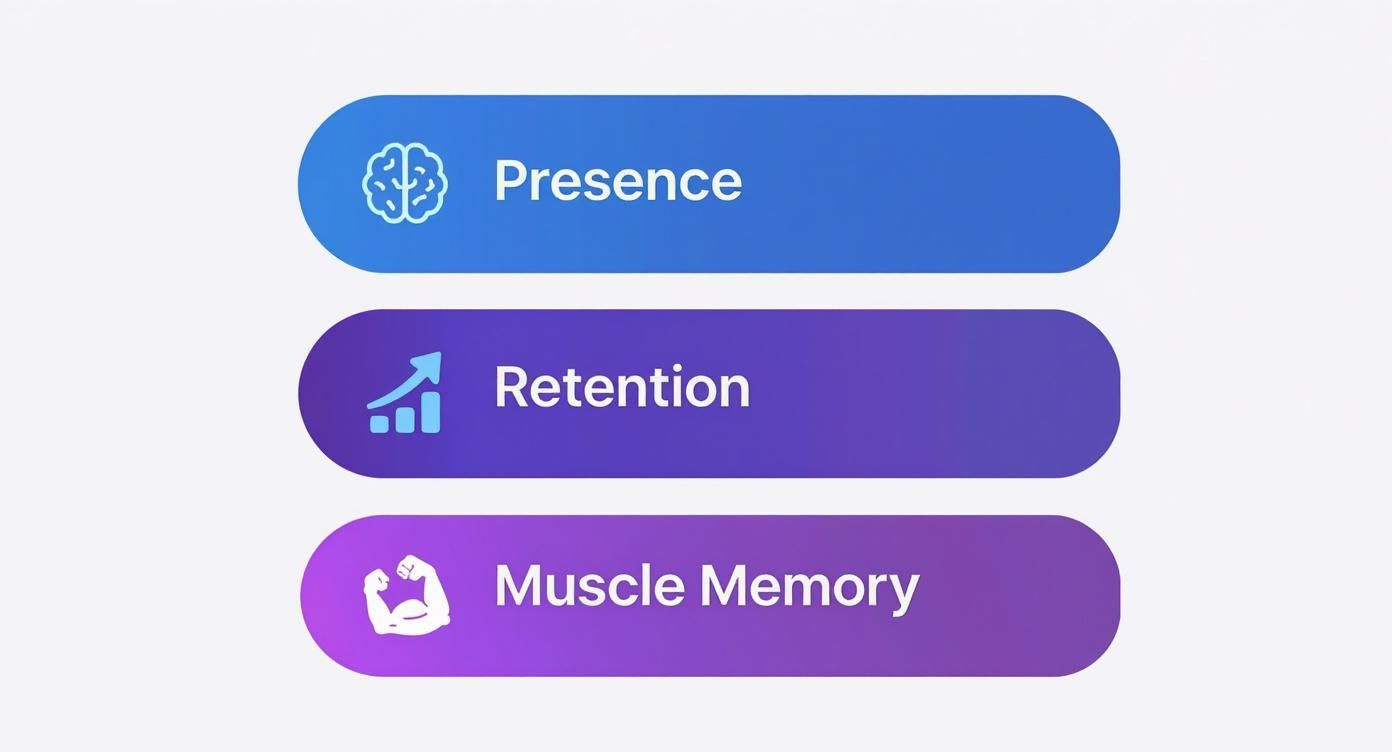
These three elements combine to create a learning experience that feels real, is memorable, and translates directly into on-the-job competence.
Enhanced Safety and Risk Mitigation
In high-stakes industries like manufacturing or energy, safety is paramount. Virtual reality provides a method to prepare employees for hazardous scenarios by eliminating physical risk. Trainees can practice emergency shutdowns, handle simulated chemical spills, or operate heavy machinery within a perfectly safe digital twin of their work environment.
The core safety benefit of VR is simple: it provides a space for unlimited trial and error where the consequences are zero. A mistake becomes a valuable learning moment, not a costly accident or a life-threatening event.
This has significant financial implications. A single workplace accident can lead to a cascade of direct and indirect costs, from medical expenses and workers' compensation to lost productivity and reputational damage. By substantially reducing the likelihood of on-the-job incidents, VR training delivers a powerful and direct return on investment.
Accelerated Performance and Proficiency
Time is a critical resource. The faster a new hire can become proficient, the sooner they contribute value. Traditional training often involves a prolonged ramp-up period where theory precedes practical application. VR inverts this model by integrating theory and practice from day one.
A new technician can perform dozens of virtual repairs before ever touching actual equipment. This builds skill and confidence at a pace that classroom lectures cannot match.
Key metrics to track include:
- Time-to-competence: How long does it take for a new employee to meet performance targets? VR is proven to significantly reduce this timeframe.
- Error reduction: Do employees make fewer mistakes after completing the VR program?
- Increased throughput: Can you train more people in less time, unconstrained by the availability of physical space or equipment?
These improvements lead directly to enhanced operational efficiency and a more agile, skilled workforce. For those looking to implement a structured measurement approach, our guide on how to measure training effectiveness offers a valuable framework.
Comparing VR Training with Traditional Methods
To put it all in perspective, let's examine how VR stacks up against conventional methods. The table below provides a straightforward comparison across the metrics that matter most.
| Metric | VR Training | Traditional Classroom | E-Learning |
|---|---|---|---|
| Learner Engagement | High (Immersive, interactive) | Moderate to Low (Passive listening) | Low (Often self-directed, easy to disengage) |
| Knowledge Retention | High (75-90%) | Low (Around 5-10% for lectures) | Moderate (Around 25-60%) |
| Safety in Training | Maximum (Zero physical risk) | Variable (Depends on the topic) | Maximum (No physical risk) |
| Time to Competence | Fast (Hands-on practice from Day 1) | Slow (Theory-first approach) | Moderate (Depends on learner motivation) |
| Scalability | High (Deployable anywhere) | Low (Limited by physical space) | High (Accessible online) |
| Cost (Long-Term) | Moderate (High initial, low operational) | High (Travel, instructor, venue costs) | Low (Low development & distribution costs) |
While traditional methods retain their place, VR offers a compelling advantage in developing deep, lasting skills in a safe and scalable manner.
Smarter Spending and Long-Term ROI
While there is an upfront cost to implementing VR, the long-term savings present a compelling business case. The financial benefits extend beyond accident avoidance; they optimize nearly every line item in a typical training budget.
Consider the traditional costs that VR can reduce or eliminate entirely:
- Travel and lodging: Specialized training can be deployed globally without flying teams to a central location.
- Equipment damage: Trainees can practice on virtual models, preventing wear and tear on high-value assets.
- Material waste: For skills like welding or painting, VR allows for endless practice without consuming expensive supplies.
- Instructor time: VR enables scalable, on-demand training, freeing up experts to focus on personalized coaching and mentoring.
When these savings are combined with improvements in productivity and safety, the return on investment becomes clear. Adopting VR is not a speculative venture; it is a calculated investment in a smarter, more effective, and financially sound training model.
Seeing VR Training in Action Across Industries
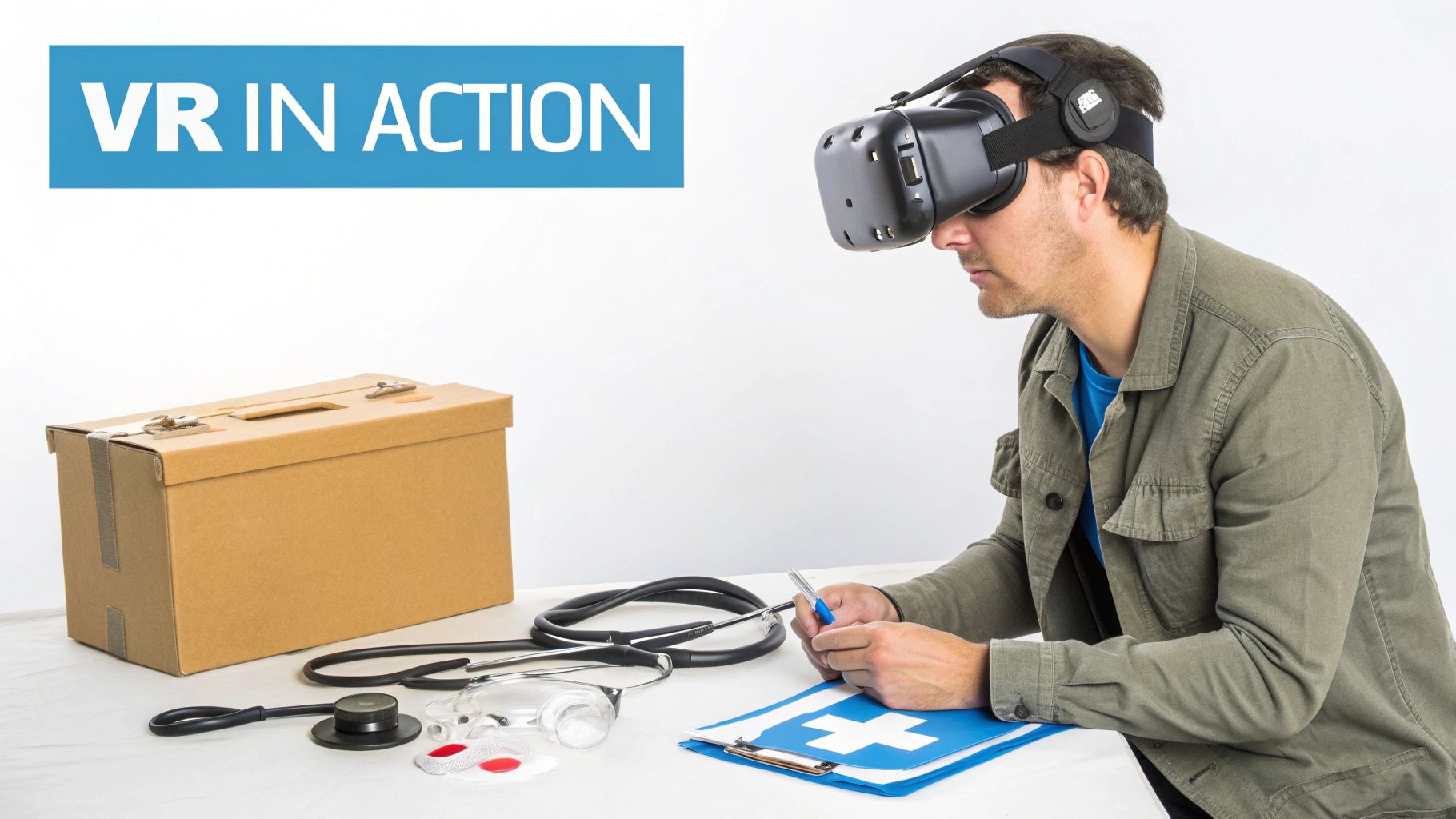
The theory behind virtual reality training is compelling, but its true value is demonstrated in its real-world applications. This technology is no longer a futuristic concept; it is a practical tool that businesses across a diverse range of industries are using to solve tangible, high-stakes challenges today.
Examining how different sectors are leveraging VR reveals the technology's versatility. From the factory floor to the hospital operating room, these programs are building safer, more competent, and more confident workforces.
Manufacturing and Industrial Operations
The manufacturing sector is a high-stakes environment characterized by complex machinery, strict safety regulations, and a constant demand for precision. Virtual reality training programs provide an ideal digital environment for employees to gain hands-on experience without real-world risks.
Consider a new hire learning on a live production line, where a single mistake could result in significant downtime or a serious injury. Now, imagine that same employee practicing on a digital twin of that line.
This approach is a game-changer for:
- Complex Assembly: Technicians can practice intricate, multi-step assembly procedures on detailed virtual models, repeating difficult steps until they achieve muscle memory—all without wasting physical components.
- Safety and Emergency Protocols: Employees can experience simulated emergencies, such as a machine malfunction or chemical leak, to build critical response skills in a completely safe setting.
- Equipment Maintenance: Crews can learn to diagnose and repair heavy machinery in a virtual space, gaining familiarity with the equipment before ever touching a real tool.
By simulating the entire factory floor, companies can accelerate new employee onboarding, reduce the risk of accidents, and ensure a consistent standard of quality and safety. The industrial applications of virtual reality are a major driver of its adoption today.
This digital-first training minimizes disruption to active production lines while dramatically shortening the time it takes for an employee to become an expert. For a closer look, explore our guide on industrial virtual reality solutions.
Healthcare and Medical Training
The stakes are highest in healthcare. VR offers a way for medical professionals to refine their skills with zero risk to patients. Surgeons can rehearse highly complex procedures in a photorealistic virtual operating room, perfecting their technique and preparing for rare complications they might not otherwise encounter.
Even before VR became widespread, as many as 65% of nursing education programs were using some form of virtual simulation, a number that has grown significantly. The technology allows nursing students to practice everything from basic IV placement to complex patient assessments in a controlled environment, building a foundation of confidence and competence before their first clinical rotation.
Beyond procedural skills, VR is also used to improve patient communication. Clinicians can practice delivering difficult news or de-escalating tense situations with AI-powered virtual patients, honing crucial soft skills that are difficult to teach in a lecture format.
Logistics and Warehouse Management
The logistics industry is the backbone of modern commerce, and its efficiency relies on a well-trained workforce. Warehouses are dynamic, often hazardous environments where operating equipment like a forklift requires significant skill. VR provides a safe and effective way to train new operators quickly.
A trainee can learn to navigate a busy, simulated warehouse, mastering the vehicle's controls and learning to react to unexpected obstacles. They can practice loading and unloading pallets without the risk of damaging inventory or causing a collision. This accelerates the learning curve and ensures that by the time they operate a real forklift, they are well-prepared.
Customer Service and Retail
Excellent customer service often depends on how employees handle challenging situations. Virtual reality training programs are now used to immerse retail and service associates in these precise scenarios, acting as a flight simulator for customer interactions.
For example, many large retailers use VR training to place employees into various scenarios, from managing high-traffic sales events to mastering new point-of-sale technology. It is a modern solution for preparing a large workforce for real-world challenges.
By allowing employees to practice and learn from mistakes in a safe environment, these programs build resilience and ensure staff can maintain composure and provide excellent service under pressure.
A Practical Roadmap for Your First VR Program
Embarking on your first virtual reality training program can seem like a significant undertaking, but with a structured plan, it becomes a series of manageable steps. The key is to shift focus from the technology itself to a specific, high-value business problem you need to solve. A successful VR initiative begins not with a headset, but with a clear purpose.
This roadmap will guide you through the process, from identifying an ideal starting point to launching a pilot program that demonstrates the power of immersive learning. Following these steps will help you build momentum, show a tangible return on investment, and pave the way for a broader, more impactful implementation.
Pinpoint a High-Impact Use Case
Before evaluating hardware or software, identify a training challenge where VR can deliver a substantial improvement. Avoid trying to solve every problem at once. Instead, look for a process that is dangerous, expensive, or difficult to practice in the real world.
The best candidates for an initial VR program often involve:
- High-Risk Scenarios: Consider tasks where an error could cause serious injury or damage expensive equipment, such as lockout/tagout procedures or operating heavy machinery.
- Complex, Infrequent Tasks: These are critical procedures that must be performed correctly but are not done often enough for employees to remain proficient, like an emergency shutdown or a complex annual repair.
- High-Cost Training: Identify training that currently requires significant travel, consumes expensive raw materials, or ties up valuable physical equipment. VR can dramatically reduce these costs.
By selecting a use case with a clear and significant problem, you are already halfway to building a strong business case. The goal is to choose a challenge where improvements in safety, efficiency, or cost will be so evident they are impossible to ignore.
Decide: Build In-House or Bring in a Partner?
Once you know what you are training for, the next question is how to create the content. You can either develop the solution internally or collaborate with a specialized VR partner. Each approach has distinct advantages and disadvantages.
Partnering with a specialized provider often accelerates the timeline and provides immediate access to expertise in immersive learning design. Conversely, an in-house team can offer greater long-term control, provided you have the necessary talent.
Here is a quick breakdown to help you decide:
| Factor | Partnering with a Specialist | Building In-House |
|---|---|---|
| Speed to Launch | Faster. Leverages existing platforms and expertise. | Slower. Requires building a team and process from scratch. |
| Initial Cost | Usually a lower upfront investment. | High. Involves hiring developers, designers, and project managers. |
| Expertise | Instant access to instructional and technical experts. | Requires significant time and effort to build knowledge internally. |
| Long-Term Control | May depend on the partner for major updates. | Full ownership of content and the technology stack. |
For most companies beginning their VR journey, working with an experienced partner is the most efficient and lowest-risk path to launching a successful pilot.
Select the Right Hardware and Software
The technology should serve your training goals, not define them. The hardware and software you choose should be dictated entirely by the needs of your specific use case.
The market for headsets has shifted toward standalone devices that do not require a connection to a high-powered PC. These are ideal for enterprise use—they are portable, easy to manage, and more affordable to deploy at scale. When choosing, consider factors like user comfort, battery life, and ease of cleaning and maintenance between sessions.
Equally important is the software platform used to manage your program. A robust platform acts as the central hub for your entire virtual reality training program, allowing you to deploy content to headsets, track user progress, and analyze performance data. It is crucial to explore your options and understand the capabilities of different virtual reality training software.
Design and Launch a Pilot Program
The most effective way to prove the value of VR is to demonstrate it with a focused pilot program. This is your opportunity to collect hard data, gather user feedback, and build a compelling case for stakeholders before committing to a company-wide rollout.
A successful pilot program requires several key components:
- A Clear Goal: Define what success looks like. Is it a 20% reduction in training time? A measurable increase in task accuracy? Document your objective.
- A Control Group: Establish a baseline for comparison. Measure the performance of employees trained in VR against a group using traditional methods.
- Data Collection: Track all relevant metrics, including user performance, engagement levels, and knowledge retention. The more data you have, the stronger your case will be.
- A Feedback Loop: Solicit feedback from participants. Use surveys and interviews to understand what worked well and where improvements can be made.
By treating your first VR project as a strategic pilot, you are not just experimenting with new technology. You are building a powerful, data-driven argument for transforming your company's approach to learning and development.
Proving the ROI of Your VR Training
Securing a budget for any new initiative requires a solid business case, and virtual reality training is no exception. Stakeholders need to see the financial justification beyond the technology's appeal. Proving the return on investment (ROI) involves moving beyond anecdotal evidence and focusing on metrics that directly impact the bottom line.
Calculating ROI is more than just subtracting costs from gains; it requires a clear framework that captures both direct savings and less tangible performance improvements. The basic formula is straightforward:
(Net Training Benefits – Training Costs) / Training Costs x 100 = ROI %
The key is to accurately identify and quantify those benefits, which typically fall into two categories.
Tracking Hard Metrics for Clear Savings
Hard metrics are the tangible, easily quantifiable data points that resonate with finance departments. These include direct cost savings and efficiency gains achieved by replacing traditional training with a VR-based approach. They form the foundation of your ROI calculation.
Begin by examining these key areas:
- Reduced Training Time: If VR can bring a new hire to full proficiency in 40 hours instead of 80, you save 40 hours of wages and lost productivity per employee.
- Lower Accident and Error Rates: Fewer mistakes on the job lead to direct savings through lower insurance premiums, fewer workers' compensation claims, and reduced costs for equipment repair.
- Decreased Travel Expenses: Eliminating the need to fly employees to a central location for training yields immediate savings on flights, hotels, and per diems.
- Eliminated Material Waste: When training for skills like welding or painting, VR eliminates the cost of scrap materials and supplies used during the learning phase.
By focusing on these numbers, you build a powerful, data-driven narrative. You are not just claiming the training is better; you are proving it is more cost-effective and efficient.
Valuing Soft Metrics for Deeper Impact
While hard metrics often secure initial approval, soft metrics complete the story. These benefits are more challenging to quantify in monetary terms but are vital for long-term success and organizational health.
The global virtual training and simulation market was valued at approximately $380.11 billion in 2024 and is projected to reach nearly $1.42 trillion by 2034. This explosive growth is driven by tangible results. VR platforms are achieving engagement rates around 75% and are proving superior for knowledge retention. You can explore these virtual training market trends for more detail.
Key soft metrics to monitor include:
- Higher Employee Confidence: Conduct pre- and post-training surveys. More confident employees tend to be faster, more decisive, and more autonomous.
- Improved Engagement Scores: High engagement during training is a strong predictor of better job satisfaction and, consequently, lower employee turnover.
- Better Knowledge Retention: Test employees on procedures weeks or months after training. Skills learned in VR are typically retained much longer than those learned from a presentation.
For a comprehensive guide on measuring the return of any training program, review these strategies for measuring training effectiveness and ROI. By combining hard data with people-focused metrics, you can present a complete picture of the significant value your VR training program delivers.
The Practical Questions: What Leaders Want to Know About VR Training
When business leaders consider implementing VR training, a few practical questions consistently arise. Addressing these concerns is often the final step before securing buy-in for a new program.
What's the Real Cost?
This is often the first question, and the answer is: it depends. A simple, repeatable training scenario will have a different cost than a complex, dynamic simulation with multiple variables. However, hardware costs have decreased significantly. With powerful and affordable standalone headsets now widely available, the initial investment is more accessible than ever.
How Do We Manage All the Headsets?
Distributing and managing VR headsets for a large team may seem like a logistical challenge. However, Mobile Device Management (MDM) platforms simplify this process. An MDM dashboard serves as a central command center, allowing your IT team to remotely update content, adjust settings, and track every headset, making large-scale deployment surprisingly manageable.
Is VR a Good Fit for Everyone?
While most users adapt quickly to VR, comfort is essential. A gradual introduction is the best approach. More importantly, the training content must be designed from the ground up to minimize the risk of motion sickness.
The future of this technology is promising. We are already seeing AI-driven scenarios that personalize the difficulty for each user and advanced haptics that make virtual interactions feel remarkably real. The technology will only become more effective and intuitive over time.
Ready to see how immersive learning can solve your team's specific training challenges? We specialize in creating virtual reality training programs that deliver real, measurable results.
Discover our solutions at AIDAR Solutions.