
Augmented Reality for Business: A Practical Guide
Augmented reality for business is no longer a futuristic concept; it is a practical tool that overlays digital information onto the physical world, helping companies improve efficiency, enhance customer engagement, and drive sales. Unlike virtual reality, which creates a completely immersive digital environment, AR enhances the user's current reality. This makes it a powerful and accessible solution for businesses across various sectors.
What Is Augmented Reality in a Business Context?
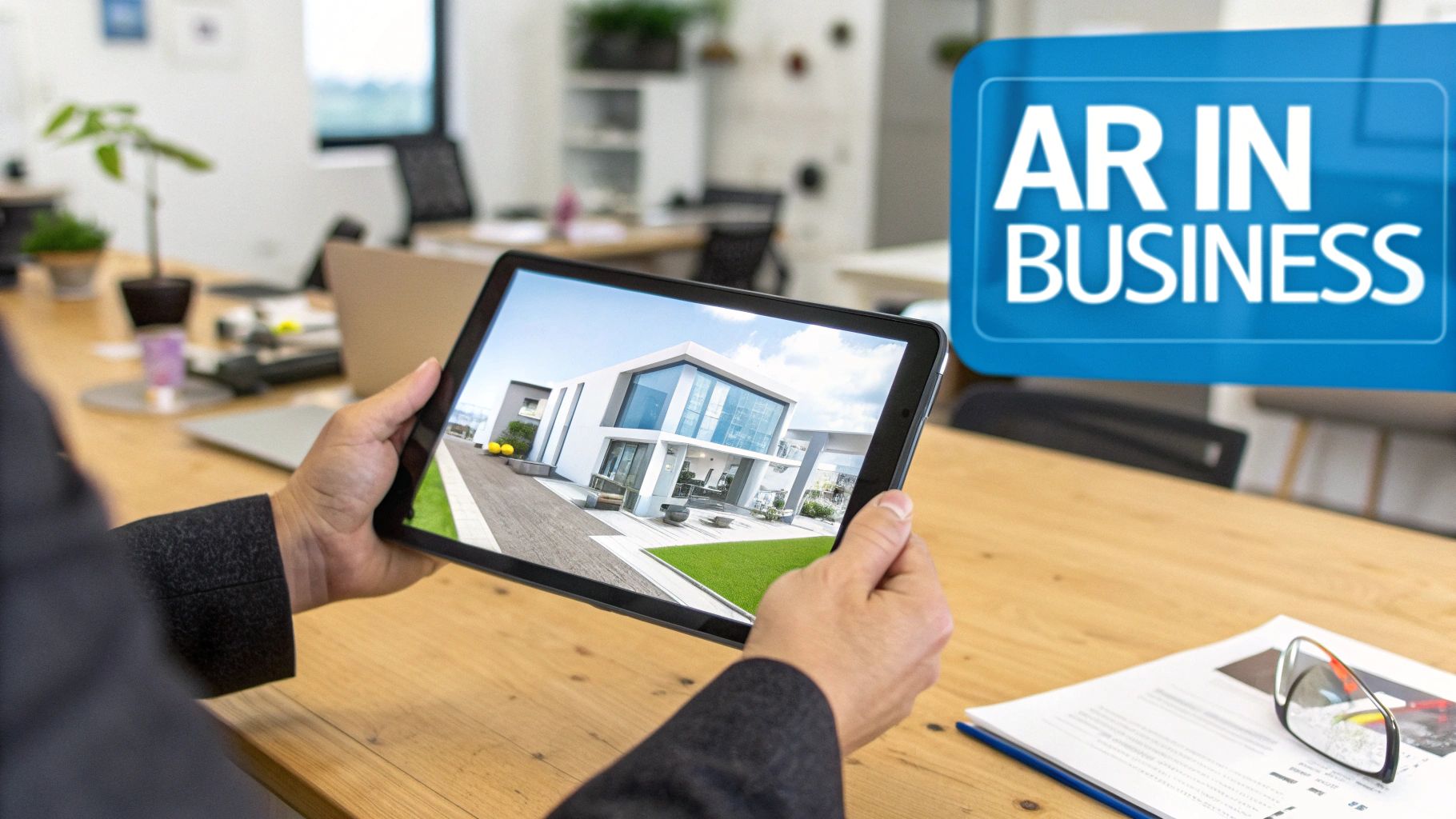
Augmented reality functions as a transparent digital layer over a real-world view, displaying critical data, step-by-step instructions, or interactive 3D models precisely when and where they are needed. For businesses, this transforms key processes, from how employees are trained and technicians service complex equipment, to how customers visualize and interact with products.
The key distinction lies in its connection to the real world. While Virtual Reality (VR) provides total immersion in a simulated space, AR maintains the user's presence in their physical environment. This practical approach is why augmented reality for business has evolved from a novelty to a core operational tool.
The Practical Power of AR
At its core, AR delivers context-aware information to help users make better decisions and complete tasks accurately on the first attempt. The technology bridges the gap between digital information and the physical world, creating tangible benefits that impact the bottom line. To understand how AR fits into the broader technological landscape, you can learn more about what is extended reality in our detailed guide.
Consider a technician who, instead of consulting dense technical manuals, points a tablet at a complex machine to see repair instructions overlaid directly onto the relevant parts. Similarly, a customer can use their phone to place a true-to-scale 3D model of a new sofa in their living room, eliminating guesswork.
By blending digital information with the physical world, AR equips your workforce and customers with the precise information they need to act decisively and accurately. It’s about enhancing human capability, not replacing it.
This guide focuses on these real-world strategies, demonstrating how to apply this technology today for measurable results in key areas:
- Elevated Customer Engagement: Create immersive shopping experiences that build buyer confidence and drive sales.
- Streamlined Operational Efficiency: Reduce errors, accelerate repairs, and improve knowledge sharing across your team.
- Boosted Sales and Marketing ROI: Shorten sales cycles with interactive product demonstrations that capture attention.
Decoding AR's Rapid Integration into the Marketplace
The recent proliferation of augmented reality in business is driven by a convergence of powerful market forces and significant technological advancements. Once a niche interest, AR is now an essential tool for companies seeking to maintain a competitive edge and connect with their audience on a deeper level.
This rapid growth is fueled by major investments and a user base that is not only familiar with AR but has come to expect it. The technology has matured beyond a gimmick into a stable, long-term trend that delivers real, measurable business outcomes.
The Smartphone as a Catalyst for AR Adoption
A primary driver for this expansion is the smartphone. Mobile AR has made this technology universally accessible. Unlike virtual reality, which often requires a dedicated headset, billions of people already possess powerful, AR-ready devices. This has created a massive, built-in audience.
The accessibility of mobile AR has significantly lowered the barrier to entry for both businesses and consumers. Companies can now deliver interactive content through the mobile apps and web browsers people use daily, without requiring customers to purchase specialized hardware.
AR's seamless integration into smartphones was the catalyst for its mainstream adoption, transforming it from a futuristic concept into a practical tool for immediate business use.
Understanding the Explosive Market Numbers
The data behind AR's growth tells a convincing story. Augmented reality has quickly evolved from a promising technology into a core business asset, with its global market value projected to exceed $198 billion by 2025.
By 2024, the number of active mobile AR users worldwide had already soared to 1.7 billion, a figure projected to surpass 2 billion the following year. In the U.S. alone, the AR user count is expected to reach 100.1 million in 2025, indicating a large and receptive audience for immersive experiences. You can dive deeper into these AR projections and consumer trends.
This data provides a powerful business case for adoption. Investing in augmented reality for business is not a speculative bet on a passing trend but a strategic move to engage a large and growing market. This growth is a global phenomenon, as highlighted by reports such as the European XR Industry Report 2025 insights.
Key factors driving this market momentum include:
- Maturing Technology: AR software and hardware are becoming more powerful, reliable, and affordable.
- Consumer Demand: Users are increasingly drawn to interactive and visual digital experiences over static content.
- Proven ROI: Early adopters are demonstrating clear returns on investment, encouraging wider adoption.
The evidence is clear: augmented reality is a permanent fixture in the business landscape. Companies that integrate AR into their operations are not just following a trend; they are positioning themselves to lead in an increasingly interactive and visual world.
The Real-World Business Advantages of AR
Beyond market growth and technological demonstrations, where does Augmented Reality deliver tangible business value? The adoption of AR is a strategic decision that produces measurable results impacting the bottom line.
These advantages can be categorized into three core pillars: elevating the customer experience, streamlining operations, and boosting marketing and sales. Each pillar represents a significant opportunity to leverage AR as a practical tool for growth.
Elevating the Customer Experience
AR fundamentally changes how customers engage with products. It transforms passive online browsing into an interactive, hands-on experience, removing the guesswork that often hinders a sale. In e-commerce, studies show that 71% of shoppers would purchase more frequently if a store offered AR.
For instance, a furniture retailer can allow customers to use their phone to place a virtual sofa in their living room. Users can walk around the object, check its dimensions, and see how the fabric complements their existing decor. This "try before you buy" capability builds significant confidence and has been shown to increase conversion rates by up to 40%. It creates a memorable and satisfying experience that fosters brand loyalty.
Streamlining Operational Efficiency
Within an organization, AR is a powerful tool for employees. It delivers information precisely when and where it is needed, reducing errors, accelerating training, and minimizing downtime. The impact is particularly significant in complex industrial and technical fields.
Consider a field technician encountering unfamiliar equipment. Instead of searching through a paper manual, they can point a tablet at the machine to see digital instructions, diagrams, and warnings overlaid on the real-world components. This real-time guidance ensures the job is completed correctly and safely on the first attempt. For more on this, see our analysis of augmented reality assistance for technicians.
This efficiency extends to training. With AR, companies can create realistic, hands-on simulations without risk or material waste. New hires can practice complex assembly or maintenance tasks in a controlled virtual environment, helping them build skills faster and improve knowledge retention.
By delivering precise information exactly when and where it's needed, AR optimizes human performance, leading to significant reductions in operational costs and dramatic improvements in productivity.
Boosting Marketing and Sales ROI
In a saturated digital advertising landscape, AR offers a way to cut through the noise. It enables the creation of immersive marketing campaigns that capture and hold attention. These interactive product visualizations help shorten the sales cycle by providing customers with the information they need to make a confident decision more quickly. Furthermore, these experiences are highly shareable, generating organic brand promotion.
An automotive manufacturer, for example, could offer a web-based AR tool that allows a user to place a new car model in their driveway. They could explore the interior, change the paint color, and inspect key features, all from their phone. This deep level of engagement is far more persuasive than static photos or videos.
Comparing Traditional Methods with AR-Enhanced Solutions
A direct comparison highlights the transformative impact of AR on common business functions. This table illustrates how AR upgrades these functions to drive better outcomes.
| Business Function | Traditional Method | AR-Enhanced Solution |
|---|---|---|
| Product Visualization | Static 2D images, videos, and text descriptions on a website. | Interactive 3D models placed in the customer's real environment. |
| Employee Training | Classroom lectures, printed manuals, and shadowing senior staff. | Immersive, hands-on simulations with step-by-step digital guidance. |
| Field Service & Repair | Phone support calls, PDF manuals, and costly expert travel. | Remote expert assistance with real-time AR annotations on a live video feed. |
| Retail Shopping | Visiting a physical store or guessing on sizes and fit online. | Virtual try-on for clothing, accessories, and makeup from any location. |
The shift is not merely incremental. AR provides a fundamentally superior method for connecting with customers, empowering employees, and driving business growth.
Proven AR Use Cases Across Major Industries
The practical power of augmented reality for business becomes clear when examining its real-world applications. Across diverse industries, AR is solving tangible problems, improving operational efficiency, and creating new avenues for customer engagement. It is not a one-size-fits-all solution but a versatile tool adapted to meet specific industry challenges.
From retail floors to factory lines, AR overlays a digital layer of information onto the physical world, providing users with critical context when and where they need it most. Let's explore some practical examples of how major sectors are leveraging this technology.
Transforming Retail and Ecommerce
In the competitive retail sector, AR has become a key tool for bridging the gap between online shopping and the in-store experience. It directly addresses a major source of friction in e-commerce: customer hesitation. Virtual try-on applications are a prime example.
Leading fashion and beauty brands now allow customers to use their phone's camera to see how products like glasses, lipstick shades, or apparel look on them in real time. This is more than a novelty; this "try before you buy" experience builds genuine consumer confidence.
By letting shoppers see how a product fits into their life—whether it's on their face or in their living room—AR cuts down on purchase anxiety and has been proven to lower product return rates.
Furniture brands have also seen significant benefits. Instead of relying on measuring tapes and guesswork, customers can place a full-scale 3D model of a sofa or table in their own room. This instantly answers key questions about size, style, and fit, leading to higher conversion rates and greater customer satisfaction.
Revolutionizing Real Estate and Architecture
The real estate industry is undergoing a technological transformation, with AR playing a pivotal role. For agents and developers, AR is an invaluable tool for demonstrating a property's potential long before it is constructed or furnished.
Imagine walking into an empty house and seeing it fully furnished in various styles on a tablet screen. AR-powered staging helps buyers visualize the space as a home, fostering an emotional connection. This technique can make a property far more appealing and accelerate the sales process.
The trend of integrating digital experiences into physical spaces is growing. For instance, innovations like Smartled's Cyber Mesh solution, which turns building facades into digital canvases, align with the core principle of AR: weaving digital content directly into our physical environment.
The market data supports this trend. The VR/AR real estate market is projected to reach $80 billion by 2025, with millions of agents already using the technology. Furthermore, 40.4% of apartment buyers are influenced by panoramic tours, underscoring the importance of visual tools. You can find more statistics on AR's growing role in real estate.
Enhancing Manufacturing and Industrial Operations
In manufacturing, where precision and efficiency are paramount, augmented reality serves as a practical guide for frontline workers. It helps reduce errors, accelerate training, and maintain operational continuity.
Practical applications include:
- Complex Assembly: An assembly line worker can wear AR glasses that project step-by-step instructions directly onto their workstation, eliminating the need to consult a manual. This hands-free guidance ensures accurate installation.
- Remote Expert Support: When a critical machine fails, a local technician can use an AR headset to share their view with a remote specialist. The expert can then annotate the live video feed to guide the repair, saving significant time and travel costs.
- Safety and Training: New employees can learn to operate heavy machinery in a safe, simulated AR environment, gaining hands-on experience without risk.
Advancing Healthcare and Medical Training
The medical field is utilizing AR to improve patient outcomes, train the next generation of healthcare professionals, and enhance surgical precision. The technology provides medical personnel with previously unavailable visual information.
For example, a surgeon can overlay a patient's 3D CT or MRI scans directly onto their body during a procedure. This provides an "x-ray view," allowing them to see tumors, blood vessels, and organs with enhanced clarity, leading to more precise and effective surgeries.
Medical schools are also benefiting from AR. Students can interact with detailed 3D models of the human body, exploring anatomy in a way that textbooks cannot replicate. This immersive, hands-on learning improves comprehension and knowledge retention.
Building Your AR Implementation Roadmap
Integrating augmented reality into your business requires a clear, strategic plan. A well-structured roadmap breaks down a complex project into manageable steps, ensuring that your initial AR initiative is focused, measurable, and aligned with your core business objectives.
The process should begin with identifying a problem, not with the technology itself. A common misstep is to adopt AR for its novelty. The most successful projects start by pinpointing a specific, high-value business challenge that AR is uniquely positioned to solve.
This infographic illustrates the implementation process for key industries like retail, real estate, and manufacturing.
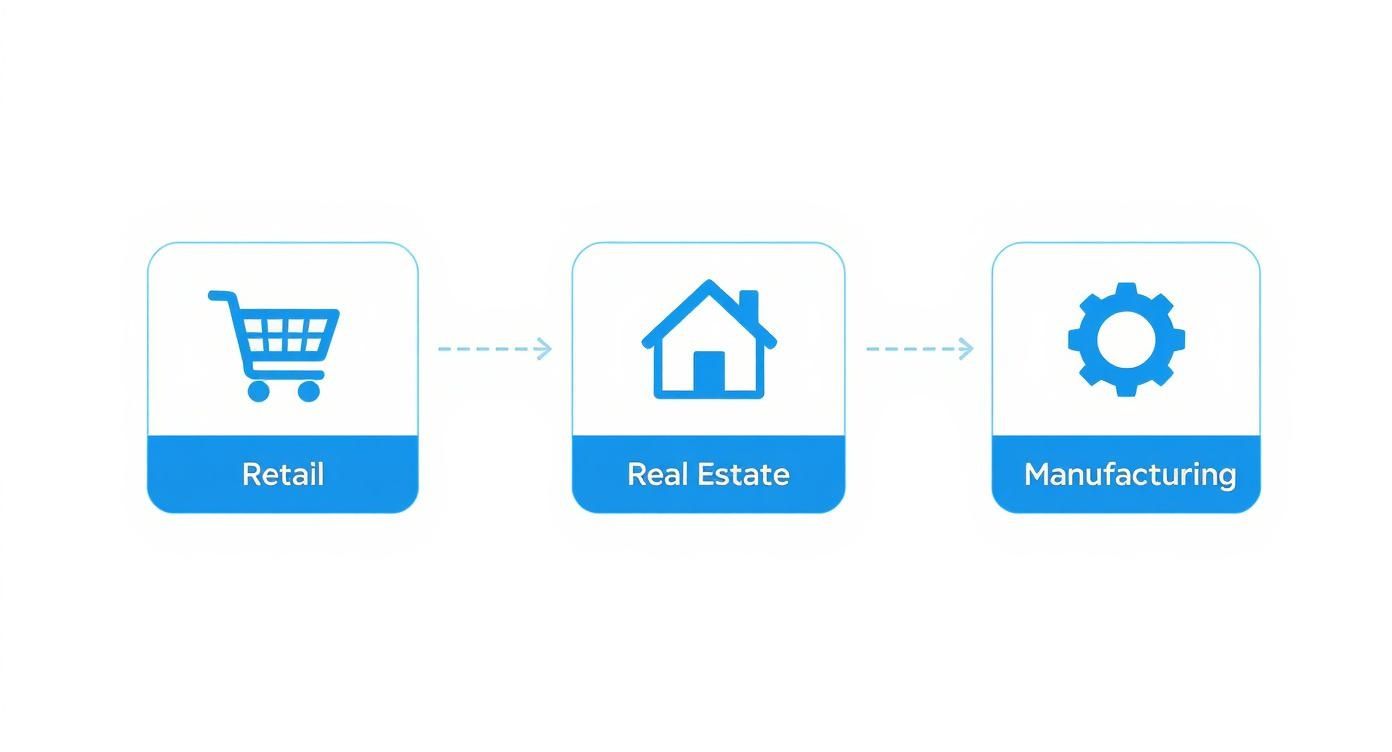
Regardless of the industry, a successful AR strategy follows a consistent path: identify the problem, then deploy a targeted solution.
Define Clear Goals and KPIs
Once the problem is identified, you must define what success looks like. Vague goals like "improving engagement" are insufficient. You need concrete, measurable Key Performance Indicators (KPIs) that are directly linked to business results.
For example, if an e-commerce brand is experiencing high product returns, a clear goal would be to reduce returns by 15% within six months. The primary KPI would be the return rate for products viewed using the new AR feature. Establishing these benchmarks from the outset is essential for proving ROI.
A pilot project is the best way to test the waters with your AR concept. It lets you measure the impact and gather priceless data before you commit to a full-scale rollout, keeping your risk low and your strategy sharp.
Choose the Right AR Technology
With clear goals established, you can select the appropriate technology. AR solutions generally fall into three categories, each designed for different business needs. Choosing the right one is fundamental to creating an effective user experience.
- Marker-Based AR: This technology is triggered when a device's camera recognizes a specific image, such as a QR code or a product logo. It is ideal for creating interactive marketing materials or providing on-demand product information.
- Markerless AR: This more advanced technology uses algorithms to recognize surfaces like floors and walls, allowing users to place digital objects into the real world without a trigger image. It is the basis for "try before you buy" furniture apps and virtual product showrooms.
- Location-Based AR: This type uses GPS and other sensors to anchor digital content to specific geographic locations. It powers interactive city tours, in-store navigation, and location-aware marketing campaigns.
Decide on a Build or Platform Approach
A key decision is whether to develop a custom AR application from scratch or utilize an existing platform. A custom build offers complete creative freedom but requires significant time, budget, and specialized development expertise.
Alternatively, using an established AR platform or a SaaS solution can enable a much faster and more cost-effective launch. These platforms often include pre-built templates and tools, making AR accessible to businesses without large in-house development teams. Clarifying your requirements will help you design a practical augmented reality workflow for your team.
Finally, a user training plan is crucial. Whether the tool is for customers or employees, adoption depends on usability. For internal tools, proper training ensures effective and safe use. For customer-facing applications, an intuitive design and a simple onboarding process are paramount. This structured approach provides a clear, practical roadmap for a confident start.
How to Measure Your Return on AR Investment
When considering an investment in augmented reality, stakeholders will inevitably ask about the return. To provide a meaningful answer, you must look beyond novelty metrics like app downloads and focus on tangible business outcomes.
Measuring the return on investment (ROI) for AR requires focusing on the key performance indicators (KPIs) that directly impact your bottom line.
Before tracking any metrics, you must define what success means for your project. Whether the goal is to increase sales, reduce operational costs, or improve team efficiency, each objective has specific metrics that will reveal the true performance of your AR solution.
Identifying Your Core Business KPIs
The KPIs you select must be directly tied to the problem your AR solution was designed to solve. Vague metrics are ineffective. You need specific, measurable data that demonstrates a clear link between AR implementation and business results.
Here are some critical KPIs to monitor, based on your objectives:
- Conversion Rate Increases: For e-commerce and retail, track the percentage of users who make a purchase after using an AR feature compared to those who do not.
- Reduction in Product Returns: AR provides customers with a better understanding of a product, reducing buyer's remorse. Monitor the return rate for items purchased with the aid of AR.
- Decreased Training Costs: Measure the reduction in instructor time, travel expenses, and material waste resulting from AR-based training simulations.
- Improved First-Time Fix Rates: For field service teams, a higher first-time fix rate means fewer follow-up visits, saving money and improving customer satisfaction.
- Higher Customer Engagement: Track metrics like session duration and interaction frequency within your AR experience to gauge how well you are connecting with your audience.
Calculating ROI in Retail: A Clear Example
Retail provides a straightforward model for demonstrating AR's financial impact. In this sector, AR is transforming the shopping experience. Retailers using AR report up to 40% higher conversion rates, and approximately 71% of consumers say they would shop more often if AR were available. The use of virtual try-on features has increased by over 200% since 2023, confirming the trend.
To calculate ROI, start with the additional revenue generated from increased sales and the cost savings from reduced returns.
ROI Formula: (Financial Gain – Investment Cost) / Investment Cost * 100
For example, assume a virtual "try-on" feature costs $50,000 to develop. Within one year, it generates an additional $150,000 in sales and saves $25,000 in return processing costs. The total financial gain is $175,000.
The ROI would be: (($175,000 – $50,000) / $50,000) * 100 = 250%.
When planning your budget and evaluating technologies, a thorough analysis of understanding pricing and ROI is essential for building a solid business case. This clear framework is what you need to prove AR's value and secure support for future initiatives.
Your Top AR Questions, Answered
As you consider integrating augmented reality for business into your operations, questions about cost, technology, and strategy are common. Addressing these key areas can demystify the process and build a stronger case for adoption.
Let's address some of the most frequent questions from business leaders exploring AR. The goal is to move from "What if?" to a clear plan of action.
What's the Real Cost of Building an AR App?
There is no single price for an AR application; the cost depends on its complexity. A simple, marker-based app for a marketing campaign or a basic product preview can often be developed on a pre-built platform for a few thousand dollars. These are excellent for initial pilot projects.
Conversely, a complex, custom-built application with features like real-time object recognition or deep integration with enterprise systems can range from $50,000 to over $300,000. The best approach is to start with a well-defined pilot project to establish the scope and budget before committing to a larger investment.
Do My Customers Need Special Goggles or Headsets?
No, and this is one of AR's most significant advantages. The vast majority of AR experiences are designed for the smartphones and tablets that billions of people already own. This "mobile AR" means your audience does not need to purchase any new hardware.
While dedicated AR glasses exist, they are primarily used in specialized industrial environments for tasks like complex assembly or hands-free remote support. For nearly all marketing, sales, or customer service applications, users can engage with the experience using their existing devices.
The fact that mobile AR just works on existing phones is what's driving its rapid growth. By removing the hardware barrier, you can deliver an immersive experience to a massive, built-in audience without asking them to buy new gadgets.
How Do I Know if a Business Problem is a Good Fit for AR?
The best use cases for AR are those where overlaying digital information onto the real world provides immediate and clear value. Look for bottlenecks in your business where a gap exists between digital data and physical action.
Start by identifying a major friction point in your operations or customer journey. Then, ask if an interactive, 3D overlay of information could solve it.
- High Training Costs: If new hires are making costly errors or require constant supervision to learn a physical task, AR can provide step-by-step guidance.
- Sales Hurdles: If customers struggle to visualize your product in their own environment (e.g., furniture, equipment, architectural designs), AR allows them to see it before they buy.
- Field Service Delays: If you are dispatching expert technicians on long, expensive trips for issues that could be diagnosed remotely, AR can bring the expert to the problem instantly.
Ready to see how AR can solve your specific business challenges? At AIDAR Solutions, we specialize in creating immersive AR and VR applications that improve efficiency, training, and support. Discover our tailored solutions and start your journey today.