
Why preventative vs predictive maintenance Matters for Your Assets
The real difference between preventative vs predictive maintenance boils down to a simple question: Do you act based on a calendar, or based on real-time evidence? Preventative maintenance is like changing your car's oil every 5,000 miles—it’s a fixed schedule. Predictive maintenance is like changing the oil only when sensors tell you it's starting to degrade. The right call depends entirely on how critical your equipment is, the true cost of failure, and what you’re trying to achieve operationally.
Understanding The Core Maintenance Philosophies
At the end of the day, any maintenance strategy is about one thing: keeping equipment running reliably and efficiently. But how you get there splits into two very different ways of thinking, dictating when you act and why. Nailing down these core approaches is the first step toward building an operational plan that's both tough and cost-effective.
Preventative Maintenance: The Scheduled Approach
Preventative maintenance (PM) is all about being proactive on a fixed timeline. Think routine inspections, cleaning, lubrication, and swapping out parts at set intervals—whether that’s every six months or after 1,000 hours of runtime. The entire goal is to stop failures before they even have a chance to happen by sticking to a strict, repeatable plan.
This method has been the bedrock of industrial operations for decades, mainly because it's so simple and predictable. You don't need fancy sensors or complex data analysis, which makes it easy to roll out across a huge range of assets.
Key Insight: Preventative maintenance operates on the belief that equipment wears down on a predictable schedule. Its success rides entirely on how accurate those pre-set timelines really are.
Predictive Maintenance: The Condition-Based Approach
Predictive maintenance (PdM), on the other hand, is a much more dynamic, "on-condition" strategy. It taps into advanced monitoring tools like IIoT sensors and data analytics to keep a constant pulse on the real-time health of an asset. Forget the rigid calendar; with PdM, you only perform maintenance when the data shows the earliest signs of a problem brewing.
This data-first approach lets teams intervene with surgical precision, fixing small issues right before they escalate into a full-blown breakdown. By listening to what the machines are actually saying, PdM helps you dodge both unexpected failures and the unnecessary labor that often comes with schedule-based plans. To get this right, you have to be meticulous about tracking your work, and you can explore the most important operational efficiency metrics in our detailed guide.
Preventative vs Predictive Maintenance at a Glance
To quickly see how these two powerful strategies stack up, this table breaks down their core differences.
| Attribute | Preventative Maintenance (PM) | Predictive Maintenance (PdM) |
|---|---|---|
| Core Principle | Time-based or usage-based intervention | Condition-based intervention |
| Action Trigger | Fixed schedule (e.g., every 3 months) | Real-time data and anomaly detection |
| Data Requirement | Minimal; relies on historical averages | Extensive; requires sensor data and analytics |
| Ideal Use Case | Lower-cost assets with predictable wear | High-value, critical assets where downtime is costly |
Ultimately, this comparison highlights the fundamental trade-off: PM offers simplicity and predictability, while PdM provides precision and optimization, but at a higher initial cost and complexity.
A Head-to-Head Comparison of Maintenance Strategies
When you move past the textbook definitions, the real story of preventative vs. predictive maintenance unfolds in your operations, your budget, and ultimately, your bottom line. Each strategy brings a completely different philosophy to managing resources, controlling costs, and handling risk. Looking at them side-by-side reveals not just what they are, but what they can actually do for your organization.
This comparison isn’t just about theory. We're going to see how these two approaches hold up against the tough realities of a modern industrial environment, from the total cost of ownership to the real-world efficiency of your maintenance teams.
Financial Impact and Total Cost of Ownership
The most obvious difference between the two is how they treat your money. Preventative maintenance is built on predictable, recurring expenses—scheduled labor, parts, lubricants. This makes budgeting feel straightforward, but it’s a model that often hides major inefficiencies under the surface.
Predictive maintenance, on the other hand, requires a bigger upfront investment in tech like sensors, software, and connectivity. But once it's running, it targets spending with surgical precision. You only perform maintenance when the data shows a fault is developing, which cuts out the cost of all those unnecessary check-ups. It's a data-first model that is far better at optimizing how you use your resources over the long haul.
The Core Financial Shift: Preventative maintenance is about budgeting for routine tasks, accepting a certain amount of waste as the price of avoiding failure. Predictive maintenance is about investing in intelligence to eliminate that waste and squeeze every bit of performance out of your assets.
Downtime Implications and Operational Continuity
Both strategies have the same goal: less unplanned downtime. They just get there in different ways. Preventative maintenance works by servicing equipment before it's expected to fail, based on manufacturer guides or past experience. This is a solid approach for catching predictable, wear-and-tear failures.
The problem? Its time-based schedule can easily miss problems that pop up between those planned checks, leaving you wide open to a surprise breakdown. Predictive maintenance closes that gap by continuously or frequently monitoring asset health. It can pick up on subtle signs—a slight increase in vibration, a tiny temperature change—that are the earliest warnings of a bigger failure.
This early warning system gives your team a much longer runway to plan and schedule the repair, turning what would have been an emergency into a manageable, planned event. That shift is absolutely critical for any company trying to reduce downtime in manufacturing and keep production lines humming.
A Deeper Look at Cost and Resource Efficiency
A closer look shows just how differently each strategy manages your money and your people.
| Metric | Preventative Maintenance (PM) | Predictive Maintenance (PdM) |
|---|---|---|
| Labor Costs | Scheduled labor is a fixed cost, but teams spend a lot of time servicing perfectly healthy assets. | Labor is only sent where it's needed, maximizing the impact of your best technicians. |
| Parts & Inventory | You have to stock parts for every scheduled replacement, which means higher carrying costs. | Inventory shrinks because you can order parts "just-in-time" for planned repairs. |
| Asset Lifespan | Reliably extends asset life but often means replacing parts that still have life left in them. | Maximizes the useful life of every component by replacing them based on actual condition. |
| Implementation Cost | Lower initial setup cost, mostly for planning and scheduling software. | Higher upfront investment in sensors, platforms, and data infrastructure. |
The True Cost Savings Potential
The debate often boils down to return on investment. While PM is a huge step up from a purely reactive "fix-it-when-it-breaks" model, it has its limits. Industry data shows that predictive maintenance typically delivers 8-12% more in cost savings than preventive and can cut expenses by as much as 40% compared to reactive strategies.
Preventative maintenance often leads to over-maintenance. Some studies estimate that up to 30% of PM tasks are performed on assets that don't need them, racking up unnecessary costs for labor and parts. You can dig into more data-backed maintenance statistics on Upkeep.com.
Ultimately, this comparison highlights a fundamental shift. Preventative maintenance is a disciplined, calendar-based "fail-safe" mindset that served industry well for decades. But predictive maintenance brings a condition-based "predict-and-prevent" model that uses data to unlock a whole new level of operational intelligence and financial efficiency.
Choosing the Right Strategy for Your Assets
Deciding between preventative and predictive maintenance isn’t about crowning a winner. It's about smart matchmaking—pairing the right tactic with the right asset. A blanket approach is a recipe for wasted money and effort. The real goal is to look at your equipment portfolio with a strategic eye, making sure every maintenance dollar works as hard as it can.
This decision boils down to a handful of core factors that define an asset's real role in your operation. By weighing each piece of equipment against these criteria, you can build a blended maintenance program that’s both tough and financially sharp, applying intense oversight where it counts and keeping things simple where it’s good enough.
Asset Criticality and Downtime Impact
The first question to ask is straightforward: what happens if this machine stops? For non-critical equipment—like a backup pump or an HVAC unit in a rarely used storeroom—an unexpected failure is an annoyance, not a catastrophe. In these situations, a scheduled, preventative maintenance plan is usually the most practical and budget-friendly choice.
But for your mission-critical machinery, it's a different story. Think about a central conveyor on your main production line, a turbine at a power plant, or a primary robotic welder. Here, unplanned downtime is a full-blown disaster, triggering huge production losses and a domino effect of delays. These are the ideal candidates for a predictive maintenance program. The staggering cost of failure makes the investment in sensors and analytics a clear business decision, letting you see trouble coming long before it grinds your operation to a halt.
Key Takeaway: The more it hurts when an asset goes down, the stronger the business case becomes for predictive maintenance. It transforms high-stakes equipment from a liability into a well-managed, reliable asset.
This simple decision tree helps visualize how to line up your maintenance strategy with your operational risk.
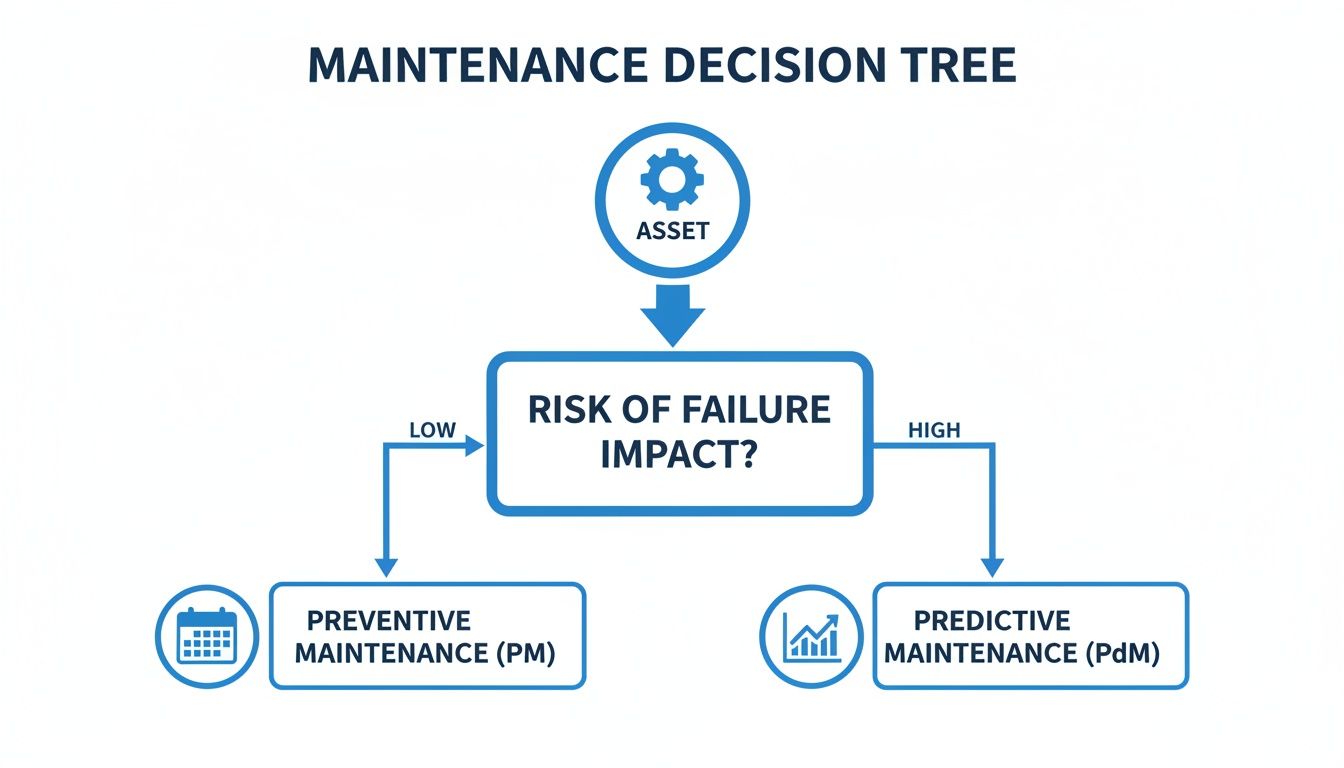
The guide makes it clear: low-risk assets are fine with scheduled PM, but your high-risk, critical equipment demands the data-driven vigilance of a PdM program.
Failure Predictability and Technical Maturity
Another crucial piece of the puzzle is how an asset fails. Some equipment has predictable wear patterns, like parts that degrade based on runtime hours or cycles. This is a perfect fit for a preventative maintenance calendar. You can reliably swap out components just before they hit their known end-of-life.
On the flip side, you have assets with complex and seemingly random failure modes. These are the machines influenced by subtle shifts in operation, environmental conditions, or a dozen interacting parts. Trying to manage them with a calendar is a guessing game. This is where predictive maintenance shines, using live data to spot the unique digital fingerprints of an impending failure that a simple schedule would completely miss.
Your team’s technical maturity also plays a big part. Rolling out predictive maintenance requires a solid data infrastructure and people who are comfortable with analytics. If your organization is just starting its digital journey, a smart approach is to build a rock-solid preventative program first, while piloting PdM on a few of your most critical assets. It’s a scalable way to grow into the technology.
The long-term economic impact is massive. By 2030, predictive maintenance powered by IIoT is expected to generate $12.6 trillion in global economic value, with smarter interventions cutting costs by 10-40%. When a single failure on a critical asset can cost over $850,000, the condition-monitoring of PdM easily beats a simple schedule, turning maintenance from a calendar-driven chore into an intelligence-led strategy. You can dive deeper into these predictive maintenance findings on makula.io.
Decision Matrix: Which Maintenance Strategy Fits Your Asset?
Choosing the right path forward can feel complex, but breaking it down by key factors makes the decision much clearer. This matrix is designed to help you quickly assess an asset and see which strategy makes the most sense based on its specific role and risk profile.
| Decision Factor | Favors Preventative Maintenance | Favors Predictive Maintenance |
|---|---|---|
| Asset Criticality | Low to moderate. Failure causes minimal disruption. | High to mission-critical. Failure results in major operational or financial losses. |
| Cost of Downtime | Low. The financial impact of the asset being offline is manageable. | High. Each hour of downtime translates to significant revenue loss. |
| Failure Predictability | High. Failure modes are well-understood and tied to usage or time. | Low. Failures are complex, random, or have subtle warning signs. |
| Cost of Repair | Lower than the cost of the asset itself. | Can be extremely high, especially with secondary damage. |
| Organizational Maturity | Simpler to implement; requires good planning and scheduling capabilities. | Requires data infrastructure, analytics tools, and a data-driven culture. |
Ultimately, this isn't an either/or choice. The most effective maintenance programs are hybrids, using this kind of logic to apply the right level of oversight to every machine in the facility. It's about being strategic, not dogmatic.
Practical Use Cases Across Key Industries
The real test of any maintenance strategy isn't in a spreadsheet—it's on the factory floor, across the power grid, and within global supply chains. The debate between preventative vs predictive maintenance gets a lot clearer when you ground it in the real world. Each approach has specific environments where it shines, making sure resources are put to intelligent use to maximize uptime and keep costs in check.

Let's look at how different industries match the right strategy to the right asset, building a maintenance ecosystem that is both resilient and financially sound.
Where Preventative Maintenance Excels
Preventative maintenance is still the go-to for assets with well-understood failure patterns, especially when the cost of downtime is manageable. Its simplicity and predictability make it a solid, cost-effective choice for a huge range of routine operational needs.
-
Commercial Facilities Management: Consider the HVAC systems in a large office building. Swapping out air filters every quarter and inspecting belts twice a year is a simple, calendar-based task that keeps the system running efficiently without needing complex sensors.
-
Logistics and Warehousing: Conveyor systems in distribution centers depend on consistent lubrication and proper belt tensioning. A regular PM schedule keeps these workhorses running, preventing minor wear from becoming a bottleneck that shuts down the entire sorting process.
-
Fleet Management: For a fleet of delivery vans, routine oil changes, tire rotations, and brake checks based on mileage are essential. These scheduled services are incredibly effective at extending vehicle life and ensuring driver safety for parts with predictable lifespans.
These examples show where the cost of some "over-maintenance" is minor compared to the reliability and simplicity gained from a scheduled approach.
High-Stakes Applications for Predictive Maintenance
Predictive maintenance (PdM) delivers its biggest ROI where unplanned failure isn't just an inconvenience—it's a catastrophe. This is the essential strategy for mission-critical, high-value assets that have to be monitored continuously.
The Critical Difference: Preventative maintenance is for assets that shouldn't fail. Predictive maintenance is for assets that absolutely can't fail.
With PdM, organizations can spot developing faults long before they become critical, turning maintenance from a defensive chore into a strategic advantage. You can dive deeper in our complete guide to predictive maintenance in manufacturing.
Here are a few places where it’s a game-changer:
-
Aviation: Jet engines are packed with thousands of sensors tracking temperature, pressure, and vibration in real-time. This flood of data lets airlines predict component fatigue with surgical precision, scheduling engine overhauls to maximize flight time while guaranteeing passenger safety.
-
Energy and Utilities: A gas turbine at a power plant is a multi-million dollar piece of machinery where failure can trigger widespread blackouts. Predictive maintenance uses vibration analysis and thermal imaging to catch imbalances or overheating early, letting operators step in before a catastrophic failure.
-
Automotive Manufacturing: Robotic arms on an assembly line have to move with flawless precision. PdM systems monitor their motor currents and joint stress to forecast potential failures, heading off line stoppages that can cost thousands of dollars per minute.
The Hybrid Model: The Best of Both Worlds
For most organizations, the smartest and most financially sound solution isn't an "either/or" choice. It's a carefully blended hybrid model. This approach applies the right strategy to the right asset based on its criticality, cost, and the impact of its failure.
By using a hybrid strategy, a company can create a tiered maintenance ecosystem. Predictive maintenance is saved for the most vital, complex, and expensive machinery—the heart of the operation. At the same time, preventative maintenance is efficiently applied to the huge number of less critical assets, ensuring baseline reliability across the board without breaking the bank.
This balanced approach optimizes resources, minimizes risk, and creates a maintenance program that's truly resilient and cost-effective.
How Technology Accelerates Maintenance Modernization
Rolling out a modern maintenance strategy—whether it’s preventative or predictive—is about more than just new software and schedules. The biggest hurdle, time and again, is the human element. You have to close the technical skills gap and give your teams the confidence to nail complex tasks every single time. This is where technologies like Augmented and Virtual Reality (AR/VR) come in, acting as the critical bridge between a great plan and real-world execution.
These immersive tools cut right to the heart of the biggest challenges: upskilling technicians and ensuring everyone follows procedures perfectly. They create a powerful, tangible link between digital insights and physical action, which in turn speeds up adoption and maximizes the return on your entire maintenance investment.

Immersive Training for Complex Tasks
One of the toughest parts of adopting advanced maintenance is getting technicians ready for a much wider range of diagnostic and repair jobs. Virtual Reality training solves this by creating a safe, controlled digital space where teams can practice intricate procedures on perfect digital twins of your most critical assets.
This kind of hands-on, simulated training lets technicians build real muscle memory and sharpen their diagnostic instincts without any risk to actual equipment or personal safety. It's a remarkably effective way to standardize your best practices and get the whole workforce skilled up, fast.
Key Insight: Immersive training takes learning out of the manual and into the real world. It guarantees that when a technician is faced with a complex PM task or a critical PdM alert, they have the confidence and skill to act decisively.
AR-Powered Remote Assistance and Guidance
When a technician on the floor runs into a problem they haven’t seen before, getting an expert's eyes on it immediately is the key to minimizing downtime. Augmented Reality completely changes this dynamic by making instant remote assistance a reality.
Using AR smart glasses or even a tablet, an on-site technician can stream their exact point-of-view to a senior expert anywhere in the world. The remote specialist sees the problem as if they were standing right there, allowing them to provide real-time guidance by overlaying digital instructions, diagrams, or notes directly onto the physical equipment. You can see more on how this streamlines work in our guide to maintenance with augmented reality.
This immediate access to expertise pays off in a few huge ways:
- Drastically Reduced Error Rates: Visual, step-by-step guidance makes sure tasks are done right the first time.
- Minimized Downtime: Problems get diagnosed and fixed faster, without the long wait for an expert to travel to the site.
- Empowered Teams: Junior technicians can tackle complex jobs with confidence, knowing a senior expert is right there with them, which accelerates their on-the-job learning.
Unlocking a Faster Return on Investment
For a real-world look at how these strategies work, just look at how PepsiCo Frito-Lay's ML-driven predictive maintenance is saving thousands of production hours. The analytics are incredibly powerful, but that value is only captured when technicians can act on those insights. AR and VR are the tools that ensure they can do it with speed and precision.
In manufacturing, making the jump from preventive to predictive can slash unplanned downtime by 50-65% and even extend the life of your assets by 20-40%. Yes, a predictive maintenance program can require a 3-4x higher upfront investment, but AR and VR tools help you hit your ROI much faster by making sure every maintenance task is performed as efficiently and accurately as possible. By giving your team the right tools, you finally close the loop between data-driven insights and flawless execution—turning your maintenance modernization plan into a true success.
Answering Your Top Maintenance Questions
As you weigh preventative against predictive maintenance, a few questions always seem to pop up. Let's tackle them head-on. Getting these common points of confusion cleared up is the key to making a confident decision that actually fits your operation, your budget, and your team.
What's the Single Biggest Hurdle in Switching to Predictive Maintenance?
Honestly? It's the people. The technology—sensors, IoT, analytics—is a challenge, sure. It requires a real investment upfront. And you absolutely need a solid plan for managing the flood of data you're about to collect. But the toughest part is shifting the culture.
You're asking a team that has spent decades in a routine-driven world to now trust data over their calendar. It’s a complete change in mindset, moving away from scheduled tasks to proactive, data-informed interventions.
The greatest hurdle is often cultural. Predictive maintenance requires teams to unlearn decades of "if it isn't broken, don't fix it" thinking and embrace a new philosophy of trusting data to guide their actions before a failure ever occurs.
Can a Small Business Really Pull Off Predictive Maintenance?
Yes, absolutely—as long as you're smart about it. Forget trying to outfit your entire facility at once. That’s a recipe for a budget nightmare. The savvy way to do it is to start small.
Pick one or two of your most critical assets, the ones where unexpected downtime would be catastrophic. Pilot your predictive maintenance program there. With so many scalable, cloud-based vendors and affordable sensors on the market now, the barrier to entry is lower than ever. The strategy is simple: start small, prove the ROI on a limited scale, and then grow the program once you've shown its value.
How Do AR and VR Fit Into a Standard Preventative Program?
Even if you’re sticking with a traditional preventative maintenance (PM) schedule, immersive tools are a game-changer. They bring a level of standardization and error-proofing to routine tasks that you just can't get otherwise.
- Virtual Reality (VR) Training: Get new technicians up to speed faster and more consistently. VR creates a safe, simulated space where they can master procedures before ever touching live equipment.
- Augmented Reality (AR) On-Site Support: Imagine your tech on the floor, looking at a machine. AR can overlay digital checklists, step-by-step visual guides, or the asset’s full service history right into their line of sight.
This dramatically cuts down on simple mistakes, makes routine checks faster, and ensures no critical step is ever missed. Your whole PM workflow becomes more reliable.
Is It a Good Idea to Use Both Strategies at Once?
Not only is it a good idea, it's often the most practical and cost-effective approach. A hybrid model lets you match the maintenance strategy to the asset's importance.
Most companies end up applying predictive maintenance to their mission-critical, high-value equipment where a sudden failure would halt operations. For everything else—the less critical assets with predictable wear patterns—they stick with a standard preventative schedule. It’s the best of both worlds, optimizing how you spend your resources while keeping risk to a minimum.
Ready to accelerate your maintenance modernization with immersive technology? AIDAR Solutions provides AR and VR tools that empower your technicians to perform tasks with greater precision and efficiency. Our solutions reduce errors, minimize downtime, and deliver a rapid return on investment. Discover how AIDAR can transform your maintenance operations today.

