Top 12 Educational VR Apps Revolutionizing Learning in 2025
Virtual Reality is no longer just for entertainment; it's a powerful tool transforming classrooms and workplaces. By creating immersive, hands-on learning environments, educational VR apps are solving real-world challenges, from making complex STEM concepts tangible for students to enabling risk-free, high-stakes training for industrial technicians. This shift allows learners to move from passive observation to active participation, dramatically improving knowledge retention, skill acquisition, and safety. VR stands as a significant evolution in digital instruction. To fully grasp its transformative potential, it's insightful to consider the broader landscape of computer-assisted learning and its various advantages and disadvantages.
This resource guide is designed to help you navigate the growing market of educational and training VR solutions. We have curated a list of the top 12 platforms and apps that deliver measurable results across K-12, higher education, and corporate training. For each entry, we provide a detailed analysis of its ideal use cases, key features, platform compatibility, and pricing. We also offer specific guidance for integration with enterprise XR platforms and assess suitability for industrial and maintenance training. Our goal is to equip you with the practical information needed to select the best VR application for your specific learning objectives.
1. AIDAR Solutions
AIDAR Solutions positions itself as a strategic partner for enterprises seeking to integrate high-impact VR and AR into their operational fabric. Rather than offering a standalone product, AIDAR provides a comprehensive platform designed for industrial and corporate training, making it an exceptional choice among educational VR apps for workforce development. Its core value proposition lies in delivering measurable business outcomes, moving beyond simple engagement to tangible ROI.
The platform is built on two key pillars: AIDAR.SKILLS for virtual reality training and AIDAR.SERVICE for augmented reality remote assistance. This dual focus ensures that learning is directly connected to on-the-job performance. Trainees can master complex procedures in a risk-free virtual environment, and then receive real-time expert support via AR when they are in the field. This seamless transition from training to application is a significant differentiator, addressing the entire employee lifecycle from onboarding to frontline execution.
Key Strengths and Use Cases
AIDAR excels in environments where training is complex, high-risk, or requires expensive physical resources. Its simulations are ideal for manufacturing, equipment maintenance, and field service operations.
- Accelerated Skill Acquisition: The platform has demonstrated the ability to reduce training time by up to 75%. For an industrial enterprise, this means a technician can become proficient in a new piece of equipment in one week instead of four, drastically speeding up time-to-competency.
- Flexible Deployment: Recognizing that industrial clients have unique IT requirements, AIDAR offers both SaaS and on-premise deployment models. This flexibility is crucial for organizations with strict data security protocols or those operating in environments with limited internet connectivity.
- Integrated Ecosystem: The platform is designed to synergize with existing enterprise systems. The company provides tailored solution architecture and integration support to ensure the VR training modules work seamlessly with an organization's Learning Management System (LMS) and operational workflows.
Expert Insight: AIDAR's focus on linking VR training with AR-guided execution offers a cohesive solution that solves a common business challenge: knowledge transfer from the classroom to the field. This makes it a powerful tool not just for learning, but for operational excellence.
While specific pricing and case studies require a direct consultation and demo, the platform's emphasis on quantifiable metrics like reduced service times and expert travel makes a compelling business case for large-scale industrial and corporate learning programs.
- Website: https://aidarsolutions.com
- Best For: Manufacturing, field service, and corporate L&D seeking scalable, ROI-driven training.
- Pricing: Custom quote; requires booking a demo for ROI modeling and cost analysis.
2. Meta Quest Store (Quest experiences)
The Meta Quest Store is the primary marketplace for native applications on Meta Quest headsets, making it a foundational resource for sourcing educational VR apps. Its strength lies in the vast, curated library of experiences that run directly on the standalone hardware, eliminating the need for a tethered PC. This makes deployment straightforward for both individual learners and institutional programs.
For enterprises and schools, Meta for Education provides a managed service to deploy specific apps across multiple headsets, enforce content policies, and control user access. This is crucial for environments where safety and focus are paramount. The store features everything from high-fidelity science simulations like MEL Chemistry VR to virtual field trips and hands-on skills training modules. While many apps require individual purchases, the one-click installation and automatic updates offer a seamless user experience.
Key Details & Considerations
- Best For: Institutions and individuals using Quest headsets who need a simple, direct-to-device content pipeline.
- Platform: Meta Quest 2, Quest 3, Quest Pro.
- Pricing: Varies per app; many are one-time purchases, with some free options available.
- Industrial Suitability: Good for foundational skills and safety primers, though specialized industrial content may be limited.
- Integration: Apps are self-contained. For broader platform integration, you would use a management solution like an MDM or an enterprise platform such as AIDAR, which can leverage these powerful standalone XR devices.
Website: https://www.meta.com/quest/store/
3. Steam (SteamVR education apps on PC)
Steam is the largest digital distribution platform for PC gaming and, by extension, a massive marketplace for PC-based VR content. Its SteamVR platform supports a wide range of headsets, making it a go-to source for high-fidelity educational VR apps that leverage the power of a dedicated gaming PC. This is ideal for experiences that demand significant graphical processing power, such as complex engineering simulations, detailed anatomical models, or historically accurate virtual environments.
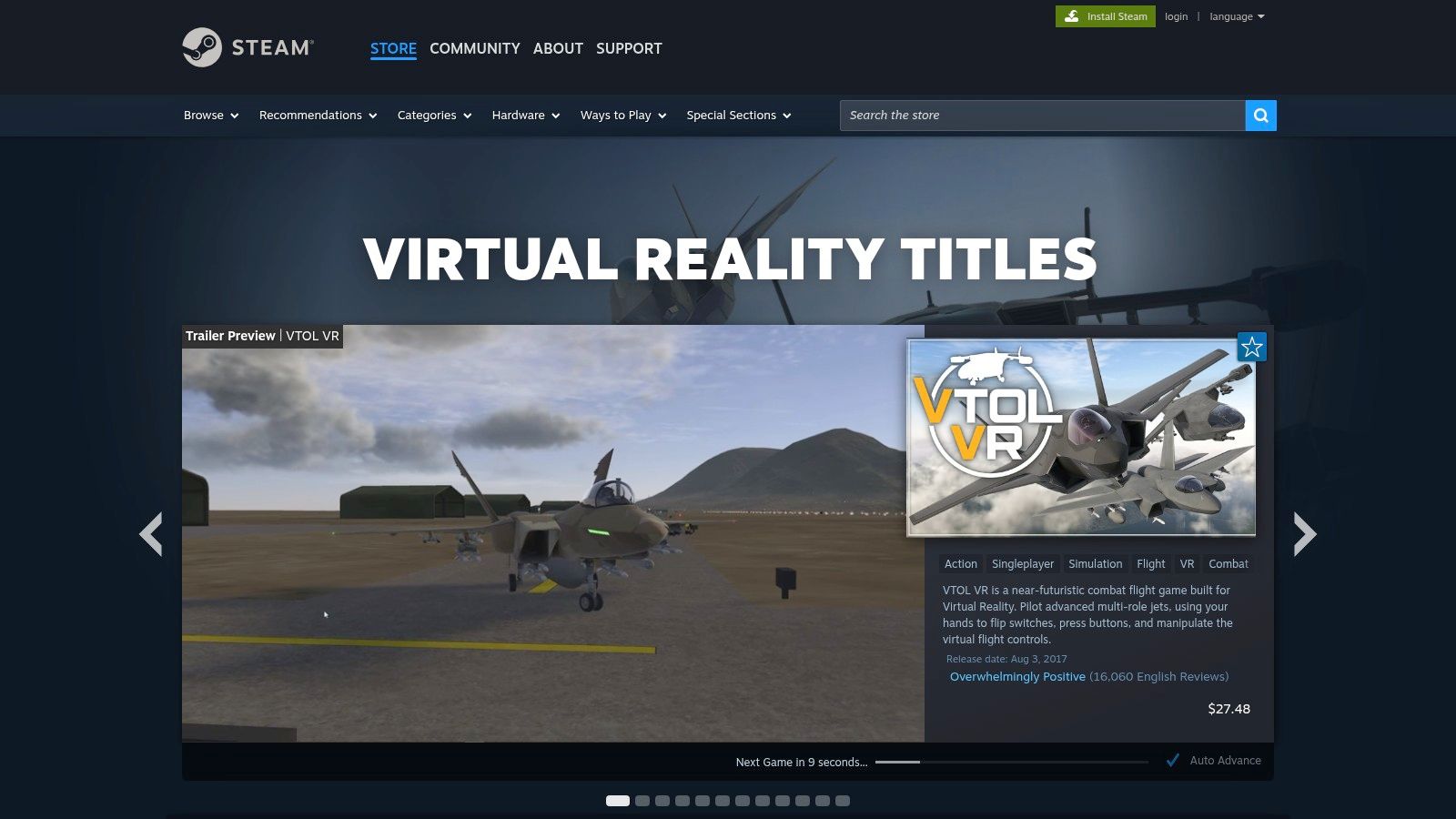
The platform’s strength lies in its vast and diverse library, which includes everything from AAA titles to niche indie projects. For education and training, this means access to a broad spectrum of tools that may not be available on standalone headset stores. User reviews, community hubs, and frequent sales events help institutions vet and acquire content affordably. However, the open nature of the platform means quality can vary, requiring careful evaluation before deployment in a professional or academic setting. The need for a capable PC and a tethered or linked connection is a key logistical consideration.
Key Details & Considerations
- Best For: Organizations and power users with PC VR hardware seeking graphically intensive or specialized educational experiences.
- Platform: PC VR (Valve Index, HTC Vive, Windows Mixed Reality) and Meta Quest headsets via Link/Air Link.
- Pricing: Varies per app; one-time purchases are standard, with frequent discounts and a strong refund policy.
- Industrial Suitability: Excellent for high-fidelity simulations, data visualization, and complex virtual labs where processing power is a priority.
- Integration: Most apps are standalone. For enterprise-level management and integration into a broader training ecosystem with platforms like AIDAR, content must be launched and managed on the connected PC.
Website: https://store.steampowered.com/vr/
4. Viveport (HTC’s cross-platform VR store and subscription)
Viveport serves as HTC’s cross-platform VR store and is distinguished by its Viveport Infinity subscription service. This model offers unlimited access to a large library of VR content for a flat monthly fee, presenting a cost-effective solution for educational programs that need a wide variety of experiences. Rather than purchasing individual licenses, institutions can provide learners with a rotating selection of educational VR apps, from historical explorations to basic science modules.
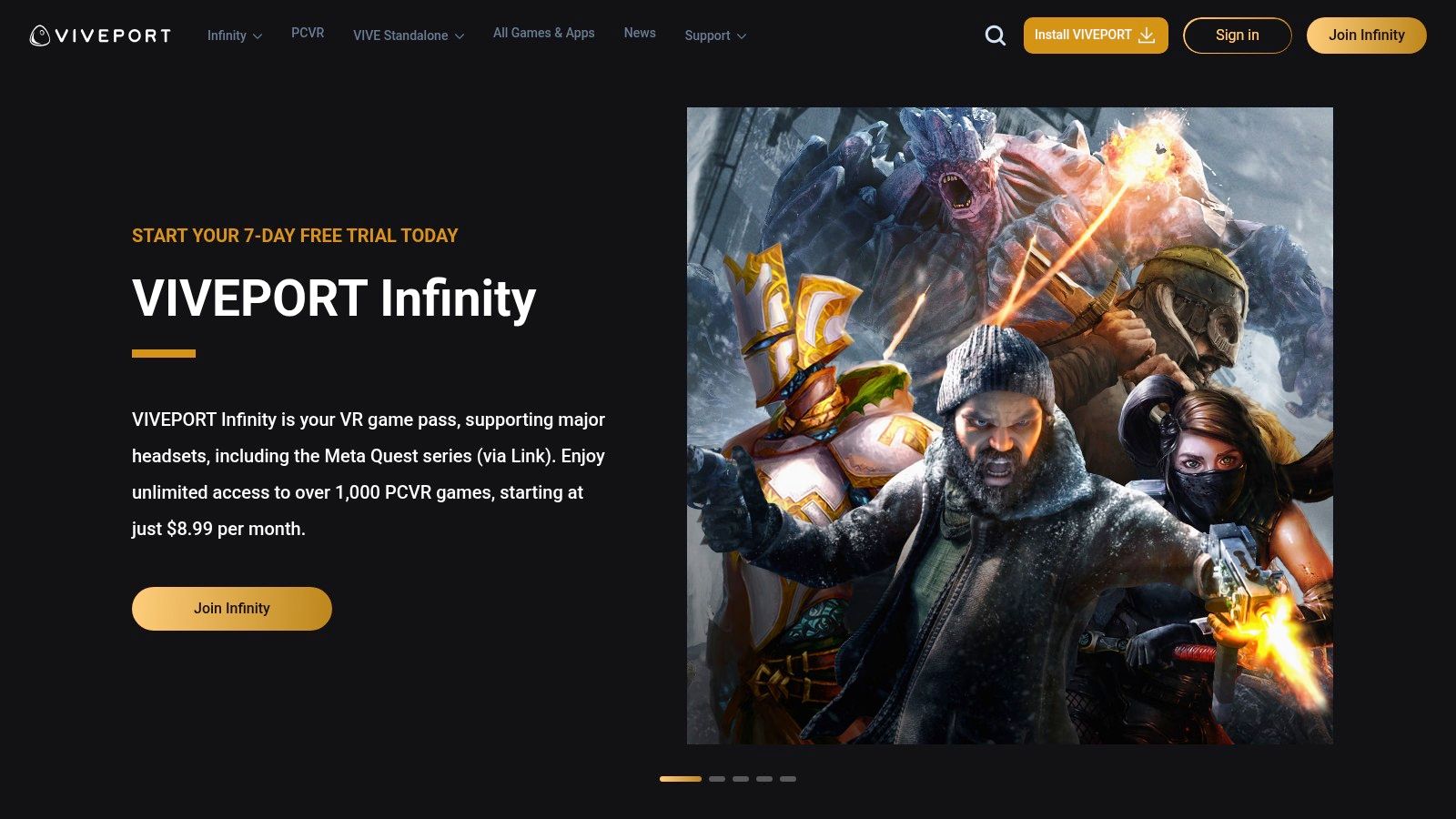
The platform is largely focused on PC VR, meaning it requires tethered headsets connected to capable computers. This setup is ideal for classroom or lab environments where hardware is stationary. While the library is extensive, its primary focus is on gaming, so educators and trainers will need to curate their own lists of suitable educational titles. However, for organizations willing to explore the catalog, Viveport provides an affordable gateway to a diverse range of VR content.
Key Details & Considerations
- Best For: Classrooms or training labs with PC VR setups looking for a budget-friendly way to access a broad and rotating content library.
- Platform: PC VR (compatible with most major headsets like HTC Vive, Valve Index, and Quest via Link/Air Link).
- Pricing: Monthly/annual subscription for Viveport Infinity; individual app purchases also available.
- Industrial Suitability: Limited; while some foundational or conceptual apps exist, it lacks the specialized, high-consequence training modules needed for heavy industry.
- Integration: Content is managed through the Viveport application. For enterprise-level management and integration with custom training modules, a more robust platform is necessary to manage the hardware and deploy specific content outside the Viveport ecosystem.
Website: https://www.viveport.com/
5. SideQuest (App Lab and indie Quest content discovery)
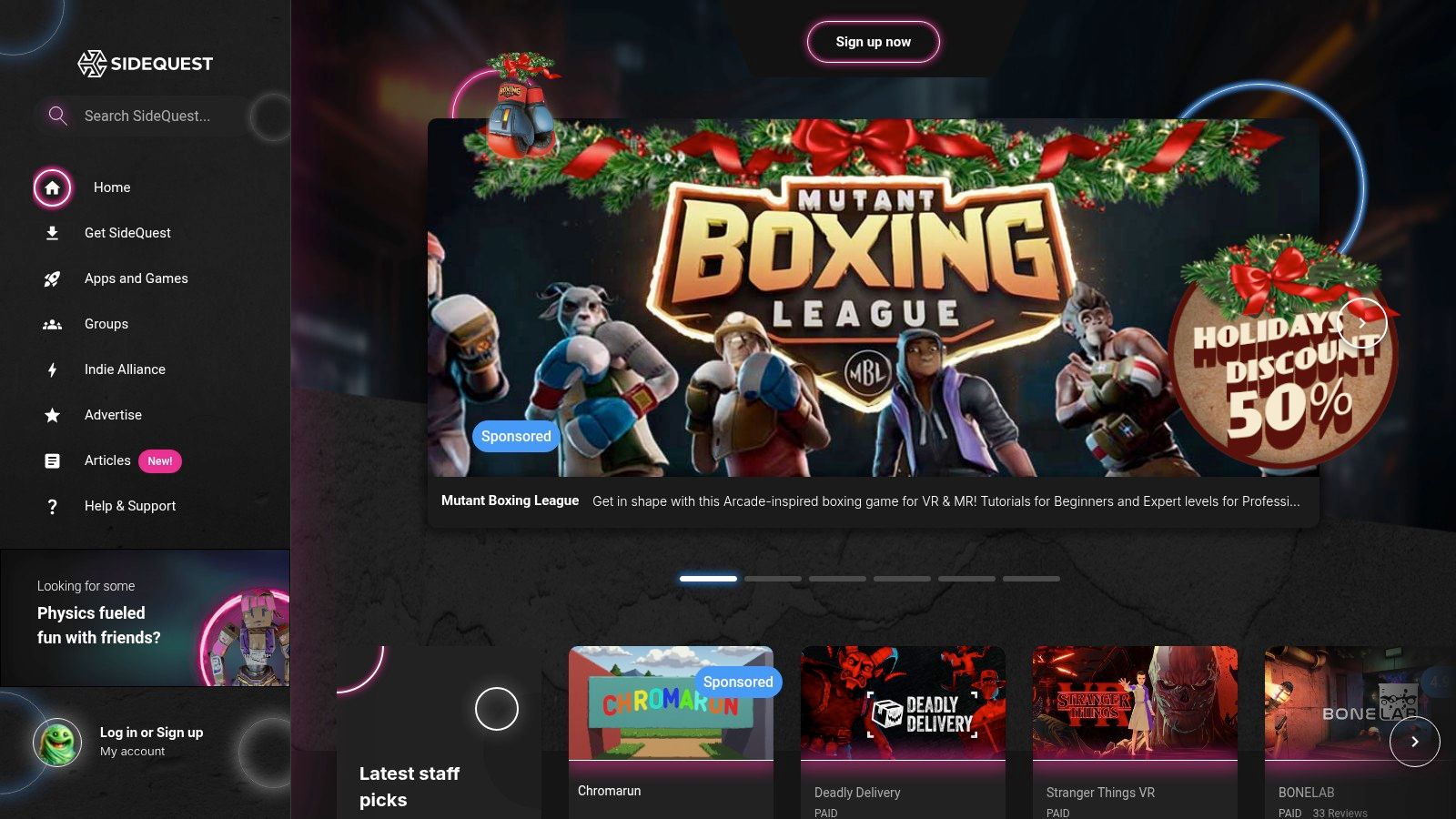
SideQuest serves as an essential discovery platform for content that exists outside the official, curated Meta Quest Store. It is the primary gateway to Meta's App Lab, a distribution path for developers to share apps that are still in development or target a niche audience. This makes it an invaluable resource for educators and trainers seeking experimental, highly specialized, or free educational VR apps that haven't yet met the criteria for a full store release.
For those willing to explore early-access projects, SideQuest offers a treasure trove of innovative learning tools, from specific historical simulations to unique artistic experiences. The platform provides a community-driven space where developers can gather feedback, making it a dynamic hub for the cutting edge of VR education. While the installation process can be more involved than the main store, the access it provides to emerging content is unmatched.
Key Details & Considerations
- Best For: Educators, researchers, and enterprises looking for emerging, niche, or low-cost educational experiences and early-access projects.
- Platform: Meta Quest 2, Quest 3, Quest Pro.
- Pricing: Primarily free content, with some paid App Lab titles available.
- Industrial Suitability: High potential for finding specialized or custom-developed training modules not available elsewhere, but quality and support can vary significantly.
- Integration: Apps are standalone and launch on the Quest headset. Sideloading requires enabling developer mode, which may have implications for device management in an enterprise setting.
Website: https://sidequestvr.com/
6. ClassVR (education-first VR platform, hardware + content)
ClassVR offers a turnkey solution designed specifically for K-12 classrooms, combining hardware, software, and curriculum-aligned content into one integrated package. Its primary advantage is its simplicity and control, providing educators with a teacher-friendly portal to manage and deploy experiences to an entire class simultaneously. This ecosystem is purpose-built for the classroom, removing the complexities of consumer-grade hardware and app stores.
The platform includes access to the Eduverse content library, which is filled with educational VR apps, virtual field trips, and interactive lessons mapped to curriculum standards. With US-based support and flexible payment options tailored for schools, ClassVR addresses the practical deployment challenges that educators face. It stands out as an all-in-one system for institutions that prioritize ease of use, classroom management, and a curated educational content library over an open, consumer-focused marketplace.
Key Details & Considerations
- Best For: K-12 schools and districts seeking a fully managed, classroom-ready VR system with curriculum-aligned content and robust teacher controls.
- Platform: ClassVR standalone headsets.
- Pricing: Subscription-based model that typically includes hardware, software portal access, content, and support.
- Industrial Suitability: Limited. The content is heavily focused on K-12 academic subjects rather than vocational or industrial skills training.
- Integration: A closed ecosystem. The platform is designed to be self-contained, with content and management handled through the ClassVR portal.
Website: https://www.classvr.com/us/
7. Prisms VR (math/science learning platform)
Prisms VR is a specialized educational platform designed to make abstract math and science concepts tangible through immersive, problem-based learning. It directly addresses the challenge of student engagement by translating complex equations and principles into interactive, spatial experiences. The platform is standards-aligned, offering modules for middle school math, Algebra, and Geometry, with robust support for classroom implementation, including teacher dashboards and analytics to track student progress.
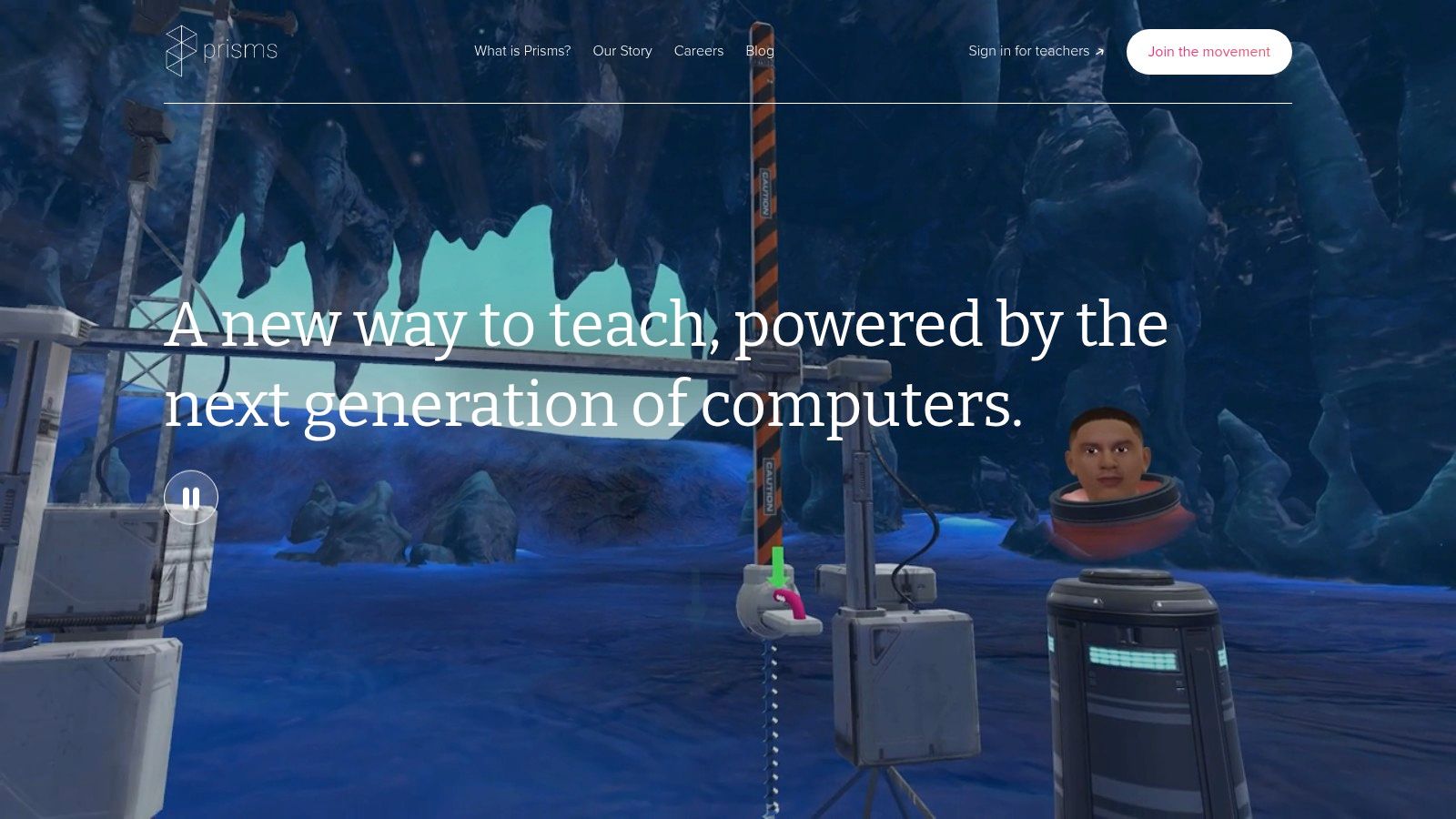
Its core strength lies in its research-backed pedagogical approach, which has shown significant learning gains in district deployments. For educators, Prisms VR provides a structured curriculum that integrates seamlessly into existing lesson plans, making it one of the most practical educational VR apps for formal K-12 settings. By allowing students to physically manipulate variables and see immediate outcomes, it transforms theoretical knowledge into applied understanding, embodying the principles of effective, kinesthetic instruction.
Key Details & Considerations
- Best For: K-12 schools and districts seeking a standards-aligned, curriculum-integrated VR solution for math and science.
- Platform: Meta Quest 2, Quest 3, Quest Pro.
- Pricing: Institutional licensing is on a per-student, per-year basis; a consumer version for at-home math learning is available on the Quest store.
- Industrial Suitability: While not designed for industrial training, its pedagogical model for teaching complex, abstract systems could inform the development of technical training modules.
- Integration: The platform is self-contained with its own analytics dashboard. It operates on standalone headsets, making it easy to deploy within a managed device environment.
Website: https://www.prismsvr.com/
8. ENGAGE XR (virtual learning platform for classes, labs, field trips)
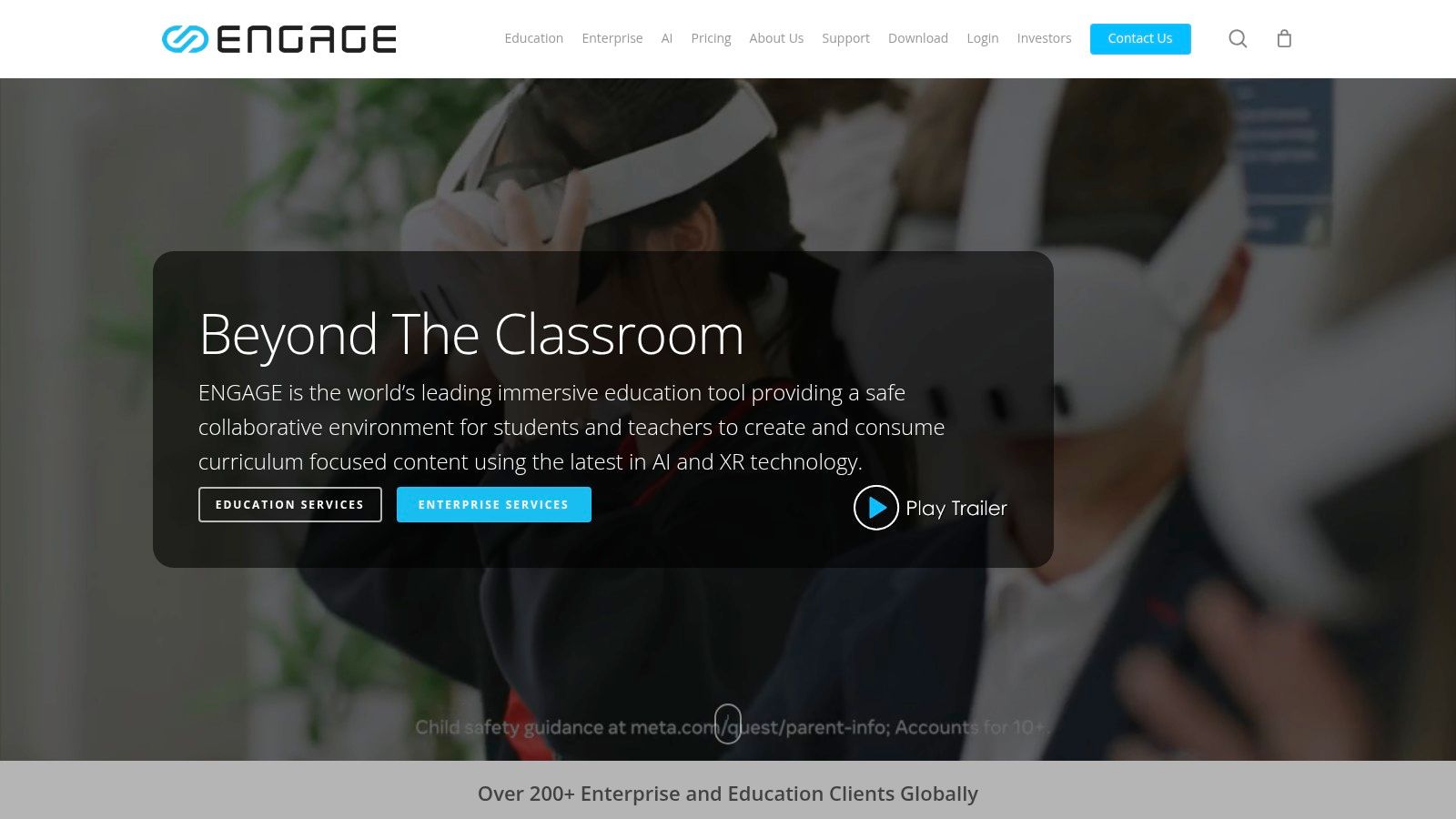
ENGAGE XR is a comprehensive metaverse platform designed for education, training, and virtual events. Unlike single-purpose educational VR apps, ENGAGE provides an entire ecosystem where educators can create, host, and manage synchronous learning experiences. It enables instructors to conduct live classes, lead virtual field trips, and build interactive training scenarios within persistent virtual spaces. The platform's strength is its focus on live, multi-user interaction and robust content creation tools.
For institutions, ENGAGE offers managed education bundles that include curated content, security features like SSO, and support for large-scale deployments. Its toolset allows for not just consumption but also the creation of custom lessons and assessments, making it a versatile solution for K–12, higher education, and corporate training. It effectively serves as a virtual campus or training center, bridging the gap between passive content and active, collaborative learning.
Key Details & Considerations
- Best For: Institutions seeking a robust platform for live, instructor-led virtual classes, large events, and custom content creation.
- Platform: Meta Quest, Pico, PCVR, Mobile, Desktop.
- Pricing: Tiered pricing with per-user licenses for education and enterprise; free version has limitations.
- Industrial Suitability: Excellent for collaborative soft skills training, procedural walkthroughs, and virtual conferences, but less focused on high-fidelity, hands-on mechanical simulations.
- Integration: Operates as a complete platform. Enterprise solutions like AIDAR can manage the deployment of the ENGAGE client across devices and integrate its use into broader, data-driven training curriculums that track learner progress across multiple applications.
Website: https://engagevr.io/
9. VictoryXR (XR labs, digital twin campuses, and education content)
VictoryXR offers a comprehensive, all-in-one solution for educational institutions aiming to integrate VR at scale. Rather than just providing individual apps, it delivers complete packages that include Meta Quest hardware, multi-year software licenses, device management, professional development for educators, and ongoing support. This turnkey approach is designed to eliminate the common friction points schools face when adopting new technology.
The platform specializes in creating immersive learning environments, from dedicated science VXRLabs and AI-powered tutors to entire digital twin campuses where students can attend classes and collaborate. By bundling hardware, curriculum-aligned software, and robust support, VictoryXR enables institutions to deploy powerful educational VR apps and experiences without needing in-house XR experts. The focus is on creating a sustainable, scalable ecosystem for long-term academic use.
Key Details & Considerations
- Best For: K-12 school districts and higher education institutions seeking a fully managed, end-to-end VR implementation with hardware and curriculum included.
- Platform: Primarily Meta Quest 2, Quest 3, Quest Pro.
- Pricing: Custom quotes based on institutional needs; pricing reflects a full-service bundle, including hardware, software, and support.
- Industrial Suitability: While academically focused, the science labs (chemistry, biology) provide excellent foundational knowledge applicable to industrial R&D and life sciences.
- Integration: Offers a self-contained, managed ecosystem. The included device management simplifies integration into a school’s IT framework, and its content can supplement learning programs managed by larger platforms.
Website: https://www.victoryxr.com/
10. Veative (STEM VR modules and assessments for schools)
Veative offers a comprehensive library of interactive STEM modules designed to integrate directly with middle and high school curricula. Its main strength is the sheer depth of its content library, which features hundreds of modules and virtual tours covering subjects from biology and chemistry to physics and mathematics. The platform is built for institutional deployment, providing detailed analytics and classroom management tools for educators.
This solution is often delivered as a turnkey package through educational technology resellers, bundling the software content with pre-configured headsets. This approach simplifies the procurement and setup process for schools, making it an attractive option for districts looking for a complete, out-of-the-box solution. By focusing on curriculum-aligned content and built-in assessments, Veative provides a structured pathway for integrating educational VR apps into formal learning environments.
Key Details & Considerations
- Best For: K-12 school districts seeking a large, curriculum-aligned library of STEM content with a structured, managed deployment model.
- Platform: Standalone VR headsets (often sold in bundles), PC VR, mobile devices.
- Pricing: Institutional packages sold through resellers; pricing is quote-based and varies by bundle size.
- Industrial Suitability: Limited. The content is explicitly designed for academic K-12 STEM education, not industrial or vocational skills training.
- Integration: Veative is a self-contained ecosystem with its own Learning Management System (LMS) and analytics. It is not designed for open integration with enterprise platforms, as its focus is on classroom management and academic reporting.
Website: https://www.veative.com/
11. MEL Science – VR Science Simulations
MEL Science provides a library of short, engaging virtual reality science lessons focused primarily on chemistry and physics. It serves as an excellent entry point for introducing complex scientific concepts in an immersive format, allowing students to visualize atomic structures and conduct experiments that would be impossible or unsafe in a traditional lab. The platform is designed for both individual home use and structured classroom environments.
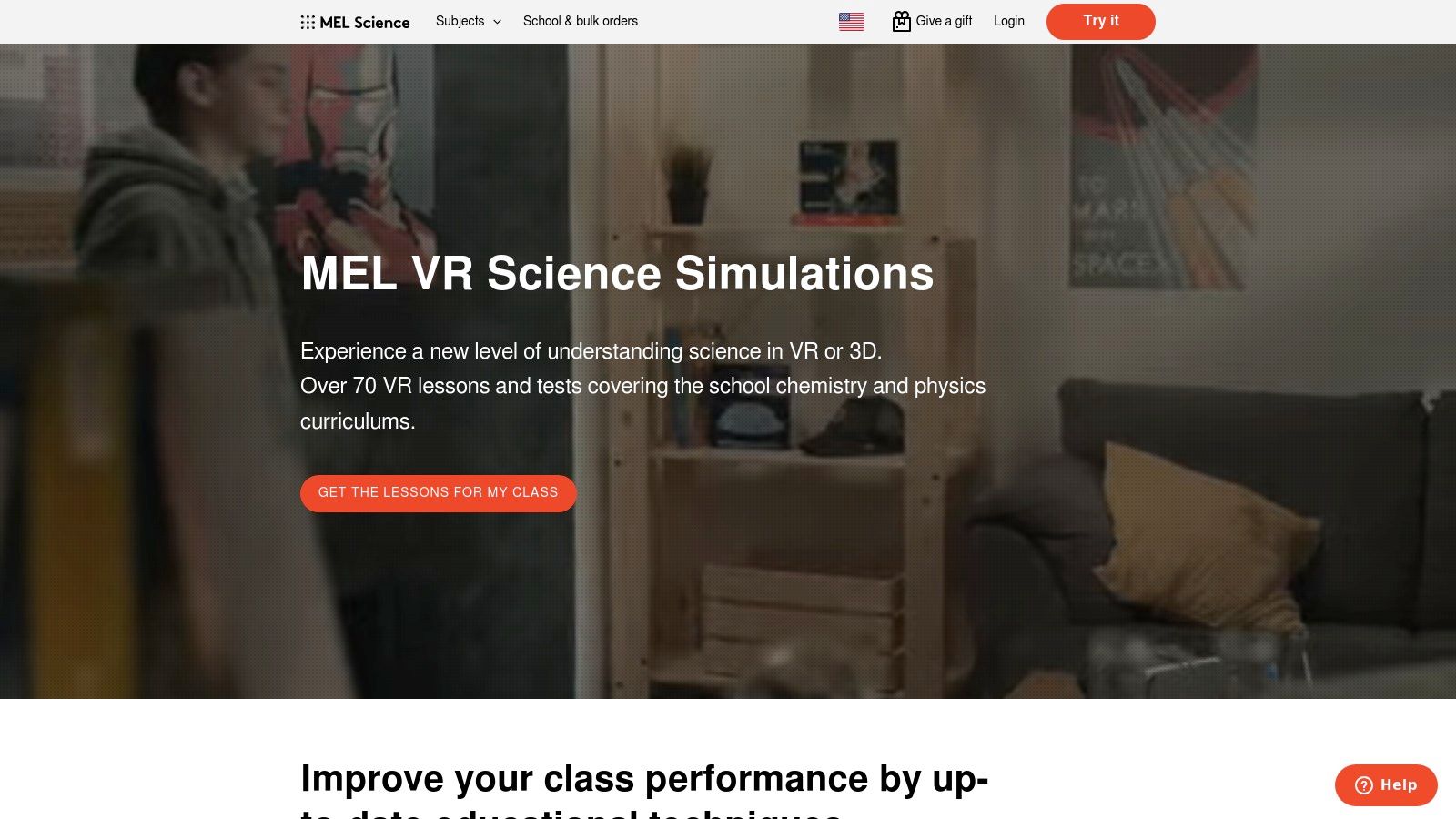
With over 70 bite-sized lessons, MEL Science translates abstract textbook topics into tangible, interactive experiences. For educators, the platform offers a dedicated teacher mode and classroom trial options, making it easy to integrate into existing curricula. While the core apps are available on mobile VR platforms, dedicated headset builds and full school licenses require direct engagement with the company. This focus makes it one of the more accessible educational VR apps for foundational science education.
Key Details & Considerations
- Best For: K-12 classrooms and homeschoolers seeking to supplement traditional chemistry and physics lessons with interactive, visual VR labs.
- Platform: Mobile VR (iOS/Android with viewers), standalone headset builds available on request.
- Pricing: Free app download with trial lessons; full access for schools requires a quote-based license.
- Industrial Suitability: Low. The content is tailored for academic science principles, not for industrial or vocational skills training.
- Integration: The lessons are self-contained experiences. Classroom deployment can be managed through school-provided device management systems, but the content itself does not integrate with larger enterprise platforms.
Website: https://melscience.com/vr/
12. VirtualSpeech (soft skills training with VR/AR and AI feedback)
VirtualSpeech offers a practical and accessible solution for developing professional soft skills, making it one of the most career-focused educational VR apps available. It provides immersive training scenarios for public speaking, sales pitches, job interviews, and leadership conversations, combining VR practice with AI-powered, real-time feedback. This unique approach allows users to rehearse critical communication skills in realistic, low-stakes environments, receiving instant analysis on pacing, filler words, and eye contact.
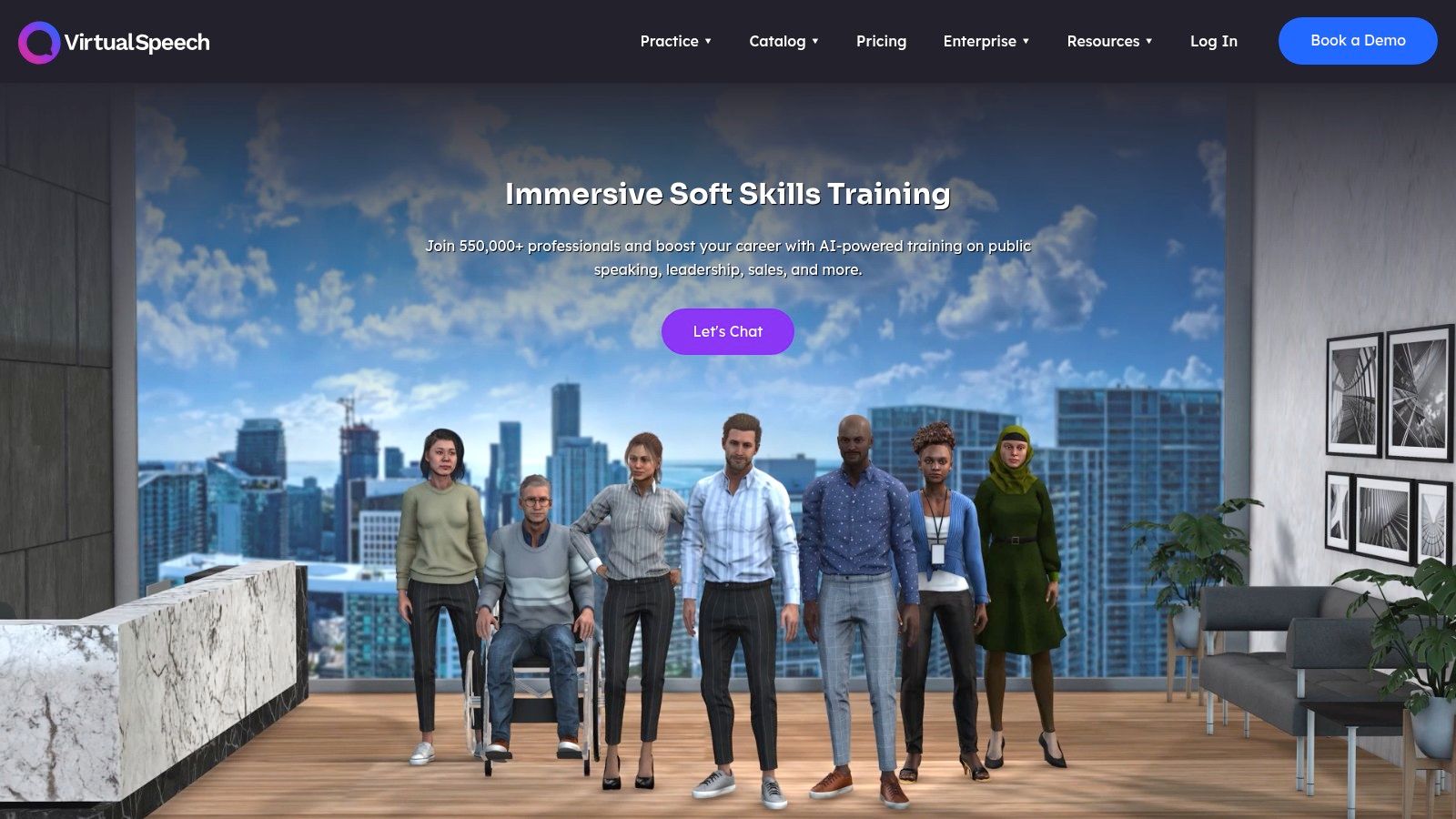
The platform is designed for both individual and organizational deployment, offering structured learning paths and certificates that align with workforce development goals. Its cross-platform availability, including VR headsets and standard web browsers, ensures accessibility for diverse training programs in higher education and enterprise settings. By gamifying the learning process and providing objective performance metrics, VirtualSpeech helps learners build tangible confidence and competence for the modern workplace.
Key Details & Considerations
- Best For: Higher education, CTE programs, and corporate L&D teams focused on job-ready soft skills like communication, sales, and leadership.
- Platform: Meta Quest, Pico, PC VR, and Web Browser.
- Pricing: Subscription-based, with plans for individuals, teams, and enterprises.
- Industrial Suitability: Excellent for developing the communication and leadership skills required for team leads, client-facing roles, and management in industrial settings.
- Integration: The platform is self-contained but can supplement broader training initiatives within an enterprise ecosystem.
Website: https://virtualspeech.com/
Top 12 Educational VR Platforms Comparison
| Solution | Core features | Quality & Impact ★ | Price / Value 💰 | Target & USP 👥 ✨ |
|---|---|---|---|---|
| 🏆 AIDAR Solutions | VR trainings (AIDAR.SKILLS), AR remote support (AIDAR.SERVICE), SaaS & on‑prem, tailored integration | ★★★★★ — up to 75% faster training; halves service time | 💰 Custom quotes; short payback / strong ROI | 👥 Manufacturing, field service, L&D · ✨ End‑to‑end integration, partner program |
| Meta Quest Store (Quest) | Large native education catalog; one‑click installs; managed edu tools | ★★★★ — curated & easy UX | 💰 Mix of free & paid apps; per‑app purchases | 👥 Consumers & schools · ✨ Seamless install/update on Quest |
| Steam (SteamVR) | PCVR marketplace; reviews, discounts, creator platforms | ★★★☆ — huge selection; quality varies | 💰 Often low prices in sales; requires gaming PC | 👥 PC VR users, labs · ✨ Biggest indie/niche library |
| Viveport (HTC) | Store + Infinity subscription; cross‑PCVR support | ★★★☆ — broad catalog, rotating access | 💰 Subscription (Infinity) for many titles | 👥 Classrooms/labs · ✨ Cost‑effective sampling via subscription |
| SideQuest | App Lab discovery hub; sideloads & early access | ★★★ — experimental & varied quality | 💰 Many free/low‑cost, some manual installs | 👥 Early adopters, educators testing niche apps · ✨ Access to App Lab/early projects |
| ClassVR | Purpose‑built headsets, management portal, Eduverse library | ★★★★ — education‑grade support | 💰 Subscription + hardware quotes | 👥 K–12 schools · ✨ Turnkey classroom management & teacher resources |
| Prisms VR | Standards‑aligned math/science modules; dashboards & analytics | ★★★★ — reported learning gains | 💰 Subscriptions / per‑student licensing | 👥 K–12 districts · ✨ Research‑backed curriculum modules |
| ENGAGE XR | Multi‑user lessons, assessments, content creation, security | ★★★★ — strong for live classes & events | 💰 Per‑user edu pricing; reseller channels | 👥 K–12, higher ed, enterprise · ✨ Synchronous lessons + assessment tools |
| VictoryXR | XR labs, digital twin campuses, hardware + managed services | ★★★★ — turnkey campus deployments | 💰 Full‑stack bundles; quoted pricing | 👥 Schools & universities · ✨ One‑stop procurement & long‑term support |
| Veative | Hundreds of STEM modules, virtual tours, analytics | ★★★ — deep subject coverage | 💰 Quote/reseller pricing; bundles | 👥 Schools needing STEM depth · ✨ Large curated STEM library |
| MEL Science (VR) | 70+ bite‑sized VR science lessons; teacher mode | ★★★ — strong chemistry/physics focus | 💰 Free app & trials; school licensing quoted | 👥 Teachers & home learners · ✨ Bite‑sized, experiment‑driven labs |
| VirtualSpeech | VR/browser soft‑skills training with AI feedback | ★★★★ — practical job‑ready practice | 💰 Individual & org plans; lower than custom builds | 👥 Workforce, higher ed, CTE · ✨ AI coaching + certificates |
Integrating Immersive Learning into Your Strategy
The landscape of educational VR apps has expanded far beyond simple games and novelty experiences. As we've explored, the ecosystem now includes everything from vast consumer-facing app stores like the Meta Quest Store and SteamVR to highly specialized platforms such as VictoryXR for digital twin campuses and VirtualSpeech for corporate soft skills training. This diversity offers unprecedented opportunities for learners of all types, whether in a K-12 classroom, a university lab, or an industrial training facility.
The core takeaway is that the most effective implementation of VR in education isn't about the novelty of the technology itself. It's about a strategic alignment between the chosen application and specific, measurable learning objectives. An app that excels at teaching high school geometry, like Prisms VR, serves a fundamentally different purpose than an enterprise-grade platform designed to simulate complex machinery maintenance.
Choosing the Right Path Forward
Selecting the ideal educational VR app requires a clear understanding of your goals, audience, and existing infrastructure. To guide your decision, consider the following critical factors:
- Learning Objectives: Is the goal knowledge retention, practical skill acquisition, or conceptual understanding? A platform like MEL Science is perfect for visualizing abstract chemistry concepts, while a hands-on industrial training module is better for mastering a physical task.
- Scalability and Management: How will you deploy and manage content across multiple users or devices? Solutions like ClassVR offer a closed ecosystem with centralized control, which is ideal for school districts. In contrast, enterprise platforms are built for large-scale industrial deployment and integration with existing corporate systems.
- Content Specificity: Do you need off-the-shelf content or highly customized simulations? While app stores provide a wide variety of general educational experiences, many industrial and enterprise use cases demand bespoke training modules that mirror proprietary equipment and procedures. For organizations looking to implement virtual reality, understanding the intricacies of how to create VR content for enterprise success is paramount.
- Integration Capabilities: A truly effective tool must fit within your current workflow. Assess whether an app can integrate with your Learning Management System (LMS), provide analytics, and connect with other enterprise software. This ensures that VR training contributes to a cohesive learning and development strategy, rather than existing in a silo.
The Future of Learning is Immersive
Virtual reality is no longer a futuristic concept; it is a practical, powerful tool that is actively reshaping how we learn and train. By moving beyond passive observation and enabling active participation, these immersive applications foster deeper engagement, improve retention, and build skills with a level of efficiency and safety that traditional methods often cannot match. The journey from identifying a need to deploying a fully integrated VR learning program requires careful planning, but the rewards are transformative. By thoughtfully selecting from the diverse range of educational VR apps available, you can unlock a new dimension of learning that prepares your students or your workforce for the challenges of tomorrow.
Ready to move beyond generic training and implement a VR solution tailored to your specific industrial needs? Discover how AIDAR Solutions provides custom, enterprise-grade VR training simulations and remote assistance tools that deliver measurable improvements in safety, efficiency, and skill mastery. Explore AIDAR Solutions to see how our platform can transform your workforce development strategy.