
Mixed Reality vs Augmented Reality: An Enterprise Guide
When discussing Mixed Reality (MR) and Augmented Reality (AR), the key difference boils down to interaction. Augmented Reality overlays digital information onto a user's view of the real world, acting as a digital heads-up display. Mixed Reality, in contrast, anchors interactive digital objects within the environment, allowing users to engage with them as if they were physically present.
Understanding The Digital Reality Spectrum
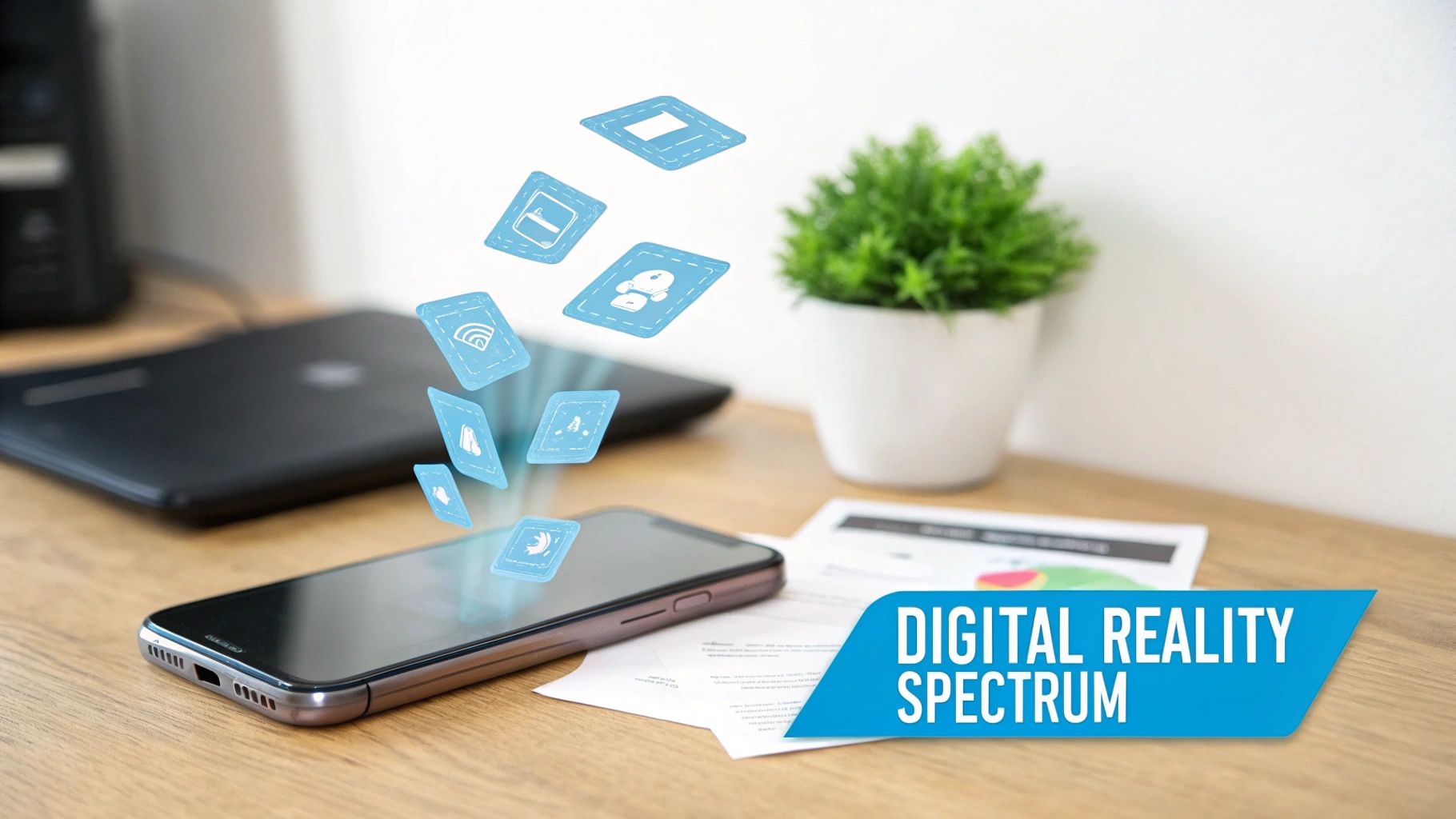
To properly understand AR and MR, it is helpful to place them on the reality-virtuality continuum. This spectrum maps the degree to which an experience is real versus digital. Both AR and MR exist between the purely physical world and a completely virtual one.
Augmented Reality is the more familiar technology, typically experienced through a smartphone or simple smart glasses. It enhances the real world by adding a digital layer—such as a pop-up with information—but these digital elements do not truly understand or react to the physical space around them.
Mixed Reality represents a significant leap forward. It does more than just overlay images; it actively maps the physical environment. This capability allows digital objects, or holograms, to be anchored to real-world surfaces and even be obscured by them. Users can walk around and interact with these digital objects as if they were solid.
This distinction is crucial for industrial and enterprise use cases. AR is ideal for delivering information precisely where it is needed, while MR excels at creating immersive, hands-on experiences. Both are part of a broader family of immersive technologies; for a better understanding of the larger context, it is useful to explore what is extended reality. Observing the evolution of other digital experiences, such as how Virtual Reality is changing video production, can also provide valuable insights.
At-a-Glance Comparison: AR vs MR
The most effective way to see the difference is through a side-by-side comparison. This table breaks down the core distinctions, offering a quick framework for understanding where each technology excels.
| Characteristic | Augmented Reality (AR) | Mixed Reality (MR) |
|---|---|---|
| User Interaction | Mostly view-only with basic screen taps. | Direct, hands-on interaction with virtual objects. |
| World Awareness | Limited understanding of the user's environment. | Spatially aware; understands surfaces, objects, and layout. |
| Immersion Level | An informational overlay on the real world. | Blends the digital and physical worlds seamlessly. |
| Typical Hardware | Smartphones, tablets, basic smart glasses. | Advanced headsets with depth sensors and powerful processors. |
Ultimately, the choice between AR and MR is not about which is "better," but which is the right tool for the specific task. AR provides context, while MR delivers interactive, spatial experiences.
Comparing The Core Technologies
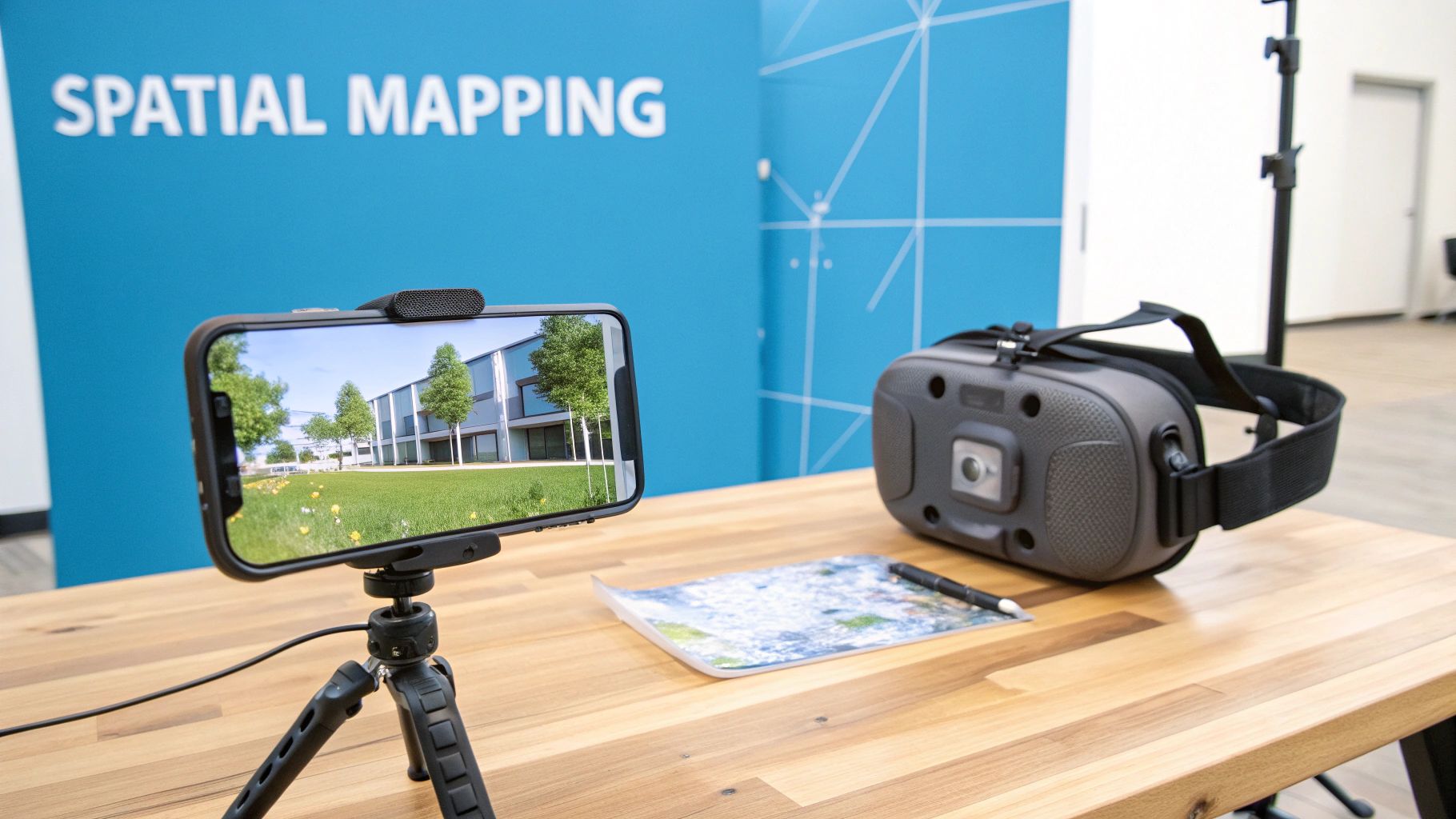
The key difference between Augmented Reality and Mixed Reality lies not just in what the user sees, but in how the technology perceives the world. Both overlay digital information onto the physical environment, but their methods for understanding and interacting with that environment are fundamentally different. Understanding this technical divide is crucial when comparing mixed reality vs augmented reality for any enterprise application.
AR solutions typically rely on simpler tracking methods. Initially, this involved marker-based tracking, where an application would recognize a specific image, like a QR code, to trigger a digital overlay. Modern AR has evolved to use a basic form of Simultaneous Localization and Mapping (SLAM), which can identify flat surfaces like floors or tabletops to place digital objects.
However, this environmental understanding is often temporary. An AR application may see a surface, but it does not build a persistent, detailed map. This is why AR objects can sometimes appear to float on top of reality rather than being a true part of it.
The Power Of Spatial Mapping In MR
This is where Mixed Reality fundamentally changes the experience, using advanced spatial mapping to build a much deeper connection with its surroundings. MR devices are equipped with a suite of sensors—including multiple cameras, depth sensors, and accelerometers—that constantly scan and build a detailed 3D mesh of the environment.
This is not a one-time scan but a persistent, dynamic 3D map. The device does not just see a table; it understands the geometry of the walls, the precise location of furniture, and the unique contours of complex machinery. This level of awareness unlocks capabilities that are beyond the reach of most AR applications.
Mixed Reality’s core advantage is its ability to treat the physical world as a canvas. Digital objects are not just placed on top of reality; they are anchored within it, respecting its physical rules and boundaries.
This sophisticated world-mapping enables MR to create a genuine blend of the physical and digital, leading to a far more immersive and interactive experience.
Occlusion: The Key Differentiator
One of the clearest benefits of spatial mapping is occlusion. In simple terms, this means digital objects can be realistically blocked from view by real-world objects.
For example, in an MR experience, a virtual engine model can sit on a real workbench. As a user walks around the bench, the physical workbench will obscure parts of the virtual engine from view, just as it would a real object. This powerful effect makes the digital content feel solid, grounded, and truly present in the room.
In a typical AR application, the digital engine would simply float on top of everything, breaking the illusion of presence as soon as the user moves.
- Augmented Reality: Digital content nearly always remains in the foreground, like a sticker placed on reality.
- Mixed Reality: Digital content respects physical objects, disappearing behind them when it should. This is essential for creating believable training and simulation scenarios.
This single feature elevates the experience from a simple information overlay to a truly interactive simulation.
Contrasting Hardware Requirements
These deep technical differences naturally lead to very different hardware. AR’s greatest strength is its accessibility; most modern smartphones and tablets have the necessary cameras and processing power to run effective AR experiences.
This makes AR incredibly easy to scale for applications like distributing digital work instructions or providing simple remote assistance to a large workforce. However, these everyday devices lack the specialized sensors required for true spatial awareness.
Mixed Reality, on the other hand, demands dedicated hardware. MR headsets are powerful, self-contained computers equipped with:
- Depth Sensors: To accurately measure distances and build the crucial 3D map of the environment.
- Multiple Cameras: To provide robust positional tracking and understand the user's surroundings.
- Powerful Onboard Processors: To handle the massive computational workload of real-time mapping, rendering, and interaction.
This specialized hardware is what enables MR to deliver such a deeply interactive and immersive experience. The hardware is designed from the ground up to merge the digital and physical worlds. For a closer look at the components that make this possible, more details can be found in our guide explaining how smart glass technology works.
The rapid pace of development in this field indicates significant market momentum. The combined spatial computing market is projected to grow from USD 20.43 billion in 2025 to USD 85.56 billion by 2030. It is noteworthy that Mixed Reality is expected to lead this growth with a higher CAGR than both AR and VR, highlighting its growing importance in industrial and enterprise sectors. You can read more about these projections on the virtual, augmented, and mixed reality market.
Enterprise Use Cases and Applications
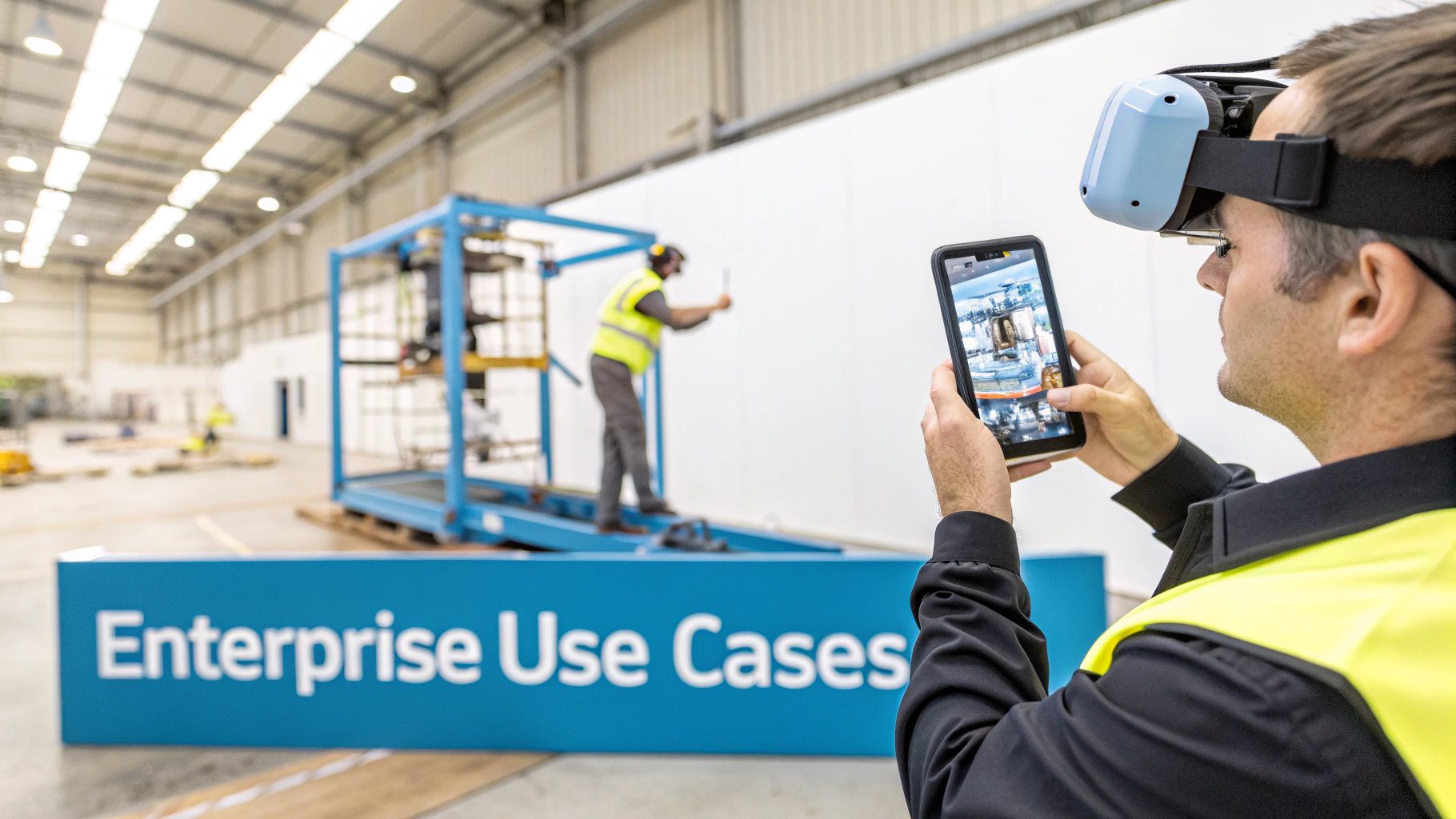
This is where theory gives way to real-world impact. Choosing between Mixed Reality and Augmented Reality is not about selecting the "better" technology; it is about matching the right tool to the specific job. Both technologies solve significant business problems, but they do so in fundamentally different ways.
Augmented Reality excels at delivering contextual, just-in-time information into a user's line of sight. Because it functions on standard smartphones and tablets, it is an excellent solution for large teams and can be deployed quickly without significant investment in specialized hardware. The primary objective is to enhance a person's view of the real world with helpful data overlays.
Mixed Reality, in contrast, is designed for hands-on interaction. By anchoring stable, interactive 3D objects in physical space, MR creates truly immersive environments for complex tasks. This makes it the preferred choice for scenarios where learning-by-doing is critical or where spatial understanding is paramount.
Augmented Reality in Action
AR is most effective when the main goal is to guide or inform someone through a real-world task. It can be thought of as a digital expert providing real-time guidance to a frontline worker.
One of the most significant applications for AR is in remote assistance. When a field technician encounters a problem with a complex machine, they can initiate a video call instead of waiting for an expert to travel to the site. The expert sees exactly what the technician sees and can draw arrows, add text, and highlight components directly on the technician's screen. These annotations "stick" to the machine, providing step-by-step guidance for the repair.
Another major application is digital work instructions. Instead of consulting paper manuals or balancing a laptop, technicians can view step-by-step instructions, safety warnings, and diagrams overlaid directly onto the equipment they are servicing. This keeps their hands free and places information where it is needed most, reducing errors. Many companies are now exploring the full spectrum of augmented reality industrial applications to achieve these productivity gains.
Mixed Reality Driving Deeper Engagement
If AR informs, MR immerses. Mixed Reality is the clear choice when a job requires more than just viewing information—it demands physical interaction with a digital replica of a complex system. It represents a leap from simple overlays to true, hands-on simulation.
A prime example is hands-on skills training. An aerospace trainee using an MR headset can see a full-scale digital twin of a jet engine in a classroom. They can walk around it, use hand gestures to disassemble it, and practice complex maintenance procedures in a completely safe and repeatable environment. This type of muscle memory cannot be developed from a 2D guide.
The core differentiator is that Mixed Reality allows a user to interact with digital content as if it were a real, physical object. This unlocks sophisticated training and collaborative scenarios where spatial understanding and manipulation are key to the task.
Collaborative design review is another area where MR is transformative. Engineering teams from different locations can meet in a shared virtual space to inspect and manipulate a 3D model of a new product. They can identify design flaws, check ergonomics, and make real-time changes to a shared digital prototype. This accelerates development cycles and avoids the expense of building multiple physical models. For many businesses, these tools are becoming part of their broader tech strategies to improve guest satisfaction by delivering better-designed products more quickly.
Comparing Industrial Application Scenarios
Selecting the right technology depends on the specific demands of the task. The table below outlines which technology is a better fit for common industrial jobs, helping to clarify the mixed reality vs augmented reality decision.
Industrial Application Scenarios: AR vs MR
| Industrial Task | Best Fit: Augmented Reality (AR) | Best Fit: Mixed Reality (MR) |
|---|---|---|
| Simple Maintenance & Repair | Ideal for checklists, schematic overlays, and remote guidance for straightforward tasks. | Best for complex repairs where a technician needs to practice on a 3D digital twin first. |
| Employee Onboarding | Excellent for guided facility tours or displaying basic operating instructions on equipment. | Unmatched for immersive training on complex machinery, allowing new hires to build hands-on skills safely. |
| Product Design & Prototyping | Useful for visualizing how a 2D design might appear in a real space, such as placing a virtual product on a shelf. | Essential for collaborative, full-scale 3D model interaction, enabling teams to refine designs in real-time. |
| Quality Assurance Inspections | Accelerates inspections by displaying digital checklists and allowing users to tag defects with annotated photos. | Allows inspectors to overlay a perfect 3D model onto a physical product to identify minute deviations. |
In summary, AR brings information to your world, while MR brings you into an interactive digital world.
Measuring Business Impact And ROI
Integrating Augmented or Mixed Reality into operations is a strategic business decision that must deliver measurable results. When weighing mixed reality vs augmented reality, the discussion must extend beyond features to focus on the tangible impact on the bottom line. The ultimate goal is to achieve a solid return on investment (ROI) by improving key performance indicators (KPIs).
These technologies are powerful tools designed to make operations more efficient, safer, and more productive. The key is to identify specific, quantifiable metrics that align with business goals before implementation. This data-first approach builds a strong business case, justifying the initial investment and proving its long-term value.
Key Performance Indicators For AR And MR
To gain executive buy-in, it is essential to focus on metrics that resonate with both operational and financial stakeholders. AR and MR solutions can drive significant improvements across several core areas of an industrial business.
- Reduce Training Time: Immersive MR simulations have been shown to decrease employee onboarding and skill development time by as much as 40%. Trainees can practice complex procedures in a safe, digital environment, building muscle memory and confidence without risking damage to expensive equipment.
- Drastically Reduce Errors: Providing digital work instructions directly in a technician's line of sight with AR can cut human error rates by over 30% on the first attempt. This increase in accuracy leads to higher quality work and a reduction in costly rework.
- Boost First-Time Fix Rates: AR-powered remote assistance is a transformative tool. It instantly connects a field technician with a seasoned expert, regardless of their location. This collaboration significantly increases first-time fix rates, eliminating the need for expensive repeat visits.
- Cut Expert Travel Costs: Remote support reduces the need to fly specialists to distant sites, a major operational expense. Companies have seen expert travel reduced by an incredible 75%, saving significant time and money while reducing their carbon footprint.
The true value of AR and MR is realized when they are applied to solve specific, high-cost problems. By targeting metrics like machine downtime or employee error rates, these technologies transition from an expense to a direct driver of profitability.
Building A Data-Driven Business Case
Connecting these KPIs to real-world scenarios makes the potential ROI tangible. For example, a manufacturing plant can use AR-based remote support to minimize machine downtime. When a critical machine fails, a local technician can use smart glasses to stream their view to an off-site expert who guides them through the repair in real time. A problem that could have taken a machine offline for days can be resolved in hours, saving thousands in lost production.
Similarly, an aerospace company might use Mixed Reality for complex assembly training. New hires can wear an MR headset to see and interact with a 3D digital twin of an aircraft part, practicing difficult assembly steps repeatedly. This dramatically shortens their onboarding time and ensures they are highly proficient before working on real hardware. To estimate the potential financial benefits for your team, you can explore different scenarios using our dedicated training ROI calculator.
The growing enterprise demand for this technology speaks for itself. The global Mixed Reality market was valued at around USD 5.03 billion in 2023 and is projected to reach USD 8.7 billion by 2025, with enterprise training and remote work leading this growth. You can explore more data in these Mixed Reality statistics and growth forecasts. This is no longer a niche interest; it is a core industrial tool. By focusing on these clear financial and operational benefits, you can effectively measure the business impact and prove the strategic value of your investment.
How To Choose The Right Solution
https://www.youtube.com/embed/_WHYJBMcE58
Selecting between Mixed Reality and Augmented Reality is not about determining which technology is superior. It is about choosing the one that best fits the job at hand. The right choice depends on a practical assessment of your goals, your work environment, and the level of interaction your team requires.
This is a strategic, not just a technical, decision. You are investing in a solution to a specific operational problem, not just acquiring new hardware. Using a clear framework helps cut through the mixed reality vs augmented reality debate and select a tool that delivers real returns.
Evaluating Your Core Requirements
Before focusing on the technology, define the problem you are trying to solve. The best approach is to ask a few simple, direct questions about the task. The answers will almost always point you in the right direction.
- What is the primary goal? Are you trying to provide quick, contextual information on the spot, or do you need to enable practice of a complex, hands-on task in a simulated environment?
- What level of interaction is needed? Does the user simply need to see information layered on their world, or do they need to physically manipulate and interact with digital 3D objects?
- What hardware is practical for your team? Can the solution run on existing smartphones and tablets, or is the task critical enough to justify investing in dedicated headsets?
Answering these questions provides a solid foundation. It ensures you select a tool that fits your workforce, rather than forcing your workforce to adapt to the tool.
Situational Recommendations: AR vs MR
Once your needs are defined, you can easily map them to the strengths of each technology. The right choice becomes clear when you consider specific, real-world situations.
Augmented Reality is the ideal choice for tasks requiring scalable, on-the-fly information overlays. Since it runs on hardware your team already possesses, it is perfect for wide-scale deployment without a massive investment.
Choose AR When You Need To:
- Provide Remote Assistance: Enable an expert to see what a field technician sees and draw instructions directly on their screen.
- Display Digital Work Instructions: Overlay step-by-step guides or safety warnings onto machinery for instant reference.
- Visualize Products in a Real Space: Show a customer how a new piece of equipment will fit on their factory floor.
On the other hand, Mixed Reality is the only choice for scenarios demanding high-fidelity simulation and deep, physical interaction. When learning by doing is essential, MR is the only technology that allows users to build muscle memory and true spatial awareness with digital objects that feel real.
Choose MR When You Need To:
- Conduct Complex, Hands-On Training: Let trainees practice assembling or maintaining an intricate digital twin of your equipment, risk-free.
- Enable Collaborative Spatial Design: Allow engineering teams to walk around and interact with a shared, full-scale 3D model in the same physical or virtual space.
- Perform Intricate Quality Control: Let an inspector overlay a perfect 3D CAD model onto a finished part to identify minute defects.
The decision boils down to this: If the goal is to inform the user within their current reality, choose AR. If the goal is to have the user interact with a new layer of reality, choose MR.
The following flowchart illustrates how both paths lead to concrete business benefits, such as reducing operational costs, enhancing workplace safety, and building a more skilled team.

This demonstrates that regardless of the technology chosen, the investment should always be tied to real-world outcomes that strengthen the business.
Aligning Solutions With Your Challenges
The market offers specialized platforms designed to solve these distinct industrial problems. Recognizing that there is no single answer in the mixed reality vs augmented reality discussion, leading providers offer tailored tools for both.
For remote support and guided work instructions where broad reach is necessary, a powerful AR solution running on standard devices is ideal. This allows a company's best experts to guide frontline technicians from anywhere, resulting in drastically lower travel costs and less machine downtime.
For deep, hands-on learning, a complete MR training platform is the solution. It provides a safe, controlled environment for teams to practice complex procedures on interactive digital twins, accelerating skill acquisition.
Market data supports this dual approach. The global AR market was valued at roughly USD 149.57 billion in 2025 and is projected to hit approximately USD 2,804.82 billion by 2034. You can read more about the growth of the augmented reality market. This explosive growth highlights the widespread adoption of AR for scalable, everyday tasks, while MR continues to prove its incredible value in more specialized, high-impact training and design scenarios. Once you understand your unique challenge, you can select the right technology to empower your people and drive real results.
Common Questions About Enterprise AR And MR
Even after the technology is understood, practical questions arise. Deciding between Augmented and Mixed Reality involves more than just technical specifications; it concerns your people, your existing systems, and your operational goals.
This section addresses the most common questions from enterprise leaders, moving beyond feature lists to discuss what it actually takes to implement these solutions successfully.
Answering these questions helps frame the mixed reality vs augmented reality discussion around solving real-world business challenges.
What’s The Deciding Factor For Employee Training?
When evaluating AR and MR for training, the decision comes down to the required level of interactivity. The right choice depends entirely on what you need your employees to do.
If the training involves providing digital work instructions, safety checklists, or overlaying reference information during a task, AR is ideal. It is an excellent tool for delivering contextual knowledge on demand and can be easily scaled using existing smartphones and tablets.
However, if employees need to physically interact with virtual objects, practice a complex repair, or build muscle memory for a difficult procedure, Mixed Reality is the only viable option. Its ability to anchor digital objects in the real world creates realistic, hands-on simulations that AR cannot replicate.
Can These Solutions Plug Into Our Existing Enterprise Systems?
Yes. Any serious enterprise-grade AR or MR platform is designed for integration. A standalone tool is a novelty; its real value comes from connecting to the systems that already run your business.
A key sign of an enterprise-ready platform is its ability to seamlessly integrate with your current software stack. This integration turns an immersive tool into a fully embedded part of your daily workflow, multiplying its value.
For instance, an AR remote assistance tool can integrate with your service management system to automatically log support calls and track resolution times. A Mixed Reality training platform can link to your Learning Management System (LMS) to track employee progress, completion rates, and proficiency scores. This connectivity creates a smooth workflow and allows you to measure the technology's impact.
What Are The Biggest Headaches When Deploying At Scale?
Transitioning from a small pilot to a full-scale deployment presents a few common challenges, particularly with Mixed Reality. Understanding these ahead of time can make the rollout across your organization much smoother.
The primary hurdles for scaling MR typically involve:
- Hardware Management: Unlike AR on phones, MR requires dedicated headsets. This introduces a fleet of devices that need to be charged, updated, managed, and assigned to users, adding a new logistical layer.
- Content Creation: Developing high-quality, interactive 3D content for MR simulations is more complex than creating 2D informational overlays for AR. It often requires specialized skills or collaboration with a provider experienced in building effective training modules.
- User Adoption: Getting a large workforce comfortable with headsets requires effort. Clear usage protocols and robust onboarding are necessary to gain buy-in. A phased rollout with a dedicated support plan is often the most effective approach to reduce friction and build momentum.
While AR is generally easier to scale due to its use of existing hardware, both technologies require a well-planned change management strategy. Working with an experienced partner who has navigated these challenges is key to a successful implementation and achieving a real return on your investment. Ultimately, the mixed reality vs augmented reality decision must include a clear plan for scalability.
At AIDAR Solutions, we specialize in guiding enterprises through these exact challenges. Whether you need the scalable remote support of AR or the immersive training power of MR, our experts help you build and deploy a solution that delivers measurable results. Find out how we can help you at https://aidarsolutions.com.

