Improving Manufacturing Processes: A Modern Guide
Improving manufacturing processes is a strategic blend of lean principles and smart technology, all aimed at one thing: maximizing output while reducing waste. This involves integrating tools like augmented reality (AR), virtual reality (VR), and data analytics to streamline operations, enhance worker training, and predict maintenance needs before they cause downtime.
The Reality of Modern Manufacturing Challenges
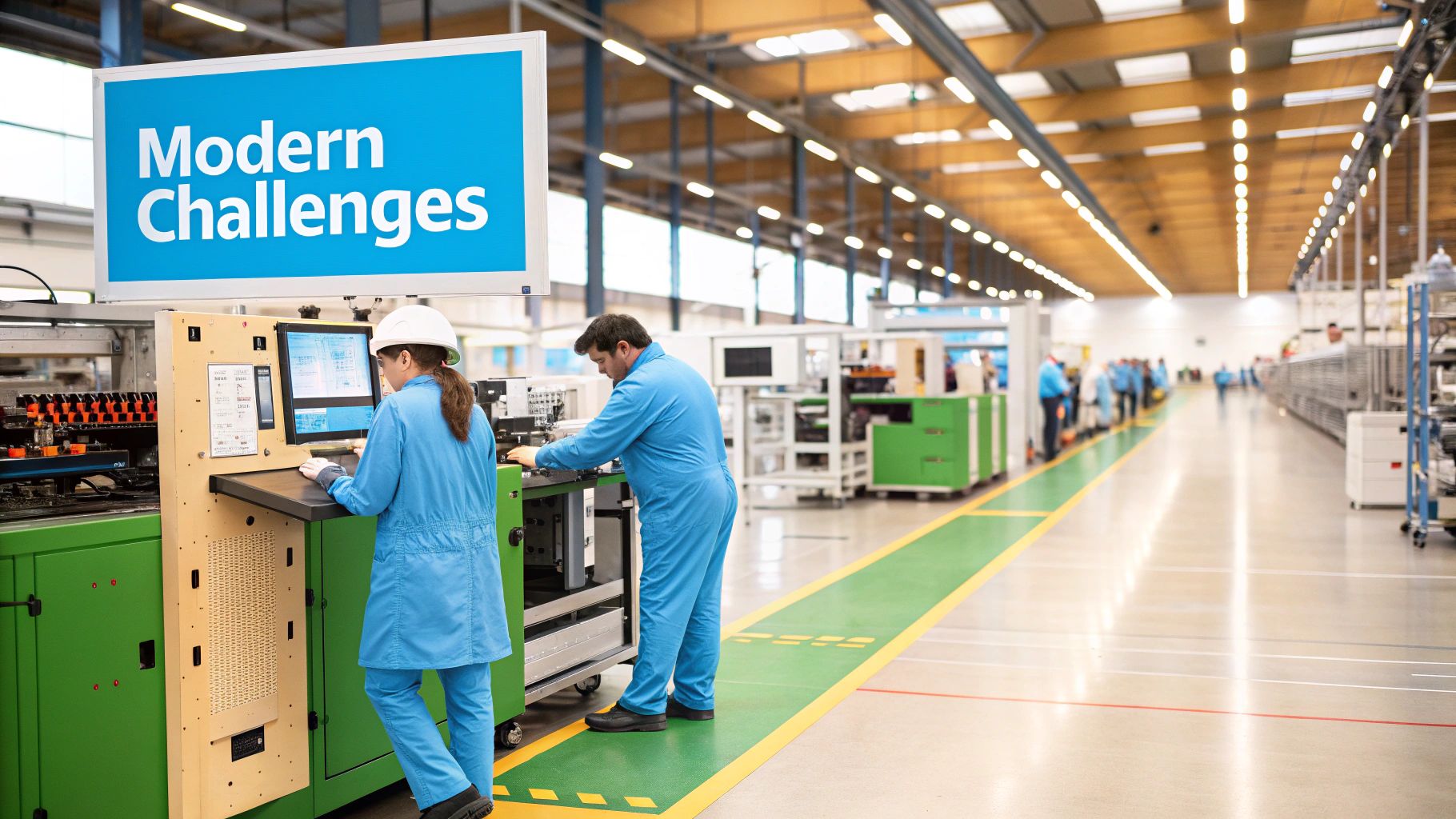
The manufacturing floor is more dynamic and demanding than ever. Producers face constant pressure from volatile supply chains that can halt production and a persistent skills gap that makes finding and retaining qualified personnel a significant challenge.
Simultaneously, customer expectations for quality and speed continue to rise. This puts immense pressure on profit margins, leaving little room for error. An operational mindset of "this is how we've always done it" has become a direct threat to competitiveness. This guide provides a clear path forward, demonstrating how improving manufacturing processes is achievable with the right strategy.
Embracing a New Operational Model
To remain competitive, companies must adopt a more resilient, intelligent production model. This is not about a single equipment upgrade but a fundamental shift in managing the entire operation, combining time-tested lean manufacturing principles with powerful digital tools.
Several key challenges are driving this evolution:
- Supply Chain Disruptions: Unexpected material shortages and delivery delays can stop a production line, resulting in significant financial losses.
- Workforce Skills Gap: As experienced personnel retire, the lack of skilled replacements creates bottlenecks and increases the risk of operational errors.
- Intense Global Competition: Fierce competition requires producing higher-quality goods faster and at a lower cost, which demands peak efficiency.
- Complex Digital Integration: Many facilities encounter technical hurdles when implementing digital transformation. For further insights, consider reviewing our guide on overcoming common digital transformation challenges.
Lasting improvement is built on a foundation of operational excellence. This foundation is then augmented with technology that empowers personnel and provides them with actionable data.
This guide will lay out practical strategies for using AR, VR, and data analytics. We will detail how these tools work in tandem to create a more efficient and agile production environment, setting the stage for sustainable growth.
Building a Strong Foundation with Lean Principles
Before implementing advanced technology, the most impactful step to improve your manufacturing processes is to establish a solid operational base. That base is lean manufacturing—a philosophy centered on maximizing value by systematically eliminating waste. It is about creating an environment where efficiency is the result of disciplined, deliberate practice.
Adopting lean principles requires moving beyond legacy workflows. It fosters a culture where every step, tool, and process is critically evaluated for its value. The goal is a clean, logical flow that reduces delays, defects, and wasted motion, which perfectly sets the stage for advanced technological optimization.
The 5S Method in Action
One of the most practical starting points is the 5S methodology. It provides a systematic approach to organizing the shop floor, creating a cleaner, safer, and more productive space. Each 'S' represents a specific action:
- Sort (Seiri): Remove all unnecessary items from the workspace. If a tool or part is not required for the immediate task, it should be tagged and relocated.
- Set in Order (Seiton): Assign a specific location for every necessary item. Arrange tools and components logically with designated, clearly labeled spots to ensure anyone can find what they need in seconds.
- Shine (Seiso): Thoroughly clean the workspace. A pristine environment helps in the early detection of maintenance issues like fluid leaks or worn parts before they escalate into major problems.
- Standardize (Seiketsu): Solidify the first three steps with clear, visual standards. This includes color-coded floor markings, shadow boards for tools, and consistent labeling to ensure organization is maintained.
- Sustain (Shitsuke): Integrate 5S into daily operations, making it a habit rather than a one-time project. This requires regular audits, ongoing training, and management commitment to embed these standards into the organizational culture.
For instance, at an assembly plant experiencing delays, technicians wasted significant time searching for tools. After implementing 5S, every critical tool was placed on a shadow board at its point of use. This simple change reduced tool retrieval time by 40%, delivering a direct efficiency boost without any new equipment investment. To explore these standards in more detail, see our guide on proven industrial best practices.
Cultivating a Kaizen Culture
While 5S organizes the physical workspace, Kaizen, or continuous improvement, organizes the team's mindset. It is the principle that small, incremental changes made consistently over time lead to significant breakthroughs in productivity and quality. A Kaizen culture transforms every employee, from a new line operator to the plant manager, into a problem-solver.
Empowering your team to identify and solve small, daily frustrations is the heart of continuous improvement. When employees feel ownership over their processes, they become your most valuable source of innovation.
Building this culture means creating effective channels for feedback and, critically, acting on it. For example, a machine operator might notice a component frequently jams due to a minor alignment issue. In a Kaizen-driven plant, that operator is encouraged to report the issue, suggest a solution (like adding a simple guide rail), and participate in its implementation.
This approach transforms the workforce from task-followers into active drivers of efficiency. The cumulative effect of these small, team-driven improvements leads to substantial reductions in waste, fewer defects, and a more engaged and motivated team. This lean foundation is the launchpad for the data-driven and immersive technologies we will explore next.
Using Data to Make Smarter Production Decisions
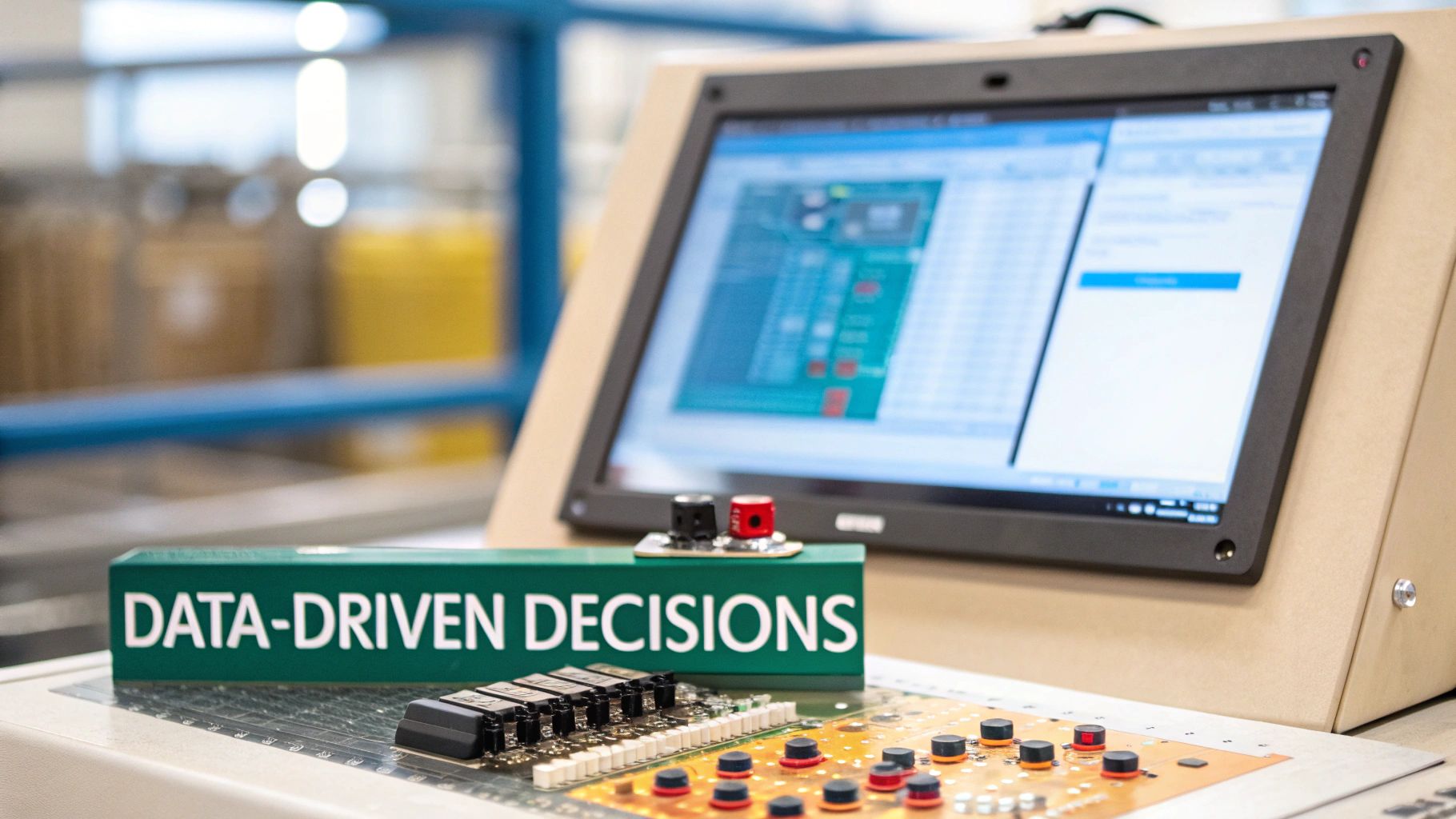
Once a lean foundation is established, the next performance leap comes from leveraging data as a strategic asset. On the modern factory floor, intuition-based decisions are no longer sufficient. Smart, data-driven decisions differentiate industry leaders from the competition.
The objective is to shift from reactive problem-solving to proactive optimization. This means capturing real-time information directly from machines and production lines to understand not just what is happening, but why. This clarity allows for the resolution of issues before they escalate into costly disruptions.
Harnessing Real-Time Machine Monitoring
The key to unlocking this operational intelligence is the Internet of Things (IoT). By embedding durable sensors on critical equipment, you can capture a continuous stream of performance data. These sensors act as the nervous system of your factory, monitoring variables like temperature, pressure, vibration patterns, and energy consumption.
This constant flow of information creates a live, digital representation of your production health. Instead of relying on manual checks or scheduled inspections, a dashboard provides real-time performance data for each machine.
For instance, a CNC machine might exhibit a minor increase in vibration that is imperceptible to a human operator. An IoT system can flag this anomaly instantly, alerting maintenance crews to a potential bearing failure long before it causes a catastrophic breakdown and unplanned downtime.
Data is the raw material of efficiency. The goal is to transform that raw data into actionable insights that prevent problems, expose hidden bottlenecks, and drive continuous improvement directly on the shop floor.
This proactive approach is the core of predictive maintenance, a strategy that uses data analysis to forecast equipment failures. By scheduling repairs based on actual machine conditions rather than a fixed calendar, you optimize maintenance resources and drastically reduce unexpected production halts.
From Data Collection to Actionable Insights
Data collection is only the first step; the true value is realized through analysis. The goal is to identify patterns, trends, and inefficiencies that are otherwise invisible. This is how you pinpoint the root causes of production bottlenecks.
Begin by focusing on key performance indicators (KPIs) that directly impact profitability. Here are three critical metrics for manufacturers:
- Overall Equipment Effectiveness (OEE): This is the industry gold standard, combining availability, performance, and quality into a single score. An OEE score below 60% indicates significant room for improvement, while world-class facilities aim for 85% or higher.
- Throughput: This metric measures the number of units produced in a specific period. Analyzing this data helps identify the slowest stages of your process, enabling resource reallocation or workflow redesign to increase output.
- Downtime: Tracking both planned and unplanned downtime is essential. Investigating the root causes of unplanned stops—whether due to equipment failure, material shortages, or changeover delays—reveals the greatest opportunities for improvement.
The adoption of smart manufacturing is accelerating for good reason. Predictive maintenance, powered by IoT sensors, can reduce equipment downtime by up to 50% and lower maintenance costs by as much as 40%. To see how data transforms industrial efficiency, it's worth exploring the benefits of analytics for manufacturers.
By turning raw data into clear, actionable intelligence, you provide your team with the tools to make smarter decisions daily. This data-first culture builds a resilient, highly efficient manufacturing operation that can adapt and thrive.
Once a solid foundation with lean principles and a data-driven culture is in place, the next step is to directly empower your people. This is where the digital world meets the physical factory floor through immersive technologies like Augmented Reality (AR) and Virtual Reality (VR).
These are no longer futuristic concepts; they are practical, operational tools delivering measurable ROI in modern factories.
Instead of requiring personnel to interpret dense manuals or 2D diagrams, AR and VR offer intuitive, contextual guidance. This fundamentally changes training, complex assembly, and maintenance, unlocking significant gains in efficiency, quality, and safety.
Enhancing Skills with Virtual Reality Training
The skills gap is one of the most significant challenges in manufacturing. Training new hires on complex, expensive, or potentially hazardous machinery is time-consuming and carries inherent risks. VR addresses this problem by creating a safe, hyper-realistic "digital twin" of the work environment.
In a VR simulation, a trainee can learn to operate a stamping press or practice a complex assembly sequence without interacting with the physical equipment. They can make mistakes, reset the simulation, and repeat the process until it becomes second nature. This hands-on practice in a zero-risk setting is invaluable.
- Accelerated Learning: Studies show that immersive learning significantly reduces training time. Participants retain information more effectively because they are actively doing, not just passively observing.
- Risk Elimination: Training on hazardous equipment, such as a robotic welder, in VR eliminates the risk of injury or damage to high-value assets.
- Cost Savings: VR training avoids the need to take production machinery offline, minimizing downtime and reducing scrap material generated during the learning process.
Consider a new technician learning a multi-step calibration procedure. In VR, they can run through the entire process multiple times, building muscle memory and confidence before ever stepping onto the production line.
Streamlining Operations with Augmented Reality Guidance
While VR excels at creating fully digital training environments, Augmented Reality enhances the real world. For daily operations, AR is transformative, particularly for complex assembly, quality checks, and maintenance tasks.
An operator wearing an AR headset can view step-by-step instructions or critical data overlaid directly onto their field of view. All necessary guidance is available instantly, without needing to look away from the task to consult a laptop or manual.
The primary benefit of AR on the factory floor is its ability to deliver the right information, to the right person, at the exact moment of need. This reduces cognitive load and dramatically minimizes the potential for human error.
Imagine an assembly technician building a custom product with numerous variations. An AR system can project a digital guide onto the physical unit, highlighting correct part placement and specifying locations for bolts and wiring. This visual guidance ensures the correct configuration is followed every time, increasing first-pass yield and eliminating costly rework. This approach is a core part of using augmented reality for training and operational support.
Practical Use Cases Driving Real ROI
The benefits of AR and VR are demonstrated by their current impact on factory floor operations.
| Application Area | How AR/VR Improves the Process | Key Benefits |
|---|---|---|
| Complex Assembly | AR overlays step-by-step visual instructions directly onto the workpiece. | Reduces assembly errors by up to 90%, increases speed, and ensures consistency. |
| Remote Expert Support | A field technician uses an AR headset to share their live view with an expert anywhere in the world. | Cuts expert travel costs by 75% and drastically reduces equipment downtime. |
| Quality Assurance | AR highlights discrepancies between a physical product and its digital CAD model. | Improves inspection speed and accuracy, catching defects that might be missed by the human eye. |
| Maintenance & Repair | VR simulations train technicians on complex repair procedures in a safe environment. | Faster skill development, improved safety, and reduced risk of damaging equipment. |
For example, a major aerospace manufacturer implemented AR to guide technicians through intricate aircraft wiring installations. The result was a 96% improvement in first-time quality and a 30% reduction in production time.
These metrics illustrate the power of empowering your team with intuitive, digital tools. This approach not only boosts productivity but also builds a more skilled, confident, and safer workforce.
Implementing AI for Proactive Quality Control
Historically, quality control in manufacturing has been a reactive process. Products were inspected at the end of the line to catch defects, leading to rework and scrap. The modern paradigm shift is toward a proactive model that prevents defects from occurring in the first place. Artificial Intelligence enables this transition, transforming quality assurance from a manual, subjective task into a precise, data-driven science.
This is not merely the adoption of a new tool; it represents a fundamental change in production philosophy. AI transcends the limitations of human inspection, enabling the identification of potential problems with unprecedented speed and precision. This also frees skilled personnel from tedious inspection tasks, allowing them to focus on high-value activities like process optimization and root cause analysis.
AI-Powered Visual Inspection
One of the most immediate applications of AI is in visual inspection. High-resolution cameras mounted over a production line, combined with machine learning algorithms, can detect microscopic defects invisible to the human eye. This includes hairline cracks in metal castings, misaligned components on a circuit board, or subtle color variations.
These AI systems are trained on vast datasets of product images, enabling them to distinguish between acceptable variations and genuine defects with high accuracy. They operate 24/7 without fatigue or distraction, applying the same rigorous standard to every unit—a level of consistency that manual inspection cannot achieve over long shifts.
As this illustrates, when you empower your team with better tools and insights from technologies like AR, VR, and AI, the result is a safer, more efficient, and more reliable production floor.
The contrast between traditional quality checks and AI-powered systems is significant.
Comparing Traditional vs AI-Powered Quality Control
| Metric | Traditional QC (Human Inspection) | AI-Powered QC (Visual Systems) |
|---|---|---|
| Approach | Reactive—finds defects after they occur. | Proactive—identifies patterns to prevent defects. |
| Speed | Slow, limited by human capacity. Bottlenecks are common. | Real-time analysis, capable of inspecting thousands of units per hour. |
| Accuracy | Subject to human error, fatigue, and inconsistency. | Extremely high, consistent accuracy. Detects microscopic flaws. |
| Data Usage | Relies on manual logs and subjective observations. | Leverages vast datasets for continuous learning and prediction. |
| Impact | Higher scrap rates and rework costs. | Significantly reduces waste and improves first-pass yield. |
This comparison highlights the transition from a manual, error-prone process to an automated, intelligent system that actively improves quality over time.
Predictive Quality Analytics
Identifying existing flaws is only one aspect of AI's capability. Its true power lies in its ability to predict problems before they occur. Machine learning algorithms can analyze real-time data from IoT sensors on equipment—monitoring variables like temperature, vibration, and pressure—to detect subtle patterns that signal an impending issue.
For example, an algorithm might notice a micro-drift in a machine’s calibration. While imperceptible to a human operator, the AI can predict that this trend will lead to out-of-spec parts within hours. It flags the issue, allowing an operator to make a quick adjustment and prevent an entire batch of defective products. This is the power of prevention.
AI's true strength in manufacturing is its ability to connect cause and effect across thousands of data points. It uncovers the hidden relationships between machine behavior and product quality, effectively transforming production data into a predictive tool.
This proactive approach is gaining widespread adoption. By 2025, AI-driven systems are expected to reduce defect rates in manufacturing by up to 30%. It is not surprising that 88% of UK manufacturers have already invested in AI or plan to do so within the next year, as noted in a recent report on emerging manufacturing industry trends.
By integrating AI into quality control, you create a self-correcting system that not only maintains standards but also continuously learns and improves. This data-first approach reduces waste, boosts throughput, and builds a more resilient and profitable operation.
Fostering a Culture of Continuous Improvement
Ultimately, the most advanced technology and data are only tools. Sustainable success in improving manufacturing processes depends on your people. New systems can be implemented, but without a culture of continuous improvement, any gains will be temporary. The goal is to create an environment where every employee feels empowered to contribute to process enhancement.
This cultural shift begins when leadership moves from simply deploying new tools to actively listening to personnel on the shop floor. The individuals operating machinery daily possess invaluable insights into operational efficiencies and potential improvements. Establishing a clear and simple channel for them to share this knowledge is the first step.
Empowering Your Team to Drive Change
For continuous improvement to become ingrained, your team must see that their suggestions are heard, valued, and acted upon. Without a straightforward system for submitting, reviewing, and implementing ideas, even the most engaged employees may become discouraged.
A practical approach is to form a small, cross-functional improvement committee. The purpose is not to create bureaucracy but to have a dedicated group that can evaluate suggestions, prioritize them based on impact, and allocate resources for pilot projects. This sends a powerful signal that employee input is taken seriously.
Beyond process optimization, it is crucial to cultivate an environment where your team can thrive and maintain momentum. You can explore strategies for sustainable team productivity that support such a culture.
True continuous improvement isn't a top-down mandate; it's a bottom-up movement. When you empower the people closest to the work to make it better, you unlock a powerful, self-sustaining engine for innovation and efficiency.
Building a Sustainable Improvement Framework
Collecting ideas is just the beginning. To sustain momentum, you need a system for tracking progress and celebrating successes. Making the entire process visible keeps engagement high and reinforces its importance. A simple, public management board—digital or physical—can be highly effective.
This board should track the lifecycle of each idea with clear statuses:
- Submitted: Every idea is formally acknowledged.
- Under Review: Shows the team that suggestions are being actively considered.
- In Progress: This stage tracks initiatives that are being tested or implemented.
- Completed: This column showcases successful changes and, crucially, quantifies the results they delivered.
Recognizing the individuals behind the ideas is as important as the improvements themselves. This can be as simple as a monthly award for the most impactful idea or a public acknowledgment in a team meeting. It demonstrates that engagement is valued, transforming process optimization from a one-off project into an integral part of daily operations.
Common Questions About Improving Manufacturing Processes
Adopting new technology often raises important questions regarding cost, potential disruption, and team adoption.
The upfront cost of AR and VR is a valid consideration, but it should be evaluated in the context of long-term return on investment (ROI). Preventing a single major equipment breakdown or significantly reducing new-hire training time can often justify the initial investment. A recommended approach is to start with a small pilot project focused on a specific, high-impact pain point. Proving the value on a smaller scale provides a clear business case for broader implementation.
Will My Team Actually Use This?
Another common question is about user adoption. How do you encourage a veteran operator to use an AR headset? The answer is to demonstrate how the technology makes their job easier.
When a technician sees that an AR tool eliminates the need to carry a cumbersome manual or wait for expert assistance on a complex repair, the benefits become clear. Key strategies for successful adoption include:
- Involve key personnel early. Allow them to participate in the selection and pilot process.
- Choose intuitive tools. Technology with a steep learning curve is less likely to be adopted.
- Frame it as a benefit. Emphasize how the technology improves safety and reduces frustration, in addition to its benefits for the company.
How Can a Smaller Business Get Started?
Many small and mid-sized businesses assume advanced manufacturing tools are beyond their reach. This is a misconception. Significant improvements can be made without a large budget.
Begin with foundational principles. Implementing a lean method like 5S to organize the workspace costs very little but can yield immediate efficiency gains and help build an improvement-focused mindset.
The most powerful improvements almost always start small. Pick one stubborn bottleneck, apply a targeted solution, measure the hell out of it, and then use that win to build momentum. It’s the smartest way to minimize risk and show real value from day one.
Ready to see how immersive tech can solve your most frustrating operational challenges? Get in touch with AIDAR Solutions today. We'll show you how our AR and VR applications can speed up training, simplify support, and drive real results on your factory floor. Find out more at https://aidarsolutions.com.