Improving manufacturing process: Lean, AR/VR, and Digital Transformation Guide
When you hear "improving the manufacturing process," it's easy to think of complex, jargon-heavy methodologies like Lean and Six Sigma. At its core, though, it’s about a straightforward goal: systematically finding and stamping out waste, cutting down on defects, and speeding everything up.
This isn't just about tweaking a few things on the line; it's a strategic move essential for staying afloat—and ahead—in a tough global market.
The Critical Need for Improving Manufacturing Process Efficiency
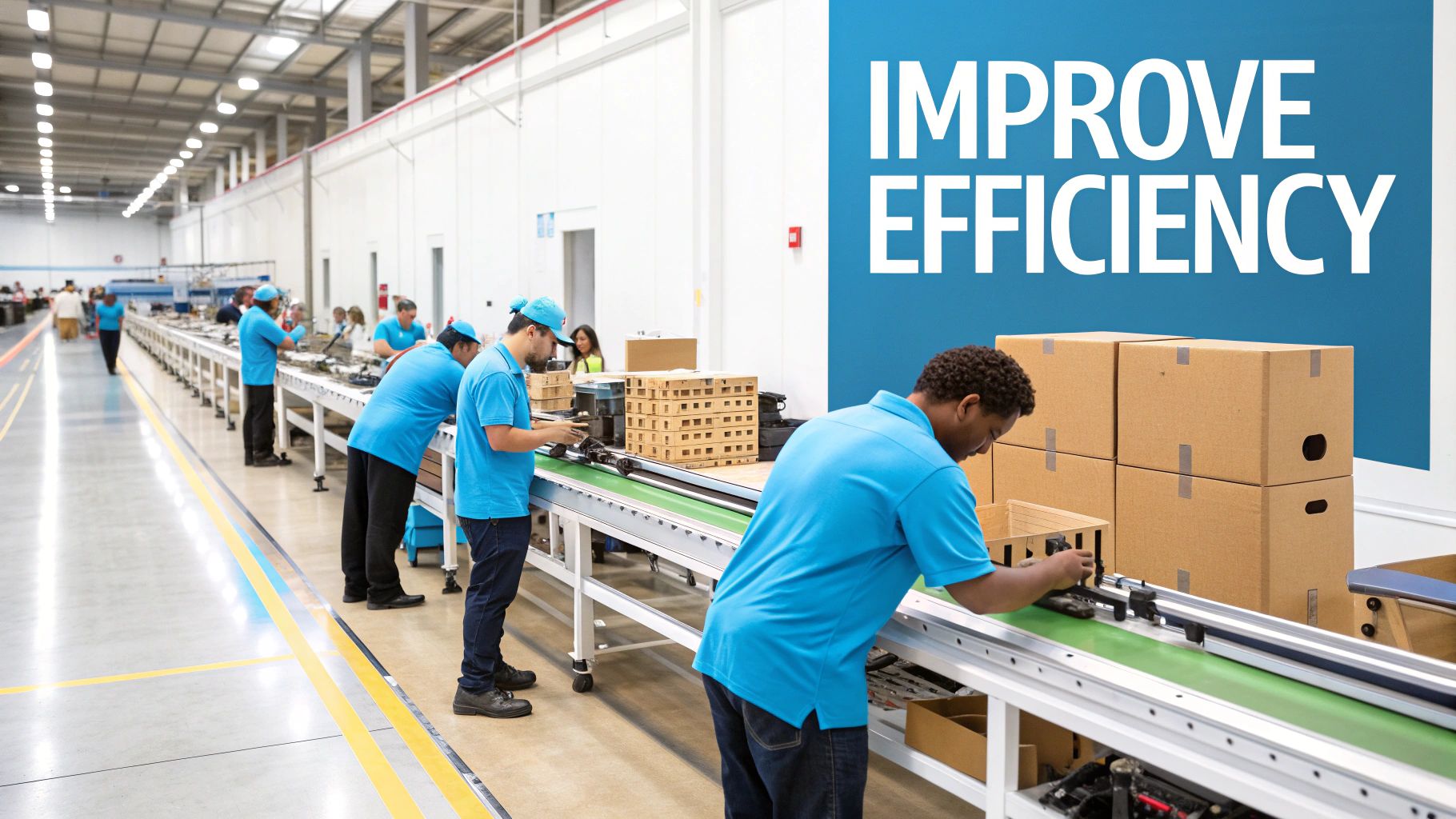
Anyone on the shop floor today feels the pressure. We’re dealing with shaky supply chains, a serious skills gap, and fierce competition from every corner of the globe. In this environment, process optimization stops being a "nice-to-have" and becomes a basic requirement for survival.
If your workflows are stuck in the past, the consequences are direct and painful: higher costs, missed delivery dates, and a drop in quality. It all eats away at your bottom line. This guide is built to give you a practical framework for getting real, tangible results, moving beyond theory to connect proven principles with modern digital tools.
Bridging Old-School Principles with New Tech
The real magic happens when you blend time-tested strategies with the right technology. This combination doesn't just solve today's problems; it builds a more resilient and agile operation for whatever comes next.
We'll be zeroing in on a few key areas:
- Finding the Real Problems: A systematic approach to uncovering the true root causes of delays, defects, and waste.
- Putting Lean to Work: Applying principles like continuous improvement (Kaizen) to methodically strip out any activity that doesn't add value.
- Bringing in Digital Tools: Using tech like Augmented and Virtual Reality (AR/VR) to supercharge training, maintenance, and support.
The smartest strategies don't make you choose between traditional methods and new technology. They weave them together, using digital tools to amplify the power of proven lean principles.
A Roadmap for Action
So, what's the plan? This guide lays out a clear, step-by-step roadmap to help you identify bottlenecks, roll out powerful solutions, and actually measure your return on investment.
To really dial in on where you can grow, you have to look at advanced process controls. For example, in additive manufacturing, something as specific as optimising metal 3D printing results with precise gas analysis can be the difference between a perfect part and a pile of scrap.
Ultimately, building a more efficient manufacturing process is about creating a culture of continuous improvement—one that’s backed by the right tools and a clear vision. This guide will give you the know-how to start that journey, connecting high-level strategy to real-world results.
Pinpointing Bottlenecks in Your Production Line
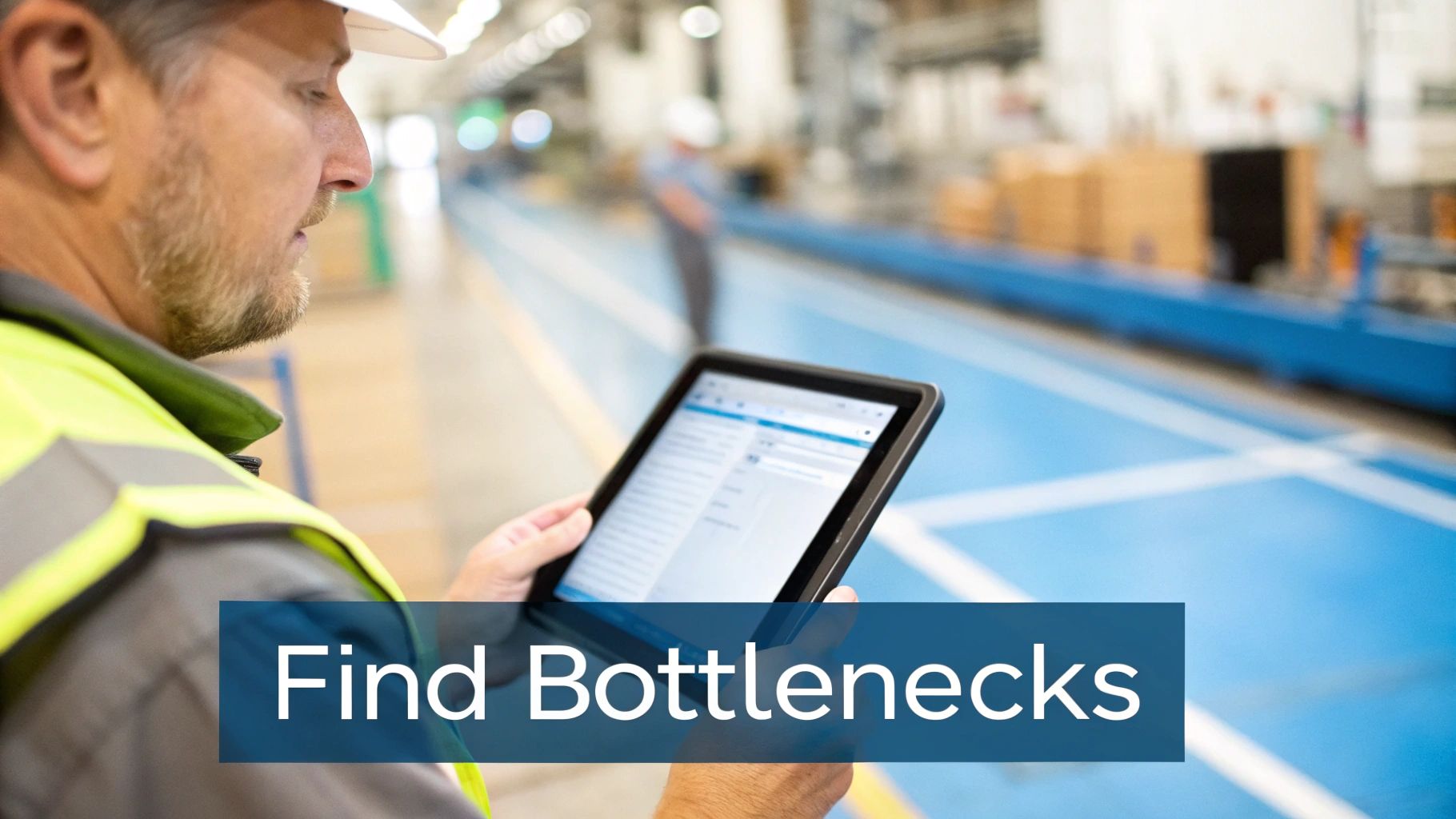
You can't fix a problem you don't fully understand. That’s the first rule of effective process improvement. Any attempt to address the symptoms without nailing down the root cause is just a recipe for wasted time, money, and frustration.
Think about a persistent delay on your assembly line. The obvious problem is that products aren't moving fast enough. But why? Is it a single, sluggish machine? An operator who needs more training? Or maybe a materials shortage that started two steps back? Finding that true bottleneck is the essential first step to improving your manufacturing process.
Digging Deeper with Root Cause Analysis
Instead of guessing, smart manufacturers rely on proven techniques to get to the heart of an issue. These structured methods give you a clear roadmap from symptom to cause, taking the ambiguity out of troubleshooting.
Two of the most practical tools in the toolbox are the 5 Whys and the Fishbone Diagram.
The 5 Whys is brilliantly simple. You start with the problem and just keep asking "Why?" until you hit the foundational issue. For example, a machine keeps failing (the problem). Asking "why" five times might reveal that the preventive maintenance schedule is completely inadequate, not just that a single part broke.
A Fishbone Diagram, sometimes called an Ishikawa diagram, helps you brainstorm and visualize all the potential causes. It organizes them into categories—like People, Process, Equipment, and Materials—making sure you've considered every angle.
The goal of root cause analysis isn't to place blame. It's to understand the system so you can make it more resilient, efficient, and reliable for everyone involved.
Using KPIs to Uncover Hidden Inefficiencies
While root cause analysis is great for investigating problems you already know about, Key Performance Indicators (KPIs) act like your plant's dashboard. They flash warning lights for issues you might not even see yet.
These metrics give you the hard data you need to spot the biggest opportunities for improvement. You can explore our complete guide on how to boost efficiency and reduce downtime in manufacturing for a deeper dive, but let's start with a few foundational KPIs.
To get a clear picture of what's happening on your floor, you need to track the right data. The table below breaks down some of the most critical KPIs for diagnosing where things are going wrong.
Key KPIs for Diagnosing Manufacturing Inefficiencies
| KPI (Key Performance Indicator) | What It Measures | Why It's Critical for Improvement |
|---|---|---|
| Overall Equipment Effectiveness (OEE) | The gold-standard metric combining Availability (uptime), Performance (speed), and Quality (good parts) into a single score. | A low OEE score (typically below 85%) is a clear signal that you're losing productivity due to machine downtime, slow cycles, or defects. It points directly to major improvement areas. |
| Cycle Time | The total time it takes to produce one complete unit, from the start of the process to the very end. | Inconsistent or long cycle times are a classic symptom of a bottleneck. It tells you exactly where your workflow is getting stuck and slowing everything down. |
| First-Pass Yield (FPY) | The percentage of products manufactured correctly the first time, without needing any rework or being scrapped. | A low FPY is a huge red flag for quality control. It means you're wasting materials, labor, and machine capacity on products that aren't right from the start. |
By consistently keeping an eye on these numbers, you can shift from constantly putting out fires to proactively making your operations better. They give you the data-driven clarity needed to focus your efforts where they'll make the biggest difference to your bottom line.
Applying Lean Principles in the Digital Age
Lean manufacturing is a powerful, time-tested philosophy built on one core idea: maximizing customer value by relentlessly eliminating waste. But the classic image of physical Kanban cards and manual process mapping doesn’t really tell the whole story today. When you merge those timeless lean principles with modern digital tools, you create a system for improving the manufacturing process that is faster, smarter, and more responsive than ever before.
This isn't about replacing the core ideas of Lean—it’s about amplifying them. Think of it like trading a paper map for a GPS. Both get you to your destination, but one gives you real-time data, instantly reroutes you around traffic, and paints a much clearer picture of the road ahead.
Supercharging Kaizen with Real-Time Data
The heart of Lean is Kaizen, or continuous improvement. It’s all about creating a culture committed to making small, incremental changes that compound over time into massive efficiency gains. Traditionally, this meant relying on observation and manual data collection. Today, digital tools give this principle a serious upgrade.
Instead of waiting for a weekly report, shop floor managers can now pull up digital dashboards that visualize production as it happens. These systems can automatically flag a machine that’s running a bit slower than its target cycle time or an assembly station that’s turning into a bottleneck.
This immediate feedback makes Kaizen far more dynamic. Teams can spot and solve problems in hours, not weeks. It fosters a culture where data-driven improvement is a daily activity, not some quarterly project.
Digital Tools for Error-Proofing
Another key Lean concept is Poka-Yoke, which translates to "mistake-proofing." The whole point is to design processes so that errors are physically impossible to make. A classic example is a USB cable that can only be plugged in one way. Well, digital technologies take this concept to a whole new level.
- Smart Tools: Connected torque wrenches can be programmed to tighten bolts to exact specifications. They can even prevent an operator from moving to the next step until the correct torque is applied.
- Vision Systems: AI-powered cameras can inspect parts for defects with a speed and accuracy that’s simply beyond human capability, automatically rejecting faulty components before they ever move down the line.
- Digital Work Instructions: Augmented Reality can overlay step-by-step instructions directly onto a piece of equipment, ensuring technicians follow the correct procedure every single time.
These tools don't just catch errors; they stop them from happening in the first place, which is the ultimate goal of Poka-Yoke. You can dig deeper into how to integrate these approaches by exploring established industrial best practices.
Lean manufacturing isn’t a rigid set of rules; it's a mindset focused on eliminating waste. Digital tools are the modern enablers of that mindset, giving you unprecedented visibility and control over your operations.
This digital-first approach also transforms maintenance from a reactive chore into a proactive strategy. Predictive maintenance, powered by IoT sensors and AI, is a perfect example of digitally-enabled waste reduction. Instead of waiting for a machine to break down (hello, unplanned downtime), you can anticipate failures before they occur. The impact is huge, with many operations cutting downtime by 50 percent and maintenance costs by 40 percent. It's no wonder that 80% of executives are allocating major budgets to smart manufacturing to get these kinds of gains.
By blending Lean’s obsession with eliminating waste with digital foresight, you build a truly resilient and efficient operation.
How AR and VR Actually Get the Job Done
While Lean principles give you a solid game plan for improving the manufacturing process, today’s technology provides the tools to execute that plan with incredible speed and accuracy. Augmented Reality (AR) and Virtual Reality (VR) have officially left the realm of science fiction. They are practical, high-impact solutions being rolled out on factory floors right now to fix stubborn, real-world problems.
These immersive tools change the very nature of how people learn and share information. We’re moving beyond dusty manuals and clunky video calls into a world of interactive, hands-on digital experiences. This shift hits two of the biggest headaches in modern manufacturing square on the nose: closing the ever-widening skills gap and crushing equipment downtime.
Let’s dig into two use cases that are complete game-changers, delivering a return on investment you can see and measure.
Immersive Training That Gets People Up to Speed Faster
Getting a new operator proficient on a complex piece of machinery is a massive drain on time, money, and resources. Traditional on-the-job training means pulling a veteran employee off their job to mentor, burning through raw materials for practice runs, and hoping nothing goes wrong—which could mean equipment damage or, even worse, an injury.
Virtual Reality training completely flips that script. It lets new hires step into a perfect digital replica—a "digital twin"—of their workstation or a specific machine.
Inside this totally safe virtual space, trainees can:
- Practice Complex Jobs: They learn multi-step assembly or maintenance routines by actually doing them. If they mess up, they just try again. No harm, no foul.
- Train for the Unexpected: VR can simulate rare and dangerous equipment failures, teaching operators how to react calmly and correctly in high-stress situations they might otherwise never see.
- Forget About Wasted Materials: Every mistake is just a learning moment, not another scrapped part for the bin. This alone drastically cuts down the cost of getting someone trained.
By separating training from the live production line, VR lets people build real muscle memory and confidence before they ever lay a hand on the actual equipment. They become productive faster, while you drive risk and waste down to near zero.
AR-Powered Remote Support to Fix Problems Instantly
When a critical machine goes down, the clock is ticking. The old way of doing things often meant flying a senior expert to the site, a delay that could stretch into days and cost thousands in travel expenses. All the while, your production line is dead in the water, creating a ripple effect of delays.
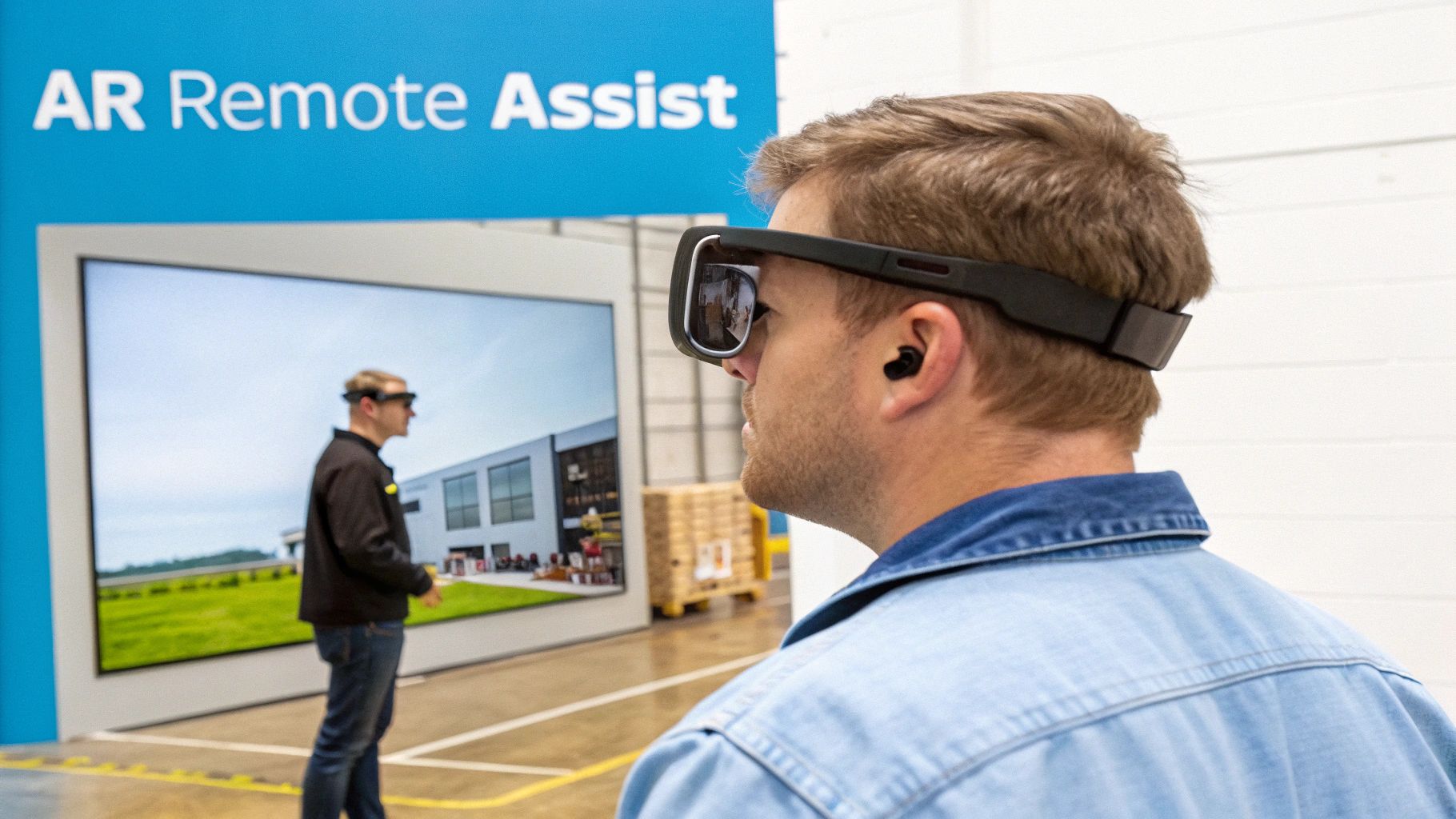
Augmented Reality offers an immediate, powerful solution. A technician on-site simply puts on a pair of smart glasses and shares their exact point-of-view with an expert who could be on the other side of the planet. But this "see-what-I-see" capability is just the start.
The remote expert can then actively guide the repair by drawing and placing digital instructions right onto the technician's view of the real world. A simple phone call becomes a fully interactive, hands-on collaboration. To get a deeper look at this, you can explore the full potential of augmented reality for manufacturing and how it transforms operations.
The Real-World Payoff of Immersive Tools
This AR-guided assistance allows the expert to give crystal-clear, step-by-step directions. They can digitally highlight the exact bolt to turn, overlay a wiring diagram, or pop up a data sheet that looks like it’s anchored to the physical machine. This completely eliminates the miscommunication and guesswork that plague audio-only support calls.
The impact on the bottom line is direct and easy to track:
- Slash Repair Times: Companies using AR for remote support regularly see their mean time to repair (MTTR) drop by 50% or more.
- Eliminate Travel Costs: The need to fly experts around the world practically vanishes, saving a fortune on flights, hotels, and expenses.
- Capture and Reuse Knowledge: Every remote session can be recorded, creating a priceless video library that shows your team exactly how to solve specific, real-world problems.
By instantly connecting your frontline workers with your best experts, AR gives your team the power to solve complex issues faster and more safely than ever before. This direct hit on uptime and efficiency makes it one of the most compelling tools for improving any manufacturing process.
Building Your Digital Transformation Roadmap
A brilliant strategy for improving the manufacturing process is useless without a solid implementation plan. Just buying new technology and hoping for the best is a surefire way to cause chaos and burn through your budget. A real digital transformation journey balances the three core pillars of any successful operation: People, Process, and Technology.
When you treat these pillars as interconnected parts of a whole, you build a foundation for change that actually sticks. It’s how you move your organization from constantly putting out fires to proactively improving, day in and day out. Let's break down how to build a practical roadmap using this framework.
The People Pillar: Your Foundation for Change
Technology doesn't drive results—people do. The human side of change is almost always the toughest part, but it's also the most critical. If your team doesn't get the "why" behind a new tool or process, adoption will grind to a halt before it ever really starts.
Getting buy-in has to start at the top, but it can’t stay there. It needs to spread through the entire organization. This means clearly communicating what’s in it for them—not just the company. Frame new tools as something that makes their jobs safer, easier, and more effective.
Next up is upskilling. With the manufacturing workforce getting older—the share of US manufacturing employees over 55 is projected to hit 25 percent—tools that get people up to speed faster are essential. VR-based simulations, for instance, can slash learning curves by up to 75 percent. This lets new hires and veteran employees alike master complex tasks in a completely risk-free environment. You can read the full productivity research from the BLS to dig deeper into these workforce trends.
The Process Pillar: Weaving in New Workflows
Once you have your people on board, the focus shifts to integrating new solutions into your daily operations without causing a massive disruption. The key here is to avoid a "big bang" rollout. Instead, kick things off with a targeted pilot program to prove the value and build momentum.
Find a single, high-impact pain point. Maybe it’s a machine with a history of downtime or a complex assembly that bottlenecks the entire line. By zeroing in on this one problem, you can score a quick, measurable win.
A successful pilot does more than just prove the technology works; it creates internal champions. When a team sees firsthand how a new tool solves their biggest headache, they become its most powerful advocates, smoothing the path for a broader rollout.
This phased approach minimizes risk and gives you room to learn and adapt as you go. Every successful pilot builds confidence and makes it that much easier to get the resources you need for the next phase. A well-structured plan is crucial here, and you can explore a complete digital transformation strategy framework to help guide your efforts.
The Technology Pillar: Choosing and Integrating the Right Tools
Finally, you need to pick the right tech and make sure it plays nicely with your existing systems. The goal isn't to chase the latest shiny object. It's to choose platforms that solve your specific operational challenges.
When you're looking at different solutions, think about a few key things:
- Integration Capabilities: Can the new platform talk to your current ERP, MES, or other enterprise systems? A tool that creates data silos will only cause more problems than it solves.
- Scalability: Pick a solution that can grow with you. It needs to work for a small pilot today and a full-scale deployment across multiple facilities tomorrow.
- User Experience (UX): The tech has to be intuitive for the people on the shop floor. A clunky, complicated interface will kill adoption, no matter how powerful the tool is.
A phased implementation plan helps manage these interconnected pillars effectively. Here's a simple framework to visualize the journey:
Phased Implementation Framework: People, Process, Technology
This table breaks down the key actions you'll need to take for each pillar as you move from initial planning to a full-scale rollout. It’s a step-by-step guide to keep your transformation on track.
| Phase | People (Actions) | Process (Actions) | Technology (Actions) |
|---|---|---|---|
| Phase 1: Discovery & Planning | Identify key stakeholders and form a cross-functional team. Communicate the "why" behind the change. | Identify a high-impact, low-risk pilot area. Map the current "as-is" process. | Evaluate potential vendors based on integration, scalability, and UX. |
| Phase 2: Pilot Program | Train a small, dedicated team on the new tool. Gather their direct feedback. | Deploy the solution in the pilot area. Measure baseline KPIs and track improvements. | Configure and test the solution in a controlled environment. |
| Phase 3: Review & Refine | Share pilot successes with the wider organization. Turn pilot users into internal champions. | Analyze pilot results. Refine the workflow based on feedback and data. | Address any technical issues or integration gaps discovered during the pilot. |
| Phase 4: Scaled Rollout | Develop a comprehensive training program for all users. Establish a support system. | Create a standardized rollout plan for other departments or facilities. | Deploy the technology across the organization in managed phases. |
| Phase 5: Continuous Improvement | Solicit ongoing feedback to drive further adoption. Recognize and reward power users. | Continuously monitor KPIs and identify new opportunities for process optimization. | Stay updated on new features and plan for future upgrades. |
By thoughtfully addressing People, Process, and Technology in this structured way, you create a comprehensive roadmap that de-risks your digital transformation. This methodical approach ensures new solutions deliver measurable results, paving the way for a more efficient, resilient, and competitive manufacturing operation.
Measuring Success and Proving ROI
Bringing new technology onto the factory floor isn't just about making things run smoother; it's about delivering a clear, undeniable return on investment (ROI). At the end of the day, every initiative aimed at improving the manufacturing process has to answer one critical question from stakeholders: was it worth it?
This is where you connect the dots. You have to translate the operational KPIs we've been talking about—like OEE and cycle time—into tangible financial results. A powerful business case shows exactly how process improvements speak the language of finance.
Think about it this way: using AR remote assistance to slash machine downtime isn't just an operational win. It directly translates to more production capacity, which means more units shipped out the door and higher revenue. The trick is to draw a straight, easy-to-follow line from the improvement on the shop floor straight to the company's bottom line.
Connecting Operational KPIs to Financial Gains
To really prove the value of these changes, you need to show how specific improvements are hitting key financial metrics. It’s a simple cause-and-effect relationship: operational efficiency is the cause, and a healthier bottom line is the effect.
Here are a few real-world examples of how this plays out:
- Reduced Downtime: Every hour of uptime you claw back is an hour of production you've restored. Just calculate the value of that output, and you've got a hard number quantifying the financial gain from faster repairs.
- Lower Travel Costs: This one is easy. Add up all the flights, hotels, and per diems you’ve saved by not having to fly an expert out for every service call. It's a direct, hard-dollar saving that’s impossible to argue with.
- Increased First-Pass Yield: When you have fewer defects, you’re spending less on wasted materials, rework labor, and scrap costs. This directly fattens the profit margin on every single unit you produce.
A successful ROI calculation doesn’t just focus on saving a few bucks here and there. It highlights how process improvements act as a strategic driver of productivity, profitability, and long-term, sustainable growth.
The infographic below lays out a simple but effective roadmap for getting these results, breaking the journey down into three essential pillars.
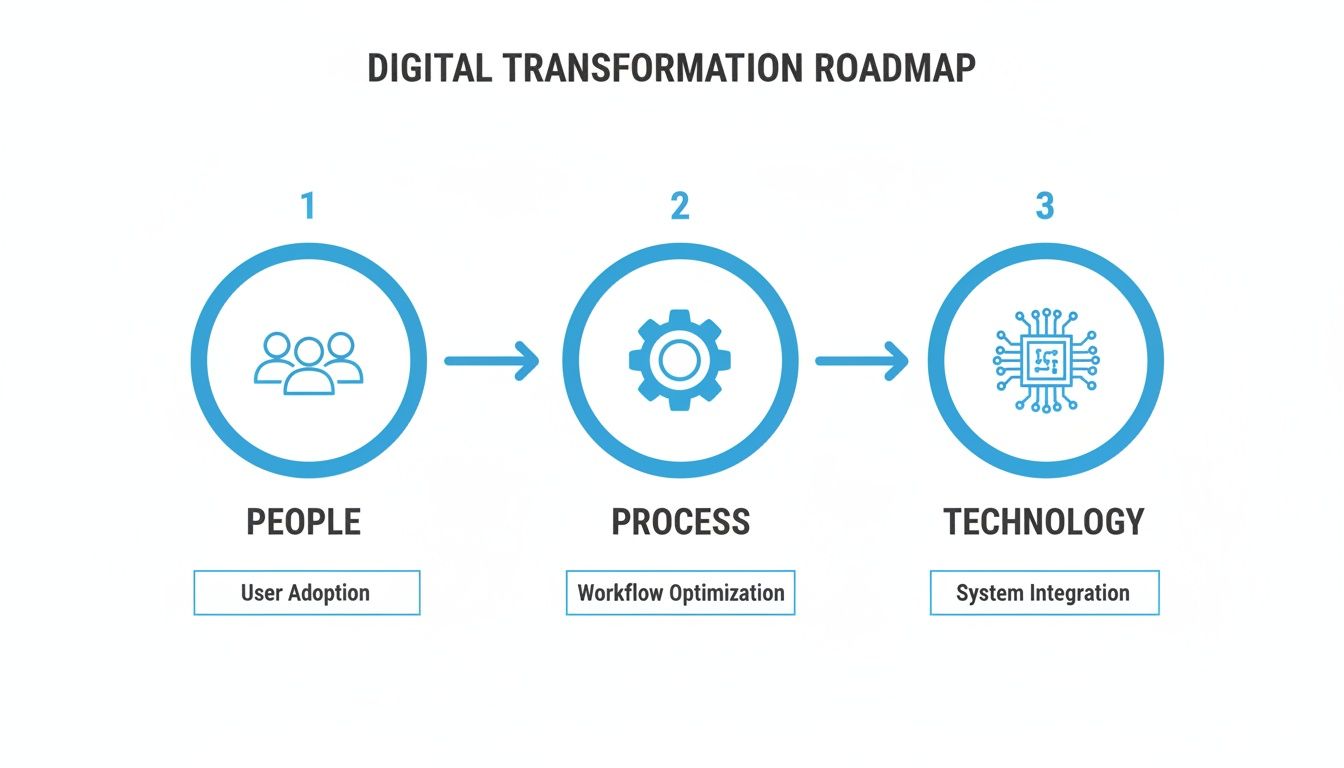
This roadmap gives you a clear visual of how focusing on people, process, and technology—in a structured, intentional way—leads directly to measurable success and a solid ROI.
Benchmarking Against Industry Results
The good news is, you don’t have to build your business case in a vacuum. There are plenty of proven industry results out there that provide powerful benchmarks.
Take AI adoption in manufacturing, for example. It's absolutely surging, with over 60 percent of companies already using it in some capacity. The data shows AI can boost throughput by up to 15 percent and slice downtime by 20 percent, with a whopping 74 percent of adopters seeing ROI within two years.
Solutions like AIDAR.SERVICE are living proof of this, cutting service times in half and reducing expert travel by 75 percent through remote AR guidance.
To get a real handle on the impact of your own improvements and build a rock-solid case, it's crucial to start unlocking key performance insights from your operational data.
When you can tie every process improvement back to a measurable financial outcome and stack it up against proven successes in the industry, you can clearly and confidently show that investing in this technology isn't a cost—it's a fundamental driver of your company's future growth.
Got Questions? We've Got Answers
Stepping into new technology always comes with a few questions. When you're looking at something that can fundamentally change how your teams work, it's smart to ask about the practicalities, the costs, and the human side of adoption. Let's tackle some of the most common ones we hear from manufacturers.
How Can We Test This Out Without a Huge Upfront Investment?
The best way to get started is to think small and targeted. Don't try to boil the ocean. Instead, pick one specific, high-impact problem on your floor.
Maybe it's that one machine that causes constant downtime, or a tricky assembly process that's a known bottleneck. By running a focused pilot program on that single use case, you can prove the value with minimal risk and cost.
A successful pilot gives you a clear, undeniable return on investment. That makes getting the budget and buy-in for a broader rollout much, much easier. Plus, modern Software-as-a-Service (SaaS) models mean you can get started without a massive capital expense, proving the tech’s worth before you commit big.
Will Our Current Workforce Actually Be Able to Use This Stuff?
One hundred percent, yes. Modern industrial AR and VR tools are built for the people who will actually be using them on the factory floor. The interfaces are intuitive—if you can use a smartphone, you can use these tools.
The real key to making it stick is smart change management. It’s not just about handing someone a headset and walking away.
It boils down to a few simple things:
- Show them the "why." Clearly explain how the new tools will make their jobs safer, less frustrating, and more efficient.
- Give them hands-on time. Let them learn in a supportive, low-pressure environment where it’s okay to ask questions.
- Find your champions. Identify the tech-savvy folks on your team and empower them to become mentors for their colleagues.
This technology is all about empowering your workers, not replacing them. It's about giving your team better, smarter tools to get the job done right.
How Is AR Remote Support Any Different from a Regular Video Call?
It's the difference between describing a problem and actually being there to solve it together. A video call is passive—you're just watching. AR remote support is fully interactive and collaborative.
Think about it this way: with a video call, an off-site expert can only listen to a description or watch a shaky phone camera. With AR, that expert sees exactly what the on-site technician sees through their smart glasses or mobile device.
From there, the expert can digitally draw on the real world. They can circle the right valve, place 3D arrows on specific components, or overlay a schematic directly onto the machine. This “see-what-I-see” superpower cuts through the confusion, dramatically slashing errors and the time it takes to get a machine back online. It’s not even in the same league as a standard video conference.
Ready to see how immersive tech can drive real, measurable results for your operation? AIDAR Solutions builds AR and VR applications that cut training times, crush downtime, and deliver a clear ROI. Explore our solutions and see what's possible.