AR in Construction: The Definitive Guide to Building Smarter
Augmented reality in the context of a construction site is a technology that layers digital information—like 3D models and project data—directly over the physical job site. It gives field teams an interactive, real-time blueprint, letting them visualize finished work, spot clashes before they happen, and improve project accuracy. It’s the bridge between the design plans on a screen and the actual work happening on the ground.
How AR Is Redefining the Modern Job Site
The construction industry has always wrestled with challenges that impact profits and stretch timelines, such as costly rework, communication breakdowns between the office and the field, and unforeseen clashes on site. These issues often trace back to one fundamental problem—the difficulty of translating complex 2D or 3D plans into physical reality.
Augmented reality addresses this problem directly. By viewing the site through a tablet or smart glasses, a project manager can walk through an empty structure and see the precise placement of HVAC ducts, plumbing runs, and electrical conduits overlaid in full scale. This immediate context eliminates guesswork.
From Blueprint to Reality
Being able to see digital models in their real-world location is a massive leap forward. It turns an abstract Building Information Model (BIM) into a practical, hands-on tool that crews can use right on the site. Instead of relying solely on tape measures and drawings, they can visually check their work against the design intent as it happens.
This empowers teams to catch mistakes early, long before they escalate into expensive fixes. The technology acts as an intuitive guide, making complicated installation steps clearer and ensuring every component aligns perfectly with the digital plan.
Tackling Costly Industry Challenges
The financial impact of on-site errors is significant. The global Architecture, Engineering, and Construction (AEC) industry is projected to reach $16.3 trillion by 2025, and rework remains a major drain on that figure. In the U.S. alone, the construction sector loses over $65 billion every year to rework caused by design flaws and miscommunication—exactly the kinds of problems better visualization can solve.
By giving teams an accurate, real-time visual reference, AR becomes a powerful quality control tool. It helps prevent the very errors that lead to these staggering rework costs, making projects more efficient and profitable.
AR is a practical solution being used on job sites today to solve these long-standing problems. It drives better collaboration, improves safety, and ultimately protects the bottom line by ensuring the job gets done right the first time.
Practical Applications Driving On-Site Efficiency
Moving beyond theory, the real value of AR in construction is its practical impact on the ground. This technology provides crews with functional tools to solve the persistent problems that affect every project, boosting productivity and delivering better outcomes.
By layering digital blueprints directly over the physical job site, AR forges a powerful link between the design intent and the on-site reality. This connection empowers teams to stop guessing and start making informed decisions on the fly, transforming complex drawings into an intuitive, real-world guide.
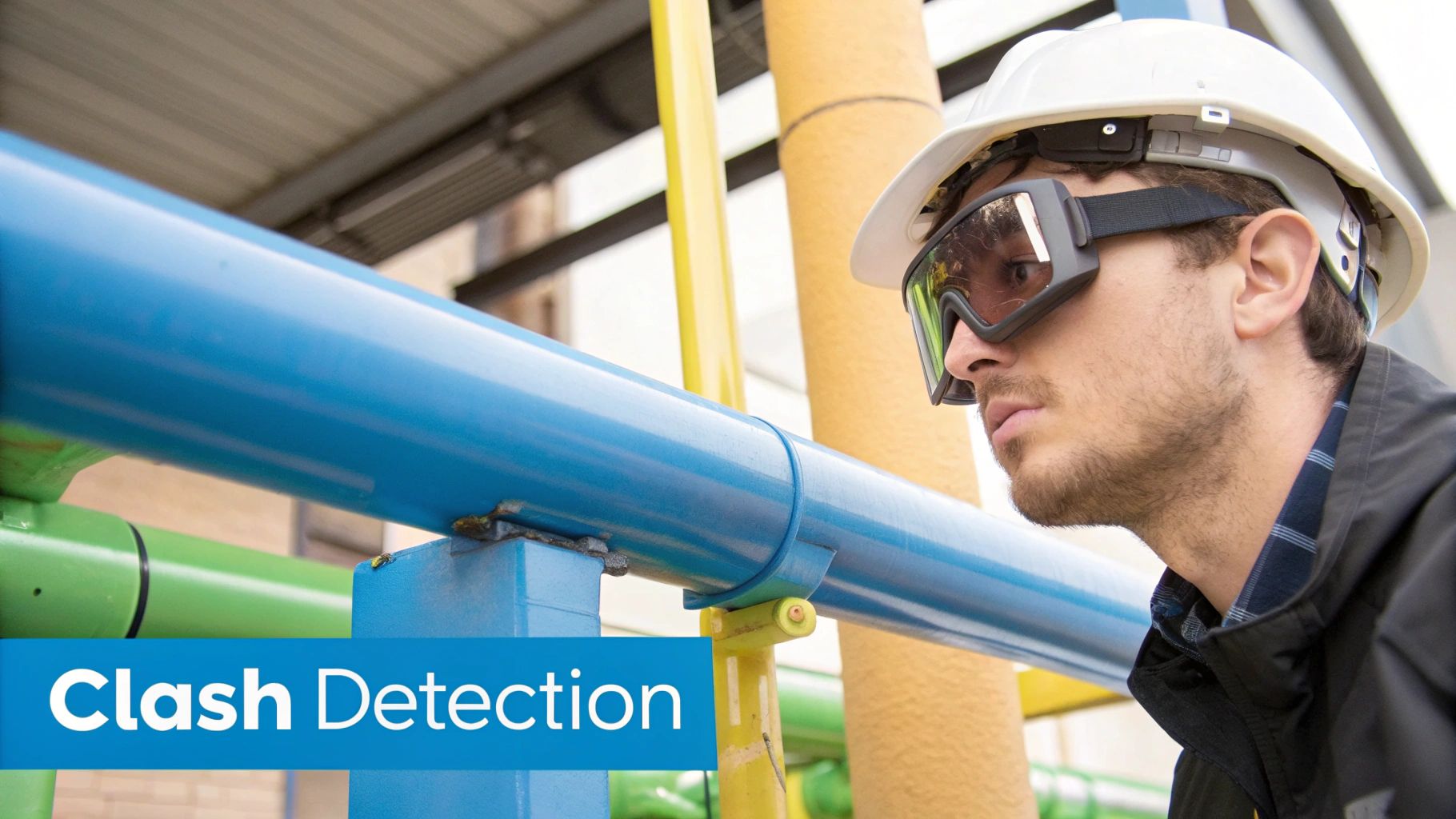
Proactive Clash Detection
One of the biggest challenges in construction is clash detection. Traditionally, a conflict between an HVAC duct and a plumbing line might not be discovered until installation is underway, resulting in costly rework and frustrating delays.
AR changes this process entirely. A foreman can walk the site, look through a tablet or smart glasses, and see a full-scale 3D model of all the MEP systems overlaid on the physical space. They can visualize how ductwork will navigate around steel beams or where electrical conduits will run. This means spotting conflicts weeks, or even months, before materials are ordered.
By identifying clashes in the virtual space before they manifest physically, construction firms can reduce rework by an average of 5-12%. This prevents budget overruns and keeps the project on schedule.
This "x-ray vision" for projects turns quality assurance from a reactive problem into a proactive strategy.
Streamlined Project Management
For project managers, AR is a game-changer for tracking progress and ensuring alignment. By comparing the live view of the job site with the BIM model, a manager can instantly confirm that work is being done to spec. The comparison is immediate and visual, eliminating the need to cross-reference drawings with physical installations.
This capability allows for quick verification of rebar placement before a concrete pour or confirmation that wall framing perfectly matches the architectural plans. This creates a detailed, visual record of construction, which is invaluable for quality control and for demonstrating progress to stakeholders.
AR also makes walkthroughs highly effective, especially for clients who are not on-site. Instead of trying to decipher complex schematics, they can see a realistic visualization of the finished space. This clarifies communication, facilitates clearer feedback, and speeds up approvals. The value of AR industrial applications like this ripple across the entire project.
To see how these use cases translate into direct on-site benefits, here's a quick breakdown:
AR Applications and Their On-Site Impact
This table outlines the key AR use cases in construction and the specific, tangible benefits each one delivers to project teams and stakeholders.
| AR Application | Primary Function | Key Benefit |
|---|---|---|
| Clash Detection | Overlaying MEP and structural models to spot conflicts | Prevents rework, reduces material waste, and avoids schedule delays. |
| Progress Tracking | Comparing as-built conditions with the digital design | Improves quality control, creates an accurate project record, and streamlines reporting. |
| Safety Visualization | Highlighting hidden hazards like underground utilities | Reduces the risk of dangerous utility strikes and enhances situational awareness. |
| Remote Support | Connecting on-site teams with off-site experts | Solves complex issues faster, minimizes downtime, and cuts travel costs. |
Ultimately, each application empowers crews with the information they need, precisely when and where they need it, leading to a smarter and more efficient job site.
Enhanced Worker Safety
Safety is paramount, and AR introduces powerful new ways to protect crews. Before excavation begins, workers can use an AR device to see the exact location of underground utilities—gas lines, water mains, and electrical cables. This visualization dramatically lowers the risk of a dangerous and expensive utility strike.
AR can also transform how teams engage with safety protocols. It provides real-time access to critical information, such as Job Safety Analyses (JSAs) and Safe Work Method Statements (SWMS), by displaying key steps or warnings directly in their field of view.
This technology is also a significant asset for training. A new hire can learn to operate heavy machinery in a safe, simulated environment or practice a high-risk task without any real-world danger. It’s hands-on, contextual learning that improves retention and safety.
Real-Time Remote Expertise
Complex issues on-site often require an off-site expert, leading to project delays. AR remote assistance eliminates this problem.
An on-site technician wearing smart glasses can share their live, first-person view with an engineer or specialist anywhere in the world. The expert sees exactly what the technician sees and can guide them through a solution step-by-step. They can add digital annotations that appear in the technician's view, highlighting a specific component or sharing a schematic. This "see-what-I-see" support can resolve issues in minutes that might otherwise take days.
Calculating the Real ROI of Adopting AR
While augmented reality is innovative, its business value comes down to the bottom line. The real value of AR in construction is its direct, measurable impact on profitability. This is not about adding another gadget; it's a strategic investment that addresses key financial drains in project budgets.
The business case for AR is built on its power to solve some of the industry's most expensive and persistent problems. It directly tackles the root causes of budget overruns and schedule delays, turning an expense into a powerful engine for savings and efficiency. The return on investment becomes clear upon examining the numbers.
Slashing Rework Costs
Rework is a major factor in project profitability, often resulting from misinterpreting 2D drawings, late-stage clash detection, or human error. Augmented reality addresses this by making clash detection a proactive, on-site activity rather than a reactive, costly fix.
A supervisor using a tablet can overlay a full-scale 3D BIM model onto the physical site. This allows them to see a potential conflict between planned ductwork and structural steel weeks before installation begins. This virtual inspection catches the exact errors that lead to cutting, refabricating, and reinstalling materials—and the associated wasted labor.
This is where AR delivers its most immediate and powerful ROI. Industry leaders have already demonstrated its effectiveness, with some firms reducing project times by up to 40% through AR-BIM integration, directly combating the costly rework problem.
Accelerating Project Schedules
Time is money in construction. Every day saved on a project schedule contributes directly to the bottom line by lowering overhead and freeing up resources. AR compresses timelines by improving communication and enabling faster, more accurate decisions in the field.
Instead of waiting for an engineer to travel to the site, an on-site technician can initiate an AR remote support call. The "see-what-I-see" view gives the expert immediate context, reducing days of downtime to a problem solved in minutes.
By removing the guesswork from complex tasks and giving crews clear, visual instructions, AR can cut the time needed for installations by up to 25%. This acceleration helps deliver projects on time or even ahead of schedule, avoiding costly late-delivery penalties.
Boosting Crew Productivity
Productivity on a construction site can be hindered by the time crews spend deciphering complex 2D blueprints. An AR device changes this dynamic, transforming flat drawings into intuitive, 3D guides that are easily understood in a real-world context.
This visual guidance streamlines various workflows, from assembly and installation to final quality checks. A worker can see precisely where to drill a hole, how to assemble a prefabricated module, or verify that rebar placement matches engineering specs. This clarity reduces mental strain and empowers crews to work more confidently and efficiently.
To truly grasp the financial upside, you need to analyze the numbers for your own operations. For a deeper look, check out our guide on how to calculate return on investment for new technology. It will help you quantify the savings from reduced labor hours and improved accuracy.
Unlocking Significant Savings
The financial benefits of AR extend beyond rework and productivity, creating a ripple effect of savings across the entire project lifecycle.
Consider these additional areas where AR drives real value:
- Reduced Material Waste: When installations are done correctly the first time, you minimize scrap and avoid costly reorders.
- Lower Travel Costs: Remote assistance and virtual site walkthroughs dramatically reduce the need for experts and stakeholders to travel to the job site.
- Improved Safety Outcomes: Visualizing underground utilities before digging prevents dangerous—and expensive—utility strikes, avoiding the financial fallout from safety incidents and project shutdowns.
Ultimately, implementing AR in your projects is a calculated business decision that directly boosts efficiency, protects your schedule, and drives higher profit margins.
Your Step-by-Step AR Implementation Roadmap
Bringing augmented reality onto a job site may seem like a large undertaking, but a structured, step-by-step approach can ensure a smooth transition. A practical roadmap eliminates guesswork and ensures your investment in AR in construction starts solving real problems and delivering value from day one.
A solid AR strategy creates a powerful feedback loop where each gain contributes to the next.
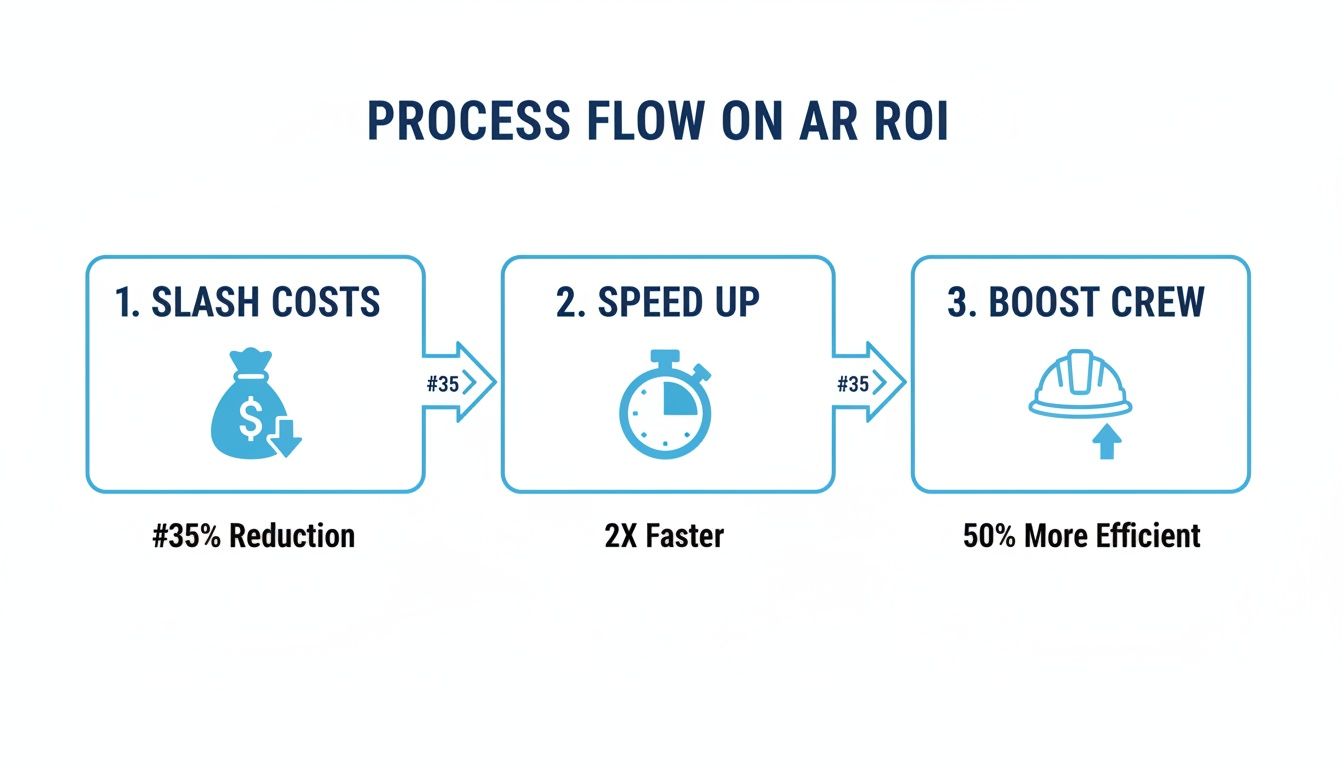
The process is designed to reduce costs and shorten timelines, which in turn frees up crews to be more productive and effective.
1. Define Your Core Objectives
Before considering hardware or software, identify your most significant on-site challenges. Is it constant rework due to MEP system clashes? Are tedious quality assurance checks impacting the schedule?
Pinpoint one or two high-impact problems where enhanced visual information would make a tangible difference. This approach is about deploying a targeted solution, not just adopting new technology.
This focus helps you set clear, measurable goals. For example, you might aim to reduce MEP-related change orders by 15% or cut inspection times by 20%. Having specific targets makes it easier to measure success.
2. Choose the Right Technology
Once you know your objectives, you can select the appropriate technology. Your AR tech stack consists of two main components: the hardware your team uses and the software that powers it.
Hardware Selection:
- Tablets and Smartphones: These are the easiest entry point. They are perfect for straightforward tasks like model viewing, progress checks, and quick quality inspections where hands-free operation is not critical.
- Smart Glasses (e.g., HoloLens, RealWear): For more involved, interactive work like guided installations or remote expert assistance, hands-free devices are essential. They allow crews to keep their hands on their tools while a digital overlay guides their work.
Software Integration:
Your AR software must be compatible with your existing design tools. Look for platforms that easily handle standard BIM files from programs like Autodesk Revit or Navisworks. A seamless data pipeline from the design office to the field is critical for a successful augmented reality workflow.
The goal is to find a solution that feels like a natural extension of your team’s toolkit, not another complicated process they have to learn.
3. Launch a Focused Pilot Project
Avoid a company-wide rollout from the start. Instead, begin with a focused pilot project.
Select a single, well-defined project—or even a specific phase of a larger job—to test your new AR tools and processes. This provides a controlled environment to prove the technology's value and identify any issues.
A successful pilot does more than validate the technology; it creates powerful internal case studies and helps you identify team members who can become AR champions. These early adopters are your best asset for driving wider adoption later.
Gather hard data during the pilot. Document time saved on inspections, errors caught before they became costly rework, and any noticeable productivity gains. This evidence will build the business case for expanding the program.
4. Scale for Widespread Success
With a successful pilot completed, you can plan a broader rollout. This stage focuses more on people and processes than on technology. An effective scaling strategy requires a solid change management plan.
Your scaling strategy should address three key points:
- Develop New Workflows: Create and document clear, standard operating procedures. Define how and when teams should use AR for clash detection or quality checks.
- Comprehensive Team Training: Provide hands-on training for everyone, from project managers to field crews. Ensure they understand not just how to use the technology, but why it makes their jobs easier and improves the project.
- Build an Internal Support System: Empower the AR champions from your pilot as internal experts. These "super-users" can handle day-to-day questions from their peers and help maintain momentum.
Scaling is a gradual process of integrating AR into your company's standard operations until it becomes an indispensable part of how you build.
The Future of Construction Is Immersive
Beyond the immediate benefits, augmented reality is laying the groundwork for a larger industry shift. It is evolving from a visualization tool into the connective tissue for the intelligent job sites of tomorrow. The true power of AR in construction is realized when it integrates with other critical innovations.
This convergence is already beginning. When AR is combined with technologies like the Internet of Things (IoT) and Artificial Intelligence (AI), the job site transforms into a data-rich environment. This leads to the digital twin—a dynamic virtual copy of a physical asset, kept perfectly in sync with the real world through a constant stream of sensor data.
The Rise of the Intelligent Job Site
Imagine a project manager walking the site with an AR headset. They see not only the BIM overlay but also live performance data from heavy machinery, concrete curing temperatures from embedded IoT sensors, and AI-driven alerts about potential equipment failures before they occur. This is the future AR is building—one based on predictive maintenance and proactive decisions, not reactive fixes.
This level of integration shifts the job site from a place of reaction to one of prediction, allowing problems to be identified and solved before they can derail schedules or budgets.
The ultimate goal is a fully connected work environment where digital information and physical reality are one and the same. This gives us a level of oversight, analysis, and control that was pure science fiction a decade ago, making everything we do safer and more efficient.
Your Competitive Edge in a New Era
In this new reality, adopting AR is a strategic imperative. The firms that embrace it today are not just solving immediate problems like rework and safety incidents. They are building the workflows and institutional knowledge to lead in a more connected and data-driven future.
- Enhanced Productivity: Teams will work faster and with fewer mistakes when guided by live data and intelligent insights in their field of view.
- Proactive Safety: Predictive alerts and real-time hazard visualization will create a fundamentally safer environment for everyone on site.
- A Clear Market Advantage: Mastering immersive technology will become a significant differentiator, helping you attract top talent and win more complex projects.
Getting started with augmented reality is more than a technology purchase. It’s a commitment to building a more efficient, sustainable, and profitable future—a future where every decision is informed, every action is precise, and every project is built for success from day one.
Common Questions About AR in Construction
As teams explore the benefits of AR in construction, practical questions naturally arise. Answering these questions is the first step toward moving from curiosity to creating a solid implementation plan.
Modern AR is designed to integrate into existing workflows, not disrupt them. The goal is to create a seamless link between digital models and the teams on the ground.
What Hardware Do We Need for AR On a Construction Site?
The required hardware depends on the specific tasks. A large budget is not necessary to get started. Most teams can begin with the devices they already have—smartphones and tablets. They're ideal for quick model reviews, progress checks, and simple QA/QC tasks.
For more involved work requiring hands-free operation, specialized AR smart glasses like the HoloLens or RealWear are suitable. These devices allow installers and technicians to see digital overlays while they work, which is invaluable for complex assemblies or remote expert assistance.
How Does AR Integrate With Our Current BIM Software?
A quality AR platform must be compatible with your existing BIM ecosystem. These platforms are built to support standard file formats like IFC and RVT from major software providers like Autodesk Revit, Navisworks, or Tekla.
The process is straightforward. You export your coordinated BIM model and load it into the AR software. On-site, your crew can then view the model at a true 1:1 scale, layered directly onto the physical job site. This creates an accurate link between the design intent and the reality of construction.
The whole point of AR is to be a bridge, not a roadblock. It works with your existing BIM data so you don't have to change your design process—you just give it a massive boost out in the field.
To get a better sense of AR's flexibility, it helps to see how augmented reality can be applied in design for things like landscape projects, which really shows its range.
Is AR Technology Difficult for Field Crews to Learn?
A common misconception is that AR is too complex for field use. In reality, today’s AR tools are designed with a strong focus on user-friendliness. The interfaces are intuitive because developers know that ease of use is critical for adoption.
Tablet-based applications are as easy to use as a smartphone, offering a natural point-and-view experience that requires minimal training.
While a headset might require a brief hands-on session, users quickly understand its value. The convenience of hands-free operation combined with real-time instructions is so practical that field crews often become the technology's biggest advocates.
Ready to see how immersive technology can transform your operations? AIDAR Solutions provides tailored AR and VR applications that slash training times, reduce rework, and empower your teams with the tools they need to succeed. Discover your ROI at https://aidarsolutions.com.