
The Real Difference AR and VR Make in Business
At its core, the difference between AR and VR is refreshingly simple. Augmented Reality (AR) overlays digital information onto your real-world view, while Virtual Reality (VR) replaces the real world entirely to immerse you in a simulated one.
Think of it this way: AR enhances reality, but VR replaces it.
Distinguishing AR and VR for Business Operations
While both fall under the broader umbrella of Extended Reality (you can explore more in our guide on what XR technology is), AR and VR solve fundamentally different business problems. Choosing the right one is a strategic decision based on how your team needs to interact with digital information and the physical world.
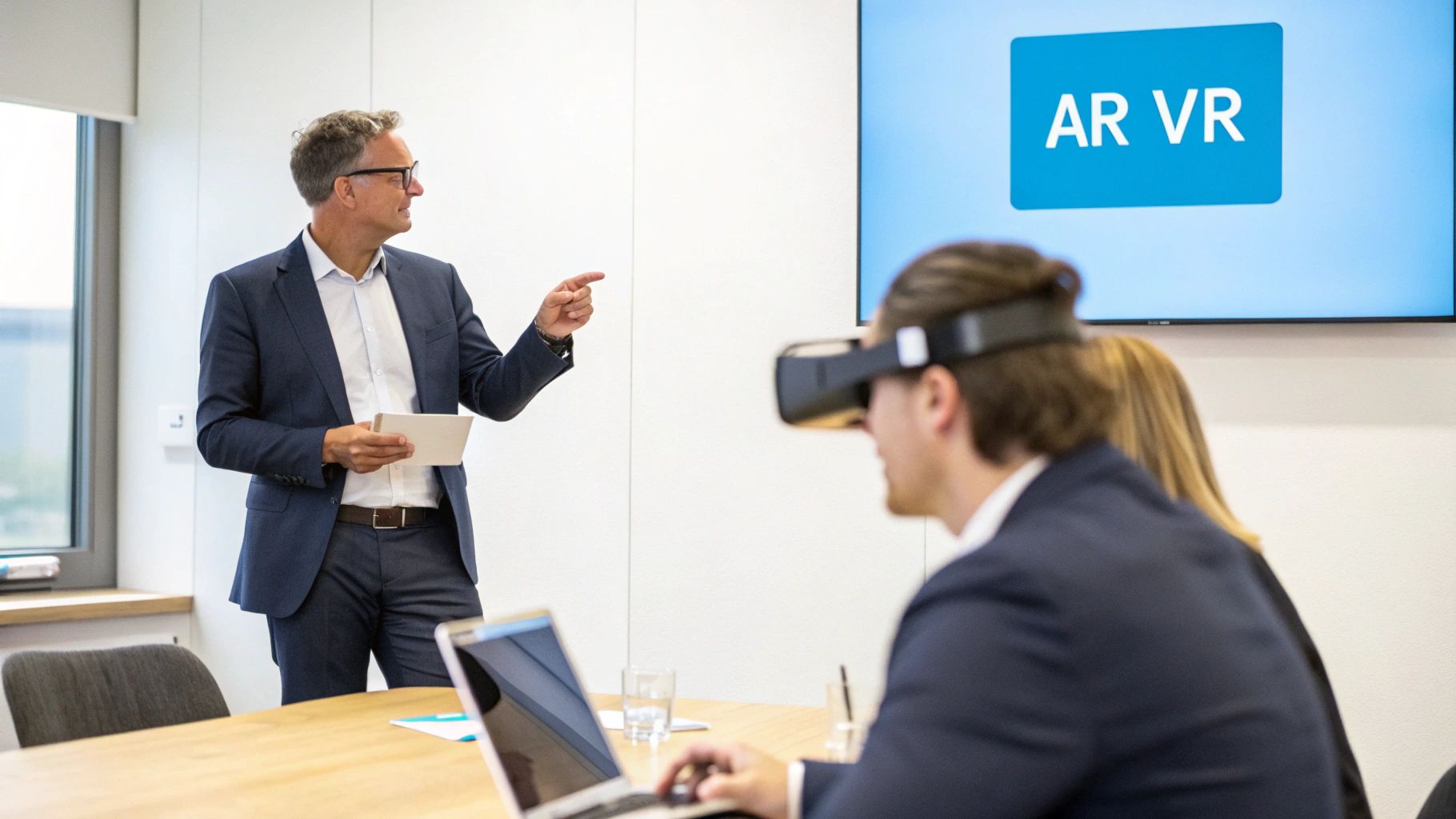
Augmented Reality (AR): Information in Context
AR technology is designed to keep team members grounded and engaged in their physical workspace. By projecting data, step-by-step instructions, or 3D diagrams onto a real-world view through smart glasses or a tablet, AR delivers crucial information directly at the point of need.
This functionality is ideal for hands-on work. For example, a field technician can receive remote guidance from an expert who sees exactly what they see, or a factory worker can follow holographic assembly instructions overlaid on the actual equipment, improving accuracy and efficiency.
Virtual Reality (VR): Simulation Without Limits
VR takes the opposite approach. It intentionally blocks out the real world with a headset, immersing the user in a completely computer-generated environment. This total immersion is its primary advantage.
It is incredibly effective for training in high-stakes scenarios where real-world mistakes are costly or dangerous. Practical applications include practicing complex surgical procedures, running emergency shutdown drills on a virtual oil rig, or collaborating on a full-scale product prototype before a single physical part is manufactured.
The strategic pivots of major tech players, like Meta's shift from Metaverse to AI Glasses, illustrate how the industry is refining these distinct applications. This focus is mirrored in market projections, with AR software expected to capture a 59.8% revenue share by 2025 as it integrates into enterprise workflows, while VR hardware continues to lead its segment due to high-impact training and simulation use cases.
AR vs VR At a Glance: Key Differences
To clarify the choice, here is a direct comparison of how these technologies function in an operational context.
| Characteristic | Augmented Reality (AR) | Virtual Reality (VR) |
|---|---|---|
| User Environment | Real world, enhanced with digital overlays | Fully immersive, computer-generated world |
| Immersion Level | Partial—user remains aware of their surroundings | Total—user is isolated from their real-world environment |
| Primary Goal | Add contextual information to real-time tasks | Create new, simulated experiences for training or design |
| Common Hardware | Smart glasses, smartphones, tablets | Headsets that completely cover the eyes |
| Key Business Use | Remote assistance, work instructions, quality control | Safety training, procedural simulations, product design |
Ultimately, the decision comes down to your specific goal. Do you need to empower an employee to perform a task better in their current environment, or do you need to transport them somewhere else entirely to learn or collaborate? That is the essential strategic question.
Comparing the Core Technology and Hardware
The primary difference between AR and VR stems from their core technology and the hardware that enables them. Each is engineered for a distinct purpose—one enhances your world, the other replaces it—and that design choice dictates everything from the display to the processing requirements. Understanding this distinction is the first step toward selecting the right tool for your operation.
AR devices like smart glasses are built for mobility and situational awareness. They use see-through displays, often called waveguides, to project digital information onto the user's real-world view. The engineering challenge is to balance overlaying useful data without obstructing the user's vision, making them ideal for active, hands-on work on a factory floor or during a remote service call.
The Role of Processing Power and Latency
AR processing has a unique function: the device must constantly scan the real world to correctly place and "anchor" digital objects so they appear stable. This requires extensive tracking technology, like cameras and sensors, to map surfaces and understand 3D space in real time. Low latency is essential—any lag between head movement and the digital overlay's response can be disorienting and render the tool ineffective.
VR headsets, on the other hand, are fully occlusive. They are designed to completely block the user's surroundings to create a convincing sense of presence in a different location. To achieve this, VR hardware prioritizes high-resolution displays and a wide Field-of-View (FOV) to fill the user's peripheral vision and minimize the distracting "screen-door effect."
A key technical differentiator is how each technology handles reality. AR must see and understand the world to augment it, demanding powerful onboard processing for real-time environmental mapping. VR’s primary function is to create a believable new world, focusing on graphical rendering and display fidelity to achieve immersion.
Tracking Technologies and User Interaction
This intense focus on graphics means most high-end VR systems are tethered to a powerful PC or console for processing, though standalone headsets are rapidly improving. VR tracking systems are designed to monitor the user's position within a specific area, allowing them to physically walk around and interact within the virtual world.
This technical split directly shapes the user experience. AR keeps users grounded in their immediate environment, making it a valuable tool for on-the-spot guidance. If you want to explore the mechanics, you can learn more about how augmented reality works and its underlying principles. In contrast, VR’s power lies in its ability to transport a user to a different place for training or collaboration, free from real-world distractions or dangers.
The hardware itself signals its intended use. Lightweight AR glasses are made for extended periods of active work. Bulkier VR headsets are meant for focused, session-based experiences. Choosing between them is a question of whether your team needs to bring digital information into their workspace or be transported to a new one.
Where AR and VR Drive Enterprise Value
The business distinction between AR and VR becomes clear when moving beyond definitions to the actual problems they solve. Each technology offers a unique approach to boosting efficiency, safety, and skills, but they thrive in different operational environments. The right choice hinges on the specific challenge you aim to address.
For Augmented Reality, its value is centered on enhancing how a worker interacts with their immediate physical world. It is about delivering critical digital information directly into their line of sight, enabling them to perform hands-on work more intelligently, quickly, and safely.
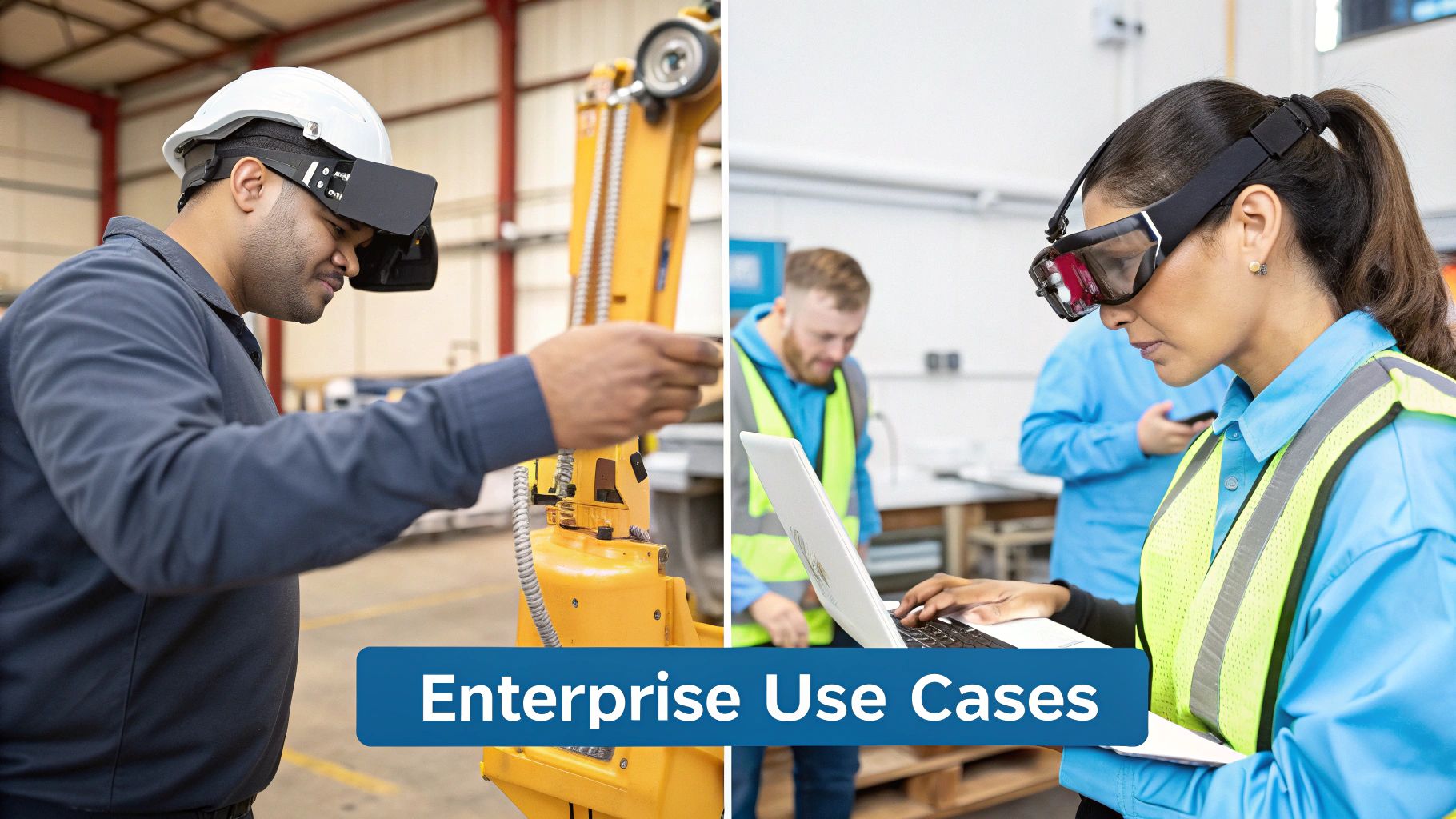
AR Use Cases for Operational Excellence
AR demonstrates its full potential when real-world context is essential. It keeps technicians grounded in their tasks while providing powerful digital capabilities.
- Remote Assistance: A junior technician facing a complex repair can use AR glasses to stream their point of view to a senior expert anywhere in the world. The expert can then annotate the technician's live feed, circling parts or displaying diagrams to guide them through the solution. This benefit significantly reduces equipment downtime and eliminates travel costs.
- Digital Work Instructions: Instead of referencing a manual or tablet, an assembly line worker can view step-by-step instructions and 3D guides overlaid directly onto their workstation. This workflow ensures procedures are followed precisely every time, strengthening quality control and reducing errors.
This practical application is fueling AR’s growth in industrial sectors. A key market differentiator is the regional and hardware focus; AR is expanding in enterprise-heavy regions like North America, which is projected to hold the largest market share in 2025, driven by a 58% dominance in HMDs and smart glasses. This is supported by a global valuation of USD 120.21 billion, with Asia-Pacific emerging as the fastest-growing region. You can discover more insights from these market dynamics from Fortune Business Insights.
VR Applications for Risk-Free Skill Development
Virtual Reality’s value proposition is entirely different. Its strength lies in removing the worker from their physical environment and placing them in a safe, controlled, and endlessly repeatable training simulation.
VR’s power is not in enhancing reality, but in replacing it. This makes it an unparalleled tool for building muscle memory and critical thinking skills for high-stakes situations where real-world mistakes are not an option.
VR provides a sandbox for risk-free training on hazardous tasks or complex procedures. In these virtual worlds, employees can practice scenarios that would be too dangerous, expensive, or impractical to replicate in real life.
Key applications include:
- Safety Training: Employees can learn to handle equipment failures, chemical spills, or emergency evacuations in a photorealistic simulation without facing actual danger.
- Complex Procedural Training: Medical students can perform intricate surgeries, and technicians can practice assembling a multi-million-dollar engine. VR provides a space to fail, learn, and repeat without costly or catastrophic consequences. You can explore a variety of compelling uses for VR in our detailed guide.
Ultimately, the decision depends on your objective. If the goal is to equip a worker with real-time information to improve performance on a physical job, AR is the appropriate tool. If you need to train someone for a complex or hazardous task in a simulated space, VR is the clear choice.
Measuring ROI for Immersive Technology
Investing in augmented or virtual reality requires a clear return. The metrics for success, however, look different for each technology. The key is to connect the solution to tangible financial and operational outcomes to build a compelling business case that aligns with stakeholder objectives.
The fundamental differences between AR and VR lead to distinct Key Performance Indicators (KPIs). AR’s value is in enhancing real-world tasks, so its ROI is measured by direct improvements in efficiency and cost savings. VR, focused on simulation, generates its value by improving human performance and preventing expensive real-world errors.
Quantifying the Value of AR in the Field
When you deploy AR for remote service or on-the-job guidance, you measure success with concrete operational savings and asset uptime. The objective is to demonstrate that overlaying digital information onto the physical world helps frontline teams work faster and with fewer errors.
Key AR metrics to track include:
- Reduced Expert Travel Costs: By enabling remote experts to guide technicians virtually, companies can achieve significant reductions in travel expenses, often by 75% or more.
- Decreased Equipment Downtime: Faster diagnostics and guided repairs get machinery back online quickly, which has a direct and immediate impact on production output and revenue.
- Improved First-Time Fix Rates: AR work instructions help ensure procedures are followed correctly, reducing repeat visits and improving customer satisfaction. A high first-time fix rate is a key indicator of operational excellence.
Calculating the financial impact of AR is direct. It is the sum of eliminated travel costs, reclaimed downtime hours, and avoided repeat service calls. These hard numbers build a strong investment case.
Measuring the Impact of VR Training
VR’s ROI is rooted in human capital development. It excels at creating skilled, confident employees in less time and at a lower cost than traditional training methods. Here, success is measured by tracking improvements in knowledge, skill, and safety.
Important VR training KPIs are:
- Shorter Training Cycles: Immersive simulations can reduce the time it takes for new hires to become proficient, accelerating employee learning by up to 75%.
- Higher Knowledge Retention: Learning by doing in a virtual environment leads to significantly better long-term retention of complex procedures.
- Lower Error Rates in Real-World Performance: Allowing employees to practice—and fail—in a risk-free setting dramatically reduces mistakes on the job. This not only cuts material waste but also helps prevent costly safety incidents.
Whether using AR to perfect a physical process or VR to simulate one, tracking the right KPIs is essential. For those ready to build a robust financial model, you can learn more about how to calculate return on investment for technology projects in our dedicated guide.
Sorting Out Deployment and Integration
Implementing an AR or VR solution involves more than hardware selection; it requires a solid plan for deployment and integration. These choices define the scalability, security, and utility of the tools within your existing IT ecosystem. An incomplete rollout strategy can lead to significant operational challenges.
The first major decision is the deployment model. Will you use a flexible Software-as-a-Service (SaaS) platform, or do you require the full control of an on-premise installation? Each path has important trade-offs for both operations and IT leaders to consider.
SaaS vs. On-Premise: Where Will Your Solution Live?
A SaaS deployment model prioritizes speed and simplicity. A third-party vendor manages server maintenance, updates, and infrastructure, allowing you to scale quickly by adding new users or sites with minimal friction. The trade-off is reliance on the vendor's security protocols and data management practices.
Conversely, an on-premise deployment brings the entire solution within your own IT infrastructure. This provides complete control over security, data privacy, and integration with other systems. For companies in heavily regulated industries, this is often a mandatory requirement. However, it requires a larger upfront investment in hardware and assigns responsibility for all maintenance and updates to your internal team.
The decision boils down to control versus convenience. SaaS allows for rapid deployment and delegates management, while on-premise delivers the deep security and data governance that many large enterprises require.
Plugging Into Your Enterprise Systems
To realize the full value of AR and VR, these tools must integrate with your core business systems. This connectivity is what transforms an innovative technology into a deeply embedded part of your daily workflow.
For example, an AR remote assistance tool that connects to your Field Service Management (FSM) platform allows a technician to access equipment history and log a service report without leaving their field of view. A VR training module that integrates with your Learning Management System (LMS) can automatically track certifications and skill assessments.
Key systems for integration often include:
- ERP Systems: For accessing work order details or inventory data.
- LMS Platforms: For managing training content and tracking employee progress.
- FSM Software: For streamlining field service workflows and data collection.
Ensuring these connections are robust and secure is critical. IT leaders must address network requirements, data encryption, and device management to protect company information. This foundational work ensures that whether you choose AR or VR, the solution becomes a true asset, not a security liability.
How to Choose the Right Immersive Solution
Choosing between AR and VR is a strategic decision, not just a technical one. It comes down to a single, critical question: is your goal to enhance a real-world task or to create a fully simulated one? Your answer is the key to unlocking real business value rather than simply investing in a new technology. This is not about picking the “better” technology—it’s about mapping the right tool to the job at hand.
The business value of AR versus VR becomes clear when you examine the core function. AR is the solution when the physical workspace is essential. For a technician needing hands-on access to equipment, AR delivers crucial data directly into their line of sight.
Conversely, VR is the answer when you need to remove someone from that physical space entirely, whether for safety, cost, or logistical reasons.
A Decision Framework for Your Business
To move forward with confidence, ask a few fundamental questions about your objectives. The answers will point you in the right direction.
- Where is the work happening? If it’s on a factory floor, at a client’s site, or in any other active environment, AR is the clear choice. Maintaining user awareness of their surroundings is critical. If the work is in a controlled setting like a training room or a design studio, VR's total immersion becomes a powerful asset.
- What is the primary objective? If you want to improve efficiency and accuracy in a real-world process, AR is your tool. If the goal is to build skills, muscle memory, and decision-making in a risk-free setting, you are looking at VR.
The core choice is whether you need to bring digital content to the worker or bring the worker to a digital environment. One empowers real-time action, while the other enables deep learning through simulation.
One of the most telling differences between these two is their market trajectory. In 2025, the global augmented reality market was valued at USD 120.21 billion, with projections soaring to USD 1,050.56 billion by 2033. In contrast, the virtual reality market stood at USD 20.83 billion in 2025. This gap does not mean VR is less important; it highlights how broadly AR is being applied in day-to-day operations for faster ROI, while VR is transforming high-value training and simulation. You can explore these market growth projections from Grand View Research for more detail.
This decision tree gives you a clear visual for choosing a deployment model.
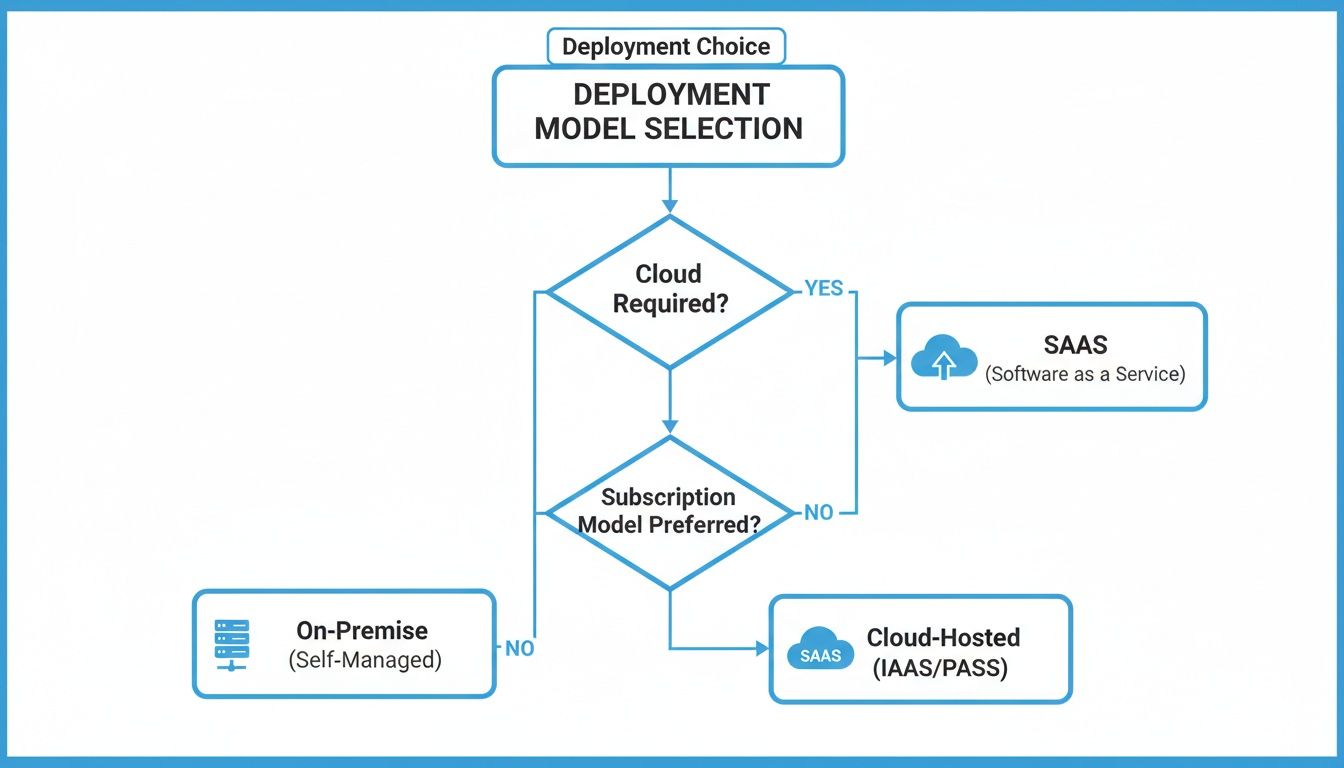
This helps visualize the trade-offs. The need for tight control and security (On-Premise) follows a different path from the need for speed and scalability (SaaS), helping you align your technology choice with your company's IT governance from day one.
A Few Common Questions About AR and VR
As you explore AR and VR, practical questions about cost, scale, and long-term value will arise. Addressing these operational details is the difference between a temporary pilot project and a genuine business transformation.
Here are straightforward answers to the questions we hear most from enterprise leaders.
What’s the Real Cost of an Enterprise AR or VR Solution?
This is where the paths for AR and VR diverge, especially regarding hardware. AR deployments often have a lower barrier to entry because they can run on the smartphones and tablets your teams may already use. VR, however, requires dedicated headsets to create full immersion, which means a higher per-user hardware cost.
Hardware is only one part of the equation. The software and integration are typically the largest cost drivers. A subscription-based SaaS platform provides predictable monthly expenses, which is often preferred for budgeting. A custom on-premise build demands a larger upfront investment but offers complete control over the system.
Which Technology Scales Better for a Big Workforce?
Both technologies can scale, but they do so differently. AR is typically easier to roll out quickly across a distributed workforce. Since solutions can be deployed on standard mobile devices, it’s a natural fit for large field service teams or employees who are not tied to a single location.
Scaling VR is more of a logistical challenge, specifically involving hardware provisioning and setting up dedicated training spaces. While establishing a single training hub is straightforward, deploying headsets to thousands of employees across dozens of sites requires a robust plan for device management and content distribution.
Your first move should be a pilot program. Select one high-impact use case, prove the concept, measure the ROI, and resolve any issues before planning a full-scale rollout.
Starting small provides the hard data needed to build a solid business case. It is the most effective way to ensure your enterprise-wide implementation is a success.
Ready to determine how immersive technology fits into your operations? The experts at AIDAR Solutions can help you map out a clear plan, whether you need AR to enhance your remote support or VR to build skills more effectively. Discover the right solution for your business.

