Exploring augmented reality industries: 2025 trends
Augmented reality has moved from a futuristic concept to a practical, value-driving technology. Today, a growing number of augmented reality industries are leveraging AR to solve critical, real-world challenges, from enhancing surgical precision in healthcare to streamlining complex assembly on the manufacturing floor and revolutionizing customer experiences in retail. This technology is no longer a novelty; it is a core driver of efficiency, safety, and measurable growth. For businesses, the conversation has shifted from "what is AR?" to "how can AR generate ROI?"
This article moves beyond surface-level descriptions to provide a strategic breakdown of AR's impact across 10 key sectors. We will dissect specific, replicable use cases, analyze their direct strategic impact on operations, and provide actionable takeaways for leaders ready to integrate immersive solutions into their workflows. You will learn not just where AR is being used, but why it is successful and how you can replicate that success.
We will explore practical applications, from guided maintenance procedures that reduce equipment downtime to interactive training modules that accelerate knowledge transfer and improve employee retention. For enterprises looking to accelerate training, reduce costly operational errors, and empower their frontline workforce, understanding these proven applications is the first step toward unlocking a significant competitive advantage. This guide is designed to provide clear, tactical insights for decision-makers evaluating how AR can solve their most pressing business problems.
1. Retail & E-Commerce
Among all augmented reality industries, retail and e-commerce have seen some of the most widespread and impactful consumer-facing adoption. AR technology directly addresses a core challenge of online shopping: the inability to physically interact with or try on a product. By overlaying digital product models onto a customer's real-world environment through their smartphone, AR creates an interactive, "try-before-you-buy" experience that significantly boosts buyer confidence and reduces hesitation.

This virtual visualization is proven to lower product return rates, a major pain point for e-commerce businesses. When customers can accurately see how a sofa fits in their living room or how a shade of lipstick looks with their skin tone, the risk of a post-purchase mismatch plummets.
Strategic Analysis & Application
The core strategy behind AR in retail is to merge the convenience of online shopping with the confidence of in-store purchasing. This "phygital" approach creates a more engaging and personalized customer journey. For apparel brands, this has become particularly transformative. As detailed in resources exploring immersive retail, leveraging Virtual Clothing Try-On Apps allows shoppers to see how garments drape and fit on their own body shape, moving beyond static size charts.
Key Takeaway: The goal is not just to show a product but to solve a customer's specific problem: "Will this fit me?" or "Will this match my decor?" AR provides a direct, personalized answer.
Actionable Implementation Tips
- Prioritize High-Consideration Items: Start with product categories where visualization is critical, such as furniture, cosmetics, eyewear, and apparel.
- Optimize for Realism: Invest in high-quality, true-to-scale 3D models. Ensure the AR experience accounts for different lighting conditions to provide an accurate representation.
- Seamless Integration: Embed the AR feature directly within your existing e-commerce app or product pages. It should be an intuitive part of the shopping flow, not a separate, clunky application.
2. Healthcare & Medical Education
In the high-stakes world of medicine, augmented reality is transitioning from a futuristic concept to an indispensable clinical tool. As one of the most transformative augmented reality industries, healthcare leverages AR to overlay critical digital information directly onto the physical world, enhancing surgical precision, revolutionizing medical training, and improving patient communication. This technology can give surgeons enhanced visualization, allowing them to see veins, organs, and critical structures in relation to a patient's body, dramatically improving procedural accuracy and safety.
For medical students, AR provides an interactive and risk-free environment to learn complex anatomy and practice procedures. Immersive platforms allow surgical trainees to perform virtual operations with haptic feedback, gaining hands-on experience without the need for cadavers. Similarly, tools that project vein maps onto a patient’s skin help nurses visualize veins for easier IV placement, reducing patient discomfort and procedure time.
Strategic Analysis & Application
The primary strategy for AR in healthcare is to enhance human capability by providing real-time, context-aware data when and where it is needed most. This improves decision-making, reduces cognitive load on medical professionals, and minimizes the potential for error. In the operating room, AR systems can enable expert surgeons to remotely guide less experienced colleagues through complex procedures, democratizing access to specialized medical knowledge.
The applications extend far beyond surgery. For a deeper look into how immersive technologies are reshaping medical instruction, explore our guide on virtual reality for medical training. These platforms offer scalable, repeatable, and highly realistic training scenarios that are difficult to replicate otherwise.
Key Takeaway: The goal of AR in medicine is to augment, not replace, the skills of clinicians. It provides a layer of digital intelligence that enhances perception, precision, and performance, leading to better patient outcomes.
Actionable Implementation Tips
- Focus on Measurable Clinical Outcomes: Prioritize applications that directly improve key metrics, such as reducing surgery times, minimizing procedural errors, or improving training efficacy.
- Ensure HIPAA and Healthcare Compliance: Data security and patient privacy are paramount. Build compliance into the foundation of any AR healthcare solution from day one.
- Invest in Rigorous Validation: Partner with medical institutions to conduct clinical trials and usability studies to validate the technology's safety and effectiveness before broad deployment.
3. Manufacturing & Industrial Maintenance
Few augmented reality industries demonstrate a clearer return on investment than manufacturing and industrial maintenance. AR directly addresses longstanding challenges like complex assembly, skills gaps, and equipment downtime. By overlaying digital information-such as step-by-step instructions, schematics, or real-time sensor data-onto a technician's view of physical equipment, AR transforms how complex tasks are performed, drastically reducing errors and accelerating problem resolution.

This hands-on, contextual guidance is a game-changer. Leading aerospace and industrial companies have used AR to reduce wiring production time and lower error rates to near-zero. Similarly, energy sector leaders utilize AR to provide visual instructions for servicing complex machinery like wind turbines, improving technician accuracy and efficiency. The technology empowers workers by delivering critical information precisely when and where it is needed.
Strategic Analysis & Application
The primary strategy for AR in manufacturing is to enhance human capability and operational intelligence. It bridges the gap between the digital twin and the physical asset, creating a safer, more efficient work environment. For maintenance teams, this means an expert can remotely guide a junior technician through a complex repair, minimizing travel costs and equipment downtime. More information about augmented reality for manufacturing highlights how this technology is central to creating the "connected worker" of Industry 4.0.
Key Takeaway: The goal is to empower the frontline worker with instant expertise, turning complex procedures into guided, error-proof workflows and improving first-time fix rates.
Actionable Implementation Tips
- Target High-Impact Tasks: Begin with processes known for high error rates, long training times, or significant safety risks, such as intricate assembly or critical equipment maintenance.
- Design for the Environment: Ensure AR hardware and interfaces are practical for industrial settings. They must be compatible with existing personal protective equipment (PPE) and function reliably in areas with variable connectivity.
- Prioritize Intuitive Interfaces: Create simple, clear user interfaces that require minimal training for non-technical workers. Voice commands and gesture controls can be crucial for hands-free operation.
4. Real Estate & Property Visualization
The real estate sector is another of the top augmented reality industries being reshaped by immersive technology. AR directly confronts the fundamental industry challenge of visualizing potential in an empty or yet-to-be-built space. By overlaying digital information, virtual furniture, and even structural changes onto a potential buyer's view of a property, AR bridges the imagination gap, allowing them to see a house as a future home rather than just an empty shell.
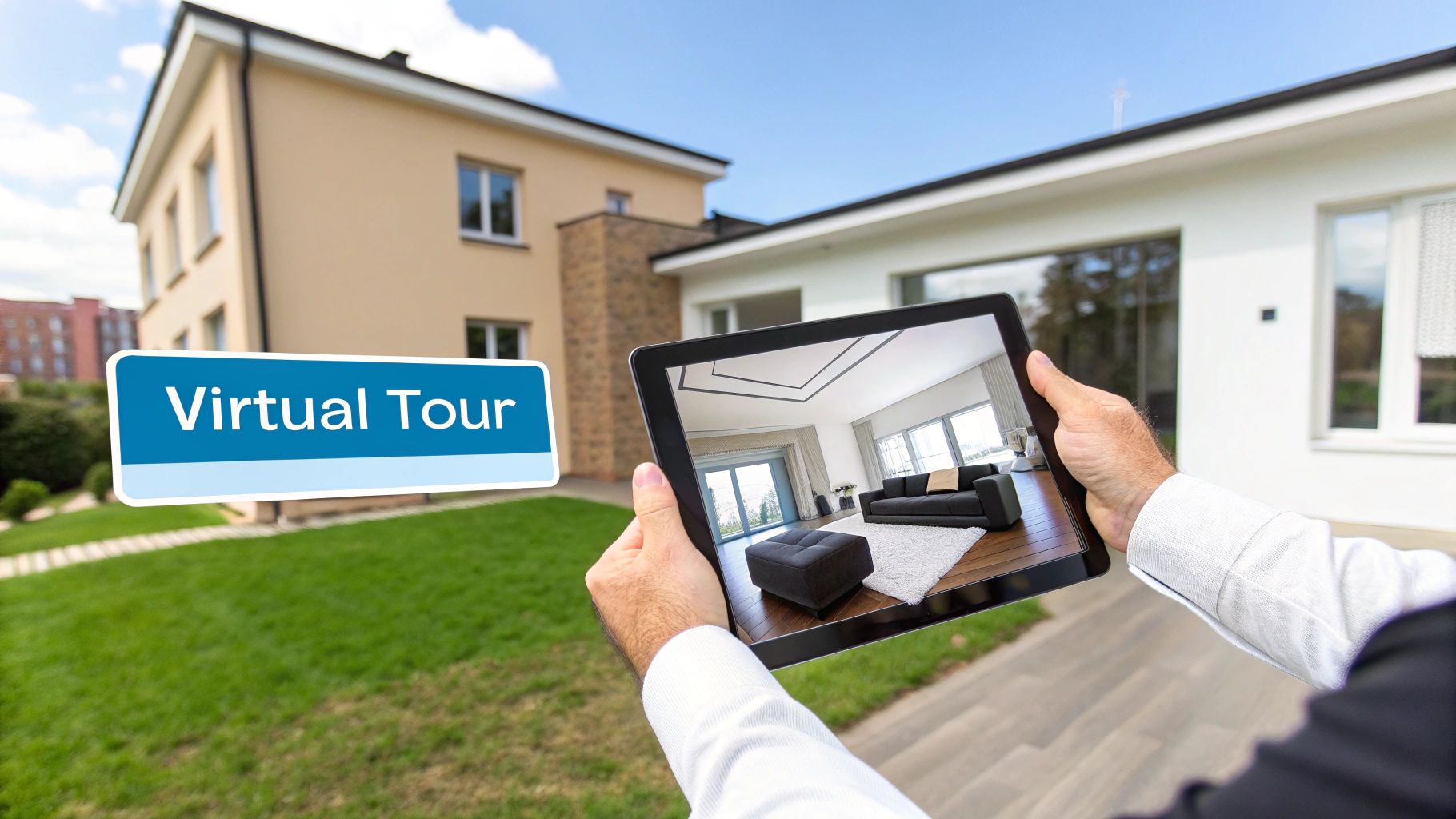
This technology empowers agents to offer immersive virtual tours and staging without the logistical costs of physical furniture. For instance, many property platforms leverage AR to give buyers a sense of a home's layout and potential from anywhere in the world. This not only expands the pool of potential buyers but also accelerates the decision-making process by providing a richer, more informative viewing experience.
Strategic Analysis & Application
The core strategy here is to transform property viewing from a passive observation into an active, engaging visualization. This helps clients form a stronger emotional connection to a property. The sector also benefits from innovative virtual home staging apps that allow real estate agents and homeowners to digitally furnish and decorate properties, enhancing buyer engagement and showcasing a property’s full potential. For new constructions, AR can project a finished building onto an empty lot, making the final vision tangible for investors and buyers long before construction is complete.
Key Takeaway: AR in real estate isn't just about showing what is there; it's about powerfully illustrating what could be there, turning empty rooms and floor plans into compelling, personalized visions.
Actionable Implementation Tips
- Combine with Virtual Staging: For vacant properties, use AR to superimpose different furnishing styles, helping buyers visualize living in the space.
- Invest in Professional 3D Assets: High-quality, accurately scaled 3D models of furniture and fixtures are crucial for a believable and useful experience.
- Offer Customization Options: Allow users to view different paint colors, flooring types, or renovation possibilities directly on their screen to personalize the viewing.
5. Education & Learning
The education sector is one of the most promising augmented reality industries, poised to transform traditional learning methods. AR technology moves education beyond static textbooks and two-dimensional screens, creating immersive and interactive experiences that bring abstract concepts to life. By overlaying digital information, 3D models, and simulations onto the real-world classroom, AR engages students in a multisensory learning process that improves comprehension, retention, and overall engagement.
This hands-on, experiential approach caters to diverse learning styles, especially kinesthetic and visual learners. Instead of just reading about the solar system, students can see planets orbiting the sun on their desks. Interactive apps allow biology students to explore the human heart in three dimensions, making complex systems intuitive and memorable in a way that flat diagrams cannot. This shift from passive consumption to active participation is the core of AR's educational power.
Strategic Analysis & Application
The primary strategy for AR in education is to make learning tangible and contextual. It bridges the gap between theoretical knowledge and practical understanding by providing safe, repeatable, and engaging virtual experiments and explorations. This method is exceptionally effective for STEM subjects, where visualizing complex processes is crucial. For example, some educational apps allow students to digitally combine elemental blocks to see chemical reactions unfold in a safe, controlled AR environment.
As technology becomes more integrated into lesson plans, educators can find a wealth of use cases. You can explore a variety of these applications in more detail with these augmented reality education examples.
Key Takeaway: The goal is to transform abstract information into a concrete, interactive experience. AR enhances learning by allowing students to "do" and "see" rather than just read and listen.
Actionable Implementation Tips
- Align with Curriculum: Ensure AR content directly supports specific learning objectives and curriculum standards to maximize its educational impact.
- Provide Teacher Support: Develop comprehensive guides, training materials, and lesson plans to help educators effectively integrate AR tools into their classrooms.
- Prioritize Accessibility: Design experiences that work well on common classroom devices like tablets and smartphones. Consider offline functionality for schools with limited internet access.
6. Navigation & Wayfinding
Of all the augmented reality industries reshaping daily life, Navigation & Wayfinding offers one of the most intuitive and practical applications. This technology superimposes digital directions, arrows, and points of interest directly onto a user's view of the real world via their smartphone camera. It solves the fundamental problem of translating a 2D map into a 3D environment, reducing the cognitive load and confusion often associated with traditional navigation in complex or unfamiliar locations.
This real-time, visual guidance is especially powerful in dense urban areas or large indoor venues like airports and shopping malls. By providing clear, contextual instructions ("turn left at the blue storefront"), AR makes navigating new environments faster, safer, and significantly less stressful for users, enhancing their overall confidence and experience.
Strategic Analysis & Application
The primary strategy for AR in navigation is to deliver "heads-up" directional information, keeping the user's attention on their physical surroundings rather than focused down on a map. This approach is not just about convenience; it enhances situational awareness and safety. For businesses operating in large physical spaces, like airports or retail centers, implementing an AR wayfinding system can directly improve visitor flow, reduce missed appointments or flights, and guide customers toward specific points of interest or promotions.
Key Takeaway: The goal is to eliminate the abstract step of map interpretation. AR provides an immediate, unambiguous answer to the user's core question: "Where, exactly, do I go next?"
Actionable Implementation Tips
- Prioritize GPS & Sensor Accuracy: A successful AR navigation experience depends on precise location tracking. Ensure your application effectively fuses GPS, compass, and accelerometer data for smooth and accurate overlays.
- Design for Mobile, One-Handed Use: Users will be walking and holding their phones. The user interface must be simple, with clear, large visual cues that can be understood at a glance.
- Optimize for Performance: AR rendering can be battery-intensive. Use efficient 3D models and rendering techniques to minimize power consumption and ensure the application is usable for extended periods.
7. Entertainment & Gaming
Entertainment and gaming represent one of the most visible and widely adopted augmented reality industries, largely responsible for introducing the technology to a global consumer audience. AR in this sector works by superimposing interactive digital elements, characters, and information onto the user's real-world view, transforming everyday environments into dynamic play spaces. This creates highly immersive and social experiences that encourage exploration and shared interaction.
The viral success of location-based games demonstrated AR's power to create a global phenomenon by blending a digital franchise with real-world gameplay. Similarly, AR filters on social media platforms have made augmented reality a daily interactive tool for hundreds of millions, driving engagement and user-generated content by allowing people to instantly alter their appearance and surroundings.
Strategic Analysis & Application
The core strategy in AR entertainment is to leverage the user's existing physical reality as the foundation for the experience. This turns a passive screen-based activity into an active, contextual one, blurring the lines between the digital and physical worlds. This approach generates a unique form of engagement that static media cannot replicate, encouraging social sharing and viral growth as users showcase their unique AR-enhanced experiences.
Key Takeaway: The goal is to make the real world more magical and interactive. Successful AR entertainment doesn't just display digital content; it makes that content feel like a natural, responsive part of the user's immediate environment.
Actionable Implementation Tips
- Design for Social Virality: Build in easy-to-use sharing features. Experiences that are fun to watch and share, like funny AR filters or impressive game captures, are more likely to spread organically.
- Prioritize Community and Events: Keep users engaged with a steady stream of new content, live events, and community-based challenges. This transforms a one-time novelty into a long-term hobby.
- Balance Gameplay with Safety: For location-based experiences, integrate clear safety guidelines and design gameplay that encourages awareness of real-world surroundings to prevent accidents.
8. Automotive & Vehicle Industry
The automotive sector is another one of the augmented reality industries undergoing a profound transformation, moving from conceptual designs to practical, in-vehicle applications. AR is being integrated across the entire automotive lifecycle, from the initial design and assembly line to the showroom floor and the driver's seat. The technology provides a powerful bridge between digital information and the physical vehicle, enhancing safety, efficiency, and the customer experience.
By overlaying crucial data directly onto a user's view, AR systems improve both production and operation. Technicians can see step-by-step repair instructions superimposed on an engine, designers can visualize and interact with full-scale virtual prototypes, and drivers can receive navigation cues that appear to be painted directly on the road ahead, minimizing distraction and improving situational awareness.
Strategic Analysis & Application
In the automotive world, the core strategy for AR is to deliver context-aware information precisely when and where it is needed. This enhances human capability, whether it's an assembly worker correctly placing a component or a driver navigating a complex interchange. For manufacturers, this means faster production, fewer errors, and a more skilled workforce. AR is now being used for both customer-facing showroom apps and in-cabin heads-up displays (HUDs).
The technology is also revolutionizing vehicle maintenance and repair. As detailed in our guide covering AR in the Automotive Industry, technicians using AR-enabled glasses can access service manuals, expert guidance, and diagnostic data hands-free, dramatically reducing service times and improving first-time fix rates.
Key Takeaway: The goal is to make complex vehicle information intuitive and immediately accessible, reducing cognitive load for both the driver and the technician.
Actionable Implementation Tips
- Prioritize Safety and Minimize Distraction: For in-car AR applications like HUDs, ensure that information is displayed non-intrusively and enhances, rather than hinders, driver focus.
- Focus on Technician Efficiency: In service bays, deploy AR to streamline complex repairs and diagnostics, providing hands-free access to schematics and expert support.
- Ensure Seamless System Integration: AR features must be deeply integrated with the vehicle's existing sensors and computer systems to provide accurate, real-time data.
9. Advertising & Marketing
In the crowded digital landscape, augmented reality has emerged as a powerful tool for marketers to cut through the noise and create genuinely interactive brand experiences. AR in advertising moves beyond passive consumption, inviting consumers to actively participate with a brand's message. By overlaying digital content onto the user's physical world, AR campaigns transform smartphones into portals for immersive storytelling, creating memorable moments that foster a deeper brand connection.
This technology boosts engagement rates significantly higher than traditional digital ads. When consumers can bring a product to life from a print ad or use a branded filter on social media, the experience becomes personal and shareable. The use of branded AR lenses on social media platforms demonstrates the technology's ability to drive brand recall and organic reach.
Strategic Analysis & Application
The primary strategy for AR in marketing is to bridge the gap between a brand’s digital presence and the consumer's physical reality, creating novel "phygital" touchpoints. This approach excels at capturing attention in a way static ads cannot. Instead of just telling consumers about a product, AR lets them experience a piece of the brand's world, whether it's through a gamified filter or an interactive product visualization that encourages exploration.
Key Takeaway: The goal of AR advertising is to transform a passive ad viewer into an active brand participant, generating not just an impression but a memorable, shareable experience.
Actionable Implementation Tips
- Prioritize Shareability: Design AR experiences with a clear call to action for users to share on social media. Build in fun, surprising, or "Instagrammable" moments.
- Focus on Simplicity: Ensure the AR experience is intuitive and easy to access. A complex or slow-loading activation will lead to high drop-off rates.
- Integrate into the Funnel: Connect the AR experience to a clear next step. This could be a link to a product page, a special offer, or an invitation to learn more, turning engagement into conversion.
10. Logistics & Warehouse Management
In the high-pressure world of logistics, efficiency and accuracy are paramount. Of all the augmented reality industries reshaping operations, logistics and warehouse management benefit from AR's ability to overlay critical data directly onto a worker's field of view. This technology transforms complex tasks like order picking, inventory scanning, and packing by providing real-time, hands-free visual guidance, dramatically reducing human error and boosting productivity.
By equipping personnel with AR glasses or devices, companies can streamline workflows from receiving to shipping. The technology visualizes the most efficient pick paths through a vast warehouse, highlights the correct item on a crowded shelf, and provides instant verification for sorting and packing. This digital layer of information minimizes cognitive load and accelerates the training process for new employees, leading to significant operational cost savings and improved order fulfillment rates.
Strategic Analysis & Application
The core strategy is to augment the human worker with digital intelligence, turning them into a hyper-efficient asset. Instead of relying on handheld scanners and paper lists, which require constant context switching, AR integrates instructions seamlessly into the worker's natural line of sight. Major logistics companies report significant efficiency gains through "vision picking," where smart glasses guide pickers step-by-step. Industrial technology providers offer AR solutions that connect frontline workers with digital information, optimizing every action on the warehouse floor.
Key Takeaway: The goal is to eliminate wasted time and motion. AR addresses the core operational challenges: "Where is the next item?" and "Is this the correct one?" by providing immediate, visually-guided answers.
Actionable Implementation Tips
- Target High-Error Tasks First: Begin with processes that have the highest rates of error or inefficiency, such as complex, multi-item order picking.
- Ensure Robust Connectivity: Warehouse environments require strong, uninterrupted wireless network coverage to support real-time data flow to AR devices.
- Integrate with Your WMS: Ensure the AR solution can seamlessly integrate with your existing Warehouse Management System (WMS) to pull order data and push back completion status.
AR: Top 10 Industry Comparison
| Sector/Industry | Implementation Complexity 🔄 | Resource Requirements ⚡ | Expected Outcomes 📊 | Ideal Use Cases 💡 | Key Advantages ⭐ |
|---|---|---|---|---|---|
| Retail & E‑Commerce | Medium–High 🔄: custom 3D models, platform integration | Medium ⚡: mobile support, cloud rendering, inventory sync | 📊 Higher conversion, lower returns, increased AOV | 💡 Furniture, apparel, cosmetics, product pages | ⭐ Better purchase confidence, engagement, differentiation |
| Healthcare & Medical Education | Very High 🔄: clinical validation, strict integrations | Very High ⚡: medical‑grade devices, trials, compliance | 📊 Improved precision, fewer complications, better training | 💡 Surgical guidance, medical training, patient education | ⭐ Enhanced clinical outcomes, training efficiency |
| Manufacturing & Industrial Maintenance | High 🔄: legacy system integration, ruggedization | High ⚡: AR glasses/tablets, sensors, secure networks | 📊 Reduced errors/time, increased uptime, safer ops | 💡 Assembly guidance, predictive maintenance, QC | ⭐ Lower operational cost, improved safety, uptime |
| Real Estate & Property Visualization | Medium 🔄: 3D scanning, accurate scale and staging | Medium ⚡: modeling resources, mobile/tablet optimization | 📊 Faster sales cycles, broader reach, fewer visits | 💡 Virtual tours, staging, construction progress | ⭐ Clearer visualization, faster decisions, remote access |
| Education & Learning | Medium 🔄: curriculum alignment, teacher training | Medium ⚡: student devices, content development | 📊 Higher engagement, improved retention, experiential learning | 💡 STEM visualization, virtual labs, historical reconstructions | ⭐ Better understanding, inclusive hands‑on learning |
| Navigation & Wayfinding | Medium 🔄: mapping, indoor positioning integration | Medium ⚡: GPS/indoor maps, continuous operation, battery usage | 📊 Fewer wrong turns, improved accessibility, contextual info | 💡 Urban walking, airports, malls, large campuses | ⭐ Intuitive guidance, reduced cognitive load |
| Entertainment & Gaming | Low–Medium 🔄: content pipelines, live ops management | Medium ⚡: servers, frequent content updates, social integration | 📊 Very high engagement, viral reach, monetization options | 💡 Location games, social AR filters, live event enhancements | ⭐ Drives adoption, strong retention, multiple revenue streams |
| Automotive & Vehicle Industry | High 🔄: in‑vehicle integration, regulatory testing | High ⚡: embedded HUDs, connectivity, validation cycles | 📊 Improved safety, better showroom/customer experiences | 💡 HUD navigation, service manuals, vehicle configuration | ⭐ Enhanced driver awareness, reduced service errors |
| Advertising & Marketing | Medium 🔄: cross‑platform campaigns, creative production | Medium ⚡: production costs, analytics, platform ops | 📊 Higher engagement, measurable interactions, shareability | 💡 Branded AR campaigns, experiential ads, social filters | ⭐ Memorable brand experiences, improved metrics |
| Logistics & Warehouse Management | High 🔄: WMS integration, durable hardware needs | High ⚡: AR wearables, robust Wi‑Fi, maintenance support | 📊 Fewer picking errors, faster throughput, better accuracy | 💡 High‑volume picking, inventory audits, shipping prep | ⭐ Efficiency gains, accuracy, reduced training time |
Integrating AR: Your Strategic Path Forward
The journey through the diverse landscape of augmented reality industries reveals a powerful, unifying theme: AR is no longer a futuristic concept but a present-day strategic imperative. From transforming the retail customer experience to revolutionizing surgical precision in healthcare, the applications we've explored demonstrate a clear and accelerating shift towards immersive digital integration. The common thread is the technology's ability to overlay critical digital information onto the physical world, creating a more intuitive, efficient, and data-rich operational environment.
This transition marks a pivotal moment for businesses. The question is no longer if AR will become a standard tool but how and when to strategically implement it for maximum competitive advantage. For industrial and enterprise sectors, the value proposition is particularly compelling, offering direct and measurable solutions to long-standing operational challenges.
Recapping the Core Strategic Insights
Across the ten industries examined, from manufacturing and logistics to education and automotive, several key takeaways consistently emerge as critical for successful AR adoption:
- Focus on High-Impact Use Cases: The most successful AR integrations target specific, high-friction points within a workflow. Rather than a blanket implementation, they solve a defined problem, such as reducing machine downtime, accelerating employee onboarding, or minimizing assembly errors. This targeted approach ensures a faster and more significant return on investment.
- Prioritize the User Experience (UX): Technology is only as effective as its adoption rate. For AR to deliver results, the interface must be intuitive for the end-user, whether that's a field technician, a warehouse picker, or a surgeon. The goal is to reduce cognitive load, not add to it.
- Ensure Seamless Workflow Integration: AR tools should not exist in a silo. They must integrate with existing systems like Enterprise Resource Planning (ERP), Learning Management Systems (LMS), and internal knowledge bases. This connectivity transforms AR from a novel gadget into an indispensable component of the digital ecosystem.
- Measure Everything: The benefits of AR are quantifiable. Organizations must establish clear Key Performance Indicators (KPIs) before implementation, such as service resolution times, training completion rates, error reduction percentages, or expert travel costs. Continuous measurement proves ROI and informs future scaling.
Your Actionable Path to AR Integration
Moving from concept to implementation requires a deliberate, strategic approach. The journey is not about adopting technology for technology's sake; it is about fundamentally re-engineering processes to be more resilient, efficient, and intelligent.
Strategic Takeaway: The first step in any AR initiative is not a technology assessment but an operational one. Identify your most significant bottleneck, whether in training, maintenance, or quality control. This is where AR will deliver the most immediate and profound impact.
Consider the tangible benefits highlighted throughout this article. For instance, AR training solutions can compress learning timelines from weeks to days, improving throughput while eliminating the risks and material waste associated with live equipment training. Similarly, AR-powered service platforms can empower a single remote expert to guide multiple on-site technicians simultaneously, effectively halving service times and slashing travel-related expenses.
These are not marginal improvements; they represent a fundamental shift in operational capability. By embracing AR, organizations are not just optimizing current processes but are building a more agile, knowledgeable, and connected workforce prepared for the challenges of tomorrow. The convergence of the physical and digital worlds is creating unprecedented opportunities across all augmented reality industries, and the time to build your strategic path forward is now.
Ready to transform your operational challenges into a competitive advantage? Explore how the suite of industrial AR solutions from AIDAR Solutions can deliver measurable ROI by enhancing your training, maintenance, and field service workflows. Visit AIDAR Solutions to schedule a personalized demo and identify your highest-impact use case today.