How to Improve Manufacturing Efficiency with AR & VR
To improve manufacturing efficiency, companies are looking beyond traditional methods and embracing immersive technologies like Augmented Reality (AR) and Virtual Reality (VR). These tools are being used to overhaul training, maintenance, and quality control processes.
These are practical, data-driven solutions that address bottlenecks on the factory floor, delivering measurable improvements in productivity and output.
The Next Frontier in Operational Excellence
Manufacturers are under constant pressure to increase output while managing costs. As production lines grow more complex and the skills gap widens, businesses require smarter, more effective ways to operate.
This is where immersive technologies provide a significant competitive advantage by transforming core manufacturing processes.
These are not futuristic concepts; they are practical tools making a difference on the factory floor today. They directly solve critical pain points in:
- Workforce Training: By creating risk-free, repeatable learning environments where mistakes do not result in costly downtime or material waste.
- Machine Maintenance: By giving technicians instant access to expert guidance, precisely when and where it is needed.
- Quality Control: By reducing human error with digital overlays and step-by-step instructions.
The Impact of Immersive Technology
The tangible benefits become clear when comparing these technologies against conventional methods. The average gains seen across training time, repair speed, and product quality demonstrate their value.
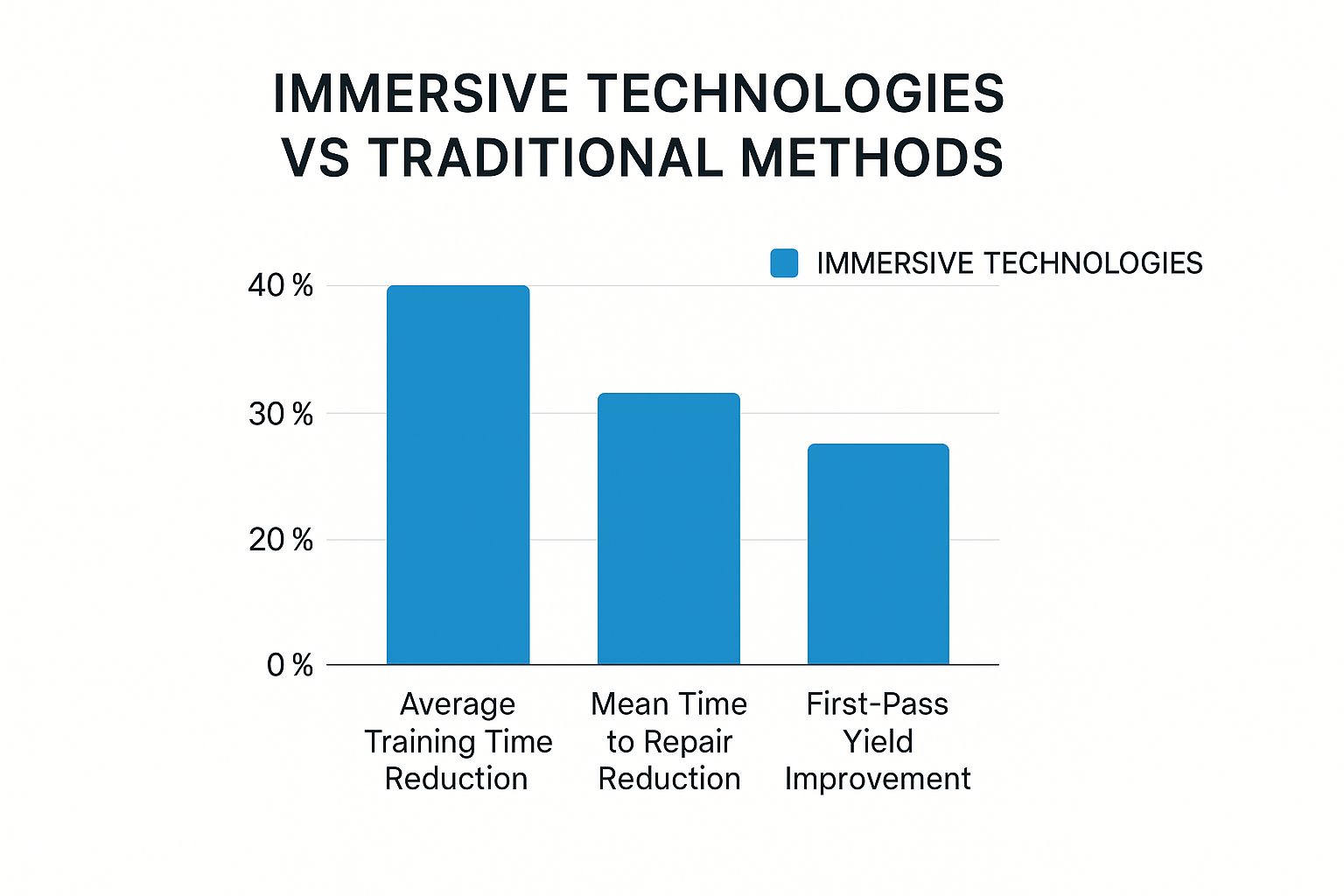
This data shows that AR and VR are not just for small, incremental improvements. They drive substantial gains in core manufacturing metrics that have a direct, positive impact on the bottom line.
Embracing Smart Manufacturing
The move toward smart factories is now essential for competitiveness. A 2024 Deloitte survey found that companies implementing smart manufacturing initiatives have seen 10% to 20% improvements in production output and up to 20% boosts in operational efficiency.
Furthermore, 92% of executives surveyed believe these technologies will be the primary driver of competitiveness within the next three years, highlighting the urgency for adoption.
The pursuit of operational excellence is not unique to manufacturing; businesses in every sector are constantly seeking ways to improve. When it comes to universal strategies for efficiency and waste reduction, the core principles are often similar across industries.
Ultimately, integrating these tools into your operation is a strategic decision to build a more resilient, skilled, and efficient workforce. By exploring the latest innovations in the manufacturing industry, companies can establish a lasting competitive edge.
In the sections that follow, we will detail how to apply these technologies to specific challenges, starting with building a more capable workforce.
Building a Skilled Workforce with VR Training
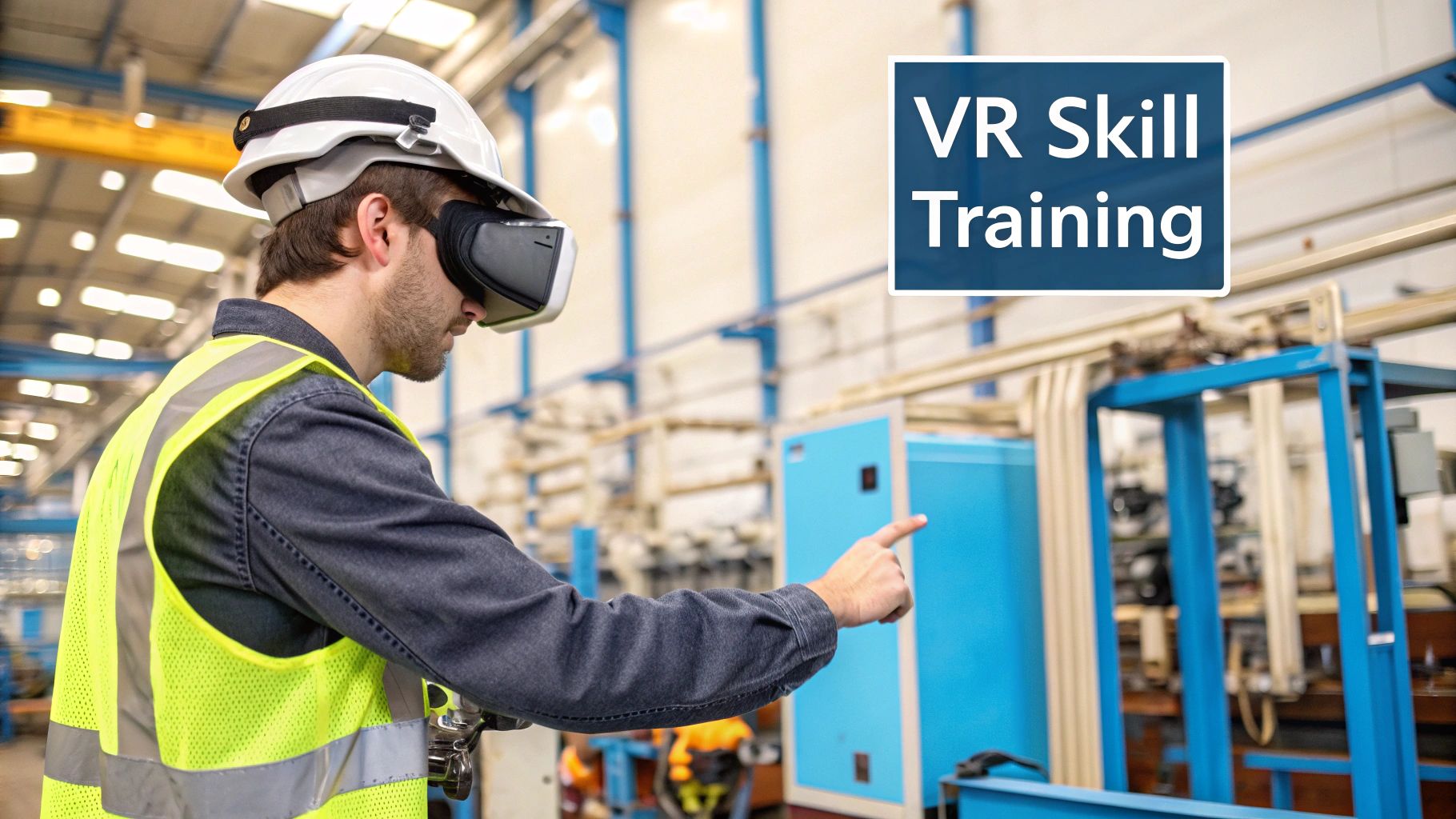
Training new hires or upskilling technicians on complex machinery presents a significant challenge. Traditional methods relying on shadowing, dense manuals, and supervised practice on live equipment are often slow, expensive, and can require taking critical machinery out of production.
This is where Virtual Reality (VR) training becomes a practical, powerful solution.
VR simulations create a risk-free environment where team members can practice intricate assemblies, troubleshoot machine faults, and master safety protocols—all without impacting the live factory floor. This allows trainees to repeat complex steps until proficiency is achieved, building muscle memory and confidence.
This approach accelerates learning. Instead of waiting for a machine to become available or for a specific malfunction to occur, a technician can run through dozens of scenarios in a single session. Such repetition builds a competent team prepared for a wide range of operational situations.
Accelerating Skills and Reducing Risk
A key advantage of VR training is the ability to prepare for rare but critical emergencies. A new hire can practice responding to a simulated equipment fire or a chemical spill in a controlled setting. This ensures they react correctly and without hesitation when a real event occurs—a level of readiness that is difficult to achieve safely through on-the-job training.
Practical use cases for VR training include:
- Welding Practice: Trainees can learn proper technique, angle, and speed in a virtual environment, receiving instant feedback without consuming expensive materials or risking injury.
- Complex Assembly: Operators can practice assembling multi-part components, with virtual guides highlighting correct part placement and torque specifications to build quality into the process.
- Safety Protocols: Employees can master lockout-tagout procedures on a virtual machine, learning the exact sequence to de-energize equipment before maintenance, ensuring protocol adherence.
This shift toward immersive learning is a cornerstone of the Industry 4.0 movement. The smart manufacturing market is projected to reach $589 billion by 2028, driven by technologies that directly enhance productivity and quality. For instance, AI-driven quality control can reduce defect rates by up to 30%, while IoT-powered predictive maintenance can reduce downtime by 50%.
Comparing Training Methods
To illustrate the benefits, let's compare VR training with traditional approaches.
Traditional Training vs VR Simulation Training
| Metric | Traditional Training | VR Simulation Training |
|---|---|---|
| Safety Risk | High; involves live machinery and real hazards. | Zero; all scenarios are simulated and risk-free. |
| Equipment Downtime | Significant; requires taking machines offline for training. | None; production continues without interruption. |
| Material Costs | High; consumes raw materials, energy, and can produce scrap. | Negligible; all materials and processes are virtual. |
| Learning Speed | Slow; dependent on equipment availability and instructor time. | Fast; scenarios can be repeated on-demand for rapid skill-building. |
| Knowledge Retention | Moderate; based on observation and limited hands-on practice. | High; immersive, hands-on learning boosts muscle memory. |
| Scalability | Limited; constrained by number of trainers and machines. | Highly scalable; train dozens of employees simultaneously. |
The conclusion is that VR does not just supplement traditional training—it fundamentally improves upon it by making learning safer, faster, and more efficient.
Enhancing Knowledge Retention and Engagement
VR training leads to higher knowledge retention. When individuals actively perform a task rather than passively observing it, they retain information at a much greater rate. The immersive nature of VR commands a user's full attention, eliminating distractions and creating a focused learning state.
This translates to fewer errors on the factory floor and a more skilled, adaptable workforce.
To integrate this into your operational strategy, consider how dedicated virtual reality training software can provide the tools needed to create, manage, and scale training programs effectively.
Slashing Downtime with AR Remote Assistance
Equipment downtime is a primary obstacle to productivity. Every minute a critical machine is idle, the entire production line can be affected, leading to delayed deadlines and rising costs.
In some sectors, such as automotive manufacturing, a single hour of downtime can cost upwards of $2 million. The traditional method of waiting for a senior engineer to travel to the site is no longer a viable way to improve manufacturing efficiency.
Augmented Reality (AR) remote assistance addresses this challenge. It closes the distance between experts and on-site problems, delivering specialized knowledge exactly where it's needed, the moment it's needed.
How AR Remote Support Works
Consider a common scenario: a complex piece of machinery on your production line unexpectedly fails. An on-site technician may lack the specific experience needed to diagnose the root cause.
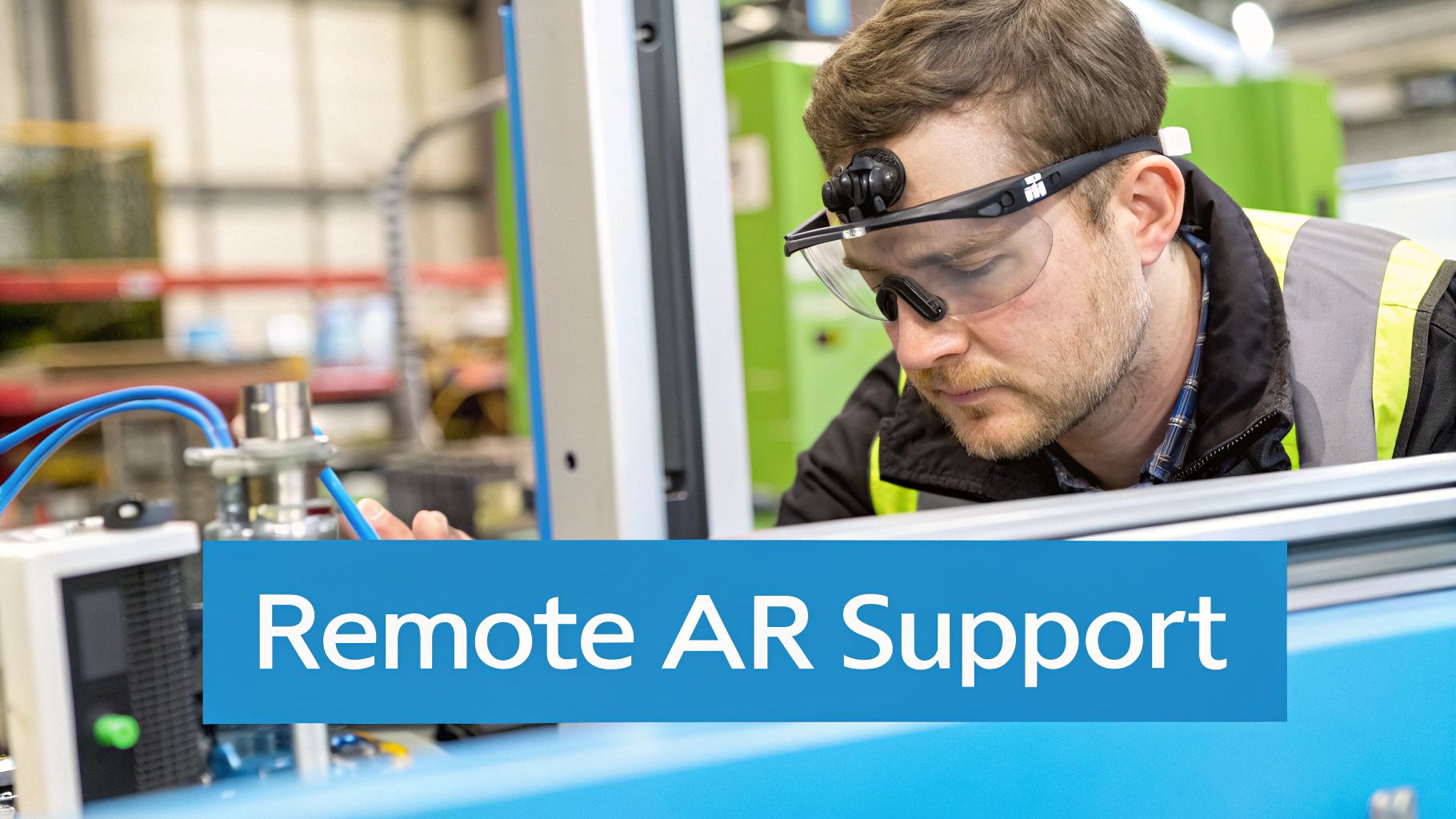
Instead of waiting hours or days for an expert to arrive, the technician wears AR glasses. They can stream a live video feed of their point-of-view to a senior engineer located anywhere in the world.
The remote expert sees precisely what the technician sees in real time. They can then overlay digital information directly onto the technician's view of the physical world.
- They can draw an arrow to highlight a specific valve that needs checking.
- They can circle the exact component that needs to be replaced.
- They can display step-by-step instructions or schematics in the technician's field of view.
This "see-what-I-see" capability removes the ambiguity of phone calls or static manuals. The technician receives clear, visual guidance, allowing them to perform complex repairs with confidence and precision.
This instant transfer of expertise represents a fundamental shift in maintenance strategy. By eliminating travel time and getting the right eyes on the problem immediately, companies drastically reduce their mean time to repair (MTTR)—a critical metric for operational health.
The Immediate Payoff for Your Factory Floor
Integrating AR into your support workflow delivers concrete, measurable results that directly impact your bottom line.
Drastically Reduced Repair Times
The most significant benefit is speed. Instant access to expert knowledge allows for faster diagnosis and resolution of issues. This keeps production lines moving and minimizes the costly impact of unplanned stops.
Eliminating Travel Costs
Transporting experts globally is expensive and inefficient. AR remote assistance eliminates the costs of flights, hotels, and lost travel time, delivering significant savings while reducing the company's carbon footprint.
Empowering Your Workforce
This technology serves as an on-demand training tool. Junior technicians learn by doing, guided by the most experienced experts in the organization. This upskilling process builds a more capable and versatile on-site team, reducing reliance on a few key individuals.
Ultimately, this is about building a more resilient and agile operation. You can learn more about setting up a system that connects your teams in our guide to augmented reality remote assistance. By adopting this technology, you create a system where expertise is always on-call, ensuring production halts are shorter, less frequent, and less damaging to your bottom line.
Improving Quality Control with AR Overlays
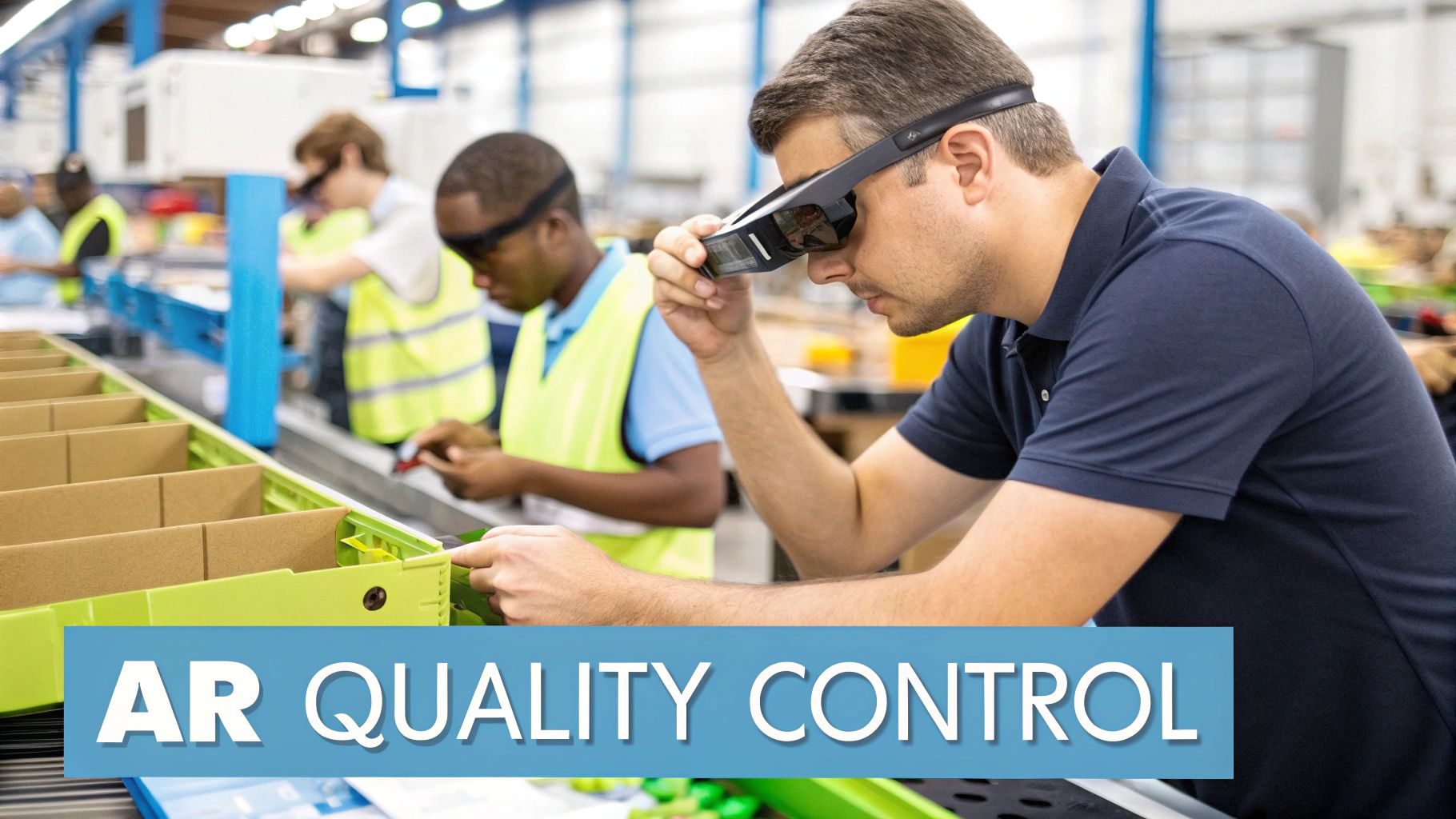
Human error is a persistent challenge in manufacturing, leading to costly rework, scrapped materials, and product inconsistencies that can damage a company's reputation.
Traditional quality assurance often relies on paper checklists, complex schematics, and memory recall—all systems susceptible to mistakes. Augmented Reality (AR) overlays provide a digital upgrade to this process by placing critical information directly into the technician's line of sight.
This technology helps prevent errors from occurring in the first place, transforming quality control into a proactive, error-proofed workflow. It is a key factor for improving manufacturing efficiency because it allows issues to be caught at the source, before they escalate into larger problems.
How AR Sharpens Inspections
Consider a technician inspecting a newly assembled automotive dashboard. Instead of looking back and forth between the part and a monitor, they view the dashboard through AR glasses. A digital guide appears over the real-world view, showing them exactly what to check.
This in-context guidance can include:
- Digital Checklists: Inspection steps appear in their field of view. A simple voice command or hand gesture marks a step as complete.
- Measurement Tolerances: The system can project acceptable measurement ranges directly onto a component, making out-of-spec parts immediately obvious.
- Component Verification: AR can highlight specific parts to confirm the correct model or serial number is installed, which is critical in complex assemblies.
- 3D Model Overlays: A perfect, to-scale 3D model of the finished product can be superimposed over the real one, making misaligned or missing components easy to identify.
By removing guesswork, AR standardizes the inspection process. A new hire, guided by these digital overlays, can perform with the same precision as a 20-year veteran, ensuring consistency across all shifts.
Boosting First-Pass Yields and Consistency
A major benefit is a significant increase in first-pass yield—the percentage of products manufactured correctly the first time without rework. When inspectors are guided by precise, contextual instructions, they can spot deviations immediately.
This has several positive operational impacts. It reduces the time and material wasted on fixing mistakes and shortens the overall production cycle. Additionally, every inspection is automatically logged, creating a rich data trail for continuous process improvement.
For an aerospace manufacturer verifying thousands of rivets on a fuselage, an AR system can highlight every required location, confirm placement, and flag any deviation in real-time. This not only speeds up the inspection but also creates a robust digital record for compliance and safety audits. This is how modern facilities improve manufacturing efficiency at scale.
How to Integrate and Scale Immersive Solutions
Transitioning an immersive technology pilot from an experiment to a fully operational tool requires a clear strategy. A successful rollout depends on how well the technology integrates into your existing manufacturing ecosystem. The full value is unlocked only when AR and VR become core, integrated parts of your daily workflow.
First, your immersive tools must communicate with your current systems. This means establishing a seamless data bridge between your AR/VR platforms and foundational software like your Manufacturing Execution System (MES) and Enterprise Resource Planning (ERP). Without this integration, the technology operates in a silo, and its impact is limited.
For example, an AR-guided assembly task should be able to pull work order details directly from your ERP. Upon completion, the AR device should automatically send completion data, timestamps, and quality metrics back to the MES. This creates a powerful, real-time feedback loop and provides a clearer view of shop floor operations.
Creating a Phased Rollout Plan
Attempting to deploy this technology across the entire factory at once can lead to significant challenges. A phased approach allows you to manage the change, gather feedback, and demonstrate value incrementally, which is critical for securing long-term stakeholder buy-in. A well-structured plan helps you improve manufacturing efficiency without overwhelming your teams.
A practical rollout plan typically includes these steps:
- Start Small, Aim High: Begin with a single, high-impact use case, such as remote assistance for a frequently problematic machine or quality control for a high-value product line.
- Deploy and Learn: Roll out the solution with a small, dedicated team. The main goal is to gather performance data and user feedback to refine the implementation.
- Expand with Proof: Use the success stories and ROI data from the initial phase to justify expanding to another production line or department.
- Standardize for Scale: Once you have several successful implementations, develop standardized best practices and training materials to prepare for broader, facility-wide adoption.
This methodical approach builds momentum and creates internal champions who can advocate for the technology's benefits. For a framework to structure these early steps, understanding the fundamentals of an augmented reality workflow can provide a solid foundation.
Measuring ROI and Driving Improvement
To justify expansion, you must demonstrate the technology's effectiveness with quantitative data. This requires continuously tracking key performance indicators (KPIs). The data collected from AR-guided tasks is invaluable for identifying production bottlenecks and driving continuous improvement.
The real power of integration is turning AR/VR from a simple guidance tool into a rich data-gathering engine. Every action a technician takes can be captured and analyzed to find hidden inefficiencies in your processes.
This data-driven approach is essential in today's global market. Manufacturing output is highly concentrated, with China and the United States expected to account for nearly 45% of global production by 2025. Countries like Japan and South Korea remain competitive through highly skilled, tech-forward workforces, proving that adopting advanced tools is crucial. You can find more data on global manufacturing leaders and their strategies.
By linking your immersive technology to your analytics platforms, you can measure tangible returns and make informed decisions to scale effectively.
Your Top Questions About AR and VR, Answered
New technology often raises questions. When considering Augmented and Virtual Reality to improve manufacturing efficiency, leaders typically have practical concerns about cost, implementation, and user adoption.
Clear answers are the first step toward making a confident decision for your operations. Let’s address some of the most common questions about this technology.
What’s a Realistic ROI for AR and VR?
The return on investment for this technology is often faster than anticipated. While there is an initial investment in hardware and software, the savings accumulate quickly in critical operational areas. Many companies see a positive ROI within 12 to 18 months.
This return is driven by direct, measurable improvements:
- Reduced Training Costs: VR can decrease training time by up to 75%. This means less time required from instructors, fewer materials consumed during practice, and new hires reaching full productivity faster.
- Lower Maintenance Expenses: AR remote support can reduce expert travel by 75% or more. Equally important, it reduces equipment downtime and associated production losses.
- Fewer Quality Errors: Teams using AR-guided inspections achieve higher first-pass yields, resulting in significantly less rework and material waste.
How Difficult Is Implementation?
Getting started is more straightforward than many assume. A common misconception is that you need to overhaul your entire IT infrastructure. In reality, modern solutions are designed for a phased rollout, allowing you to start small and scale as you see results.
A recommended approach is to begin with a single, high-impact pilot project. Select one complex assembly task and build a VR training module for it, or use AR to support a particularly challenging piece of equipment. This approach minimizes disruption and helps build momentum and team buy-in.
Today's platforms are also designed to be user-friendly. Many offer no-code or low-code editors, enabling your subject matter experts—the people who know the equipment best—to create training guides and digital work instructions without programming skills.
Will My Team Adopt This Technology?
While any change can be met with initial skepticism, user adoption rates typically increase once employees experience the benefits firsthand. Technicians often appreciate AR because it simplifies their jobs. Instead of consulting paper manuals or making frustrating support calls, they receive clear, visual instructions in their line of sight, helping them solve problems faster and more confidently.
The same is true for VR training. Trainees find it more engaging than traditional classroom settings. The hands-on, interactive simulations help them retain complex information more effectively.
The key to successful adoption is to involve your team early in the process. Explain the reasons for the change, demonstrate how it helps them succeed, and provide proper training. When employees see technology as a tool for their own success, they are more likely to embrace it.
Ready to see how this technology can directly improve manufacturing efficiency in your facility? AIDAR Solutions creates focused AR and VR applications that deliver real-world results in training, maintenance, and quality control. Explore our solutions and see what's possible.