What Is Synchronous Learning And How Is It Evolving
Synchronous learning is a live, interactive training methodology where instructors and participants are connected at the same time in a shared virtual space. It is the distinction between a live, collaborative workshop and a pre-recorded tutorial viewed independently. One is a dynamic, real-time exchange, while the other is a static lecture.
Understanding Synchronous Learning In The Modern Workplace
At its core, synchronous learning is the digital equivalent of a traditional classroom, defined by educational activities that occur simultaneously for all participants. This real-time connection is its primary characteristic and what distinguishes it from self-paced, asynchronous training modules.
This approach brings the immediacy of a live session to a workforce that may be globally distributed. It is built on a foundation of instant feedback, collaborative problem-solving, and direct communication between experts and learners. For Learning & Development managers and operations leaders, this model offers a powerful method for building a more agile and skilled team.
The Core Components
An effective synchronous learning session is a structured experience built around several key components:
- Real-Time Interaction: Participants can ask questions, engage in discussions, and receive immediate answers. This instant feedback loop is crucial for clarifying concepts and preventing misunderstandings.
- Collaborative Activities: Teams can work together on practical tasks using tools like virtual breakout rooms and shared digital whiteboards. This helps translate theoretical knowledge into practical teamwork.
- Instructor-Led Guidance: An expert guides the session, assessing participant comprehension and adjusting the pace or content as needed to ensure the material is understood.
This model is gaining significant momentum. The synchronous e-learning market is projected to grow at a CAGR of 18.5% from 2026 to 2034, outpacing many other digital education segments. The format is well-suited for complex industrial training, where a hands-on, immersive feel is required without the logistical challenges of co-locating the workforce.
Of course, the effectiveness of these sessions depends on reliable digital infrastructure. Understanding the requirements for the best internet for remote work is fundamental to creating high-quality virtual sessions. The objective is to make the technology seamless, allowing participants to focus entirely on skill development. To understand how this fits into a broader strategy, explore our guide on immersive learning.
The Journey From Virtual Classrooms To Immersive Workspaces
Synchronous learning has evolved significantly from its origins. It began with simple video conferencing and webinars—platforms that first demonstrated the effectiveness of real-time, remote interaction for corporate training. They established the essential groundwork for today's advanced solutions.
The global pandemic was a significant turning point, making remote collaboration a business necessity and accelerating the adoption of synchronous tools. This shift fueled substantial growth in the e-learning industry, which surpassed $243 billion in 2022 and is projected to reach nearly $337 billion by 2026. This surge confirmed the essential role and scalability of these technologies.
To appreciate the current state of synchronous learning, it is useful to understand this foundation. Before immersive workspaces, the dominant model was the digital classroom. Gaining a clear understanding of what is a virtual classroom is key to recognizing this evolution.
From Screens To Simulations
While video conferencing enabled communication, it often limited learners to a passive role of observing presentations. The next major advancement for synchronous learning involves shifting from passive observation to active, hands-on participation. This transition is being driven by immersive technologies like Augmented Reality (AR) and Virtual Reality (VR).
These tools are fundamentally changing remote training.
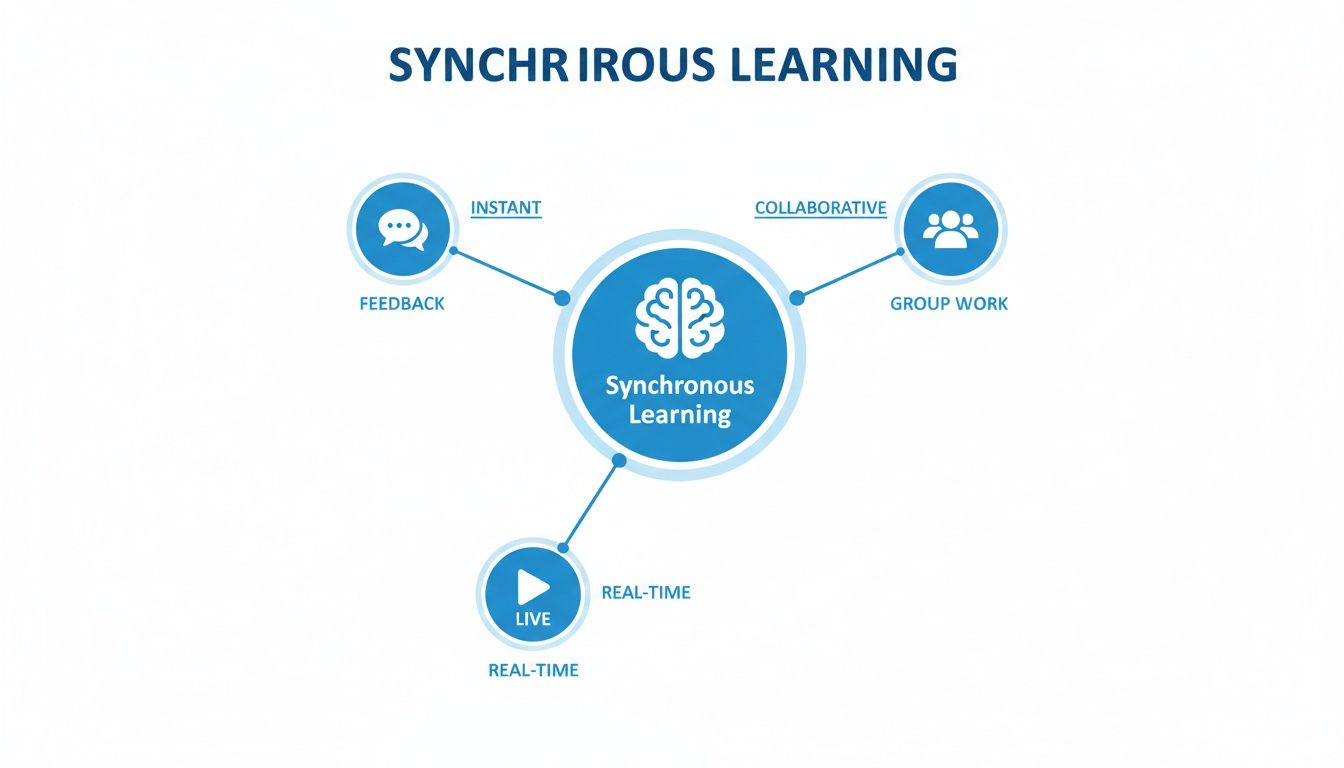
This visual illustrates the core principles: live, group-based learning centered on instant feedback. Immersive technology amplifies these pillars by moving them from a two-dimensional screen into a three-dimensional, interactive environment.
Instead of merely discussing a piece of machinery on a video call, teams can now gather around its photorealistic 3D model in a shared virtual space. An expert can guide trainees through a complex assembly step-by-step, allowing learners to gain hands-on experience in a risk-free setting.
This is the evolution from a basic virtual classroom to a fully functional immersive workspace. For industrial operations and field service, this represents a transformative change, directly addressing the need for practical skills development that traditional e-learning struggled to provide.
You can see the mechanics of this approach in our guide on what is virtual reality training. This evolution turns synchronous learning into a powerful engine for building real-world, job-ready skills.
Driving Real-World Results for Industrial and Field Service Teams
For industrial and field service organizations, synchronous learning is a direct path to improved business outcomes. By creating a live, interactive learning environment, companies can accelerate skill development where it is most critical: on the factory floor and in the field. This real-time approach directly addresses key operational challenges.
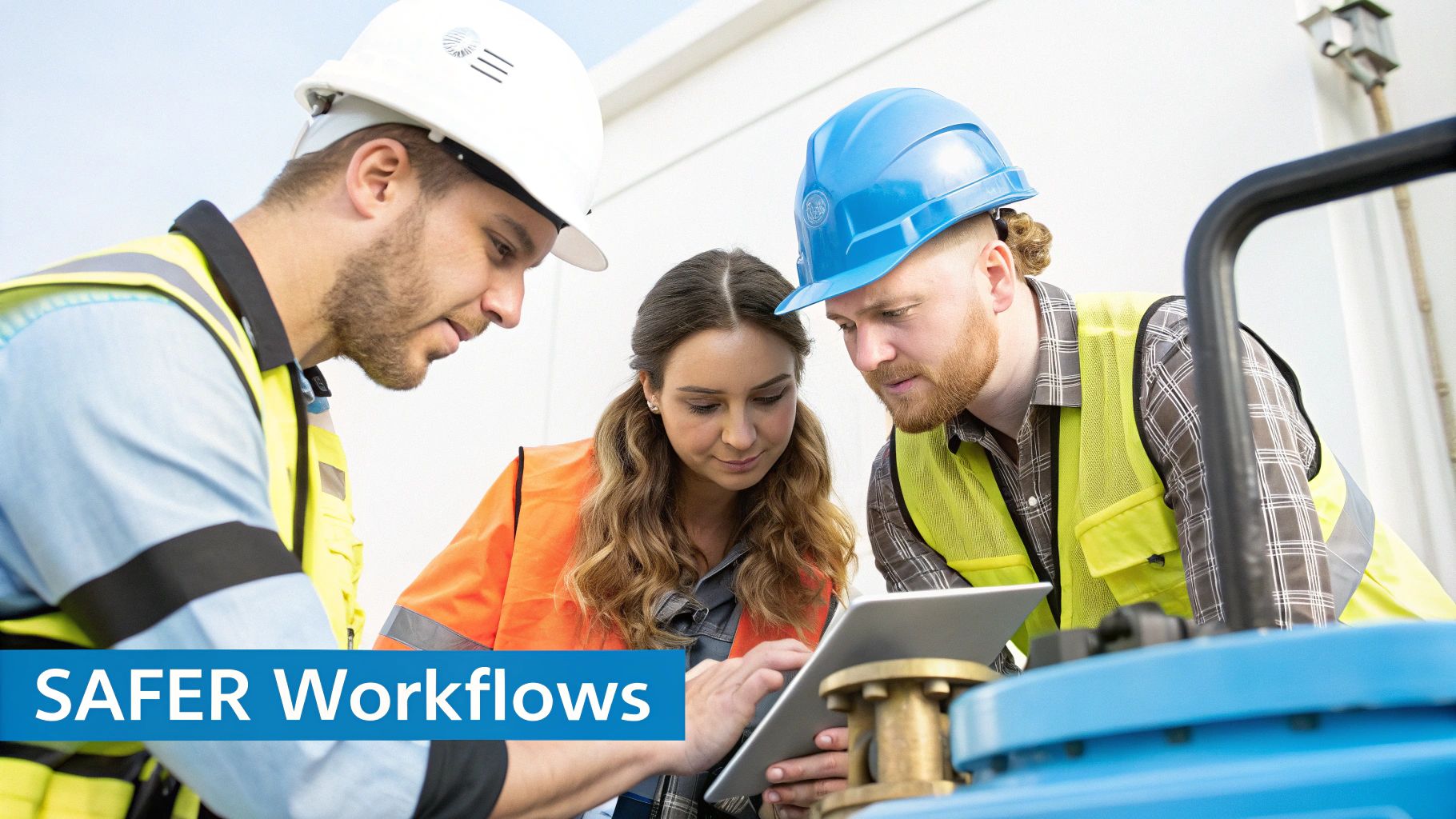
Immediate, expert feedback during a live session is highly effective. When a technician is learning a complex repair procedure, they can ask questions and receive instant clarification, preventing the formation of incorrect habits. This dynamic Q&A and group problem-solving significantly boosts knowledge retention and reduces the likelihood of costly errors later on.
Boosting Safety and Efficiency with Immersive Tools
The impact is amplified when synchronous learning is combined with immersive AR and VR. These technologies shift training from theoretical discussion to practical application—all within a safe, controlled virtual environment.
- Radically Improved Safety: Trainees can practice operating heavy machinery or handling hazardous materials in a true-to-life simulation. This builds the muscle memory required for safety protocols without putting personnel or equipment at risk.
- Zero Waste: Learning a new assembly process in VR means no raw materials are consumed by mistakes during training. Every practice run is purely digital, preserving physical resources for production.
- Massively Lower Costs: Companies can eliminate the significant expenses associated with travel for on-site training. Experts and trainees connect in a shared virtual room from any location, saving on flights, accommodations, and lost productivity.
Data supports these benefits. For manufacturing teams, virtual training has been shown to accelerate learning by 75% and reduce service times. You can explore how modern platforms deliver this ROI and review more powerful eLearning statistics that highlight the impact of this trend.
Building a Cohesive Culture Across Dispersed Teams
Beyond technical skills, synchronous learning is instrumental in fostering a unified corporate culture. For teams distributed across different regions or countries, live training sessions bring everyone together.
These shared experiences forge team cohesion and ensure the consistent implementation of best practices across the organization. This reinforces a standardized way of working, which is vital for maintaining quality and operational excellence.
When a senior expert in one country guides a junior technician in another through a live session, the company does more than solve a technical problem. It actively transfers institutional knowledge and strengthens the bonds of its global workforce.
Ultimately, synchronous learning for industrial teams delivers tangible, bottom-line benefits. It creates a safer, more skilled, and more connected workforce prepared to manage the complexities of modern operations. This approach transforms training from a cost center into a strategic investment in peak performance.
Putting Synchronous Learning Into Practice With AR And VR
While the theory is compelling, the practical application of synchronous learning with immersive technologies demonstrates its true value. Augmented Reality (AR) and Virtual Reality (VR) transform this training model from an abstract concept into a hands-on, practical tool that delivers a clear return on investment.
These platforms create a shared digital space where teams can interact with equipment, processes, and each other, regardless of their physical location. This converts passive listening into active participation—a critical transition for learning complex, real-world skills. Let’s examine two common use cases.
Use Case 1: Virtual Training For Complex Assembly
Consider a group of new hires who need to learn a complex industrial assembly procedure. The traditional method would involve flying all personnel to a central training facility, an expensive and logistically challenging process. With VR, the entire training session occurs in a shared virtual workshop.
Each technician wears a VR headset and enters a digital twin of the factory floor, where they see a photorealistic 3D model of the equipment. An instructor joins them in the same virtual space to guide them through the assembly step-by-step.
- Real-Time Guidance: The instructor can demonstrate the correct procedure, highlight critical components, and observe as each trainee performs the task.
- Immediate Correction: If a trainee makes an error, such as selecting the wrong part or using an incorrect sequence, the instructor can immediately intervene and provide correction, reinforcing the proper method.
- Risk-Free Practice: Trainees can repeat complex steps as many times as needed without any risk of damaging expensive equipment or causing injury.
This type of synchronous VR session provides all the benefits of in-person, over-the-shoulder coaching but with significantly improved scalability and safety.
Use Case 2: Remote Assistance With Augmented Reality
Now, imagine a field service technician is at a remote job site facing an unexpected equipment failure. The machine is unfamiliar, and the foremost expert is located thousands of miles away. This is where AR-powered synchronous learning becomes a mission-critical tool.
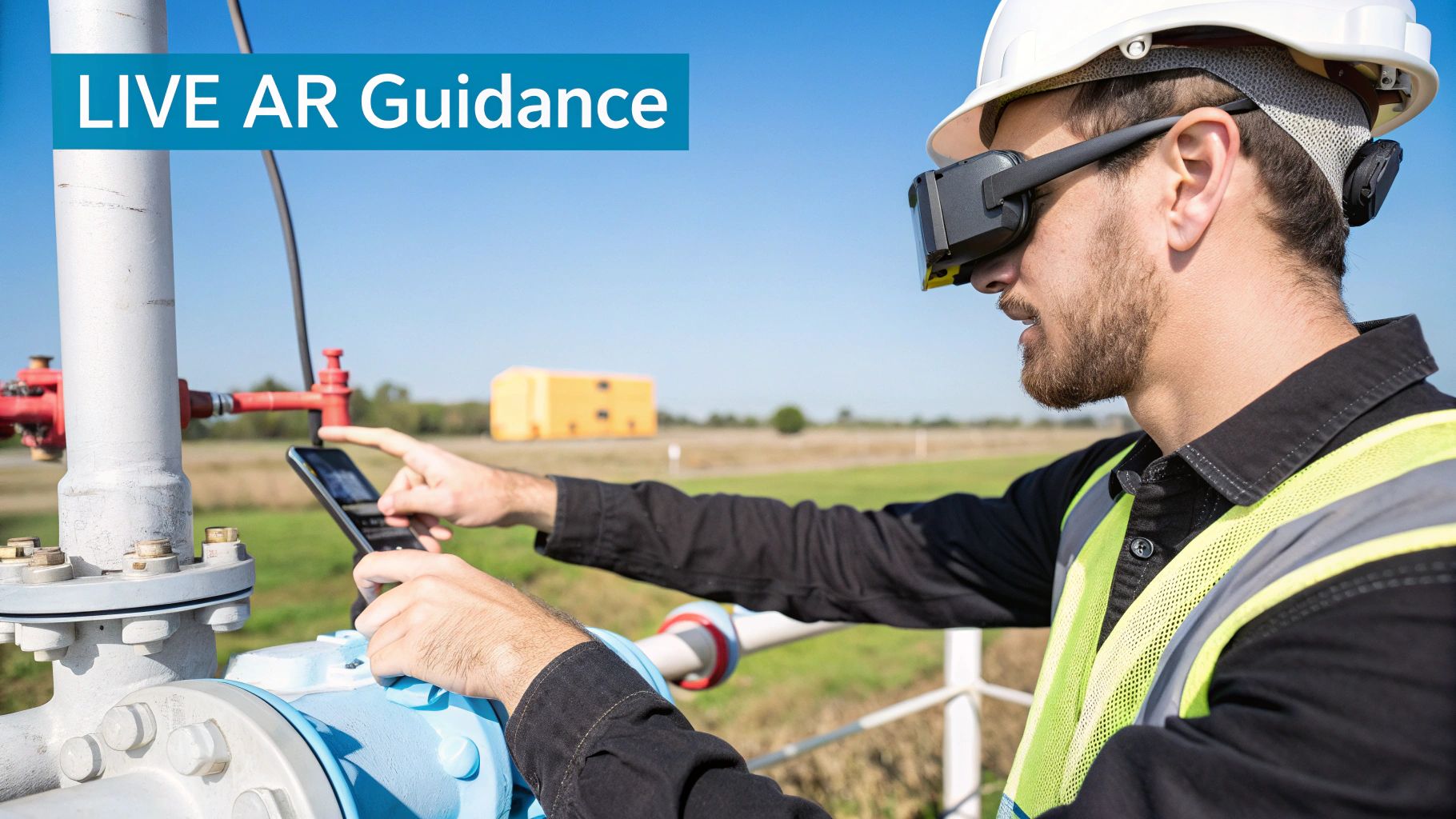
The on-site technician wears AR glasses, which stream their exact point-of-view to the remote expert in real time. The expert sees precisely what the technician sees.
The expert can then provide real-time instructions by overlaying digital annotations, diagrams, or arrows directly onto the technician's view of the physical equipment. This provides clear, unambiguous guidance from anywhere in the world.
This AR-guided session empowers the on-site worker to perform complex repairs with confidence. It reduces equipment downtime and eliminates the need for costly expert travel. Solutions designed for this scenario can turn any location into a live, interactive classroom.
These examples demonstrate how platforms focused on augmented reality and training are solving real, bottom-line business problems. They make synchronous learning an essential tool for any modern industrial company.
Implementing Your Synchronous Training Program
Implementing an effective synchronous training program requires more than sending a calendar invitation. For L&D and operations managers, the goal is to build a complete ecosystem that supports real-time, hands-on learning, beginning with the selection of appropriate technology.
While standard video conferencing tools have utility, they are often insufficient for training hands-on industrial skills. This is where immersive AR and VR platforms excel. They are designed to shift learning from passive observation to active participation. Platforms like AIDAR.SKILLS create shared virtual workshops where teams can practice complex procedures on digital twins of real equipment while receiving instant feedback from an instructor.
Designing Content That Clicks (and Training the Trainers)
Once a platform is in place, the focus shifts to content. A common mistake is attempting to replicate a traditional classroom lecture in a virtual format. Effective synchronous sessions are built on interaction.
The key is to design shorter, focused modules with ample opportunities for participation. A strong immersive session might begin with a brief instructor demonstration before immediately transitioning to a hands-on task for learners to complete within the virtual environment.
Equally important is preparing instructors to be effective virtual facilitators. Leading a session in VR is fundamentally different from presenting in a physical room. Instructors must be proficient in navigating the virtual environment, using the platform’s tools to guide participants, and assessing engagement without traditional face-to-face cues. This typically requires dedicated "train-the-trainer" workshops to build their comfort and confidence.
Getting Your Team Ready and Blending It All Together
Finally, prepare your learners. For many, this will be their first experience with immersive training. A brief orientation on how to use the equipment—such as an AR or VR headset—and what to expect during the session can significantly improve the experience. It reduces anxiety and increases engagement from the start.
For a comprehensive learning journey, integrate live synchronous sessions with asynchronous materials. This blended approach is highly effective. Foundational knowledge can be delivered through self-paced modules that employees complete on their own schedules. This reserves valuable live session time for its highest and best use: hands-on practice, group problem-solving, and direct Q&A with experts.
Here is a checklist to guide your implementation:
- Technology Check: Does the platform support the hands-on, interactive simulations your teams require?
- Content Design: Are sessions structured as interactive modules rather than lengthy lectures?
- Instructor Readiness: Have trainers received specific coaching on facilitating in an immersive environment?
- Learner Onboarding: Is there a clear process for familiarizing employees with the technology before their first session?
- Blended Learning: Are you using asynchronous content to prepare learners for live training, creating a cohesive learning path?
Measuring Success and Avoiding Common Pitfalls
To secure executive buy-in for synchronous learning, it is essential to demonstrate its value beyond vanity metrics like attendance. Success is not measured by participation but by tangible improvements in on-the-job performance.
Instead of only tracking attendance, focus on metrics that are meaningful to the business. How quickly are new hires reaching full productivity (time-to-proficiency)? Is there a decrease in errors on the assembly line (reduction in error rates)? These data points provide a powerful narrative that justifies the investment.
Key Metrics to Track
To build a solid business case, focus on KPIs that directly link training to skill acquisition and operational efficiency. These metrics provide clear evidence of impact.
- Skill Competency Rates: Use practical, hands-on assessments within the virtual environment to confirm that team members can perform tasks correctly and safely post-training.
- First-Time Fix Rates: For field service teams, this is a critical indicator. An increase in the percentage of issues resolved on the first visit is a clear sign that training is effective.
- Employee Engagement Scores: Survey participants before and after training to gauge their confidence levels, satisfaction with the session, and perceived value. For a deeper analysis of this topic, see our complete guide on how to measure training effectiveness.
Navigating Common Challenges
Even well-planned synchronous programs can encounter challenges. The two most common are virtual fatigue and technical issues, both of which can undermine engagement and the learning experience.
While virtual fatigue is a valid concern, the highly interactive nature of immersive AR and VR provides a built-in mitigation. When learners are actively performing tasks in a simulation rather than passively viewing a screen, their focus and engagement remain significantly higher.
The most effective way to avoid these issues is to design sessions with interactivity as a core principle. Schedule short, structured breaks to allow for mental resets. More importantly, leverage the engaging, hands-on features of your AR/VR platform. When you transform training into an active experience, you not only avoid common pitfalls but also deliver learning that has a lasting impact.
Frequently Asked Questions About Synchronous Learning
Is Synchronous Learning More Expensive?
This is a frequent question, and the initial investment in an AR or VR platform can appear substantial. However, this perspective only considers part of the equation.
The true ROI of synchronous learning becomes apparent when training is viewed as a strategic investment rather than a cost. It dramatically accelerates skill acquisition and reduces the on-the-job errors that lead to significant expenses. Furthermore, it eliminates the travel costs associated with centralizing personnel for training. The value lies not in the platform itself, but in achieving workforce readiness faster and more effectively, as guided, real-time practice is more efficient than correcting mistakes after they occur.
How Do You Keep Remote Teams Engaged?
Engagement is about active participation, not passive observation. The traditional webinar model is no longer sufficient.
Effective synchronous sessions are built around interaction, using tools like polls, breakout rooms for small-group problem-solving, and Q&A sessions. When immersive tools like VR are introduced, engagement becomes a natural outcome of the experience. Participants are not passively watching; they are actively performing tasks within a simulated environment. This hands-on approach inherently commands attention in a way a slideshow cannot, reinforcing knowledge for long-term retention.
Can It Work For Technical, Hands-On Skills?
Yes, this is precisely where modern synchronous learning, particularly with AR and VR, excels. These are not merely videos; they are realistic, interactive 3D simulations of your most complex equipment.
Your technicians can practice a complex, multi-step repair procedure safely from any location. They can repeat the process as many times as necessary, all under the live guidance of a seasoned expert who can see exactly what they are doing. This methodology bridges the gap between theory and practice without putting people or equipment at risk.
Ready to transform your team's skills with training that actually sticks? See how AIDAR Solutions uses advanced AR and VR platforms to deliver real-time, measurable results. Explore our solutions.